STRATEGIC MANAGEMENT
Presented by
Simran Kaur
MBA 2ND Year
BUSINESS POLICY
 Statement dealing with acquisition of resources
with which organizational goals can be achieved
 Study of roles and responsibilities of top level
management
 Man made or pre-determined course of action
 Long range planning
NATURE OF BUSINESS POLICY
 Futuristic decisions
 Defines goals
 Overall guide
 Focuses on allocation of scarce resources
 Long life
 Taken at top level
IMPORTANCE OF BUSINESS POLICY
 Coordination
 Quick decisions
 Effective control
 Minimize costs
 Build a learning culture
LIMITATIONS OF BUSINESS POLICY
 Inadequate coverage
 Limited area
 Static
 Consistency in policies
 Provides set rules
PROCESS OF FORMULATING
BUSINESS POLICY
1. Definition of policy area
2. Identify policy alternatives
3. Evaluation of alternatives
4. Selection of alternative business policy
5. Implementation of business policy
6. monitor
STRATEGIC MANAGEMENT
 Begins with formulation of mission statement
 Then portfolio of business model is prepared
 Ends at conducting functional activities
 Not a one-time process but re-evaluated and
implemented periodically
CHARACTERISTICS OF
STRATEGIC MANAGEMENT
 Long term issues
 Competitive advantage
 Impact on operations
 Complex
 Uncertain and future-oriented
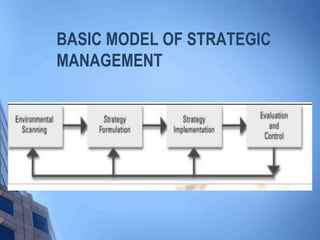
BASIC MODEL OF STRATEGIC
MANAGEMENT
BASIC MODEL OF STRATEGIC
MANAGEMENT(CONTD.)
1. Environmental Scanning (study of internal and
external environment of the organization)
2. Strategy formulation (developing corporate
vision, identifying corporate mission, setting
realistic objectives, formulating strategies and
establishing policy guidelines)
3. Strategy implementation (successful execution of
selected strategy)
BASIC MODEL OF STRATEGIC
MANAGEMENT(CONTD.)
4. Evaluation and control (analyzing market
response)
5. Feedback (suitable and prompt feedback)
IMPORTANCE OF STRATEGIC
MANAGEMENT
 Fulfilling responsibilities of Board members
 Measuring progress
 Assessing objectives
 Identifies SWOT
 Decision-making framework
LIMITATIONS OF STRATEGIC
MANAGEMENT
 Time consuming
 Challenging process
 Absence of short term benefits
 Limited to set of rules
 Poor adaptability
VISION
 Declaration of company’s goals for mid-term or
long-term future
 Provide a concentrated view of organization
 Provides employees with common goal and
stimulating them for conducting their routine
operations efficiently
FEATURES OF VISION
 Mental exercise
 Select target market
 Realistic
 Attractive
 Dynamic and flexible
 Reflects future plan
PROCESS OF DEVELOPING
STRATEGIC VISION
1. Understanding the organization
2. Conduct a vision audit
3. Target the vision
4. Set vision context
5. Develop future scenarios
6. Generate alternative visions
7. Choose the final vision
SIGNIFICANCE OF VISION
 Establishing standard of excellence
 Bridging gap between present and future
 Outlining future
 Helping employees in goal setting
 Helps in strategy framing
 Creating effectiveness
LIMITATIONS OF VISION
 Incomplete
 Not forward looking
 Too broad
 Not distinctive
 Too reliant on superlatives
MISSION
 Describes reason for existence of the organization
 Specifies organizational culture and values
 Specifies what qualities the organization will
uphold and impart to society or community
CHARACTERISTICS OF MISSION
 Target consumers
 Target region
 Values
 Technology
 Financial objectives
 Image
COMPONENTS OF MISSION
 Customers
 Products or services
 Markets
 Technology
 Concern for survival, growth and profitability
 Philosophy
 Self-concept
 Concern for public image
 Concern for employees
DEVELOPING A MISSION
1. Key decision-maker’s policy – philosophy
2. Visionary long-term concept
3. Organizational mission
BENEFITS OF MISSION
 Inspiring employees
 Improving performance
 Defines basic goal
 Guiding corporate decision making
 Business plans
 Company direction
OBJECTIVES
 Organization’s articulated aims or responses to
address major change or improvement,
competitiveness or social issues, and business
advantages
 Represent a managerial commitment to achieve
specified results in a specified period or time
CLASSIFICATION OF
OBJECTIVES
1. Primary objective
2. Secondary objective
3. Short-term objective
4. Medium-term objective
5. Long-term objective
6. Financial objective
7. Non-financial objective
SETTING OF OBJECTIVES
1. Classifying objectives
2. Reasonableness and consistency
3. Areas of objectives
4. Realistic and practical
5. Balancing of short-range and long-range
objectives
6. Change of adjustments
IMPORTANCE OF OBJECTIVES
 Direction
 Legitimacy
 Coordination
 Form standards
 Motivators
STRATEGIC DECISION MAKING
 A decision is the act of choosing among two or
more options
 Process of selecting alternatives among the
existing situation to make decisions that have
long-term implication for organization performance
NATURE OF STRATEGIC
DECISION MAKING
 Long-term direction
 Scope of organization’s activities
 Operational decisions
 Complex
 High degree of uncertainty
 Demand an integrated approach
MODES OF STRATEGIC DECISION
MAKING
 Entrepreneurial mode
 Adaptive mode
 Planning mode
 Logical incrementalism mode
STRATEGIC DECISION MAKING
PROCESS
1. Planning process
2. Programming system
3. Performing modalities
4. Profitability factor
5. Developmental growth
ISSUES IN STRATEGIC DECISION
MAKING
 Contextual issues
 Personality/style
 Effect of biases
 Role of values
 Role of consensus
 Nature of strategic decisions
GLOBAL STRATEGIC
MANAGEMENT
 Involves analysis of internal capabilities and
external environment of a firm
 Field of study effectively addressed by
interdisciplinary issues of marketing, organization
theory, business strategy and international
management and concentrates on maximizing firm
performance
FEATURES OF GLOBAL
STRATEGIC MANAGEMENT
 Planning process
 Ongoing process
 Based on global environment
 Part of overall corporate policy
 Integrated management
POSITIVE IMPACT OF
GLOBALIZATION
 Boost in economy
 Increased rate of employment
 Availability of advanced technology
 Balanced development of world economies
 Adaptation of foreign taste and trend
NEGATIVE IMPACT OF
GLOBALIZATION
 Reduced job and incomes
 Cut-throat competition
 Inequality
 Inflation
 Loss of culture
BARRIERS IN GLOBAL
STRATEGIC MANAGEMENT
 Orientation for globalization
 Emerging e-commerce and internet culture
 Cut-throat competition
 Diversification
 Motive for CSR and ethics
THANK YOU!!!

Strategic management

  • 1.
  • 2.
    BUSINESS POLICY  Statementdealing with acquisition of resources with which organizational goals can be achieved  Study of roles and responsibilities of top level management  Man made or pre-determined course of action  Long range planning

  • 3.
    NATURE OF BUSINESSPOLICY  Futuristic decisions  Defines goals  Overall guide  Focuses on allocation of scarce resources  Long life  Taken at top level
  • 4.
    IMPORTANCE OF BUSINESSPOLICY  Coordination  Quick decisions  Effective control  Minimize costs  Build a learning culture
  • 5.
    LIMITATIONS OF BUSINESSPOLICY  Inadequate coverage  Limited area  Static  Consistency in policies  Provides set rules
  • 6.
    PROCESS OF FORMULATING BUSINESSPOLICY 1. Definition of policy area 2. Identify policy alternatives 3. Evaluation of alternatives 4. Selection of alternative business policy 5. Implementation of business policy 6. monitor
  • 7.
    STRATEGIC MANAGEMENT  Beginswith formulation of mission statement  Then portfolio of business model is prepared  Ends at conducting functional activities  Not a one-time process but re-evaluated and implemented periodically
  • 8.
    CHARACTERISTICS OF STRATEGIC MANAGEMENT Long term issues  Competitive advantage  Impact on operations  Complex  Uncertain and future-oriented
  • 9.
    BASIC MODEL OFSTRATEGIC MANAGEMENT
  • 10.
    BASIC MODEL OFSTRATEGIC MANAGEMENT(CONTD.) 1. Environmental Scanning (study of internal and external environment of the organization) 2. Strategy formulation (developing corporate vision, identifying corporate mission, setting realistic objectives, formulating strategies and establishing policy guidelines) 3. Strategy implementation (successful execution of selected strategy)
  • 11.
    BASIC MODEL OFSTRATEGIC MANAGEMENT(CONTD.) 4. Evaluation and control (analyzing market response) 5. Feedback (suitable and prompt feedback)
  • 12.
    IMPORTANCE OF STRATEGIC MANAGEMENT Fulfilling responsibilities of Board members  Measuring progress  Assessing objectives  Identifies SWOT  Decision-making framework
  • 13.
    LIMITATIONS OF STRATEGIC MANAGEMENT Time consuming  Challenging process  Absence of short term benefits  Limited to set of rules  Poor adaptability
  • 14.
    VISION  Declaration ofcompany’s goals for mid-term or long-term future  Provide a concentrated view of organization  Provides employees with common goal and stimulating them for conducting their routine operations efficiently
  • 15.
    FEATURES OF VISION Mental exercise  Select target market  Realistic  Attractive  Dynamic and flexible  Reflects future plan
  • 16.
    PROCESS OF DEVELOPING STRATEGICVISION 1. Understanding the organization 2. Conduct a vision audit 3. Target the vision 4. Set vision context 5. Develop future scenarios 6. Generate alternative visions 7. Choose the final vision
  • 17.
    SIGNIFICANCE OF VISION Establishing standard of excellence  Bridging gap between present and future  Outlining future  Helping employees in goal setting  Helps in strategy framing  Creating effectiveness
  • 18.
    LIMITATIONS OF VISION Incomplete  Not forward looking  Too broad  Not distinctive  Too reliant on superlatives
  • 19.
    MISSION  Describes reasonfor existence of the organization  Specifies organizational culture and values  Specifies what qualities the organization will uphold and impart to society or community
  • 20.
    CHARACTERISTICS OF MISSION Target consumers  Target region  Values  Technology  Financial objectives  Image
  • 21.
    COMPONENTS OF MISSION Customers  Products or services  Markets  Technology  Concern for survival, growth and profitability  Philosophy  Self-concept  Concern for public image  Concern for employees
  • 22.
    DEVELOPING A MISSION 1.Key decision-maker’s policy – philosophy 2. Visionary long-term concept 3. Organizational mission
  • 23.
    BENEFITS OF MISSION Inspiring employees  Improving performance  Defines basic goal  Guiding corporate decision making  Business plans  Company direction
  • 24.
    OBJECTIVES  Organization’s articulatedaims or responses to address major change or improvement, competitiveness or social issues, and business advantages  Represent a managerial commitment to achieve specified results in a specified period or time
  • 25.
    CLASSIFICATION OF OBJECTIVES 1. Primaryobjective 2. Secondary objective 3. Short-term objective 4. Medium-term objective 5. Long-term objective 6. Financial objective 7. Non-financial objective
  • 26.
    SETTING OF OBJECTIVES 1.Classifying objectives 2. Reasonableness and consistency 3. Areas of objectives 4. Realistic and practical 5. Balancing of short-range and long-range objectives 6. Change of adjustments
  • 27.
    IMPORTANCE OF OBJECTIVES Direction  Legitimacy  Coordination  Form standards  Motivators
  • 28.
    STRATEGIC DECISION MAKING A decision is the act of choosing among two or more options  Process of selecting alternatives among the existing situation to make decisions that have long-term implication for organization performance
  • 29.
    NATURE OF STRATEGIC DECISIONMAKING  Long-term direction  Scope of organization’s activities  Operational decisions  Complex  High degree of uncertainty  Demand an integrated approach
  • 30.
    MODES OF STRATEGICDECISION MAKING  Entrepreneurial mode  Adaptive mode  Planning mode  Logical incrementalism mode
  • 31.
    STRATEGIC DECISION MAKING PROCESS 1.Planning process 2. Programming system 3. Performing modalities 4. Profitability factor 5. Developmental growth
  • 32.
    ISSUES IN STRATEGICDECISION MAKING  Contextual issues  Personality/style  Effect of biases  Role of values  Role of consensus  Nature of strategic decisions
  • 33.
    GLOBAL STRATEGIC MANAGEMENT  Involvesanalysis of internal capabilities and external environment of a firm  Field of study effectively addressed by interdisciplinary issues of marketing, organization theory, business strategy and international management and concentrates on maximizing firm performance
  • 34.
    FEATURES OF GLOBAL STRATEGICMANAGEMENT  Planning process  Ongoing process  Based on global environment  Part of overall corporate policy  Integrated management
  • 35.
    POSITIVE IMPACT OF GLOBALIZATION Boost in economy  Increased rate of employment  Availability of advanced technology  Balanced development of world economies  Adaptation of foreign taste and trend
  • 36.
    NEGATIVE IMPACT OF GLOBALIZATION Reduced job and incomes  Cut-throat competition  Inequality  Inflation  Loss of culture
  • 37.
    BARRIERS IN GLOBAL STRATEGICMANAGEMENT  Orientation for globalization  Emerging e-commerce and internet culture  Cut-throat competition  Diversification  Motive for CSR and ethics
  • 38.