Strategies in Action


   “Even if you’re on the right
    track, you’ll get run over if
    you just sit there.”
                   - Will Rogers
Strategies for Competitive Advantage –
Rajiv B Deo                              1/135
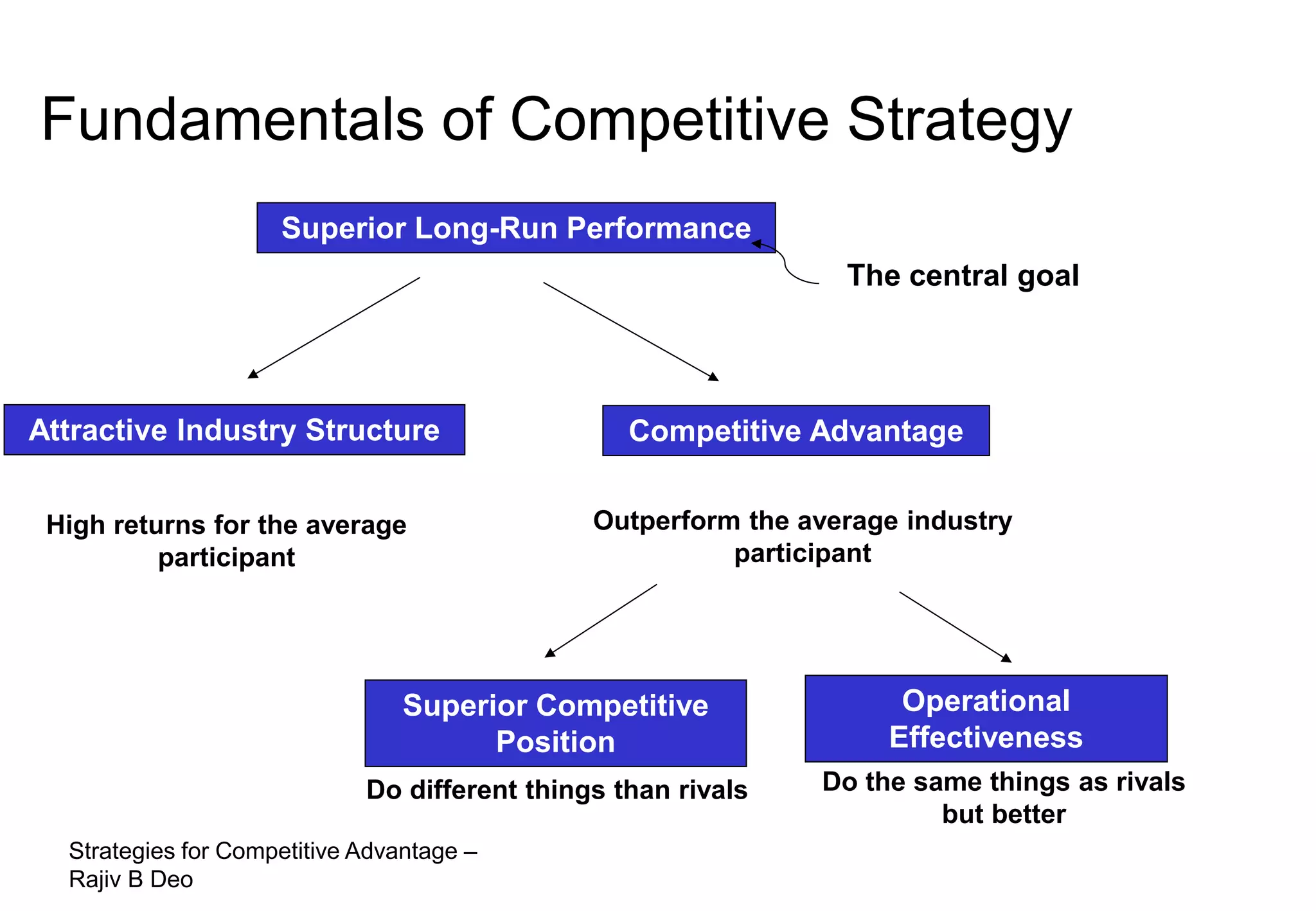
Fundamentals of Competitive Strategy
                     Superior Long-Run Performance
                                                                 The central goal


Attractive Industry Structure                     Competitive Advantage


 High returns for the average                  Outperform the average industry
          participant                                    participant


                                 Superior Competitive                Operational
                                       Position                     Effectiveness
                             Do different things than rivals   Do the same things as rivals
                                                                        but better
  Strategies for Competitive Advantage –
  Rajiv B Deo
Hierarchies of Strategy
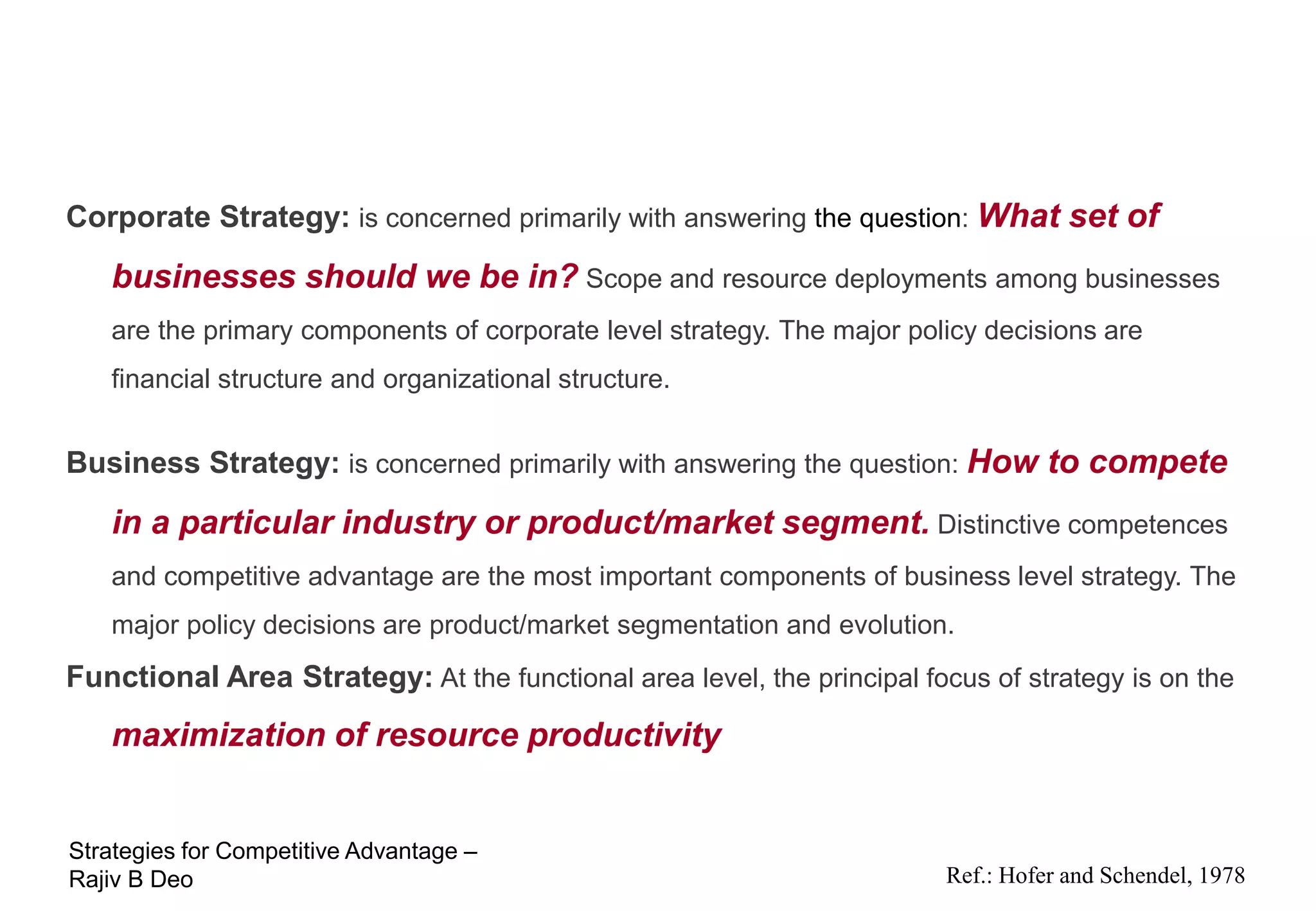
Corporate Strategy: is concerned primarily with answering the question: What set of
   businesses should we be in? Scope and resource deployments among businesses
   are the primary components of corporate level strategy. The major policy decisions are
   financial structure and organizational structure.


Business Strategy: is concerned primarily with answering the question: How to compete
   in a particular industry or product/market segment. Distinctive competences
   and competitive advantage are the most important components of business level strategy. The
   major policy decisions are product/market segmentation and evolution.
Functional Area Strategy: At the functional area level, the principal focus of strategy is on the
   maximization of resource productivity


Strategies for Competitive Advantage –
Rajiv B Deo                                                              Ref.: Hofer and Schendel, 1978
Common pitfalls

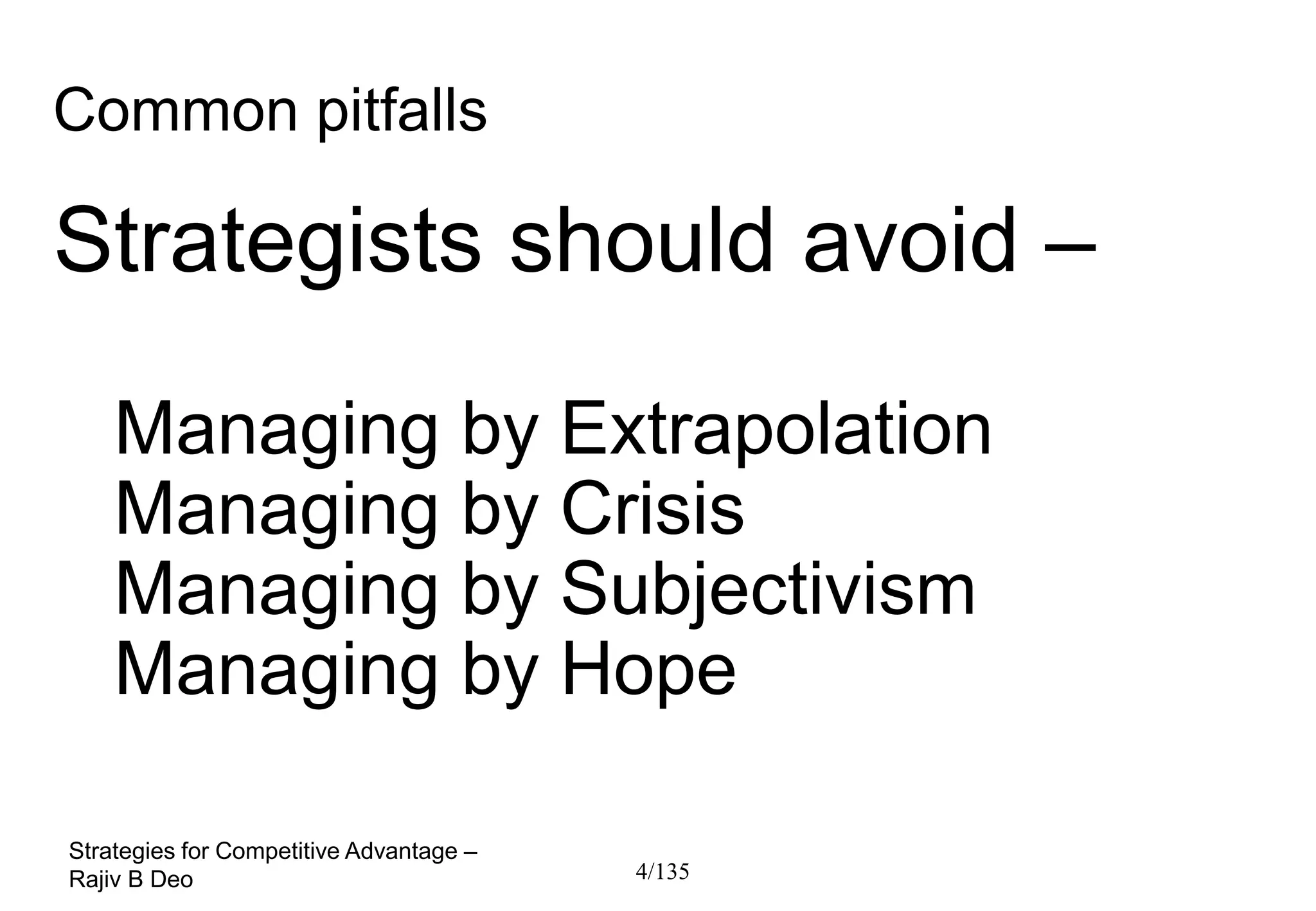
Strategists should avoid –

    Managing by Extrapolation
    Managing by Crisis
    Managing by Subjectivism
    Managing by Hope

Strategies for Competitive Advantage –
Rajiv B Deo                              4/135
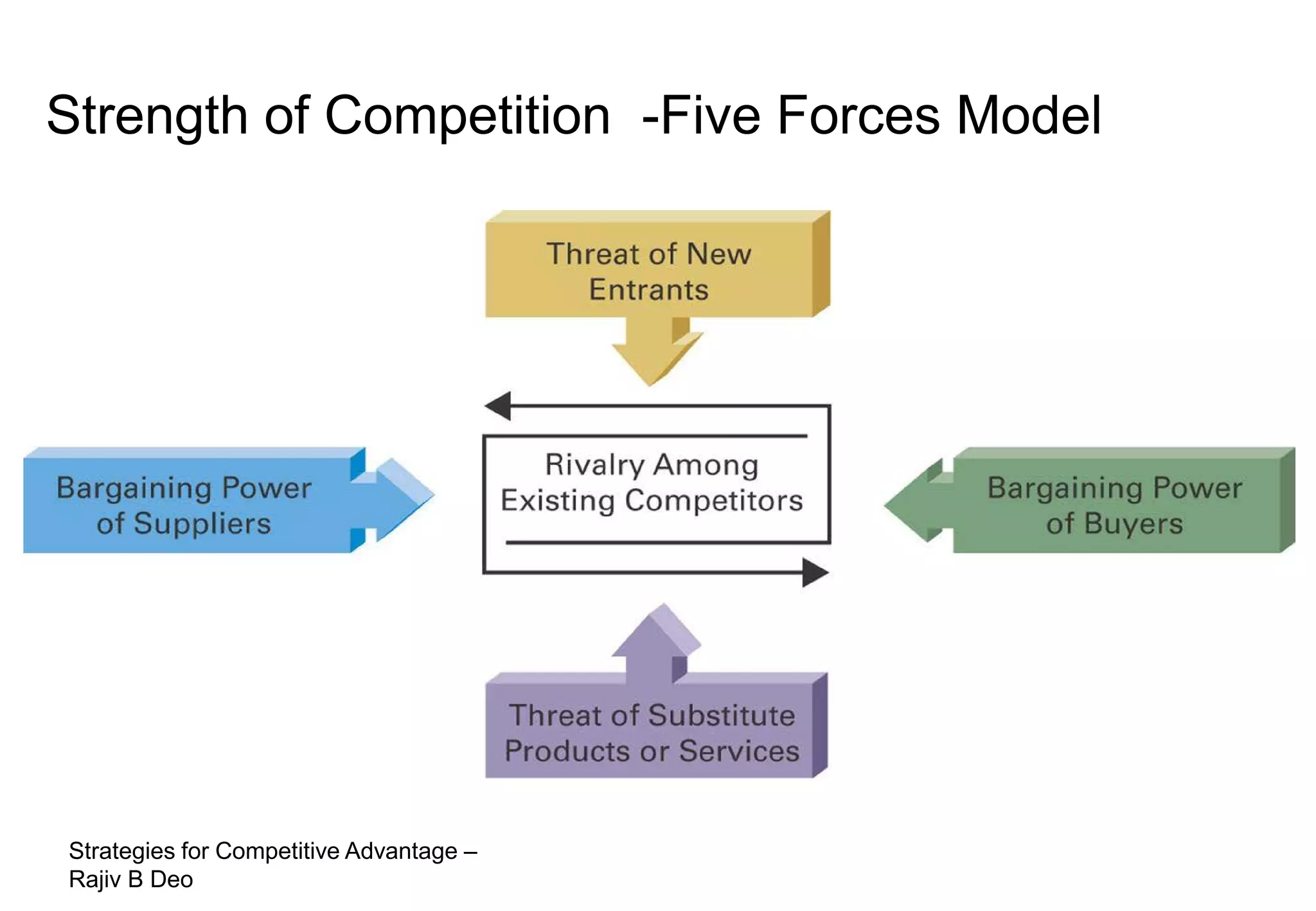
Strength of Competition -Five Forces Model


Strategies for Competitive Advantage –
Rajiv B Deo
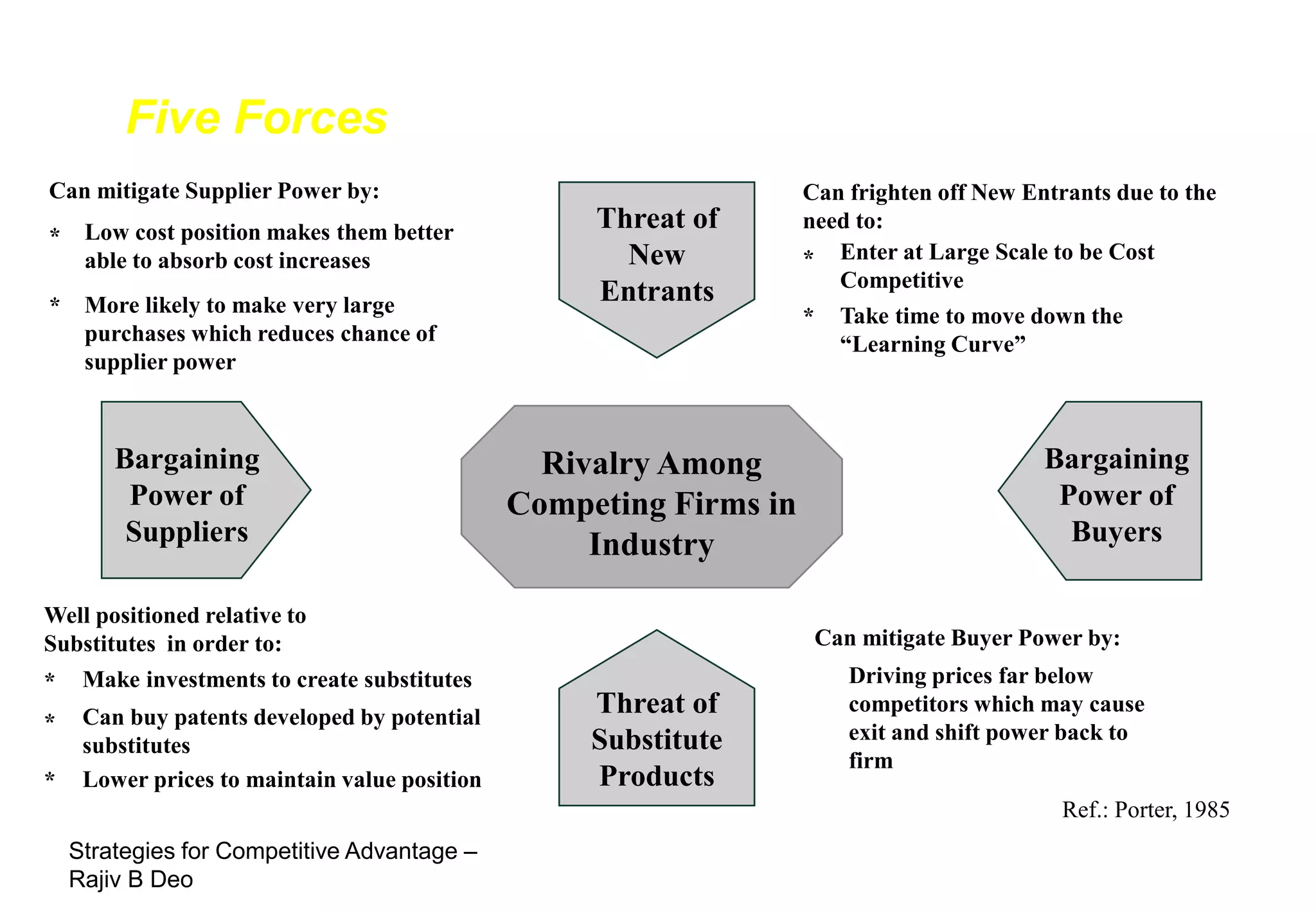
Effective Cost Leaders can remain profitable even when
the Five Forces appear unattractive
Can mitigate Supplier Power by:                                     Can frighten off New Entrants due to the
     Low cost position makes them better            Threat of       need to:
*
     able to absorb cost increases                    New           * Enter at Large Scale to be Cost
                                                                       Competitive
*    More likely to make very large
                                                    Entrants
                                                                    *   Take time to move down the
     purchases which reduces chance of                                  “Learning Curve”
     supplier power


        Bargaining                               Rivalry Among                             Bargaining
         Power of                              Competing Firms in                           Power of
         Suppliers                                  Industry                                 Buyers

Well positioned relative to
Substitutes in order to:                                             Can mitigate Buyer Power by:
*    Make investments to create substitutes                             Driving prices far below
     Can buy patents developed by potential
                                                    Threat of           competitors which may cause
*                                                                       exit and shift power back to
     substitutes                                    Substitute
                                                                        firm
*    Lower prices to maintain value position        Products
                                                                                             Ref.: Porter, 1985
    Strategies for Competitive Advantage –
    Rajiv B Deo
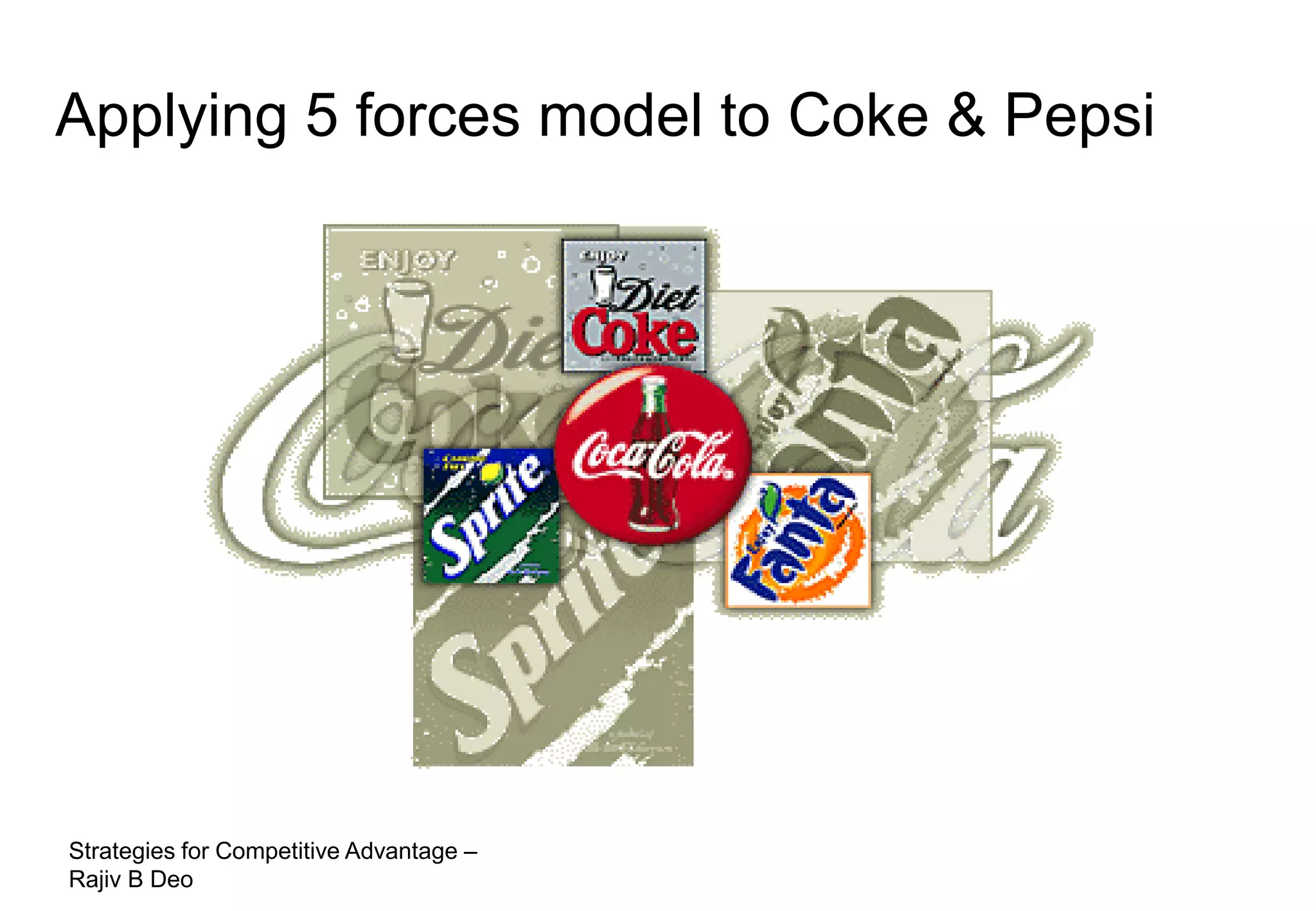
Applying 5 forces model to Coke & Pepsi


Strategies for Competitive Advantage –
Rajiv B Deo
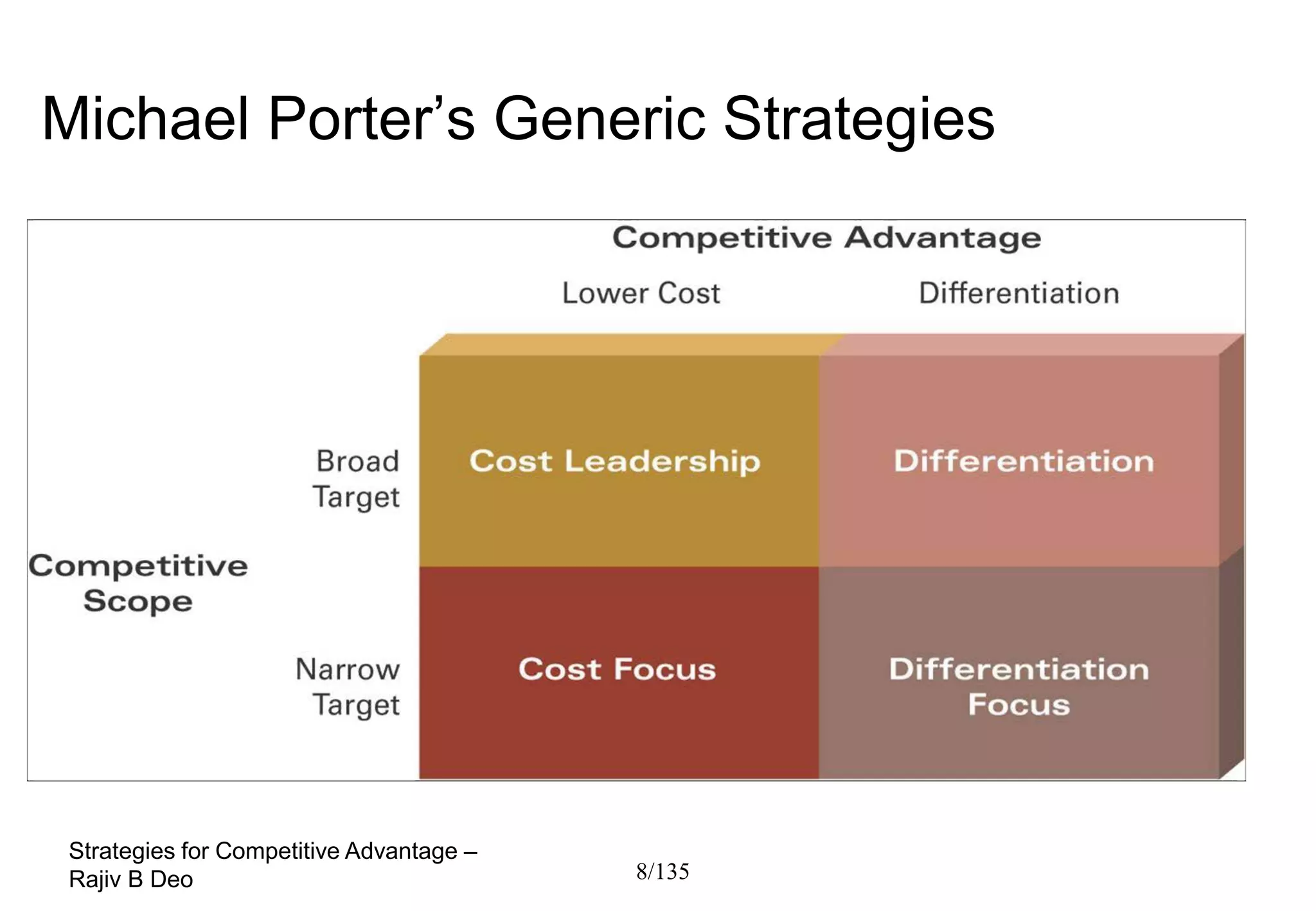
Michael Porter’s Generic Strategies


 Strategies for Competitive Advantage –
 Rajiv B Deo                              8/135
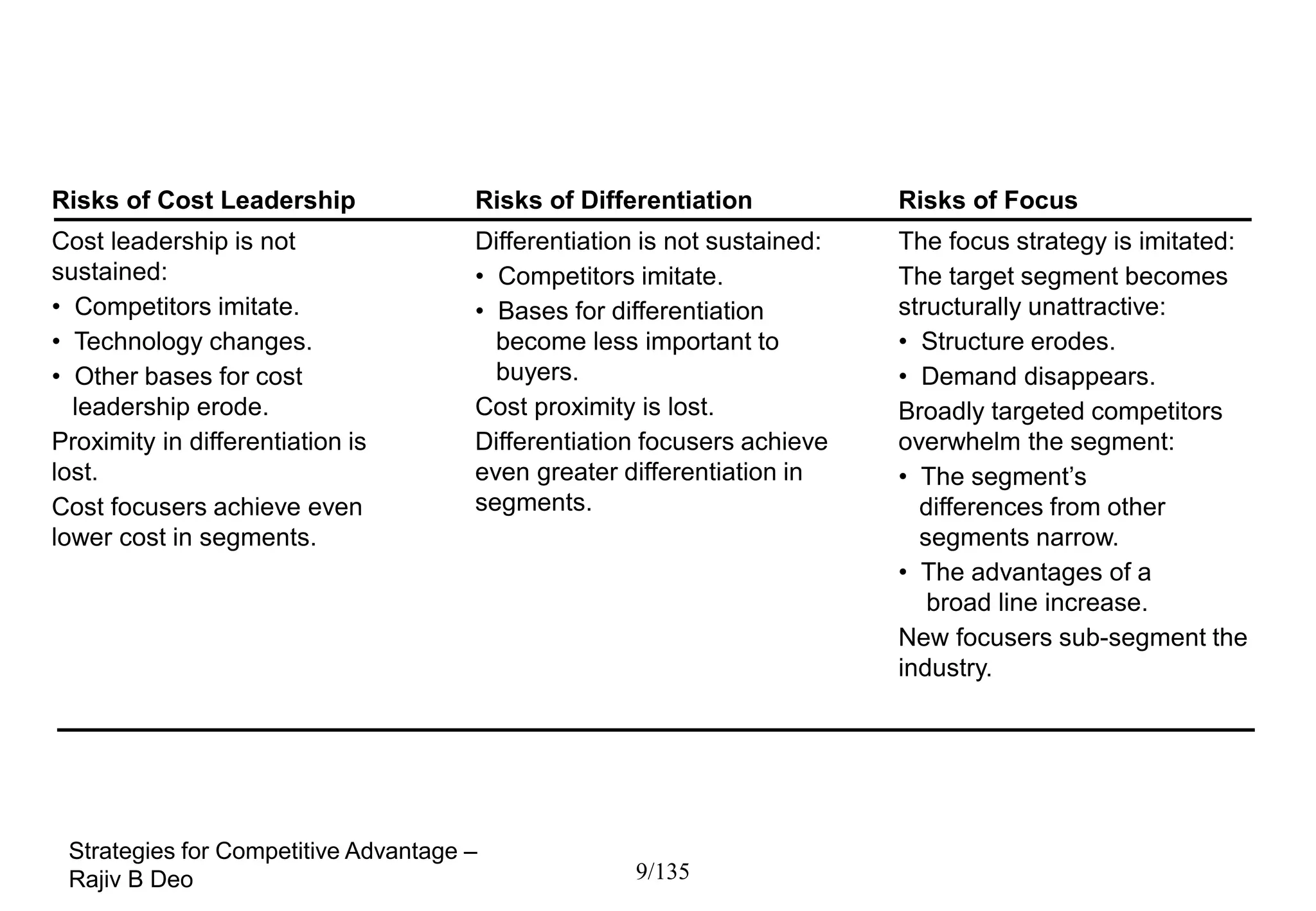
Risks of Generic Competitive Strategies
Risks of Cost Leadership              Risks of Differentiation            Risks of Focus
Cost leadership is not                Differentiation is not sustained:   The focus strategy is imitated:
sustained:                            • Competitors imitate.              The target segment becomes
• Competitors imitate.                • Bases for differentiation         structurally unattractive:
• Technology changes.                   become less important to          • Structure erodes.
• Other bases for cost                  buyers.                           • Demand disappears.
  leadership erode.                   Cost proximity is lost.             Broadly targeted competitors
Proximity in differentiation is       Differentiation focusers achieve    overwhelm the segment:
lost.                                 even greater differentiation in     • The segment’s
Cost focusers achieve even            segments.                             differences from other
lower cost in segments.                                                     segments narrow.
                                                                          • The advantages of a
                                                                             broad line increase.
                                                                          New focusers sub-segment the
                                                                          industry.


 Strategies for Competitive Advantage –
 Rajiv B Deo                                         9/135
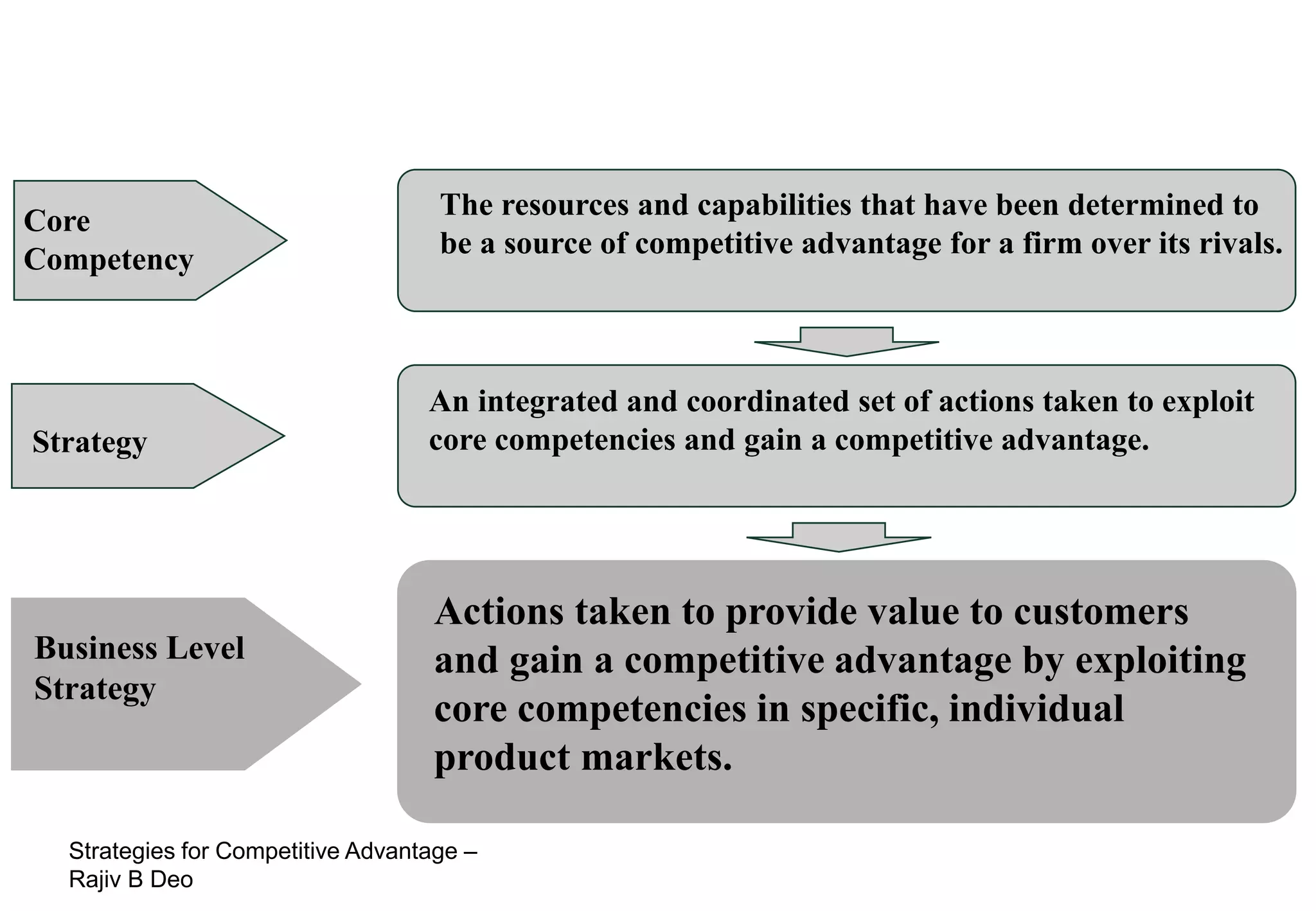
Business Level Strategy
                                    The resources and capabilities that have been determined to
Core
                                    be a source of competitive advantage for a firm over its rivals.
Competency


                                   An integrated and coordinated set of actions taken to exploit
Strategy                           core competencies and gain a competitive advantage.


                                   Actions taken to provide value to customers
Business Level                     and gain a competitive advantage by exploiting
Strategy
                                   core competencies in specific, individual
                                   product markets.

  Strategies for Competitive Advantage –
  Rajiv B Deo
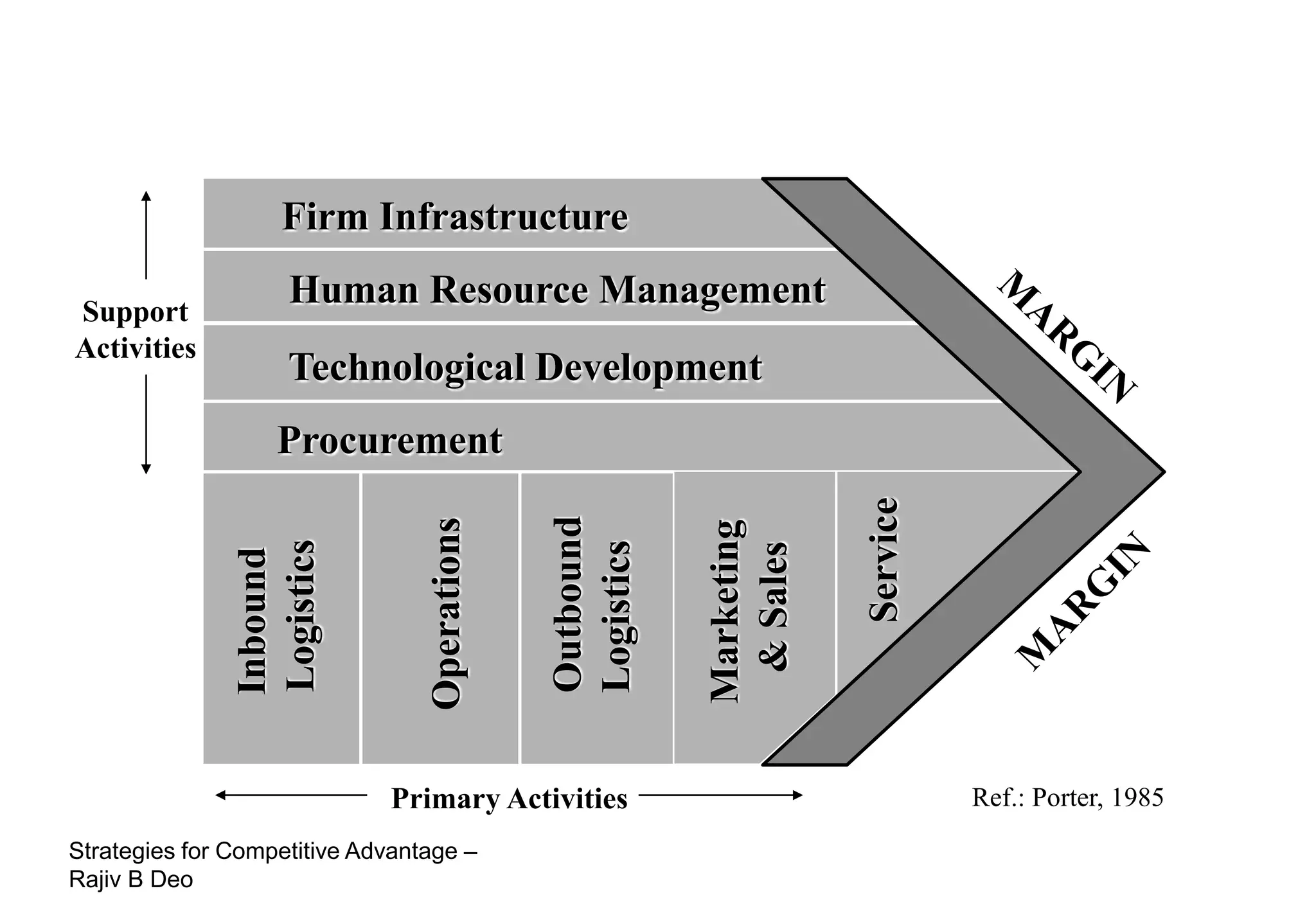
Value Chain Analysis
                   Firm Infrastructure

Support
                    Human Resource Management
Activities
                    Technological Development
                   Procurement


                                                                      Service
                                              Outbound
                                 Operations


                                                          Marketing
               Logistics


                                              Logistics


                                                           & Sales
               Inbound


                             Primary Activities                                 Ref.: Porter, 1985
Strategies for Competitive Advantage –
Rajiv B Deo
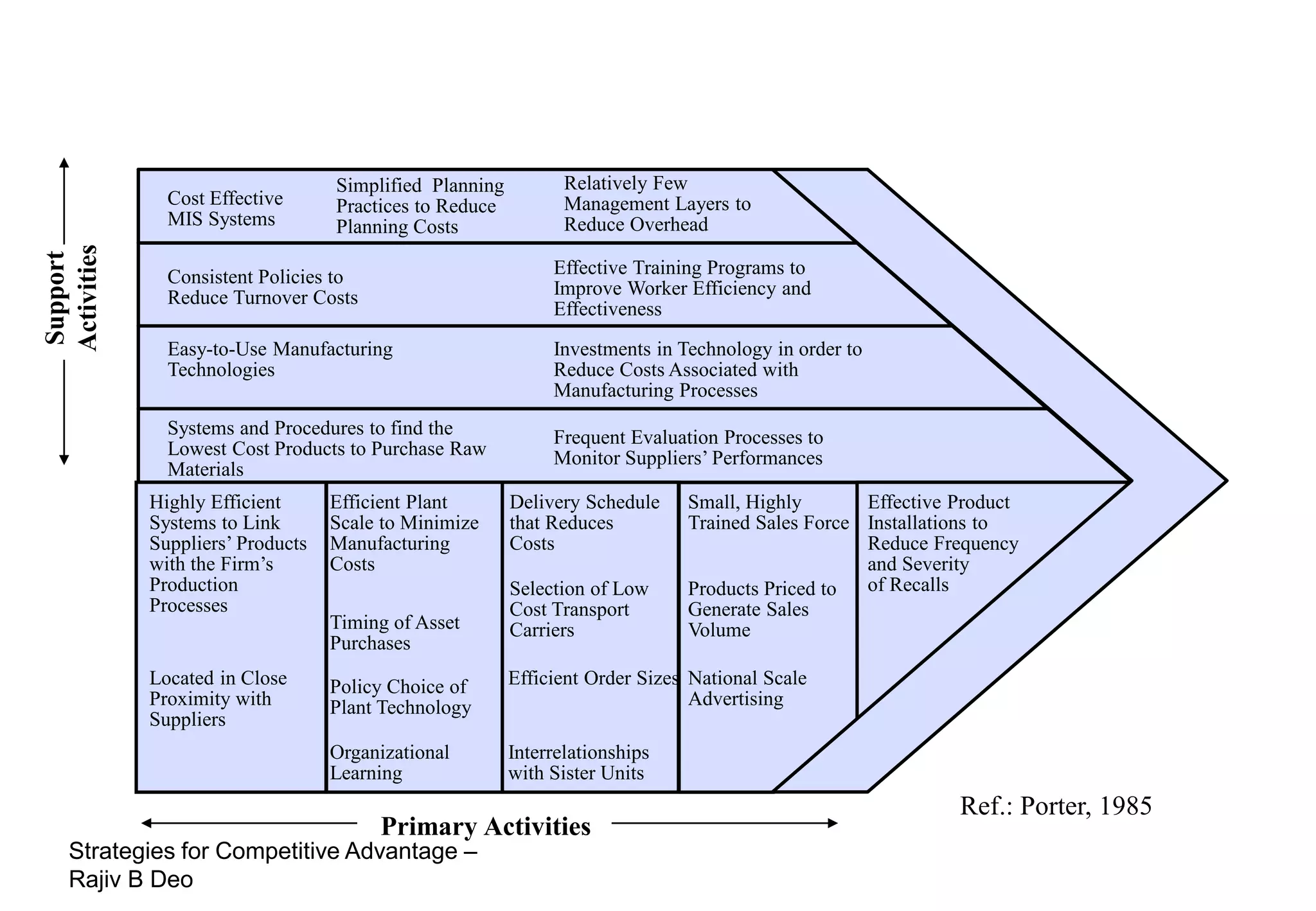
Value Creating Activities common to a
Cost Leadership Business
                                   Simplified Planning          Relatively Few
               Cost Effective      Practices to Reduce          Management Layers to
               MIS Systems         Planning Costs               Reduce Overhead
Activities
Support


               Consistent Policies to                         Effective Training Programs to
               Reduce Turnover Costs                          Improve Worker Efficiency and
                                                              Effectiveness
               Easy-to-Use Manufacturing                      Investments in Technology in order to
               Technologies                                   Reduce Costs Associated with
                                                              Manufacturing Processes
               Systems and Procedures to find the             Frequent Evaluation Processes to
               Lowest Cost Products to Purchase Raw           Monitor Suppliers’ Performances
               Materials
             Highly Efficient      Efficient Plant       Delivery Schedule    Small, Highly       Effective Product
             Systems to Link       Scale to Minimize     that Reduces         Trained Sales Force Installations to
             Suppliers’ Products   Manufacturing         Costs                                    Reduce Frequency
             with the Firm’s       Costs                                                          and Severity
             Production                                  Selection of Low     Products Priced to  of Recalls
             Processes                                   Cost Transport       Generate Sales
                                   Timing of Asset       Carriers             Volume
                                   Purchases
             Located in Close      Policy Choice of      Efficient Order Sizes National Scale
             Proximity with        Plant Technology                            Advertising
             Suppliers
                                   Organizational        Interrelationships
                                   Learning              with Sister Units
                                                                                                            Ref.: Porter, 1985
                                        Primary Activities
    Strategies for Competitive Advantage –
    Rajiv B Deo
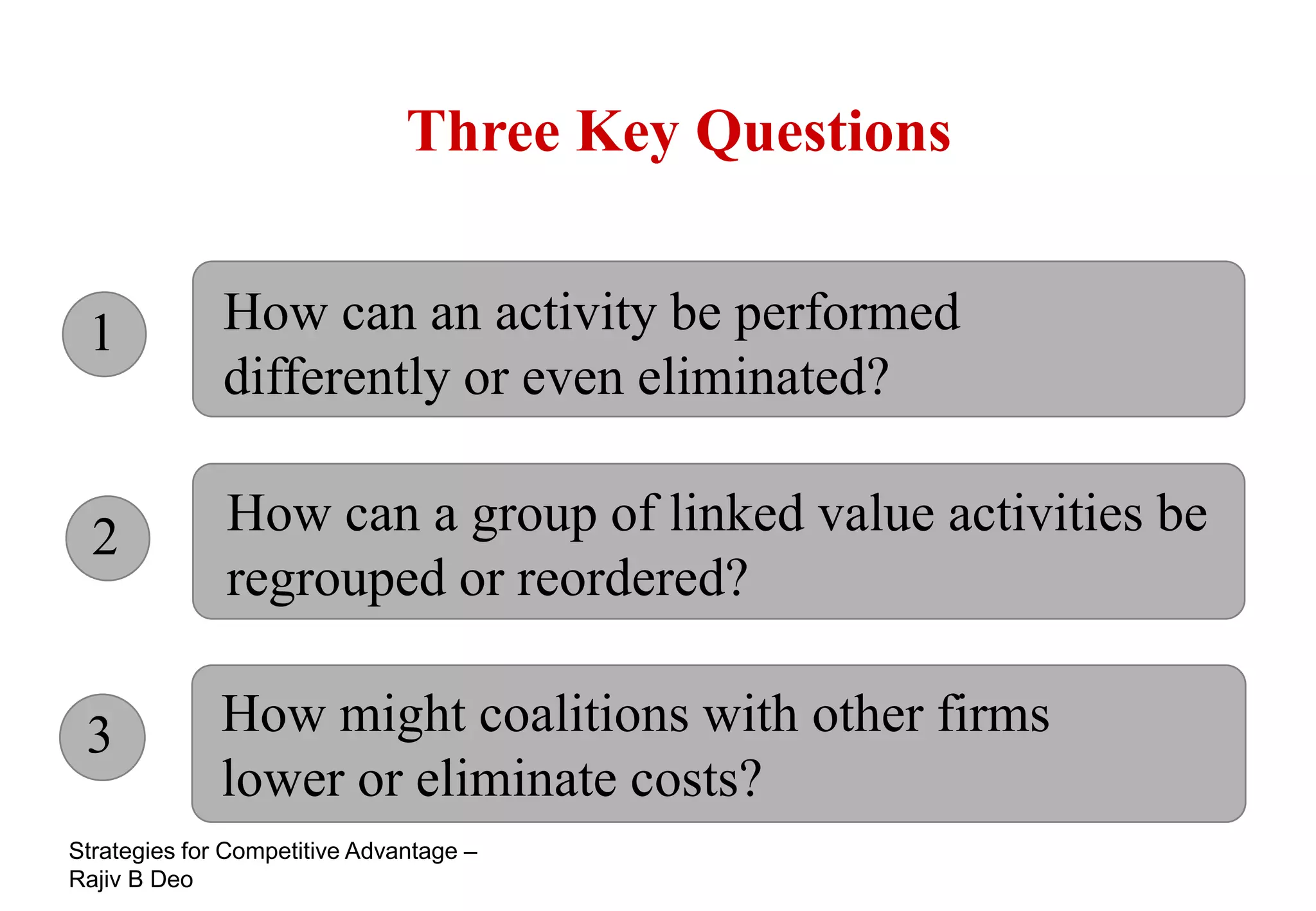
Three Key Questions


 1            How can an activity be performed
              differently or even eliminated?

  2           How can a group of linked value activities be
              regrouped or reordered?

 3            How might coalitions with other firms
              lower or eliminate costs?
Strategies for Competitive Advantage –
Rajiv B Deo
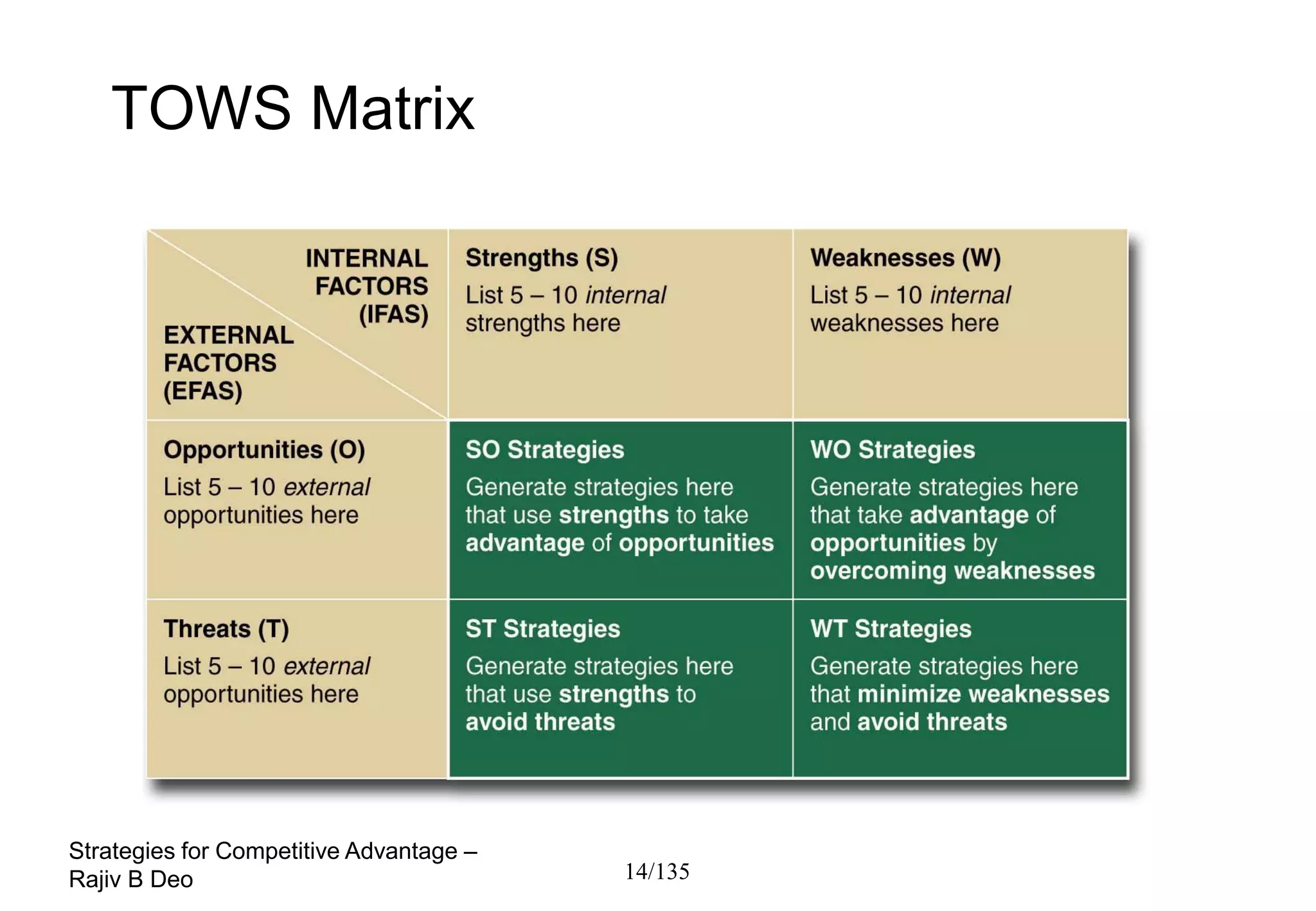
TOWS Matrix


Strategies for Competitive Advantage –
Rajiv B Deo                              14/135
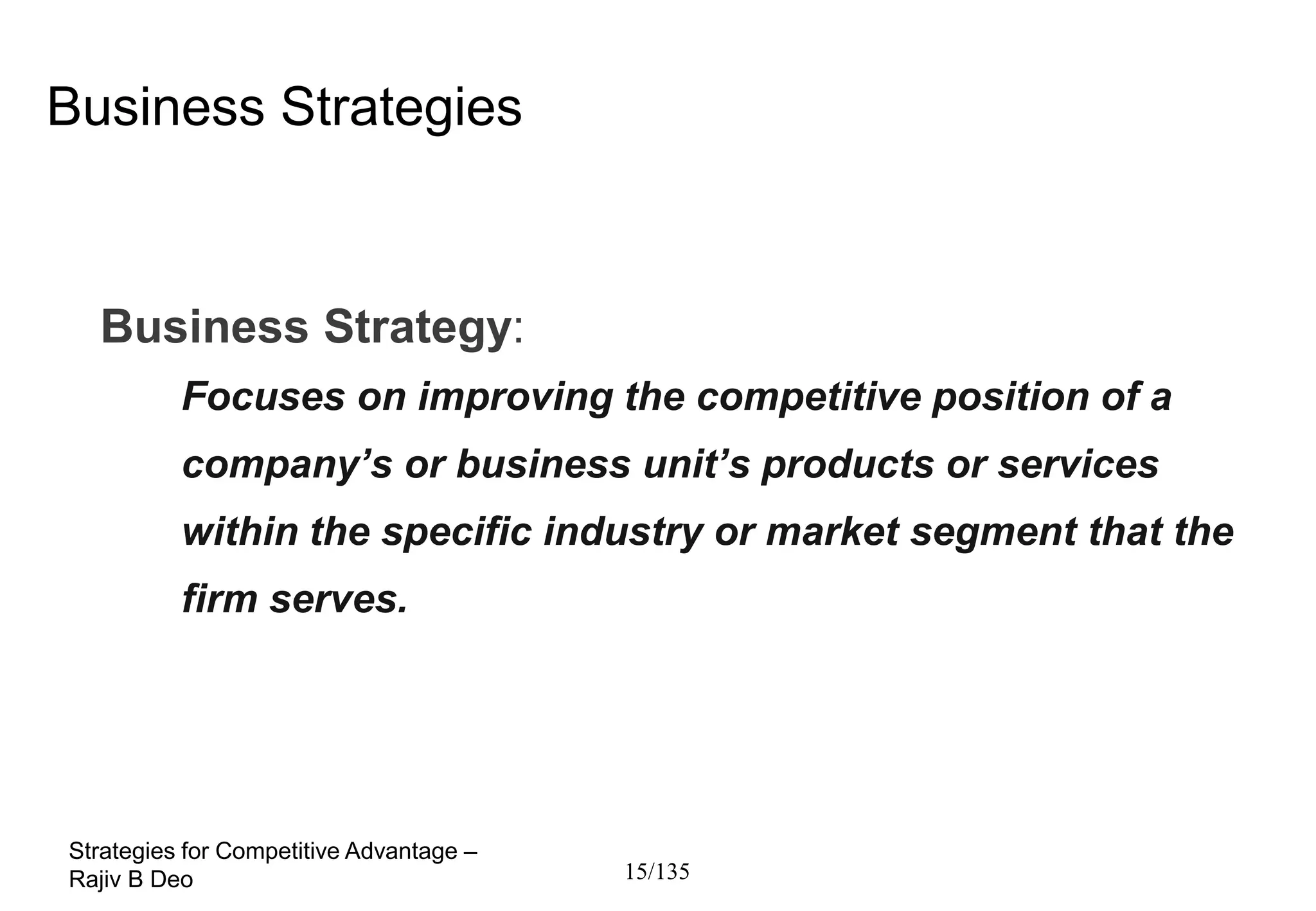
Business Strategies


  Business Strategy:
          Focuses on improving the competitive position of a
          company’s or business unit’s products or services
          within the specific industry or market segment that the
          firm serves.


Strategies for Competitive Advantage –
Rajiv B Deo                              15/135
Porter’s Competitive Strategies


  Competitive Strategy:
           Low cost?
           Differentiation?
           Compete head to head in large market?
           Focus on niche?


Strategies for Competitive Advantage –
Rajiv B Deo                              16/135
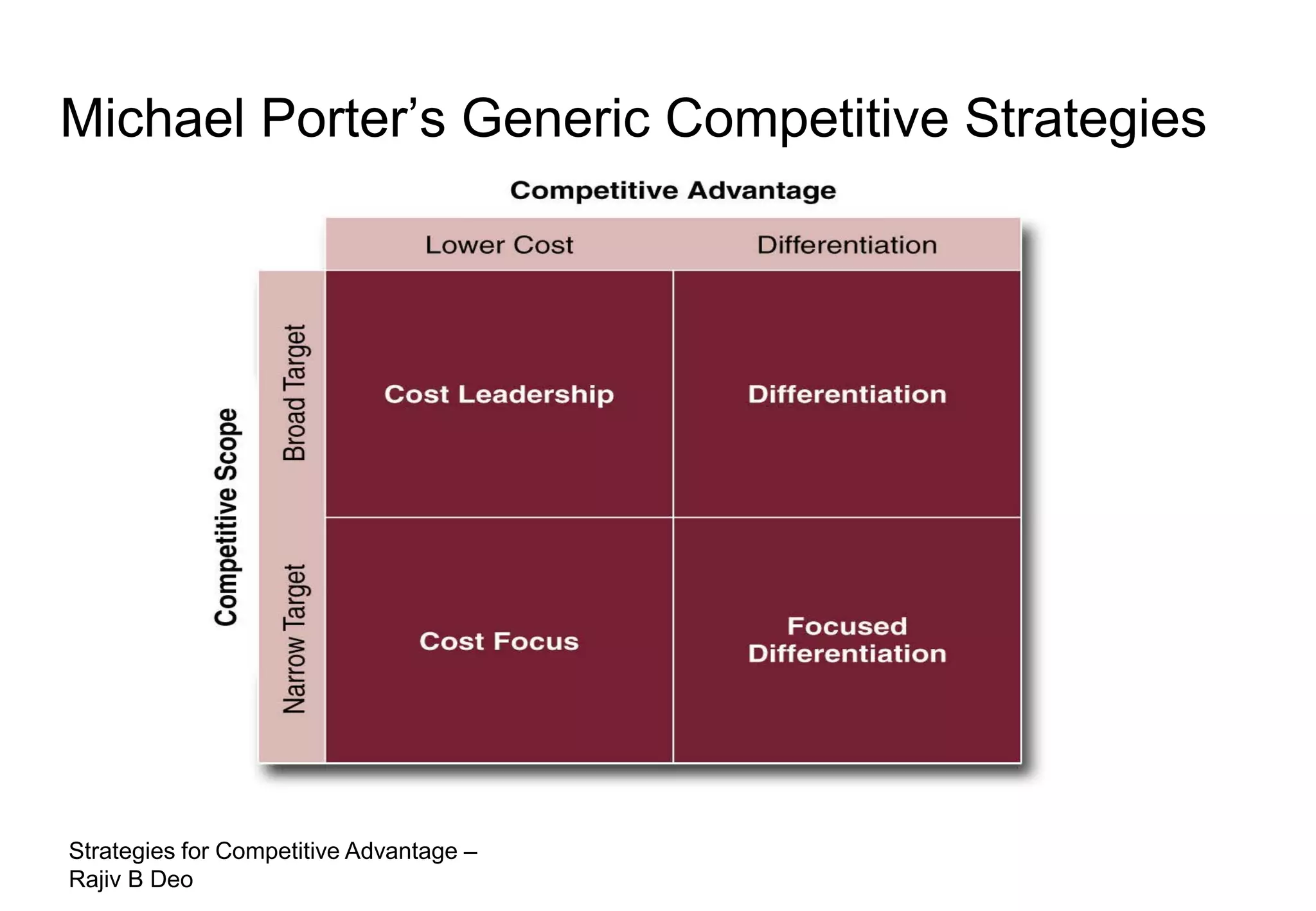
Michael Porter’s Generic Competitive Strategies


Strategies for Competitive Advantage –
Rajiv B Deo
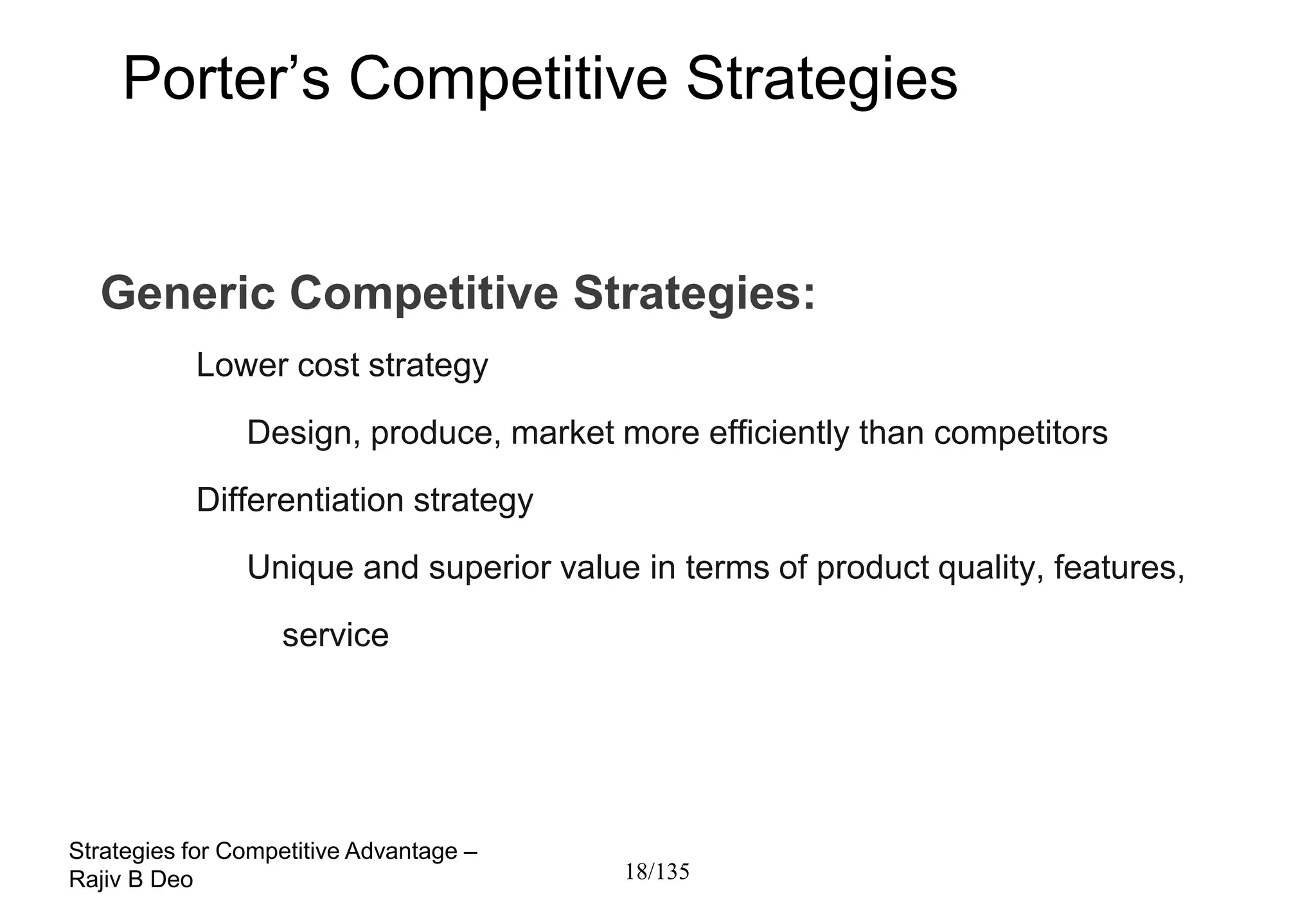
Porter’s Competitive Strategies


  Generic Competitive Strategies:
           Lower cost strategy
                Design, produce, market more efficiently than competitors
           Differentiation strategy
                Unique and superior value in terms of product quality, features,
                   service


Strategies for Competitive Advantage –
Rajiv B Deo                              18/135
Porter’s Competitive Strategies


  Competitive Advantage:
           Determined by Competitive Scope
                Breadth of the company’s target market


Strategies for Competitive Advantage –
Rajiv B Deo                              19/135
Porter’s Competitive Strategies


  Cost Leadership:
           Low-cost competitive strategy
           Aimed at broad mass market
           Aggressive construction of efficient-scale facilities
           Cost reductions
           Cost minimization


Strategies for Competitive Advantage –
Rajiv B Deo                              20/135
Porter’s Competitive Strategies


  Differentiation:
           Broad mass market
           Unique product or service
           Charge premiums
           Lower customer sensitivity to price


Strategies for Competitive Advantage –
Rajiv B Deo                              21/135
Porter’s Competitive Strategies


  Cost focus:
           Low cost competitive strategy
           Focus on particular buyer group or market
           Niche focused
           Seek cost advantage in target market


Strategies for Competitive Advantage –
Rajiv B Deo                              22/135
Porter’s Competitive Strategies


  Differentiation focus:
           Focus on particular group or geographic market
           Seek differentiation in targeted market segment
           Serve special needs of narrow target market


Strategies for Competitive Advantage –
Rajiv B Deo                              23/135
Porter’s Competitive Strategies


  Stuck in the middle:
           No competitive advantage
           Below-average performance


Strategies for Competitive Advantage –
Rajiv B Deo                              24/135
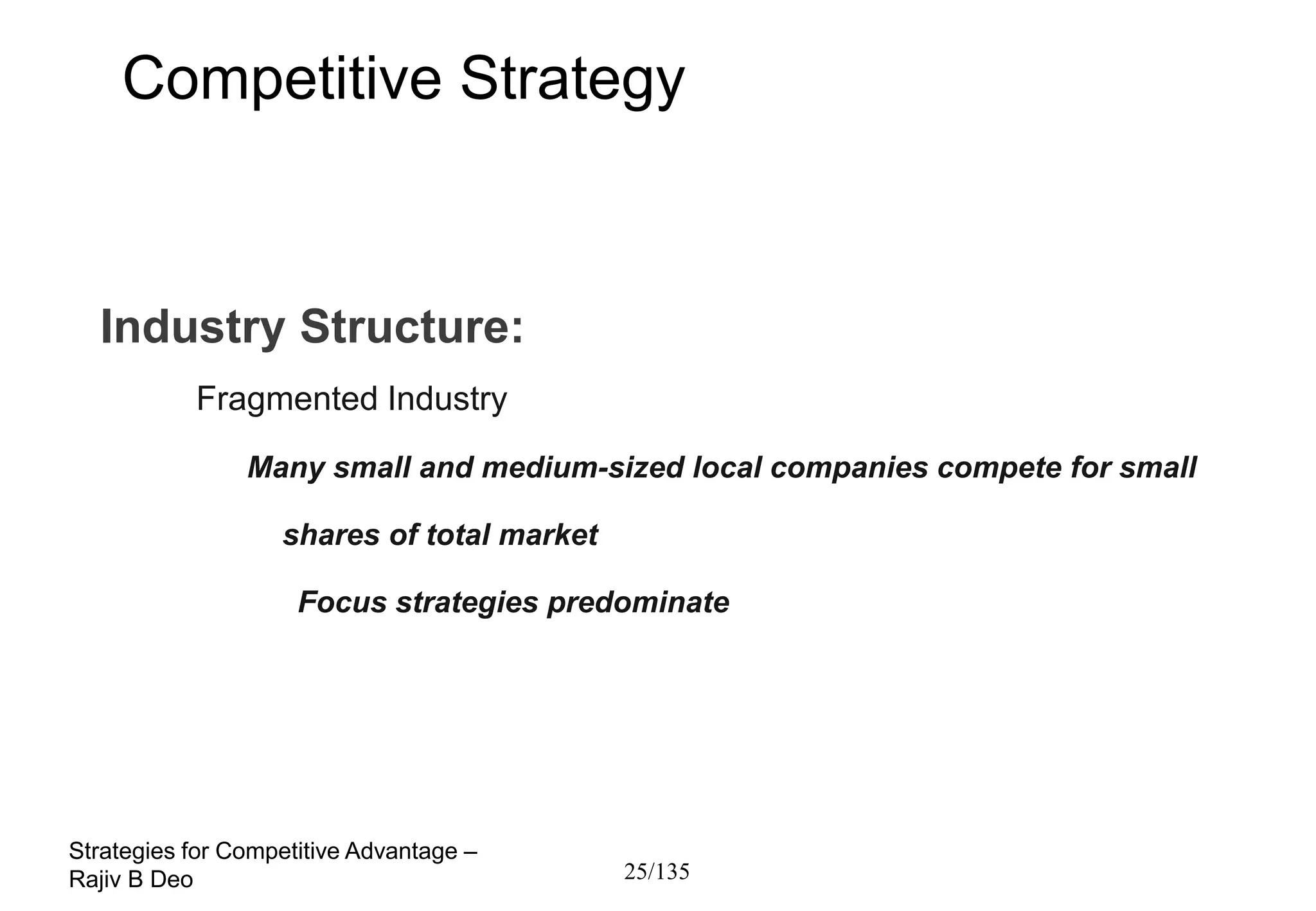
Competitive Strategy


  Industry Structure:
           Fragmented Industry

                Many small and medium-sized local companies compete for small

                   shares of total market

                     Focus strategies predominate


Strategies for Competitive Advantage –
Rajiv B Deo                                 25/135
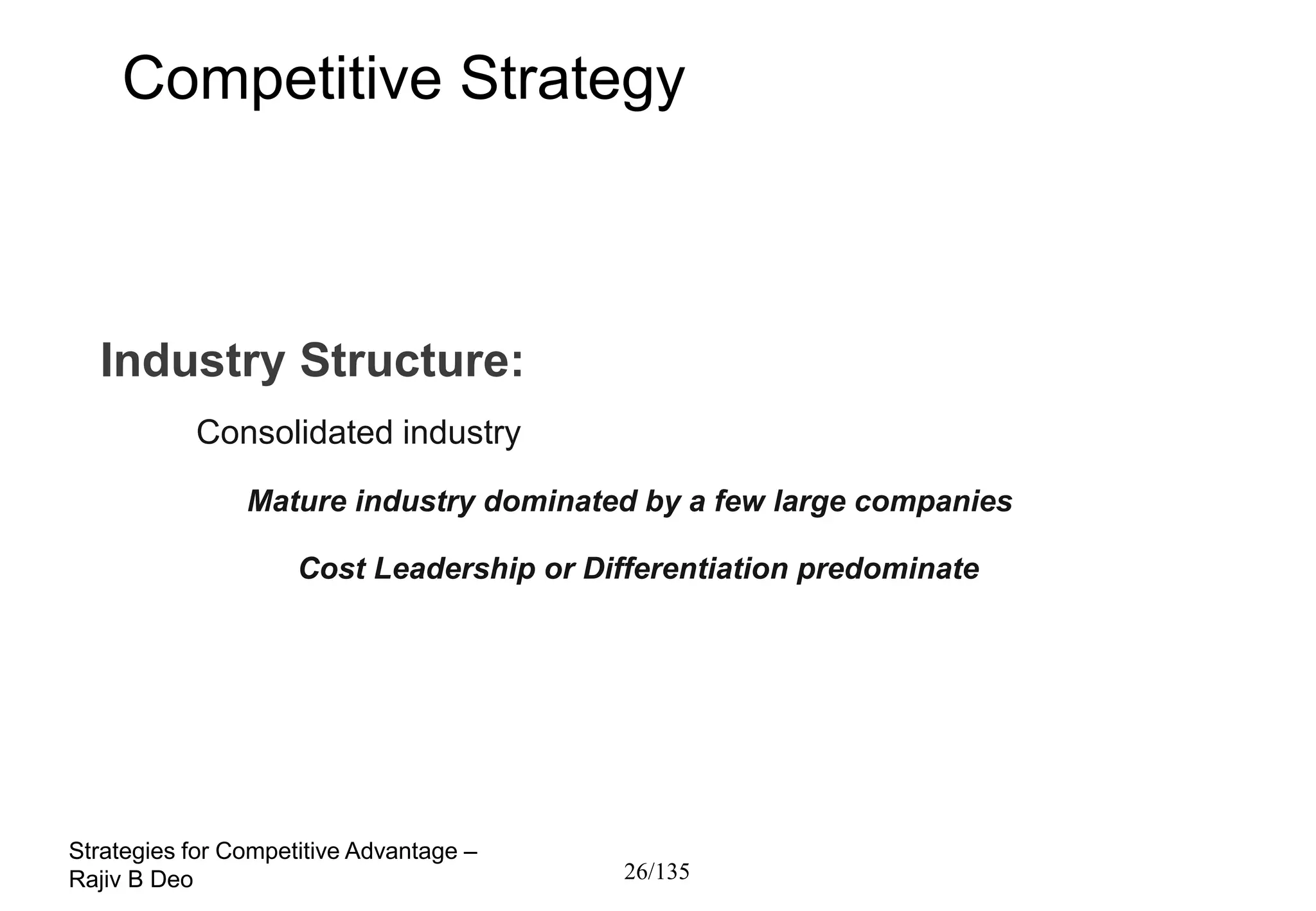
Competitive Strategy


  Industry Structure:
           Consolidated industry
                Mature industry dominated by a few large companies

                     Cost Leadership or Differentiation predominate


Strategies for Competitive Advantage –
Rajiv B Deo                                26/135
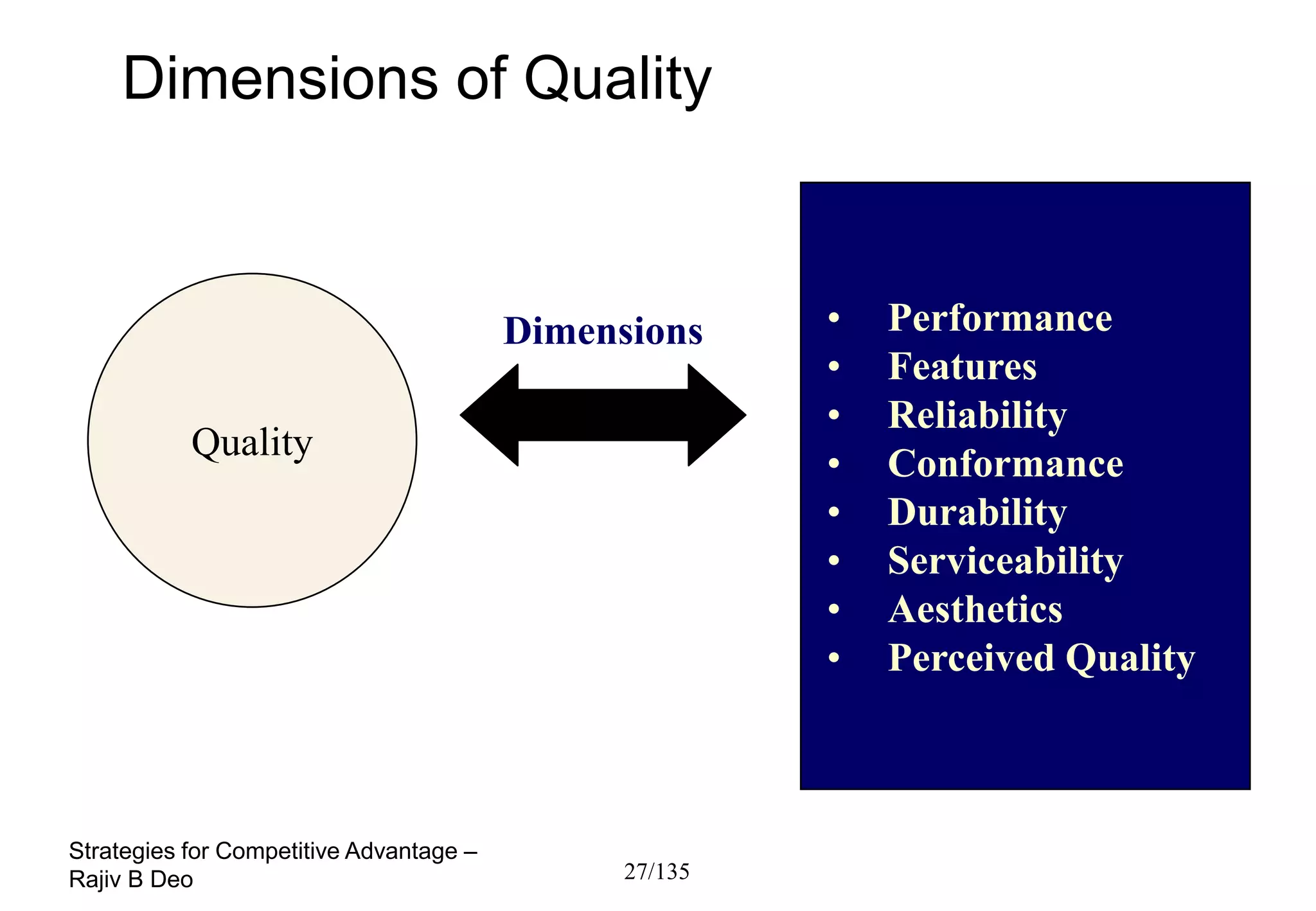
Dimensions of Quality


                                         Dimensions     •   Performance
                                                        •   Features
                                                        •   Reliability
           Quality
                                                        •   Conformance
                                                        •   Durability
                                                        •   Serviceability
                                                        •   Aesthetics
                                                        •   Perceived Quality


Strategies for Competitive Advantage –
Rajiv B Deo                                    27/135
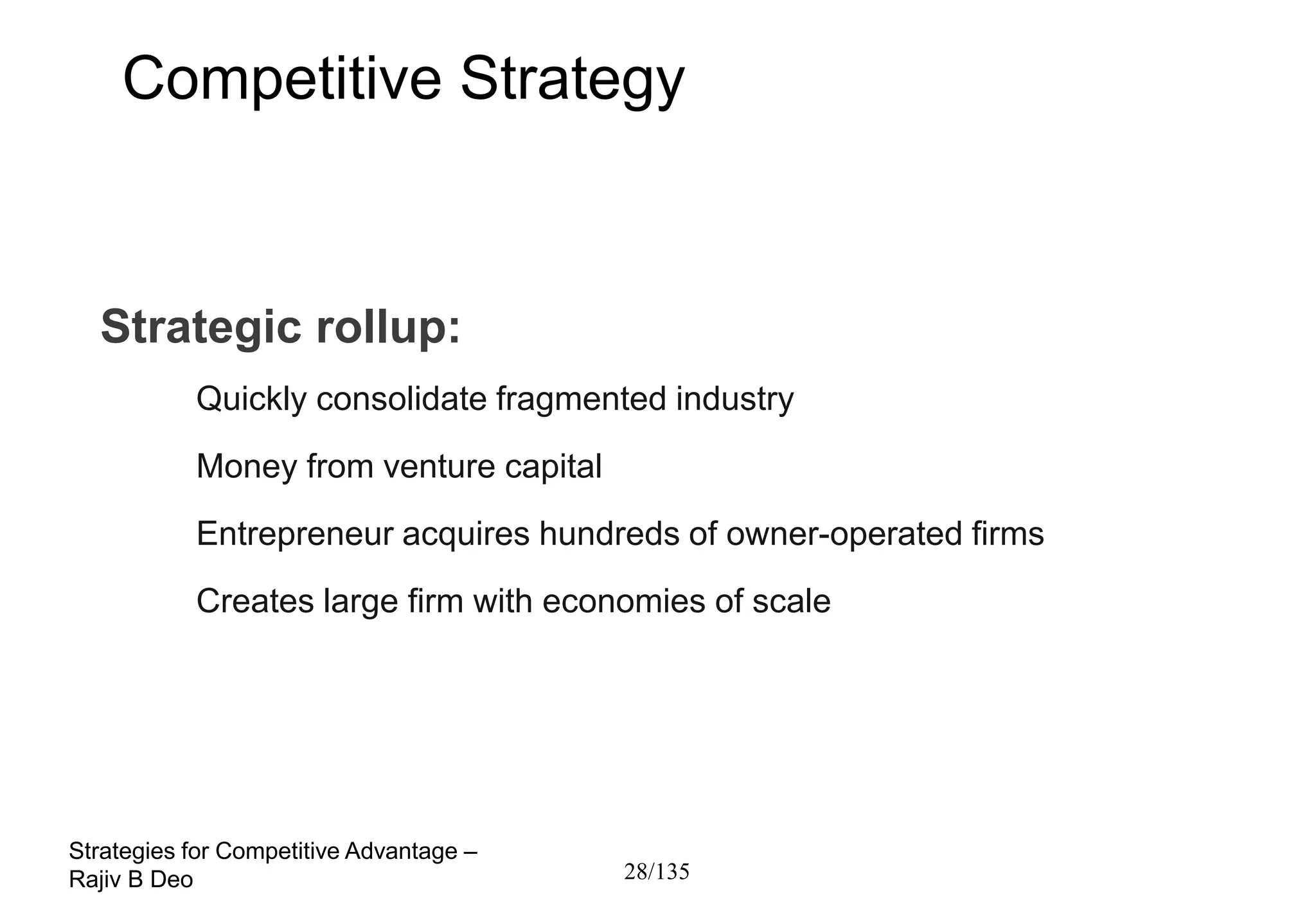
Competitive Strategy


  Strategic rollup:
           Quickly consolidate fragmented industry
           Money from venture capital
           Entrepreneur acquires hundreds of owner-operated firms
           Creates large firm with economies of scale


Strategies for Competitive Advantage –
Rajiv B Deo                              28/135
Competitive Strategy


  Strategic rollup:
           Differ from Conventional M&A’s

                Large number of firms

                Owner-operated firms

                Goal to reinvent entire industry


Strategies for Competitive Advantage –
Rajiv B Deo                               29/135
Competitive Tactics


  Tactic:
           Specific operating plan detailing how a strategy is to be implemented in
               terms of when and where it is to be put into action.
                Timing tactics

                Market location tactics


Strategies for Competitive Advantage –
Rajiv B Deo                               30/135
Competitive Tactics


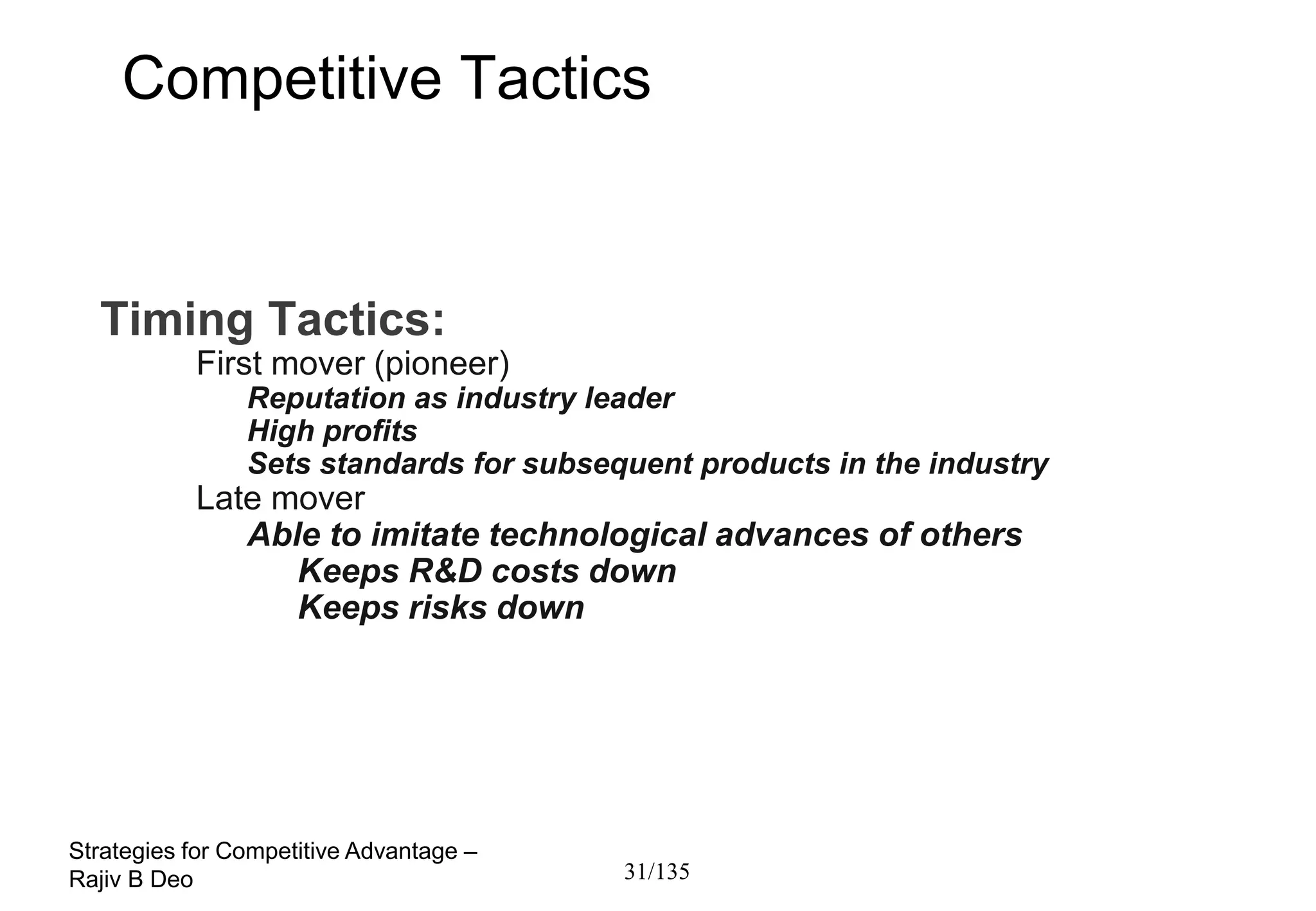
  Timing Tactics:
           First mover (pioneer)
                Reputation as industry leader
                High profits
                Sets standards for subsequent products in the industry
           Late mover
              Able to imitate technological advances of others
                 Keeps R&D costs down
                 Keeps risks down


Strategies for Competitive Advantage –
Rajiv B Deo                              31/135
Competitive Tactics

  Market Location Tactics:
           Offensive Tactics
                Frontal assault
                Flanking maneuver
                Bypass attack
                Encirclement
                Guerrilla warfare


Strategies for Competitive Advantage –
Rajiv B Deo                              32/135
Competitive Tactics


  Market Location Tactics:
           Defensive Tactics
                Raise structural barriers
                Increase expected retaliation
                Lower the inducement for attack


Strategies for Competitive Advantage –
Rajiv B Deo                              33/135
Cooperative Strategies


  Cooperative Strategies:
           Collusion
                Active cooperation of firms to reduce output and raise prices
                     Explicit
                     Tacit


Strategies for Competitive Advantage –
Rajiv B Deo                              34/135
Cooperative Strategies


  Cooperative Strategies:
           Strategic Alliance:
                     Partnership of two or more corporations or business units
                        to achieve strategically significant objectives that are
                        mutually beneficial.


Strategies for Competitive Advantage –
Rajiv B Deo                                35/135
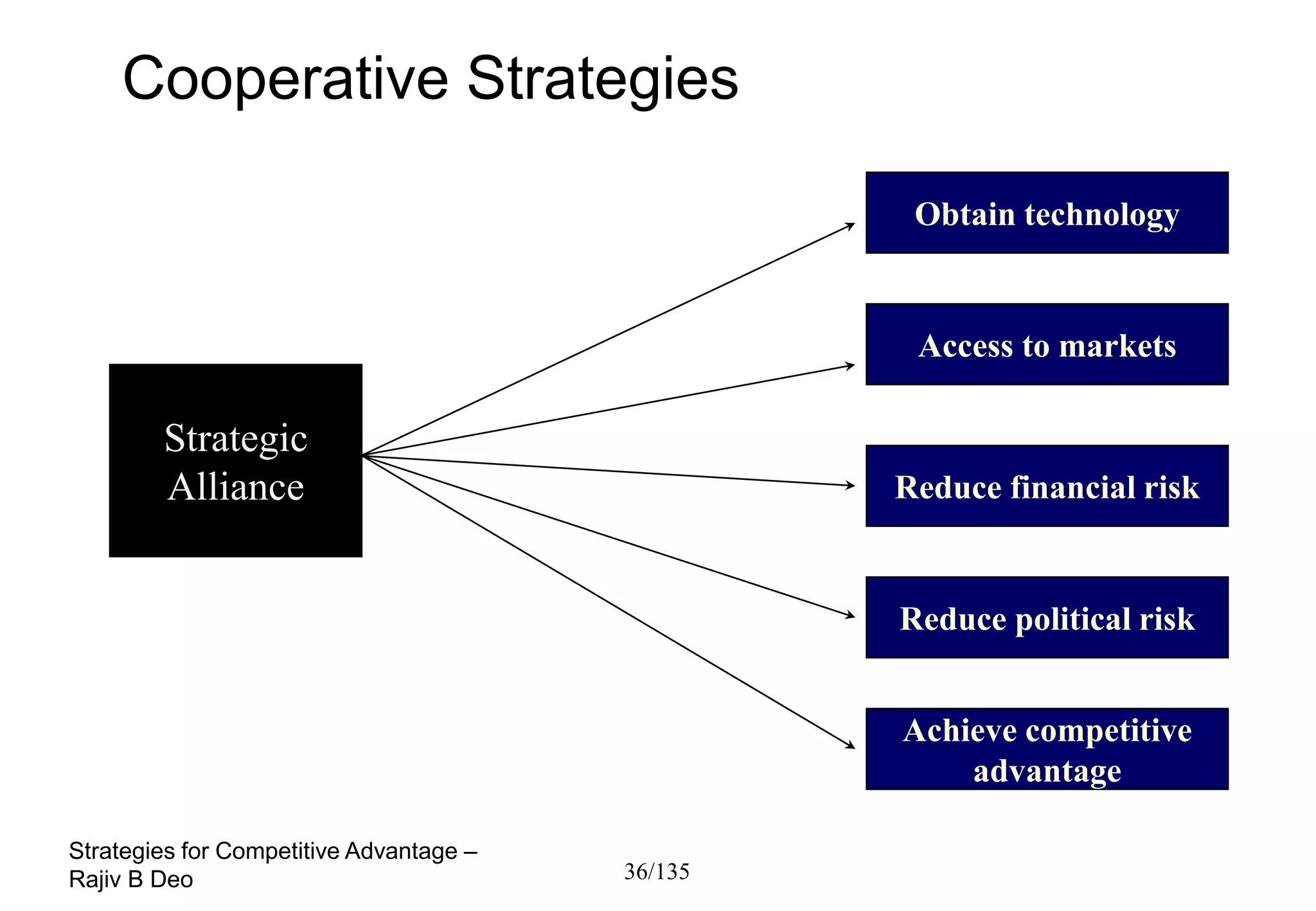
Cooperative Strategies

                                                   Obtain technology


                                                   Access to markets

        Strategic
        Alliance                                  Reduce financial risk


                                                  Reduce political risk


                                                  Achieve competitive
                                                      advantage

Strategies for Competitive Advantage –
Rajiv B Deo                              36/135
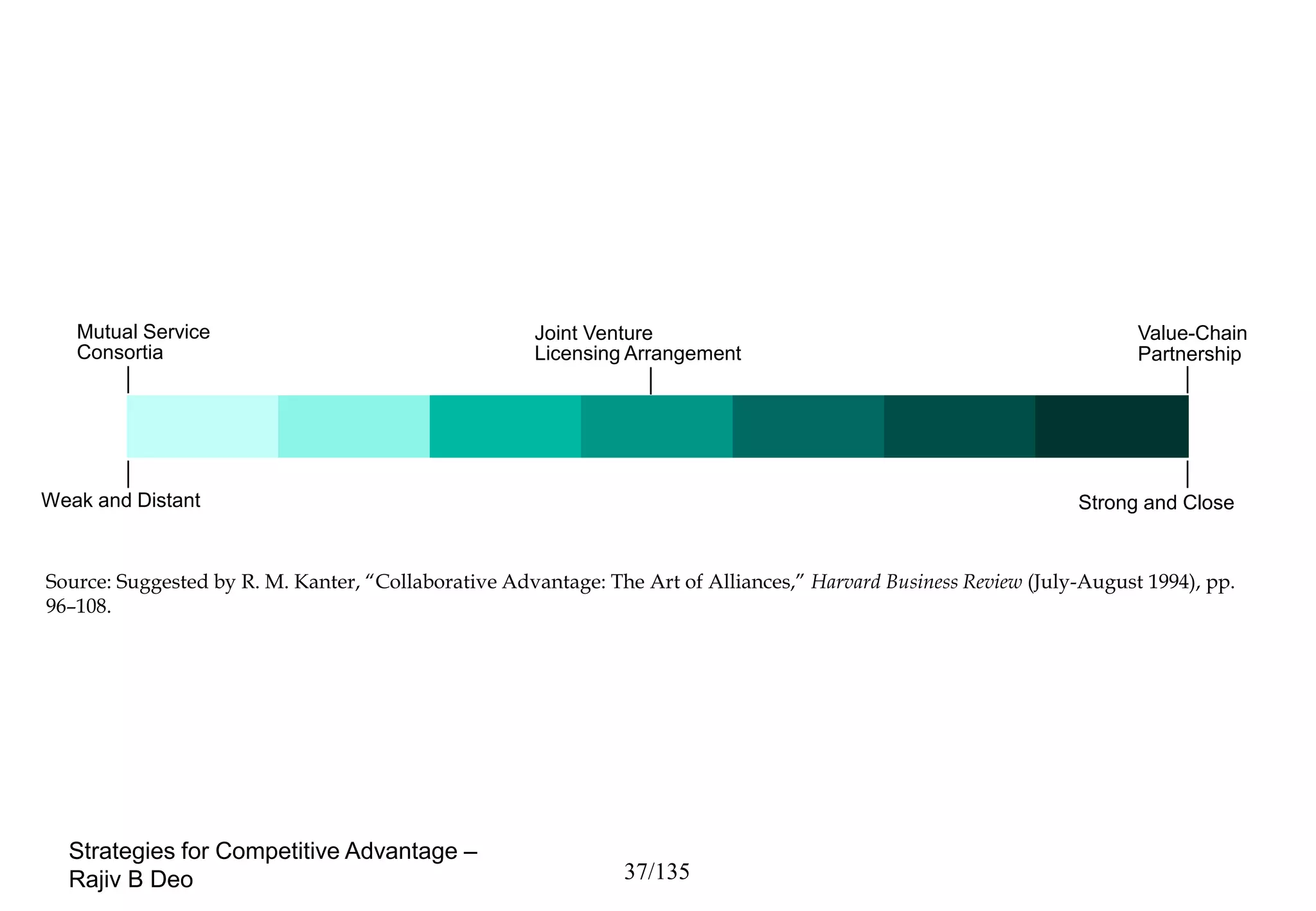
Continuum of Strategic Alliances


   Mutual Service                                    Joint Venture                                                      Value-Chain
   Consortia                                         Licensing Arrangement                                              Partnership


Weak and Distant                                                                                                 Strong and Close


Source: Suggested by R. M. Kanter, “Collaborative Advantage: The Art of Alliances,” Harvard Business Review (July-August 1994), pp.
96–108.


  Strategies for Competitive Advantage –
  Rajiv B Deo                                                  37/135
Introduction


   • Competitive advantage – a company provides a product or service
        in a way that customers value more than what the competition is able
        to do.


   • Application architect - information technology professional who can
        design creative technology-based business solutions.


Strategies for Competitive Advantage –
Rajiv B Deo
Developing A Strategy For The Internet
Age
• Business process - a standardized set of activities that
The Value Chain
  accomplishes a specific task, such as processing a
     customer’s order.


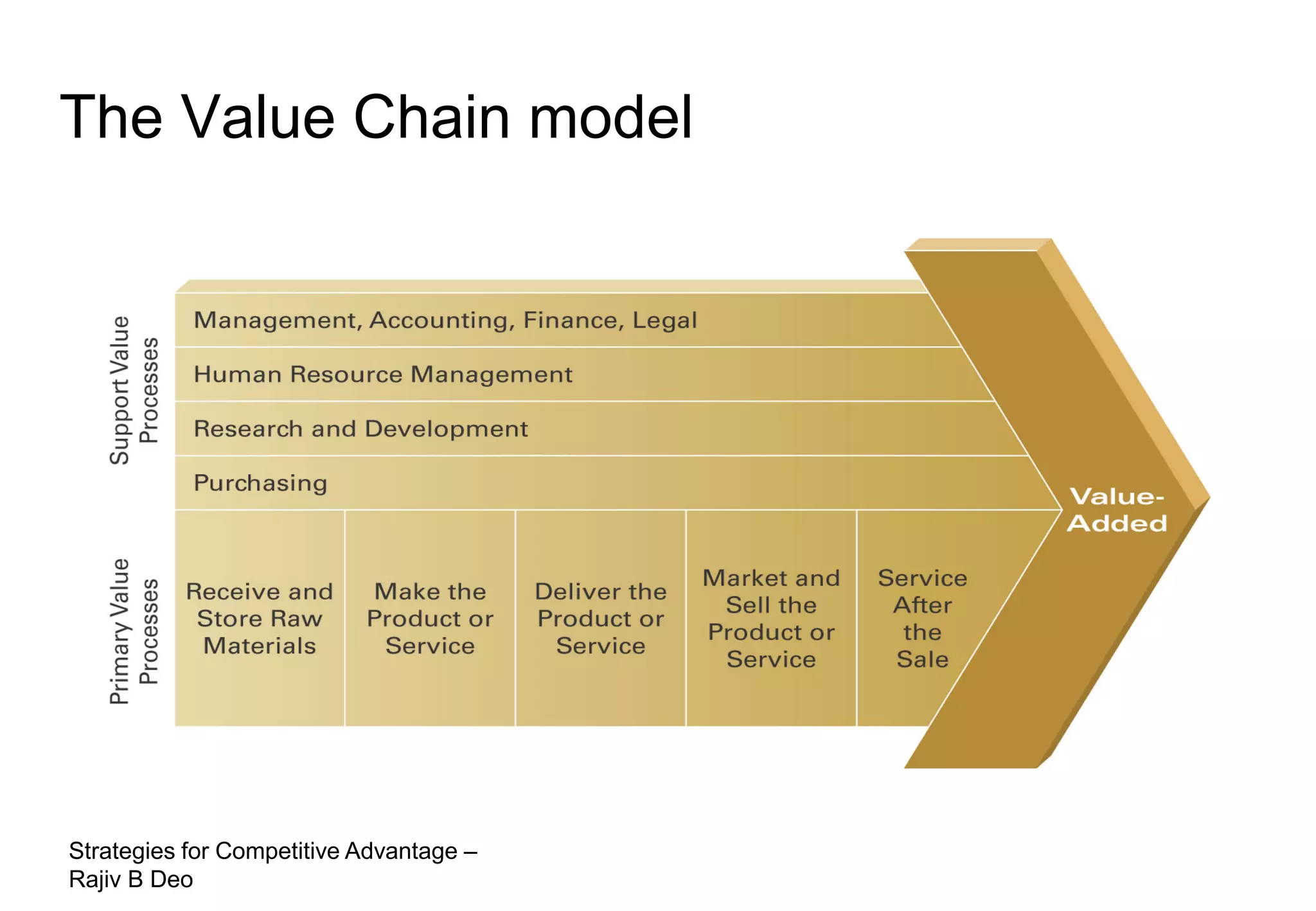
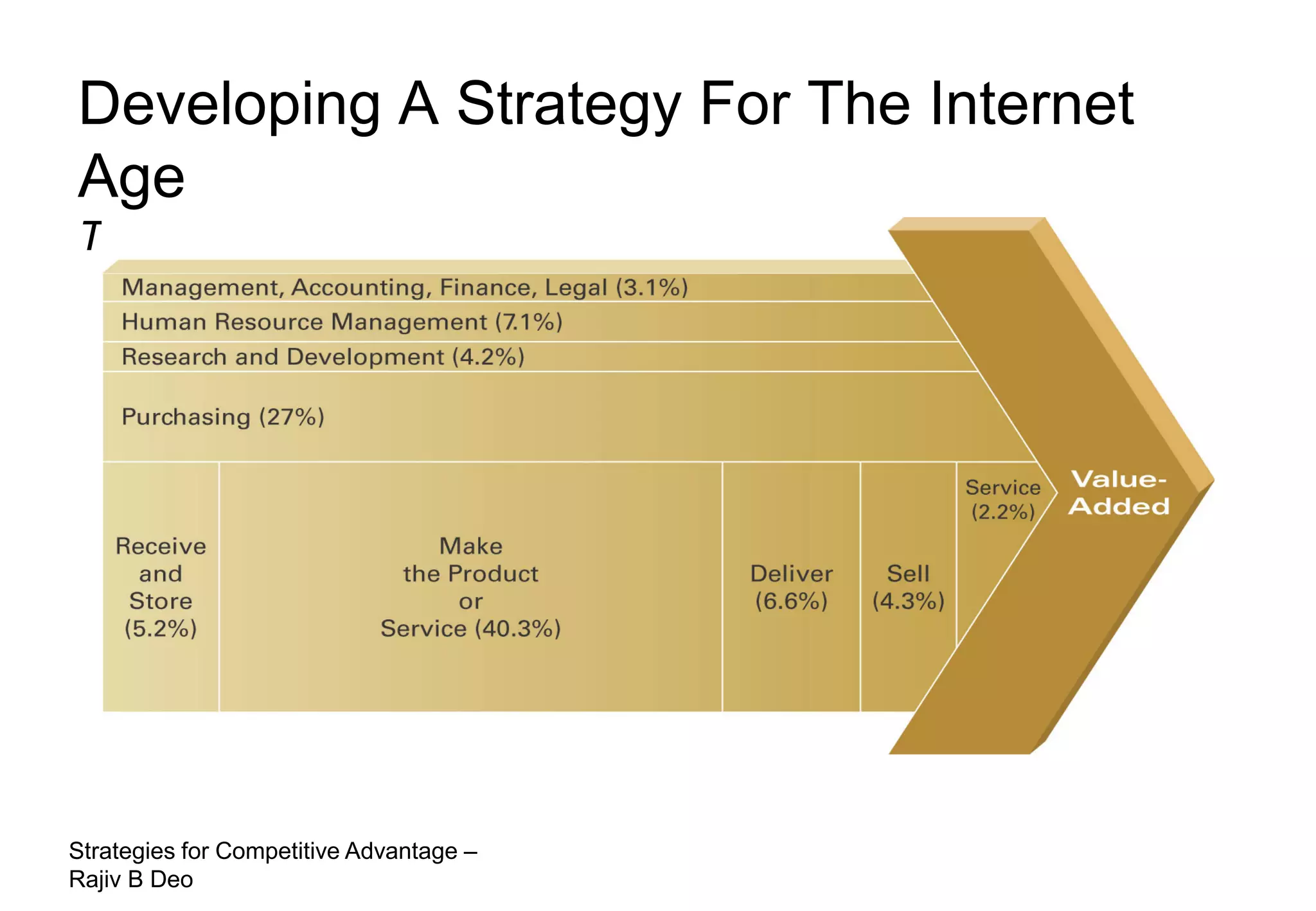
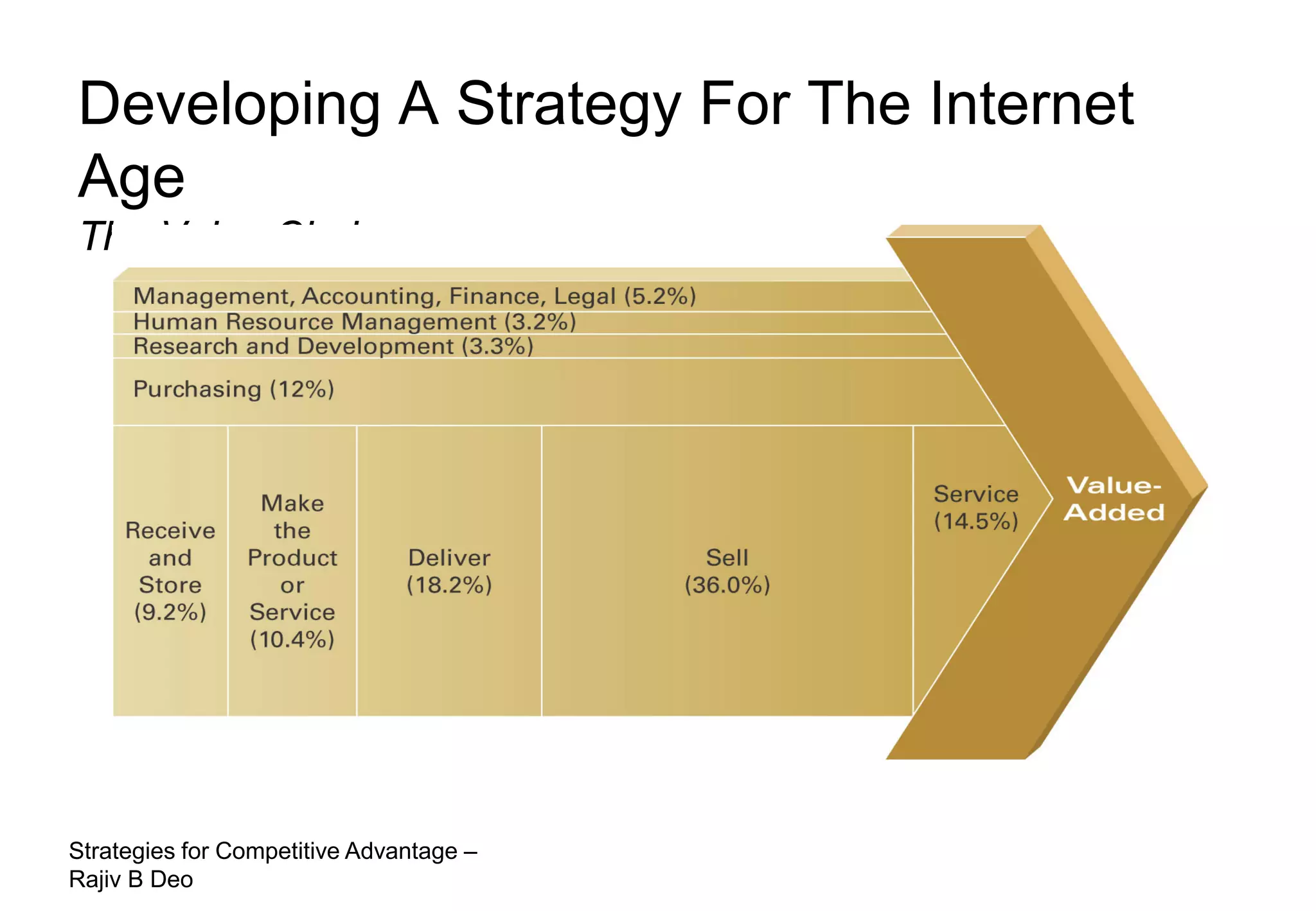
 • Value chain - views the organization as a chain – or series –
     of processes, each of which adds value to the product or
     service for the customer.


Strategies for Competitive Advantage –
Rajiv B Deo
The Value Chain model


Strategies for Competitive Advantage –
Rajiv B Deo
Using Value Chain model to develop a Strategy
   •Plan for a better way of meeting customer demands.
   •Identifying processes that add value.
   •Identifying processes that reduce value.


 Strategies for Competitive Advantage –
 Rajiv B Deo
Developing A Strategy For The Internet
Age
The Value Chain


Strategies for Competitive Advantage –
Rajiv B Deo
Developing A Strategy For The Internet
Age
The Value Chain


Strategies for Competitive Advantage –
Rajiv B Deo
Developing A Strategy For The Internet
Age
• Just-in-time - an approach that produces or delivers a product or service just at
Looking Beyond The Four Walls Of The Company
    the time the customer wants it.


•   Supply chain - consists of the paths reaching out to all of a company’s suppliers

    of parts and services.


•   Collaborative planning, forecasting, and replenishment (CPFR) - a concept

    that encourages and facilitates collaborative processes between members of a

    supply chain.

Strategies for Competitive Advantage –
Rajiv B Deo
Summing It Up

Important considerations you should keep in mind as you work
    to bring an IT competitive advantage to your organization
    include:
    Be efficient and effective.
    Competition is all around you.
    Push the state-of-the-art.
    IT competitive advantages are only temporary.


Strategies for Competitive Advantage –
Rajiv B Deo

Strategies for competitive advantage

  • 1.
    Strategies in Action “Even if you’re on the right track, you’ll get run over if you just sit there.” - Will Rogers Strategies for Competitive Advantage – Rajiv B Deo 1/135
  • 2.
    Fundamentals of CompetitiveStrategy Superior Long-Run Performance The central goal Attractive Industry Structure Competitive Advantage High returns for the average Outperform the average industry participant participant Superior Competitive Operational Position Effectiveness Do different things than rivals Do the same things as rivals but better Strategies for Competitive Advantage – Rajiv B Deo
  • 3.
    Hierarchies of Strategy CorporateStrategy: is concerned primarily with answering the question: What set of businesses should we be in? Scope and resource deployments among businesses are the primary components of corporate level strategy. The major policy decisions are financial structure and organizational structure. Business Strategy: is concerned primarily with answering the question: How to compete in a particular industry or product/market segment. Distinctive competences and competitive advantage are the most important components of business level strategy. The major policy decisions are product/market segmentation and evolution. Functional Area Strategy: At the functional area level, the principal focus of strategy is on the maximization of resource productivity Strategies for Competitive Advantage – Rajiv B Deo Ref.: Hofer and Schendel, 1978
  • 4.
    Common pitfalls Strategists shouldavoid – Managing by Extrapolation Managing by Crisis Managing by Subjectivism Managing by Hope Strategies for Competitive Advantage – Rajiv B Deo 4/135
  • 5.
    Strength of Competition-Five Forces Model Strategies for Competitive Advantage – Rajiv B Deo
  • 6.
    Effective Cost Leaderscan remain profitable even when the Five Forces appear unattractive Can mitigate Supplier Power by: Can frighten off New Entrants due to the Low cost position makes them better Threat of need to: * able to absorb cost increases New * Enter at Large Scale to be Cost Competitive * More likely to make very large Entrants * Take time to move down the purchases which reduces chance of “Learning Curve” supplier power Bargaining Rivalry Among Bargaining Power of Competing Firms in Power of Suppliers Industry Buyers Well positioned relative to Substitutes in order to: Can mitigate Buyer Power by: * Make investments to create substitutes Driving prices far below Can buy patents developed by potential Threat of competitors which may cause * exit and shift power back to substitutes Substitute firm * Lower prices to maintain value position Products Ref.: Porter, 1985 Strategies for Competitive Advantage – Rajiv B Deo
  • 7.
    Applying 5 forcesmodel to Coke & Pepsi Strategies for Competitive Advantage – Rajiv B Deo
  • 8.
    Michael Porter’s GenericStrategies Strategies for Competitive Advantage – Rajiv B Deo 8/135
  • 9.
    Risks of GenericCompetitive Strategies Risks of Cost Leadership Risks of Differentiation Risks of Focus Cost leadership is not Differentiation is not sustained: The focus strategy is imitated: sustained: • Competitors imitate. The target segment becomes • Competitors imitate. • Bases for differentiation structurally unattractive: • Technology changes. become less important to • Structure erodes. • Other bases for cost buyers. • Demand disappears. leadership erode. Cost proximity is lost. Broadly targeted competitors Proximity in differentiation is Differentiation focusers achieve overwhelm the segment: lost. even greater differentiation in • The segment’s Cost focusers achieve even segments. differences from other lower cost in segments. segments narrow. • The advantages of a broad line increase. New focusers sub-segment the industry. Strategies for Competitive Advantage – Rajiv B Deo 9/135
  • 10.
    Business Level Strategy The resources and capabilities that have been determined to Core be a source of competitive advantage for a firm over its rivals. Competency An integrated and coordinated set of actions taken to exploit Strategy core competencies and gain a competitive advantage. Actions taken to provide value to customers Business Level and gain a competitive advantage by exploiting Strategy core competencies in specific, individual product markets. Strategies for Competitive Advantage – Rajiv B Deo
  • 11.
    Value Chain Analysis Firm Infrastructure Support Human Resource Management Activities Technological Development Procurement Service Outbound Operations Marketing Logistics Logistics & Sales Inbound Primary Activities Ref.: Porter, 1985 Strategies for Competitive Advantage – Rajiv B Deo
  • 12.
    Value Creating Activitiescommon to a Cost Leadership Business Simplified Planning Relatively Few Cost Effective Practices to Reduce Management Layers to MIS Systems Planning Costs Reduce Overhead Activities Support Consistent Policies to Effective Training Programs to Reduce Turnover Costs Improve Worker Efficiency and Effectiveness Easy-to-Use Manufacturing Investments in Technology in order to Technologies Reduce Costs Associated with Manufacturing Processes Systems and Procedures to find the Frequent Evaluation Processes to Lowest Cost Products to Purchase Raw Monitor Suppliers’ Performances Materials Highly Efficient Efficient Plant Delivery Schedule Small, Highly Effective Product Systems to Link Scale to Minimize that Reduces Trained Sales Force Installations to Suppliers’ Products Manufacturing Costs Reduce Frequency with the Firm’s Costs and Severity Production Selection of Low Products Priced to of Recalls Processes Cost Transport Generate Sales Timing of Asset Carriers Volume Purchases Located in Close Policy Choice of Efficient Order Sizes National Scale Proximity with Plant Technology Advertising Suppliers Organizational Interrelationships Learning with Sister Units Ref.: Porter, 1985 Primary Activities Strategies for Competitive Advantage – Rajiv B Deo
  • 13.
    Three Key Questions 1 How can an activity be performed differently or even eliminated? 2 How can a group of linked value activities be regrouped or reordered? 3 How might coalitions with other firms lower or eliminate costs? Strategies for Competitive Advantage – Rajiv B Deo
  • 14.
    TOWS Matrix Strategies forCompetitive Advantage – Rajiv B Deo 14/135
  • 15.
    Business Strategies Business Strategy: Focuses on improving the competitive position of a company’s or business unit’s products or services within the specific industry or market segment that the firm serves. Strategies for Competitive Advantage – Rajiv B Deo 15/135
  • 16.
    Porter’s Competitive Strategies Competitive Strategy: Low cost? Differentiation? Compete head to head in large market? Focus on niche? Strategies for Competitive Advantage – Rajiv B Deo 16/135
  • 17.
    Michael Porter’s GenericCompetitive Strategies Strategies for Competitive Advantage – Rajiv B Deo
  • 18.
    Porter’s Competitive Strategies Generic Competitive Strategies: Lower cost strategy Design, produce, market more efficiently than competitors Differentiation strategy Unique and superior value in terms of product quality, features, service Strategies for Competitive Advantage – Rajiv B Deo 18/135
  • 19.
    Porter’s Competitive Strategies Competitive Advantage: Determined by Competitive Scope Breadth of the company’s target market Strategies for Competitive Advantage – Rajiv B Deo 19/135
  • 20.
    Porter’s Competitive Strategies Cost Leadership: Low-cost competitive strategy Aimed at broad mass market Aggressive construction of efficient-scale facilities Cost reductions Cost minimization Strategies for Competitive Advantage – Rajiv B Deo 20/135
  • 21.
    Porter’s Competitive Strategies Differentiation: Broad mass market Unique product or service Charge premiums Lower customer sensitivity to price Strategies for Competitive Advantage – Rajiv B Deo 21/135
  • 22.
    Porter’s Competitive Strategies Cost focus: Low cost competitive strategy Focus on particular buyer group or market Niche focused Seek cost advantage in target market Strategies for Competitive Advantage – Rajiv B Deo 22/135
  • 23.
    Porter’s Competitive Strategies Differentiation focus: Focus on particular group or geographic market Seek differentiation in targeted market segment Serve special needs of narrow target market Strategies for Competitive Advantage – Rajiv B Deo 23/135
  • 24.
    Porter’s Competitive Strategies Stuck in the middle: No competitive advantage Below-average performance Strategies for Competitive Advantage – Rajiv B Deo 24/135
  • 25.
    Competitive Strategy Industry Structure: Fragmented Industry Many small and medium-sized local companies compete for small shares of total market Focus strategies predominate Strategies for Competitive Advantage – Rajiv B Deo 25/135
  • 26.
    Competitive Strategy Industry Structure: Consolidated industry Mature industry dominated by a few large companies Cost Leadership or Differentiation predominate Strategies for Competitive Advantage – Rajiv B Deo 26/135
  • 27.
    Dimensions of Quality Dimensions • Performance • Features • Reliability Quality • Conformance • Durability • Serviceability • Aesthetics • Perceived Quality Strategies for Competitive Advantage – Rajiv B Deo 27/135
  • 28.
    Competitive Strategy Strategic rollup: Quickly consolidate fragmented industry Money from venture capital Entrepreneur acquires hundreds of owner-operated firms Creates large firm with economies of scale Strategies for Competitive Advantage – Rajiv B Deo 28/135
  • 29.
    Competitive Strategy Strategic rollup: Differ from Conventional M&A’s Large number of firms Owner-operated firms Goal to reinvent entire industry Strategies for Competitive Advantage – Rajiv B Deo 29/135
  • 30.
    Competitive Tactics Tactic: Specific operating plan detailing how a strategy is to be implemented in terms of when and where it is to be put into action. Timing tactics Market location tactics Strategies for Competitive Advantage – Rajiv B Deo 30/135
  • 31.
    Competitive Tactics Timing Tactics: First mover (pioneer) Reputation as industry leader High profits Sets standards for subsequent products in the industry Late mover Able to imitate technological advances of others Keeps R&D costs down Keeps risks down Strategies for Competitive Advantage – Rajiv B Deo 31/135
  • 32.
    Competitive Tactics Market Location Tactics: Offensive Tactics Frontal assault Flanking maneuver Bypass attack Encirclement Guerrilla warfare Strategies for Competitive Advantage – Rajiv B Deo 32/135
  • 33.
    Competitive Tactics Market Location Tactics: Defensive Tactics Raise structural barriers Increase expected retaliation Lower the inducement for attack Strategies for Competitive Advantage – Rajiv B Deo 33/135
  • 34.
    Cooperative Strategies Cooperative Strategies: Collusion Active cooperation of firms to reduce output and raise prices Explicit Tacit Strategies for Competitive Advantage – Rajiv B Deo 34/135
  • 35.
    Cooperative Strategies Cooperative Strategies: Strategic Alliance: Partnership of two or more corporations or business units to achieve strategically significant objectives that are mutually beneficial. Strategies for Competitive Advantage – Rajiv B Deo 35/135
  • 36.
    Cooperative Strategies Obtain technology Access to markets Strategic Alliance Reduce financial risk Reduce political risk Achieve competitive advantage Strategies for Competitive Advantage – Rajiv B Deo 36/135
  • 37.
    Continuum of StrategicAlliances Mutual Service Joint Venture Value-Chain Consortia Licensing Arrangement Partnership Weak and Distant Strong and Close Source: Suggested by R. M. Kanter, “Collaborative Advantage: The Art of Alliances,” Harvard Business Review (July-August 1994), pp. 96–108. Strategies for Competitive Advantage – Rajiv B Deo 37/135
  • 38.
    Introduction • Competitive advantage – a company provides a product or service in a way that customers value more than what the competition is able to do. • Application architect - information technology professional who can design creative technology-based business solutions. Strategies for Competitive Advantage – Rajiv B Deo
  • 39.
    Developing A StrategyFor The Internet Age • Business process - a standardized set of activities that The Value Chain accomplishes a specific task, such as processing a customer’s order. • Value chain - views the organization as a chain – or series – of processes, each of which adds value to the product or service for the customer. Strategies for Competitive Advantage – Rajiv B Deo
  • 40.
    The Value Chainmodel Strategies for Competitive Advantage – Rajiv B Deo
  • 41.
    Using Value Chainmodel to develop a Strategy •Plan for a better way of meeting customer demands. •Identifying processes that add value. •Identifying processes that reduce value. Strategies for Competitive Advantage – Rajiv B Deo
  • 42.
    Developing A StrategyFor The Internet Age The Value Chain Strategies for Competitive Advantage – Rajiv B Deo
  • 43.
    Developing A StrategyFor The Internet Age The Value Chain Strategies for Competitive Advantage – Rajiv B Deo
  • 44.
    Developing A StrategyFor The Internet Age • Just-in-time - an approach that produces or delivers a product or service just at Looking Beyond The Four Walls Of The Company the time the customer wants it. • Supply chain - consists of the paths reaching out to all of a company’s suppliers of parts and services. • Collaborative planning, forecasting, and replenishment (CPFR) - a concept that encourages and facilitates collaborative processes between members of a supply chain. Strategies for Competitive Advantage – Rajiv B Deo
  • 45.
    Summing It Up Importantconsiderations you should keep in mind as you work to bring an IT competitive advantage to your organization include:  Be efficient and effective.  Competition is all around you.  Push the state-of-the-art.  IT competitive advantages are only temporary. Strategies for Competitive Advantage – Rajiv B Deo