Strategic Cost Control

                        Vinod Bidwaik
    http://vinodtbidwaik.blogspot.com
Types of Costs
 Productive Costs: Provide value to customer
 Support Cost: Necessary, but don't benefit Customer
 Waste: No value to customer
Avoid Waste
 By rectifying mistakes
 By not producing items that nobody wants
 By eliminating some of the processing steps that may not be
 required.
 By stopping movement of employee without purpose
 By unwanted transport of goods or movement without real
 purpose
 By expediting the upstream activity, so that people or assets
 may not wait idle
 By measuring all the costs and inputs of a particular process.
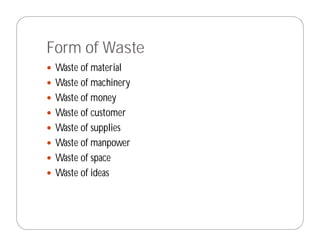
Form of Waste
 Waste of material
 Waste of machinery
 Waste of money
 Waste of customer
 Waste of supplies
 Waste of manpower
 Waste of space
 Waste of ideas
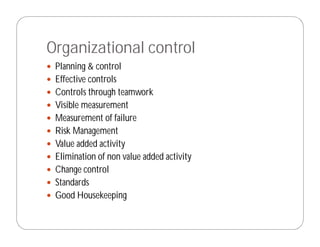
Organizational control
 Planning & control
 Effective controls
 Controls through teamwork
 Visible measurement
 Measurement of failure
 Risk Management
 Value added activity
 Elimination of non value added activity
 Change control
 Standards
 Good Housekeeping
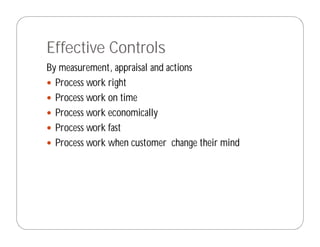
Effective Controls
By measurement, appraisal and actions
  Process work right
  Process work on time
  Process work economically
  Process work fast
  Process work when customer change their mind
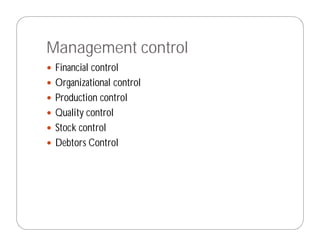
Management control
 Financial control
 Organizational control
 Production control
 Quality control
 Stock control
 Debtors Control
Profit planning, control & improvement
 Budget & budgetary control
 Marginal costing
 Cost volume profit analysis and break even charts
 Differential & comparative cost analysis
Strategic thinking about cost control
 Does the cost allocation mechanism work?
 Can functional heads distinguish those costs assigned to their
 activities over which they may have some influence?
 Are Managers fully aware of the cost implications of their
 own decisions?
Two forms
 Restraints: Weak & over detailed and stifle the initiative of
 managers
 Freedoms: Often fail through inadequate information on full
 costs
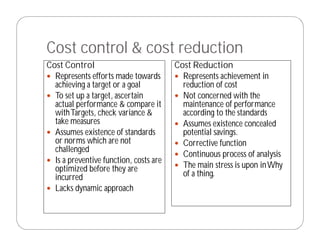
Cost control & cost reduction
Cost Control                            Cost Reduction
  Represents efforts made towards         Represents achievement in
  achieving a target or a goal            reduction of cost
  To set up a target, ascertain           Not concerned with the
  actual performance & compare it         maintenance of performance
  with Targets, check variance &          according to the standards
  take measures                           Assumes existence concealed
  Assumes existence of standards          potential savings.
  or norms which are not                  Corrective function
  challenged
                                          Continuous process of analysis
  Is a preventive function, costs are
  optimized before they are               The main stress is upon in Why
  incurred                                of a thing.
  Lacks dynamic approach
Why controls?
 Better planning
 Improved motivation
 Economic use of time
 Improved competitive edge
 Increased commitment
 Better decision making
 Improved efficiency
 More profit
Planning overhead cost control
 Establish company objective and targets
 Develop detailed programmes
 Organize resources to meet the objectives
 Establish performance standards
 Develop a system of budgets
 Report on performance
Basic elements
                     Productivity:

 More production in lesser manpower

                          Or

 More manpower to produce even more
Doing more with less
 Deliver more of Profits, Productivity, Quality, Sales


 With less of Money, Staff, Time, Machinery
Strategy
 Is a means to achieve goals
 Links all parts of an organization
 Covers all major aspects of an organization
 Is a long term plan
 Ensures that all parts of the plan are compatible
 Identifies basic issues such as
 What is our business?
 What should it be?
 What are our products/services, functions, markets?
 What should we do to achieve our objectives?
Strategy
 Is a result of analyzing the strength & weaknesses of the
 organization
 Determining opportunities & threats
 Is an organization’s planned response to its environment over
 time.
Elements of Strategy
 Goals/objectives to be achieved
 Policies for action
 Programme to achieve goals within the set limits.
Strategic Costs
 Can you define your strategic costs?
 What is your attitude towards costs?
 What is your approach towards cost cutting?
 Do you practice the new art of cost cutting?
 What can you do yourself to cut costs?
 Are your profits cost effective?
Think big…………….. But don’t throw away the
       small small parts, nuts and bolts..
Attitude towards cost
 Means knowing when, how and which costs to cut
 One that value wise spending, prudent cutting and
 organizational flexibility
Hidden costs
 Think bottle necks
 Cycle times
 Downtime rates
 Machine set up times and changeovers
 Reuse of scrap material
 R&D
 Procure time
Methods & Procedures

                 KISS


          Keep It Short & Simple
Simple production control
Simple Communications
Simple Measurement
Agree with suppliers to take five days longer credit
Cut debtors days by five through better collection
Reduce stock by 5% by using Material Management
techniques. (JIT, FIFO etc)
Get one new customer per day/week
Procedures
 Customer needs
 Organization needs
 Employee needs
Do we need procedures and processes?
If yes when?
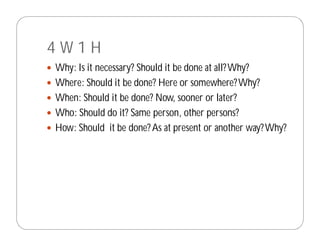
4W1H
Why: Is it necessary? Should it be done at all? Why?
Where: Should it be done? Here or somewhere? Why?
When: Should it be done? Now, sooner or later?
Who: Should do it? Same person, other persons?
How: Should it be done? As at present or another way? Why?
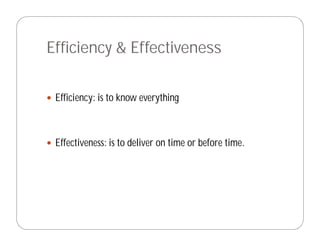
Efficiency & Effectiveness

 Efficiency: is to know everything


 Effectiveness: is to deliver on time or before time.
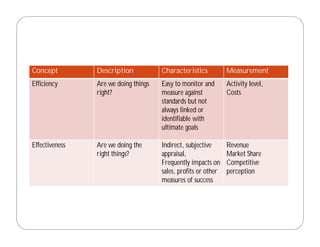
Concept         Description           Characteristics           Measurement
Efficiency      Are we doing things   Easy to monitor and       Activity level,
                right?                measure against           Costs
                                      standards but not
                                      always linked or
                                      identifiable with
                                      ultimate goals

Effectiveness   Are we doing the      Indirect, subjective      Revenue
                right things?         appraisal,                Market Share
                                      Frequently impacts on     Competitive
                                      sales, profits or other   perception
                                      measures of success
Employers don’t pay wages- they only handle the money.
Product pay wages…. Henry Ford
Don’t reduce staff
 Ask more from your key people
 People are better than you think
Thank you!
Vinod Bidwaik
http://vinodtbidwaik.blogspot.com
Vinod Bidwaik is the seasoned HR professional working with DSM India Pvt. Ltd. as the Head-HR for
India operations. He has wide experience in large Indian and Multi-National companies like M & M,
Semperit Group and Sakaal Media Group on senior level positions. He has rich experience in HR and
IR. He has an expertise working on greenfield projects and establishing HR department. He
implemented various HR practices; OD interventions in his organizations. During his tenure with
Semperit, the company was awarded for Best Innovative HR Practices during 2002 by NIPM. He holds
Master degree in Personnel Management, Diploma in Production Management. He is the regular
writer for various management journals like BMA Review, Human Factor and other management
Journals. He is on editorial advisory board of CJMR, Journal of Management Research of CMRD, at
Pune. He writes regular columns in various newspapers on management and development. He is
invited for Guest lectures on specialized subjects by various management and engineering
institutions. He is a life member of Bombay Management Association and holds various honorary
positions in different associations.


Disclaimer: Views expressed here are his own views and do not represent his
organization's (current & past) views.

Strategic cost control

  • 1.
    Strategic Cost Control Vinod Bidwaik http://vinodtbidwaik.blogspot.com
  • 2.
    Types of Costs Productive Costs: Provide value to customer Support Cost: Necessary, but don't benefit Customer Waste: No value to customer
  • 3.
    Avoid Waste Byrectifying mistakes By not producing items that nobody wants By eliminating some of the processing steps that may not be required. By stopping movement of employee without purpose By unwanted transport of goods or movement without real purpose By expediting the upstream activity, so that people or assets may not wait idle By measuring all the costs and inputs of a particular process.
  • 4.
    Form of Waste Waste of material Waste of machinery Waste of money Waste of customer Waste of supplies Waste of manpower Waste of space Waste of ideas
  • 5.
    Organizational control Planning& control Effective controls Controls through teamwork Visible measurement Measurement of failure Risk Management Value added activity Elimination of non value added activity Change control Standards Good Housekeeping
  • 6.
    Effective Controls By measurement,appraisal and actions Process work right Process work on time Process work economically Process work fast Process work when customer change their mind
  • 7.
    Management control Financialcontrol Organizational control Production control Quality control Stock control Debtors Control
  • 8.
    Profit planning, control& improvement Budget & budgetary control Marginal costing Cost volume profit analysis and break even charts Differential & comparative cost analysis
  • 9.
    Strategic thinking aboutcost control Does the cost allocation mechanism work? Can functional heads distinguish those costs assigned to their activities over which they may have some influence? Are Managers fully aware of the cost implications of their own decisions?
  • 10.
    Two forms Restraints:Weak & over detailed and stifle the initiative of managers Freedoms: Often fail through inadequate information on full costs
  • 11.
    Cost control &cost reduction Cost Control Cost Reduction Represents efforts made towards Represents achievement in achieving a target or a goal reduction of cost To set up a target, ascertain Not concerned with the actual performance & compare it maintenance of performance with Targets, check variance & according to the standards take measures Assumes existence concealed Assumes existence of standards potential savings. or norms which are not Corrective function challenged Continuous process of analysis Is a preventive function, costs are optimized before they are The main stress is upon in Why incurred of a thing. Lacks dynamic approach
  • 12.
    Why controls? Betterplanning Improved motivation Economic use of time Improved competitive edge Increased commitment Better decision making Improved efficiency More profit
  • 13.
    Planning overhead costcontrol Establish company objective and targets Develop detailed programmes Organize resources to meet the objectives Establish performance standards Develop a system of budgets Report on performance
  • 14.
    Basic elements Productivity: More production in lesser manpower Or More manpower to produce even more
  • 15.
    Doing more withless Deliver more of Profits, Productivity, Quality, Sales With less of Money, Staff, Time, Machinery
  • 16.
    Strategy Is ameans to achieve goals Links all parts of an organization Covers all major aspects of an organization Is a long term plan Ensures that all parts of the plan are compatible Identifies basic issues such as What is our business? What should it be? What are our products/services, functions, markets? What should we do to achieve our objectives?
  • 17.
    Strategy Is aresult of analyzing the strength & weaknesses of the organization Determining opportunities & threats Is an organization’s planned response to its environment over time.
  • 18.
    Elements of Strategy Goals/objectives to be achieved Policies for action Programme to achieve goals within the set limits.
  • 19.
    Strategic Costs Canyou define your strategic costs? What is your attitude towards costs? What is your approach towards cost cutting? Do you practice the new art of cost cutting? What can you do yourself to cut costs? Are your profits cost effective?
  • 20.
    Think big…………….. Butdon’t throw away the small small parts, nuts and bolts..
  • 21.
    Attitude towards cost Means knowing when, how and which costs to cut One that value wise spending, prudent cutting and organizational flexibility
  • 22.
    Hidden costs Thinkbottle necks Cycle times Downtime rates Machine set up times and changeovers Reuse of scrap material R&D Procure time
  • 23.
    Methods & Procedures KISS Keep It Short & Simple
  • 24.
    Simple production control SimpleCommunications Simple Measurement
  • 25.
    Agree with suppliersto take five days longer credit Cut debtors days by five through better collection Reduce stock by 5% by using Material Management techniques. (JIT, FIFO etc) Get one new customer per day/week
  • 26.
    Procedures Customer needs Organization needs Employee needs
  • 27.
    Do we needprocedures and processes? If yes when?
  • 28.
    4W1H Why: Is itnecessary? Should it be done at all? Why? Where: Should it be done? Here or somewhere? Why? When: Should it be done? Now, sooner or later? Who: Should do it? Same person, other persons? How: Should it be done? As at present or another way? Why?
  • 29.
    Efficiency & Effectiveness Efficiency: is to know everything Effectiveness: is to deliver on time or before time.
  • 30.
    Concept Description Characteristics Measurement Efficiency Are we doing things Easy to monitor and Activity level, right? measure against Costs standards but not always linked or identifiable with ultimate goals Effectiveness Are we doing the Indirect, subjective Revenue right things? appraisal, Market Share Frequently impacts on Competitive sales, profits or other perception measures of success
  • 31.
    Employers don’t paywages- they only handle the money. Product pay wages…. Henry Ford
  • 32.
    Don’t reduce staff Ask more from your key people People are better than you think
  • 33.
  • 34.
    Vinod Bidwaik http://vinodtbidwaik.blogspot.com Vinod Bidwaikis the seasoned HR professional working with DSM India Pvt. Ltd. as the Head-HR for India operations. He has wide experience in large Indian and Multi-National companies like M & M, Semperit Group and Sakaal Media Group on senior level positions. He has rich experience in HR and IR. He has an expertise working on greenfield projects and establishing HR department. He implemented various HR practices; OD interventions in his organizations. During his tenure with Semperit, the company was awarded for Best Innovative HR Practices during 2002 by NIPM. He holds Master degree in Personnel Management, Diploma in Production Management. He is the regular writer for various management journals like BMA Review, Human Factor and other management Journals. He is on editorial advisory board of CJMR, Journal of Management Research of CMRD, at Pune. He writes regular columns in various newspapers on management and development. He is invited for Guest lectures on specialized subjects by various management and engineering institutions. He is a life member of Bombay Management Association and holds various honorary positions in different associations. Disclaimer: Views expressed here are his own views and do not represent his organization's (current & past) views.