NAME: DHEERAJ AGRAWAL
DIV.: C
ROLL NO.: 11
ENROLL NO.: 147110592023
SUBJECT
FINANCIAL MANAGEMENT
PARUL INSTITUTE OF MANAGEMENT &
RESEARCH
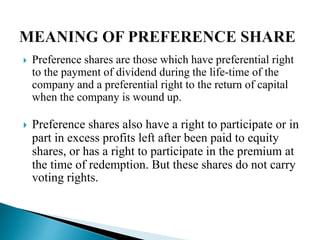
 Preference shares are those which have preferential right
to the payment of dividend during the life-time of the
company and a preferential right to the return of capital
when the company is wound up.
 Preference shares also have a right to participate or in
part in excess profits left after been paid to equity
shares, or has a right to participate in the premium at
the time of redemption. But these shares do not carry
voting rights.
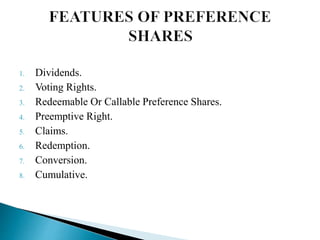
1. Dividends.
2. Voting Rights.
3. Redeemable Or Callable Preference Shares.
4. Preemptive Right.
5. Claims.
6. Redemption.
7. Conversion.
8. Cumulative.
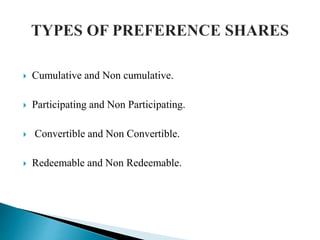
 Cumulative and Non cumulative.
 Participating and Non Participating.
 Convertible and Non Convertible.
 Redeemable and Non Redeemable.
 Holders of Cumulative preference shares are entitled to
recover the arrears of preference dividend before any dividend
is paid on equity shares.
 In the case of Non- cumulative Preference shares arrears of
dividend do not accumulate and hence, if dividend is to be
paid to equity shareholder in any year, dividend at a fixed rate
for only 1 year will have to be paid to preference shareholder
before equity dividend is paid.
 Participating Preference shareholders are not only entitle to
only fixed rate of dividend but have the right to receive any
surplus profit which remains after dividend has been paid at a
certain rate to equity shareholders.
 Non Participating Preference shareholders are entitle to only
fixed rate of dividend.
 Holder of Convertible Preference shares enjoy the right to get
preference share converted into equity shares according to the
terms of issue.
 Holder of Non Convertible Preference shares do not enjoy any
such right.
 Redeemable Preference shares are those preference shares
whose amount can be returned by the company to their holder
within the life time of the company subject to the terms of the
issue and fulfillment of certain legal conditions laid down in
the companies act.
 The amount of Non Redeemable Preference shares can be
returned only company is wound up.
1. No Obligation for Dividends.
2. No Interference.
3. No Charge on Assets.
4. Flexibility.
5. Variety.
 COMPANIES POINT OF VIEW:
 Fixed Return.
 No Voting Right.
 Flexibility in Capital Structure.
 No Burden on Finance.
 No Charge on Assets.
 Widens Capital Market.
 INVESTORS POINT OF VIEW:
 Regular Fixed Income.
 Preferential Rights.
 Lesser Capital Losses.
 Fair Security.
 COMPANIES POINT OF VIEW:
 Higher Rate of Dividend.
 Financial Burden.
 Dilution of Claim Over Assets.
 Adverse effect on credit-worthiness.
 Tax disadvantage.
 INVESTORS POINT OF VIEW:
 No Voting Right.
 Fixed Income.
 No claim over surplus.
 No Guarantee of Assets.
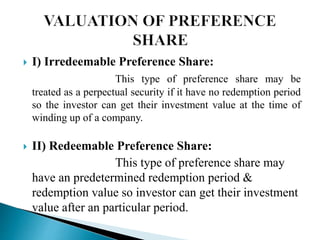
 I) Irredeemable Preference Share:
This type of preference share may be
treated as a perpectual security if it have no redemption period
so the investor can get their investment value at the time of
winding up of a company.
 II) Redeemable Preference Share:
This type of preference share may
have an predetermined redemption period &
redemption value so investor can get their investment
value after an particular period.
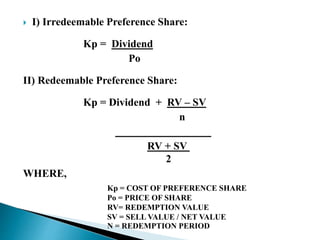
 I) Irredeemable Preference Share:
Kp = Dividend
Po
II) Redeemable Preference Share:
Kp = Dividend + RV – SV
n
RV + SV
2
WHERE,
Kp = COST OF PREFERENCE SHARE
Po = PRICE OF SHARE
RV= REDEMPTION VALUE
SV = SELL VALUE / NET VALUE
N = REDEMPTION PERIOD
VALUATION OF PREFERENCE SHARE

VALUATION OF PREFERENCE SHARE

  • 1.
    NAME: DHEERAJ AGRAWAL DIV.:C ROLL NO.: 11 ENROLL NO.: 147110592023 SUBJECT FINANCIAL MANAGEMENT PARUL INSTITUTE OF MANAGEMENT & RESEARCH
  • 2.
     Preference sharesare those which have preferential right to the payment of dividend during the life-time of the company and a preferential right to the return of capital when the company is wound up.  Preference shares also have a right to participate or in part in excess profits left after been paid to equity shares, or has a right to participate in the premium at the time of redemption. But these shares do not carry voting rights.
  • 3.
    1. Dividends. 2. VotingRights. 3. Redeemable Or Callable Preference Shares. 4. Preemptive Right. 5. Claims. 6. Redemption. 7. Conversion. 8. Cumulative.
  • 4.
     Cumulative andNon cumulative.  Participating and Non Participating.  Convertible and Non Convertible.  Redeemable and Non Redeemable.
  • 5.
     Holders ofCumulative preference shares are entitled to recover the arrears of preference dividend before any dividend is paid on equity shares.  In the case of Non- cumulative Preference shares arrears of dividend do not accumulate and hence, if dividend is to be paid to equity shareholder in any year, dividend at a fixed rate for only 1 year will have to be paid to preference shareholder before equity dividend is paid.
  • 6.
     Participating Preferenceshareholders are not only entitle to only fixed rate of dividend but have the right to receive any surplus profit which remains after dividend has been paid at a certain rate to equity shareholders.  Non Participating Preference shareholders are entitle to only fixed rate of dividend.
  • 7.
     Holder ofConvertible Preference shares enjoy the right to get preference share converted into equity shares according to the terms of issue.  Holder of Non Convertible Preference shares do not enjoy any such right.
  • 8.
     Redeemable Preferenceshares are those preference shares whose amount can be returned by the company to their holder within the life time of the company subject to the terms of the issue and fulfillment of certain legal conditions laid down in the companies act.  The amount of Non Redeemable Preference shares can be returned only company is wound up.
  • 9.
    1. No Obligationfor Dividends. 2. No Interference. 3. No Charge on Assets. 4. Flexibility. 5. Variety.
  • 10.
     COMPANIES POINTOF VIEW:  Fixed Return.  No Voting Right.  Flexibility in Capital Structure.  No Burden on Finance.  No Charge on Assets.  Widens Capital Market.
  • 11.
     INVESTORS POINTOF VIEW:  Regular Fixed Income.  Preferential Rights.  Lesser Capital Losses.  Fair Security.
  • 12.
     COMPANIES POINTOF VIEW:  Higher Rate of Dividend.  Financial Burden.  Dilution of Claim Over Assets.  Adverse effect on credit-worthiness.  Tax disadvantage.
  • 13.
     INVESTORS POINTOF VIEW:  No Voting Right.  Fixed Income.  No claim over surplus.  No Guarantee of Assets.
  • 14.
     I) IrredeemablePreference Share: This type of preference share may be treated as a perpectual security if it have no redemption period so the investor can get their investment value at the time of winding up of a company.  II) Redeemable Preference Share: This type of preference share may have an predetermined redemption period & redemption value so investor can get their investment value after an particular period.
  • 15.
     I) IrredeemablePreference Share: Kp = Dividend Po II) Redeemable Preference Share: Kp = Dividend + RV – SV n RV + SV 2 WHERE, Kp = COST OF PREFERENCE SHARE Po = PRICE OF SHARE RV= REDEMPTION VALUE SV = SELL VALUE / NET VALUE N = REDEMPTION PERIOD