Introduction
Transfer pricing
 Determination of price on the exchange of
goods or services between related parties
 Also referred to as intercompany transactions
 Upstream transfers go from subsidiary to
parent, while downstream transfers are from
parent to subsidiary
 Transfers also occurs between different
subsidiaries of the same parent
 Significant proportion of international
transactions are intercompany transfers (In
2012, represented 42% of U.S. total goods
trade) 12-3
 TP means the value or price at which transactions take
place amongst related parties.
 TP are the prices at which an enterprise transfers
physical goods and intangible property and provides
services to associated enterprises
 TP gain significance because these can be used by the
controlling party to their advantage to minimise tax
incidence.
 Approximately 60% of the total transactions across the
world are between related parties.
 If the transactions are across different tax jurisdictions,
where tax rates are different, shifting is beneficial.
Transfer Price: What and Why?
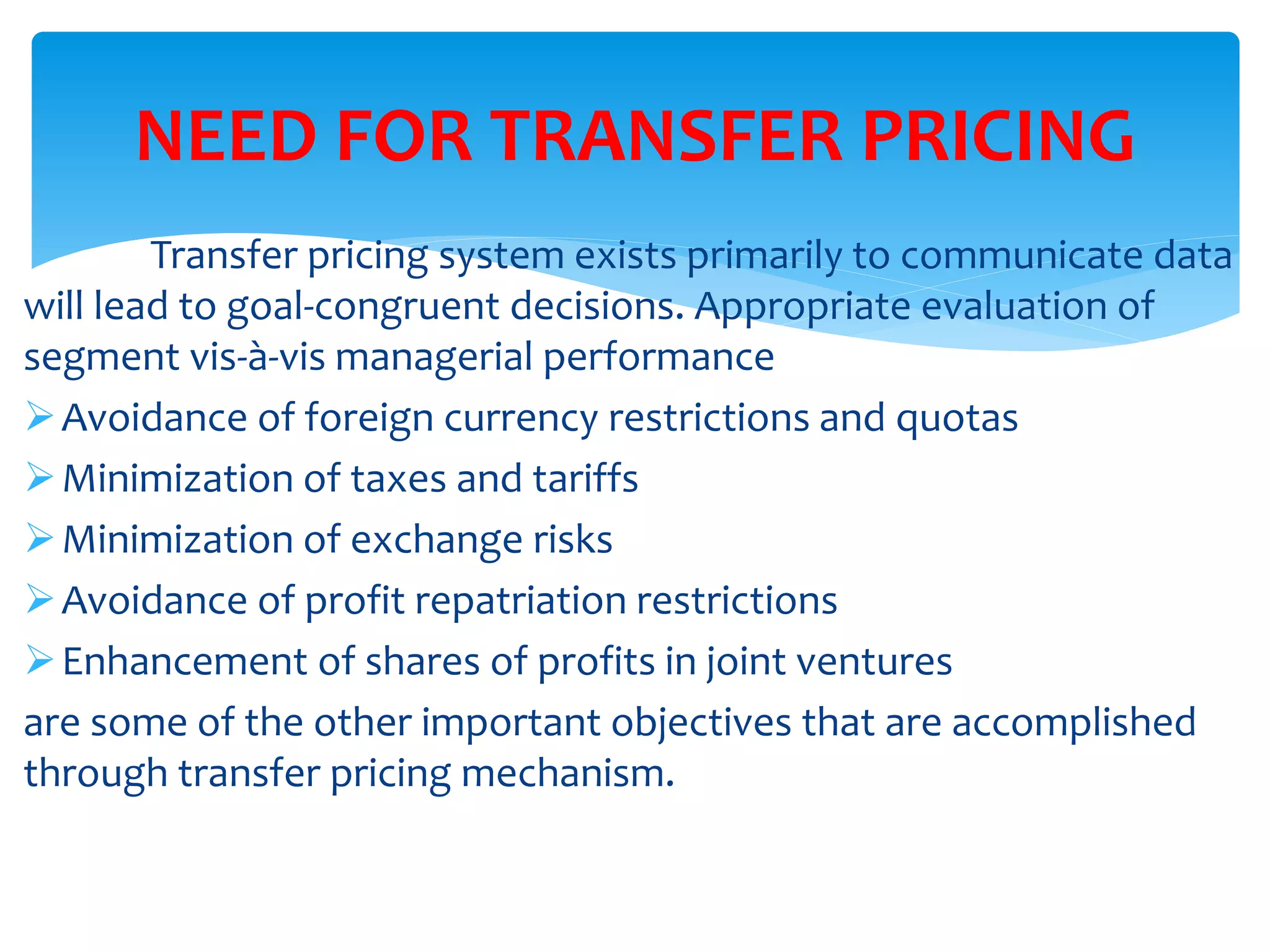
Transfer pricing system exists primarily to communicate data
will lead to goal-congruent decisions. Appropriate evaluation of
segment vis-à-vis managerial performance
Avoidance of foreign currency restrictions and quotas
Minimization of taxes and tariffs
Minimization of exchange risks
Avoidance of profit repatriation restrictions
Enhancement of shares of profits in joint ventures
are some of the other important objectives that are accomplished
through transfer pricing mechanism.
NEED FOR TRANSFER PRICING
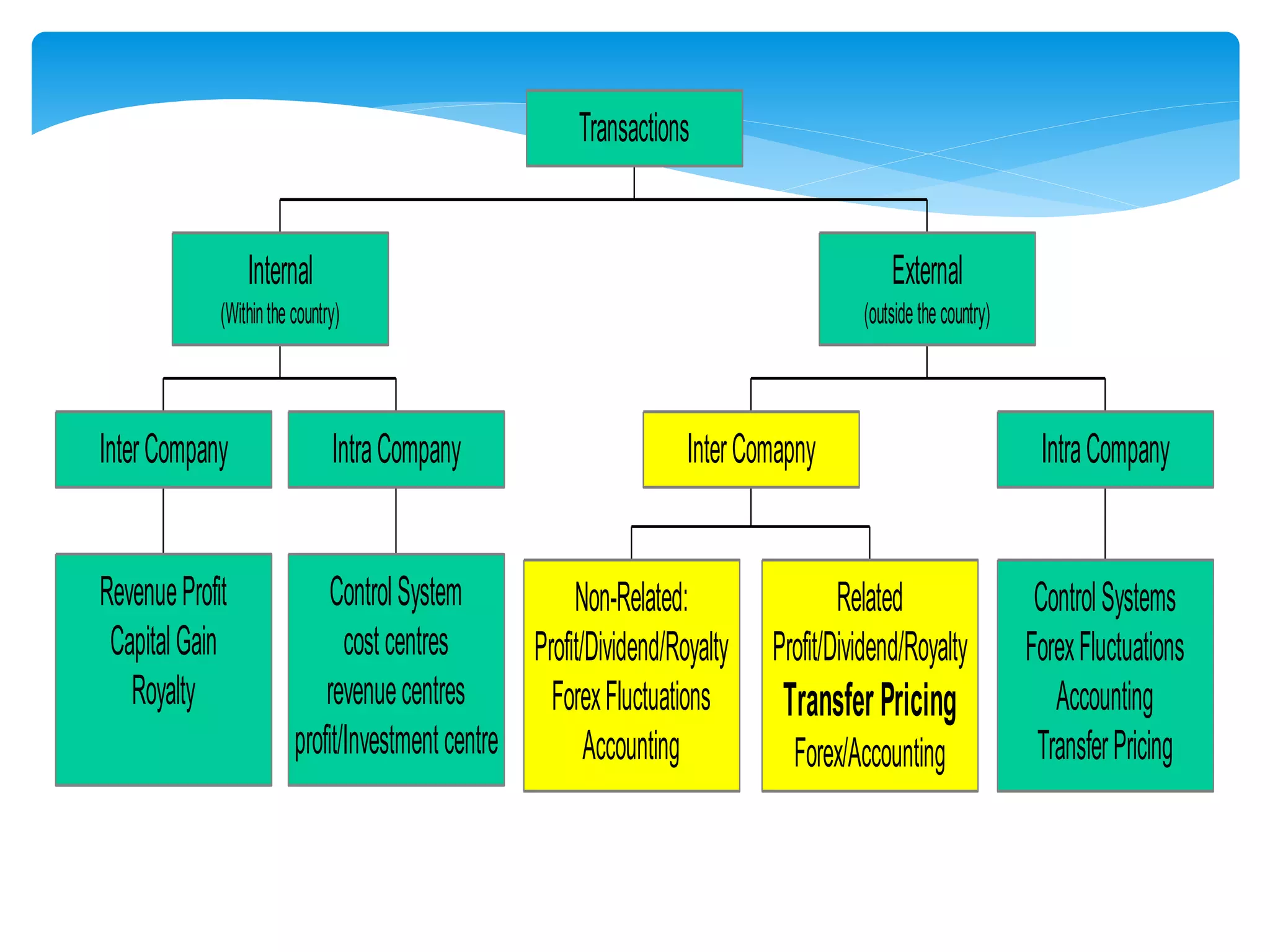
RevenueProfit
CapitalGain
Royalty
InterCompany
ControlSystem
costcentres
revenuecentres
profit/Investmentcentre
IntraCompany
Internal
(Withinthecountry)
Non-Related:
Profit/Dividend/Royalty
ForexFluctuations
Accounting
Related
Profit/Dividend/Royalty
TransferPricing
Forex/Accounting
InterComapny
ControlSystems
ForexFluctuations
Accounting
TransferPricing
IntraCompany
External
(outsidethecountry)
Transactions
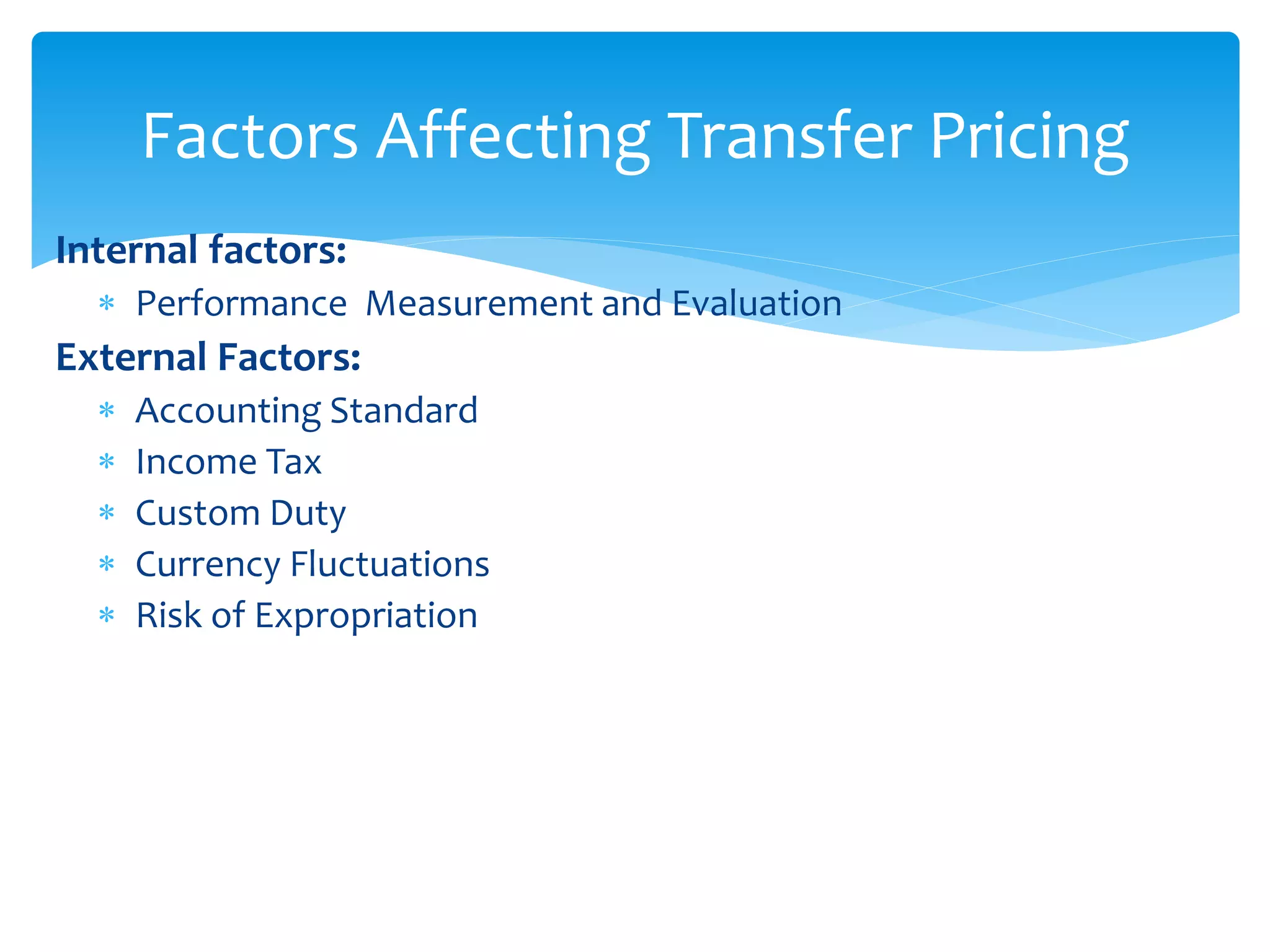
Internal factors:
 Performance Measurement and Evaluation
External Factors:
 Accounting Standard
 Income Tax
 Custom Duty
 Currency Fluctuations
 Risk of Expropriation
Factors Affecting Transfer Pricing
Transfer Price Regulations
International
 OECD formulated
“Guidelines on transfer
pricing”. They serve as
generally accepted
practices by the tax
authorities
India
 The Finance Act 2001
introduced the detailed
TPR w.e.f. 1st April 2001
 The Income Tax Act
 AS-18
 Other Relevant Acts
Requires disclosure of ‘any elements of the related
party transactions necessary for an understanding of
the financial statements’.
Accounting Standard 18
Related Parties
 Control by ownership
 50% of the voting right
 Control over composition of board of directors
 Power to appoint or remove the directors
 Control of substantial interest
 20% or more interest in the voting power
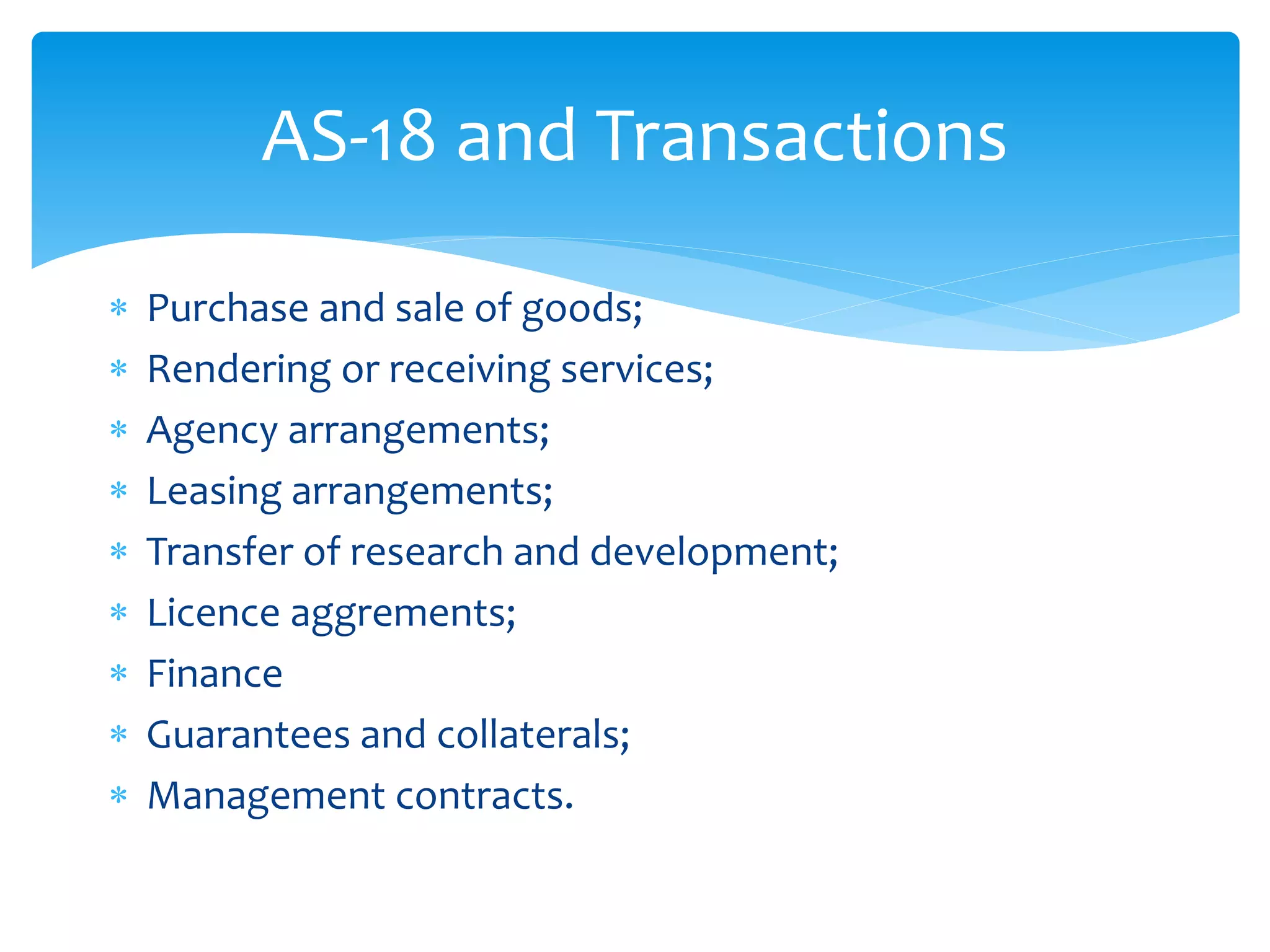
AS-18 and Transactions
 Purchase and sale of goods;
 Rendering or receiving services;
 Agency arrangements;
 Leasing arrangements;
 Transfer of research and development;
 Licence aggrements;
 Finance
 Guarantees and collaterals;
 Management contracts.
Comparable uncontrolled price method
Resale price method
Cost plus method
Profit split method
Transactional net margin method
Such other method as may be prescribed by the Board
METHODS OF TRANSFER PRICING
Steps for CUP method
 The price charged or paid for property transferred or services
provided in a comparable uncontrolled transaction, (i.e.,
transaction between enterprises other than associated enterprises
other whether resident or non-resident) or a number of such
transactions, is identified.
 Such price is adjusted to account for differences, if any between
the international transaction and the comparable uncontrolled
transactions or between the enterprises entering into such
transactions, which could materially affect the price in the open
market.
 The adjusted price arrived at under above step is taken to be an
Arm’s length price in respect of the property transferred or
services provided in the international transaction
Comparable uncontrolled price method
Steps for RPM
 The price at which property purchased or services obtained by the
enterprise from an associated enterprise is resold or are provided to an
unrelated enterprise, is identified;
 Such resale price is reduced by the amount of a normal gross profit margin
accrued to the enterprise or to an unrelated enterprise from the purchase
and resale of the same or similar services, in a comparable uncontrolled
transaction, or a number of such transactions;
 The price so arrived at is further reduced by the expenses incurred by the
enterprise in connection with the purchase of property or obtaining of
services;
 To price so arrived at is adjusted to take into account the functional and
other differences, including differences in accounting practices, in any,
between the international transaction and the comparable uncontrolled
transactions, or between the enterprises entering into such transactions,
which could materially affect the amount of gross profit margin in the open
market;
 The adjusted price arrived at under above step is taken to be an Arm’s length
price in respect of the purchase of the property or obtaining of the services
by the enterprises from the associated enterprise.
RESALE PRICE METHOD
The direct and indirect costs of production incurred by the
incurred by the enterprise in respect of property transferred or
services provided to an associated enterprise, are deter
COST PLUS METHOD
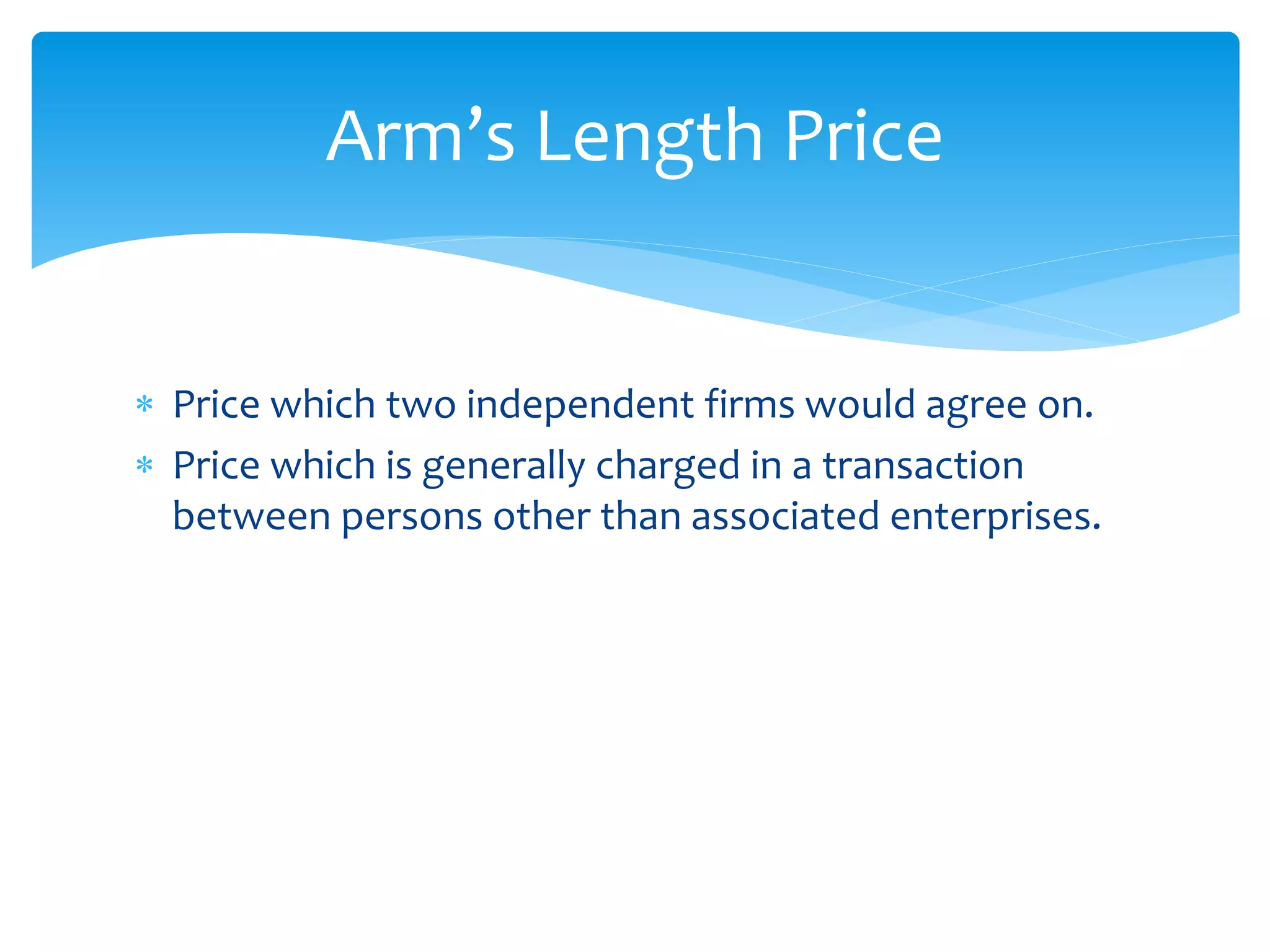
 Price which two independent firms would agree on.
 Price which is generally charged in a transaction
between persons other than associated enterprises.
Arm’s Length Price
 Comparable uncontrolled price method
 Resale price method
 Cost plus method
 Profit split method
Arm’s Length Price: 92C
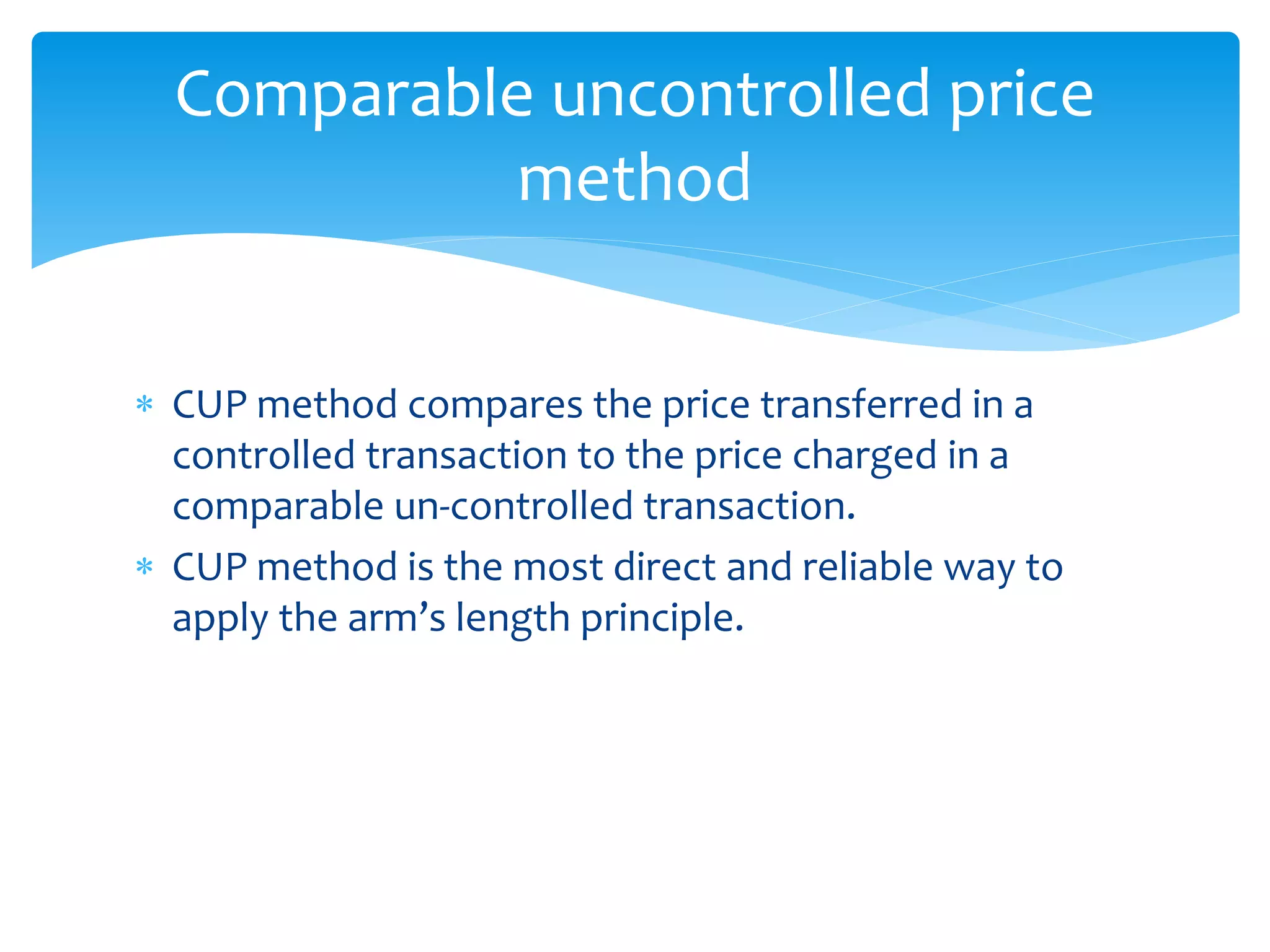
 CUP method compares the price transferred in a
controlled transaction to the price charged in a
comparable un-controlled transaction.
 CUP method is the most direct and reliable way to
apply the arm’s length principle.
Comparable uncontrolled price
method
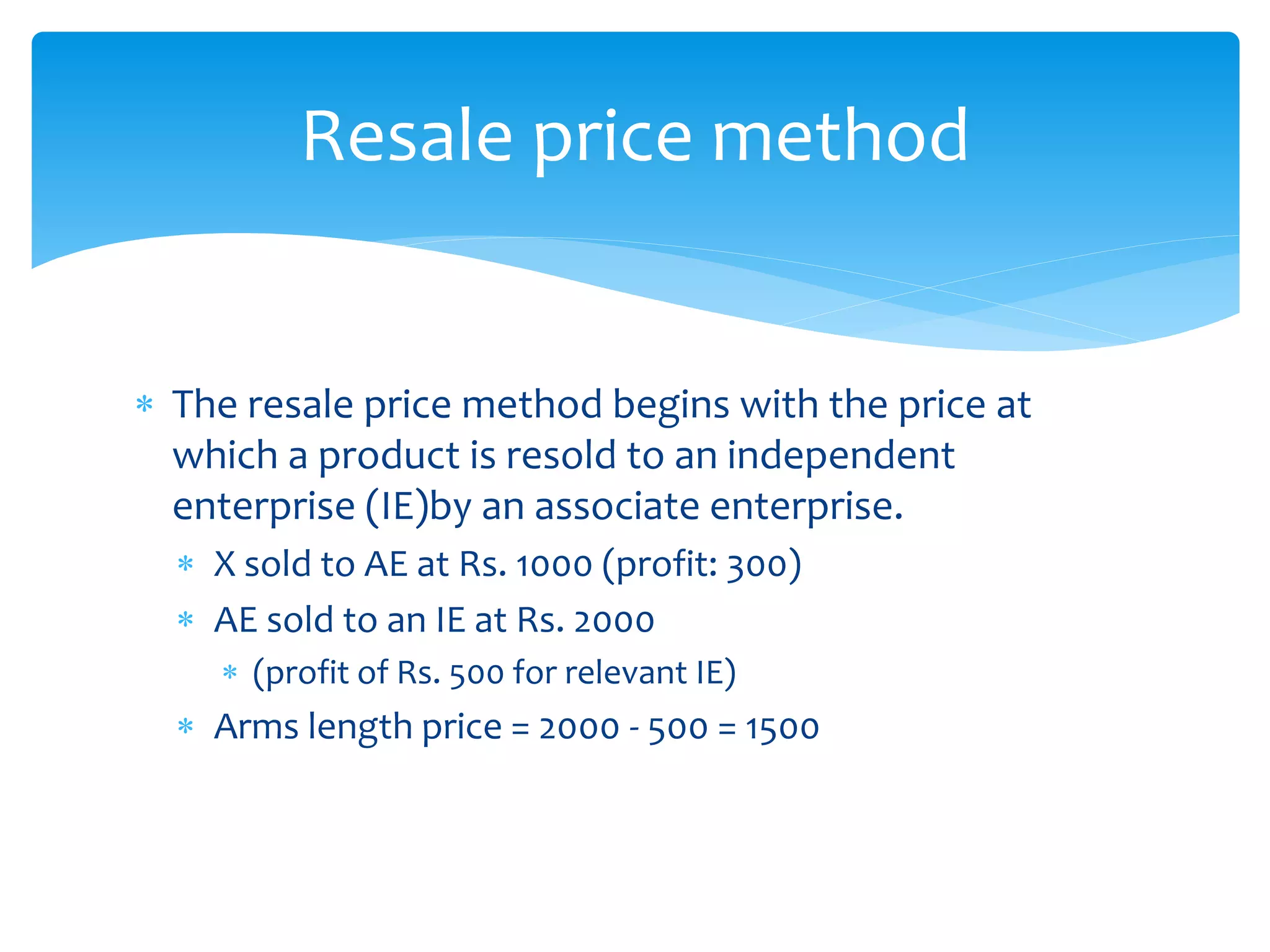
 The resale price method begins with the price at
which a product is resold to an independent
enterprise (IE)by an associate enterprise.
 X sold to AE at Rs. 1000 (profit: 300)
 AE sold to an IE at Rs. 2000
 (profit of Rs. 500 for relevant IE)
 Arms length price = 2000 - 500 = 1500
Resale price method
 PSM is used when transactions are inter-related and is
not possible to evaluate separately.
 PSM first identifies the profit to be split for the AE.
The profit so determined is split between the AE on
the basis of the functions performed/assets/CE
Profit Split Method
 In CP method, first the cost incurred is determined.
An appropriate cost plus mark-up is then added to the
cost to arrive at an appropriate profit. The resultant
figure is the arm’s length price.
Cost Plus Method
Some Transactions subject to ALP
• Purchase at little or
no cost.
• Payment for services
never rendered.
• Sales below MP/
Purchase above MP
• Interest free
borrowings
• Exchanging property
• Selling of real estate
at a price different
from MP
• Use of trade names
or patents at
exorbitant rates even
after their expiry.
Introduction to Transfer pricing

Introduction to Transfer pricing

  • 3.
    Introduction Transfer pricing  Determinationof price on the exchange of goods or services between related parties  Also referred to as intercompany transactions  Upstream transfers go from subsidiary to parent, while downstream transfers are from parent to subsidiary  Transfers also occurs between different subsidiaries of the same parent  Significant proportion of international transactions are intercompany transfers (In 2012, represented 42% of U.S. total goods trade) 12-3
  • 5.
     TP meansthe value or price at which transactions take place amongst related parties.  TP are the prices at which an enterprise transfers physical goods and intangible property and provides services to associated enterprises  TP gain significance because these can be used by the controlling party to their advantage to minimise tax incidence.  Approximately 60% of the total transactions across the world are between related parties.  If the transactions are across different tax jurisdictions, where tax rates are different, shifting is beneficial. Transfer Price: What and Why?
  • 9.
    Transfer pricing systemexists primarily to communicate data will lead to goal-congruent decisions. Appropriate evaluation of segment vis-à-vis managerial performance Avoidance of foreign currency restrictions and quotas Minimization of taxes and tariffs Minimization of exchange risks Avoidance of profit repatriation restrictions Enhancement of shares of profits in joint ventures are some of the other important objectives that are accomplished through transfer pricing mechanism. NEED FOR TRANSFER PRICING
  • 10.
  • 12.
    Internal factors:  PerformanceMeasurement and Evaluation External Factors:  Accounting Standard  Income Tax  Custom Duty  Currency Fluctuations  Risk of Expropriation Factors Affecting Transfer Pricing
  • 13.
    Transfer Price Regulations International OECD formulated “Guidelines on transfer pricing”. They serve as generally accepted practices by the tax authorities India  The Finance Act 2001 introduced the detailed TPR w.e.f. 1st April 2001  The Income Tax Act  AS-18  Other Relevant Acts
  • 14.
    Requires disclosure of‘any elements of the related party transactions necessary for an understanding of the financial statements’. Accounting Standard 18
  • 15.
    Related Parties  Controlby ownership  50% of the voting right  Control over composition of board of directors  Power to appoint or remove the directors  Control of substantial interest  20% or more interest in the voting power
  • 16.
    AS-18 and Transactions Purchase and sale of goods;  Rendering or receiving services;  Agency arrangements;  Leasing arrangements;  Transfer of research and development;  Licence aggrements;  Finance  Guarantees and collaterals;  Management contracts.
  • 21.
    Comparable uncontrolled pricemethod Resale price method Cost plus method Profit split method Transactional net margin method Such other method as may be prescribed by the Board METHODS OF TRANSFER PRICING
  • 22.
    Steps for CUPmethod  The price charged or paid for property transferred or services provided in a comparable uncontrolled transaction, (i.e., transaction between enterprises other than associated enterprises other whether resident or non-resident) or a number of such transactions, is identified.  Such price is adjusted to account for differences, if any between the international transaction and the comparable uncontrolled transactions or between the enterprises entering into such transactions, which could materially affect the price in the open market.  The adjusted price arrived at under above step is taken to be an Arm’s length price in respect of the property transferred or services provided in the international transaction Comparable uncontrolled price method
  • 23.
    Steps for RPM The price at which property purchased or services obtained by the enterprise from an associated enterprise is resold or are provided to an unrelated enterprise, is identified;  Such resale price is reduced by the amount of a normal gross profit margin accrued to the enterprise or to an unrelated enterprise from the purchase and resale of the same or similar services, in a comparable uncontrolled transaction, or a number of such transactions;  The price so arrived at is further reduced by the expenses incurred by the enterprise in connection with the purchase of property or obtaining of services;  To price so arrived at is adjusted to take into account the functional and other differences, including differences in accounting practices, in any, between the international transaction and the comparable uncontrolled transactions, or between the enterprises entering into such transactions, which could materially affect the amount of gross profit margin in the open market;  The adjusted price arrived at under above step is taken to be an Arm’s length price in respect of the purchase of the property or obtaining of the services by the enterprises from the associated enterprise. RESALE PRICE METHOD
  • 24.
    The direct andindirect costs of production incurred by the incurred by the enterprise in respect of property transferred or services provided to an associated enterprise, are deter COST PLUS METHOD
  • 28.
     Price whichtwo independent firms would agree on.  Price which is generally charged in a transaction between persons other than associated enterprises. Arm’s Length Price
  • 29.
     Comparable uncontrolledprice method  Resale price method  Cost plus method  Profit split method Arm’s Length Price: 92C
  • 30.
     CUP methodcompares the price transferred in a controlled transaction to the price charged in a comparable un-controlled transaction.  CUP method is the most direct and reliable way to apply the arm’s length principle. Comparable uncontrolled price method
  • 31.
     The resaleprice method begins with the price at which a product is resold to an independent enterprise (IE)by an associate enterprise.  X sold to AE at Rs. 1000 (profit: 300)  AE sold to an IE at Rs. 2000  (profit of Rs. 500 for relevant IE)  Arms length price = 2000 - 500 = 1500 Resale price method
  • 32.
     PSM isused when transactions are inter-related and is not possible to evaluate separately.  PSM first identifies the profit to be split for the AE. The profit so determined is split between the AE on the basis of the functions performed/assets/CE Profit Split Method
  • 33.
     In CPmethod, first the cost incurred is determined. An appropriate cost plus mark-up is then added to the cost to arrive at an appropriate profit. The resultant figure is the arm’s length price. Cost Plus Method
  • 34.
    Some Transactions subjectto ALP • Purchase at little or no cost. • Payment for services never rendered. • Sales below MP/ Purchase above MP • Interest free borrowings • Exchanging property • Selling of real estate at a price different from MP • Use of trade names or patents at exorbitant rates even after their expiry.