Strategic Management Concepts:
A Competitive Advantage Approach
Sixteenth Edition
Topic 4
The Internal
Assessment/Audit
Copyright © 2017, 2015, 2013 Pearson Education, Inc. All Rights Reserved
Learning Objectives (1 of 2)
4.1 Describe the nature and role of an internal assessment
in formulating strategies.
4.2 Discuss why organizational culture is so important in
formulating strategies.
4.3 Identify the basic functions (activities) that make up
management and their relevance in formulating
strategies.
4.4 Identify the basic functions of marketing and their
relevance in formulating strategies.
4.5 Discuss the nature and role of finance and accounting
in formulating strategies.
Copyright © 2017, 2015, 2013 Pearson Education, Inc. All Rights Reserved
Learning Objectives (2 of 2)
4.6 Discuss the nature and role of production/operations in
formulating strategies.
4.7 Discuss the nature and role of research and
development (R&D) in formulating strategies.
4.8 Discuss the nature and role of management information
systems (MIS) in formulating strategies.
4.9 Explain value chain analysis and its relevance in
formulating strategies.
4.10 Develop and use an Internal Factor Evaluation (IFE)
Matrix.
Copyright © 2017, 2015, 2013 Pearson Education, Inc. All Rights Reserved
Introductory Video: The Internal
Environment
Copyright © 2017, 2015, 2013 Pearson Education, Inc. All Rights Reserved
Key Internal Forces
• Distinctive competencies
– A firm’s strengths that cannot be easily matched or
imitated by competitors
– Building competitive advantages involves taking
advantage of distinctive competencies.
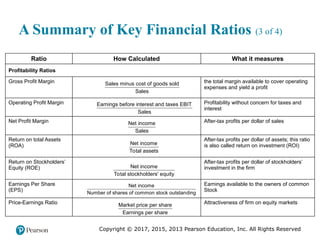
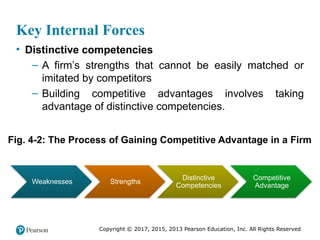
Fig. 4-2: The Process of Gaining Competitive Advantage in a Firm
Weaknesses Strengths
Distinctive
Competencies
Competitive
Advantage
Copyright © 2017, 2015, 2013 Pearson Education, Inc. All Rights Reserved
Key Internal Forces
• Distinctive competencies
– A firm’s strengths that cannot be easily matched or
imitated by competitors
– Building competitive advantages involves taking
advantage of distinctive competencies.
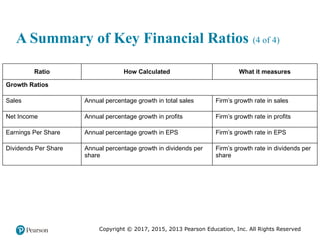
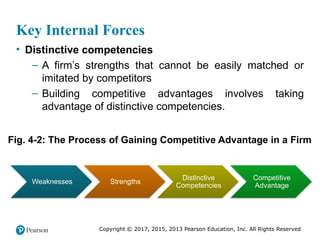
Fig. 4-2: The Process of Gaining Competitive Advantage in a Firm
Weaknesses Strengths
Distinctive
Competencies
Competitive
Advantage
Copyright © 2017, 2015, 2013 Pearson Education, Inc. All Rights Reserved
The Process of Performing an Internal Audit
• The internal audit
– Requires gathering, assimilating, and prioritizing
information about the firm's management, marketing,
finance, accounting, production/operations, research
and development (R and D), and management
information systems operations
– Provides more opportunity for participants to
understand how their jobs, departments, and divisions
fit into the whole firm
Copyright © 2017, 2015, 2013 Pearson Education, Inc. All Rights Reserved
The Resource-Based View (RBV
• The Resource-Based View (RBV) Approach
– contends that internal resources are more important for
a firm than external factors in achieving and sustaining
competitive advantage
– organizational performance is primarily determined by
internal resources that can be grouped into three all-
encompassing categories: physical resources,
human resources, and organizational resources.
Copyright © 2017, 2015, 2013 Pearson Education, Inc. All Rights Reserved
The Resource-Based View (RBV)
• For a resource to be valuable, it must be either (1) rare,
(2) hard to imitate, or (3) not easily substitutable.
• These three characteristics of resources are called
Empirical Indicators
• These enable a firm to implement strategies that improve
its efficiency and effectiveness and lead to a sustainable
competitive advantage.
• Resource-based view theory asserts that resources are
actually what helps a firm exploit opportunities and
neutralize threats.
Copyright © 2017, 2015, 2013 Pearson Education, Inc. All Rights Reserved
Integrating Strategy and Culture
• Organizational culture significantly affects planning
activities.
• If strategies can capitalize on cultural strengths, such as a
strong work ethic or highly ethical beliefs, then
management often can swiftly and easily implement
changes.
Copyright © 2017, 2015, 2013 Pearson Education, Inc. All Rights Reserved
Organizational Culture
• Organizational culture is “a pattern of behavior that has
been developed by an organization as it learns to cope
with its problem of external adaptation and internal
integration and that has worked well enough to be
considered valid and to be taught to new members as the
correct way to perceive, think, and feel.”
Copyright © 2017, 2015, 2013 Pearson Education, Inc. All Rights Reserved
Aspects of Organizational Culture
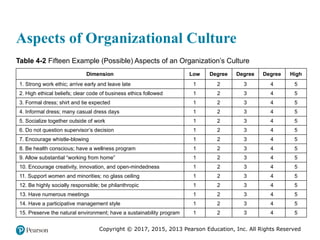
Table 4-2 Fifteen Example (Possible) Aspects of an Organization’s Culture
Dimension Low Degree Degree Degree High
1. Strong work ethic; arrive early and leave late 1 2 3 4 5
2. High ethical beliefs; clear code of business ethics followed 1 2 3 4 5
3. Formal dress; shirt and tie expected 1 2 3 4 5
4. Informal dress; many casual dress days 1 2 3 4 5
5. Socialize together outside of work 1 2 3 4 5
6. Do not question supervisor’s decision 1 2 3 4 5
7. Encourage whistle-blowing 1 2 3 4 5
8. Be health conscious; have a wellness program 1 2 3 4 5
9. Allow substantial “working from home” 1 2 3 4 5
10. Encourage creativity, innovation, and open-mindedness 1 2 3 4 5
11. Support women and minorities; no glass ceiling 1 2 3 4 5
12. Be highly socially responsible; be philanthropic 1 2 3 4 5
13. Have numerous meetings 1 2 3 4 5
14. Have a participative management style 1 2 3 4 5
15. Preserve the natural environment; have a sustainability program 1 2 3 4 5
Copyright © 2017, 2015, 2013 Pearson Education, Inc. All Rights Reserved
Management
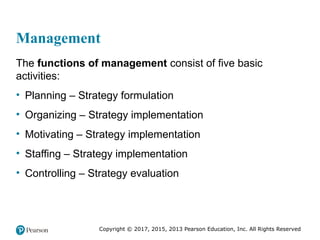
The functions of management consist of five basic
activities:
• Planning – Strategy formulation
• Organizing – Strategy implementation
• Motivating – Strategy implementation
• Staffing – Strategy implementation
• Controlling – Strategy evaluation
Copyright © 2017, 2015, 2013 Pearson Education, Inc. All Rights Reserved
The Basic Functions of Management (1 of 2)
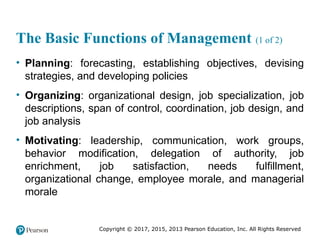
• Planning: forecasting, establishing objectives, devising
strategies, and developing policies
• Organizing: organizational design, job specialization, job
descriptions, span of control, coordination, job design, and
job analysis
• Motivating: leadership, communication, work groups,
behavior modification, delegation of authority, job
enrichment, job satisfaction, needs fulfillment,
organizational change, employee morale, and managerial
morale
Copyright © 2017, 2015, 2013 Pearson Education, Inc. All Rights Reserved
The Basic Functions of Management (2 of 2)
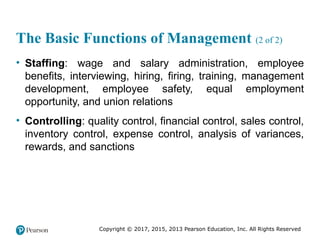
• Staffing: wage and salary administration, employee
benefits, interviewing, hiring, firing, training, management
development, employee safety, equal employment
opportunity, and union relations
• Controlling: quality control, financial control, sales control,
inventory control, expense control, analysis of variances,
rewards, and sanctions
Copyright © 2017, 2015, 2013 Pearson Education, Inc. All Rights Reserved
Management Audit Checklist of
Questions (1 of 2)
1. Does the firm use strategic-management concepts?
2. Are company objectives and goals measurable and well
communicated?
3. Do managers at all hierarchical levels plan effectively?
4. Do managers delegate authority well?
5. Is the organization's structure appropriate?
Copyright © 2017, 2015, 2013 Pearson Education, Inc. All Rights Reserved
Management Audit Checklist of
Questions (2 of 2)
6. Are job descriptions and job specifications clear?
7. Is employee morale high?
8. Are employee turnover and absenteeism low?
9. Are organizational reward and control mechanisms
effective?
Copyright © 2017, 2015, 2013 Pearson Education, Inc. All Rights Reserved
Marketing
• the process of defining, anticipating, creating, and fulfilling
customers’ needs and wants for products and services
Copyright © 2017, 2015, 2013 Pearson Education, Inc. All Rights Reserved
Functions of Marketing
• Customer analysis
• Selling products and services
• Product and service planning
• Pricing
• Distribution
• Marketing research
• Cost/ benefit analysis
Copyright © 2017, 2015, 2013 Pearson Education, Inc. All Rights Reserved
Customer Analysis
• Customer Analysis
– the examination and evaluation of consumer needs,
desires, and wants
– involves administering customer surveys, analyzing
consumer information, evaluating market positioning
strategies, developing customer profiles, and
determining optimal market segmentation strategies
Copyright © 2017, 2015, 2013 Pearson Education, Inc. All Rights Reserved
Selling Products and Services
• Selling
– includes many marketing activities, such as advertising,
sales promotion, publicity, personal selling, sales force
management, customer relations, and dealer relations
Copyright © 2017, 2015, 2013 Pearson Education, Inc. All Rights Reserved
Product and Service Planning
• Product and Service Planning
– includes activities such as test marketing; product and
brand positioning; devising warranties; packaging;
determining product options, features, style, and
quality; deleting old products; and providing for
customer service
– important when a company is pursuing product
development or diversification
Copyright © 2017, 2015, 2013 Pearson Education, Inc. All Rights Reserved
Pricing
• Pricing
– Five major stakeholders affect pricing decisions:
consumers, governments, suppliers, distributors, and
competitors
– Sometimes an organization will pursue a forward
integration strategy primarily to gain better control over
prices charged to consumers.
Copyright © 2017, 2015, 2013 Pearson Education, Inc. All Rights Reserved
Distribution
• Distribution
– includes warehousing, distribution channels,
distribution coverage, retail site locations, sales
territories, inventory levels and location, transportation
carriers, wholesaling, and retailing
– especially important when a firm is striving to
implement a market development or forward integration
strategy
Copyright © 2017, 2015, 2013 Pearson Education, Inc. All Rights Reserved
Marketing Research
• Marketing Research
– the systematic gathering, recording, and analyzing of
data about problems relating to the marketing of goods
and services
– can uncover critical strengths and weaknesses
Copyright © 2017, 2015, 2013 Pearson Education, Inc. All Rights Reserved
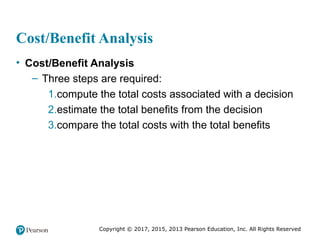
Cost/Benefit Analysis
• Cost/Benefit Analysis
– Three steps are required:
1.compute the total costs associated with a decision
2.estimate the total benefits from the decision
3.compare the total costs with the total benefits
Copyright © 2017, 2015, 2013 Pearson Education, Inc. All Rights Reserved
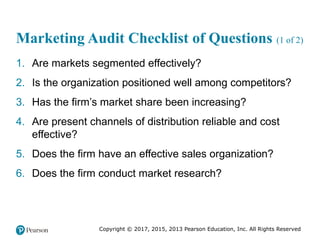
Marketing Audit Checklist of Questions (1 of 2)
1. Are markets segmented effectively?
2. Is the organization positioned well among competitors?
3. Has the firm’s market share been increasing?
4. Are present channels of distribution reliable and cost
effective?
5. Does the firm have an effective sales organization?
6. Does the firm conduct market research?
Copyright © 2017, 2015, 2013 Pearson Education, Inc. All Rights Reserved
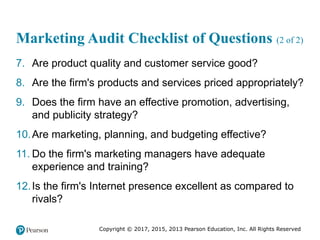
Marketing Audit Checklist of Questions (2 of 2)
7. Are product quality and customer service good?
8. Are the firm's products and services priced appropriately?
9. Does the firm have an effective promotion, advertising,
and publicity strategy?
10.Are marketing, planning, and budgeting effective?
11. Do the firm's marketing managers have adequate
experience and training?
12.Is the firm's Internet presence excellent as compared to
rivals?
Copyright © 2017, 2015, 2013 Pearson Education, Inc. All Rights Reserved
Finance/Accounting Functions (1 of 4)
The functions of finance/accounting comprise three
decisions:
1. The investment decision
2. The financing decision
3. The dividend decision
Copyright © 2017, 2015, 2013 Pearson Education, Inc. All Rights Reserved
Finance/Accounting Functions (2 of 4)
• Investment Decision (Capital Budgeting)
– the allocation and reallocation of capital and resources
to projects, products, assets, and divisions of an
organization
• Financing Decision
– determines the best capital structure for the firm and
includes examining various methods by which the firm
can raise capital
Copyright © 2017, 2015, 2013 Pearson Education, Inc. All Rights Reserved
Finance/Accounting Functions (3 of 4)
• Dividend Decisions
– concern issues such as the percentage of earnings
paid to stockholders, the stability of dividends paid over
time, and the repurchase or issuance of stock
– determine the amount of funds that are retained in a
firm compared to the amount paid out to stockholders
Copyright © 2017, 2015, 2013 Pearson Education, Inc. All Rights Reserved
Finance/Accounting Functions (4 of 4)
1. How has each ratio changed over time?
2. How does each ratio compare to industry norms?
3. How does each ratio compare with key competitors?
Copyright © 2017, 2015, 2013 Pearson Education, Inc. All Rights Reserved
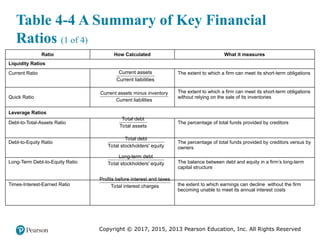
Table 4-4 A Summary of Key Financial
Ratios (1 of 4)
Ratio How Calculated What it measures
Liquidity Ratios BLANK BLANK
Current Ratio Current assets over Current liabilities
The extent to which a firm can meet its short-term obligations
Quick Ratio
Current assets minus inventory over Current liabilities
The extent to which a firm can meet its short-term obligations
without relying on the sale of its inventories
Leverage Ratios Blank Blank
Debt-to-Total-Assets Ratio Total debt over Total assets
The percentage of total funds provided by creditors
Debt-to-Equity Ratio Total debt over Total stockholders’ equity
The percentage of total funds provided by creditors versus by
owners
Long-Term Debt-to-Equity Ratio Long-term debt over Total stockholders’ equity
The balance between debt and equity in a firm’s long-term
capital structure
Times-Interest-Earned Ratio Profits before interest and taxes over Total interest charges
the extent to which earnings can decline without the firm
becoming unable to meet its annual interest costs
Current assets
Current liabilities
Current assets minus inventory
Current liabilities
Total debt
Total assets
Total debt
Total stockholders' equity
Long-term debt
Total stockholders' equity
Profits before interest and taxes
Total interest charges
Copyright © 2017, 2015, 2013 Pearson Education, Inc. All Rights Reserved
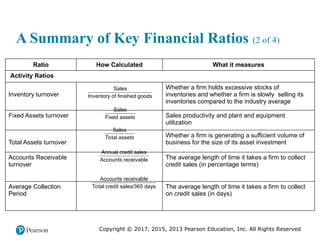
A Summary of Key Financial Ratios (2 of 4)
Ratio How Calculated What it measures
Activity Ratios Blank Blank
Inventory turnover
Sales over Inventory of finished goods
Whether a firm holds excessive stocks of
inventories and whether a firm is slowly selling its
inventories compared to the industry average
Fixed Assets turnover Sales over Fixed assets Sales productivity and plant and equipment
utilization
Total Assets turnover Sales over Total assets
Whether a firm is generating a sufficient volume of
business for the size of its asset investment
Accounts Receivable
turnover
Annual credit sales over Accounts
receivable
The average length of time it takes a firm to collect
credit sales (in percentage terms)
Average Collection
Period
Accounts receivable over total credit sales per
365 days The average length of time it takes a firm to collect
on credit sales (in days)
Sales
Inventory of finished goods
Sales
Fixed assets
Sales
Total assets
Annual credit sales
Accounts receivable
Accounts receivable
Total credit sales/365 days
Copyright © 2017, 2015, 2013 Pearson Education, Inc. All Rights Reserved
A Summary of Key Financial Ratios (3 of 4)
Ratio How Calculated What it measures
Profitability Ratios Blank Blank
Gross Profit Margin Sales minus cost of goods sold over Sales the total margin available to cover operating
expenses and yield a profit
Operating Profit Margin Earnings before interest and taxes EBIT over Sales Profitability without concern for taxes and
interest
Net Profit Margin Net income over sales After-tax profits per dollar of sales
Return on total Assets
(ROA)
Net income over Total assets After-tax profits per dollar of assets; this ratio
is also called return on investment (ROI)
Return on Stockholders’
Equity (ROE)
Net Income over Total stockholders’ equity After-tax profits per dollar of stockholders’
investment in the firm
Earnings Per Share
(EPS)
Net income over Number of shares of common stock outstanding Earnings available to the owners of common
Stock
Price-Earnings Ratio Market price per share over Earnings per share Attractiveness of firm on equity markets
Sales minus cost of goods sold
Sales
Earnings before interest and taxes EBIT
Sales
Net income
Sales
Net income
Total assets
Net income
Total stockholders' equity
Net income
Number of shares of common stock outstanding
Market price per share
Earnings per share
Copyright © 2017, 2015, 2013 Pearson Education, Inc. All Rights Reserved
A Summary of Key Financial Ratios (4 of 4)
Ratio How Calculated What it measures
Growth Ratios Blank Blank
Sales Annual percentage growth in total sales Firm’s growth rate in sales
Net Income Annual percentage growth in profits Firm’s growth rate in profits
Earnings Per Share Annual percentage growth in EPS Firm’s growth rate in EPS
Dividends Per Share Annual percentage growth in dividends per
share
Firm’s growth rate in dividends per
share
Copyright © 2017, 2015, 2013 Pearson Education, Inc. All Rights Reserved
Finance/Accounting Audit Checklist (1 of 2)
1. Where is the firm financially strong and weak as indicated
by financial ratio analyses?
2. Can the firm raise needed short-term capital?
3. Can the firm raise needed long-term capital through debt
and/or equity?
4. Does the firm have sufficient working capital?
5. Are capital budgeting procedures effective?
Copyright © 2017, 2015, 2013 Pearson Education, Inc. All Rights Reserved
Finance/Accounting Audit Checklist (2 of 2)
6. Are dividend payout policies reasonable?
7. Does the firm have good relations with its investors and
stockholders?
8. Are the firm's financial managers experienced and well
trained?
9. Is the firm's debt situation excellent?
Copyright © 2017, 2015, 2013 Pearson Education, Inc. All Rights Reserved
Production/Operations
• Production/operations function
– consists of all those activities that transform inputs into
goods and services
• Production/operations management deals with inputs,
transformations, and outputs that vary across industries
and markets.
Copyright © 2017, 2015, 2013 Pearson Education, Inc. All Rights Reserved
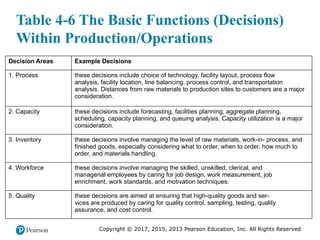
Table 4-6 The Basic Functions (Decisions)
Within Production/Operations
Decision Areas Example Decisions
1. Process these decisions include choice of technology, facility layout, process flow
analysis, facility location, line balancing, process control, and transportation
analysis. Distances from raw materials to production sites to customers are a major
consideration.
2. Capacity these decisions include forecasting, facilities planning, aggregate planning,
scheduling, capacity planning, and queuing analysis. Capacity utilization is a major
consideration.
3. Inventory these decisions involve managing the level of raw materials, work-in- process, and
finished goods, especially considering what to order, when to order, how much to
order, and materials handling.
4. Workforce these decisions involve managing the skilled, unskilled, clerical, and
managerial employees by caring for job design, work measurement, job
enrichment, work standards, and motivation techniques.
5. Quality these decisions are aimed at ensuring that high-quality goods and ser-
vices are produced by caring for quality control, sampling, testing, quality
assurance, and cost control.
Copyright © 2017, 2015, 2013 Pearson Education, Inc. All Rights Reserved
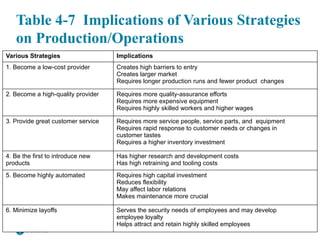
Table 4-7 Implications of Various Strategies
on Production/Operations
Various Strategies Implications
1. Become a low-cost provider Creates high barriers to entry
Creates larger market
Requires longer production runs and fewer product changes
2. Become a high-quality provider Requires more quality-assurance efforts
Requires more expensive equipment
Requires highly skilled workers and higher wages
3. Provide great customer service Requires more service people, service parts, and equipment
Requires rapid response to customer needs or changes in
customer tastes
Requires a higher inventory investment
4. Be the first to introduce new
products
Has higher research and development costs
Has high retraining and tooling costs
5. Become highly automated Requires high capital investment
Reduces flexibility
May affect labor relations
Makes maintenance more crucial
6. Minimize layoffs Serves the security needs of employees and may develop
employee loyalty
Helps attract and retain highly skilled employees
Copyright © 2017, 2015, 2013 Pearson Education, Inc. All Rights Reserved
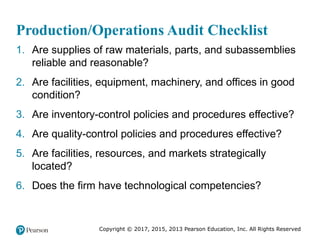
Production/Operations Audit Checklist
1. Are supplies of raw materials, parts, and subassemblies
reliable and reasonable?
2. Are facilities, equipment, machinery, and offices in good
condition?
3. Are inventory-control policies and procedures effective?
4. Are quality-control policies and procedures effective?
5. Are facilities, resources, and markets strategically
located?
6. Does the firm have technological competencies?
Copyright © 2017, 2015, 2013 Pearson Education, Inc. All Rights Reserved
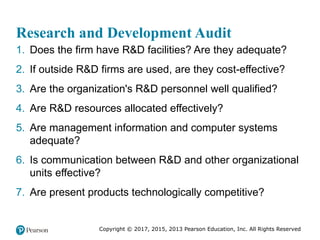
Research and Development Audit
1. Does the firm have R&D facilities? Are they adequate?
2. If outside R&D firms are used, are they cost-effective?
3. Are the organization's R&D personnel well qualified?
4. Are R&D resources allocated effectively?
5. Are management information and computer systems
adequate?
6. Is communication between R&D and other organizational
units effective?
7. Are present products technologically competitive?
Copyright © 2017, 2015, 2013 Pearson Education, Inc. All Rights Reserved
Management Information Systems
• Management Information System
– Receives raw material from both external and internal
evaluation of an organization
– Improves the performance of an enterprise by
improving the quality of managerial decisions
– Collects, codes, stores, synthesizes, and presents
information in such a manner that it answers important
operating and strategic questions
Copyright © 2017, 2015, 2013 Pearson Education, Inc. All Rights Reserved
Management Information Systems Audit (1 of 2)
1. Do all managers in the firm use the information system to
make decisions?
2. Is there a chief information officer or director of
information systems position in the firm?
3. Are data in the information system updated regularly?
4. Do managers from all functional areas of the firm
contribute input to the information system?
5. Are there effective passwords for entry into the firm's
information system?
Copyright © 2017, 2015, 2013 Pearson Education, Inc. All Rights Reserved
Management Information Systems Audit (2 of 2)
6. Are strategists of the firm familiar with the information
systems of rival firms?
7. Is the information system user-friendly?
8. Do all users of the information system understand the
competitive advantages that information can provide
firms?
9. Are computer training workshops provided for users of
the information system?
10.Is the firm’s information system continually being
improved in content- and user-friendliness?
Copyright © 2017, 2015, 2013 Pearson Education, Inc. All Rights Reserved
Value Chain Analysis (VCA)
• Value Chain Analysis (VCA)
– refers to the process whereby a firm determines the
costs associated with organizational activities from
purchasing raw materials to manufacturing product(s)
to marketing those products
– aims to identify where low-cost advantages or
disadvantages exist anywhere along the value chain
from raw material to customer service activities
Copyright © 2017, 2015, 2013 Pearson Education, Inc. All Rights Reserved
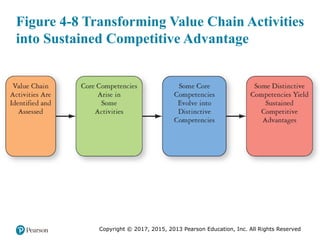
Figure 4-8 Transforming Value Chain Activities
into Sustained Competitive Advantage
Copyright © 2017, 2015, 2013 Pearson Education, Inc. All Rights Reserved
Benchmarking
• Benchmarking
– an analytical tool used to determine whether a firm's
value chain activities are competitive compared to
rivals and thus conducive to winning in the marketplace
– entails measuring costs of value chain activities across
an industry to determine “best practices”
Copyright © 2017, 2015, 2013 Pearson Education, Inc. All Rights Reserved
The Internal Factor Evaluation (IFE) Matrix
1. List key internal factors as identified in the internal-audit
process.
2. Assign a weight that ranges from 0.0 (not important) to
1.0 (all-important) to each factor.
3. Assign a 1-to-4 rating to each factor to indicate whether
that factor represents a strength or weakness.
4. Multiply each factor's weight by its rating to determine a
weighted score for each variable.
5. Sum the weighted scores for each variable to determine
the total weighted score for the organization.
Copyright © 2017, 2015, 2013 Pearson Education, Inc. All Rights Reserved
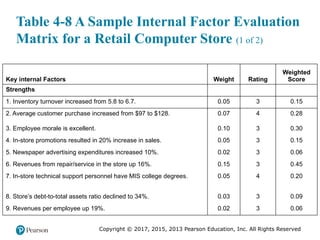
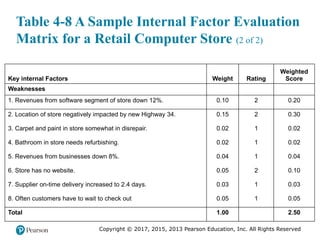
Table 4-8 A Sample Internal Factor Evaluation
Matrix for a Retail Computer Store (1 of 2)
Key internal Factors Weight Rating
Weighted
Score
Strengths Blank Blank Blank
1. Inventory turnover increased from 5.8 to 6.7. 0.05 3 0.15
2. Average customer purchase increased from $97 to $128. 0.07 4 0.28
3. Employee morale is excellent. 0.10 3 0.30
4. In-store promotions resulted in 20% increase in sales. 0.05 3 0.15
5. Newspaper advertising expenditures increased 10%. 0.02 3 0.06
6. Revenues from repair/service in the store up 16%. 0.15 3 0.45
7. In-store technical support personnel have MIS college degrees. 0.05 4 0.20
8. Store’s debt-to-total assets ratio declined to 34%. 0.03 3 0.09
9. Revenues per employee up 19%. 0.02 3 0.06
Copyright © 2017, 2015, 2013 Pearson Education, Inc. All Rights Reserved
Table 4-8 A Sample Internal Factor Evaluation
Matrix for a Retail Computer Store (2 of 2)
Key internal Factors Weight Rating
Weighted
Score
Weaknesses Blank Blank Blank
1. Revenues from software segment of store down 12%. 0.10 2 0.20
2. Location of store negatively impacted by new Highway 34. 0.15 2 0.30
3. Carpet and paint in store somewhat in disrepair. 0.02 1 0.02
4. Bathroom in store needs refurbishing. 0.02 1 0.02
5. Revenues from businesses down 8%. 0.04 1 0.04
6. Store has no website. 0.05 2 0.10
7. Supplier on-time delivery increased to 2.4 days. 0.03 1 0.03
8. Often customers have to wait to check out 0.05 1 0.05
Total 1.00 BLANK 2.50

SM_PPT_Topic 4_Internal Assessment.pptxxx

  • 1.
    Strategic Management Concepts: ACompetitive Advantage Approach Sixteenth Edition Topic 4 The Internal Assessment/Audit Copyright © 2017, 2015, 2013 Pearson Education, Inc. All Rights Reserved
  • 2.
    Copyright © 2017,2015, 2013 Pearson Education, Inc. All Rights Reserved Learning Objectives (1 of 2) 4.1 Describe the nature and role of an internal assessment in formulating strategies. 4.2 Discuss why organizational culture is so important in formulating strategies. 4.3 Identify the basic functions (activities) that make up management and their relevance in formulating strategies. 4.4 Identify the basic functions of marketing and their relevance in formulating strategies. 4.5 Discuss the nature and role of finance and accounting in formulating strategies.
  • 3.
    Copyright © 2017,2015, 2013 Pearson Education, Inc. All Rights Reserved Learning Objectives (2 of 2) 4.6 Discuss the nature and role of production/operations in formulating strategies. 4.7 Discuss the nature and role of research and development (R&D) in formulating strategies. 4.8 Discuss the nature and role of management information systems (MIS) in formulating strategies. 4.9 Explain value chain analysis and its relevance in formulating strategies. 4.10 Develop and use an Internal Factor Evaluation (IFE) Matrix.
  • 4.
    Copyright © 2017,2015, 2013 Pearson Education, Inc. All Rights Reserved Introductory Video: The Internal Environment
  • 5.
    Copyright © 2017,2015, 2013 Pearson Education, Inc. All Rights Reserved Key Internal Forces • Distinctive competencies – A firm’s strengths that cannot be easily matched or imitated by competitors – Building competitive advantages involves taking advantage of distinctive competencies. Fig. 4-2: The Process of Gaining Competitive Advantage in a Firm Weaknesses Strengths Distinctive Competencies Competitive Advantage
  • 6.
    Copyright © 2017,2015, 2013 Pearson Education, Inc. All Rights Reserved Key Internal Forces • Distinctive competencies – A firm’s strengths that cannot be easily matched or imitated by competitors – Building competitive advantages involves taking advantage of distinctive competencies. Fig. 4-2: The Process of Gaining Competitive Advantage in a Firm Weaknesses Strengths Distinctive Competencies Competitive Advantage
  • 7.
    Copyright © 2017,2015, 2013 Pearson Education, Inc. All Rights Reserved The Process of Performing an Internal Audit • The internal audit – Requires gathering, assimilating, and prioritizing information about the firm's management, marketing, finance, accounting, production/operations, research and development (R and D), and management information systems operations – Provides more opportunity for participants to understand how their jobs, departments, and divisions fit into the whole firm
  • 8.
    Copyright © 2017,2015, 2013 Pearson Education, Inc. All Rights Reserved The Resource-Based View (RBV • The Resource-Based View (RBV) Approach – contends that internal resources are more important for a firm than external factors in achieving and sustaining competitive advantage – organizational performance is primarily determined by internal resources that can be grouped into three all- encompassing categories: physical resources, human resources, and organizational resources.
  • 9.
    Copyright © 2017,2015, 2013 Pearson Education, Inc. All Rights Reserved The Resource-Based View (RBV) • For a resource to be valuable, it must be either (1) rare, (2) hard to imitate, or (3) not easily substitutable. • These three characteristics of resources are called Empirical Indicators • These enable a firm to implement strategies that improve its efficiency and effectiveness and lead to a sustainable competitive advantage. • Resource-based view theory asserts that resources are actually what helps a firm exploit opportunities and neutralize threats.
  • 10.
    Copyright © 2017,2015, 2013 Pearson Education, Inc. All Rights Reserved Integrating Strategy and Culture • Organizational culture significantly affects planning activities. • If strategies can capitalize on cultural strengths, such as a strong work ethic or highly ethical beliefs, then management often can swiftly and easily implement changes.
  • 11.
    Copyright © 2017,2015, 2013 Pearson Education, Inc. All Rights Reserved Organizational Culture • Organizational culture is “a pattern of behavior that has been developed by an organization as it learns to cope with its problem of external adaptation and internal integration and that has worked well enough to be considered valid and to be taught to new members as the correct way to perceive, think, and feel.”
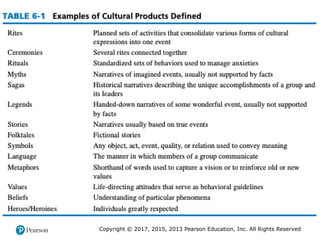
  • 12.
    Copyright © 2017,2015, 2013 Pearson Education, Inc. All Rights Reserved
  • 13.
    Copyright © 2017,2015, 2013 Pearson Education, Inc. All Rights Reserved Aspects of Organizational Culture Table 4-2 Fifteen Example (Possible) Aspects of an Organization’s Culture Dimension Low Degree Degree Degree High 1. Strong work ethic; arrive early and leave late 1 2 3 4 5 2. High ethical beliefs; clear code of business ethics followed 1 2 3 4 5 3. Formal dress; shirt and tie expected 1 2 3 4 5 4. Informal dress; many casual dress days 1 2 3 4 5 5. Socialize together outside of work 1 2 3 4 5 6. Do not question supervisor’s decision 1 2 3 4 5 7. Encourage whistle-blowing 1 2 3 4 5 8. Be health conscious; have a wellness program 1 2 3 4 5 9. Allow substantial “working from home” 1 2 3 4 5 10. Encourage creativity, innovation, and open-mindedness 1 2 3 4 5 11. Support women and minorities; no glass ceiling 1 2 3 4 5 12. Be highly socially responsible; be philanthropic 1 2 3 4 5 13. Have numerous meetings 1 2 3 4 5 14. Have a participative management style 1 2 3 4 5 15. Preserve the natural environment; have a sustainability program 1 2 3 4 5
  • 14.
    Copyright © 2017,2015, 2013 Pearson Education, Inc. All Rights Reserved Management The functions of management consist of five basic activities: • Planning – Strategy formulation • Organizing – Strategy implementation • Motivating – Strategy implementation • Staffing – Strategy implementation • Controlling – Strategy evaluation
  • 15.
    Copyright © 2017,2015, 2013 Pearson Education, Inc. All Rights Reserved The Basic Functions of Management (1 of 2) • Planning: forecasting, establishing objectives, devising strategies, and developing policies • Organizing: organizational design, job specialization, job descriptions, span of control, coordination, job design, and job analysis • Motivating: leadership, communication, work groups, behavior modification, delegation of authority, job enrichment, job satisfaction, needs fulfillment, organizational change, employee morale, and managerial morale
  • 16.
    Copyright © 2017,2015, 2013 Pearson Education, Inc. All Rights Reserved The Basic Functions of Management (2 of 2) • Staffing: wage and salary administration, employee benefits, interviewing, hiring, firing, training, management development, employee safety, equal employment opportunity, and union relations • Controlling: quality control, financial control, sales control, inventory control, expense control, analysis of variances, rewards, and sanctions
  • 17.
    Copyright © 2017,2015, 2013 Pearson Education, Inc. All Rights Reserved Management Audit Checklist of Questions (1 of 2) 1. Does the firm use strategic-management concepts? 2. Are company objectives and goals measurable and well communicated? 3. Do managers at all hierarchical levels plan effectively? 4. Do managers delegate authority well? 5. Is the organization's structure appropriate?
  • 18.
    Copyright © 2017,2015, 2013 Pearson Education, Inc. All Rights Reserved Management Audit Checklist of Questions (2 of 2) 6. Are job descriptions and job specifications clear? 7. Is employee morale high? 8. Are employee turnover and absenteeism low? 9. Are organizational reward and control mechanisms effective?
  • 19.
    Copyright © 2017,2015, 2013 Pearson Education, Inc. All Rights Reserved Marketing • the process of defining, anticipating, creating, and fulfilling customers’ needs and wants for products and services
  • 20.
    Copyright © 2017,2015, 2013 Pearson Education, Inc. All Rights Reserved Functions of Marketing • Customer analysis • Selling products and services • Product and service planning • Pricing • Distribution • Marketing research • Cost/ benefit analysis
  • 21.
    Copyright © 2017,2015, 2013 Pearson Education, Inc. All Rights Reserved Customer Analysis • Customer Analysis – the examination and evaluation of consumer needs, desires, and wants – involves administering customer surveys, analyzing consumer information, evaluating market positioning strategies, developing customer profiles, and determining optimal market segmentation strategies
  • 22.
    Copyright © 2017,2015, 2013 Pearson Education, Inc. All Rights Reserved Selling Products and Services • Selling – includes many marketing activities, such as advertising, sales promotion, publicity, personal selling, sales force management, customer relations, and dealer relations
  • 23.
    Copyright © 2017,2015, 2013 Pearson Education, Inc. All Rights Reserved Product and Service Planning • Product and Service Planning – includes activities such as test marketing; product and brand positioning; devising warranties; packaging; determining product options, features, style, and quality; deleting old products; and providing for customer service – important when a company is pursuing product development or diversification
  • 24.
    Copyright © 2017,2015, 2013 Pearson Education, Inc. All Rights Reserved Pricing • Pricing – Five major stakeholders affect pricing decisions: consumers, governments, suppliers, distributors, and competitors – Sometimes an organization will pursue a forward integration strategy primarily to gain better control over prices charged to consumers.
  • 25.
    Copyright © 2017,2015, 2013 Pearson Education, Inc. All Rights Reserved Distribution • Distribution – includes warehousing, distribution channels, distribution coverage, retail site locations, sales territories, inventory levels and location, transportation carriers, wholesaling, and retailing – especially important when a firm is striving to implement a market development or forward integration strategy
  • 26.
    Copyright © 2017,2015, 2013 Pearson Education, Inc. All Rights Reserved Marketing Research • Marketing Research – the systematic gathering, recording, and analyzing of data about problems relating to the marketing of goods and services – can uncover critical strengths and weaknesses
  • 27.
    Copyright © 2017,2015, 2013 Pearson Education, Inc. All Rights Reserved Cost/Benefit Analysis • Cost/Benefit Analysis – Three steps are required: 1.compute the total costs associated with a decision 2.estimate the total benefits from the decision 3.compare the total costs with the total benefits
  • 28.
    Copyright © 2017,2015, 2013 Pearson Education, Inc. All Rights Reserved Marketing Audit Checklist of Questions (1 of 2) 1. Are markets segmented effectively? 2. Is the organization positioned well among competitors? 3. Has the firm’s market share been increasing? 4. Are present channels of distribution reliable and cost effective? 5. Does the firm have an effective sales organization? 6. Does the firm conduct market research?
  • 29.
    Copyright © 2017,2015, 2013 Pearson Education, Inc. All Rights Reserved Marketing Audit Checklist of Questions (2 of 2) 7. Are product quality and customer service good? 8. Are the firm's products and services priced appropriately? 9. Does the firm have an effective promotion, advertising, and publicity strategy? 10.Are marketing, planning, and budgeting effective? 11. Do the firm's marketing managers have adequate experience and training? 12.Is the firm's Internet presence excellent as compared to rivals?
  • 30.
    Copyright © 2017,2015, 2013 Pearson Education, Inc. All Rights Reserved Finance/Accounting Functions (1 of 4) The functions of finance/accounting comprise three decisions: 1. The investment decision 2. The financing decision 3. The dividend decision
  • 31.
    Copyright © 2017,2015, 2013 Pearson Education, Inc. All Rights Reserved Finance/Accounting Functions (2 of 4) • Investment Decision (Capital Budgeting) – the allocation and reallocation of capital and resources to projects, products, assets, and divisions of an organization • Financing Decision – determines the best capital structure for the firm and includes examining various methods by which the firm can raise capital
  • 32.
    Copyright © 2017,2015, 2013 Pearson Education, Inc. All Rights Reserved Finance/Accounting Functions (3 of 4) • Dividend Decisions – concern issues such as the percentage of earnings paid to stockholders, the stability of dividends paid over time, and the repurchase or issuance of stock – determine the amount of funds that are retained in a firm compared to the amount paid out to stockholders
  • 33.
    Copyright © 2017,2015, 2013 Pearson Education, Inc. All Rights Reserved Finance/Accounting Functions (4 of 4) 1. How has each ratio changed over time? 2. How does each ratio compare to industry norms? 3. How does each ratio compare with key competitors?
  • 34.
    Copyright © 2017,2015, 2013 Pearson Education, Inc. All Rights Reserved Table 4-4 A Summary of Key Financial Ratios (1 of 4) Ratio How Calculated What it measures Liquidity Ratios BLANK BLANK Current Ratio Current assets over Current liabilities The extent to which a firm can meet its short-term obligations Quick Ratio Current assets minus inventory over Current liabilities The extent to which a firm can meet its short-term obligations without relying on the sale of its inventories Leverage Ratios Blank Blank Debt-to-Total-Assets Ratio Total debt over Total assets The percentage of total funds provided by creditors Debt-to-Equity Ratio Total debt over Total stockholders’ equity The percentage of total funds provided by creditors versus by owners Long-Term Debt-to-Equity Ratio Long-term debt over Total stockholders’ equity The balance between debt and equity in a firm’s long-term capital structure Times-Interest-Earned Ratio Profits before interest and taxes over Total interest charges the extent to which earnings can decline without the firm becoming unable to meet its annual interest costs Current assets Current liabilities Current assets minus inventory Current liabilities Total debt Total assets Total debt Total stockholders' equity Long-term debt Total stockholders' equity Profits before interest and taxes Total interest charges
  • 35.
    Copyright © 2017,2015, 2013 Pearson Education, Inc. All Rights Reserved A Summary of Key Financial Ratios (2 of 4) Ratio How Calculated What it measures Activity Ratios Blank Blank Inventory turnover Sales over Inventory of finished goods Whether a firm holds excessive stocks of inventories and whether a firm is slowly selling its inventories compared to the industry average Fixed Assets turnover Sales over Fixed assets Sales productivity and plant and equipment utilization Total Assets turnover Sales over Total assets Whether a firm is generating a sufficient volume of business for the size of its asset investment Accounts Receivable turnover Annual credit sales over Accounts receivable The average length of time it takes a firm to collect credit sales (in percentage terms) Average Collection Period Accounts receivable over total credit sales per 365 days The average length of time it takes a firm to collect on credit sales (in days) Sales Inventory of finished goods Sales Fixed assets Sales Total assets Annual credit sales Accounts receivable Accounts receivable Total credit sales/365 days
  • 36.
    Copyright © 2017,2015, 2013 Pearson Education, Inc. All Rights Reserved A Summary of Key Financial Ratios (3 of 4) Ratio How Calculated What it measures Profitability Ratios Blank Blank Gross Profit Margin Sales minus cost of goods sold over Sales the total margin available to cover operating expenses and yield a profit Operating Profit Margin Earnings before interest and taxes EBIT over Sales Profitability without concern for taxes and interest Net Profit Margin Net income over sales After-tax profits per dollar of sales Return on total Assets (ROA) Net income over Total assets After-tax profits per dollar of assets; this ratio is also called return on investment (ROI) Return on Stockholders’ Equity (ROE) Net Income over Total stockholders’ equity After-tax profits per dollar of stockholders’ investment in the firm Earnings Per Share (EPS) Net income over Number of shares of common stock outstanding Earnings available to the owners of common Stock Price-Earnings Ratio Market price per share over Earnings per share Attractiveness of firm on equity markets Sales minus cost of goods sold Sales Earnings before interest and taxes EBIT Sales Net income Sales Net income Total assets Net income Total stockholders' equity Net income Number of shares of common stock outstanding Market price per share Earnings per share
  • 37.
    Copyright © 2017,2015, 2013 Pearson Education, Inc. All Rights Reserved A Summary of Key Financial Ratios (4 of 4) Ratio How Calculated What it measures Growth Ratios Blank Blank Sales Annual percentage growth in total sales Firm’s growth rate in sales Net Income Annual percentage growth in profits Firm’s growth rate in profits Earnings Per Share Annual percentage growth in EPS Firm’s growth rate in EPS Dividends Per Share Annual percentage growth in dividends per share Firm’s growth rate in dividends per share
  • 38.
    Copyright © 2017,2015, 2013 Pearson Education, Inc. All Rights Reserved Finance/Accounting Audit Checklist (1 of 2) 1. Where is the firm financially strong and weak as indicated by financial ratio analyses? 2. Can the firm raise needed short-term capital? 3. Can the firm raise needed long-term capital through debt and/or equity? 4. Does the firm have sufficient working capital? 5. Are capital budgeting procedures effective?
  • 39.
    Copyright © 2017,2015, 2013 Pearson Education, Inc. All Rights Reserved Finance/Accounting Audit Checklist (2 of 2) 6. Are dividend payout policies reasonable? 7. Does the firm have good relations with its investors and stockholders? 8. Are the firm's financial managers experienced and well trained? 9. Is the firm's debt situation excellent?
  • 40.
    Copyright © 2017,2015, 2013 Pearson Education, Inc. All Rights Reserved Production/Operations • Production/operations function – consists of all those activities that transform inputs into goods and services • Production/operations management deals with inputs, transformations, and outputs that vary across industries and markets.
  • 41.
    Copyright © 2017,2015, 2013 Pearson Education, Inc. All Rights Reserved Table 4-6 The Basic Functions (Decisions) Within Production/Operations Decision Areas Example Decisions 1. Process these decisions include choice of technology, facility layout, process flow analysis, facility location, line balancing, process control, and transportation analysis. Distances from raw materials to production sites to customers are a major consideration. 2. Capacity these decisions include forecasting, facilities planning, aggregate planning, scheduling, capacity planning, and queuing analysis. Capacity utilization is a major consideration. 3. Inventory these decisions involve managing the level of raw materials, work-in- process, and finished goods, especially considering what to order, when to order, how much to order, and materials handling. 4. Workforce these decisions involve managing the skilled, unskilled, clerical, and managerial employees by caring for job design, work measurement, job enrichment, work standards, and motivation techniques. 5. Quality these decisions are aimed at ensuring that high-quality goods and ser- vices are produced by caring for quality control, sampling, testing, quality assurance, and cost control.
  • 42.
    Copyright © 2017,2015, 2013 Pearson Education, Inc. All Rights Reserved Table 4-7 Implications of Various Strategies on Production/Operations Various Strategies Implications 1. Become a low-cost provider Creates high barriers to entry Creates larger market Requires longer production runs and fewer product changes 2. Become a high-quality provider Requires more quality-assurance efforts Requires more expensive equipment Requires highly skilled workers and higher wages 3. Provide great customer service Requires more service people, service parts, and equipment Requires rapid response to customer needs or changes in customer tastes Requires a higher inventory investment 4. Be the first to introduce new products Has higher research and development costs Has high retraining and tooling costs 5. Become highly automated Requires high capital investment Reduces flexibility May affect labor relations Makes maintenance more crucial 6. Minimize layoffs Serves the security needs of employees and may develop employee loyalty Helps attract and retain highly skilled employees
  • 43.
    Copyright © 2017,2015, 2013 Pearson Education, Inc. All Rights Reserved Production/Operations Audit Checklist 1. Are supplies of raw materials, parts, and subassemblies reliable and reasonable? 2. Are facilities, equipment, machinery, and offices in good condition? 3. Are inventory-control policies and procedures effective? 4. Are quality-control policies and procedures effective? 5. Are facilities, resources, and markets strategically located? 6. Does the firm have technological competencies?
  • 44.
    Copyright © 2017,2015, 2013 Pearson Education, Inc. All Rights Reserved Research and Development Audit 1. Does the firm have R&D facilities? Are they adequate? 2. If outside R&D firms are used, are they cost-effective? 3. Are the organization's R&D personnel well qualified? 4. Are R&D resources allocated effectively? 5. Are management information and computer systems adequate? 6. Is communication between R&D and other organizational units effective? 7. Are present products technologically competitive?
  • 45.
    Copyright © 2017,2015, 2013 Pearson Education, Inc. All Rights Reserved Management Information Systems • Management Information System – Receives raw material from both external and internal evaluation of an organization – Improves the performance of an enterprise by improving the quality of managerial decisions – Collects, codes, stores, synthesizes, and presents information in such a manner that it answers important operating and strategic questions
  • 46.
    Copyright © 2017,2015, 2013 Pearson Education, Inc. All Rights Reserved Management Information Systems Audit (1 of 2) 1. Do all managers in the firm use the information system to make decisions? 2. Is there a chief information officer or director of information systems position in the firm? 3. Are data in the information system updated regularly? 4. Do managers from all functional areas of the firm contribute input to the information system? 5. Are there effective passwords for entry into the firm's information system?
  • 47.
    Copyright © 2017,2015, 2013 Pearson Education, Inc. All Rights Reserved Management Information Systems Audit (2 of 2) 6. Are strategists of the firm familiar with the information systems of rival firms? 7. Is the information system user-friendly? 8. Do all users of the information system understand the competitive advantages that information can provide firms? 9. Are computer training workshops provided for users of the information system? 10.Is the firm’s information system continually being improved in content- and user-friendliness?
  • 48.
    Copyright © 2017,2015, 2013 Pearson Education, Inc. All Rights Reserved Value Chain Analysis (VCA) • Value Chain Analysis (VCA) – refers to the process whereby a firm determines the costs associated with organizational activities from purchasing raw materials to manufacturing product(s) to marketing those products – aims to identify where low-cost advantages or disadvantages exist anywhere along the value chain from raw material to customer service activities
  • 49.
    Copyright © 2017,2015, 2013 Pearson Education, Inc. All Rights Reserved Figure 4-8 Transforming Value Chain Activities into Sustained Competitive Advantage
  • 50.
    Copyright © 2017,2015, 2013 Pearson Education, Inc. All Rights Reserved Benchmarking • Benchmarking – an analytical tool used to determine whether a firm's value chain activities are competitive compared to rivals and thus conducive to winning in the marketplace – entails measuring costs of value chain activities across an industry to determine “best practices”
  • 51.
    Copyright © 2017,2015, 2013 Pearson Education, Inc. All Rights Reserved The Internal Factor Evaluation (IFE) Matrix 1. List key internal factors as identified in the internal-audit process. 2. Assign a weight that ranges from 0.0 (not important) to 1.0 (all-important) to each factor. 3. Assign a 1-to-4 rating to each factor to indicate whether that factor represents a strength or weakness. 4. Multiply each factor's weight by its rating to determine a weighted score for each variable. 5. Sum the weighted scores for each variable to determine the total weighted score for the organization.
  • 52.
    Copyright © 2017,2015, 2013 Pearson Education, Inc. All Rights Reserved Table 4-8 A Sample Internal Factor Evaluation Matrix for a Retail Computer Store (1 of 2) Key internal Factors Weight Rating Weighted Score Strengths Blank Blank Blank 1. Inventory turnover increased from 5.8 to 6.7. 0.05 3 0.15 2. Average customer purchase increased from $97 to $128. 0.07 4 0.28 3. Employee morale is excellent. 0.10 3 0.30 4. In-store promotions resulted in 20% increase in sales. 0.05 3 0.15 5. Newspaper advertising expenditures increased 10%. 0.02 3 0.06 6. Revenues from repair/service in the store up 16%. 0.15 3 0.45 7. In-store technical support personnel have MIS college degrees. 0.05 4 0.20 8. Store’s debt-to-total assets ratio declined to 34%. 0.03 3 0.09 9. Revenues per employee up 19%. 0.02 3 0.06
  • 53.
    Copyright © 2017,2015, 2013 Pearson Education, Inc. All Rights Reserved Table 4-8 A Sample Internal Factor Evaluation Matrix for a Retail Computer Store (2 of 2) Key internal Factors Weight Rating Weighted Score Weaknesses Blank Blank Blank 1. Revenues from software segment of store down 12%. 0.10 2 0.20 2. Location of store negatively impacted by new Highway 34. 0.15 2 0.30 3. Carpet and paint in store somewhat in disrepair. 0.02 1 0.02 4. Bathroom in store needs refurbishing. 0.02 1 0.02 5. Revenues from businesses down 8%. 0.04 1 0.04 6. Store has no website. 0.05 2 0.10 7. Supplier on-time delivery increased to 2.4 days. 0.03 1 0.03 8. Often customers have to wait to check out 0.05 1 0.05 Total 1.00 BLANK 2.50

Editor's Notes

  • #2 After studying this chapter, you should be able to do the following: 4-1. Describe the nature and role of an internal assessment in formulating strategies. 4-2. Discuss why organizational culture is so important in formulating strategies. 4-3. Identify the basic functions (activities) that make up management and their relevance in formulating strategies. 4-4. Identify the basic functions of marketing and their relevance in formulating strategies. 4-5. Discuss the nature and role of finance/accounting in formulating strategies. 4-6. Discuss the nature and role of production/operations in formulating strategies. 4-7. Discuss the nature and role of research and development (R&D) in formulating strategies. 4-8. Discuss the nature and role of management information systems (MIS) in formulating strategies. 4-9. Explain value chain analysis and its relevance in formulating strategies. 4-10. Develop and use an Internal Factor Evaluation (IFE) Matrix.
  • #3 This chapter focuses on identifying and evaluating a firm’s strengths and weaknesses in the functional areas of business, including management, marketing, finance, accounting, production/operations, research and development (R&D), and management information systems (MIS). Relationships among these areas of business are examined. Also, strategic implications of important functional area concepts are explained. In addition, this chapter describes the process of performing an internal audit. The resource-based view (RBV) of strategic management is introduced, as is value chain analysis (VCA) and benchmarking.
  • #5 Strategies are designed in part to improve on a firm’s weaknesses, turning them into strengths—and maybe even into distinctive competencies that can provide the firm with competitive advantages over rival firms. A complete internal assessment is vital to help a firm formulate, implement, and evaluate strategies to enable it to gain and sustain competitive advantages. For different types of organizations, such as hospitals, universities, and government agencies, the functional business areas differ. In a hospital, for example, functional areas may include cardiology, hematology, nursing, maintenance, physician support, and receivables. Functional areas of a university can include athletic programs, placement services, housing, fund-raising, academic research, counseling, and intramural programs. Regardless of the type or size of firm, effective strategic planning hinges on identification and prioritization of internal strengths and weaknesses.
  • #6 Strategies are designed in part to improve on a firm’s weaknesses, turning them into strengths—and maybe even into distinctive competencies that can provide the firm with competitive advantages over rival firms. Strengths that cannot be easily matched or imitated by competitors are called distinctive competencies. Building competitive advantages involves taking advantage of distinctive competencies. Strategies are designed in part to improve on a firm’s weaknesses, turning them into strengths—and maybe even into distinctive competencies. Figure 6-2 illustrates that all firms should continually strive to improve on their weaknesses, turning them into strengths, and ultimately develop distinctive competencies that can provide the firm with competitive advantages over rival firms.
  • #7 The process of performing an internal audit closely parallels the process of performing an external audit. Representative managers and employees from throughout the firm need to be involved in determining a firm’s strengths and weaknesses. The internal audit requires gathering, assimilating, and prioritizing information about the firm’s management, marketing, finance and accounting, production and operations, R&D, and MIS operations to reveal the firm’s most important strengths and most severe weaknesses. All organizations have strengths and weaknesses in the functional areas of business. No enterprise is equally strong or weak in all areas. Strategic planning is most successful when managers and employees from all functional areas work together to provide ideas and information.
  • #8 Physical resources include all plant and equipment, location, technology, raw materials, and machines; human resources include all employees, training, experience, intelligence, knowledge, skills, and abilities; and organizational resources include firm structure, planning processes, information systems, patents, trademarks, copyrights, databases, and so on.
  • #9 The basic premise of the RBV is that the mix, type, amount, and nature of a firm’s internal resources should be considered first and foremost in devising strategies that can lead to sustainable competitive advantage.
  • #10 Every business entity has a unique organizational culture that impacts strategic-planning activities.
  • #11 This definition emphasizes the importance of matching external with internal factors in making strategic decisions. Organizational culture captures the subtle, elusive, and largely unconscious forces that shape a workplace. Remarkably resistant to change, culture can represent a major strength or weakness for any firm. It can be an underlying reason for strengths or weaknesses in any of the major business functions. Remarkably resistant to change, culture can represent a major strength or weakness for any firm. It can be an underlying reason for strengths or weaknesses in any of the major business functions.
  • #13 Table 4-2 provides some example (possible) aspects of an organization’s culture. Note that you might want to ask employees and managers to rate the degree that the dimension characterizes the firm.
  • #14 These activities are important to assess in strategic planning because an organization should continually capitalize on its management strengths and improve on its management weaknesses.
  • #15 Planning consists of all those managerial activities related to preparing for the future. Organizing includes all those managerial activities that result in a structure of task and authority relationships. Motivating involves efforts directed toward shaping human behavior.
  • #16 Staffing refers to human resource (HR) activities. Controlling refers to all those managerial activities directed toward ensuring that actual results are consistent with planned results.
  • #17 This checklist of questions can help determine specific strengths and weaknesses in the functional area of business. An answer of no to any question could indicate a potential weakness. Positive or yes answers to the checklist questions suggest potential areas of strength.
  • #19 Marketing can be described as the process of defining, anticipating, creating, and fulfilling customers’ needs and wants for products and services.
  • #20 These are the seven basic functions of marketing. Each will be described on the following slides.
  • #21 Customer analysis is the first function of marketing.
  • #22 Selling products and services is the second function of marketing. Successful strategy implementation generally rests on the ability of an organization to sell some product or service.
  • #23 Product and service planning is the third function of marketing.
  • #24 Pricing is the fourth function of marketing.
  • #25 Distribution is the fifth function of marketing.
  • #26 Marketing research is the sixth function of marketing.
  • #27 Cost/benefit analysis is the seventh function of marketing.
  • #28 These questions about marketing must be examined in strategic planning.
  • #30 According to James Van Horne, the functions of finance/accounting comprise three decisions: the investment decision, the financing decision, and the dividend decision.
  • #31 After strategies are formulated, capital budgeting decisions are required to successfully implement strategies. Firms may raise capital by, for example, issuing stock, increasing debt, selling assets, or using a combination of these approaches.
  • #32 Three financial ratios that are helpful in evaluating a firm’s dividend decisions are the earnings-per-share ratio, the dividends-per-share ratio, and the price-earnings ratio.
  • #33 Financial ratios are computed from an organization’s income statement and balance sheet. Computing financial ratios is like taking a photograph—the results reflect a situation at just one point in time. Comparing ratios over time and to industry averages is more likely to result in meaningful statistics that can be used to identify and evaluate strengths and weaknesses. Financial ratio analysis should be conducted on three separate fronts.
  • #34 Financial ratios such as those on the next several slides are used in determining appropriate strategies for an organization.
  • #38 Some finance and accounting questions that should be examined in any strategic analysis of the firm are given here.
  • #40 Production and operations activities often represent the largest part of an organization’s human and capital assets.
  • #41 Roger Schroeder suggests that production and operations management comprises five functions or decision areas: process, capacity, inventory, workforce, and quality.
  • #42 James Dilworth has outlined implications of several types of strategic decisions a company might make.
  • #43 Questions such as these should be examined during the analysis of production and operations.
  • #44 Organizations invest in R&D because they believe that such an investment will lead to a superior product or service and will give them competitive advantages.
  • #45 The heart of an information system is a database containing the kinds of records and data important to managers.
  • #46 Questions such as these should be asked when conducting an MIS audit.
  • #48 According to Porter, the business of a firm can best be described as a value chain, in which total revenues minus total costs of all activities undertaken to develop and market a product or service yields value.
  • #49 More and more companies are using VCA to gain and sustain competitive advantage by being especially efficient and effective along various parts of the value chain.
  • #50 Benchmarking enables a firm to take action to improve its competitiveness by identifying (and improving on) value chain activities where rival firms have comparative advantages in cost, service, reputation, or operation.
  • #51 A summary step in conducting an internal strategic-management audit is to construct an Internal Factor Evaluation (IFE) Matrix.
  • #52 The table reveals that the two most important factors to be successful in the retail computer store business are “Revenues from repair/service in the store” and “Employee morale.” Note that the store is doing best on “Average customer purchase” amount and “In-store technical support.” The store is having major problems with its carpet, bathroom, paint, and checkout procedures. Note also that the matrix contains substantial quantitative data rather than vague statements.
  • #53 The table reveals that the two most important factors to be successful in the retail computer store business are “Revenues from repair/service in the store” and “Employee morale.” Note that the store is doing best on “Average customer purchase” amount and “In-store technical support.” The store is having major problems with its carpet, bathroom, paint, and checkout procedures. Note also that the matrix contains substantial quantitative data rather than vague statements.