
Department of obstetrics and gynecology
Head of the department : L. Markin, MD, Dr. of Med. Sc.,
Prof.
Name : mahmoud abbass alawny
Course : 4th
Group : 7th
Topic : INFLAMMATORY DISEASES OF THE FEMALE
SEXUAL ORGANS
INFLAMMATORY DISEASES OF THE FEMALE SEXUAL ORGANS ( Pelvic
inflammatory disease (PID) )
๏‚— Pelvic inflammatory disease (PID) is an infection of
the female reproductive organs. It usually occurs when
sexually transmitted bacteria spread from vagina to
uterus, fallopian tubes or ovaries.
๏‚— Normal vaginal microflora contains: Lactobacillus
(70-90%), Staphylococcus epidermalis (30-60%),
diphteroids (30-60%), Hemolytic Streptococci (10-
20%), nonhaemolytic streptococci (5-30%),
Escherichia coli (20-25%), Bacteroides (5-15%),
Peptococcus (10-60%), Peptostreptococcus (10-40%),
Clostridium (5-15%).
Common Signs and Symptoms of
Pelvic Inflammatory Disease
๏‚— Pain in lower abdomen and pelvis
๏‚— Heavy vaginal discharge with an unpleasant odor
๏‚— Abnormal uterine bleeding, especially during or after
intercourse, or between menstrual cycles
๏‚— Pain or bleeding during intercourse
๏‚— Fever, sometimes with chills
๏‚— Painful or difficult urination
Bartholinitis
๏‚— is inflammation of one or both of the two Bartholin's glands,
which are located one on either side of the opening of the
vagina, behind the labia (lips). The inflammation is
sometimes due to germs picked up during sex, but in many
cases the inflammation is not sexually transmitted
๏‚— Causes : Staphylococci , Streptoccci , Coliforms ,
gonococcus
๏‚— Symptoms : pain and soreness in the region of one of the
labia minora , swelling in the same area , possibly a
slight discharge
๏‚— Treatment & Management : antibiotics should be started
immediately prior to incision and drainage.
Drugs : lidocaine 2% ointment , ceftriaxone ,
Vulvovaginitis
๏‚— is a general term referring to many types of vaginal infection,
although we will talk on the following disorders, which affect the
vulvar region: Vulvovaginal candidiasis, Atrophic vaginitis, Vulvar
vestibulitis, Contact dermatitis .
๏‚— Signs and symptoms : Vulvar pruritus and burning , Erythema
and edema of the vestibule and of the labia majora and minora ,
Irritation and pain , discharge .
๏‚— Treatment & Management :
Vulvovaginal candidiasis : Butoconazole , Hydrocortisone topical
Atrophic vaginitis : topical vaginal estrogen for 1-2 weeks
Vulvar vestibulitis: no specific cure is available
Contact dermatitis : Hydrocortisone (0.5-1%) and fluorinated
corticosteroids in lotions or creams .
Cervicitis
๏‚— Cervicitis is an inflammation of the uterine cervix,
characteristically diagnosed by: (1) a visible, purulent or
mucopurulent endocervical exudate in the endocervical
canal or on an endocervical swab specimen and/or
(2) sustained
๏‚— Signs and symptoms : Dyspareunia, discharge, bleeding,
burning, itching, odor, pelvic pain .
๏‚— Treatment & Management :
Ceftriaxone
Acyclovir
Topical Podofilox
Topical Tinidazole
Endometritis
๏‚— Endometritis is inflammation of the endometrial lining of
the uterus. In addition to the endometrium, inflammation
may involve the myometrium and, occasionally, the
parametrium.
๏‚— Signs and symptoms : Fever, uterine tenderness, abdominal
pain, leukocytosis
๏‚— Treatment & Management : antibiotic therapy
A combination of Ampicillin and Aminoglycoside .
A combination of Clindamycin with Gentamicin
or Metronidasol with Unasyn .
In some cases uterine curettage is performed after
temperature normalization.
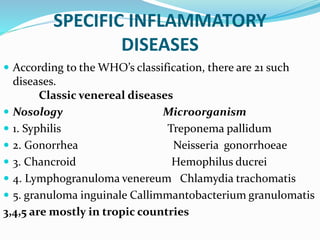
SPECIFIC INFLAMMATORY
DISEASES
๏‚— According to the WHOโ€™s classification, there are 21 such
diseases.
Classic venereal diseases
๏‚— Nosology Microorganism
๏‚— 1. Syphilis Treponema pallidum
๏‚— 2. Gonorrhea Neisseria gonorrhoeae
๏‚— 3. Chancroid Hemophilus ducrei
๏‚— 4. Lymphogranuloma venereum Chlamydia trachomatis
๏‚— 5. granuloma inguinale Callimmantobacterium granulomatis
3,4,5 are mostly in tropic countries
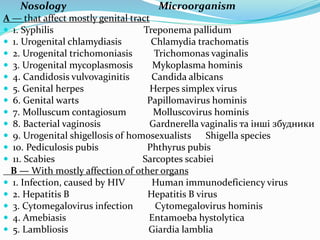
Nosology Microorganism
A โ€” that affect mostly genital tract
๏‚— 1. Syphilis Treponema pallidum
๏‚— 1. Urogenital chlamydiasis Chlamydia trachomatis
๏‚— 2. Urogenital trichomoniasis Trichomonas vaginalis
๏‚— 3. Urogenital mycoplasmosis Mykoplasma hominis
๏‚— 4. Candidosis vulvovaginitis Candida albicans
๏‚— 5. Genital herpes Herpes simplex virus
๏‚— 6. Genital warts Papillomavirus hominis
๏‚— 7. Molluscum contagiosum Molluscovirus hominis
๏‚— 8. Bacterial vaginosis Gardnerella vaginalis ั‚ะฐ iะฝัˆi ะทะฑัƒะดะฝะธะบะธ
๏‚— 9. Urogenital shigellosis of homosexualists Shigella species
๏‚— 10. Pediculosis pubis Phthyrus pubis
๏‚— 11. Scabies Sarcoptes scabiei
B โ€” With mostly affection of other organs
๏‚— 1. Infection, caused by HIV Human immunodeficiency virus
๏‚— 2. Hepatitis B Hepatitis B virus
๏‚— 3. Cytomegalovirus infection Cytomegalovirus hominis
๏‚— 4. Amebiasis Entamoeba hystolytica
๏‚— 5. Lambliosis Giardia lamblia
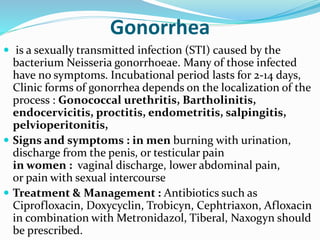
Gonorrhea
๏‚— is a sexually transmitted infection (STI) caused by the
bacterium Neisseria gonorrhoeae. Many of those infected
have no symptoms. Incubational period lasts for 2-14 days,
Clinic forms of gonorrhea depends on the localization of the
process : Gonococcal urethritis, Bartholinitis,
endocervicitis, proctitis, endometritis, salpingitis,
pelvioperitonitis,
๏‚— Signs and symptoms : in men burning with urination,
discharge from the penis, or testicular pain
in women : vaginal discharge, lower abdominal pain,
or pain with sexual intercourse
๏‚— Treatment & Management : Antibiotics such as
Ciprofloxacin, Doxycyclin, Trobicyn, Cephtriaxon, Afloxacin
in combination with Metronidazol, Tiberal, Naxogyn should
be prescribed.
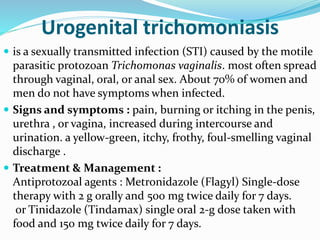
Urogenital trichomoniasis
๏‚— is a sexually transmitted infection (STI) caused by the motile
parasitic protozoan Trichomonas vaginalis. most often spread
through vaginal, oral, or anal sex. About 70% of women and
men do not have symptoms when infected.
๏‚— Signs and symptoms : pain, burning or itching in the penis,
urethra , or vagina, increased during intercourse and
urination. a yellow-green, itchy, frothy, foul-smelling vaginal
discharge .
๏‚— Treatment & Management :
Antiprotozoal agents : Metronidazole (Flagyl) Single-dose
therapy with 2 g orally and 500 mg twice daily for 7 days.
or Tinidazole (Tindamax) single oral 2-g dose taken with
food and 150 mg twice daily for 7 days.
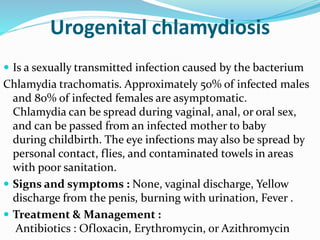
Urogenital chlamydiosis
๏‚— Is a sexually transmitted infection caused by the bacterium
Chlamydia trachomatis. Approximately 50% of infected males
and 80% of infected females are asymptomatic.
Chlamydia can be spread during vaginal, anal, or oral sex,
and can be passed from an infected mother to baby
during childbirth. The eye infections may also be spread by
personal contact, flies, and contaminated towels in areas
with poor sanitation.
๏‚— Signs and symptoms : None, vaginal discharge, Yellow
discharge from the penis, burning with urination, Fever .
๏‚— Treatment & Management :
Antibiotics : Ofloxacin, Erythromycin, or Azithromycin
Urogenital mycoplasmosis
๏‚— The Microbal agents are Mycoplasma hominis, Mycoplasma
genitaloum, Ureaplasma urealiticum. Is transmitted sexually
and they are highly spread among the population. can occur
in acute and chronic form, and has no symptoms .
The agents may be activated under the influence of
menstruation, oral contraceptives, pregnancy, delivery.
๏‚— Treatment & Management :
oral tetracycline for 7 days
Clindamycin or Clarithromycin is an alternative treatment
for tetracycline-resistant M hominis
Herpesvirus infection
๏‚— Is caused by Herpes simplex virus, mostly of the second type
(HSV-2). Source of the infection are infected persons and
carriers. It can be transmitted during urogenital contact. The
virus is located mostly in mucos membranes of urogenital
tract in men and cervical canal in women . The incubation
period is 3-7 days.
๏‚— Signs and symptoms : High temperature (102-104ยฐF),
Anorexia, fever, headache, malaise, and myalgia, Local
symptoms include pain, itching, dysuria, vaginal and
urethral discharge, and tender lymphadenopathy.
Herpetic vesicles appear on the external genitalia, labia majora,
labia minora, vaginal vestibule, and introitus.
๏‚— Treatment & Management : Penciclovir 0.1% apply q2hr
while awake for 4 days
Condyloma acuminata
๏‚— an epidermal manifestation attributed to the epidermotropic
human papillomavirus (HPV) 16 and 18 types,
๏‚— Signs and symptoms : Eruptions may appear pearly, filiform,
fungating, cauliflower, or plaquelike. They can be smooth,
verrucous, or lobulated.
difficulties at walking, intercourse, During pregnancy and
delivery they can cause bleeding.
๏‚— Treatment & Management : If genital warts are large, laser
vaporization is performed.
Podophyllum resin : 25% for 1-4 hr depending on condition of
lesion .
Interferon alfa-n3 : 250,000 million unit/mL per wart
intralesional inj 2 times/week up to 8 weeks
Kunecatechins ; 15% Apply topically q8hr
Pelvic Inflammatory
Disease Workup
is often based on clinical criteria, with or without additional
laboratory and imaging evidence.
Procedures :
๏‚— Laparoscopic confirmation
๏‚— Transvaginal ultrasonographic scanning or magnetic
resonance imaging (MRI) showing thickened, fluid-filled
tubes with or without free pelvic fluid or tubo-ovarian
abscess (TOA)
๏‚— Endometrial biopsy showing endometritis.
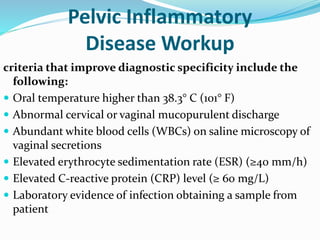
Pelvic Inflammatory
Disease Workup
criteria that improve diagnostic specificity include the
following:
๏‚— Oral temperature higher than 38.3ยฐ C (101ยฐ F)
๏‚— Abnormal cervical or vaginal mucopurulent discharge
๏‚— Abundant white blood cells (WBCs) on saline microscopy of
vaginal secretions
๏‚— Elevated erythrocyte sedimentation rate (ESR) (โ‰ฅ40 mm/h)
๏‚— Elevated C-reactive protein (CRP) level (โ‰ฅ 60 mg/L)
๏‚— Laboratory evidence of infection obtaining a sample from
patient
Pelvic inflammatory disease

Pelvic inflammatory disease

  • 1.
    Department of obstetricsand gynecology Head of the department : L. Markin, MD, Dr. of Med. Sc., Prof. Name : mahmoud abbass alawny Course : 4th Group : 7th Topic : INFLAMMATORY DISEASES OF THE FEMALE SEXUAL ORGANS
  • 2.
    INFLAMMATORY DISEASES OFTHE FEMALE SEXUAL ORGANS ( Pelvic inflammatory disease (PID) ) ๏‚— Pelvic inflammatory disease (PID) is an infection of the female reproductive organs. It usually occurs when sexually transmitted bacteria spread from vagina to uterus, fallopian tubes or ovaries. ๏‚— Normal vaginal microflora contains: Lactobacillus (70-90%), Staphylococcus epidermalis (30-60%), diphteroids (30-60%), Hemolytic Streptococci (10- 20%), nonhaemolytic streptococci (5-30%), Escherichia coli (20-25%), Bacteroides (5-15%), Peptococcus (10-60%), Peptostreptococcus (10-40%), Clostridium (5-15%).
  • 3.
    Common Signs andSymptoms of Pelvic Inflammatory Disease ๏‚— Pain in lower abdomen and pelvis ๏‚— Heavy vaginal discharge with an unpleasant odor ๏‚— Abnormal uterine bleeding, especially during or after intercourse, or between menstrual cycles ๏‚— Pain or bleeding during intercourse ๏‚— Fever, sometimes with chills ๏‚— Painful or difficult urination
  • 4.
    Bartholinitis ๏‚— is inflammationof one or both of the two Bartholin's glands, which are located one on either side of the opening of the vagina, behind the labia (lips). The inflammation is sometimes due to germs picked up during sex, but in many cases the inflammation is not sexually transmitted ๏‚— Causes : Staphylococci , Streptoccci , Coliforms , gonococcus ๏‚— Symptoms : pain and soreness in the region of one of the labia minora , swelling in the same area , possibly a slight discharge ๏‚— Treatment & Management : antibiotics should be started immediately prior to incision and drainage. Drugs : lidocaine 2% ointment , ceftriaxone ,
  • 5.
    Vulvovaginitis ๏‚— is ageneral term referring to many types of vaginal infection, although we will talk on the following disorders, which affect the vulvar region: Vulvovaginal candidiasis, Atrophic vaginitis, Vulvar vestibulitis, Contact dermatitis . ๏‚— Signs and symptoms : Vulvar pruritus and burning , Erythema and edema of the vestibule and of the labia majora and minora , Irritation and pain , discharge . ๏‚— Treatment & Management : Vulvovaginal candidiasis : Butoconazole , Hydrocortisone topical Atrophic vaginitis : topical vaginal estrogen for 1-2 weeks Vulvar vestibulitis: no specific cure is available Contact dermatitis : Hydrocortisone (0.5-1%) and fluorinated corticosteroids in lotions or creams .
  • 6.
    Cervicitis ๏‚— Cervicitis isan inflammation of the uterine cervix, characteristically diagnosed by: (1) a visible, purulent or mucopurulent endocervical exudate in the endocervical canal or on an endocervical swab specimen and/or (2) sustained ๏‚— Signs and symptoms : Dyspareunia, discharge, bleeding, burning, itching, odor, pelvic pain . ๏‚— Treatment & Management : Ceftriaxone Acyclovir Topical Podofilox Topical Tinidazole
  • 7.
    Endometritis ๏‚— Endometritis isinflammation of the endometrial lining of the uterus. In addition to the endometrium, inflammation may involve the myometrium and, occasionally, the parametrium. ๏‚— Signs and symptoms : Fever, uterine tenderness, abdominal pain, leukocytosis ๏‚— Treatment & Management : antibiotic therapy A combination of Ampicillin and Aminoglycoside . A combination of Clindamycin with Gentamicin or Metronidasol with Unasyn . In some cases uterine curettage is performed after temperature normalization.
  • 8.
    SPECIFIC INFLAMMATORY DISEASES ๏‚— Accordingto the WHOโ€™s classification, there are 21 such diseases. Classic venereal diseases ๏‚— Nosology Microorganism ๏‚— 1. Syphilis Treponema pallidum ๏‚— 2. Gonorrhea Neisseria gonorrhoeae ๏‚— 3. Chancroid Hemophilus ducrei ๏‚— 4. Lymphogranuloma venereum Chlamydia trachomatis ๏‚— 5. granuloma inguinale Callimmantobacterium granulomatis 3,4,5 are mostly in tropic countries
  • 9.
    Nosology Microorganism A โ€”that affect mostly genital tract ๏‚— 1. Syphilis Treponema pallidum ๏‚— 1. Urogenital chlamydiasis Chlamydia trachomatis ๏‚— 2. Urogenital trichomoniasis Trichomonas vaginalis ๏‚— 3. Urogenital mycoplasmosis Mykoplasma hominis ๏‚— 4. Candidosis vulvovaginitis Candida albicans ๏‚— 5. Genital herpes Herpes simplex virus ๏‚— 6. Genital warts Papillomavirus hominis ๏‚— 7. Molluscum contagiosum Molluscovirus hominis ๏‚— 8. Bacterial vaginosis Gardnerella vaginalis ั‚ะฐ iะฝัˆi ะทะฑัƒะดะฝะธะบะธ ๏‚— 9. Urogenital shigellosis of homosexualists Shigella species ๏‚— 10. Pediculosis pubis Phthyrus pubis ๏‚— 11. Scabies Sarcoptes scabiei B โ€” With mostly affection of other organs ๏‚— 1. Infection, caused by HIV Human immunodeficiency virus ๏‚— 2. Hepatitis B Hepatitis B virus ๏‚— 3. Cytomegalovirus infection Cytomegalovirus hominis ๏‚— 4. Amebiasis Entamoeba hystolytica ๏‚— 5. Lambliosis Giardia lamblia
  • 10.
    Gonorrhea ๏‚— is asexually transmitted infection (STI) caused by the bacterium Neisseria gonorrhoeae. Many of those infected have no symptoms. Incubational period lasts for 2-14 days, Clinic forms of gonorrhea depends on the localization of the process : Gonococcal urethritis, Bartholinitis, endocervicitis, proctitis, endometritis, salpingitis, pelvioperitonitis, ๏‚— Signs and symptoms : in men burning with urination, discharge from the penis, or testicular pain in women : vaginal discharge, lower abdominal pain, or pain with sexual intercourse ๏‚— Treatment & Management : Antibiotics such as Ciprofloxacin, Doxycyclin, Trobicyn, Cephtriaxon, Afloxacin in combination with Metronidazol, Tiberal, Naxogyn should be prescribed.
  • 11.
    Urogenital trichomoniasis ๏‚— isa sexually transmitted infection (STI) caused by the motile parasitic protozoan Trichomonas vaginalis. most often spread through vaginal, oral, or anal sex. About 70% of women and men do not have symptoms when infected. ๏‚— Signs and symptoms : pain, burning or itching in the penis, urethra , or vagina, increased during intercourse and urination. a yellow-green, itchy, frothy, foul-smelling vaginal discharge . ๏‚— Treatment & Management : Antiprotozoal agents : Metronidazole (Flagyl) Single-dose therapy with 2 g orally and 500 mg twice daily for 7 days. or Tinidazole (Tindamax) single oral 2-g dose taken with food and 150 mg twice daily for 7 days.
  • 12.
    Urogenital chlamydiosis ๏‚— Isa sexually transmitted infection caused by the bacterium Chlamydia trachomatis. Approximately 50% of infected males and 80% of infected females are asymptomatic. Chlamydia can be spread during vaginal, anal, or oral sex, and can be passed from an infected mother to baby during childbirth. The eye infections may also be spread by personal contact, flies, and contaminated towels in areas with poor sanitation. ๏‚— Signs and symptoms : None, vaginal discharge, Yellow discharge from the penis, burning with urination, Fever . ๏‚— Treatment & Management : Antibiotics : Ofloxacin, Erythromycin, or Azithromycin
  • 13.
    Urogenital mycoplasmosis ๏‚— TheMicrobal agents are Mycoplasma hominis, Mycoplasma genitaloum, Ureaplasma urealiticum. Is transmitted sexually and they are highly spread among the population. can occur in acute and chronic form, and has no symptoms . The agents may be activated under the influence of menstruation, oral contraceptives, pregnancy, delivery. ๏‚— Treatment & Management : oral tetracycline for 7 days Clindamycin or Clarithromycin is an alternative treatment for tetracycline-resistant M hominis
  • 14.
    Herpesvirus infection ๏‚— Iscaused by Herpes simplex virus, mostly of the second type (HSV-2). Source of the infection are infected persons and carriers. It can be transmitted during urogenital contact. The virus is located mostly in mucos membranes of urogenital tract in men and cervical canal in women . The incubation period is 3-7 days. ๏‚— Signs and symptoms : High temperature (102-104ยฐF), Anorexia, fever, headache, malaise, and myalgia, Local symptoms include pain, itching, dysuria, vaginal and urethral discharge, and tender lymphadenopathy. Herpetic vesicles appear on the external genitalia, labia majora, labia minora, vaginal vestibule, and introitus. ๏‚— Treatment & Management : Penciclovir 0.1% apply q2hr while awake for 4 days
  • 15.
    Condyloma acuminata ๏‚— anepidermal manifestation attributed to the epidermotropic human papillomavirus (HPV) 16 and 18 types, ๏‚— Signs and symptoms : Eruptions may appear pearly, filiform, fungating, cauliflower, or plaquelike. They can be smooth, verrucous, or lobulated. difficulties at walking, intercourse, During pregnancy and delivery they can cause bleeding. ๏‚— Treatment & Management : If genital warts are large, laser vaporization is performed. Podophyllum resin : 25% for 1-4 hr depending on condition of lesion . Interferon alfa-n3 : 250,000 million unit/mL per wart intralesional inj 2 times/week up to 8 weeks Kunecatechins ; 15% Apply topically q8hr
  • 16.
    Pelvic Inflammatory Disease Workup isoften based on clinical criteria, with or without additional laboratory and imaging evidence. Procedures : ๏‚— Laparoscopic confirmation ๏‚— Transvaginal ultrasonographic scanning or magnetic resonance imaging (MRI) showing thickened, fluid-filled tubes with or without free pelvic fluid or tubo-ovarian abscess (TOA) ๏‚— Endometrial biopsy showing endometritis.
  • 17.
    Pelvic Inflammatory Disease Workup criteriathat improve diagnostic specificity include the following: ๏‚— Oral temperature higher than 38.3ยฐ C (101ยฐ F) ๏‚— Abnormal cervical or vaginal mucopurulent discharge ๏‚— Abundant white blood cells (WBCs) on saline microscopy of vaginal secretions ๏‚— Elevated erythrocyte sedimentation rate (ESR) (โ‰ฅ40 mm/h) ๏‚— Elevated C-reactive protein (CRP) level (โ‰ฅ 60 mg/L) ๏‚— Laboratory evidence of infection obtaining a sample from patient