OCULAR MOTILITY
Walter Emediong
Introduction
• Under normal conditions, the image of the object of regard falls
simultaneously on the fovea of each eye, when the eyes are in perfect
alignment. Any deviation from perfect ocular alignment is known as
“STRABISMUS.”
Recti and Oblique muscle
DUCTION
• Monocular rotations with no consideration of the position of the
other eye
• Adduction : Inward rotation
• Abduction : Outward rotation
• Elevation or Supraduction : Upward rotation
• Depression or Infraduction : Downward rotation
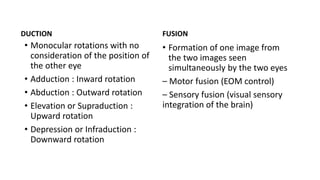
DUCTION
• Monocular rotations with no
consideration of the position of
the other eye
• Adduction : Inward rotation
• Abduction : Outward rotation
• Elevation or Supraduction :
Upward rotation
• Depression or Infraduction :
Downward rotation
FUSION
• Formation of one image from
the two images seen
simultaneously by the two eyes
– Motor fusion (EOM control)
– Sensory fusion (visual sensory
integration of the brain)
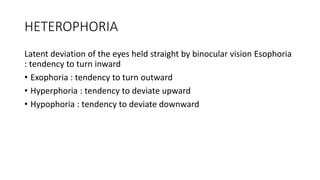
HETEROPHORIA
Latent deviation of the eyes held straight by binocular vision Esophoria
: tendency to turn inward
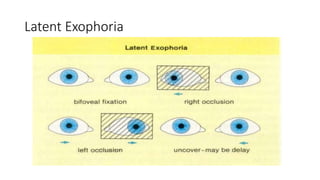
• Exophoria : tendency to turn outward
• Hyperphoria : tendency to deviate upward
• Hypophoria : tendency to deviate downward
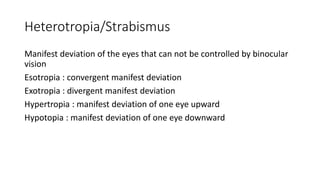
Heterotropia/Strabismus
Manifest deviation of the eyes that can not be controlled by binocular
vision
Esotropia : convergent manifest deviation
Exotropia : divergent manifest deviation
Hypertropia : manifest deviation of one eye upward
Hypotopia : manifest deviation of one eye downward
Definition of Other Terms
• Orthophoria : absence of any tendency of either eye to deviate when fusion is
suspended
• Primary deviation : deviation measured with the normal eye fixating and the eye with
the paretic muscle deviating
• Secondary deviation : deviation measured with the paretic eye fixing and the normal eye
deviating
• Prism Diopter - a unit of angular measurement used to characterize ocular deviations
• Torsion : rotation of the eye about its anteroposterior axis
• Intorsion : 12 o clock meridian turning toward the midline
• Extorsion : 12 o clock meridian turning away from the midline
• Conjugate Movement : Movement of the two eyes in the same direction at the same
time
• Vergences : Movement of two eyes in opposite directions
• Convergence : The eyes turn inwards
• Divergence : The eyes turn outwards
Synergistic and Antagonistic EOMS
• Sherrington’s Law - There is a reciprocal innervation of antagonistic
muscles.
– The antagonist relaxes as the agonist contracts eg. The right eye’s
right gaze would involve a contraction of the right lateral rectus and a
relaxation of the right medial rectus
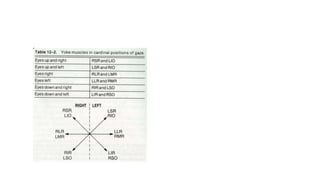
Yoke Muscles
• Hering’s Law : for movements of both eyes in the same direction, the
corresponding agonist muscles receive equal innervation
– e.g. When gazing right the right lateral rectus contracts along with the
left medial rectus
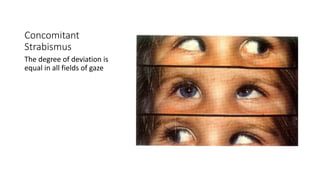
Concomitant
Strabismus
The degree of deviation is
equal in all fields of gaze
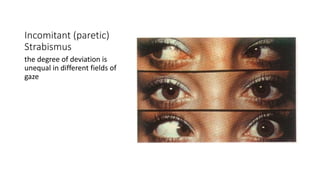
Incomitant (paretic)
Strabismus
the degree of deviation is
unequal in different fields of
gaze
Overshoot in Incomitant Esotropia
Amblyopia
Vision loss without any organic or anatomic ocular pathology
• Strabismic
• Refractive
• Deprivation
Sensory Changes in Strabismus
• Diplopia
• Suppression
• Amblyopia
• Anomalous Retinal Correspondence
• Eccentric Fixation
History
• Family History
• Age at Onset
• Type of Onset (gradual, sudden, intermittent)
• Type of Deviation (comitant or incomitant)
• Fixation (one eye or alternating)
EOM Function
Ocular Examination
• Visual acuity adapted for age
• Determination of Refractive Error
• Inspection
Examination Specific for Ocular Motility
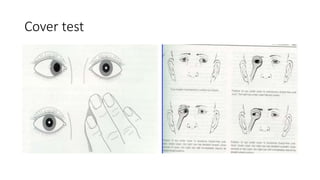
• Cover Test
• Uncover Test
• Alternate Cover Test
• Prism plus Cover Test
• Maddox Rod Test
• Hirschberg Test
• Krimsky Test
• Gaze Positions
• Convergence Measurement
Cover test
Latent Exophoria
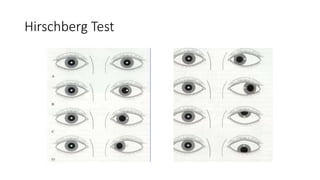
Hirschberg Test
Krimsky Test
Patient’s View in Maddox Rod Testing
Treatment of Amblyopia
• Occlusion Therapy
• Refraction
• Orthoptic Exercises
Surgical Management of Strabismus
• Resection - strengthening procedure
• Recession - weakening procedure
Squint Surgery

OCULAR MOTILITY.pptx

  • 1.
  • 2.
    Introduction • Under normalconditions, the image of the object of regard falls simultaneously on the fovea of each eye, when the eyes are in perfect alignment. Any deviation from perfect ocular alignment is known as “STRABISMUS.”
  • 3.
  • 5.
    DUCTION • Monocular rotationswith no consideration of the position of the other eye • Adduction : Inward rotation • Abduction : Outward rotation • Elevation or Supraduction : Upward rotation • Depression or Infraduction : Downward rotation
  • 6.
    DUCTION • Monocular rotationswith no consideration of the position of the other eye • Adduction : Inward rotation • Abduction : Outward rotation • Elevation or Supraduction : Upward rotation • Depression or Infraduction : Downward rotation FUSION • Formation of one image from the two images seen simultaneously by the two eyes – Motor fusion (EOM control) – Sensory fusion (visual sensory integration of the brain)
  • 7.
    HETEROPHORIA Latent deviation ofthe eyes held straight by binocular vision Esophoria : tendency to turn inward • Exophoria : tendency to turn outward • Hyperphoria : tendency to deviate upward • Hypophoria : tendency to deviate downward
  • 8.
    Heterotropia/Strabismus Manifest deviation ofthe eyes that can not be controlled by binocular vision Esotropia : convergent manifest deviation Exotropia : divergent manifest deviation Hypertropia : manifest deviation of one eye upward Hypotopia : manifest deviation of one eye downward
  • 9.
    Definition of OtherTerms • Orthophoria : absence of any tendency of either eye to deviate when fusion is suspended • Primary deviation : deviation measured with the normal eye fixating and the eye with the paretic muscle deviating • Secondary deviation : deviation measured with the paretic eye fixing and the normal eye deviating • Prism Diopter - a unit of angular measurement used to characterize ocular deviations • Torsion : rotation of the eye about its anteroposterior axis • Intorsion : 12 o clock meridian turning toward the midline • Extorsion : 12 o clock meridian turning away from the midline • Conjugate Movement : Movement of the two eyes in the same direction at the same time • Vergences : Movement of two eyes in opposite directions • Convergence : The eyes turn inwards • Divergence : The eyes turn outwards
  • 10.
    Synergistic and AntagonisticEOMS • Sherrington’s Law - There is a reciprocal innervation of antagonistic muscles. – The antagonist relaxes as the agonist contracts eg. The right eye’s right gaze would involve a contraction of the right lateral rectus and a relaxation of the right medial rectus
  • 11.
    Yoke Muscles • Hering’sLaw : for movements of both eyes in the same direction, the corresponding agonist muscles receive equal innervation – e.g. When gazing right the right lateral rectus contracts along with the left medial rectus
  • 12.
    Concomitant Strabismus The degree ofdeviation is equal in all fields of gaze
  • 13.
    Incomitant (paretic) Strabismus the degreeof deviation is unequal in different fields of gaze
  • 14.
  • 15.
    Amblyopia Vision loss withoutany organic or anatomic ocular pathology • Strabismic • Refractive • Deprivation
  • 16.
    Sensory Changes inStrabismus • Diplopia • Suppression • Amblyopia • Anomalous Retinal Correspondence • Eccentric Fixation
  • 17.
    History • Family History •Age at Onset • Type of Onset (gradual, sudden, intermittent) • Type of Deviation (comitant or incomitant) • Fixation (one eye or alternating)
  • 18.
  • 19.
    Ocular Examination • Visualacuity adapted for age • Determination of Refractive Error • Inspection
  • 20.
    Examination Specific forOcular Motility • Cover Test • Uncover Test • Alternate Cover Test • Prism plus Cover Test • Maddox Rod Test • Hirschberg Test • Krimsky Test • Gaze Positions • Convergence Measurement
  • 21.
  • 22.
  • 23.
  • 24.
  • 25.
    Patient’s View inMaddox Rod Testing
  • 26.
    Treatment of Amblyopia •Occlusion Therapy • Refraction • Orthoptic Exercises Surgical Management of Strabismus • Resection - strengthening procedure • Recession - weakening procedure
  • 27.