Fire Safety Training Presented by Environmental Safety Services, Division of Public Safety, Georgia Southern University
Fire Safety Training Dr. Francois Song Director, Environmental Safety Services Bob Seel Occupational Health/Safety Officer   (912) 486-7161
Fire Safety Training  What we are going to Learn: How fires start. What “fire” is. Leading causes of fire. Emergency procedures. Extinguishment Theory. Classification of fire. How to use a portable fire extinguisher. Reporting an emergency.
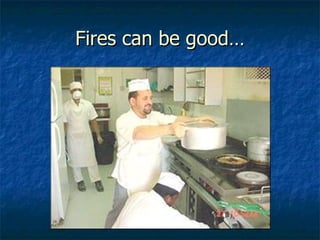
Fires can be good…
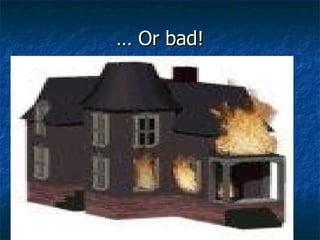
… Or bad!
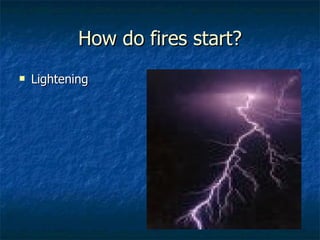
How do fires start? Lightening
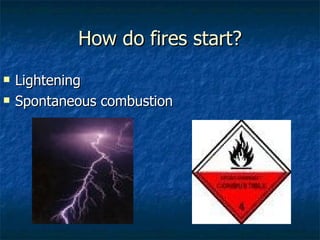
How do fires start? Lightening Spontaneous combustion
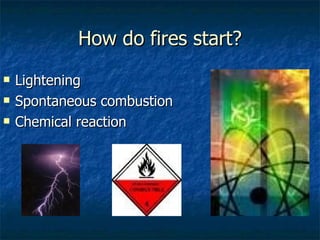
How do fires start? Lightening Spontaneous combustion Chemical reaction
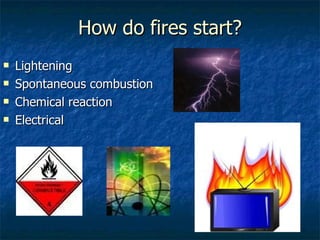
How do fires start? Lightening Spontaneous combustion Chemical reaction Electrical
How do fires start? People start fires Sometimes when they want to…
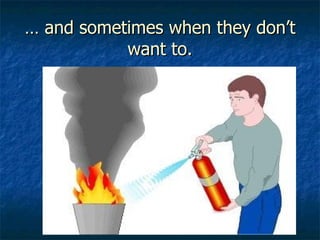
…  and sometimes when they don’t want to.
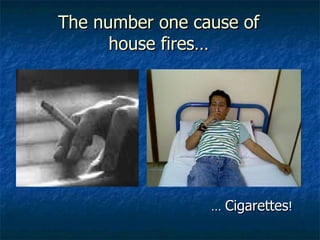
The number one cause of house fires… …  Cigarettes !
What is Fire ? A rapid chemical reaction The self-sustaining process of rapid oxidation of a fuel which produces heat and light.
Some causes of Fire  Electricity Space Heaters Housekeeping Construction Improper Storage Cleaning Supplies Combustible Liquids Flammable Liquids Equipment Carelessness   Unattended Cooking Prevention is the best way to fight a fire!
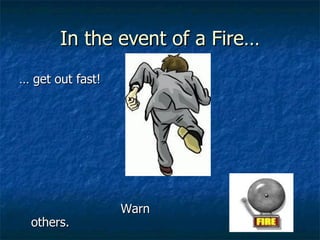
In the event of a Fire… …  get out fast! Warn others.
Emergency Procedures If there is a fire in your building, please proceed to the nearest exit and leave in an orderly manner. Remain outside until you are given the all clear by the fire or police department.
Be Prepared In your building, know the location of: 1. The nearest exit. 2. A secondary route of  escape. 3. The location of fire extinguishers. 4. The location of fire alarm pull stations.
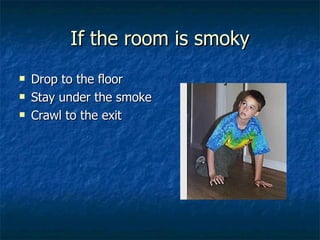
If the room is smoky Drop to the floor Stay under the smoke Crawl to the exit
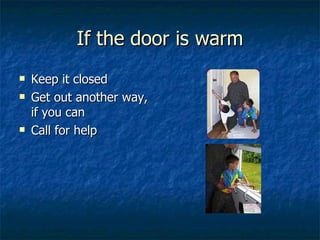
If the door is warm Keep it closed Get out another way, if you can Call for help
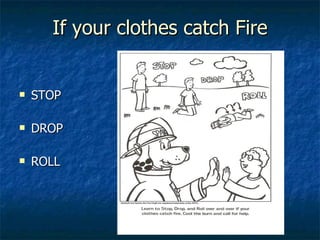
If your clothes catch Fire STOP DROP ROLL
In the event of a Fire Small fire Warn others Call for help Public Safety @ 5234 Emergency @ 9 –  911 Attempt to extinguish Use fire extinguisher if trained
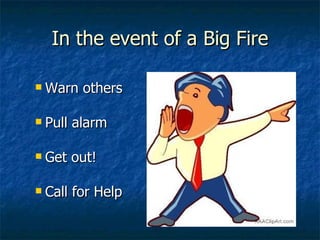
In the event of a Big Fire Warn others Pull alarm Get out! Call for Help
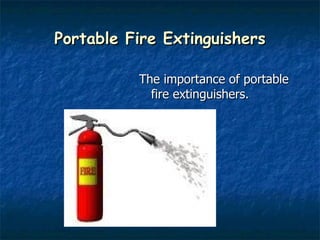
Portable Fire Extinguishers The importance of portable fire extinguishers.
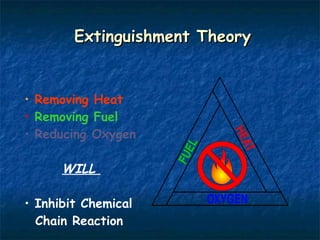
Extinguishment Theory Removing Heat Removing Fuel Reducing Oxygen WILL  Inhibit Chemical  Chain Reaction
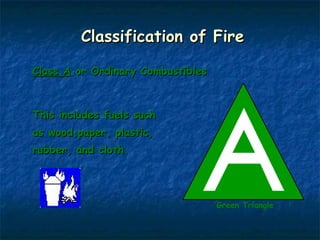
Classification of Fire Class A  or Ordinary Combustibles This includes fuels such  as wood,paper, plastic, rubber, and cloth. Green Triangle
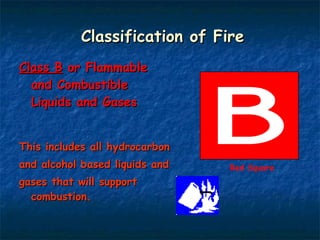
Classification of Fire Class B  or Flammable and Combustible Liquids and Gases This includes all hydrocarbon  and alcohol based liquids and  gases that will support combustion. Red Square
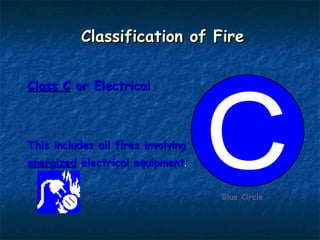
Classification of Fire Class C  or Electrical This includes all fires involving  energized  electrical equipment . Blue Circle
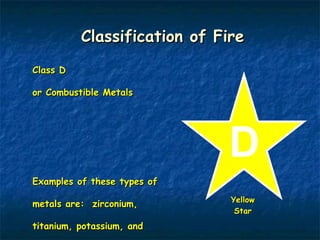
Classification of Fire Class D or Combustible Metals Examples of these types of metals are:  zirconium, titanium, potassium, and magnesium. D Yellow  Star
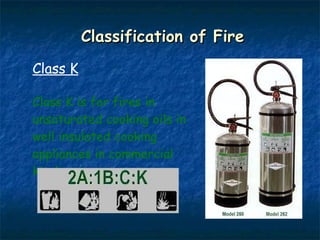
Classification of Fire Class K Class K is for fires in unsaturated cooking oils in well insulated cooking appliances in commercial kitchens.
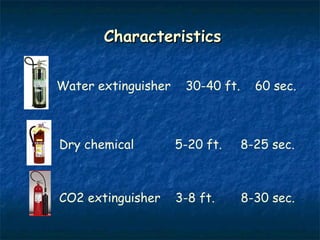
Characteristics Water extinguisher  30-40 ft.  60 sec. Dry chemical  5-20 ft.  8-25 sec. CO2 extinguisher  3-8 ft.  8-30 sec.
The Right Decision Making That “Right” Decision To use a Portable Fire Extinguisher You are trained in the use of extinguishers. You know what is burning. Fire is not spreading rapidly. Smoke and heat has not filled the area. You have a clear path of escape. Follow your instincts.
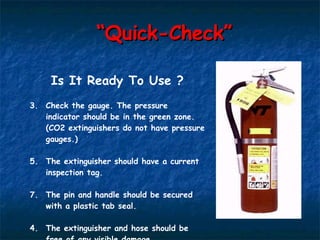
“ Quick-Check” Is It Ready To Use ? Check the gauge. The pressure indicator should be in the green zone. (CO2 extinguishers do not have pressure gauges.) The extinguisher should have a current inspection tag. The pin and handle should be secured with a plastic tab seal. 4. The extinguisher and hose should be free of any visible damage.
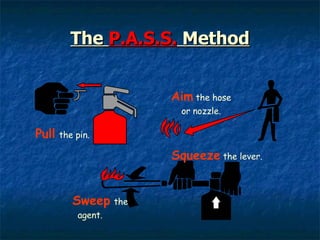
The  P.A.S.S.  Method Pull   the pin. Aim  the hose or nozzle. Squeeze  the lever. Sweep   the agent.
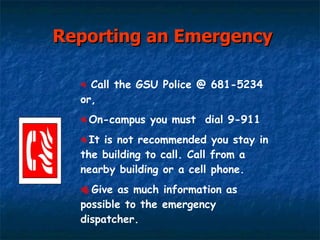
Reporting an Emergency Call the GSU Police @ 681-5234 or, On-campus you must  dial 9-911 It is not recommended you stay in the building to call. Call from a nearby building or a cell phone. Give as much information as possible to the emergency dispatcher.
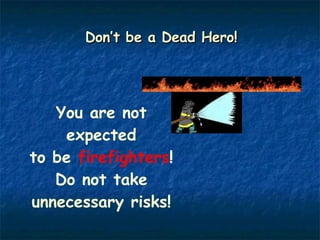
Don’t be a Dead Hero! You are not expected to be  firefighters !  Do not take unnecessary risks!
Thank You for your Time Any Questions? Contact the GSU Fire Safety Program at: 486-7161 Or visit us at: http://services.georgiasouthern.edu/ess/

Fire Safety Training

  • 1.
    Fire Safety TrainingPresented by Environmental Safety Services, Division of Public Safety, Georgia Southern University
  • 2.
    Fire Safety TrainingDr. Francois Song Director, Environmental Safety Services Bob Seel Occupational Health/Safety Officer (912) 486-7161
  • 3.
    Fire Safety Training What we are going to Learn: How fires start. What “fire” is. Leading causes of fire. Emergency procedures. Extinguishment Theory. Classification of fire. How to use a portable fire extinguisher. Reporting an emergency.
  • 4.
    Fires can begood…
  • 5.
  • 6.
    How do firesstart? Lightening
  • 7.
    How do firesstart? Lightening Spontaneous combustion
  • 8.
    How do firesstart? Lightening Spontaneous combustion Chemical reaction
  • 9.
    How do firesstart? Lightening Spontaneous combustion Chemical reaction Electrical
  • 10.
    How do firesstart? People start fires Sometimes when they want to…
  • 11.
    … andsometimes when they don’t want to.
  • 12.
    The number onecause of house fires… … Cigarettes !
  • 13.
    What is Fire? A rapid chemical reaction The self-sustaining process of rapid oxidation of a fuel which produces heat and light.
  • 14.
    Some causes ofFire Electricity Space Heaters Housekeeping Construction Improper Storage Cleaning Supplies Combustible Liquids Flammable Liquids Equipment Carelessness Unattended Cooking Prevention is the best way to fight a fire!
  • 15.
    In the eventof a Fire… … get out fast! Warn others.
  • 16.
    Emergency Procedures Ifthere is a fire in your building, please proceed to the nearest exit and leave in an orderly manner. Remain outside until you are given the all clear by the fire or police department.
  • 17.
    Be Prepared Inyour building, know the location of: 1. The nearest exit. 2. A secondary route of escape. 3. The location of fire extinguishers. 4. The location of fire alarm pull stations.
  • 18.
    If the roomis smoky Drop to the floor Stay under the smoke Crawl to the exit
  • 19.
    If the dooris warm Keep it closed Get out another way, if you can Call for help
  • 20.
    If your clothescatch Fire STOP DROP ROLL
  • 21.
    In the eventof a Fire Small fire Warn others Call for help Public Safety @ 5234 Emergency @ 9 – 911 Attempt to extinguish Use fire extinguisher if trained
  • 22.
    In the eventof a Big Fire Warn others Pull alarm Get out! Call for Help
  • 23.
    Portable Fire ExtinguishersThe importance of portable fire extinguishers.
  • 24.
    Extinguishment Theory RemovingHeat Removing Fuel Reducing Oxygen WILL Inhibit Chemical Chain Reaction
  • 25.
    Classification of FireClass A or Ordinary Combustibles This includes fuels such as wood,paper, plastic, rubber, and cloth. Green Triangle
  • 26.
    Classification of FireClass B or Flammable and Combustible Liquids and Gases This includes all hydrocarbon and alcohol based liquids and gases that will support combustion. Red Square
  • 27.
    Classification of FireClass C or Electrical This includes all fires involving energized electrical equipment . Blue Circle
  • 28.
    Classification of FireClass D or Combustible Metals Examples of these types of metals are: zirconium, titanium, potassium, and magnesium. D Yellow Star
  • 29.
    Classification of FireClass K Class K is for fires in unsaturated cooking oils in well insulated cooking appliances in commercial kitchens.
  • 30.
    Characteristics Water extinguisher 30-40 ft. 60 sec. Dry chemical 5-20 ft. 8-25 sec. CO2 extinguisher 3-8 ft. 8-30 sec.
  • 31.
    The Right DecisionMaking That “Right” Decision To use a Portable Fire Extinguisher You are trained in the use of extinguishers. You know what is burning. Fire is not spreading rapidly. Smoke and heat has not filled the area. You have a clear path of escape. Follow your instincts.
  • 32.
    “ Quick-Check” IsIt Ready To Use ? Check the gauge. The pressure indicator should be in the green zone. (CO2 extinguishers do not have pressure gauges.) The extinguisher should have a current inspection tag. The pin and handle should be secured with a plastic tab seal. 4. The extinguisher and hose should be free of any visible damage.
  • 33.
    The P.A.S.S. Method Pull the pin. Aim the hose or nozzle. Squeeze the lever. Sweep the agent.
  • 34.
    Reporting an EmergencyCall the GSU Police @ 681-5234 or, On-campus you must dial 9-911 It is not recommended you stay in the building to call. Call from a nearby building or a cell phone. Give as much information as possible to the emergency dispatcher.
  • 35.
    Don’t be aDead Hero! You are not expected to be firefighters ! Do not take unnecessary risks!
  • 36.
    Thank You foryour Time Any Questions? Contact the GSU Fire Safety Program at: 486-7161 Or visit us at: http://services.georgiasouthern.edu/ess/

Editor's Notes

  • #2 Welcome to Georgia Southern University’s Fire Safety Training class. Today’s class is presented by Environmental Safety Services, A division of Public Safety.