Springfield Clinic
Fire Safety Training Program
The fire safety training program is
designed to provide education and
training to all employees whose jobs
have been determined to put them at
risk of exposure to fire.
The Program Consists of Instructions
Followed by a Brief Test.
Upon Completion, an Employee
Verification Screen Will Be Completed,
Authenticated and Forwarded to Human
Resources to Be Maintained on File.
OSHA Requires That All Employees Be
Trained in Fire Safety Procedures
Annually.
This program contains general outlined
procedures, which are to be followed for
all fires. It is not intended to give you all
the answers.
The safety of personnel is the
responsibility of every employee.
Therefore, it is especially important that
all of us know exactly what to do in a
fire.
Remember:
Springfield Clinic employees are
responsible for our patients, visitors,
and our fellow co-workers.
Fire Plan
Some employees will have special
assignments in the event of a fire. It is
the responsibility of each employee to
consult his or her supervisor to
determine if they have assigned duties
in the event of a fire.
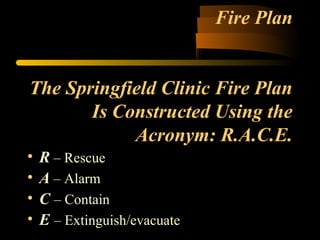
Fire Plan
The Springfield Clinic Fire Plan
Is Constructed Using the
Acronym: R.A.C.E.
• R – Rescue
• A – Alarm
• C – Contain
• E – Extinguish/evacuate
Rescue
Patients and individuals in immediate
danger should be moved to the closest
safe area such as the waiting room, an
office or in the hallway beyond the fire
doors. Stay calm, walk, and never run.
Alarm
Pull the fire alarm lever located nearest
to the fire.
As a rule, most fire alarm pull stations
are at or near exits from each floor.
Contain
Close all doors in the zone where the
fire is located and ensure that stairwells
and doors in all zones are closed to
prevent the spread of smoke.
Some smoke and fire doors will close
automatically.
Extinguish and/or Evacuate
Use a fire extinguisher to extinguish
the fire if you can do so without
placing yourself or the patients at risk.
Evacuate the area by following the
evacuation procedure.
Evacuation Plan
Attempt to extinguish the fire by using the fire
extinguishers provided in all areas (or use
materials handy and suitable for the type of fire).
Under no circumstances should an employee
place himself/herself or the patients at risk. It is
more important that a rapid, safe evacuation of
the building occur.
Evacuation Plan (Cont.)
1. Evacuation routes are posted in each area.
2. Patients and employees are to gather in
groups.
3. Evacuate by way of stairwells. Do not use
elevators for evacuation.
Evacuation Plan (Cont.)
4. Each patient care area or department will gather
at a designated safe area away from the
building.
5. The nursing staff is responsible for the number
of patients in their immediate area. Directors
will be responsible for the number of employees
in their department.
Important Note!!
Non-ambulatory patients are to be
moved to a safe area, such as a
hallway or stairwell behind fire doors.
It may be necessary to carry non-
ambulatory patients down the
stairways to safety. The “Dr. Atlas”
team and fire department personnel
will be available for this assignment.
Additional Reminders…
• If circumstances warrant, disconnect
oxygen, fans, ventilating equipment,
gas and electrical equipment.
• Check to see that exits are free and
unobstructed.
• Reassure patients. Be sure that all are
accounted for.
Use of Telephone
Do not use the telephone except when
necessary to give important
information to the switchboard. Do
not call the switchboard for
information. Information will be
disseminated as necessary for your
safety by those in charge.
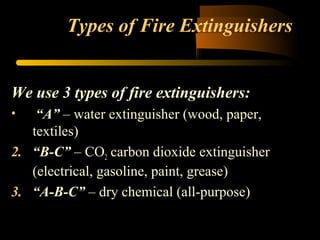
Types of Fire Extinguishers
We use 3 types of fire extinguishers:
• “A” – water extinguisher (wood, paper,
textiles)
2. “B-C” – CO2 carbon dioxide extinguisher
(electrical, gasoline, paint, grease)
3. “A-B-C” – dry chemical (all-purpose)
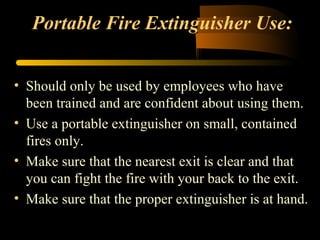
Portable Fire Extinguisher Use:
• Should only be used by employees who have
been trained and are confident about using them.
• Use a portable extinguisher on small, contained
fires only.
• Make sure that the nearest exit is clear and that
you can fight the fire with your back to the exit.
• Make sure that the proper extinguisher is at hand.
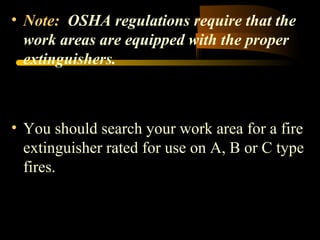
• Note: OSHA regulations require that the
work areas are equipped with the proper
extinguishers.
• You should search your work area for a fire
extinguisher rated for use on A, B or C type
fires.
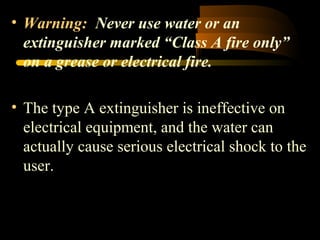
• Warning: Never use water or an
extinguisher marked “Class A fire only”
on a grease or electrical fire.
• The type A extinguisher is ineffective on
electrical equipment, and the water can
actually cause serious electrical shock to the
user.
Operating a Portable Fire
Extinguisher:
Regardless of the type of extinguisher, there
are certain features that make them similar.
All have the following:
• A carrying handle or operating lever/button
• A locking pin
• A pressure gauge or indicator
• Discharge nozzle or horn
• A label bearing type and operating instructions
Extinguisher Technique
All A, B-C, and ABC Extinguishers Work in the
Same Manner. This Operating Technique Is
Called PASS:
• P – PULL the pin
• A – AIM the nozzle low
• S – SQUEEZE the lever
• S – SWEEP from side to side
P.A.S.S.
• After the fire has been extinguished, watch
the area. If the fire starts up again, repeat
the PASS technique.
• It is essential to follow this technique
because all portable extinguishers operate
for a brief period of time, usually from 8 to
30 seconds.
Click here to take quiz

Fire Safety Training

  • 1.
    Springfield Clinic Fire SafetyTraining Program The fire safety training program is designed to provide education and training to all employees whose jobs have been determined to put them at risk of exposure to fire.
  • 2.
    The Program Consistsof Instructions Followed by a Brief Test. Upon Completion, an Employee Verification Screen Will Be Completed, Authenticated and Forwarded to Human Resources to Be Maintained on File. OSHA Requires That All Employees Be Trained in Fire Safety Procedures Annually.
  • 3.
    This program containsgeneral outlined procedures, which are to be followed for all fires. It is not intended to give you all the answers. The safety of personnel is the responsibility of every employee. Therefore, it is especially important that all of us know exactly what to do in a fire.
  • 4.
    Remember: Springfield Clinic employeesare responsible for our patients, visitors, and our fellow co-workers.
  • 5.
    Fire Plan Some employeeswill have special assignments in the event of a fire. It is the responsibility of each employee to consult his or her supervisor to determine if they have assigned duties in the event of a fire.
  • 6.
    Fire Plan The SpringfieldClinic Fire Plan Is Constructed Using the Acronym: R.A.C.E. • R – Rescue • A – Alarm • C – Contain • E – Extinguish/evacuate
  • 7.
    Rescue Patients and individualsin immediate danger should be moved to the closest safe area such as the waiting room, an office or in the hallway beyond the fire doors. Stay calm, walk, and never run.
  • 8.
    Alarm Pull the firealarm lever located nearest to the fire. As a rule, most fire alarm pull stations are at or near exits from each floor.
  • 9.
    Contain Close all doorsin the zone where the fire is located and ensure that stairwells and doors in all zones are closed to prevent the spread of smoke. Some smoke and fire doors will close automatically.
  • 10.
    Extinguish and/or Evacuate Usea fire extinguisher to extinguish the fire if you can do so without placing yourself or the patients at risk. Evacuate the area by following the evacuation procedure.
  • 11.
    Evacuation Plan Attempt toextinguish the fire by using the fire extinguishers provided in all areas (or use materials handy and suitable for the type of fire). Under no circumstances should an employee place himself/herself or the patients at risk. It is more important that a rapid, safe evacuation of the building occur.
  • 12.
    Evacuation Plan (Cont.) 1.Evacuation routes are posted in each area. 2. Patients and employees are to gather in groups. 3. Evacuate by way of stairwells. Do not use elevators for evacuation.
  • 13.
    Evacuation Plan (Cont.) 4.Each patient care area or department will gather at a designated safe area away from the building. 5. The nursing staff is responsible for the number of patients in their immediate area. Directors will be responsible for the number of employees in their department.
  • 14.
    Important Note!! Non-ambulatory patientsare to be moved to a safe area, such as a hallway or stairwell behind fire doors. It may be necessary to carry non- ambulatory patients down the stairways to safety. The “Dr. Atlas” team and fire department personnel will be available for this assignment.
  • 15.
    Additional Reminders… • Ifcircumstances warrant, disconnect oxygen, fans, ventilating equipment, gas and electrical equipment. • Check to see that exits are free and unobstructed. • Reassure patients. Be sure that all are accounted for.
  • 16.
    Use of Telephone Donot use the telephone except when necessary to give important information to the switchboard. Do not call the switchboard for information. Information will be disseminated as necessary for your safety by those in charge.
  • 17.
    Types of FireExtinguishers We use 3 types of fire extinguishers: • “A” – water extinguisher (wood, paper, textiles) 2. “B-C” – CO2 carbon dioxide extinguisher (electrical, gasoline, paint, grease) 3. “A-B-C” – dry chemical (all-purpose)
  • 18.
    Portable Fire ExtinguisherUse: • Should only be used by employees who have been trained and are confident about using them. • Use a portable extinguisher on small, contained fires only. • Make sure that the nearest exit is clear and that you can fight the fire with your back to the exit. • Make sure that the proper extinguisher is at hand.
  • 19.
    • Note: OSHAregulations require that the work areas are equipped with the proper extinguishers. • You should search your work area for a fire extinguisher rated for use on A, B or C type fires.
  • 20.
    • Warning: Neveruse water or an extinguisher marked “Class A fire only” on a grease or electrical fire. • The type A extinguisher is ineffective on electrical equipment, and the water can actually cause serious electrical shock to the user.
  • 21.
    Operating a PortableFire Extinguisher: Regardless of the type of extinguisher, there are certain features that make them similar. All have the following: • A carrying handle or operating lever/button • A locking pin • A pressure gauge or indicator • Discharge nozzle or horn • A label bearing type and operating instructions
  • 22.
    Extinguisher Technique All A,B-C, and ABC Extinguishers Work in the Same Manner. This Operating Technique Is Called PASS: • P – PULL the pin • A – AIM the nozzle low • S – SQUEEZE the lever • S – SWEEP from side to side
  • 23.
    P.A.S.S. • After thefire has been extinguished, watch the area. If the fire starts up again, repeat the PASS technique. • It is essential to follow this technique because all portable extinguishers operate for a brief period of time, usually from 8 to 30 seconds.
  • 24.
    Click here totake quiz