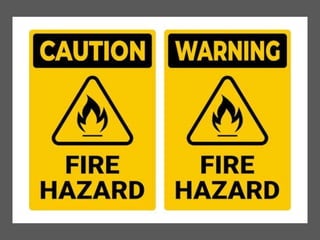
FIRE HAZARDS
• Any conditions that
favor any growth or
development of fire.
• Requirements are
fuel, oxygen and
heat
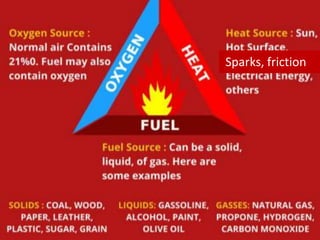
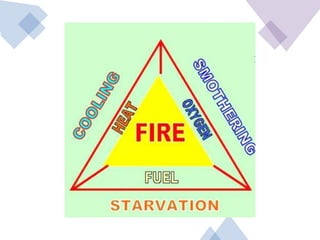
The elements that
make up a fire are
described in the
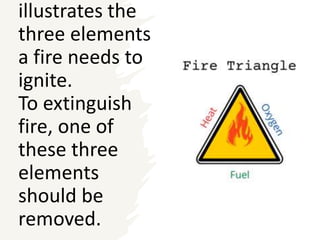
Fire Triangle
Sparks, friction
illustrates the
three elements
a fire needs to
ignite.
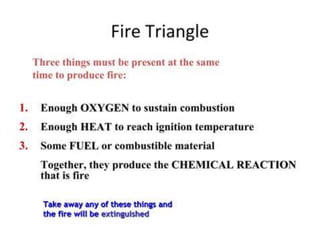
To extinguish
fire, one of
these three
elements
should be
removed.
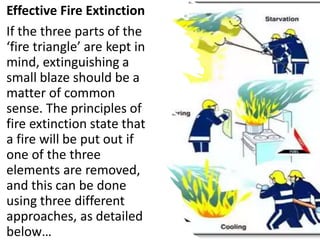
Effective Fire Extinction
If the three parts of the
‘fire triangle’ are kept in
mind, extinguishing a
small blaze should be a
matter of common
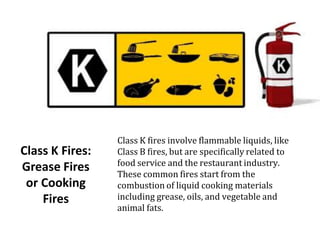
sense. The principles of
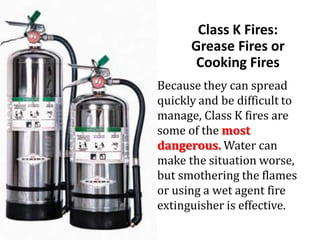
fire extinction state that
a fire will be put out if
one of the three
elements are removed,
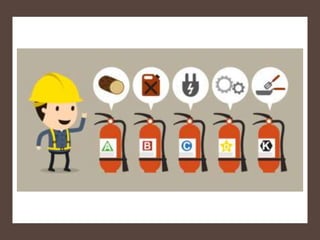
and this can be done
using three different
approaches, as detailed
below…
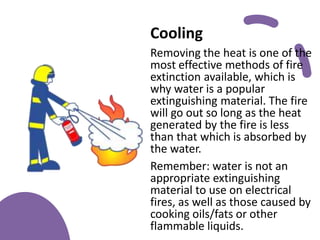
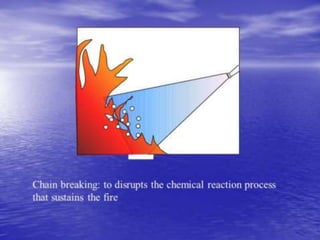
Cooling
Removing the heat is one of the
most effective methods of fire
extinction available, which is
why water is a popular
extinguishing material. The fire
will go out so long as the heat
generated by the fire is less
than that which is absorbed by
the water.
Remember: water is not an
appropriate extinguishing
material to use on electrical
fires, as well as those caused by
cooking oils/fats or other
flammable liquids.
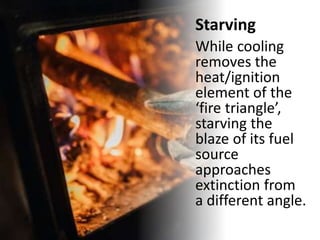
Starving
While cooling
removes the
heat/ignition
element of the
‘fire triangle’,
starving the
blaze of its fuel
source
approaches
extinction from
a different angle.
Starving
A raging fire will
burn itself out if it
runs out of
flammable
materials, such as a
bonfire out in the
open that isn’t in
contact with any
other wood or dry
grass. Similarly, a
gas fire will
immediately
extinguish if the gas
supply is cut off.
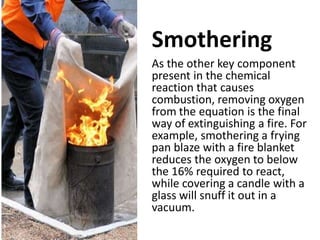
Smothering
As the other key component
present in the chemical
reaction that causes
combustion, removing oxygen
from the equation is the final
way of extinguishing a fire. For
example, smothering a frying
pan blaze with a fire blanket
reduces the oxygen to below
the 16% required to react,
while covering a candle with a
glass will snuff it out in a
vacuum.
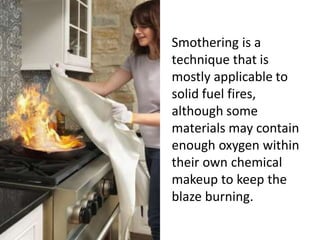
Smothering is a
technique that is
mostly applicable to
solid fuel fires,
although some
materials may contain
enough oxygen within
their own chemical
makeup to keep the
blaze burning.
Can we always use water
to extinguish fire?
Can we always use the
same fire extinguisher to
extinguish fire?
five
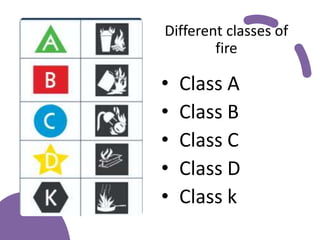
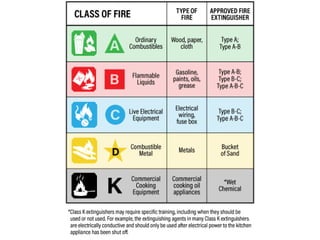
Different classes of
fire
• Class A
• Class B
• Class C
• Class D
• Class k
Class A
Fires:
“Ordinary”
Fires
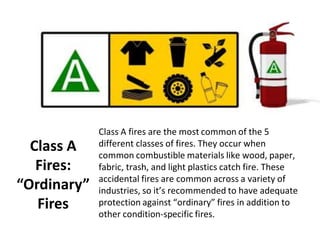
Class A fires are the most common of the 5
different classes of fires. They occur when
common combustible materials like wood, paper,
fabric, trash, and light plastics catch fire. These
accidental fires are common across a variety of
industries, so it’s recommended to have adequate
protection against “ordinary” fires in addition to
other condition-specific fires.
Class A Fires:
“Ordinary” Fires
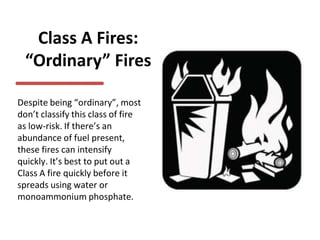
Despite being “ordinary”, most
don’t classify this class of fire
as low-risk. If there’s an
abundance of fuel present,
these fires can intensify
quickly. It’s best to put out a
Class A fire quickly before it
spreads using water or
monoammonium phosphate.
Class B Fires:
Liquids &
Gases
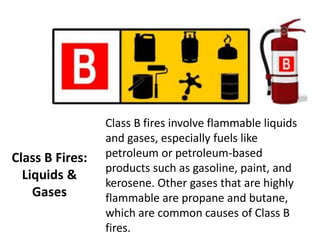
Class B fires involve flammable liquids
and gases, especially fuels like
petroleum or petroleum-based
products such as gasoline, paint, and
kerosene. Other gases that are highly
flammable are propane and butane,
which are common causes of Class B
fires.
Class B Fires:
Liquids & Gases
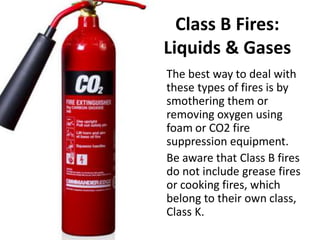
The best way to deal with
these types of fires is by
smothering them or
removing oxygen using
foam or CO2 fire
suppression equipment.
Be aware that Class B fires
do not include grease fires
or cooking fires, which
belong to their own class,
Class K.
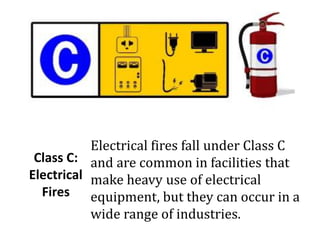
Class C:
Electrical
Fires
Electrical fires fall under Class C
and are common in facilities that
make heavy use of electrical
equipment, but they can occur in a
wide range of industries.
Class C:
Electrical Fires
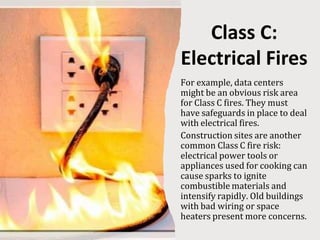
For example, data centers
might be an obvious risk area
for Class C fires. They must
have safeguards in place to deal
with electrical fires.
Construction sites are another
common Class C fire risk:
electrical power tools or
appliances used for cooking can
cause sparks to ignite
combustible materials and
intensify rapidly. Old buildings
with bad wiring or space
heaters present more concerns.
Class C: Electrical
Fires
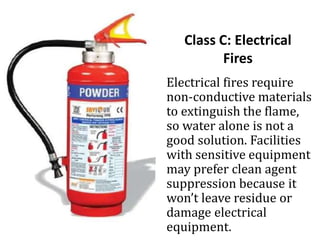
Electrical fires require
non-conductive materials
to extinguish the flame,
so water alone is not a
good solution. Facilities
with sensitive equipment
may prefer clean agent
suppression because it
won’t leave residue or
damage electrical
equipment.
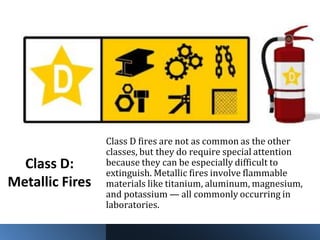
Class D:
Metallic Fires
Class D fires are not as common as the other
classes, but they do require special attention
because they can be especially difficult to
extinguish. Metallic fires involve flammable
materials like titanium, aluminum, magnesium,
and potassium — all commonly occurring in
laboratories.
Class D: Metallic Fires
Class D fires cannot be
addressed with water,
as this can exacerbate
the fire and would be
potentially dangerous.
Dry powder agents are
the best solution for
smothering the flames
and limiting damage to
property or people.
Class K Fires:
Grease Fires
or Cooking
Fires
Class K fires involve flammable liquids, like
Class B fires, but are specifically related to
food service and the restaurant industry.
These common fires start from the
combustion of liquid cooking materials
including grease, oils, and vegetable and
animal fats.
Class K Fires:
Grease Fires or
Cooking Fires
Because they can spread
quickly and be difficult to
manage, Class K fires are
some of the most
dangerous. Water can
make the situation worse,
but smothering the flames
or using a wet agent fire
extinguisher is effective.
Now that we
understand how
each fire starts, we
can prepare for
how to fight them
— or better yet,
prevent them from
happening in the
first place.
What is a fire
extinguisher?
How do we use a
fire extinguisher?
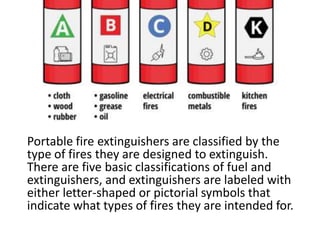
Portable fire extinguishers are classified by the
type of fires they are designed to extinguish.
There are five basic classifications of fuel and
extinguishers, and extinguishers are labeled with
either letter-shaped or pictorial symbols that
indicate what types of fires they are intended for.
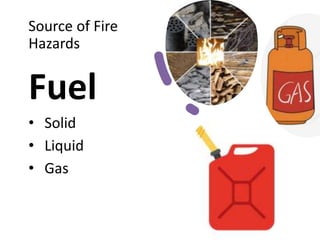
Source of Fire
Hazards
Fuel
• Solid
• Liquid
• Gas
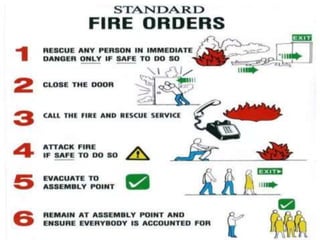
What to do if
a Fire Starts
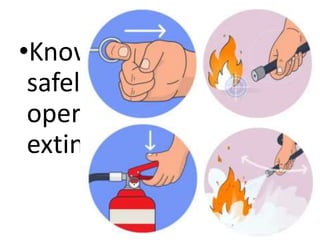
•Know how to
safely
operate a fire
extinguisher
What to do if a Fire Starts:
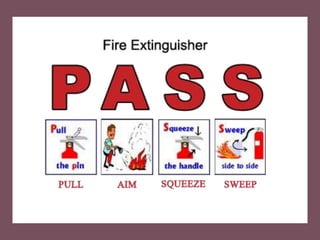
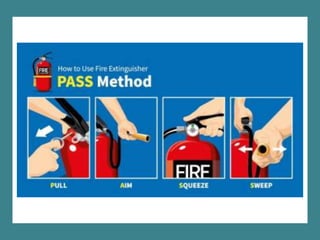
• Know how to safely operate a fire extinguisher
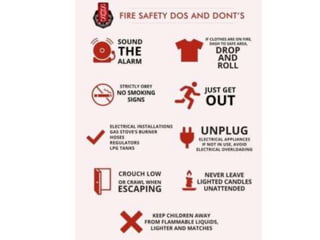
• Remember to GET OUT, STAY OUT and CALL 9-1-1 or your local emergency phone
number.
• Yell "Fire!" several times and go outside right away. If you live in a building with
elevators, use the stairs. Leave all your things where they are and save yourself.
• If closed doors or handles are warm or smoke blocks your primary escape route, use
your second way out. Never open doors that are warm to the touch.
• If you must escape through smoke, get low and go under the smoke to your exit. Close
doors behind you.
• If smoke, heat or flames block your exit routes, stay in the room with doors closed.
Place a wet towel under the door and call the fire department or 9-1-1. Open a window
and wave a brightly colored cloth or flashlight to signal for help.
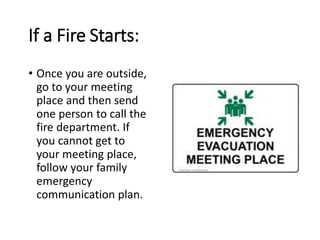
• Once you are outside, go to your meeting place and then send one person to call the
fire department. If you cannot get to your meeting place, follow your family emergency
communication plan.
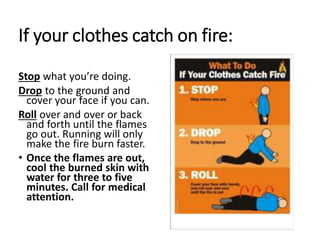
If your clothes catch on fire:
• Stop what you’re doing.
• Drop to the ground and cover your face if you can.
• Roll over and over or back and forth until the
flames go out. Running will only make the fire
burn faster.
• Once the flames are out, cool the burned skin
with water for three to five minutes. Call for
medical attention.
Fire Safety Signs
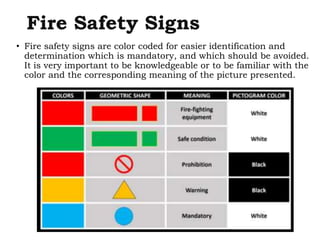
• Fire safety signs are color coded for easier identification and
determination which is mandatory, and which should be avoided.
It is very important to be knowledgeable or to be familiar with the
color and the corresponding meaning of the picture presented.
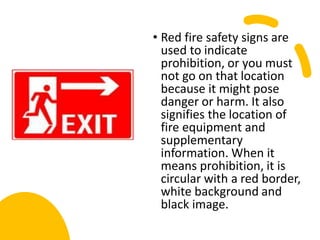
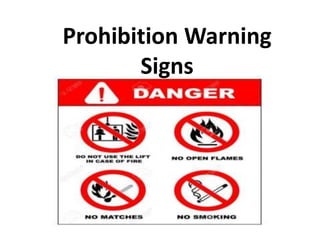
• Red fire safety signs are
used to indicate
prohibition, or you must
not go on that location
because it might pose
danger or harm. It also
signifies the location of
fire equipment and
supplementary
information. When it
means prohibition, it is
circular with a red border,
white background and
black image.
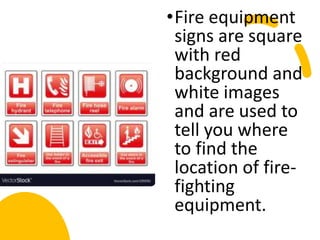
•Fire equipment
signs are square
with red
background and
white images
and are used to
tell you where
to find the
location of fire-
fighting
equipment.
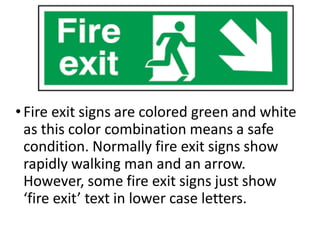
•Fire exit signs are colored green and white
as this color combination means a safe
condition. Normally fire exit signs show
rapidly walking man and an arrow.
However, some fire exit signs just show
‘fire exit’ text in lower case letters.
Prohibition Warning
Signs
• Blue fire safety signs
are used to indicate a
mandatory action or
a must do action.
These blue signs
mean that you need
to do the appropriate
action for your safety.
Blue fire safety signs
are circular in shape
and feature a white
graphic or white text.
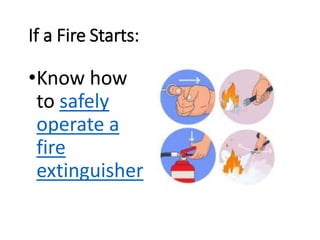
If a Fire Starts:
•Know how
to safely
operate a
fire
extinguisher
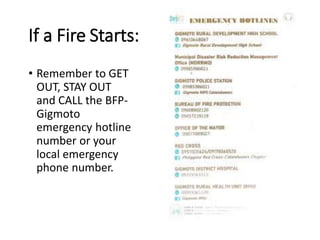
If a Fire Starts:
• Remember to GET
OUT, STAY OUT
and CALL the BFP-
Gigmoto
emergency hotline
number or your
local emergency
phone number.
If a Fire Starts:
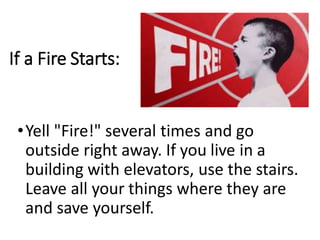
•Yell "Fire!" several times and go
outside right away. If you live in a
building with elevators, use the stairs.
Leave all your things where they are
and save yourself.
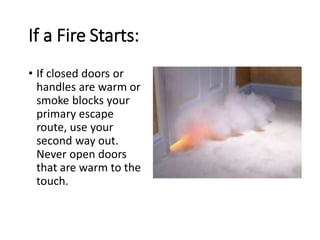
If a Fire Starts:
• If closed doors or
handles are warm or
smoke blocks your
primary escape
route, use your
second way out.
Never open doors
that are warm to the
touch.
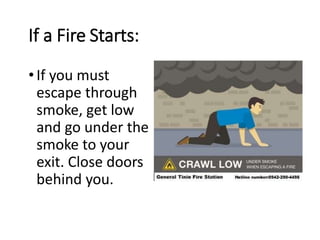
If a Fire Starts:
•If you must
escape through
smoke, get low
and go under the
smoke to your
exit. Close doors
behind you.
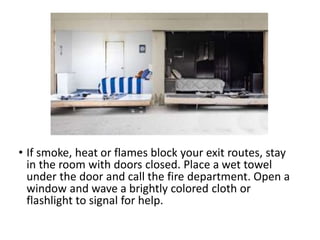
• If smoke, heat or flames block your exit routes, stay
in the room with doors closed. Place a wet towel
under the door and call the fire department. Open a
window and wave a brightly colored cloth or
flashlight to signal for help.
If a Fire Starts:
• Once you are outside,
go to your meeting
place and then send
one person to call the
fire department. If
you cannot get to
your meeting place,
follow your family
emergency
communication plan.
If your clothes catch on fire:
Stop what you’re doing.
Drop to the ground and
cover your face if you can.
Roll over and over or back
and forth until the flames
go out. Running will only
make the fire burn faster.
• Once the flames are out,
cool the burned skin with
water for three to five
minutes. Call for medical
attention.

fire hazard ppt final disaster rrr.pdf.pptx

  • 2.
    FIRE HAZARDS • Anyconditions that favor any growth or development of fire. • Requirements are fuel, oxygen and heat
  • 3.
    The elements that makeup a fire are described in the Fire Triangle
  • 4.
  • 6.
    illustrates the three elements afire needs to ignite. To extinguish fire, one of these three elements should be removed.
  • 7.
    Effective Fire Extinction Ifthe three parts of the ‘fire triangle’ are kept in mind, extinguishing a small blaze should be a matter of common sense. The principles of fire extinction state that a fire will be put out if one of the three elements are removed, and this can be done using three different approaches, as detailed below…
  • 9.
    Cooling Removing the heatis one of the most effective methods of fire extinction available, which is why water is a popular extinguishing material. The fire will go out so long as the heat generated by the fire is less than that which is absorbed by the water. Remember: water is not an appropriate extinguishing material to use on electrical fires, as well as those caused by cooking oils/fats or other flammable liquids.
  • 10.
    Starving While cooling removes the heat/ignition elementof the ‘fire triangle’, starving the blaze of its fuel source approaches extinction from a different angle.
  • 11.
    Starving A raging firewill burn itself out if it runs out of flammable materials, such as a bonfire out in the open that isn’t in contact with any other wood or dry grass. Similarly, a gas fire will immediately extinguish if the gas supply is cut off.
  • 12.
    Smothering As the otherkey component present in the chemical reaction that causes combustion, removing oxygen from the equation is the final way of extinguishing a fire. For example, smothering a frying pan blaze with a fire blanket reduces the oxygen to below the 16% required to react, while covering a candle with a glass will snuff it out in a vacuum.
  • 13.
    Smothering is a techniquethat is mostly applicable to solid fuel fires, although some materials may contain enough oxygen within their own chemical makeup to keep the blaze burning.
  • 16.
    Can we alwaysuse water to extinguish fire? Can we always use the same fire extinguisher to extinguish fire?
  • 17.
  • 18.
    Different classes of fire •Class A • Class B • Class C • Class D • Class k
  • 19.
    Class A Fires: “Ordinary” Fires Class Afires are the most common of the 5 different classes of fires. They occur when common combustible materials like wood, paper, fabric, trash, and light plastics catch fire. These accidental fires are common across a variety of industries, so it’s recommended to have adequate protection against “ordinary” fires in addition to other condition-specific fires.
  • 20.
    Class A Fires: “Ordinary”Fires Despite being “ordinary”, most don’t classify this class of fire as low-risk. If there’s an abundance of fuel present, these fires can intensify quickly. It’s best to put out a Class A fire quickly before it spreads using water or monoammonium phosphate.
  • 21.
    Class B Fires: Liquids& Gases Class B fires involve flammable liquids and gases, especially fuels like petroleum or petroleum-based products such as gasoline, paint, and kerosene. Other gases that are highly flammable are propane and butane, which are common causes of Class B fires.
  • 22.
    Class B Fires: Liquids& Gases The best way to deal with these types of fires is by smothering them or removing oxygen using foam or CO2 fire suppression equipment. Be aware that Class B fires do not include grease fires or cooking fires, which belong to their own class, Class K.
  • 23.
    Class C: Electrical Fires Electrical firesfall under Class C and are common in facilities that make heavy use of electrical equipment, but they can occur in a wide range of industries.
  • 24.
    Class C: Electrical Fires Forexample, data centers might be an obvious risk area for Class C fires. They must have safeguards in place to deal with electrical fires. Construction sites are another common Class C fire risk: electrical power tools or appliances used for cooking can cause sparks to ignite combustible materials and intensify rapidly. Old buildings with bad wiring or space heaters present more concerns.
  • 25.
    Class C: Electrical Fires Electricalfires require non-conductive materials to extinguish the flame, so water alone is not a good solution. Facilities with sensitive equipment may prefer clean agent suppression because it won’t leave residue or damage electrical equipment.
  • 26.
    Class D: Metallic Fires ClassD fires are not as common as the other classes, but they do require special attention because they can be especially difficult to extinguish. Metallic fires involve flammable materials like titanium, aluminum, magnesium, and potassium — all commonly occurring in laboratories.
  • 27.
    Class D: MetallicFires Class D fires cannot be addressed with water, as this can exacerbate the fire and would be potentially dangerous. Dry powder agents are the best solution for smothering the flames and limiting damage to property or people.
  • 28.
    Class K Fires: GreaseFires or Cooking Fires Class K fires involve flammable liquids, like Class B fires, but are specifically related to food service and the restaurant industry. These common fires start from the combustion of liquid cooking materials including grease, oils, and vegetable and animal fats.
  • 29.
    Class K Fires: GreaseFires or Cooking Fires Because they can spread quickly and be difficult to manage, Class K fires are some of the most dangerous. Water can make the situation worse, but smothering the flames or using a wet agent fire extinguisher is effective.
  • 30.
    Now that we understandhow each fire starts, we can prepare for how to fight them — or better yet, prevent them from happening in the first place.
  • 32.
    What is afire extinguisher? How do we use a fire extinguisher?
  • 33.
    Portable fire extinguishersare classified by the type of fires they are designed to extinguish. There are five basic classifications of fuel and extinguishers, and extinguishers are labeled with either letter-shaped or pictorial symbols that indicate what types of fires they are intended for.
  • 38.
    Source of Fire Hazards Fuel •Solid • Liquid • Gas
  • 41.
    What to doif a Fire Starts
  • 42.
    •Know how to safely operatea fire extinguisher
  • 43.
    What to doif a Fire Starts: • Know how to safely operate a fire extinguisher • Remember to GET OUT, STAY OUT and CALL 9-1-1 or your local emergency phone number. • Yell "Fire!" several times and go outside right away. If you live in a building with elevators, use the stairs. Leave all your things where they are and save yourself. • If closed doors or handles are warm or smoke blocks your primary escape route, use your second way out. Never open doors that are warm to the touch. • If you must escape through smoke, get low and go under the smoke to your exit. Close doors behind you. • If smoke, heat or flames block your exit routes, stay in the room with doors closed. Place a wet towel under the door and call the fire department or 9-1-1. Open a window and wave a brightly colored cloth or flashlight to signal for help. • Once you are outside, go to your meeting place and then send one person to call the fire department. If you cannot get to your meeting place, follow your family emergency communication plan.
  • 44.
    If your clothescatch on fire: • Stop what you’re doing. • Drop to the ground and cover your face if you can. • Roll over and over or back and forth until the flames go out. Running will only make the fire burn faster. • Once the flames are out, cool the burned skin with water for three to five minutes. Call for medical attention.
  • 45.
    Fire Safety Signs •Fire safety signs are color coded for easier identification and determination which is mandatory, and which should be avoided. It is very important to be knowledgeable or to be familiar with the color and the corresponding meaning of the picture presented.
  • 46.
    • Red firesafety signs are used to indicate prohibition, or you must not go on that location because it might pose danger or harm. It also signifies the location of fire equipment and supplementary information. When it means prohibition, it is circular with a red border, white background and black image.
  • 47.
    •Fire equipment signs aresquare with red background and white images and are used to tell you where to find the location of fire- fighting equipment.
  • 48.
    •Fire exit signsare colored green and white as this color combination means a safe condition. Normally fire exit signs show rapidly walking man and an arrow. However, some fire exit signs just show ‘fire exit’ text in lower case letters.
  • 49.
  • 51.
    • Blue firesafety signs are used to indicate a mandatory action or a must do action. These blue signs mean that you need to do the appropriate action for your safety. Blue fire safety signs are circular in shape and feature a white graphic or white text.
  • 52.
    If a FireStarts: •Know how to safely operate a fire extinguisher
  • 53.
    If a FireStarts: • Remember to GET OUT, STAY OUT and CALL the BFP- Gigmoto emergency hotline number or your local emergency phone number.
  • 54.
    If a FireStarts: •Yell "Fire!" several times and go outside right away. If you live in a building with elevators, use the stairs. Leave all your things where they are and save yourself.
  • 55.
    If a FireStarts: • If closed doors or handles are warm or smoke blocks your primary escape route, use your second way out. Never open doors that are warm to the touch.
  • 56.
    If a FireStarts: •If you must escape through smoke, get low and go under the smoke to your exit. Close doors behind you.
  • 57.
    • If smoke,heat or flames block your exit routes, stay in the room with doors closed. Place a wet towel under the door and call the fire department. Open a window and wave a brightly colored cloth or flashlight to signal for help.
  • 58.
    If a FireStarts: • Once you are outside, go to your meeting place and then send one person to call the fire department. If you cannot get to your meeting place, follow your family emergency communication plan.
  • 59.
    If your clothescatch on fire: Stop what you’re doing. Drop to the ground and cover your face if you can. Roll over and over or back and forth until the flames go out. Running will only make the fire burn faster. • Once the flames are out, cool the burned skin with water for three to five minutes. Call for medical attention.