General Fire Safety Presented by: Steve N. Bertonaschi
OverviewObjectivesFire Extinguisher IntroTypes of Fire ExtinguishersFire Extinguisher LabelingFire Extinguisher MaintenanceUsing a Fire Extinguisher – P.A.S.S.Summary
ObjectiveIntended Learning Objective: By the end of this training you will know how to utilize a fire extinguisher properly for displacing a small fire.
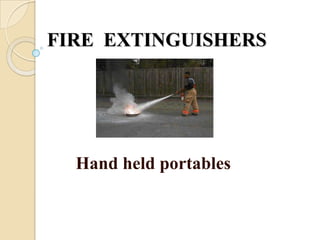
FIRE  EXTINGUISHERSHand held portables
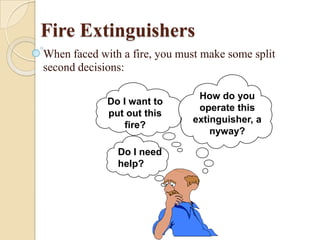
Fire ExtinguishersWhen faced with a fire, you must make some split second decisions:How do you operate this extinguisher, anyway?Do I want to put out this fire?Do I need help?
Fire ExtinguishersWhen seconds count……Even a willing operator might not be successfully able to extinguish a fire unless they know how to actuate the available equipment.
Fire ExtinguishersTYPES OF FIRE There are three common types or classes of fires and extinguishers that correspond. However, there are many more types of extinguishers:Class A: Solids such as paper, wood, plastic etc (Common)
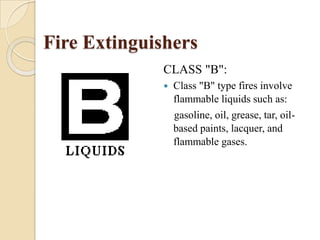
Class B: Flammable liquids such as paraffin, petrol, oil etc (Common)
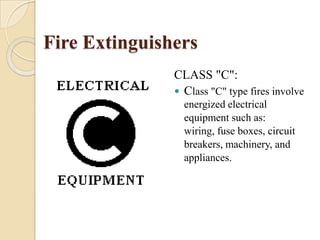
Class C: Fires involving electrical apparatus (Common)
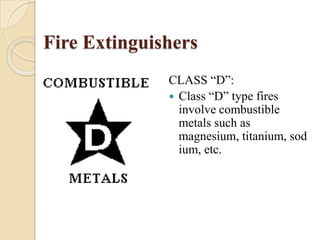
Class D: Metals such as aluminum, magnesium, titanium etc
Class E: Gases such as propane, butane, methane etc
Class F: Cooking oil & fat etc
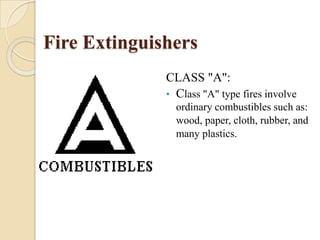
Class K: For use on major fires are kitchen firesFire ExtinguishersCLASS "A": Class "A" type fires involve ordinary combustibles such as: wood, paper, cloth, rubber, and many plastics.Fire ExtinguishersCLASS "B": Class "B" type fires involve flammable liquids such as:    gasoline, oil, grease, tar, oil-based paints, lacquer, and flammable gases.
Fire ExtinguishersCLASS "C": Class "C" type fires involve energized electrical equipment such as: wiring, fuse boxes, circuit breakers, machinery, and appliances.
Fire ExtinguishersCLASS “D”:Class “D” type fires involve combustible metals such as magnesium, titanium, sodium, etc.
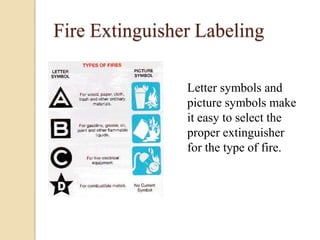
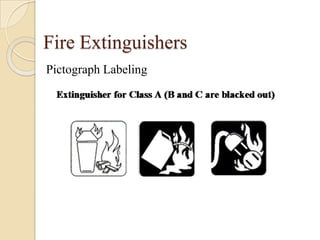
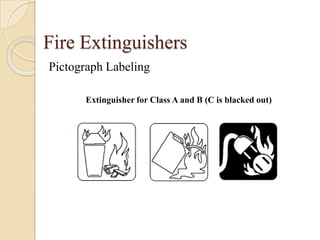
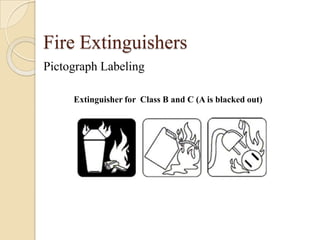
Fire Extinguisher LabelingLetter symbols and picture symbols make it easy to select the proper extinguisher for the type of fire.
Fire ExtinguishersNewer extinguishers now carry aPictograph Labeling System
Fire ExtinguishersPictograph Labeling
Fire ExtinguishersPictograph LabelingExtinguisher for Class A and B (C is blacked out)
Fire ExtinguishersPictograph LabelingExtinguisher for  Class B and C (A is blacked out)
Fire ExtinguishersMaintenance 	The best piece of equipment will not operate if it is not recharged and maintained properly.
	History has proven that nearly every fire extinguisher failure can be traced back to human negligence.Fire ExtinguishersSafety Tips: Portable Fire ExtinguishersThis is a brief overview of the important points of using a portable fire extinguisher.
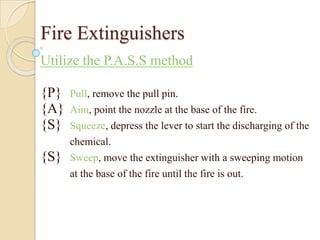
Fire can be devastating, but when used properly, a fire extinguisher can save lives.Fire ExtinguishersUsing a Fire ExtinguisherP.A.S.S. is an acronym for the 4-step method for operating most common fire extinguishers.Fire ExtinguishersUtilize the P.A.S.S method{P} 	Pull, remove the pull pin.{A}	Aim, point the nozzle at the base of the fire.{S}	Squeeze, depress the lever to start the discharging of the 	chemical.{S}	Sweep, move the extinguisher with a sweeping motion 	at the base of the fire until the fire is out.
Fire ExtinguishersRemember……….	The average hand portable extinguisher will only operate for 30 seconds ----- and there is NO TIME	to learn during an actual emergency.

General Fire Safety

  • 1.
    General Fire SafetyPresented by: Steve N. Bertonaschi
  • 2.
    OverviewObjectivesFire Extinguisher IntroTypesof Fire ExtinguishersFire Extinguisher LabelingFire Extinguisher MaintenanceUsing a Fire Extinguisher – P.A.S.S.Summary
  • 3.
    ObjectiveIntended Learning Objective:By the end of this training you will know how to utilize a fire extinguisher properly for displacing a small fire.
  • 4.
  • 5.
    Fire ExtinguishersWhen facedwith a fire, you must make some split second decisions:How do you operate this extinguisher, anyway?Do I want to put out this fire?Do I need help?
  • 6.
    Fire ExtinguishersWhen secondscount……Even a willing operator might not be successfully able to extinguish a fire unless they know how to actuate the available equipment.
  • 7.
    Fire ExtinguishersTYPES OFFIRE There are three common types or classes of fires and extinguishers that correspond. However, there are many more types of extinguishers:Class A: Solids such as paper, wood, plastic etc (Common)
  • 8.
    Class B: Flammableliquids such as paraffin, petrol, oil etc (Common)
  • 9.
    Class C: Firesinvolving electrical apparatus (Common)
  • 10.
    Class D: Metalssuch as aluminum, magnesium, titanium etc
  • 11.
    Class E: Gasessuch as propane, butane, methane etc
  • 12.
    Class F: Cookingoil & fat etc
  • 13.
    Class K: Foruse on major fires are kitchen firesFire ExtinguishersCLASS "A": Class "A" type fires involve ordinary combustibles such as: wood, paper, cloth, rubber, and many plastics.Fire ExtinguishersCLASS "B": Class "B" type fires involve flammable liquids such as: gasoline, oil, grease, tar, oil-based paints, lacquer, and flammable gases.
  • 14.
    Fire ExtinguishersCLASS "C":Class "C" type fires involve energized electrical equipment such as: wiring, fuse boxes, circuit breakers, machinery, and appliances.
  • 15.
    Fire ExtinguishersCLASS “D”:Class“D” type fires involve combustible metals such as magnesium, titanium, sodium, etc.
  • 16.
    Fire Extinguisher LabelingLettersymbols and picture symbols make it easy to select the proper extinguisher for the type of fire.
  • 17.
    Fire ExtinguishersNewer extinguishersnow carry aPictograph Labeling System
  • 18.
  • 19.
    Fire ExtinguishersPictograph LabelingExtinguisherfor Class A and B (C is blacked out)
  • 20.
    Fire ExtinguishersPictograph LabelingExtinguisherfor Class B and C (A is blacked out)
  • 21.
    Fire ExtinguishersMaintenance Thebest piece of equipment will not operate if it is not recharged and maintained properly.
  • 22.
    History has proventhat nearly every fire extinguisher failure can be traced back to human negligence.Fire ExtinguishersSafety Tips: Portable Fire ExtinguishersThis is a brief overview of the important points of using a portable fire extinguisher.
  • 23.
    Fire can bedevastating, but when used properly, a fire extinguisher can save lives.Fire ExtinguishersUsing a Fire ExtinguisherP.A.S.S. is an acronym for the 4-step method for operating most common fire extinguishers.Fire ExtinguishersUtilize the P.A.S.S method{P} Pull, remove the pull pin.{A} Aim, point the nozzle at the base of the fire.{S} Squeeze, depress the lever to start the discharging of the chemical.{S} Sweep, move the extinguisher with a sweeping motion at the base of the fire until the fire is out.
  • 24.
    Fire ExtinguishersRemember………. The averagehand portable extinguisher will only operate for 30 seconds ----- and there is NO TIME to learn during an actual emergency.