GROUP MEMBERS
 IRFAN
AHMAD
 MUHAMMAD
JUNAID
 MUHAMMAD
ISHAQ
 ALAM NASIR
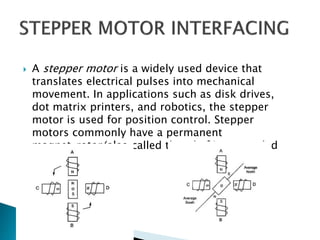
 A stepper motor is a widely used device that
translates electrical pulses into mechanical
movement. In applications such as disk drives,
dot matrix printers, and robotics, the stepper
motor is used for position control. Stepper
motors commonly have a permanent
magnet rotor (also called the shaft) surrounded
by a stator.
 The most common stepper motors have four
stator windings that are paired with a center-
tapped common. This type of stepper motor
is commonly referred to as a. four-phase or
unipolar stepper motor. The center tap allows
a change of current direction in each of two
coils when a winding is grounded, thereby
resulting in a polarity change of the stator .
 where poles of the same polarity repel.
 and opposite poles attract.
 The direction of the rotation is dictated by
the stator poles.
 The direction of the rotation is dictated by the
stator poles.
 The stator poles are determined by the current
sent through the wire coils.
 As the direction of the current is changed, the
polarity is also changed causing the reverse
motion of the rotor. The stepper motor discussed
here has a total of 6 leads: 4 leads representing
the four stator windings and 2 commons for the
center-tapped leads. As the sequence of power is
applied to each stator winding
 the rotor will rotate.
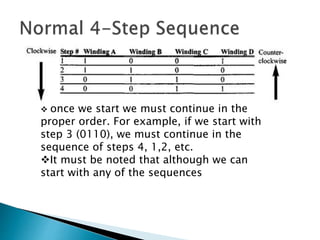
 once we start we must continue in the
proper order. For example, if we start with
step 3 (0110), we must continue in the
sequence of steps 4, 1,2, etc.
It must be noted that although we can
start with any of the sequences
 How much movement is
associated with a single step?
This depends on the internal
construction of the motor, in
particular the number of teeth
on the stator and the rotor.
The step angle is the minimum
degree of rotation associated
with a single step. Various
motors have different step
angles. It shows some step
angles for various motors. ,
notice the term steps per
revolution. This is the total
number of steps needed to
rotate one complete rotation or
360 degrees (e.g., 180 steps x
2 degrees =360
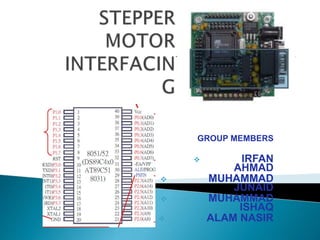
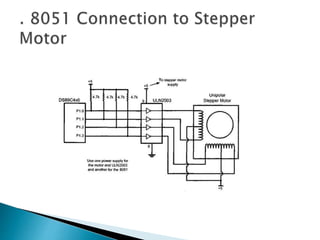
 The four leads of the stator winding are controlled by four
bits of the 8051 port (Pl.O
- P1.3).
 However, since the 8051 lacks sufficient current to drive
the stepper motor windings,
 we must use a driver such as the ULN2003 to energize the
stator.
 Insteadof the ULN2003, we could have used transistors as
drivers,
 notice that if transistors are used as drivers, we must also
use diodes to take care of inductive current generated
when the coil is turned off.
 One reason that
using the ULN2003 is preferable to the use of transistors
as drivers is that the ULN2003 has an internal diode to
take care of back EMF
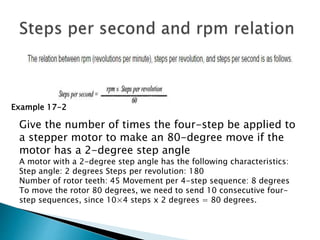
Example 17-2
Give the number of times the four-step be applied to
a stepper motor to make an 80-degree move if the
motor has a 2-degree step angle
A motor with a 2-degree step angle has the following characteristics:
Step angle: 2 degrees Steps per revolution: 180
Number of rotor teeth: 45 Movement per 4-step sequence: 8 degrees
To move the rotor 80 degrees, we need to send 10 consecutive four-
step sequences, since 10×4 steps x 2 degrees = 80 degrees.
Motor speed
The motor speed, measured in steps per second
(steps/s), is a function of the switching rate
Holding torque
the amount of torque, from an external source,
required to break away the shaft from its holding
position. This is measured with rated voltage and
current applied to the motor.” The unit of torque is
ounce-inch (or kg-cm)
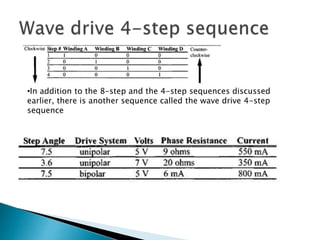
•In addition to the 8-step and the 4-step sequences discussed
earlier, there is another sequence called the wave drive 4-step
sequence
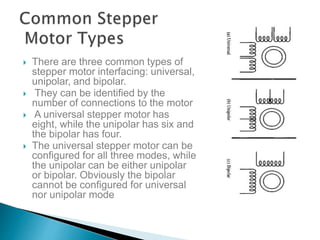
 There are three common types of
stepper motor interfacing: universal,
unipolar, and bipolar.
 They can be identified by the
number of connections to the motor
 A universal stepper motor has
eight, while the unipolar has six and
the bipolar has four.
 The universal stepper motor can be
configured for all three modes, while
the unipolar can be either unipolar
or bipolar. Obviously the bipolar
cannot be configured for universal
nor unipolar mode
 shows an interface to a
unipolar stepper motor
using transistors. Diodes
are used to reduce the back
EMF spike created when the
coils are energized and de-
energized
 TIP transistors can be used
to supply higher current to
the motor
 These transistors can
accommodate higher
voltages and currents.
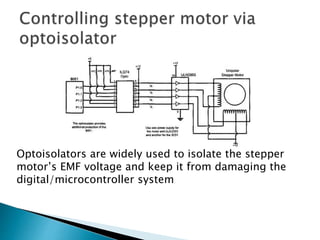
Optoisolators are widely used to isolate the stepper
motor’s EMF voltage and keep it from damaging the
digital/microcontroller system
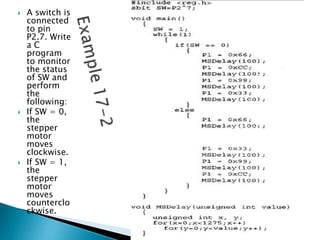
 A switch is
connected
to pin
P2.7. Write
a C
program
to monitor
the status
of SW and
perform
the
following:
 If SW = 0,
the
stepper
motor
moves
clockwise.
 If SW = 1,
the
stepper
motor
moves
counterclo
ckwise.
Stepper motor

Stepper motor

  • 1.
    GROUP MEMBERS  IRFAN AHMAD MUHAMMAD JUNAID  MUHAMMAD ISHAQ  ALAM NASIR
  • 2.
     A steppermotor is a widely used device that translates electrical pulses into mechanical movement. In applications such as disk drives, dot matrix printers, and robotics, the stepper motor is used for position control. Stepper motors commonly have a permanent magnet rotor (also called the shaft) surrounded by a stator.
  • 3.
     The mostcommon stepper motors have four stator windings that are paired with a center- tapped common. This type of stepper motor is commonly referred to as a. four-phase or unipolar stepper motor. The center tap allows a change of current direction in each of two coils when a winding is grounded, thereby resulting in a polarity change of the stator .  where poles of the same polarity repel.  and opposite poles attract.  The direction of the rotation is dictated by the stator poles.
  • 4.
     The directionof the rotation is dictated by the stator poles.  The stator poles are determined by the current sent through the wire coils.  As the direction of the current is changed, the polarity is also changed causing the reverse motion of the rotor. The stepper motor discussed here has a total of 6 leads: 4 leads representing the four stator windings and 2 commons for the center-tapped leads. As the sequence of power is applied to each stator winding  the rotor will rotate.
  • 5.
     once westart we must continue in the proper order. For example, if we start with step 3 (0110), we must continue in the sequence of steps 4, 1,2, etc. It must be noted that although we can start with any of the sequences
  • 6.
     How muchmovement is associated with a single step? This depends on the internal construction of the motor, in particular the number of teeth on the stator and the rotor. The step angle is the minimum degree of rotation associated with a single step. Various motors have different step angles. It shows some step angles for various motors. , notice the term steps per revolution. This is the total number of steps needed to rotate one complete rotation or 360 degrees (e.g., 180 steps x 2 degrees =360
  • 7.
     The fourleads of the stator winding are controlled by four bits of the 8051 port (Pl.O - P1.3).  However, since the 8051 lacks sufficient current to drive the stepper motor windings,  we must use a driver such as the ULN2003 to energize the stator.  Insteadof the ULN2003, we could have used transistors as drivers,  notice that if transistors are used as drivers, we must also use diodes to take care of inductive current generated when the coil is turned off.  One reason that using the ULN2003 is preferable to the use of transistors as drivers is that the ULN2003 has an internal diode to take care of back EMF
  • 9.
    Example 17-2 Give thenumber of times the four-step be applied to a stepper motor to make an 80-degree move if the motor has a 2-degree step angle A motor with a 2-degree step angle has the following characteristics: Step angle: 2 degrees Steps per revolution: 180 Number of rotor teeth: 45 Movement per 4-step sequence: 8 degrees To move the rotor 80 degrees, we need to send 10 consecutive four- step sequences, since 10×4 steps x 2 degrees = 80 degrees.
  • 10.
    Motor speed The motorspeed, measured in steps per second (steps/s), is a function of the switching rate Holding torque the amount of torque, from an external source, required to break away the shaft from its holding position. This is measured with rated voltage and current applied to the motor.” The unit of torque is ounce-inch (or kg-cm)
  • 11.
    •In addition tothe 8-step and the 4-step sequences discussed earlier, there is another sequence called the wave drive 4-step sequence
  • 12.
     There arethree common types of stepper motor interfacing: universal, unipolar, and bipolar.  They can be identified by the number of connections to the motor  A universal stepper motor has eight, while the unipolar has six and the bipolar has four.  The universal stepper motor can be configured for all three modes, while the unipolar can be either unipolar or bipolar. Obviously the bipolar cannot be configured for universal nor unipolar mode
  • 13.
     shows aninterface to a unipolar stepper motor using transistors. Diodes are used to reduce the back EMF spike created when the coils are energized and de- energized  TIP transistors can be used to supply higher current to the motor  These transistors can accommodate higher voltages and currents.
  • 14.
    Optoisolators are widelyused to isolate the stepper motor’s EMF voltage and keep it from damaging the digital/microcontroller system
  • 15.
     A switchis connected to pin P2.7. Write a C program to monitor the status of SW and perform the following:  If SW = 0, the stepper motor moves clockwise.  If SW = 1, the stepper motor moves counterclo ckwise.