

“ Listening to the Boss” Stephen Schueler  Procter and Gamble 1 June’2’ 2010
Key for business is to keep the BOSS happy!
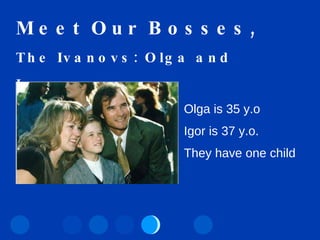
Meet Our Bosses, The Ivanovs: Olga and Igor… Olga is   35 y.o Igor is 37 y.o. They have one child
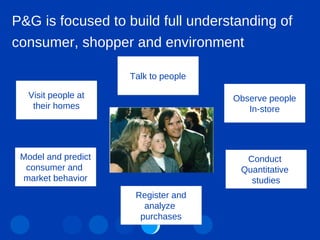
P&G is focused to build full understanding of consumer, shopper and environment Talk to people Visit people at their homes Observe people In-store Register and analyze  purchases Conduct  Quantitative  studies Model and predict consumer and  market behavior
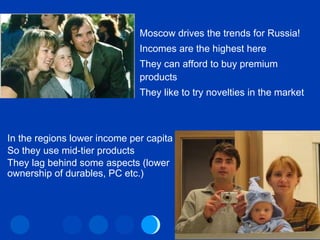
Life in Moscow Moscow drives the trends for Russia! Incomes are the highest here They can afford to buy premium products They like to try novelties in the market In the regions lower income per capita So they use mid-tier products They lag behind some aspects (lower ownership of durables, PC etc.)
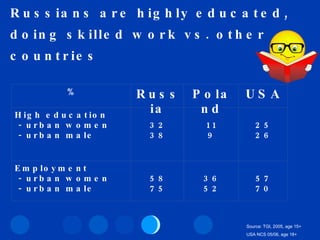
Russians are highly educated, doing skilled work vs. other countries Source: TGI, 2005, age 15+ USA NCS 05/06, age 18+ % Russia Poland USA High education  - urban women - urban male 32 38 11 9 25 26 Employment  - urban women - urban male 58 75 36 52 57 70
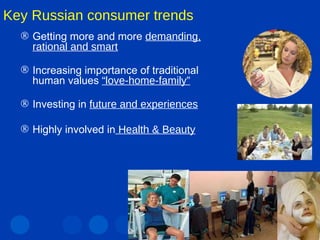
Key Russian consumer trends   Getting more and more  demanding, rational and smart Increasing importance of traditional human values  “love-home-family” Investing in  future and experiences Highly involved in  Health & Beauty
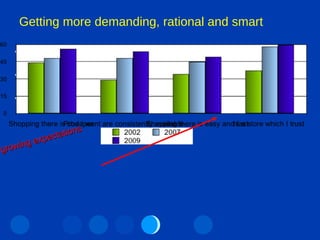
Getting more demanding, rational and smart Rely only on personal budget Quality, reliability and customization  Shopping is planning and value growing expectations
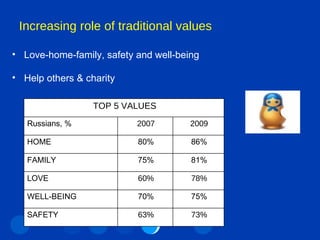
Increasing role of traditional values Love-home-family, safety and well-being Help others & charity TOP 5 VALUES Russians, % 2007 2009 HOME 80% 86% FAMILY  75% 81% LOVE 60% 78% WELL-BEING 70% 75% SAFETY 63% 73%
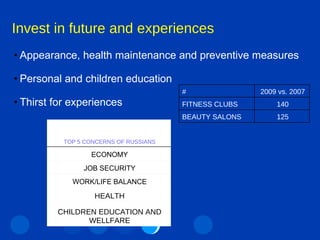
Invest in future and experiences   Appearance, health maintenance and preventive measures Personal and children education Thirst for experiences # 2009 vs. 2007 FITNESS CLUBS 140 BEAUTY SALONS 125 TOP 5 CONCERNS OF RUSSIANS ECONOMY JOB SECURITY WORK/LIFE BALANCE HEALTH CHILDREN EDUCATION AND WELLFARE
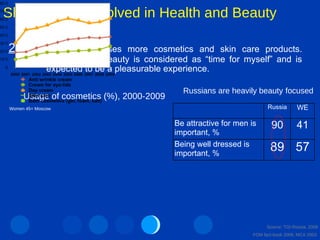
She is highly involved in Health and Beauty 2009   –  She  purchases more cosmetics and skin care products. Shopping for beauty is considered as “time for myself” and is expected to be a pleasurable experience.  Source: TGI Russia, 2009 FOM fact-book 2009, MCA 2003   Usage of cosmetics (%), 2000-2009 Women 45+ Moscow Russians are heavily beauty   focused 57 89 Being well dressed is important, % 41 90 Be attractive for men is important, % WE Russia
What did we learn regarding  Crisis Impact on Russian Consumer?
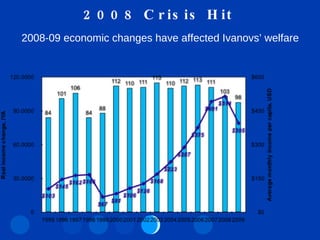
2008 Crisis Hit 2008-09 economic changes have affected Ivanovs’ welfare
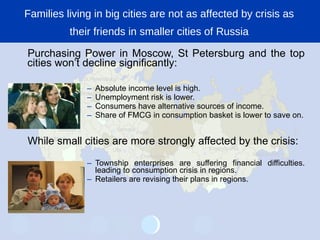
Purchasing Power in Moscow, St Petersburg and the top cities won’t decline significantly: Absolute income level is high. Unemployment risk is lower. Consumers have alternative sources of income.  Share of FMCG in consumption basket is lower to save on. While small cities are more strongly affected by the crisis: Township enterprises are suffering financial difficulties. leading to consumption crisis in regions. Retailers are revising their plans in regions. Families living in big cities are not as affected by crisis as their friends in smaller cities of Russia Novosibirsk Krasnoyarsk Vladivostok Ekaterinburg Volgograd Saratov Moscow St.Petersburg Kazan Samara Izhevsk Omsk Chelyabinsk Perm Ufa
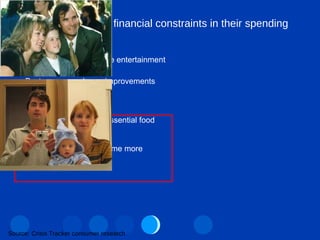
The Ivanovs reflected financial constraints in their spending behavior Cut down on out of home entertainment Postpone some home improvements Cut travelling Started saving on non-essential food and clothes Shopping behavior became more rational Source: Crisis Tracker consumer research
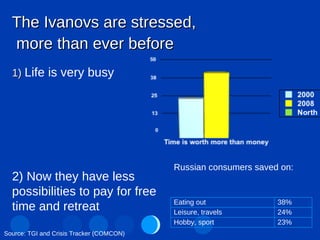
The Ivanovs are stressed,  more than ever before 1)  Life is very busy 2) Now they have less possibilities to pay for free time and retreat Source: TGI and Crisis Tracker (COMCON) Russian consumers saved on: Eating out 38% Leisure, travels 24% Hobby, sport 23%
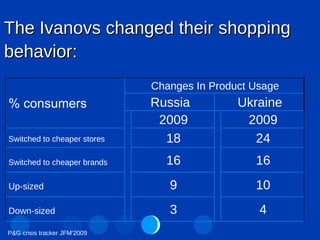
The Ivanovs changed their shopping behavior:   P&G crisis tracker JFM’2009 % consumers Changes In Product Usage Russia Ukraine 2009 2009 Switched to cheaper stores 18 24 Switched to cheaper brands  16 16 Up-sized 9 10 Down-sized 3 4
How could we together improve the lives of Russian Consumers post-crisis?
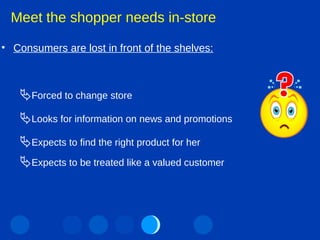
Forced to change store Looks for information on news and promotions Expects to find the right product for her   Expects to be treated like a valued customer  Meet the shopper needs in-store Consumers are lost in front of the shelves:
Opportunity for joint collaboration between Retailers and  Suppliers to improve in-store experience: 1. Help to organize departments & categories according to SHOPPER NEEDS 2. Drive PRODUCT AVAILABILITY on-shelf
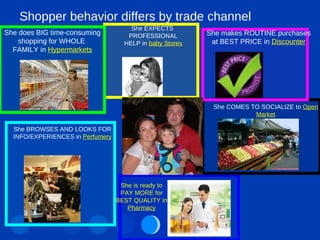
Shopper behavior differs by trade channel She does BIG time-consuming shopping for WHOLE  FAMILY in  Hypermarkets She EXPECTS  PROFESSIONAL HELP in  baby Stores She BROWSES AND LOOKS FOR INFO/EXPERIENCES in  Perfumery She COMES TO SOCIALIZE to  Open Market She makes ROUTINE purchases at BEST PRICE in  Discounter She is ready to PAY MORE for BEST QUALITY in  Pharmacy
Design right Shopping Experience for each channel Relevant Assortment Right Shelf based on Shopper Decision Tree Right Category Adjacency within the Department Right Navigation Right Promotional Strategy
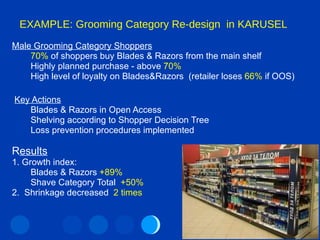
EXAMPLE: Grooming Category Re-design  in KARUSEL Male Grooming Category Shoppers 70%  of shoppers buy Blades & Razors from the main shelf Highly planned purchase - above  70%   High level of loyalty on Blades&Razors  (retailer loses  66%  if OOS) Key Actions Blades & Razors in Open Access  Shelving according to Shopper Decision Tree Loss prevention procedures implemented  R esults 1. Growth index: Blades & Razors  +89% Shave Category Total  +50% 2.  Shrinkage decreased  2 times
Improving Product Availability In-Store Shelf OOS reduction  Joint Root Cause Analysis Category-specific approach Leverage technology to optimize Supply Advanced EDI; GDSN Reduce Shrinkage Focus on high pilferage items/ implement “Roadmap”
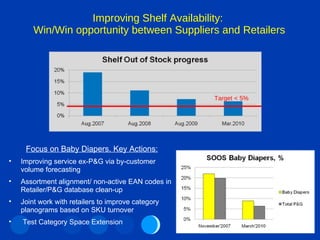
Improving Shelf Availability:  Win/Win opportunity between Suppliers and Retailers Target < 5% Focus on Baby Diapers. Key Actions: Improving service ex-P&G via by-customer volume forecasting Assortment alignment/ non-active EAN codes in Retailer/P&G database clean-up Joint work with retailers to improve category planograms based on SKU turnover Test Category Space Extension
Enabling Technologies in Joint Integration Areas P&G and METRO:  Integration of advanced  EDI  into  daily business procedures 3 full-time employees  work-reduction (Joint value for P&G and METRO); Assured  data accuracy  in invoicing documents Service level increase by 14 points Implementation of advanced electronic data flow Switch to Direct Deliveries via MGL Information flow  optimization  and  automation  of core  logistics   processes
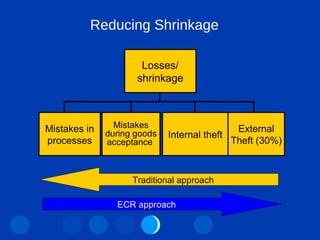
Reducing Shrinkage ECR approach Traditional approach Mistakes in processes Mistakes during goods acceptance  Internal theft External Theft (30%) Losses/ shrinkage
In Summary: It starts with deep understanding of the Russian consumer and environment Suppliers and Retailers should partner to turn this knowledge into winning in-store solutions; Those who collaborate most effectively will best meet the needs of their consumers
THANK  YOU

Stephen schueler. p&g

  • 1.
    Listening to the Boss” Stephen Schueler Procter and Gamble 1 June’2’ 2010
  • 2.
    Key for businessis to keep the BOSS happy!
  • 3.
    Meet Our Bosses,The Ivanovs: Olga and Igor… Olga is 35 y.o Igor is 37 y.o. They have one child
  • 4.
    P&G is focusedto build full understanding of consumer, shopper and environment Talk to people Visit people at their homes Observe people In-store Register and analyze purchases Conduct Quantitative studies Model and predict consumer and market behavior
  • 5.
    Life in MoscowMoscow drives the trends for Russia! Incomes are the highest here They can afford to buy premium products They like to try novelties in the market In the regions lower income per capita So they use mid-tier products They lag behind some aspects (lower ownership of durables, PC etc.)
  • 6.
    Russians are highlyeducated, doing skilled work vs. other countries Source: TGI, 2005, age 15+ USA NCS 05/06, age 18+ % Russia Poland USA High education - urban women - urban male 32 38 11 9 25 26 Employment - urban women - urban male 58 75 36 52 57 70
  • 7.
    Key Russian consumertrends Getting more and more demanding, rational and smart Increasing importance of traditional human values “love-home-family” Investing in future and experiences Highly involved in Health & Beauty
  • 8.
    Getting more demanding,rational and smart Rely only on personal budget Quality, reliability and customization Shopping is planning and value growing expectations
  • 9.
    Increasing role oftraditional values Love-home-family, safety and well-being Help others & charity TOP 5 VALUES Russians, % 2007 2009 HOME 80% 86% FAMILY 75% 81% LOVE 60% 78% WELL-BEING 70% 75% SAFETY 63% 73%
  • 10.
    Invest in futureand experiences Appearance, health maintenance and preventive measures Personal and children education Thirst for experiences # 2009 vs. 2007 FITNESS CLUBS 140 BEAUTY SALONS 125 TOP 5 CONCERNS OF RUSSIANS ECONOMY JOB SECURITY WORK/LIFE BALANCE HEALTH CHILDREN EDUCATION AND WELLFARE
  • 11.
    She is highlyinvolved in Health and Beauty 2009 – She purchases more cosmetics and skin care products. Shopping for beauty is considered as “time for myself” and is expected to be a pleasurable experience. Source: TGI Russia, 2009 FOM fact-book 2009, MCA 2003 Usage of cosmetics (%), 2000-2009 Women 45+ Moscow Russians are heavily beauty focused 57 89 Being well dressed is important, % 41 90 Be attractive for men is important, % WE Russia
  • 12.
    What did welearn regarding Crisis Impact on Russian Consumer?
  • 13.
    2008 Crisis Hit2008-09 economic changes have affected Ivanovs’ welfare
  • 14.
    Purchasing Power inMoscow, St Petersburg and the top cities won’t decline significantly: Absolute income level is high. Unemployment risk is lower. Consumers have alternative sources of income. Share of FMCG in consumption basket is lower to save on. While small cities are more strongly affected by the crisis: Township enterprises are suffering financial difficulties. leading to consumption crisis in regions. Retailers are revising their plans in regions. Families living in big cities are not as affected by crisis as their friends in smaller cities of Russia Novosibirsk Krasnoyarsk Vladivostok Ekaterinburg Volgograd Saratov Moscow St.Petersburg Kazan Samara Izhevsk Omsk Chelyabinsk Perm Ufa
  • 15.
    The Ivanovs reflectedfinancial constraints in their spending behavior Cut down on out of home entertainment Postpone some home improvements Cut travelling Started saving on non-essential food and clothes Shopping behavior became more rational Source: Crisis Tracker consumer research
  • 16.
    The Ivanovs arestressed, more than ever before 1) Life is very busy 2) Now they have less possibilities to pay for free time and retreat Source: TGI and Crisis Tracker (COMCON) Russian consumers saved on: Eating out 38% Leisure, travels 24% Hobby, sport 23%
  • 17.
    The Ivanovs changedtheir shopping behavior: P&G crisis tracker JFM’2009 % consumers Changes In Product Usage Russia Ukraine 2009 2009 Switched to cheaper stores 18 24 Switched to cheaper brands 16 16 Up-sized 9 10 Down-sized 3 4
  • 18.
    How could wetogether improve the lives of Russian Consumers post-crisis?
  • 19.
    Forced to changestore Looks for information on news and promotions Expects to find the right product for her Expects to be treated like a valued customer Meet the shopper needs in-store Consumers are lost in front of the shelves:
  • 20.
    Opportunity for jointcollaboration between Retailers and Suppliers to improve in-store experience: 1. Help to organize departments & categories according to SHOPPER NEEDS 2. Drive PRODUCT AVAILABILITY on-shelf
  • 21.
    Shopper behavior differsby trade channel She does BIG time-consuming shopping for WHOLE FAMILY in Hypermarkets She EXPECTS PROFESSIONAL HELP in baby Stores She BROWSES AND LOOKS FOR INFO/EXPERIENCES in Perfumery She COMES TO SOCIALIZE to Open Market She makes ROUTINE purchases at BEST PRICE in Discounter She is ready to PAY MORE for BEST QUALITY in Pharmacy
  • 22.
    Design right ShoppingExperience for each channel Relevant Assortment Right Shelf based on Shopper Decision Tree Right Category Adjacency within the Department Right Navigation Right Promotional Strategy
  • 23.
    EXAMPLE: Grooming CategoryRe-design in KARUSEL Male Grooming Category Shoppers 70% of shoppers buy Blades & Razors from the main shelf Highly planned purchase - above 70% High level of loyalty on Blades&Razors (retailer loses 66% if OOS) Key Actions Blades & Razors in Open Access Shelving according to Shopper Decision Tree Loss prevention procedures implemented R esults 1. Growth index: Blades & Razors +89% Shave Category Total +50% 2. Shrinkage decreased 2 times
  • 24.
    Improving Product AvailabilityIn-Store Shelf OOS reduction Joint Root Cause Analysis Category-specific approach Leverage technology to optimize Supply Advanced EDI; GDSN Reduce Shrinkage Focus on high pilferage items/ implement “Roadmap”
  • 25.
    Improving Shelf Availability: Win/Win opportunity between Suppliers and Retailers Target < 5% Focus on Baby Diapers. Key Actions: Improving service ex-P&G via by-customer volume forecasting Assortment alignment/ non-active EAN codes in Retailer/P&G database clean-up Joint work with retailers to improve category planograms based on SKU turnover Test Category Space Extension
  • 26.
    Enabling Technologies inJoint Integration Areas P&G and METRO: Integration of advanced EDI into daily business procedures 3 full-time employees work-reduction (Joint value for P&G and METRO); Assured data accuracy in invoicing documents Service level increase by 14 points Implementation of advanced electronic data flow Switch to Direct Deliveries via MGL Information flow optimization and automation of core logistics processes
  • 27.
    Reducing Shrinkage ECRapproach Traditional approach Mistakes in processes Mistakes during goods acceptance Internal theft External Theft (30%) Losses/ shrinkage
  • 28.
    In Summary: Itstarts with deep understanding of the Russian consumer and environment Suppliers and Retailers should partner to turn this knowledge into winning in-store solutions; Those who collaborate most effectively will best meet the needs of their consumers
  • 29.

Editor's Notes

  • #4 Let me introduce to you our bosses. They are Ivanovs family. They live in Moscow. Olga is 35. Her husband Igor is 37. They have one child. They will be with us through this session, showing us who Russian consumers are and what their life is like.
  • #6 The Ivanovs live in Moscow, the most developed city. Moscow gives the tendencies for Russia. Monthly income per capita is the highest here. So consumers can afford to buy premium products (Ariel, Oral-B, Pantene, Mach 3, Aerosol Gels) They like to try novelties in the market but the family of her cousin Proskovia who lives just 600 km away from Moscow, is lagging behind in some aspects of modern life ( lower ownership of durables, mobile phone, PC, limiting communication opportunities) Thier spending is lower, and their income just half of Moscow, which is adequate to live there, so the family use mid-tier products (Slalom, Myth, Shamtu, Shaving Foam)
  • #7 While their lifestyles are different, both the Ivanovs and the Petrovs are highly educated, indeed 3 times as many women in Russia have higher education than women in Poland. In Voronezh region alone, there are 17 universities or higher learning institutes. In Moscow, there are 207. In Total Russia there are 1044 universities. More of them are working. They are not “developing world” consumers. They are “developed world” consumers who happen to have a lower income than their Western counterparts.
  • #8 These are not new trends; but we see them evolving, playing more important role and being successfully leveraged by other companies &amp; brands (incl. competition). These trends are universal and relevant across categories so have potential to be used in scalable programs
  • #9 Source: Shopper 2 The ways to be smart shopper differs - pre-planning, reading info on pack, buying only best quality, looking for best price of favorite product… The value of products/brands will increasingly be defined by subjective consumers’ perception of quality. The rationality and demanding also very subjective in terms of its demonstration
  • #10 Sources of info: GIM value study, VCIOM “Values transformation study”, Comcon “Consumers trends 2009”
  • #11 Sources of info: Nielsen Consumer confidence study Russia 2009, Comcon “Consumer trends 2009”
  • #14 In the end of 2008 they experienced the current economic crisis. Their real incomes have dropped again as result of currency devaluation and increasing unemployment / reduced salaries. However the their incomes today are about 3 times higher in absolute and the drop is less significant than in 1998 crisis.
  • #15 Now let’s see how Mrs Ivanova lives and feels during the recession. Despite the recession, purchasing power in Moscow, St. Pete and top 22 cities don’t decline significantly. This is mainly cities with 1 mn inh with the developed industry and infrastructure. Thus, absolute income level is high and consumers have alternative sources of income. Cities are big, a lot of work places, so unemployment risk is lower. Share of FMCG is the shopping basket is lower to save on it. Small cities are more strongly affected by the crisis. Because township-forming enterprises are suffering financial difficulties that influences on absolute income. In turn this leads to consumption decline and probably down-tiering in the regions. So, Shoppers in the top cities are less vulnerable vs ones living in the regions and Modern Trade will focus on big cities to minimize risks.
  • #16 To cope with the crisis, Mrs Ivanova and her family start saving on traveling, going out and luxury items (clothes, jewelry, delicacy food etc.). They postpone some of the planned home improvements. They buy less of unhealthy snacks, buy delicacy products (such as caviar, fresh fish and expensive chocolate) less often. Making shopping Mrs Ivanova shows more rational approach (no children, less impulse purchases, doing shopping lists)
  • #18 Ivanovs’ also adapt their behavior in P&amp;G categories by using different economizing strategies: downtrading and downtiering are the top saving strategies, upsizing become more important
  • #20 As already mentioned in consumer part, shopping experience gets tougher: Increase in demand; Complexity of store environment; Budget constrains; Forced change of store/channel We need to simplify in-store experience by executing power SKUs, shelf based design and promo, consultancy
  • #28 Традиционно, на взгляд сотрудников магазинов, именно внешнее воровство является основной проблемой. Здесь как пример хочу привести ситуацию с одной из крупнейших наших сетей, где мы пару лет назад столкнувшись с серьезными потерями и чтобы не испортить отношения с сетью договорились размещать наши кассеты только на кассах в закрытых дисплеях. Что вы думаете – сейчас мы опять столкнулись с проблемой потерь и это несмотря на то, что наши кассеты располагаются только на кассах в закрытых дисплеях. Поэтому наиболее эффективной последовательностью работы над потерями является та, которая предлагается ЕСР. Только когда мы знаем, что из 100 привезенных в магазин кассет 100 доехало до торгового зала, наши усилия по предотвращения потерь в зале будут эффективны. В противном случае мы боремся с ветряными мельницами.
  • #30 Together we can help them.