Presentation by: Furagganan, Garcia, Lorenzo
"Language acquisition does not require extensive use of
conscious grammatical rules, and does not require
tedious drill." Stephen Krashen
"Acquisition requires meaningful interaction in the target
language - natural communication - in which speakers
are concerned not with the form of their utterances but
with the messages they are conveying and
understanding." Stephen Krashen
"In the real world, conversations with sympathetic
native speakers who are willing to help the acquirer
understand are very helpful.” Stephen Krashen
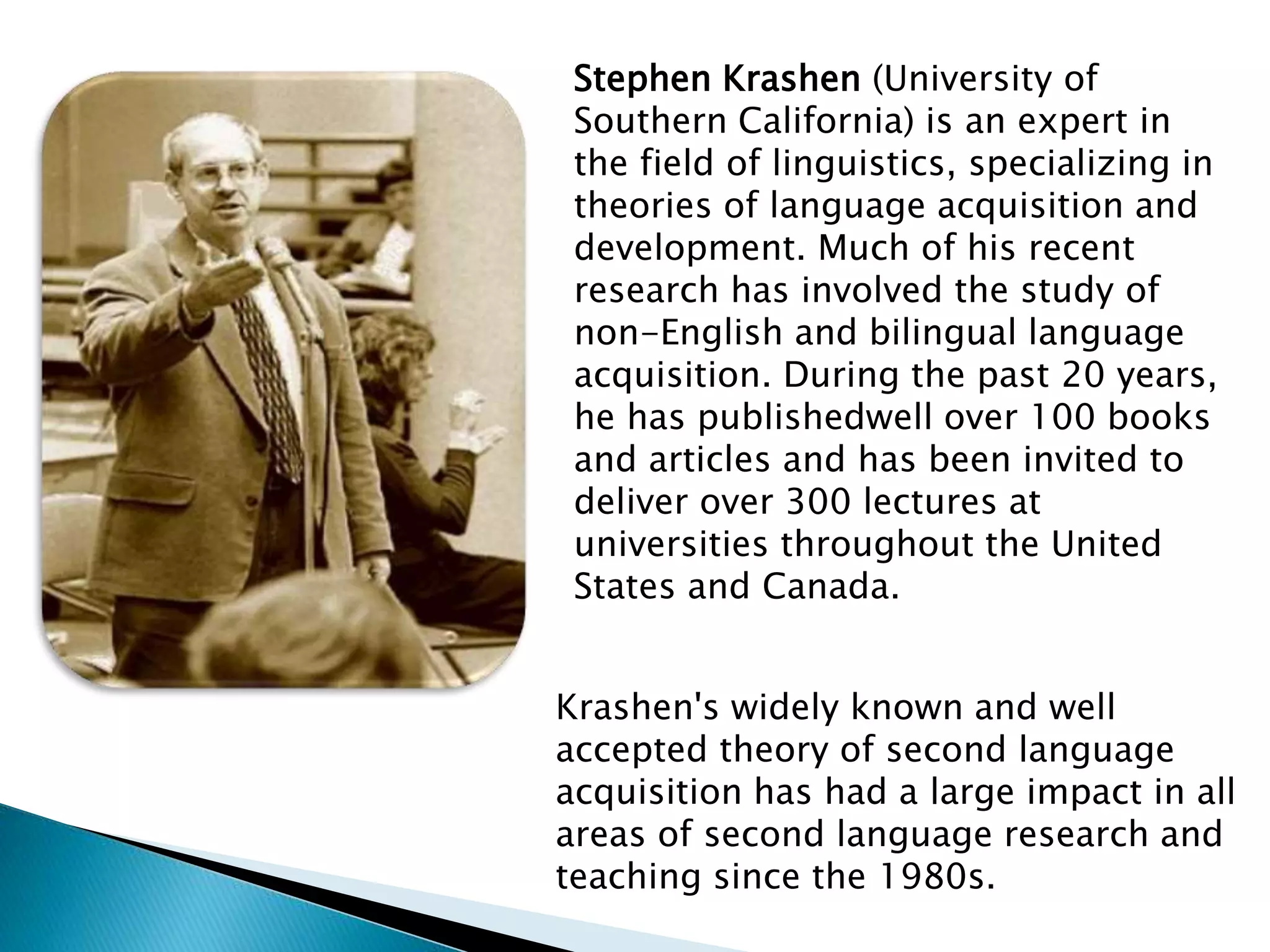
Stephen Krashen (University of
Southern California) is an expert in
the field of linguistics, specializing in
theories of language acquisition and
development. Much of his recent
research has involved the study of
non-English and bilingual language
acquisition. During the past 20 years,
he has publishedwell over 100 books
and articles and has been invited to
deliver over 300 lectures at
universities throughout the United
States and Canada.
Krashen's widely known and well
accepted theory of second language
acquisition has had a large impact in all
areas of second language research and
teaching since the 1980s.
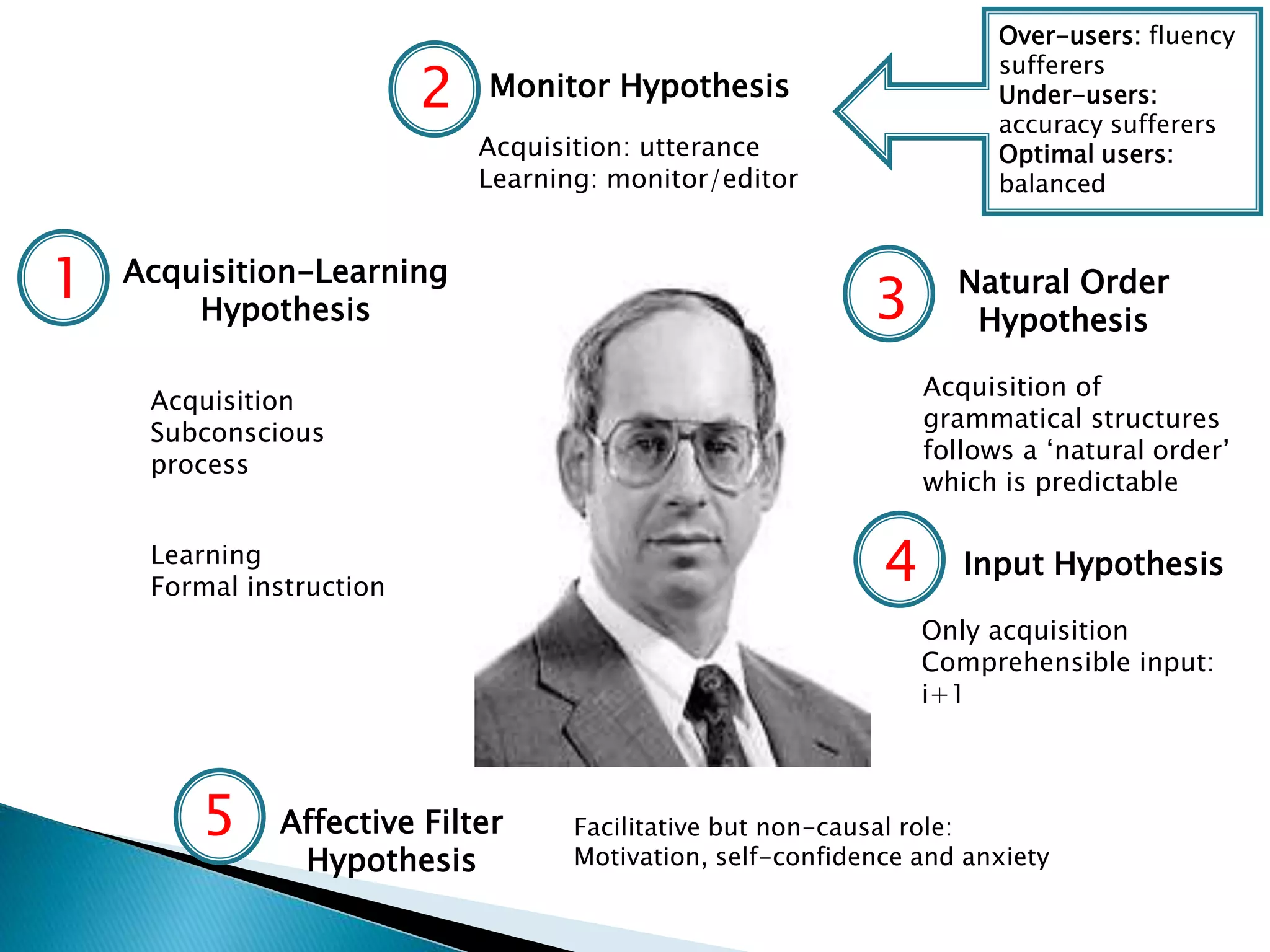
Krashen's theory of second language acquisition
consists of five main hypotheses:
 the Acquisition-Learning hypothesis,
 the Monitor hypothesis,
 the Input hypothesis,
 the Natural Order hypothesis,
 and the Affective Filter hypothesis.
Acquisition-Learning
Hypothesis
Acquisition
Subconscious
process
Learning
Formal instruction
Monitor Hypothesis
Acquisition: utterance
Learning: monitor/editor
Natural Order
Hypothesis
Acquisition of
grammatical structures
follows a ‘natural order’
which is predictable
Input Hypothesis
Only acquisition
Comprehensible input:
i+1
Affective Filter
Hypothesis
Facilitative but non-causal role:
Motivation, self-confidence and anxiety
Over-users: fluency
sufferers
Under-users:
accuracy sufferers
Optimal users:
balanced
1
2
3
4
5
References:
http://www.sk.com.br/sk-krash.htm
https://www.thinglink.com/scene/40375
694672684646

Stephen krashen's Theory of second language acquisition

  • 1.
  • 2.
    "Language acquisition doesnot require extensive use of conscious grammatical rules, and does not require tedious drill." Stephen Krashen "Acquisition requires meaningful interaction in the target language - natural communication - in which speakers are concerned not with the form of their utterances but with the messages they are conveying and understanding." Stephen Krashen "In the real world, conversations with sympathetic native speakers who are willing to help the acquirer understand are very helpful.” Stephen Krashen
  • 3.
    Stephen Krashen (Universityof Southern California) is an expert in the field of linguistics, specializing in theories of language acquisition and development. Much of his recent research has involved the study of non-English and bilingual language acquisition. During the past 20 years, he has publishedwell over 100 books and articles and has been invited to deliver over 300 lectures at universities throughout the United States and Canada. Krashen's widely known and well accepted theory of second language acquisition has had a large impact in all areas of second language research and teaching since the 1980s.
  • 4.
    Krashen's theory ofsecond language acquisition consists of five main hypotheses:  the Acquisition-Learning hypothesis,  the Monitor hypothesis,  the Input hypothesis,  the Natural Order hypothesis,  and the Affective Filter hypothesis.
  • 5.
    Acquisition-Learning Hypothesis Acquisition Subconscious process Learning Formal instruction Monitor Hypothesis Acquisition:utterance Learning: monitor/editor Natural Order Hypothesis Acquisition of grammatical structures follows a ‘natural order’ which is predictable Input Hypothesis Only acquisition Comprehensible input: i+1 Affective Filter Hypothesis Facilitative but non-causal role: Motivation, self-confidence and anxiety Over-users: fluency sufferers Under-users: accuracy sufferers Optimal users: balanced 1 2 3 4 5
  • 6.