Stephen D Krashen
Second Language Acquisition
Dr. Nikhitha Raju
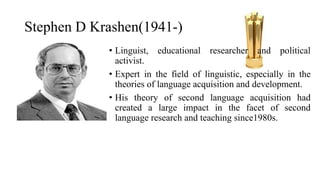
Stephen D Krashen(1941-)
• Linguist, educational researcher and political
activist.
• Expert in the field of linguistic, especially in the
theories of language acquisition and development.
• His theory of second language acquisition had
created a large impact in the facet of second
language research and teaching since1980s.
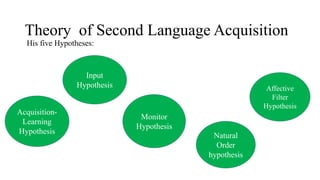
Theory of Second Language Acquisition
His five Hypotheses:
Affective
Filter
Hypothesis
Acquisition-
Learning
Hypothesis
Input
Hypothesis
Monitor
Hypothesis
Natural
Order
hypothesis
Acquisition v/s Learning
• Two different ways of developing skills in a second language:
Acquisition
Learning
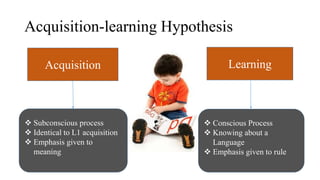
Acquisition-learning Hypothesis
Acquisition Learning
 Subconscious process
 Identical to L1 acquisition
 Emphasis given to
meaning
 Conscious Process
 Knowing about a
Language
 Emphasis given to rule
Input Hypothesis
• Meaningful output only possible when we get
valuable input.
• According to Krashen, comprehensible input is
one of the most effective thing for language
acquisition.
• By comprehensible input Krashen meant that
one level beyond the level of current
competence.
• Acquisition must be possible when a person
gets more target language atmosphere.
Input Hypothesis
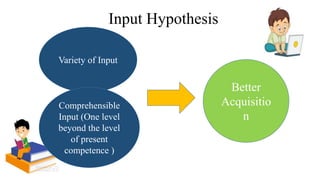
Variety of Input
Comprehensible
Input (One level
beyond the level
of present
competence )
Better
Acquisitio
n
Affective Filter Hypothesis
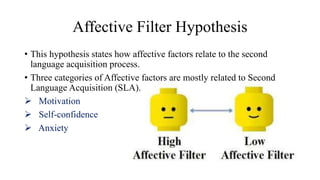
• This hypothesis states how affective factors relate to the second
language acquisition process.
• Three categories of Affective factors are mostly related to Second
Language Acquisition (SLA).
 Motivation
 Self-confidence
 Anxiety
Affective Filter Hypothesis
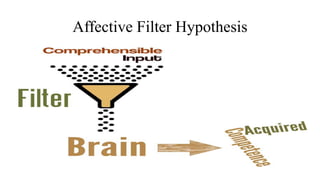
 High level of
Anxiety
 Lack of Motivation
 Lack of Self-confidence
Monitor Hypothesis
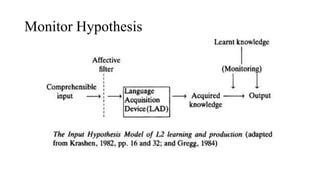
• Acquisition initiates our utterance in a second language.
• Learning has only one function, and that is as a Monitor or editor.
• This monitoring can happen before or after we speak or write(Self-
correction).
• This hypothesis implies that conscious learning plays a limited role in
second language performance.
• There are three conditions must be fulfilled to activate the monitor
system; such as time, focus on form and sufficient knowledge of the
rules.
Monitor Hypothesis
Monitor Hypothesis
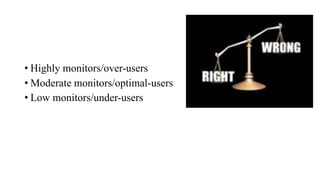
• Highly monitors/over-users
• Moderate monitors/optimal-users
• Low monitors/under-users
Monitor Hypothesis
• High monitors are usually monitoring their own output. As a result,
such performers may speak hesitantly, often self-correct in the Middle
of Utterance so they cannot speak with any real fluency
• Low monitors are not ready to use their conscious Knowledge. Low
monitors are uninfluenced by error correction.
• Moderate monitors use the monitor when it is appropriate and when
it does not interfere with communication. They are not use grammar in
ordinary conversation., where it might interfere.
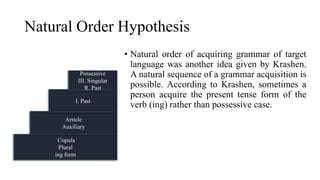
Natural Order Hypothesis
• Natural order of acquiring grammar of target
language was another idea given by Krashen.
A natural sequence of a grammar acquisition is
possible. According to Krashen, sometimes a
person acquire the present tense form of the
verb (ing) rather than possessive case.
Copula
Plural
ing form
Article
Auxiliary
I. Past
Possessive
III. Singular
R. Past
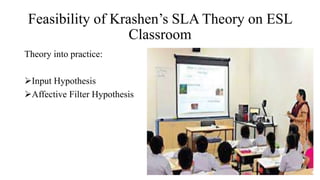
Feasibility of Krashen’s SLA Theory on ESL
Classroom
Theory into practice:
Input Hypothesis
Affective Filter Hypothesis

Theory of second language acquisition by Stephen D Krashen.pptx

  • 1.
    Stephen D Krashen SecondLanguage Acquisition Dr. Nikhitha Raju
  • 2.
    Stephen D Krashen(1941-) •Linguist, educational researcher and political activist. • Expert in the field of linguistic, especially in the theories of language acquisition and development. • His theory of second language acquisition had created a large impact in the facet of second language research and teaching since1980s.
  • 3.
    Theory of SecondLanguage Acquisition His five Hypotheses: Affective Filter Hypothesis Acquisition- Learning Hypothesis Input Hypothesis Monitor Hypothesis Natural Order hypothesis
  • 4.
    Acquisition v/s Learning •Two different ways of developing skills in a second language: Acquisition Learning
  • 5.
    Acquisition-learning Hypothesis Acquisition Learning Subconscious process  Identical to L1 acquisition  Emphasis given to meaning  Conscious Process  Knowing about a Language  Emphasis given to rule
  • 6.
    Input Hypothesis • Meaningfuloutput only possible when we get valuable input. • According to Krashen, comprehensible input is one of the most effective thing for language acquisition. • By comprehensible input Krashen meant that one level beyond the level of current competence. • Acquisition must be possible when a person gets more target language atmosphere.
  • 7.
    Input Hypothesis Variety ofInput Comprehensible Input (One level beyond the level of present competence ) Better Acquisitio n
  • 8.
    Affective Filter Hypothesis •This hypothesis states how affective factors relate to the second language acquisition process. • Three categories of Affective factors are mostly related to Second Language Acquisition (SLA).  Motivation  Self-confidence  Anxiety
  • 9.
  • 10.
     High levelof Anxiety
  • 11.
     Lack ofMotivation
  • 12.
     Lack ofSelf-confidence
  • 13.
    Monitor Hypothesis • Acquisitioninitiates our utterance in a second language. • Learning has only one function, and that is as a Monitor or editor. • This monitoring can happen before or after we speak or write(Self- correction). • This hypothesis implies that conscious learning plays a limited role in second language performance. • There are three conditions must be fulfilled to activate the monitor system; such as time, focus on form and sufficient knowledge of the rules.
  • 14.
  • 15.
    Monitor Hypothesis • Highlymonitors/over-users • Moderate monitors/optimal-users • Low monitors/under-users
  • 16.
    Monitor Hypothesis • Highmonitors are usually monitoring their own output. As a result, such performers may speak hesitantly, often self-correct in the Middle of Utterance so they cannot speak with any real fluency • Low monitors are not ready to use their conscious Knowledge. Low monitors are uninfluenced by error correction. • Moderate monitors use the monitor when it is appropriate and when it does not interfere with communication. They are not use grammar in ordinary conversation., where it might interfere.
  • 17.
    Natural Order Hypothesis •Natural order of acquiring grammar of target language was another idea given by Krashen. A natural sequence of a grammar acquisition is possible. According to Krashen, sometimes a person acquire the present tense form of the verb (ing) rather than possessive case. Copula Plural ing form Article Auxiliary I. Past Possessive III. Singular R. Past
  • 18.
    Feasibility of Krashen’sSLA Theory on ESL Classroom Theory into practice: Input Hypothesis Affective Filter Hypothesis