Second language acquisition
vs
foreign language learnirg
• Learning a foreign language is not a matter of reading
some grammar rules and memorizing some vocabulary
words-- although those are important activities, not to
be ignored. Acquiring a language is learning askill, not
a body of information.
• It's as much like learning to swim or ride a bike as it is
like learning about the Revolutionary War. That is, you
must not only understand the ideas and concepts, have
information at hand, but you must also make your
body accustomed to using that information in physical
activity: in this case the physical activity involved is
speaking, listening, writing and reading.
• There is an important distinction made by linguists
between language acquisition and language learning.
• Children acquire language through a subconscious process
during which they are unaware of grammatical rules. This is
similar to the way they acquire their first language. They
get a feel for what is and what isn’t correct. In order to
acquire language, the learner needs a source of natural
communication. The emphasis is on the text of the
communication and not on the form. Young students who
are in the process of acquiring English readily acquire the
language to communicate with classmates.
• Language learning, on the other hand, is not
communicative. It is the result of direct instruction in
the rules of language. And it certainly is not an age-
appropriate activity for your young learners. In
language learning, students have conscious knowledge
of the new language and can talk about that
knowledge. They can fill in the blanks on a grammar
page. Research has shown, however, that knowing
grammar rules does not necessarily result in good
speaking or writing. A student who has memorized the
rules of the language may be able to succeed on a
standardized test of English language but may not be
able to speak or write correctly.
In other words…
• Language acquisition is very similar to the
process children use in acquiring first
language. It requires meaningful interaction in
the target language- natural communication-
in which speakers are concerned not with the
form of their utterances but with the
messages they are conveying and
understanding
Stephen Krashen
• Stephen Krashen, Emeritus Professor of
Linguistics and Education at the University of
Southern California, believes that there is no
fundamental difference between the way we
acquire our first language and our subsequent
languages. He claims that humans have
an innate ability that guides the language
learning process.
• Infants learn their mother tongue simply by listening
attentively to spoken language that is (made)
meaningful to them. Foreign languages are acquired in
the same way.
• The claim that humans possess an innate language
learning ability stems from Chomsky (1965), who
rejected Skinner's (1957) behaviourist theory that
language learning is habit formation through stimulus
and response. Chomsky called the special inborn
language capability the Language Acquisition Device
(LAD). From this he developed the theory that all
languages share an underlying system named Universal
Grammar.
The Monitor Model
• Krashen synthesizes his theories of
second/foreign language learning in what is
usually referred to as the Monitor Model. The
Monitor Model has 5 components:
• The Acquisition-Learning Hypothesis
• The Natural Order Hypothesis
• The Monitor Hypothesis
• The Input Hypothesis
• The Affective Filter Hypothesis
Acquisition
• There are two ways of developing language
ability: by acquisition and by learning. Acquisition
is a sub-conscious process, as in the case of a
child learning its own language or an adult
'picking up' a second language simply by living
and working in a foreign country. Learning is the
conscious process of developing a foreign
language through language lessons and a focus
on the grammatical features of that language.
• NOTE: According to Krashen learned language
cannot be turned into acquisition.
The Natural Order Hypothesis
• Language is acquired in a predictable order by
all learners. This order does not depend on
the apparent simplicity or complexity of the
grammatical features involved. The natural
order of acquisition cannot be influenced by
direct teaching of features that the learner is
not yet ready to acquire.
• It is claimed that the natural order of acquisition
is very similar for a native-English child learning
its own language and for an adult learning English
as a foreign language. For example, the -ing form
(present continuous) will be acquired early on
and almost certainly before the -s inflection in
the third person present simple (she likes, he
eats, etc.) As Krashen points out, much of the
frustration experienced by teachers and their
students in grammar lessons results from the
attempt to inculcate a grammatical form which
the learner is not yet ready to acquire.
The Monitor Hypothesis
• We are able to use what we have learned (in Krashen's
sense) about the rules of a language in monitoring (or
self-correcting) our language output. Clearly, this is
possible in the correction of written work. It is much
more difficult when engaging in regular talk.
• Krashen states that it is often difficult to use the
monitor correctly since the rules of a language can be
extremely complex. Two examples from English are the
rules about the articles (a/the) and the future "tense".
Even assuming the learner has a good knowledge of
the rule in question, it is difficult to focus on grammar
while simultaneously attempting to convey meaning
(and possibly feeling).
• The monitoring function is the practical result of
the learned grammar. According to Krashen, the
acquisition system is the utterance initiator, while
the learning system performs the role of the
'monitor' or the 'editor'. The 'monitor' acts in a
planning, editing and correcting function when
three specific conditions are met: that is, the
second language learner has sufficient time at
his/her disposal, he/she focuses on form or thinks
about correctness, and he/she knows the rule.
Over-users- under-users- optimal-
users
• Krashen also suggests that there is individual variation
among language learners with regard to 'monitor' use.
He distinguishes those learners that use the 'monitor'
all the time (over-users); those learners who have not
learned or who prefer not to use their conscious
knowledge (under-users); and those learners that use
the 'monitor' appropriately (optimal users). An
evaluation of the person's psychological profile can
help to determine to what group they belong. Usually
extroverts are under-users, while introverts and
perfectionists are over-users. Lack of self-confidence is
frequently related to the over-use of the 'monitor'.
The Input Hypothesis
• We acquire language in one way only: when
we are exposed to input (written or spoken
language) that is comprehensible to us.
Comprehensible input is the necessary but
also sufficient condition for language
acquisition to take place. It requires no effort
on the part of the learner.
• Krashen now refers to this as
the Comprehension Hypothesis. It states that
learners acquire language when they are
exposed to input at i+1, where i is the current
state or stage of language proficiency.
Learners use their existing acquired linguistic
competence together with their general world
knowledge to make sense of the messages
they receive in language just beyond where
they currently are (the+1).
• This theory has clear implications for language
teachers; namely, that their language
instruction should be full of rich input (both
spoken and written language) that is tuned at
the appropriate level for the learners in the
class.
The Affective Filter Hypothesis
• Comprehensible input will not result in language
acquisition if that input is filtered out before it
can reach the brain's language processing
faculties. The filtering may occur because of
anxiety, poor self-esteem or low motivation.
• Learners with a low affective filter will not only be
efficient language acquirers of the
comprehensible input they receive. They are also
more likely to interact with others,
unembarrassed by making mistakes for example,
and thus increase the amount of that input.
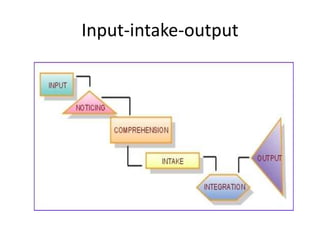
Input-intake-output
• Comprehended input may be analyzed and has the
potential of being assimilated through the process of
intake. Psycholinguistic processing occurs at this stage
where new information may be matched against
existing stored knowledge. The next stage, integration,
involves storage of new information for later use,
hypothesis formulation, and confirmation or
reformulation of existing hypotheses. The final stage,
output, is an "overt manifestation" of the acquisition
process. The different stages may be influenced by a
number of factors, such as saliency and frequency,
prior knowledge, and attention, as well as by affective
factors.

Second language-acquisition-vs-language-learning

  • 1.
  • 2.
    • Learning aforeign language is not a matter of reading some grammar rules and memorizing some vocabulary words-- although those are important activities, not to be ignored. Acquiring a language is learning askill, not a body of information. • It's as much like learning to swim or ride a bike as it is like learning about the Revolutionary War. That is, you must not only understand the ideas and concepts, have information at hand, but you must also make your body accustomed to using that information in physical activity: in this case the physical activity involved is speaking, listening, writing and reading.
  • 3.
    • There isan important distinction made by linguists between language acquisition and language learning. • Children acquire language through a subconscious process during which they are unaware of grammatical rules. This is similar to the way they acquire their first language. They get a feel for what is and what isn’t correct. In order to acquire language, the learner needs a source of natural communication. The emphasis is on the text of the communication and not on the form. Young students who are in the process of acquiring English readily acquire the language to communicate with classmates.
  • 4.
    • Language learning,on the other hand, is not communicative. It is the result of direct instruction in the rules of language. And it certainly is not an age- appropriate activity for your young learners. In language learning, students have conscious knowledge of the new language and can talk about that knowledge. They can fill in the blanks on a grammar page. Research has shown, however, that knowing grammar rules does not necessarily result in good speaking or writing. A student who has memorized the rules of the language may be able to succeed on a standardized test of English language but may not be able to speak or write correctly.
  • 5.
    In other words… •Language acquisition is very similar to the process children use in acquiring first language. It requires meaningful interaction in the target language- natural communication- in which speakers are concerned not with the form of their utterances but with the messages they are conveying and understanding
  • 6.
    Stephen Krashen • StephenKrashen, Emeritus Professor of Linguistics and Education at the University of Southern California, believes that there is no fundamental difference between the way we acquire our first language and our subsequent languages. He claims that humans have an innate ability that guides the language learning process.
  • 7.
    • Infants learntheir mother tongue simply by listening attentively to spoken language that is (made) meaningful to them. Foreign languages are acquired in the same way. • The claim that humans possess an innate language learning ability stems from Chomsky (1965), who rejected Skinner's (1957) behaviourist theory that language learning is habit formation through stimulus and response. Chomsky called the special inborn language capability the Language Acquisition Device (LAD). From this he developed the theory that all languages share an underlying system named Universal Grammar.
  • 8.
    The Monitor Model •Krashen synthesizes his theories of second/foreign language learning in what is usually referred to as the Monitor Model. The Monitor Model has 5 components: • The Acquisition-Learning Hypothesis • The Natural Order Hypothesis • The Monitor Hypothesis • The Input Hypothesis • The Affective Filter Hypothesis
  • 9.
    Acquisition • There aretwo ways of developing language ability: by acquisition and by learning. Acquisition is a sub-conscious process, as in the case of a child learning its own language or an adult 'picking up' a second language simply by living and working in a foreign country. Learning is the conscious process of developing a foreign language through language lessons and a focus on the grammatical features of that language. • NOTE: According to Krashen learned language cannot be turned into acquisition.
  • 10.
    The Natural OrderHypothesis • Language is acquired in a predictable order by all learners. This order does not depend on the apparent simplicity or complexity of the grammatical features involved. The natural order of acquisition cannot be influenced by direct teaching of features that the learner is not yet ready to acquire.
  • 11.
    • It isclaimed that the natural order of acquisition is very similar for a native-English child learning its own language and for an adult learning English as a foreign language. For example, the -ing form (present continuous) will be acquired early on and almost certainly before the -s inflection in the third person present simple (she likes, he eats, etc.) As Krashen points out, much of the frustration experienced by teachers and their students in grammar lessons results from the attempt to inculcate a grammatical form which the learner is not yet ready to acquire.
  • 12.
    The Monitor Hypothesis •We are able to use what we have learned (in Krashen's sense) about the rules of a language in monitoring (or self-correcting) our language output. Clearly, this is possible in the correction of written work. It is much more difficult when engaging in regular talk. • Krashen states that it is often difficult to use the monitor correctly since the rules of a language can be extremely complex. Two examples from English are the rules about the articles (a/the) and the future "tense". Even assuming the learner has a good knowledge of the rule in question, it is difficult to focus on grammar while simultaneously attempting to convey meaning (and possibly feeling).
  • 13.
    • The monitoringfunction is the practical result of the learned grammar. According to Krashen, the acquisition system is the utterance initiator, while the learning system performs the role of the 'monitor' or the 'editor'. The 'monitor' acts in a planning, editing and correcting function when three specific conditions are met: that is, the second language learner has sufficient time at his/her disposal, he/she focuses on form or thinks about correctness, and he/she knows the rule.
  • 14.
    Over-users- under-users- optimal- users •Krashen also suggests that there is individual variation among language learners with regard to 'monitor' use. He distinguishes those learners that use the 'monitor' all the time (over-users); those learners who have not learned or who prefer not to use their conscious knowledge (under-users); and those learners that use the 'monitor' appropriately (optimal users). An evaluation of the person's psychological profile can help to determine to what group they belong. Usually extroverts are under-users, while introverts and perfectionists are over-users. Lack of self-confidence is frequently related to the over-use of the 'monitor'.
  • 15.
    The Input Hypothesis •We acquire language in one way only: when we are exposed to input (written or spoken language) that is comprehensible to us. Comprehensible input is the necessary but also sufficient condition for language acquisition to take place. It requires no effort on the part of the learner.
  • 16.
    • Krashen nowrefers to this as the Comprehension Hypothesis. It states that learners acquire language when they are exposed to input at i+1, where i is the current state or stage of language proficiency. Learners use their existing acquired linguistic competence together with their general world knowledge to make sense of the messages they receive in language just beyond where they currently are (the+1).
  • 17.
    • This theoryhas clear implications for language teachers; namely, that their language instruction should be full of rich input (both spoken and written language) that is tuned at the appropriate level for the learners in the class.
  • 18.
    The Affective FilterHypothesis • Comprehensible input will not result in language acquisition if that input is filtered out before it can reach the brain's language processing faculties. The filtering may occur because of anxiety, poor self-esteem or low motivation. • Learners with a low affective filter will not only be efficient language acquirers of the comprehensible input they receive. They are also more likely to interact with others, unembarrassed by making mistakes for example, and thus increase the amount of that input.
  • 19.
  • 20.
    • Comprehended inputmay be analyzed and has the potential of being assimilated through the process of intake. Psycholinguistic processing occurs at this stage where new information may be matched against existing stored knowledge. The next stage, integration, involves storage of new information for later use, hypothesis formulation, and confirmation or reformulation of existing hypotheses. The final stage, output, is an "overt manifestation" of the acquisition process. The different stages may be influenced by a number of factors, such as saliency and frequency, prior knowledge, and attention, as well as by affective factors.