Stephen Krashen developed a theory of language acquisition consisting of five main hypotheses: 1) the acquisition-learning hypothesis states that acquisition is subconscious while learning is conscious, 2) the monitor hypothesis explains that learning serves as an editor but overuse can inhibit acquisition, 3) the natural order hypothesis proposes that acquisition follows a natural progression, 4) the input hypothesis claims we acquire via comprehensible input just beyond our level, and 5) the affective filter hypothesis argues that factors like anxiety can block acquisition. Krashen's theory transformed language teaching in the 1980s and remains influential in second language acquisition theory today.
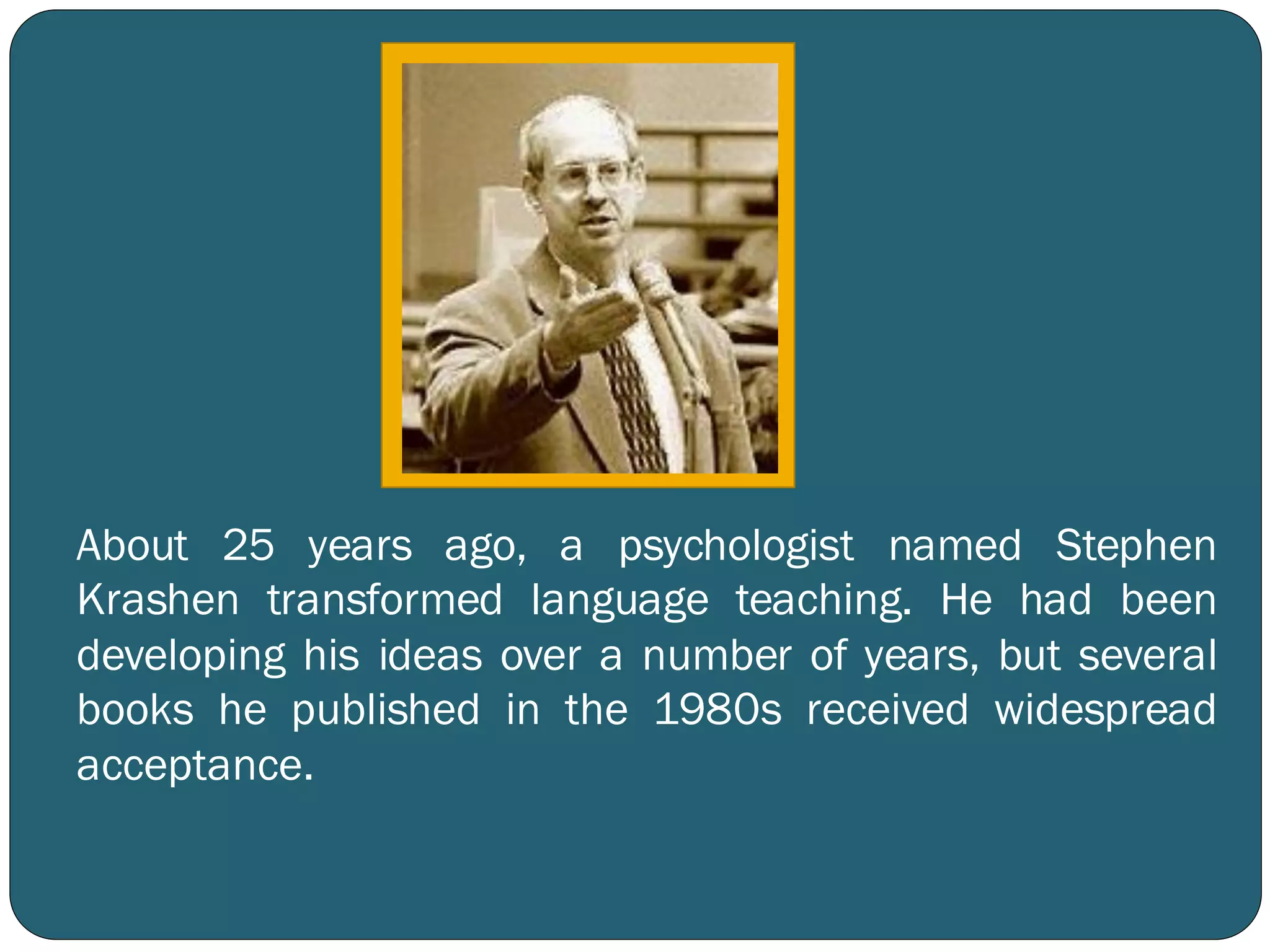
About 25 yearsago, a psychologist named Stephen
Krashen transformed language teaching. He had been
developing his ideas over a number of years, but several
books he published in the 1980s received widespread
acceptance.
3.
STEPHEN KRASHEN’S LANGUAGE
ACQUISITIONTHEORY
This theory states that acquisition and learning
are two separate processes. Learning is to know
about a language - formal knowledge; acquisition
is the unconscious mind related activity that
occurs when the language is used in conversation.
Krashen embodies the following hypotheses in his
theory:
4.
Much hasbeen made of Krashen's theory of second
language acquisition, which consists of five main
hypotheses:
• The acquisition learning hypothesis
• the monitor hypothesis,
• the natural order hypothesis,
• the input hypothesis, and
• the affective filter hypothesis.
http://www.youtube.com/watch?v=NiTsduRreug&feature=related
5.
According toKrashen’s acquisition-learning
hypothesis, there are two independent ways to
develop our linguistic skills: acquisition and learning.
This theory is at the core of modern language
acquisition theory, and is perhaps the most
fundamental of Krashen's theories on second
acquisition.
6.
Acquisition
Subconscious processwhere individual is not aware. One is unaware
of the process as it is happening and when the new knowledge is
acquired, the acquirer generally does not realize that he or she
possesses any new knowledge.
According to Krashen, both adults and children can subconsciously
acquire language, and either written or oral language can be
acquired. This process is similar to the process that children undergo
when learning their native language.
Acquisition requires meaningful interaction in the target language,
during which the acquirer is focused on meaning rather than form.
7.
Learning
Learning a language,on the other hand, is a
conscious process, much like what one experiences
in school. New knowledge or language forms are
represented consciously in the learner's mind,
frequently in the form of language "rules" and
"grammar" and the process often involves error
correction. Language learning involves formal
instruction, and according to Krashen, is less
effective than acquisition.
8.
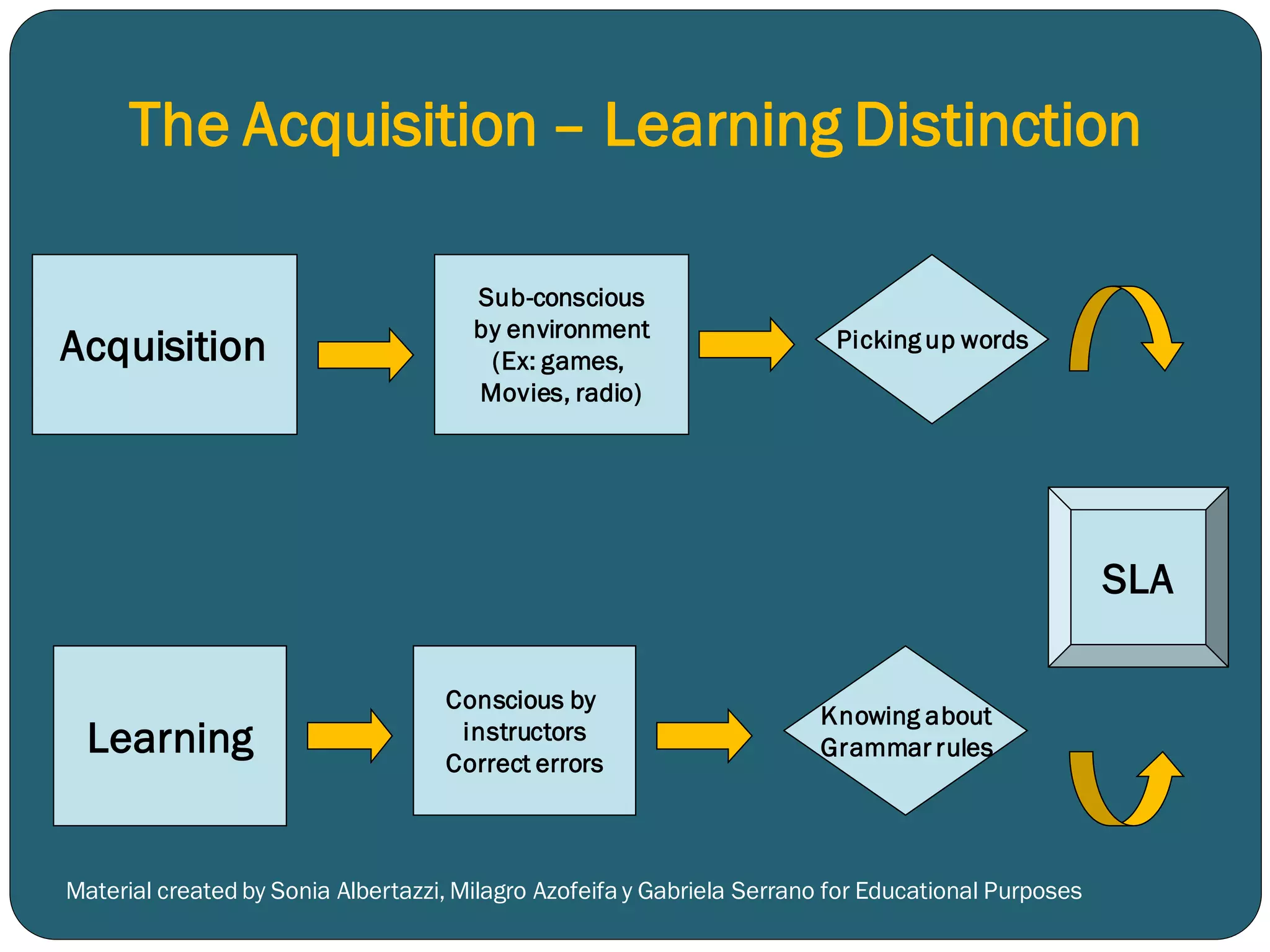
Material created bySonia Albertazzi, Milagro Azofeifa y Gabriela Serrano for Educational Purposes
The Acquisition – Learning Distinction
Acquisition
Sub-conscious
by environment
(Ex: games,
Movies, radio)
Picking up words
Learning
Conscious by
instructors
Correct errors
Knowing about
Grammar rules
SLA
9.
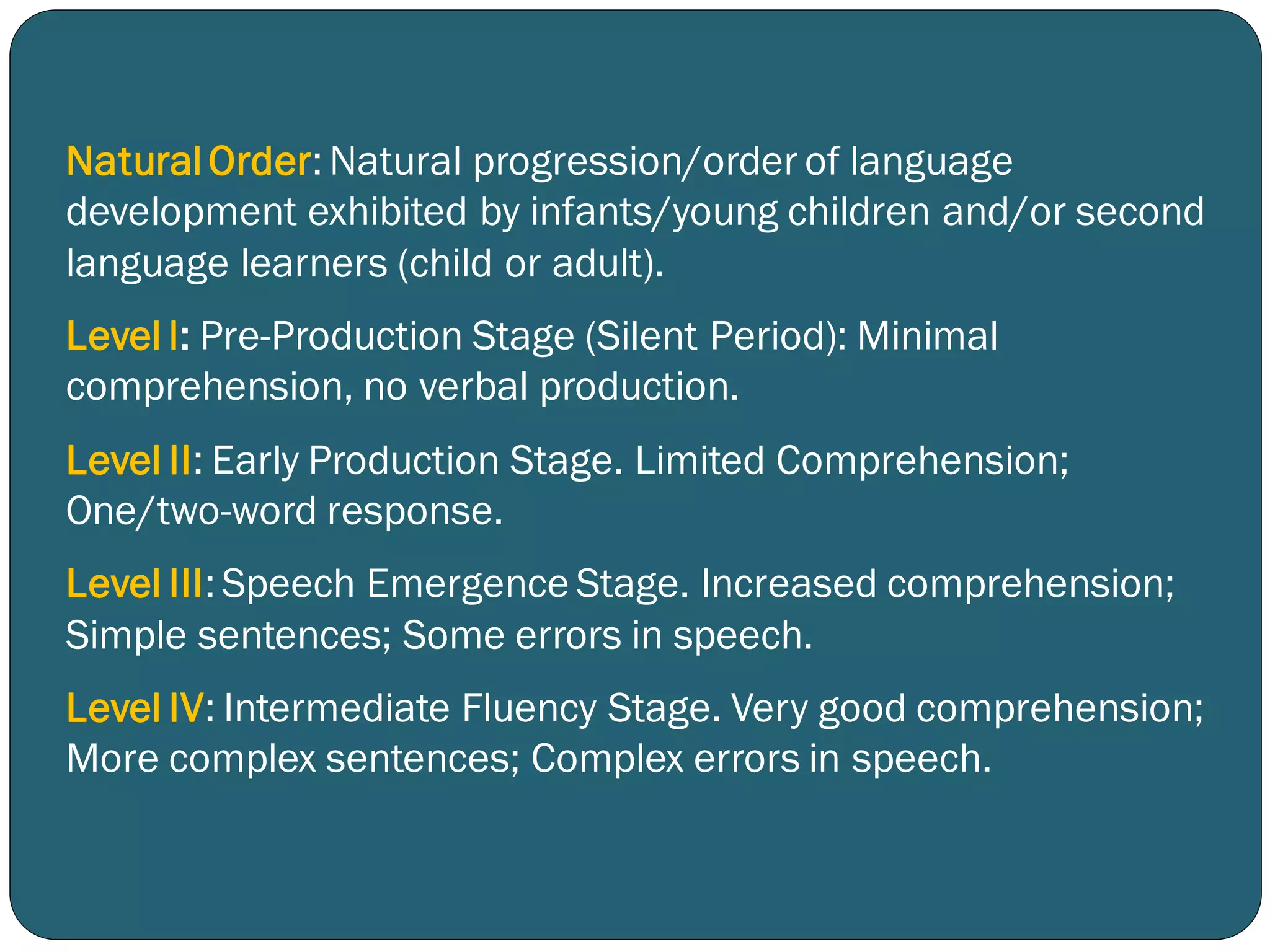
NaturalOrder: Natural progression/orderof language
development exhibited by infants/young children and/or second
language learners (child or adult).
Level l: Pre-Production Stage (Silent Period): Minimal
comprehension, no verbal production.
Level II: Early Production Stage. Limited Comprehension;
One/two-word response.
Level III: Speech Emergence Stage. Increased comprehension;
Simple sentences; Some errors in speech.
Level IV: Intermediate Fluency Stage. Very good comprehension;
More complex sentences; Complex errors in speech.
10.
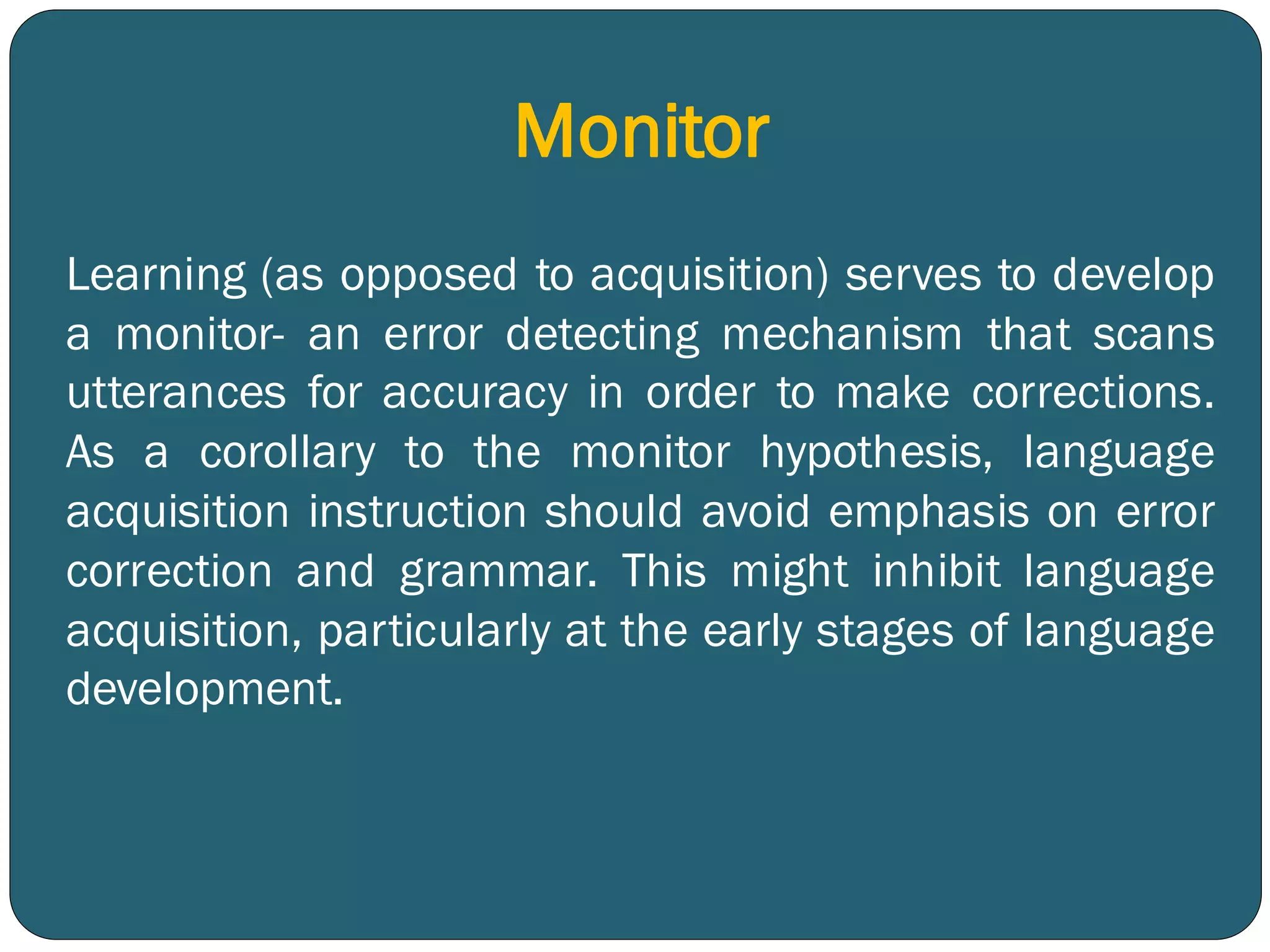
Monitor
Learning (as opposedto acquisition) serves to develop
a monitor- an error detecting mechanism that scans
utterances for accuracy in order to make corrections.
As a corollary to the monitor hypothesis, language
acquisition instruction should avoid emphasis on error
correction and grammar. This might inhibit language
acquisition, particularly at the early stages of language
development.
11.
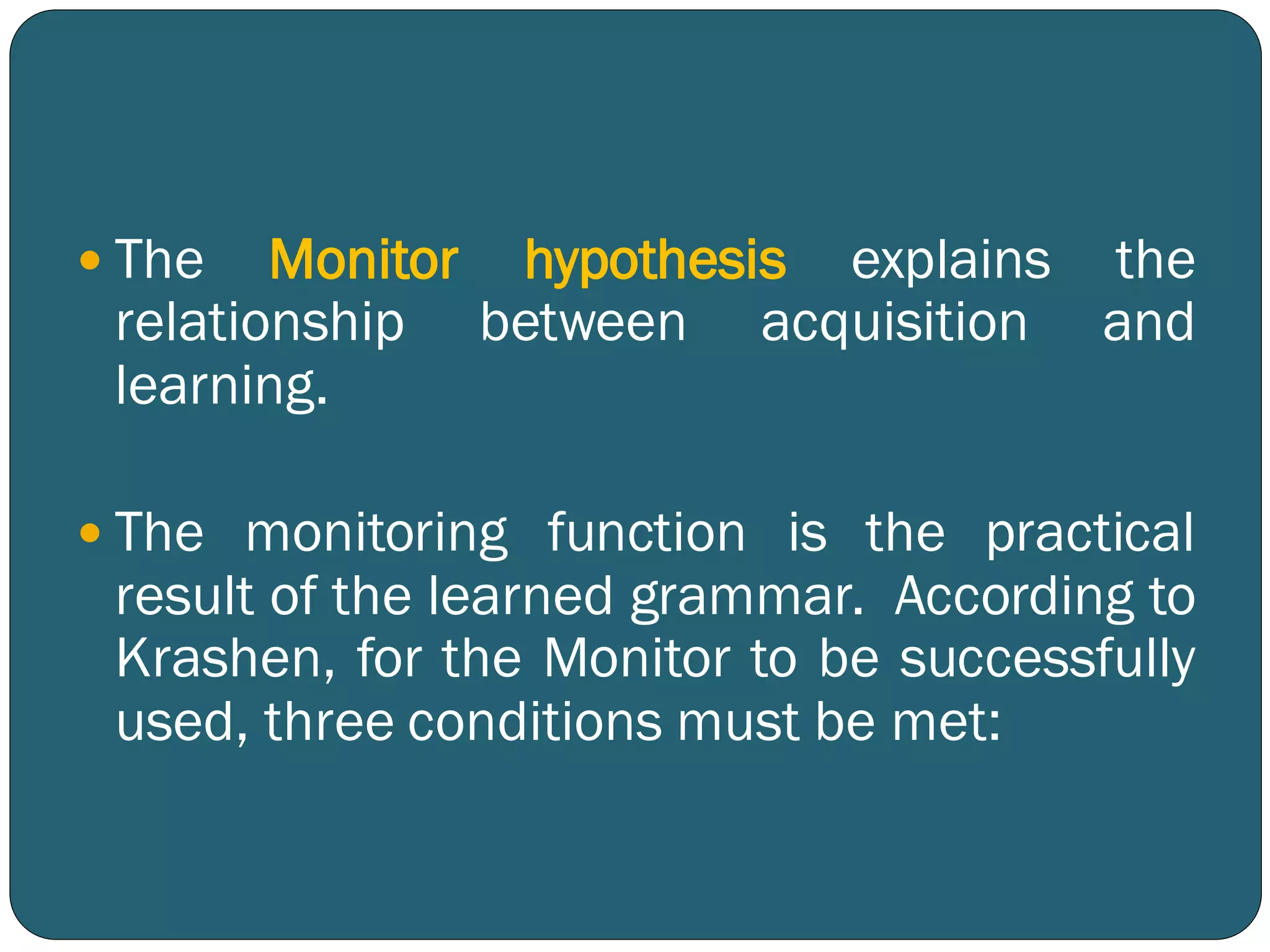
The Monitorhypothesis explains the
relationship between acquisition and
learning.
The monitoring function is the practical
result of the learned grammar. According to
Krashen, for the Monitor to be successfully
used, three conditions must be met:
12.
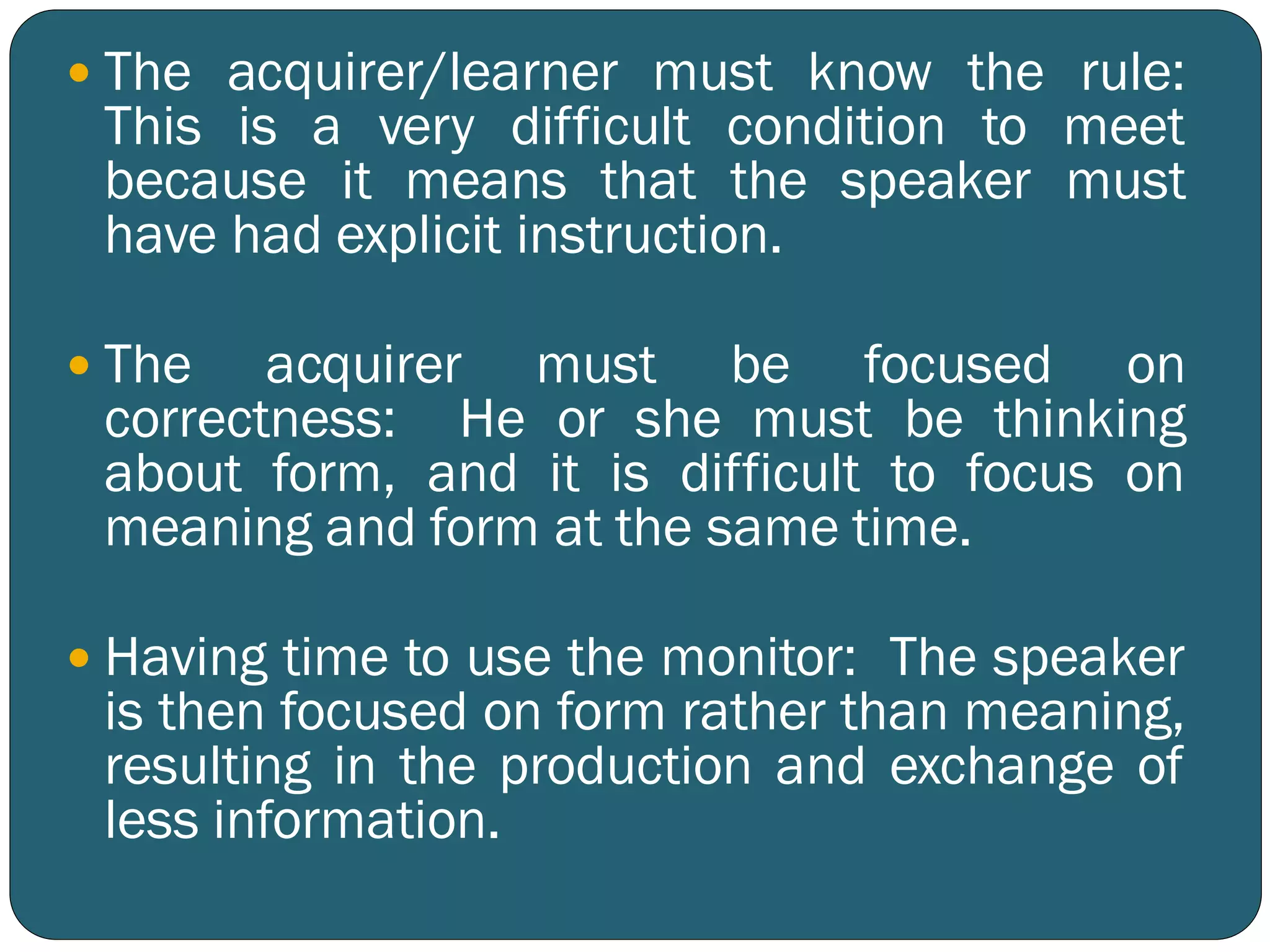
The acquirer/learnermust know the rule:
This is a very difficult condition to meet
because it means that the speaker must
have had explicit instruction.
The acquirer must be focused on
correctness: He or she must be thinking
about form, and it is difficult to focus on
meaning and form at the same time.
Having time to use the monitor: The speaker
is then focused on form rather than meaning,
resulting in the production and exchange of
less information.
13.
Due tothese difficulties, Krashen recommends
using the monitor at times when it does not interfere
with communication, such as while writing.
14.
Affective Filter: Optimalinput occurs when the
"affective filter" is low. The affective filter is a screen of
emotion that can block language acquisition or learning
if it keeps the users from being too self-conscious or
too embarrassed to take risks during communicative
exchanges
The Affective Filter hypothesis, embodies Krashen's
view that a number of 'affective variables' play a
facilitative, but non-causal, role in second language
acquisition.
These variables include: motivation, self-confidence
and anxiety.
15.
Low motivation,low self-esteem, and debilitating
anxiety can combine to 'raise' the affective filter and
form a 'mental block' that prevents comprehensible
input from being used for acquisition. In other
words, when the filter is 'up' it impedes language
acquisition.
Krashen claims that learners with high motivation,
self-confidence, a good self-image, and a low level
of anxiety are better equipped for success in
second language acquisition.
16.
Krashen claimsthat learners with high motivation, self-
confidence, a good self-image, and a low level of
anxiety are better equipped for success in second
language acquisition.
17.
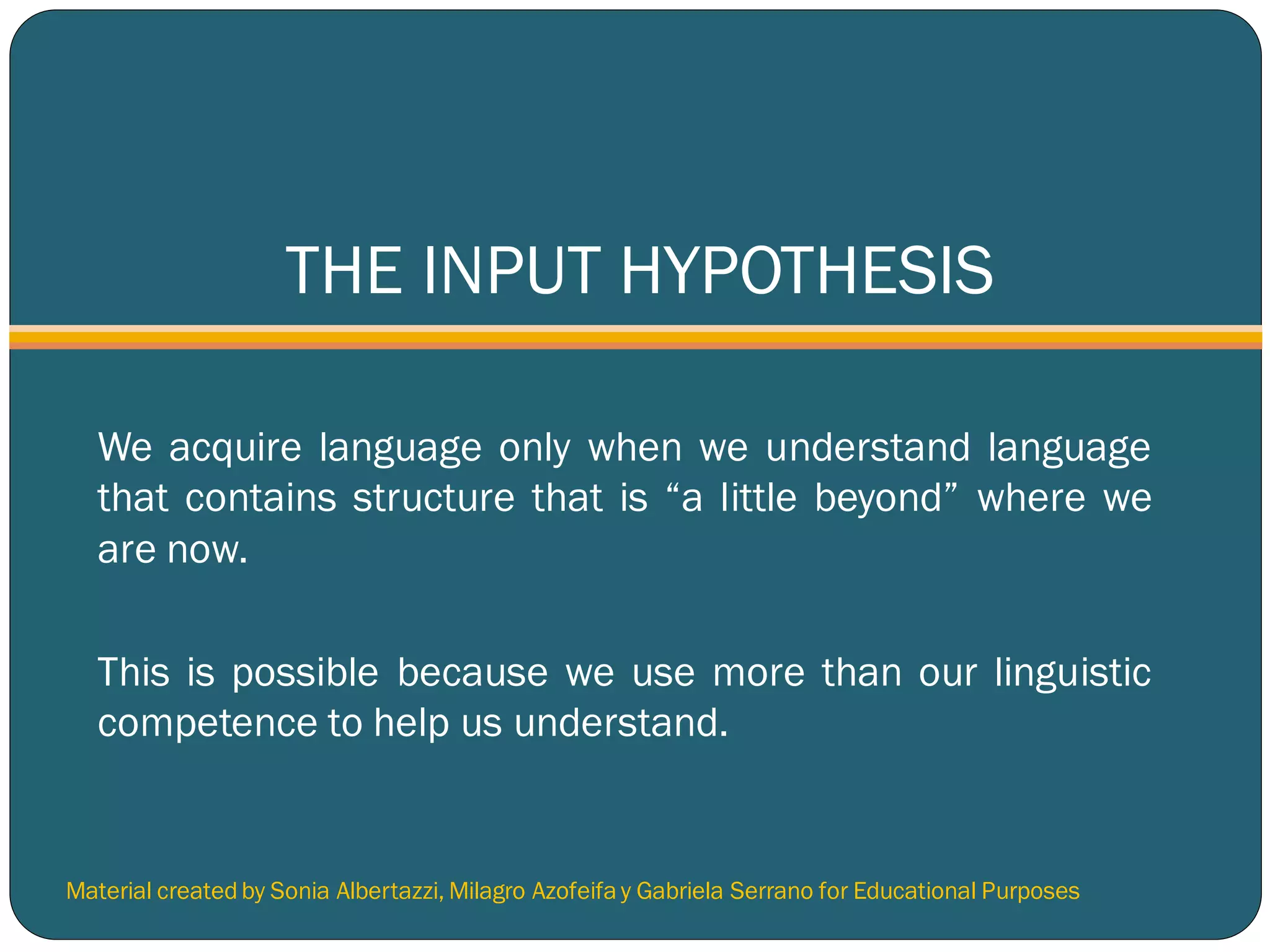
THE INPUT HYPOTHESIS
Weacquire language only when we understand language
that contains structure that is “a little beyond” where we
are now.
This is possible because we use more than our linguistic
competence to help us understand.
Material createdby Sonia Albertazzi, Milagro Azofeifa y Gabriela Serrano for Educational Purposes
18.
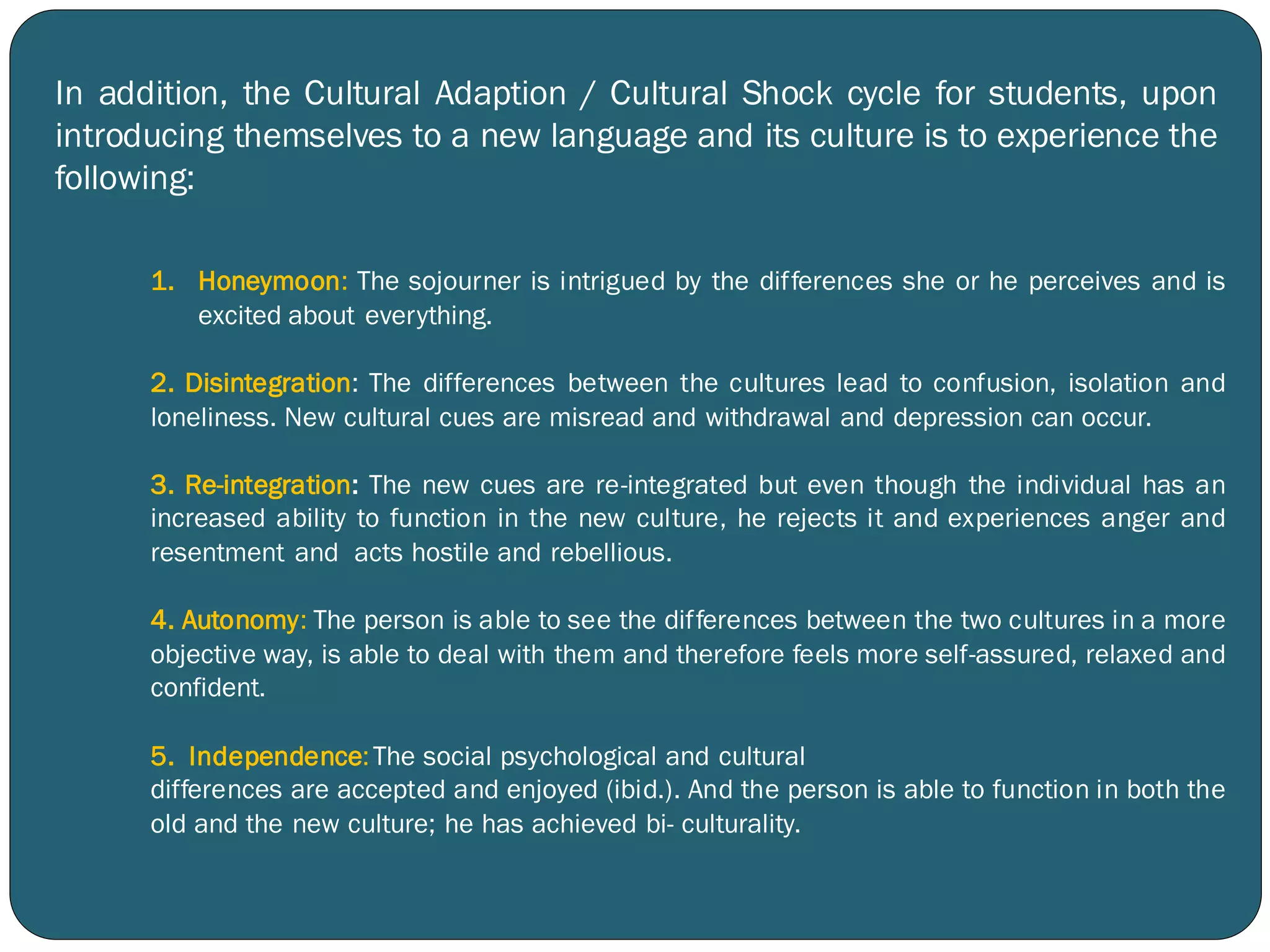
1. Honeymoon: Thesojourner is intrigued by the differences she or he perceives and is
excited about everything.
2. Disintegration: The differences between the cultures lead to confusion, isolation and
loneliness. New cultural cues are misread and withdrawal and depression can occur.
3. Re-integration: The new cues are re-integrated but even though the individual has an
increased ability to function in the new culture, he rejects it and experiences anger and
resentment and acts hostile and rebellious.
4. Autonomy: The person is able to see the differences between the two cultures in a more
objective way, is able to deal with them and therefore feels more self-assured, relaxed and
confident.
5. Independence:The social psychological and cultural
differences are accepted and enjoyed (ibid.). And the person is able to function in both the
old and the new culture; he has achieved bi- culturality.
In addition, the Cultural Adaption / Cultural Shock cycle for students, upon
introducing themselves to a new language and its culture is to experience the
following:
19.
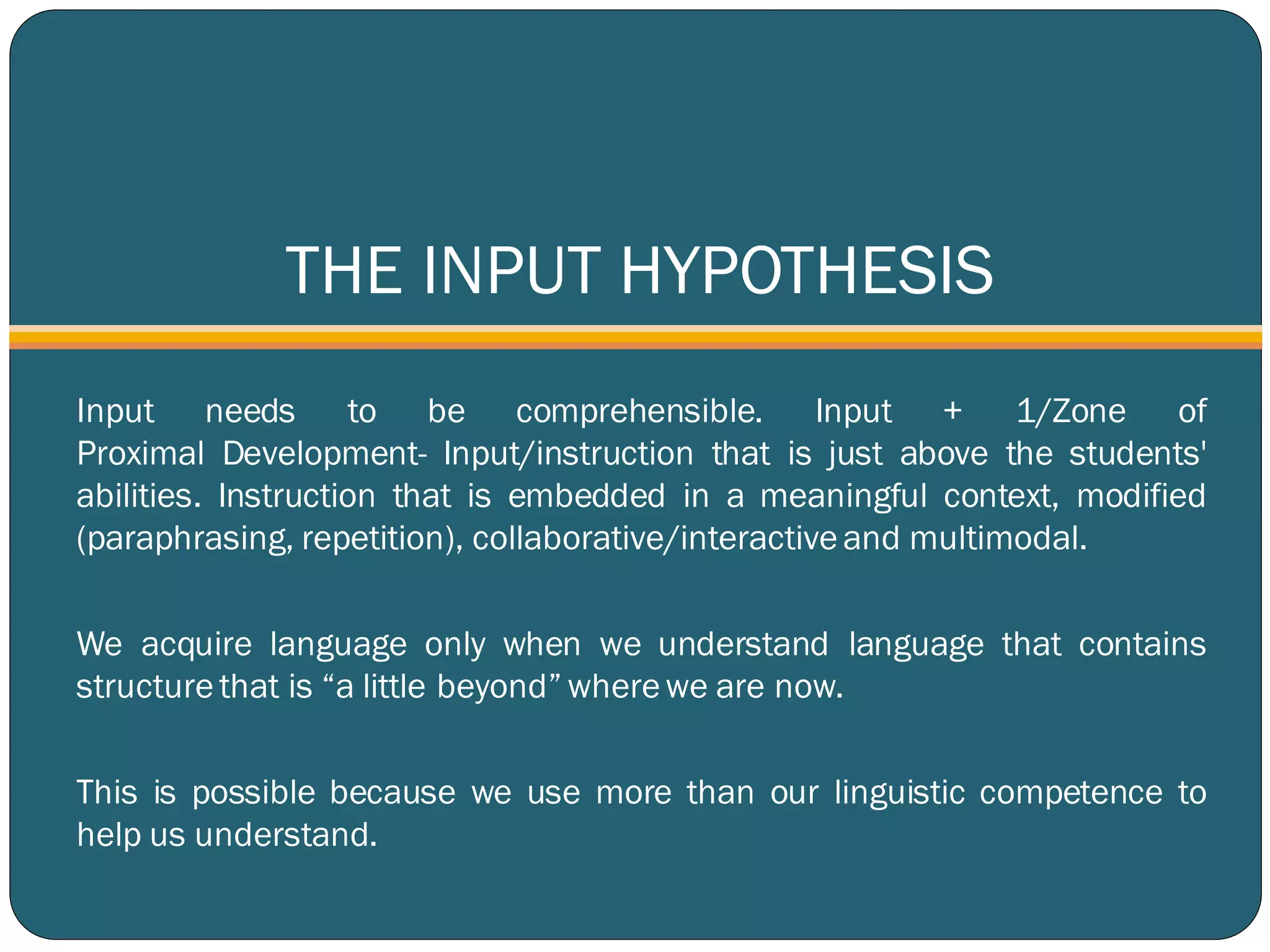
THE INPUT HYPOTHESIS
Inputneeds to be comprehensible. Input + 1/Zone of
Proximal Development- Input/instruction that is just above the students'
abilities. Instruction that is embedded in a meaningful context, modified
(paraphrasing, repetition), collaborative/interactiveand multimodal.
We acquire language only when we understand language that contains
structure that is “a little beyond” wherewe are now.
This is possible because we use more than our linguistic competence to
help us understand.
20.
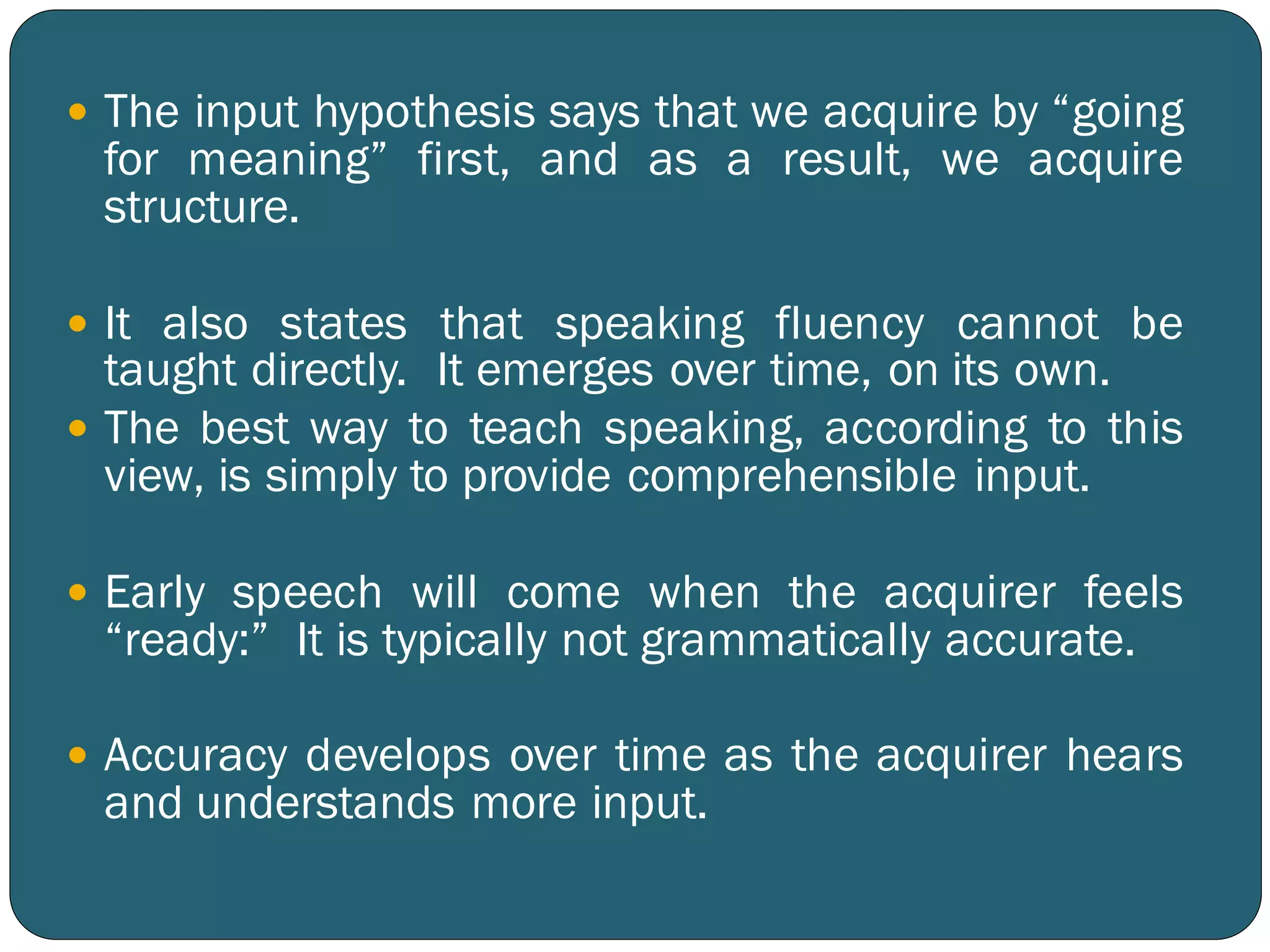
The inputhypothesis says that we acquire by “going
for meaning” first, and as a result, we acquire
structure.
It also states that speaking fluency cannot be
taught directly. It emerges over time, on its own.
The best way to teach speaking, according to this
view, is simply to provide comprehensible input.
Early speech will come when the acquirer feels
“ready:” It is typically not grammatically accurate.
Accuracy develops over time as the acquirer hears
and understands more input.
21.
BIBLIOGRAPHY
Krashen, StephenD. Principles and Practice in Second
Language Acquisition. Prentice-Hall International,
1987.
Krashen, Stephen D. Second Language Acquisition and
Second Language Learning. Prentice-Hall International,
1988.