Disadvantages of steelconstruction :
High Maintenance Costs And More Corrosion
Most steels are susceptible to corrosion
when freely exposed to air and water and must
therefore be periodically painted. This requires
extra cost and special care. The use of weathering
steels, in stable design applications, tends to
eliminate this cost. If not properly maintained,
steel members can loose 1 to 1.5 mm of their
thickness each year.
Fireproofing Costs
Although steel members are incombustible,
their strength is tremendously reduced at
temperatures prevailing in fires. At about 400ºC,
creep becomes much more pronounced. Creep is
defined as plastic deformation under a constant
load for a long period of time. This produces
excessively large deflections/deformations of
main members forcing the other members to
higher stresses or even to collapse.
Susceptibility To Buckling
The steel sections usually consist of
a combination of thin plates. Further, the
overall steel member dimensions are
also smaller than reinforced concrete
members. If these slender members are
subjected to compression, there are
greater chances of buckling.
Higher Initial Cost / Less
Availability
In few countries, steel is not available in
abundance and its initial cost is vary
high compared with the other structural
materials.
Aesthetics
For certain types of buildings, the steel
form is architecturally preferred.
However, for majority of residential and
office buildings, steel structures without
the use of false ceiling and cladding are
2.
Listing out therequired characteristics of structural steel, explain
the significance of its ductility in design and construction :
Characteristics of Structural Steel:
• High Strength: Structural steel must have high tensile strength to bear heavy loads without failing. The ability to withstand
stress and support weight is crucial in any construction.
•Ductility: Ductility is the ability of steel to undergo significant deformation before fracture. It allows the steel to absorb
energy and deform under stress, which is especially important during seismic or accidental loading.
•Weldability: Steel must be easy to weld and join with other components without compromising its structural integrity. This
is important for creating strong, durable connections.
•Corrosion Resistance: Steel should be resistant to rust and degradation from environmental factors (e.g., moisture, salt),
to ensure longevity and safety of structures.
•Fatigue Resistance: The material should withstand repetitive loading and unloading cycles without failure, especially in
areas subject to vibration or fluctuating stresses.
•Workability: Steel should be able to be easily fabricated and formed into the required shapes and sizes using processes
like cutting, bending, and shaping.
•Cost-effectiveness: While steel should meet all the necessary mechanical and physical properties, it should also be
cost-effective for use in construction to keep projects within budget.
•Fire Resistance: Structural steel must be designed to resist high temperatures during fires to maintain its strength
and prevent premature failure.
•Toughness: The material should be able to absorb energy during deformation and resist sudden fractures or brittle
failure, particularly in low temperatures or extreme conditions.
•Dimensional Stability: Steel should maintain its shape and size under varying environmental conditions, avoiding
expansion, contraction, or distortion that could lead to structural failure.
3.
significance of itsductility in design and construction :
•Energy Absorption: Ductility allows structural steel to deform plastically before failure, which means it can
absorb large amounts of energy during events like earthquakes or impacts without collapsing immediately.
This provides more time for people to evacuate and prevents sudden structural failure.
•Prevention of Brittle Failure: Ductile materials can withstand large deformations before fracture, which is
crucial in preventing sudden and catastrophic failures, such as those that might occur with brittle materials.
This is especially important in high-risk areas like bridges or high-rise buildings.
•Enhanced Safety: In construction, ductility ensures that structures can undergo temporary deformations
under loads (such as wind or seismic forces) without breaking apart. The material will bend or stretch instead
of fracturing, offering a "warning" to engineers and allowing for corrective action or repair.
•Seismic Design: Ductile materials are essential in seismic-resistant design because they can endure the
cyclic movements associated with earthquakes without failing. This is vital for buildings located in seismic
zones, as it allows the structure to absorb and dissipate the seismic energy.
•Design Flexibility: Ductile steel provides designers with more flexibility in creating structures that can
withstand unexpected forces. It offers a level of tolerance for deviations in load distribution and can still
maintain structural integrity.
Tensile Properties ofStructural Steel :
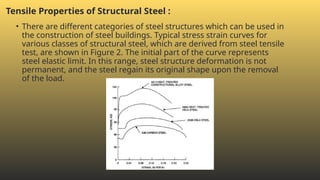
• There are different categories of steel structures which can be used in
the construction of steel buildings. Typical stress strain curves for
various classes of structural steel, which are derived from steel tensile
test, are shown in Figure 2. The initial part of the curve represents
steel elastic limit. In this range, steel structure deformation is not
permanent, and the steel regain its original shape upon the removal
of the load.
6.
• Shear strengthof steel structure is specified at the failure
under shear stress and it is about 0.57 times yield stress of
structural steel. Regarding elastic shear modulus, it is
expressed as the ratio of shear stress to shear strain in
elastic range of steel structure. Commonly, elastic shear
modulus of steel structure can be taken as 75.84Gpa or the
following formula can be used to compute elastic shear
modulus.
• Creep of Structural Steel Relaxation
Shear Properties of Structural Steel
7.
Creep of StructuralSteel Relaxation
• It is a step by step reduction of structural steel under a constant stress.
Usually, yield strength of steel structure increases around 5% over
stress relieved strain and the steel structure would suffer from plastic
elongation which around 0.01.
• Creep of Structural Steel Relaxation:
It is a step by step reduction of structural steel under a constant stress.
Usually, yield strength of steel structure increases around 5% over stress
relieved strain and the steel structure would suffer from plastic
elongation which around 0.01.
8.
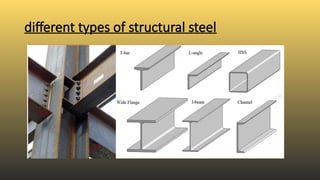
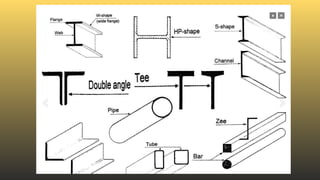
What are thedifferent types of structural steel?
Define and explain allthe mechanical properties
to be tested and satisfied as per
codalrequirements.
Define and explainallthe mechanical properties to
be tested and satisfied as per codalrequirements.
• List of Mechanical Properties of Materials
• The following are the mechanical properties of materials.
Toughness
Brittleness
Stiffness
Ductility
Malleability
Cohesion
Strength
Elasticity
Stress
Strain
Plasticity
Hardness
Impact strength
Fatigue
Creep
13.
• Strength
• Strengthis the mechanical property that enables a metal to resist deformation load.
• The strength of a material is its capacity to withstand destruction under the action of
external loads.
• The stronger the materials the greater the load it can withstand.
• Elasticity
• According to the dictionary, elasticity is the ability of an object or material to resume its
normal shape after being stretched or compressed.
• When a material has a load applied to it, the load causes the material to deform.
• The elasticity of a material is its power to come back to its original position after
deformation when the stress or load is released.
• Heat-treated springs, rubber, etc are good examples of elastic materials.
• Stress
• Whenever we apply an external force on an object, its particles act in the opposite direction,
applying a restoring force. The restoring force per unit area is referred to as stress.
14.
• Hardness
• Theresistance of a material to force penetration or bending is hardness.
• Hardness is the ability of a material to resist scratching, abrasion, cutting, or penetration.
• Hardness indicates the degree of hardness of a material that can be imparted particularly steel by the
process of hardening.
• It determines the depth and distribution of hardness introduced by the quenching process.
• Toughness
• It is the property of a material that enables it to withstand shock or impact.
• Toughness is the opposite condition of brittleness.
• The toughness may be considering the combination of strength and plasticity.
• Manganese steel, wrought iron, mild steel, etc are examples of toughness materials.
• Ductility
• The ductility is a property of a material that enables it to be drawn out into a thin wire.
• Mild steel, copper, and aluminum are good examples of a ductile material.
15.
• Creep
• Thecreep is a slow and progressive deformation of a material with time at a constant force.
• The simplest type of creep deformation is viscous flow.
• Some metals generally exhibit creep at high temperatures, whereas plastic, rubber, and similar
amorphous materials are very temperature-sensitive to creep.
• The force for a specified rate of strain at constant temperature is called creep strength.
• Malleability
• Malleability is a property of a material that permits it to be hammered or rolled into sheets of other
sizes and shapes.
• Aluminum, copper, tin, lead e#1tc are examples of malleable metals.
• Cohesion
• It is a mechanical property.
• Cohesion is a property of a solid body by which it resists being broken into a fragment.