Bending Test
Brittle materials
(Cast iron – Concrete)
Ductile materials (Steel)
• Types of bending tests:
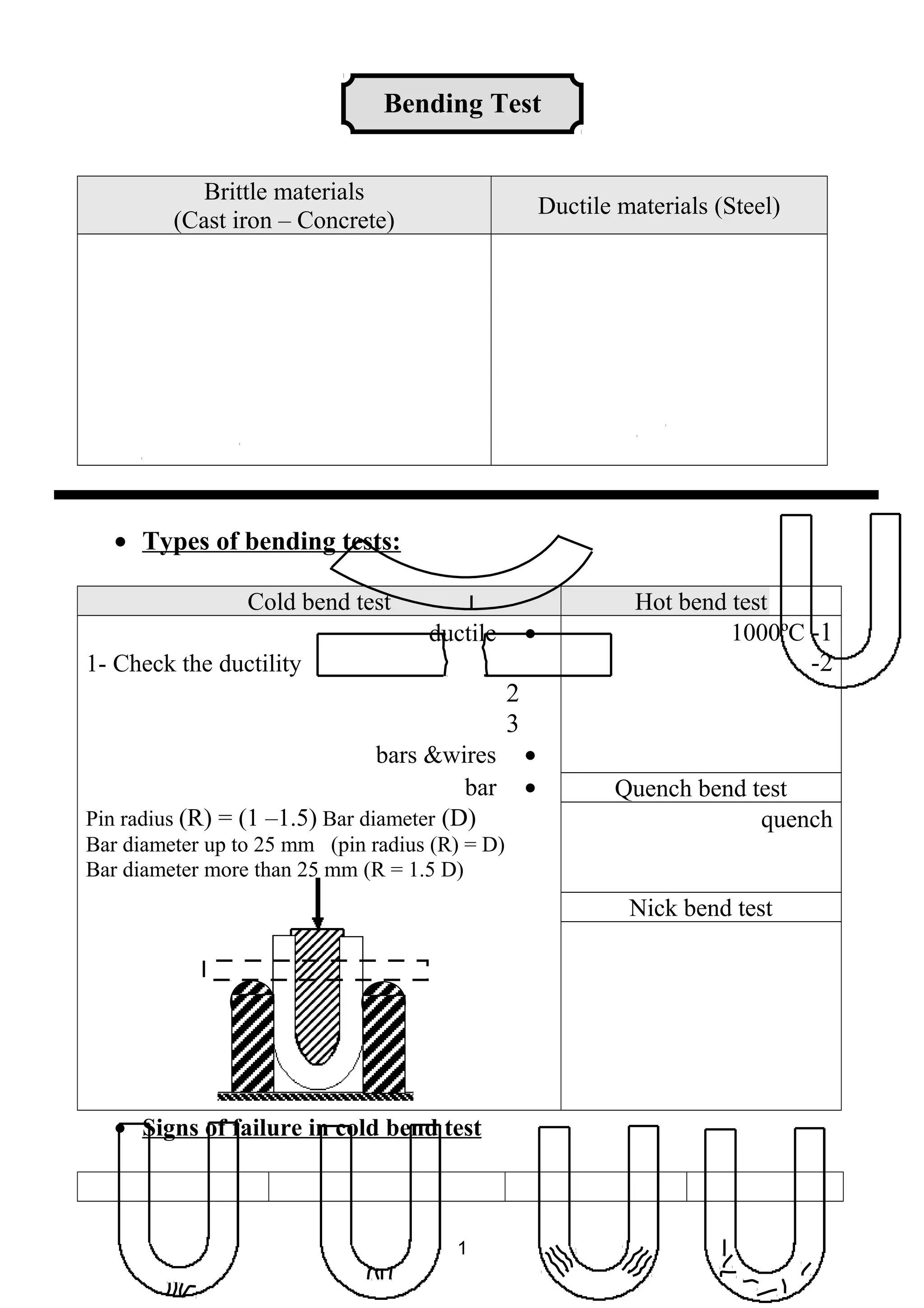
Cold bend test Hot bend test
•ductile
1- Check the ductility
2
3
•bars &wires
•bar
Pin radius (R) = (1 –1.5) Bar diameter (D)
Bar diameter up to 25 mm (pin radius (R) = D)
Bar diameter more than 25 mm (R = 1.5 D)
1-1000ºC
2-
Quench bend test
quench
Nick bend test
• Signs of failure in cold bend test
1
Mp.l
. Y
I
Mmax
. Y
I
½ Pp.l
X ∆p.l
Ao
Lo
⅔ Pmax
X ∆max
Ao
Lo
Pp.l
. L3
48 ∆p.l
. I
Tensile stresses Compressive stresses Shear stresses Defects
• Loads causing bending stresses
Moment (M)
1. 3-Point bending
2. Center load
3. Simple beam
M =
Cantilever M = P L
Two point loading
Third points
4-Point bending M =
Quarter points
1bendingtwo point loading
2cast ironcenter load
σP.LBending stress at proportional limit
2
P L
4
P L
6
P
/2
P
/2
P
/2
P
/2
P
P
σmaxModulus of rupture
M.RModulus of resilience
M.T.Modulus of toughness
E
Modulus of elasticity (stiffness)
Area (A) Y Moment of inertia (I)
π
/4 D2 π
/64 D4
π
/4( D2
-d2
) π
/64 (D4
– d4
)
bh
• The effect of variables on the results:
1. Specimen dimensions
When the cross-section area (or) the length (decrease), the modulus of
rupture (Increase) and modulus of elasticity (decrease)
modulus of rupture
3
P
Δ
bh3
21
D
2
D
2
h
2
D
D
d
h
b
The modulus of rupture and the modulus of elasticity are lower for I section
extreme fiberStrength
2. Types of loading
modulus of rupture
Modulus of rupture from Cantilever > Modulus of rupture from Center
load (3-point) > Modulus of rupture from 4-point loading
Modulus of rupture for 4-point loading is less than that for 3-point loading
by (10 – 25%)
Rate of loading
The greater the test speed the higher the measured strength and hardness
1-To avoid shear failure L/d = (6 -12(
2- To avoid buckling L/b < 15 (b = width)
( ) A timber beam of circular cross-section simply supported over a span of 50
cm was tested in bending under a central load. If the modulus of elasticity of
this wood was 790 ton/cm2
and the loads versus mid span vertical deflection
were as follows:
P, ton 0 0.6 1 1.4 1.8 2.2 2.6 2.7 2.8
Δ, mm 0 0.5 0.8 1.2 1.5 2 3 4 5
Draw the load-deflection diagram and determine:
a- Diameter of the beam b- Elastic bending strength
c- Modulus of rupture d- Modulus of resilience
e- Modulus of toughness
4
Modulus of elasticity E = = = 790 ton/cm2
D = 5.3 cm
Elastic bending strength = = = 1.54 ton/cm2
Modulus of rupture = = = 2.4 ton/cm2
Modulus of resilience = = = 1.22 x 10⁻⁴
ton/cm2
Modulus of toughness = = = 8.46 x 10⁻⁴
ton/cm2
( ) A cast iron beam of circular cross section was simply supported over a span
of 50 cm and tested in bending under concentrated load at its mid-span. The
modulus of elasticity is 800 ton/cm2
. Find:
− The diameter of the beam if the resilience is 0.2 ton.cm and the load at the
proportional limit is 2 ton
− The maximum load on the beam if the maximum bending strength is 2.8
ton/cm2
− Explain the fracture behavior of the beam.
5
0
0.5
1
1.5
2
2.5
3
0 0.5 1 1.5 2 2.5 3 3.5 4 4.5 5 5.5
P
Δ
W
D L = 50 cm I = π
/64
D4
Y = D/2M =
PL
4
½ Pp.l
X ∆p.l
Ao
Lo
⅔ Pmax
X ∆max
Ao
Lo
Pp.l
. L3
48 ∆p.l
. I
1.8 x (50)3
48 x 0.15 x π
/64
D4
Mp.l
Y
I π
/64
x (5.3)4
4
1.8 x 50
2
5.3
X
Mmax
Y
I π
/64
x (5.3)4
4
2.8 x 50
2
5.3
X
½ x 1.8 x 0.15
π
/4
(5.3)2
x 50
⅔ x 2.8 x 0.5
π
/4
(5.3)2
x 50
W
D L = 50 cm I = π
/64
D4
Y = D/2M =
PL
4
Pp.l = 2 ton Resilience = ½ Pp.l X ∆p.l = ½ x 2 x ∆p.l = 0.2 ∆p.l = 0.2 cm
Modulus of elasticity E = = = 800 ton/cm2
D = 5.1 cm
Modulus of rupture = = = 2.8 ton/cm2
Pmax = 2.92 ton
( ) A bending test was carried out on two cast iron beams, A and B, by loading
each beam in the center of its span to fracture. The following readings were
recorded:
Beam Diameter (mm) Span (mm) Fracture load (kg) Central deflection (mm)
A 40 600 1500 1.4
B 60 800 2000 1.6
Which one can be considered better than the other for strength property
and toughness property?
Beam A Beam B
Y = D/2 = 40/2 = 20 mm
I= π
/64 D4
= π
/64 (40)4
Y = D/2 = 60/2 = 30 mm
I= π
/64 D4
= π
/64 (60)4
6
Pp.l
. L3
48 ∆p.l
. I
2 x (50)3
48 x 0.2 x π
/64
D4
Mmax
Y
I π
/64
x (5.1)4
4
Pmax
x 50
2
5.1
X
Strength properties
=
σ =0.036 ton/mm2
=
σ =0.019 ton/mm2
Toughness properties
T = ⅔ Pmax x ∆max = ⅔ x 1.5 x 1.4
T = 1.4 ton. mm
T = ⅔ Pmax x ∆max = ⅔ x 2 x 1.6
T = 2.13 ton. mm
Beam A is better than beam B for strength properties and lower in toughness
properties
( ) A beam of circular cross-section of 5 cm in diameter, simply supported over
a span of 40 cm, and was tested in bending under a central load. The loads
and corresponding deflections until rupture were as follows:
Load ( ton)
0 0.5 1 1.25 1.7 2 2.4
2.5
5
2.6
Deflection (mm) 0 0.4 0.8 1 1.5 2 3 4 4.8
(i) Draw the load-deflection diagram and determine:
• Stress at proportional limit
• Modulus of elasticity in bending
• Modulus of rupture
• Modulus of resilience
(ii) Draw the bending stress distribution on a section at 10 cm from the
support when the central load was 1 ton
7
π
/64
x (40)4
4
1.5 x 600
2
40
XMmax
Y
I
σ = π
/64
x (60)4
4
2 x 800
2
60
XMmax
Y
I
σ =
W
5 cm
L = 40 cm I = π
/64
(5)4
Y = 5/2 = 2.5M =
PL
4
Modulus of elasticity E = = = 543 ton/cm2
Elastic bending strength = = = 1.02 ton/cm2
Modulus of rupture = = = 2.12 ton/cm2
Modulus of resilience = = = 7.96 x 10⁻⁵
ton/cm2
( ) A cast iron beam of circular cross-section of 7 cm in diameter, simply
supported over a span of 60 cm was tested in bending under a central load.
If the loads and corresponding deflections until rupture were as follows:
Load ( ton) 0 1.2 2 2.8 3.6 4.4 5.2 5.5 5.6
Deflection (mm) 0 1 1.6 2.4 3 4 6 8 10
Draw the load-deflection diagram and determine:
i) Modulus of rupture.
ii) Modulus of elasticity, E, in bending.
iii) Draw fracture shape of the beam.
8
½ Pp.l
X ∆p.l
Ao
Lo
Pp.l
. L3
48 ∆p.l
. I
1.25 x (40)3
48 x 0.1 x π
/64
(5)4
Mp.l
Y
I π
/64
x (5)4
4
1.25 x
2
5
X
Mmax
Y
I π
/64
x (5)4
4
2.6 x 50
2
5
X
½ x 1.25 x 0.1
π
/4
(5)2
x 40
0
0.5
1
1.5
2
2.5
3
0 1 2 3 4 5 6
P
Δ
W
7 cm
L = 60 cm I = π
/64
(7)4
Y = 7/2 = 3.5M =
PL
4
Mmax
Y
I π
/64
x (7)4
X
Pp.l
. L3
48 ∆p.l
. I
3.6 x (60)3
48 x 0.3 x π
/64
(7)4
0
100
200
300
400
500
600
700
800
0 5 10 15 20 25 30 35 40 45
P
Δ
I = 1
/12
[2.5(5)3
] Y = 5/2 = 2.5
L = 90 cm M =
PL
4
W
2.5 cm
5cm
Modulus of rupture = = = 2.49 ton/cm2
Modulus of elasticity E = = = 458 ton/cm2
Fracture Shape
( ) A timber beam was centrally loaded; the distance between supports being 90
cm, the cross section of the beam was 2.5 cm breadth and 5 cm depth. If the
loads and corresponding deflections are as follows:
Load ( Kg) 100 200 300 400 500 600 700 750
Deflection (mm)
4.75 9.52 14.3 19.02
23.8
6
27.2
36.
1
Failure
Draw the load-deflection diagram and determine:
a) Extreme fiber stress at limit of proportionality
b) Modulus of rupture
c) Modulus of resilience
d) Modulus of toughness
e) Stiffness of material
9
0
1
2
3
4
5
6
0 2 4 6 8 10 12
P
Δ
4
5.6 x 60
2
7
W
D cm
L = 80 mm I = π
/64
(D)4
Y = D/2M =
PL
4
1000
1200P
Stress at proportional limit = = = 1.08 ton/cm2
Modulus of rupture = = = 1.62 ton/cm2
Modulus of resilience = = = 0.53 x 10⁻³
ton/cm2
Modulus of toughness = = = 1.87 x 10⁻³
ton/cm2
Modulus of elasticity E = = = 122 ton/cm2
( ) A cast iron beam of circular cross-section was tested in bending under a
central load and on support 80 mm apart. If the modulus of resilience of this
grade of cast iron equals 0.196 Kg/cm2
and the loads and corresponding
deflections measured during the test are as follows:
Load ( Kg)
150 300 450 600 750
90
0
1050 1100
Deflection (mm) 1.05 2.1 3.15 4.2 5.25 6.8 8.88 Failure
Draw the load-deflection diagram and determine:
a) Diameter of cross section
b) Modulus of rupture
10
½ Pp.l
X ∆p.l
Ao
Lo
⅔ Pmax
X ∆max
Ao
Lo
Mp.l
Y
I 1
/12
[2.5(5)3
]
4
0.5 x
2
5
X
Mmax
Y
I 1
/12
[2.5(5)3
]
4
0.75 x
2
5
X
½ x 0.5 x 2.386
2.5 x 5 x 90
⅔ x 0.75 x 4.2
2.5 x 5 x 90
Pp.l
. L3
48 ∆p.l
. I
0.5 x (90)3
48 x 2.386 x 1
/12
[2.5(5)3
]
0
200
400
600
800
0 1 2 3 4 5 6 7 8 9 10
Δ
c) Modulus of elasticity
Modulus of resilience = = = 1.96 x 10⁻³
kg/mm2
D = 126 mm
Modulus of rupture = = = 0.112 kg/mm2
Modulus of elasticity E = = = 0.123 kg/mm2
( ) A simply supported cast iron beam of square cross-section 12cm x 12cm was
centrally loaded by 24 tons, if the bending strength of the beam is 25
kg/mm2
. Calculate the span of the beam.
= = 25 kg/mm2
L = 1200 mm
11
Mmax
Y
I π
/64
x (126)4
4
1100 x 80
2
126
X
½ Pp.l
X ∆p.l
Ao
Lo
½ x 750 x 5.25
π
/4
(D)2
x 80
Pp.l
. L3
48 ∆p.l
. I
750 x (80)3
48 x 5.25 x π
/64
(126)4
I = 1
/12
[120(120)3
] Y = 120/2 = 60mm
L =??? M =
PL
4
P
12 cm
12cm
1
/12
[120(120)3
]
4
24000 L
2
120
XM . Y
I
σ =
( ) A cantilever 1.2 m consisting of a steel tube with external and internal
diameters of 6 and 5 cm respectively, carries a concentrated load of W (Kg)
at the free end. Neglecting the weight of the tube, it is required to find the
value of W if the maximum bending stress is not to exceed 1.3 ton/cm2
.
= = 1.3 ton/cm2
W = 0.119 ton = 119 kg
12
π
/64
[(6)4
- (5)4
]
W x 120 x 3M .Y
I
σ =
M = P L
P
L = 120 cm I = π
/64
[(6)4
- (5)4
] Y = D/2 = 6/2 = 3 cm
6
5
I = 1
/12
[10(15)3
] Y = 15/2 = 7.5cm
L = 240 cm
M =
W L
4
=
240W
4
I = 1
/12
[10(h)3
] Y = h/2
M =
W x 0.6 x 100
2
=
( ) A simply supported beam of 2.4 m span
has a constant width of 10 cm throughout
its length with varying depth of 15 cm at
the centre to minimum at the ends as
shown in fig. the beam is carrying a point
load W at its mid span. Find the
minimum depth of the beam at a section
0.6 m from the left hand support. Such that the maximum bending stress at
this section is equal to that at the mid span of the beam.
At mid span
= = 0.16 W
At 0.6 m from left support
30 W
13
2.4m
W
BCA
10
15
W
W/2W/2
0.6 m
10
10
15
1
/12
[10(15)3
]
4
240 W
2
15
XM . Y
I
σ1
=
2 = =
σ1 = σ2
0.16 W = 18 W / h2
h = 10.61 cm
14
h
10
1
/12
[10(h)3
]
30 W XM . Y
I
σ = 2
h
h2
18W

3 bending test

  • 1.
    Bending Test Brittle materials (Castiron – Concrete) Ductile materials (Steel) • Types of bending tests: Cold bend test Hot bend test •ductile 1- Check the ductility 2 3 •bars &wires •bar Pin radius (R) = (1 –1.5) Bar diameter (D) Bar diameter up to 25 mm (pin radius (R) = D) Bar diameter more than 25 mm (R = 1.5 D) 1-1000ºC 2- Quench bend test quench Nick bend test • Signs of failure in cold bend test 1
  • 2.
    Mp.l . Y I Mmax . Y I ½Pp.l X ∆p.l Ao Lo ⅔ Pmax X ∆max Ao Lo Pp.l . L3 48 ∆p.l . I Tensile stresses Compressive stresses Shear stresses Defects • Loads causing bending stresses Moment (M) 1. 3-Point bending 2. Center load 3. Simple beam M = Cantilever M = P L Two point loading Third points 4-Point bending M = Quarter points 1bendingtwo point loading 2cast ironcenter load σP.LBending stress at proportional limit 2 P L 4 P L 6 P /2 P /2 P /2 P /2 P P
  • 3.
    σmaxModulus of rupture M.RModulusof resilience M.T.Modulus of toughness E Modulus of elasticity (stiffness) Area (A) Y Moment of inertia (I) π /4 D2 π /64 D4 π /4( D2 -d2 ) π /64 (D4 – d4 ) bh • The effect of variables on the results: 1. Specimen dimensions When the cross-section area (or) the length (decrease), the modulus of rupture (Increase) and modulus of elasticity (decrease) modulus of rupture 3 P Δ bh3 21 D 2 D 2 h 2 D D d h b
  • 4.
    The modulus ofrupture and the modulus of elasticity are lower for I section extreme fiberStrength 2. Types of loading modulus of rupture Modulus of rupture from Cantilever > Modulus of rupture from Center load (3-point) > Modulus of rupture from 4-point loading Modulus of rupture for 4-point loading is less than that for 3-point loading by (10 – 25%) Rate of loading The greater the test speed the higher the measured strength and hardness 1-To avoid shear failure L/d = (6 -12( 2- To avoid buckling L/b < 15 (b = width) ( ) A timber beam of circular cross-section simply supported over a span of 50 cm was tested in bending under a central load. If the modulus of elasticity of this wood was 790 ton/cm2 and the loads versus mid span vertical deflection were as follows: P, ton 0 0.6 1 1.4 1.8 2.2 2.6 2.7 2.8 Δ, mm 0 0.5 0.8 1.2 1.5 2 3 4 5 Draw the load-deflection diagram and determine: a- Diameter of the beam b- Elastic bending strength c- Modulus of rupture d- Modulus of resilience e- Modulus of toughness 4
  • 5.
    Modulus of elasticityE = = = 790 ton/cm2 D = 5.3 cm Elastic bending strength = = = 1.54 ton/cm2 Modulus of rupture = = = 2.4 ton/cm2 Modulus of resilience = = = 1.22 x 10⁻⁴ ton/cm2 Modulus of toughness = = = 8.46 x 10⁻⁴ ton/cm2 ( ) A cast iron beam of circular cross section was simply supported over a span of 50 cm and tested in bending under concentrated load at its mid-span. The modulus of elasticity is 800 ton/cm2 . Find: − The diameter of the beam if the resilience is 0.2 ton.cm and the load at the proportional limit is 2 ton − The maximum load on the beam if the maximum bending strength is 2.8 ton/cm2 − Explain the fracture behavior of the beam. 5 0 0.5 1 1.5 2 2.5 3 0 0.5 1 1.5 2 2.5 3 3.5 4 4.5 5 5.5 P Δ W D L = 50 cm I = π /64 D4 Y = D/2M = PL 4 ½ Pp.l X ∆p.l Ao Lo ⅔ Pmax X ∆max Ao Lo Pp.l . L3 48 ∆p.l . I 1.8 x (50)3 48 x 0.15 x π /64 D4 Mp.l Y I π /64 x (5.3)4 4 1.8 x 50 2 5.3 X Mmax Y I π /64 x (5.3)4 4 2.8 x 50 2 5.3 X ½ x 1.8 x 0.15 π /4 (5.3)2 x 50 ⅔ x 2.8 x 0.5 π /4 (5.3)2 x 50 W D L = 50 cm I = π /64 D4 Y = D/2M = PL 4
  • 6.
    Pp.l = 2ton Resilience = ½ Pp.l X ∆p.l = ½ x 2 x ∆p.l = 0.2 ∆p.l = 0.2 cm Modulus of elasticity E = = = 800 ton/cm2 D = 5.1 cm Modulus of rupture = = = 2.8 ton/cm2 Pmax = 2.92 ton ( ) A bending test was carried out on two cast iron beams, A and B, by loading each beam in the center of its span to fracture. The following readings were recorded: Beam Diameter (mm) Span (mm) Fracture load (kg) Central deflection (mm) A 40 600 1500 1.4 B 60 800 2000 1.6 Which one can be considered better than the other for strength property and toughness property? Beam A Beam B Y = D/2 = 40/2 = 20 mm I= π /64 D4 = π /64 (40)4 Y = D/2 = 60/2 = 30 mm I= π /64 D4 = π /64 (60)4 6 Pp.l . L3 48 ∆p.l . I 2 x (50)3 48 x 0.2 x π /64 D4 Mmax Y I π /64 x (5.1)4 4 Pmax x 50 2 5.1 X
  • 7.
    Strength properties = σ =0.036ton/mm2 = σ =0.019 ton/mm2 Toughness properties T = ⅔ Pmax x ∆max = ⅔ x 1.5 x 1.4 T = 1.4 ton. mm T = ⅔ Pmax x ∆max = ⅔ x 2 x 1.6 T = 2.13 ton. mm Beam A is better than beam B for strength properties and lower in toughness properties ( ) A beam of circular cross-section of 5 cm in diameter, simply supported over a span of 40 cm, and was tested in bending under a central load. The loads and corresponding deflections until rupture were as follows: Load ( ton) 0 0.5 1 1.25 1.7 2 2.4 2.5 5 2.6 Deflection (mm) 0 0.4 0.8 1 1.5 2 3 4 4.8 (i) Draw the load-deflection diagram and determine: • Stress at proportional limit • Modulus of elasticity in bending • Modulus of rupture • Modulus of resilience (ii) Draw the bending stress distribution on a section at 10 cm from the support when the central load was 1 ton 7 π /64 x (40)4 4 1.5 x 600 2 40 XMmax Y I σ = π /64 x (60)4 4 2 x 800 2 60 XMmax Y I σ = W 5 cm L = 40 cm I = π /64 (5)4 Y = 5/2 = 2.5M = PL 4
  • 8.
    Modulus of elasticityE = = = 543 ton/cm2 Elastic bending strength = = = 1.02 ton/cm2 Modulus of rupture = = = 2.12 ton/cm2 Modulus of resilience = = = 7.96 x 10⁻⁵ ton/cm2 ( ) A cast iron beam of circular cross-section of 7 cm in diameter, simply supported over a span of 60 cm was tested in bending under a central load. If the loads and corresponding deflections until rupture were as follows: Load ( ton) 0 1.2 2 2.8 3.6 4.4 5.2 5.5 5.6 Deflection (mm) 0 1 1.6 2.4 3 4 6 8 10 Draw the load-deflection diagram and determine: i) Modulus of rupture. ii) Modulus of elasticity, E, in bending. iii) Draw fracture shape of the beam. 8 ½ Pp.l X ∆p.l Ao Lo Pp.l . L3 48 ∆p.l . I 1.25 x (40)3 48 x 0.1 x π /64 (5)4 Mp.l Y I π /64 x (5)4 4 1.25 x 2 5 X Mmax Y I π /64 x (5)4 4 2.6 x 50 2 5 X ½ x 1.25 x 0.1 π /4 (5)2 x 40 0 0.5 1 1.5 2 2.5 3 0 1 2 3 4 5 6 P Δ W 7 cm L = 60 cm I = π /64 (7)4 Y = 7/2 = 3.5M = PL 4
  • 9.
    Mmax Y I π /64 x (7)4 X Pp.l .L3 48 ∆p.l . I 3.6 x (60)3 48 x 0.3 x π /64 (7)4 0 100 200 300 400 500 600 700 800 0 5 10 15 20 25 30 35 40 45 P Δ I = 1 /12 [2.5(5)3 ] Y = 5/2 = 2.5 L = 90 cm M = PL 4 W 2.5 cm 5cm Modulus of rupture = = = 2.49 ton/cm2 Modulus of elasticity E = = = 458 ton/cm2 Fracture Shape ( ) A timber beam was centrally loaded; the distance between supports being 90 cm, the cross section of the beam was 2.5 cm breadth and 5 cm depth. If the loads and corresponding deflections are as follows: Load ( Kg) 100 200 300 400 500 600 700 750 Deflection (mm) 4.75 9.52 14.3 19.02 23.8 6 27.2 36. 1 Failure Draw the load-deflection diagram and determine: a) Extreme fiber stress at limit of proportionality b) Modulus of rupture c) Modulus of resilience d) Modulus of toughness e) Stiffness of material 9 0 1 2 3 4 5 6 0 2 4 6 8 10 12 P Δ 4 5.6 x 60 2 7
  • 10.
    W D cm L =80 mm I = π /64 (D)4 Y = D/2M = PL 4 1000 1200P Stress at proportional limit = = = 1.08 ton/cm2 Modulus of rupture = = = 1.62 ton/cm2 Modulus of resilience = = = 0.53 x 10⁻³ ton/cm2 Modulus of toughness = = = 1.87 x 10⁻³ ton/cm2 Modulus of elasticity E = = = 122 ton/cm2 ( ) A cast iron beam of circular cross-section was tested in bending under a central load and on support 80 mm apart. If the modulus of resilience of this grade of cast iron equals 0.196 Kg/cm2 and the loads and corresponding deflections measured during the test are as follows: Load ( Kg) 150 300 450 600 750 90 0 1050 1100 Deflection (mm) 1.05 2.1 3.15 4.2 5.25 6.8 8.88 Failure Draw the load-deflection diagram and determine: a) Diameter of cross section b) Modulus of rupture 10 ½ Pp.l X ∆p.l Ao Lo ⅔ Pmax X ∆max Ao Lo Mp.l Y I 1 /12 [2.5(5)3 ] 4 0.5 x 2 5 X Mmax Y I 1 /12 [2.5(5)3 ] 4 0.75 x 2 5 X ½ x 0.5 x 2.386 2.5 x 5 x 90 ⅔ x 0.75 x 4.2 2.5 x 5 x 90 Pp.l . L3 48 ∆p.l . I 0.5 x (90)3 48 x 2.386 x 1 /12 [2.5(5)3 ]
  • 11.
    0 200 400 600 800 0 1 23 4 5 6 7 8 9 10 Δ c) Modulus of elasticity Modulus of resilience = = = 1.96 x 10⁻³ kg/mm2 D = 126 mm Modulus of rupture = = = 0.112 kg/mm2 Modulus of elasticity E = = = 0.123 kg/mm2 ( ) A simply supported cast iron beam of square cross-section 12cm x 12cm was centrally loaded by 24 tons, if the bending strength of the beam is 25 kg/mm2 . Calculate the span of the beam. = = 25 kg/mm2 L = 1200 mm 11 Mmax Y I π /64 x (126)4 4 1100 x 80 2 126 X ½ Pp.l X ∆p.l Ao Lo ½ x 750 x 5.25 π /4 (D)2 x 80 Pp.l . L3 48 ∆p.l . I 750 x (80)3 48 x 5.25 x π /64 (126)4 I = 1 /12 [120(120)3 ] Y = 120/2 = 60mm L =??? M = PL 4 P 12 cm 12cm 1 /12 [120(120)3 ] 4 24000 L 2 120 XM . Y I σ =
  • 12.
    ( ) Acantilever 1.2 m consisting of a steel tube with external and internal diameters of 6 and 5 cm respectively, carries a concentrated load of W (Kg) at the free end. Neglecting the weight of the tube, it is required to find the value of W if the maximum bending stress is not to exceed 1.3 ton/cm2 . = = 1.3 ton/cm2 W = 0.119 ton = 119 kg 12 π /64 [(6)4 - (5)4 ] W x 120 x 3M .Y I σ = M = P L P L = 120 cm I = π /64 [(6)4 - (5)4 ] Y = D/2 = 6/2 = 3 cm 6 5
  • 13.
    I = 1 /12 [10(15)3 ]Y = 15/2 = 7.5cm L = 240 cm M = W L 4 = 240W 4 I = 1 /12 [10(h)3 ] Y = h/2 M = W x 0.6 x 100 2 = ( ) A simply supported beam of 2.4 m span has a constant width of 10 cm throughout its length with varying depth of 15 cm at the centre to minimum at the ends as shown in fig. the beam is carrying a point load W at its mid span. Find the minimum depth of the beam at a section 0.6 m from the left hand support. Such that the maximum bending stress at this section is equal to that at the mid span of the beam. At mid span = = 0.16 W At 0.6 m from left support 30 W 13 2.4m W BCA 10 15 W W/2W/2 0.6 m 10 10 15 1 /12 [10(15)3 ] 4 240 W 2 15 XM . Y I σ1 =
  • 14.
    2 = = σ1= σ2 0.16 W = 18 W / h2 h = 10.61 cm 14 h 10 1 /12 [10(h)3 ] 30 W XM . Y I σ = 2 h h2 18W