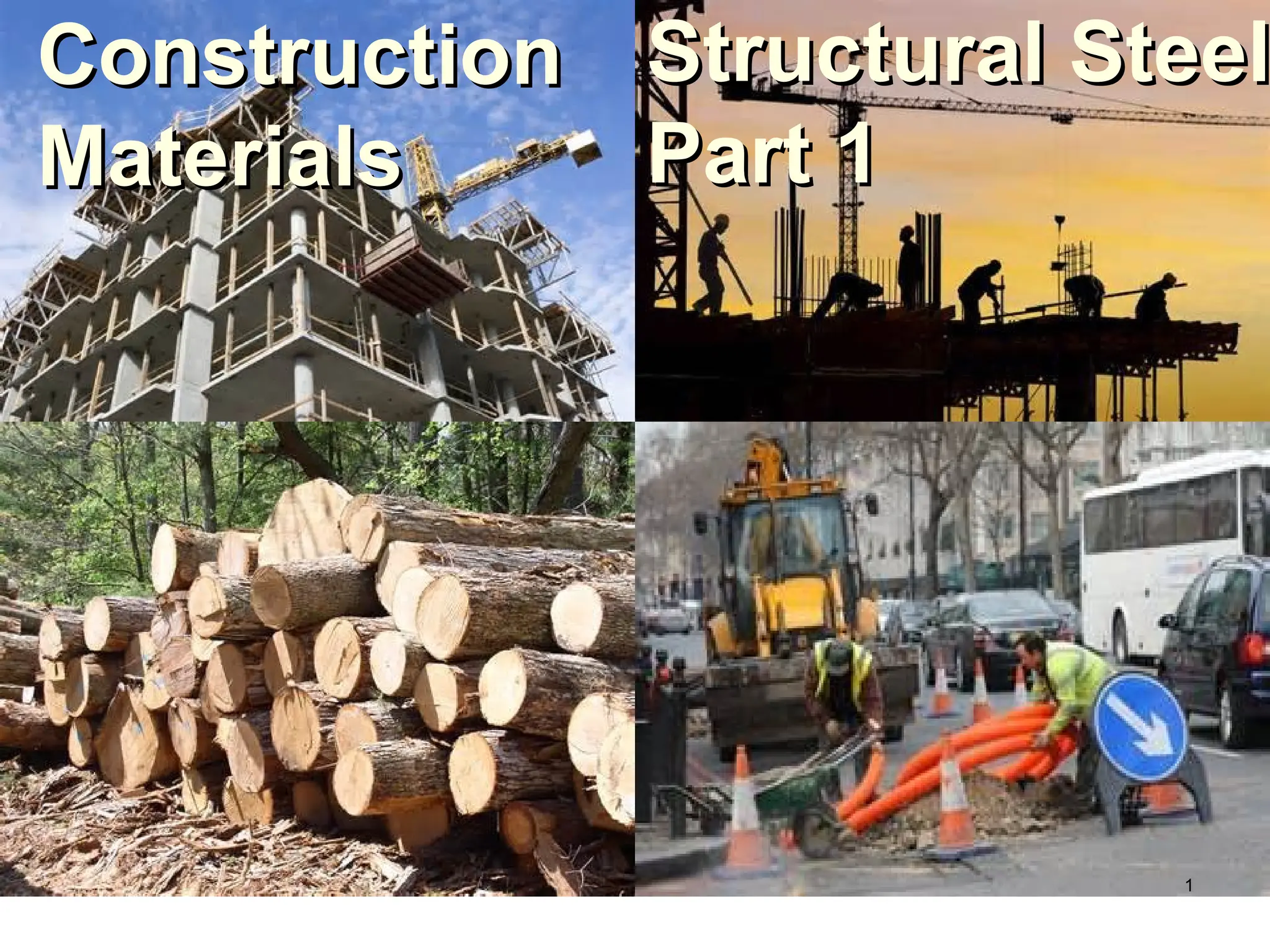
Construction
Construction
Materials
Materials
1
Structural Steel
Structural Steel
Part 1
Part 1
6.0 Learning Objectives
At the end of the session, students should be able to:
1.Eurocodes and classification
2.Explain the characteristics and structural uses of iron-carbon
alloys.
3.Describe the composition and properties of mild and high tensile
steel.
4.Describe different types of steel.
5.Explain the mechanical and manufacturing process of steel.
6.Explain the forming process of steel.
7.Explain the tensile test of steel.
8.Describe the different ways of protecting steel from corrosion. 2
3
6.1a Eurocodes
Eurocodes are a set of design and technical rules
developed by the European Committee for Standardisation
for the structural design of construction works.
The purposes of the Eurocodes are:
•A means to prove compliance with the requirements for
mechanical strength and stability and safety in case of
fire.
•A basis for construction, technical and engineering
specifications for building works
4
6.1a Eurocodes
By March 2010 the Eurocodes are mandatory for the
specification of European public works and are
intended to become the standard for the private sector.
The Eurocodes therefore replace the existing national
building codes published by national standard bodies
such as BS 5950, although many countries had a period
of co-existence.
Additionally, each country is expected to issue a
National Annex to the Eurocodes which will need
referencing for a particular country (e.g. The UK
National Annex).
5
6.1a Eurocodes
EN 1990 to EN 1999
These range covers multiple discipline in structural
design according to specification of a project It applies
to the design of buildings and civil engineering works in
steel.
EN 1990 is intended to be used in conjunction with EN
1991 to EN 1999 for the following:-
1.Structural design of buildings
2.Civil engineering works
3.Geotechnical aspects
4.Structural fire design
5.Earthquakes
6.Temporary structures.
6
6.1b Glossary of Terms
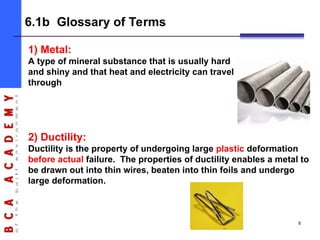
1) Metal:
A type of mineral substance that is usually hard
and shiny and that heat and electricity can travel
through
2) Ductility:
Ductility is the property of undergoing large plastic deformation
before actual failure. The properties of ductility enables a metal to
be drawn out into thin wires, beaten into thin foils and undergo
large deformation.
7
6.1b Glossary of Terms
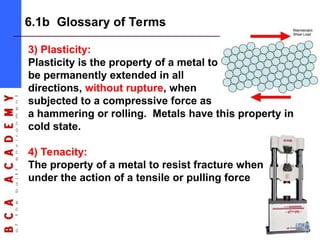
3) Plasticity:
Plasticity is the property of a metal to
be permanently extended in all
directions, without rupture, when
subjected to a compressive force as
a hammering or rolling. Metals have this property in
cold state.
4) Tenacity:
The property of a metal to resist fracture when
under the action of a tensile or pulling force
8
6.1b Glossary of Terms
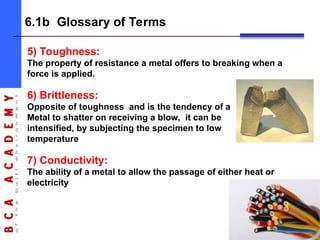
5) Toughness:
The property of resistance a metal offers to breaking when a
force is applied.
6) Brittleness:
Opposite of toughness and is the tendency of a
Metal to shatter on receiving a blow, it can be
intensified, by subjecting the specimen to low
temperature
7) Conductivity:
The ability of a metal to allow the passage of either heat or
electricity
9
6.1b Glossary of Terms
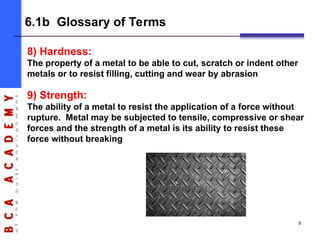
8) Hardness:
The property of a metal to be able to cut, scratch or indent other
metals or to resist filling, cutting and wear by abrasion
9) Strength:
The ability of a metal to resist the application of a force without
rupture. Metal may be subjected to tensile, compressive or shear
forces and the strength of a metal is its ability to resist these
force without breaking
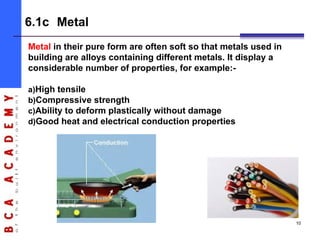
Metal in their pure form are often soft so that metals used in
building are alloys containing different metals. It display a
considerable number of properties, for example:-
a)High tensile
b)Compressive strength
c)Ability to deform plastically without damage
d)Good heat and electrical conduction properties
6.1c Metal
10
Classification of Metals
Ferrous metals:
Contain substantial proportion of iron such as:-
a)Cast iron
b)Wrought iron
c)Mild steel
The great differences in the properties of these materials are
mainly due to the presence of carbon in the metal depending on
the amount and the manner in which it exists in the iron.
Non-ferrous metal:
Which contain little or no iron such as:-.
a)Aluminum
b)Copper
c)Lead
d)Zinc
6.1c Metal
11
Iron is extracted from four principal ores (rocks):
- Hematite
- Limonite
- Magnetite
-Taconite
Iron (Fe), is a silvery - white, flexible, ductile, magnetic or
magnetisable metallic element. Since the iron is included with
many other minerals in earth, it is necessary to separate the iron
in a blast furnace
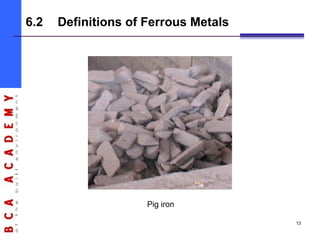
The iron product from the furnace is a crude “pig iron”
“Wrought Iron” is the iron in its almost pure state. It may contain
carbon in quantities ranging from 0.2 to 0.5 percent to give it more
hardness. Wrought iron is easily forged and welded and is used
extensively for decorative purposes
6.2 Definitions of Ferrous Metals
12
Pig iron
6.2 Definitions of Ferrous Metals
13
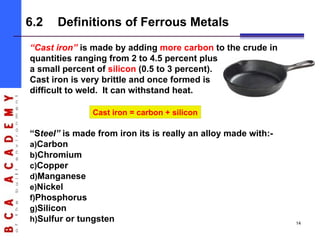
“Cast iron” is made by adding more carbon to the crude in
quantities ranging from 2 to 4.5 percent plus
a small percent of silicon (0.5 to 3 percent).
Cast iron is very brittle and once formed is
difficult to weld. It can withstand heat.
“Steel” is made from iron its is really an alloy made with:-
a)Carbon
b)Chromium
c)Copper
d)Manganese
e)Nickel
f)Phosphorus
g)Silicon
h)Sulfur or tungsten
6.2 Definitions of Ferrous Metals
Cast iron = carbon + silicon
14
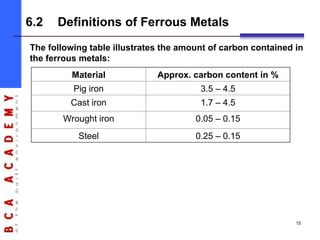
The following table illustrates the amount of carbon contained in
the ferrous metals:
Material Approx. carbon content in %
Pig iron 3.5 – 4.5
Cast iron 1.7 – 4.5
Wrought iron 0.05 – 0.15
Steel 0.25 – 0.15
6.2 Definitions of Ferrous Metals
15
The properties of iron-carbon alloys such as cast iron,
wrought iron and steel are given as follows:
1. Cast Iron:
Properties
1)Cast iron has a high compressive strength and low
tensile strength. The ultimate compressive and
ultimate tensile strengths are 700 and 150 N/mm2
2)It is brittle and does not absorb shock
3)Its unit weight is 7030 to 7130 kg/m3
4)It has low melting point of about 1200o
C
6.3 Characteristics and Uses of Iron-Carbon Alloys
16
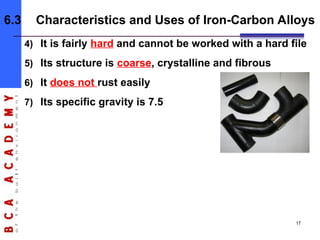
4) It is fairly hard and cannot be worked with a hard file
5) Its structure is coarse, crystalline and fibrous
6) It does not rust easily
7) Its specific gravity is 7.5
6.3 Characteristics and Uses of Iron-Carbon Alloys
17
Uses:
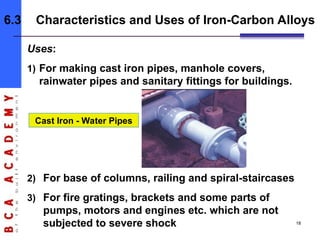
1) For making cast iron pipes, manhole covers,
rainwater pipes and sanitary fittings for buildings.
Cast Iron - Water Pipes
2) For base of columns, railing and spiral-staircases
3) For fire gratings, brackets and some parts of
pumps, motors and engines etc. which are not
subjected to severe shock
6.3 Characteristics and Uses of Iron-Carbon Alloys
18
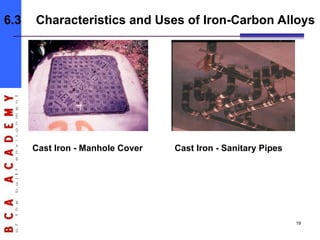
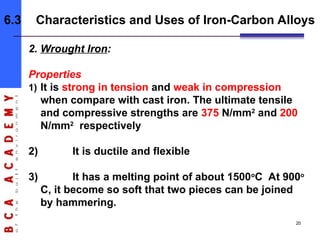
Cast Iron - Manhole Cover Cast Iron - Sanitary Pipes
6.3 Characteristics and Uses of Iron-Carbon Alloys
19
2. Wrought Iron:
Properties
1) It is strong in tension and weak in compression
when compare with cast iron. The ultimate tensile
and compressive strengths are 375 N/mm2
and 200
N/mm2
respectively
2) It is ductile and flexible
3) It has a melting point of about 1500o
C At 900o
C, it become so soft that two pieces can be joined
by hammering.
6.3 Characteristics and Uses of Iron-Carbon Alloys
20
4) It can be forged and welded satisfactorily
5) It is very tough and has great shock resistance
6) It rusts more easily than cast iron
7) It is unaffected by saline water
6.3 Characteristics and Uses of Iron-Carbon Alloys
21
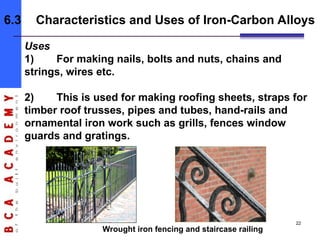
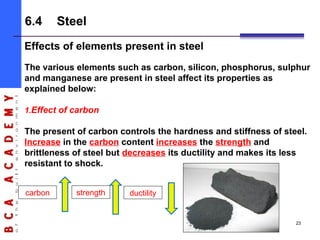
Uses
1) For making nails, bolts and nuts, chains and
strings, wires etc.
2) This is used for making roofing sheets, straps for
timber roof trusses, pipes and tubes, hand-rails and
ornamental iron work such as grills, fences window
guards and gratings.
Wrought iron fencing and staircase railing
6.3 Characteristics and Uses of Iron-Carbon Alloys
22
Effects of elements present in steel
The various elements such as carbon, silicon, phosphorus, sulphur
and manganese are present in steel affect its properties as
explained below:
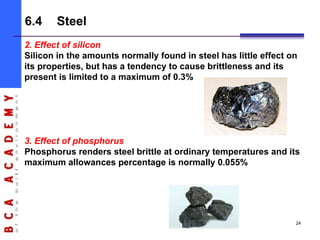
1.Effect of carbon
The present of carbon controls the hardness and stiffness of steel.
Increase in the carbon content increases the strength and
brittleness of steel but decreases its ductility and makes its less
resistant to shock.
6.4 Steel
carbon strength ductility
23
2. Effect of silicon
Silicon in the amounts normally found in steel has little effect on
its properties, but has a tendency to cause brittleness and its
present is limited to a maximum of 0.3%
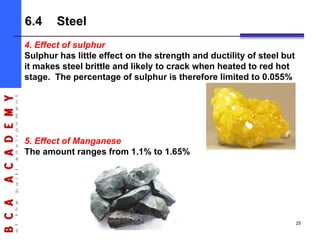
3. Effect of phosphorus
Phosphorus renders steel brittle at ordinary temperatures and its
maximum allowances percentage is normally 0.055%
6.4 Steel
24
4. Effect of sulphur
Sulphur has little effect on the strength and ductility of steel but
it makes steel brittle and likely to crack when heated to red hot
stage. The percentage of sulphur is therefore limited to 0.055%
5. Effect of Manganese
The amount ranges from 1.1% to 1.65%
6.4 Steel
25
Composition
Carbon 0.23% - 0.25% (Max)
Sulphur 0.055%
Phosphorus 0.055%
Properties of mild steel
a)Its structure is fibrous with dark bluish color
b)It is malleable and ductile
c)It is more tough and elastic than cast iron and wrought iron
d)It can be easily welded, riveted and forged
e)It is equally strong in compression, tension and in shear
f)It is difficult to harden and temper
g)Its specific gravity is 7.8
6.5 Mild steel
26
Uses
a)As rolled structural sections like I-section, T-section, channel
section, angle iron, plates, round and square rods in
construction works
b)Mild steel round bars are extensively used as reinforcements in
Reinforced Cement Concrete (RCC)
c)Mild steel tubes are finding much use in structures
d)Plain and corrugated sheets of mild steel are being used as roof
coverings
e)Mild steel is also used in the manufacture of various tools and
equipment, machine parts and industrial buildings etc
6.5 Mild steel
27
High Tensile Steel:
Composition
Carbon 0.8%
Manganese 0.6%
Silicon 0.2%
Sulphur 0.05%
Phosphorus 0.05%
Uses - High tensile steel is normally used in pre-stressed concrete
6.5 Mild steel
28
Chemically and physical properties:
Steel and Iron:
Contains less than 2% carbon, while iron may contain more.
Steel is stronger, more ductile and malleable, and resists shock
better.
In the forming processes of steel, the advantages of cold working
over hot working are:
a)Cold working results in more accurately finishing products
because
there is no cooling shrinkage.
b)Cold working also results in smoother surfaces because oxide
does
not form as it does during hot working.
6.6 Characteristics and Uses of Iron-Carbon Alloys
29
TYPES OF STEEL
Steel is given different names based on its alloyed (blended)
composition
1. Carbon steel
Carbon steel may be classified three ways:
a) Low-carbon steel – less than ¼ % carbon
b) Medium-carbon steel – ¼ to ½ % carbon
c) High-carbon steel – over ½% carbon
6.7 Types of Steel
30
2. Alloy steel
Alloy steel is the steel also include any one or a combination of
other minerals and metals listed before.
If a brittle steel is needed, phosphorus, sulphur and silicon
may be added proportionately to the alloy.
If strength is needed, nickel is added. Structural steel
building members may contain nickel. Hardness may be increased
by adding manganese.
Chromium and copper improve steel’s resistance to corrosion
(e.g. stainless steel)
6.7 Types of Steel
31
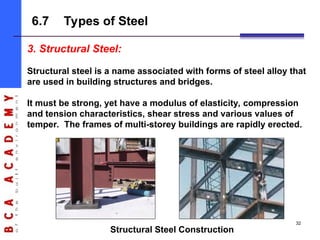
3. Structural Steel:
Structural steel is a name associated with forms of steel alloy that
are used in building structures and bridges.
It must be strong, yet have a modulus of elasticity, compression
and tension characteristics, shear stress and various values of
temper. The frames of multi-storey buildings are rapidly erected.
6.7 Types of Steel
Structural Steel Construction
32
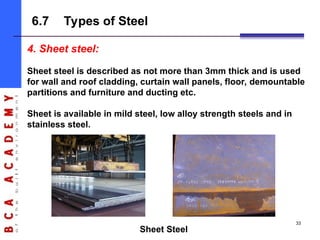
4. Sheet steel:
Sheet steel is described as not more than 3mm thick and is used
for wall and roof cladding, curtain wall panels, floor, demountable
partitions and furniture and ducting etc.
Sheet is available in mild steel, low alloy strength steels and in
stainless steel.
6.7 Types of Steel
Sheet Steel
33
Heat Treatment for steel:
After steel cools and is given its final shape, further
heating and cooling processes can change the
internal structure and thereby impart certain
properties.
“Normalizing” consists of heating the steel to a
temperature of about 815o
C or higher and cooling
several hundred degree slowly in air to obtain a
uniformity of structure.
6.8 Manufacturing of steel
34
“Annealing” consists of heating the steel to a
temperature slightly lower than for normalising and
cooling it several hundred degrees very slowly usually
in furnace.
It is used to toughen and reduce brittleness in steel.
Annealing may be performed at any of the mills and at
various stages in the milling operation
“Quenching” consists of cooling steel very rapidly in
oil, water or brine from a temperature of about 815o
C.
Quenching increases hardness and strength but
reduces ductility
6.8 Manufacturing of steel
35
“Tempering” consists of re-heating the quenched steel
to a temperature of 150 to 650o
C and cooling in air to
reduce the residual stresses and increase ductility.
Heating to the lower temperature range produces
greater hardness and wears resistance while higher
heat produces greater toughness.
6.8 Manufacturing of steel
36
37
REFERANCE
BCA Academy text book – Construction Materials

Lesson 6 - Structural Steel Part 1_2015.ppt

  • 1.
  • 2.
    6.0 Learning Objectives Atthe end of the session, students should be able to: 1.Eurocodes and classification 2.Explain the characteristics and structural uses of iron-carbon alloys. 3.Describe the composition and properties of mild and high tensile steel. 4.Describe different types of steel. 5.Explain the mechanical and manufacturing process of steel. 6.Explain the forming process of steel. 7.Explain the tensile test of steel. 8.Describe the different ways of protecting steel from corrosion. 2
  • 3.
    3 6.1a Eurocodes Eurocodes area set of design and technical rules developed by the European Committee for Standardisation for the structural design of construction works. The purposes of the Eurocodes are: •A means to prove compliance with the requirements for mechanical strength and stability and safety in case of fire. •A basis for construction, technical and engineering specifications for building works
  • 4.
    4 6.1a Eurocodes By March2010 the Eurocodes are mandatory for the specification of European public works and are intended to become the standard for the private sector. The Eurocodes therefore replace the existing national building codes published by national standard bodies such as BS 5950, although many countries had a period of co-existence. Additionally, each country is expected to issue a National Annex to the Eurocodes which will need referencing for a particular country (e.g. The UK National Annex).
  • 5.
    5 6.1a Eurocodes EN 1990to EN 1999 These range covers multiple discipline in structural design according to specification of a project It applies to the design of buildings and civil engineering works in steel. EN 1990 is intended to be used in conjunction with EN 1991 to EN 1999 for the following:- 1.Structural design of buildings 2.Civil engineering works 3.Geotechnical aspects 4.Structural fire design 5.Earthquakes 6.Temporary structures.
  • 6.
    6 6.1b Glossary ofTerms 1) Metal: A type of mineral substance that is usually hard and shiny and that heat and electricity can travel through 2) Ductility: Ductility is the property of undergoing large plastic deformation before actual failure. The properties of ductility enables a metal to be drawn out into thin wires, beaten into thin foils and undergo large deformation.
  • 7.
    7 6.1b Glossary ofTerms 3) Plasticity: Plasticity is the property of a metal to be permanently extended in all directions, without rupture, when subjected to a compressive force as a hammering or rolling. Metals have this property in cold state. 4) Tenacity: The property of a metal to resist fracture when under the action of a tensile or pulling force
  • 8.
    8 6.1b Glossary ofTerms 5) Toughness: The property of resistance a metal offers to breaking when a force is applied. 6) Brittleness: Opposite of toughness and is the tendency of a Metal to shatter on receiving a blow, it can be intensified, by subjecting the specimen to low temperature 7) Conductivity: The ability of a metal to allow the passage of either heat or electricity
  • 9.
    9 6.1b Glossary ofTerms 8) Hardness: The property of a metal to be able to cut, scratch or indent other metals or to resist filling, cutting and wear by abrasion 9) Strength: The ability of a metal to resist the application of a force without rupture. Metal may be subjected to tensile, compressive or shear forces and the strength of a metal is its ability to resist these force without breaking
  • 10.
    Metal in theirpure form are often soft so that metals used in building are alloys containing different metals. It display a considerable number of properties, for example:- a)High tensile b)Compressive strength c)Ability to deform plastically without damage d)Good heat and electrical conduction properties 6.1c Metal 10
  • 11.
    Classification of Metals Ferrousmetals: Contain substantial proportion of iron such as:- a)Cast iron b)Wrought iron c)Mild steel The great differences in the properties of these materials are mainly due to the presence of carbon in the metal depending on the amount and the manner in which it exists in the iron. Non-ferrous metal: Which contain little or no iron such as:-. a)Aluminum b)Copper c)Lead d)Zinc 6.1c Metal 11
  • 12.
    Iron is extractedfrom four principal ores (rocks): - Hematite - Limonite - Magnetite -Taconite Iron (Fe), is a silvery - white, flexible, ductile, magnetic or magnetisable metallic element. Since the iron is included with many other minerals in earth, it is necessary to separate the iron in a blast furnace The iron product from the furnace is a crude “pig iron” “Wrought Iron” is the iron in its almost pure state. It may contain carbon in quantities ranging from 0.2 to 0.5 percent to give it more hardness. Wrought iron is easily forged and welded and is used extensively for decorative purposes 6.2 Definitions of Ferrous Metals 12
  • 13.
    Pig iron 6.2 Definitionsof Ferrous Metals 13
  • 14.
    “Cast iron” ismade by adding more carbon to the crude in quantities ranging from 2 to 4.5 percent plus a small percent of silicon (0.5 to 3 percent). Cast iron is very brittle and once formed is difficult to weld. It can withstand heat. “Steel” is made from iron its is really an alloy made with:- a)Carbon b)Chromium c)Copper d)Manganese e)Nickel f)Phosphorus g)Silicon h)Sulfur or tungsten 6.2 Definitions of Ferrous Metals Cast iron = carbon + silicon 14
  • 15.
    The following tableillustrates the amount of carbon contained in the ferrous metals: Material Approx. carbon content in % Pig iron 3.5 – 4.5 Cast iron 1.7 – 4.5 Wrought iron 0.05 – 0.15 Steel 0.25 – 0.15 6.2 Definitions of Ferrous Metals 15
  • 16.
    The properties ofiron-carbon alloys such as cast iron, wrought iron and steel are given as follows: 1. Cast Iron: Properties 1)Cast iron has a high compressive strength and low tensile strength. The ultimate compressive and ultimate tensile strengths are 700 and 150 N/mm2 2)It is brittle and does not absorb shock 3)Its unit weight is 7030 to 7130 kg/m3 4)It has low melting point of about 1200o C 6.3 Characteristics and Uses of Iron-Carbon Alloys 16
  • 17.
    4) It isfairly hard and cannot be worked with a hard file 5) Its structure is coarse, crystalline and fibrous 6) It does not rust easily 7) Its specific gravity is 7.5 6.3 Characteristics and Uses of Iron-Carbon Alloys 17
  • 18.
    Uses: 1) For makingcast iron pipes, manhole covers, rainwater pipes and sanitary fittings for buildings. Cast Iron - Water Pipes 2) For base of columns, railing and spiral-staircases 3) For fire gratings, brackets and some parts of pumps, motors and engines etc. which are not subjected to severe shock 6.3 Characteristics and Uses of Iron-Carbon Alloys 18
  • 19.
    Cast Iron -Manhole Cover Cast Iron - Sanitary Pipes 6.3 Characteristics and Uses of Iron-Carbon Alloys 19
  • 20.
    2. Wrought Iron: Properties 1)It is strong in tension and weak in compression when compare with cast iron. The ultimate tensile and compressive strengths are 375 N/mm2 and 200 N/mm2 respectively 2) It is ductile and flexible 3) It has a melting point of about 1500o C At 900o C, it become so soft that two pieces can be joined by hammering. 6.3 Characteristics and Uses of Iron-Carbon Alloys 20
  • 21.
    4) It canbe forged and welded satisfactorily 5) It is very tough and has great shock resistance 6) It rusts more easily than cast iron 7) It is unaffected by saline water 6.3 Characteristics and Uses of Iron-Carbon Alloys 21
  • 22.
    Uses 1) For makingnails, bolts and nuts, chains and strings, wires etc. 2) This is used for making roofing sheets, straps for timber roof trusses, pipes and tubes, hand-rails and ornamental iron work such as grills, fences window guards and gratings. Wrought iron fencing and staircase railing 6.3 Characteristics and Uses of Iron-Carbon Alloys 22
  • 23.
    Effects of elementspresent in steel The various elements such as carbon, silicon, phosphorus, sulphur and manganese are present in steel affect its properties as explained below: 1.Effect of carbon The present of carbon controls the hardness and stiffness of steel. Increase in the carbon content increases the strength and brittleness of steel but decreases its ductility and makes its less resistant to shock. 6.4 Steel carbon strength ductility 23
  • 24.
    2. Effect ofsilicon Silicon in the amounts normally found in steel has little effect on its properties, but has a tendency to cause brittleness and its present is limited to a maximum of 0.3% 3. Effect of phosphorus Phosphorus renders steel brittle at ordinary temperatures and its maximum allowances percentage is normally 0.055% 6.4 Steel 24
  • 25.
    4. Effect ofsulphur Sulphur has little effect on the strength and ductility of steel but it makes steel brittle and likely to crack when heated to red hot stage. The percentage of sulphur is therefore limited to 0.055% 5. Effect of Manganese The amount ranges from 1.1% to 1.65% 6.4 Steel 25
  • 26.
    Composition Carbon 0.23% -0.25% (Max) Sulphur 0.055% Phosphorus 0.055% Properties of mild steel a)Its structure is fibrous with dark bluish color b)It is malleable and ductile c)It is more tough and elastic than cast iron and wrought iron d)It can be easily welded, riveted and forged e)It is equally strong in compression, tension and in shear f)It is difficult to harden and temper g)Its specific gravity is 7.8 6.5 Mild steel 26
  • 27.
    Uses a)As rolled structuralsections like I-section, T-section, channel section, angle iron, plates, round and square rods in construction works b)Mild steel round bars are extensively used as reinforcements in Reinforced Cement Concrete (RCC) c)Mild steel tubes are finding much use in structures d)Plain and corrugated sheets of mild steel are being used as roof coverings e)Mild steel is also used in the manufacture of various tools and equipment, machine parts and industrial buildings etc 6.5 Mild steel 27
  • 28.
    High Tensile Steel: Composition Carbon0.8% Manganese 0.6% Silicon 0.2% Sulphur 0.05% Phosphorus 0.05% Uses - High tensile steel is normally used in pre-stressed concrete 6.5 Mild steel 28
  • 29.
    Chemically and physicalproperties: Steel and Iron: Contains less than 2% carbon, while iron may contain more. Steel is stronger, more ductile and malleable, and resists shock better. In the forming processes of steel, the advantages of cold working over hot working are: a)Cold working results in more accurately finishing products because there is no cooling shrinkage. b)Cold working also results in smoother surfaces because oxide does not form as it does during hot working. 6.6 Characteristics and Uses of Iron-Carbon Alloys 29
  • 30.
    TYPES OF STEEL Steelis given different names based on its alloyed (blended) composition 1. Carbon steel Carbon steel may be classified three ways: a) Low-carbon steel – less than ¼ % carbon b) Medium-carbon steel – ¼ to ½ % carbon c) High-carbon steel – over ½% carbon 6.7 Types of Steel 30
  • 31.
    2. Alloy steel Alloysteel is the steel also include any one or a combination of other minerals and metals listed before. If a brittle steel is needed, phosphorus, sulphur and silicon may be added proportionately to the alloy. If strength is needed, nickel is added. Structural steel building members may contain nickel. Hardness may be increased by adding manganese. Chromium and copper improve steel’s resistance to corrosion (e.g. stainless steel) 6.7 Types of Steel 31
  • 32.
    3. Structural Steel: Structuralsteel is a name associated with forms of steel alloy that are used in building structures and bridges. It must be strong, yet have a modulus of elasticity, compression and tension characteristics, shear stress and various values of temper. The frames of multi-storey buildings are rapidly erected. 6.7 Types of Steel Structural Steel Construction 32
  • 33.
    4. Sheet steel: Sheetsteel is described as not more than 3mm thick and is used for wall and roof cladding, curtain wall panels, floor, demountable partitions and furniture and ducting etc. Sheet is available in mild steel, low alloy strength steels and in stainless steel. 6.7 Types of Steel Sheet Steel 33
  • 34.
    Heat Treatment forsteel: After steel cools and is given its final shape, further heating and cooling processes can change the internal structure and thereby impart certain properties. “Normalizing” consists of heating the steel to a temperature of about 815o C or higher and cooling several hundred degree slowly in air to obtain a uniformity of structure. 6.8 Manufacturing of steel 34
  • 35.
    “Annealing” consists ofheating the steel to a temperature slightly lower than for normalising and cooling it several hundred degrees very slowly usually in furnace. It is used to toughen and reduce brittleness in steel. Annealing may be performed at any of the mills and at various stages in the milling operation “Quenching” consists of cooling steel very rapidly in oil, water or brine from a temperature of about 815o C. Quenching increases hardness and strength but reduces ductility 6.8 Manufacturing of steel 35
  • 36.
    “Tempering” consists ofre-heating the quenched steel to a temperature of 150 to 650o C and cooling in air to reduce the residual stresses and increase ductility. Heating to the lower temperature range produces greater hardness and wears resistance while higher heat produces greater toughness. 6.8 Manufacturing of steel 36
  • 37.
    37 REFERANCE BCA Academy textbook – Construction Materials