1.7 Metals
**These slides contain referenced materials
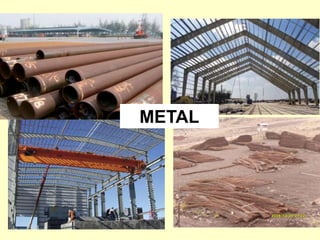
METAL
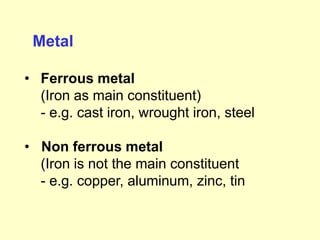
Metal
• Ferrous metal
(Iron as main constituent)
- e.g. cast iron, wrought iron, steel
• Non ferrous metal
(Iron is not the main constituent
- e.g. copper, aluminum, zinc, tin
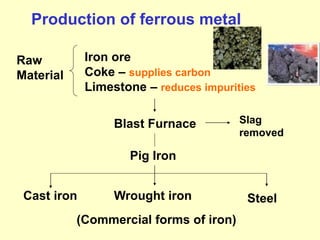
Iron ore
Coke – supplies carbon
Limestone – reduces impurities
Blast Furnace
Cast iron
Pig Iron
Wrought iron Steel
(Commercial forms of iron)
Production of ferrous metal
Slag
removed
Raw
Material
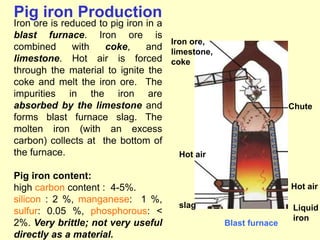
Pig iron Production
Iron ore is reduced to pig iron in a
blast furnace. Iron ore is
combined with coke, and
limestone. Hot air is forced
through the material to ignite the
coke and melt the iron ore. The
impurities in the iron are
absorbed by the limestone and
forms blast furnace slag. The
molten iron (with an excess
carbon) collects at the bottom of
the furnace.
Pig iron content:
high carbon content : 4-5%.
silicon : 2 %, manganese: 1 %,
sulfur: 0.05 %, phosphorous: <
2%. Very brittle; not very useful
directly as a material.
Hot air
Blast furnace
Iron ore,
limestone,
coke
slag Liquid
iron
Hot air
Chute
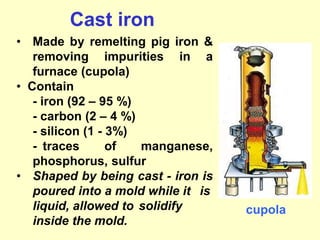
• Made by remelting pig iron &
removing impurities in a
furnace (cupola)
• Contain
- iron (92 – 95 %)
- carbon (2 – 4 %)
- silicon (1 - 3%)
- traces of manganese,
phosphorus, sulfur
• Shaped by being cast - iron is
poured into a mold while it is
liquid, allowed to solidify
inside the mold.
Cast iron
cupola
Properties
• Brittle – due to large carbon amount,
difficult to weld.
• Low tensile strength (110 MPa) but high
compressive strength.
Types (depends on chemical composition
and cooling rate)
• Gray cast iron – commonly used
• White cast iron – harder, more resistant
• Malleable cast iron – can be malleable
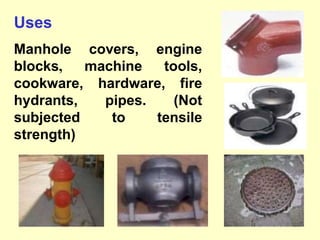
Uses
Manhole covers, engine
blocks, machine tools,
cookware, hardware, fire
hydrants, pipes. (Not
subjected to tensile
strength)
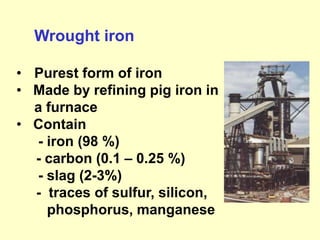
Wrought iron
• Purest form of iron
• Made by refining pig iron in
a furnace
• Contain
- iron (98 %)
- carbon (0.1 – 0.25 %)
- slag (2-3%)
- traces of sulfur, silicon,
phosphorus, manganese
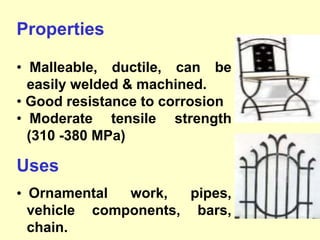
Properties
• Malleable, ductile, can be
easily welded & machined.
• Good resistance to corrosion
• Moderate tensile strength
(310 -380 MPa)
Uses
• Ornamental work, pipes,
vehicle components, bars,
chain.
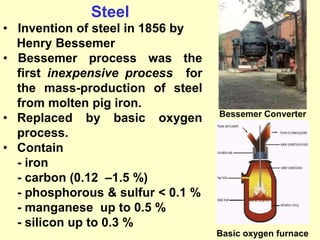
• Invention of steel in 1856 by
Henry Bessemer
• Bessemer process was the
first inexpensive process for
the mass-production of steel
from molten pig iron.
• Replaced by basic oxygen
process.
• Contain
- iron
- carbon (0.12 –1.5 %)
- phosphorous & sulfur < 0.1 %
- manganese up to 0.5 %
- silicon up to 0.3 %
Steel
Bessemer Converter
Basic oxygen furnace
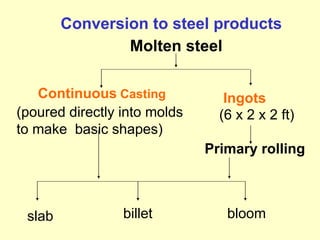
Conversion to steel products
Molten steel
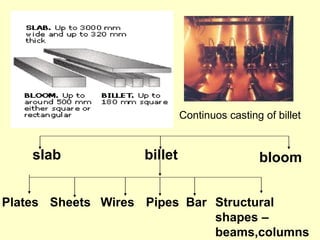
slab billet bloom
Continuous Casting
(poured directly into molds
to make basic shapes)
Primary rolling
Ingots
(6 x 2 x 2 ft)
Wires
Sheets
Plates Pipes Bar Structural
shapes –
beams,columns
Continuos casting of billet
slab billet bloom
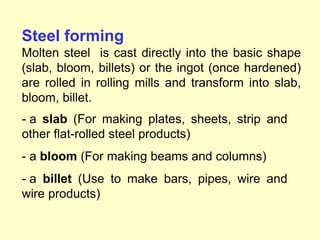
Steel forming
Molten steel is cast directly into the basic shape
(slab, bloom, billets) or the ingot (once hardened)
are rolled in rolling mills and transform into slab,
bloom, billet.
- a slab (For making plates, sheets, strip and
other flat-rolled steel products)
- a bloom (For making beams and columns)
- a billet (Use to make bars, pipes, wire and
wire products)
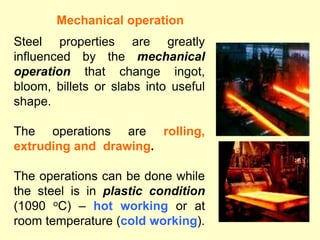
Steel properties are greatly
influenced by the mechanical
operation that change ingot,
bloom, billets or slabs into useful
shape.
The operations are rolling,
extruding and drawing.
The operations can be done while
the steel is in plastic condition
(1090 oC) – hot working or at
room temperature (cold working).
Mechanical operation
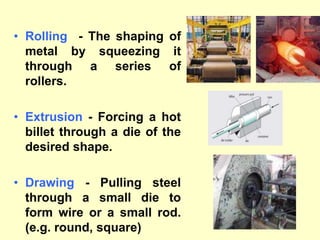
• Rolling - The shaping of
metal by squeezing it
through a series of
rollers.
• Extrusion - Forcing a hot
billet through a die of the
desired shape.
• Drawing - Pulling steel
through a small die to
form wire or a small rod.
(e.g. round, square)
Properties of steel
A steel with a wide variety of characteristics can
be produced by
• altering the carbon content
• adding alloy (metal e.g. nickel, chromium,
tungsten etc.) to steel to improve its
characteristics e.g. corrosion resistance,
strength, ductility and machinability.
e.g. Stainless steel contains chromium and
nickel. Anti corrosion & acid proof.
• different heat treatment
• mechanical operation (hot or cold rolling,
drawing, extrusion etc.
Heat treatment of Steel
The heating and cooling processes are used to
change the structure of a metal and alter its
mechanical properties. (e.g. Cooling rapidly in
cold water makes it harder and more brittle)
Ductility
Steel has high ductility. Ductility is the property
of a material by which it can withstand
extensive deformation without failure under
high tensile stresses. It usually shows large
visible deflections before failure or collapse.
Types of steel
• Mild steel (Low carbon steel) < 0·25% carbon);
cheap, strong and easily shaped. Main metal for
construction.
• Medium carbon steel (0·25% - 0.5 % carbon)
Rails, boilers, plates, axles, structures.
Tensile Strength
Most important property. Depends on types of
steel. Tensile strength for structural steel (400 –
900 MPa)
• Steel Alloy
Ni-steel (Gear, shaft, cable), Mn-steel (Rail
tracks)
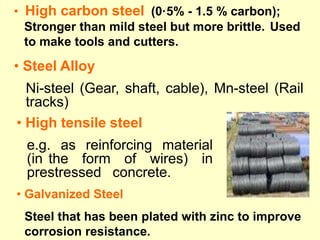
• High tensile steel
e.g. as reinforcing material
(in the form of wires) in
prestressed concrete.
• High carbon steel (0·5% - 1.5 % carbon);
Stronger than mild steel but more brittle. Used
to make tools and cutters.
• Galvanized Steel
Steel that has been plated with zinc to improve
corrosion resistance.
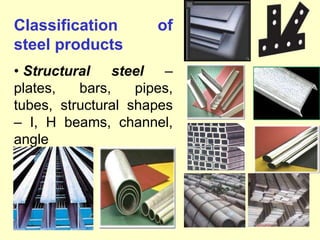
Classification of
steel products
• Structural steel –
plates, bars, pipes,
tubes, structural shapes
– I, H beams, channel,
angle
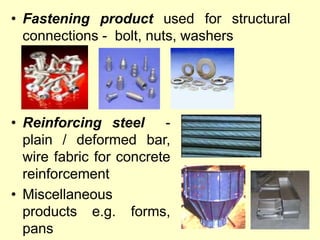
• Fastening product used for structural
connections - bolt, nuts, washers
• Reinforcing steel -
plain / deformed bar,
wire fabric for concrete
reinforcement
• Miscellaneous
products e.g. forms,
pans
.
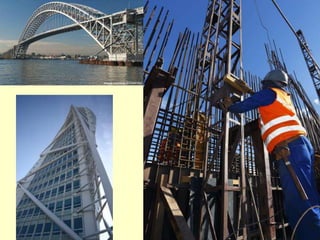
1. High strength/weight ratio
Steel has a high strength/weight ratio.
This property makes steel a very
attractive structural material for high
-rise buildings & long span bridges
Advantages of steel in building
construction
2. Ductility
Steel can undergo large plastic
deformation before failure, thus
providing a large reserve strength.
Properly designed steel structures can
have high ductility, which is an
important characteristic for resisting
shock loading such as blasts or
earthquakes.
3. Speed of erection.
Steel structures can be erected quite
rapidly therefore reducing the cost of
construction. Structural steel framing can
be rapidly designed, purchased,
fabricated and erected without need for
curing and other delays of concrete and
masonry construction.
4. Quality of construction
Steel structures can be built with high-
quality workmanship.
5. Ease of repair, modification & change
Steel structures in general can be repaired
quickly and easily. When building uses
change or are improved, structural steel
can be easily modified and reinforced to
accommodate the new requirements.
6. Adaptation of prefabrication
Highly suitable for prefabrication and mass
production.
7. Repetitive use
Steel can be reused after a structure is
disassembled. Most steel today is a recycled
product, and nearly all structural steel from
building demolition is recycled. This provides
salvage value, reduces demolition expenses,
reduces landfill volume and helps the
environment
8. Expanding existing structures
Steel buildings can be easily expanded in any
direction.
Disadvantages of steel
1. General cost
Steel structures may be more costly than
other types of structures.
2. Fireproofing
The strength of steel is reduced
substantially when heated at temperatures
commonly observed in building fires.
Consequently, steel frames in buildings
must have adequate fireproofing.
3. Maintenance
Steel structures exposed to air and water, such
as bridges, are susceptible to corrosion and
should be painted regularly. Application of
weathering and corrosion-resistant steels may
eliminate this problem.
4. Susceptibility to buckling
Due to high strength/weight ratio, steel
compression members are in general more
slender and consequently more susceptible to
buckling than reinforced concrete compression
members.
Aluminum
• Lightweight - 1/3 weight of steel and copper;
excellent corrosion resistance; low strength
Uses
• Roofing, window & door frames, door & window
handles, protective covering
Non ferrous metal
- use as original metal or as alloy
Copper
• High electrical conductivity; readily bent & cut;
good corrosion resistance
Uses
• Electrical conductor, heating vessels
Tin
• Resistance to acid corrosion, good conductor of
heat & electricity
Uses
• Protective covering, alloy, household purpose,
coating for food containers
Zinc
• Good conductor of heat; high corrosion resistance,
Uses
• Roofing material, batteries, protective covering

chapter 1 lecture 07-.ppt

  • 1.
    1.7 Metals **These slidescontain referenced materials
  • 2.
  • 3.
    Metal • Ferrous metal (Ironas main constituent) - e.g. cast iron, wrought iron, steel • Non ferrous metal (Iron is not the main constituent - e.g. copper, aluminum, zinc, tin
  • 4.
    Iron ore Coke –supplies carbon Limestone – reduces impurities Blast Furnace Cast iron Pig Iron Wrought iron Steel (Commercial forms of iron) Production of ferrous metal Slag removed Raw Material
  • 5.
    Pig iron Production Ironore is reduced to pig iron in a blast furnace. Iron ore is combined with coke, and limestone. Hot air is forced through the material to ignite the coke and melt the iron ore. The impurities in the iron are absorbed by the limestone and forms blast furnace slag. The molten iron (with an excess carbon) collects at the bottom of the furnace. Pig iron content: high carbon content : 4-5%. silicon : 2 %, manganese: 1 %, sulfur: 0.05 %, phosphorous: < 2%. Very brittle; not very useful directly as a material. Hot air Blast furnace Iron ore, limestone, coke slag Liquid iron Hot air Chute
  • 6.
    • Made byremelting pig iron & removing impurities in a furnace (cupola) • Contain - iron (92 – 95 %) - carbon (2 – 4 %) - silicon (1 - 3%) - traces of manganese, phosphorus, sulfur • Shaped by being cast - iron is poured into a mold while it is liquid, allowed to solidify inside the mold. Cast iron cupola
  • 7.
    Properties • Brittle –due to large carbon amount, difficult to weld. • Low tensile strength (110 MPa) but high compressive strength. Types (depends on chemical composition and cooling rate) • Gray cast iron – commonly used • White cast iron – harder, more resistant • Malleable cast iron – can be malleable
  • 8.
    Uses Manhole covers, engine blocks,machine tools, cookware, hardware, fire hydrants, pipes. (Not subjected to tensile strength)
  • 9.
    Wrought iron • Purestform of iron • Made by refining pig iron in a furnace • Contain - iron (98 %) - carbon (0.1 – 0.25 %) - slag (2-3%) - traces of sulfur, silicon, phosphorus, manganese
  • 10.
    Properties • Malleable, ductile,can be easily welded & machined. • Good resistance to corrosion • Moderate tensile strength (310 -380 MPa) Uses • Ornamental work, pipes, vehicle components, bars, chain.
  • 11.
    • Invention ofsteel in 1856 by Henry Bessemer • Bessemer process was the first inexpensive process for the mass-production of steel from molten pig iron. • Replaced by basic oxygen process. • Contain - iron - carbon (0.12 –1.5 %) - phosphorous & sulfur < 0.1 % - manganese up to 0.5 % - silicon up to 0.3 % Steel Bessemer Converter Basic oxygen furnace
  • 12.
    Conversion to steelproducts Molten steel slab billet bloom Continuous Casting (poured directly into molds to make basic shapes) Primary rolling Ingots (6 x 2 x 2 ft)
  • 13.
    Wires Sheets Plates Pipes BarStructural shapes – beams,columns Continuos casting of billet slab billet bloom
  • 14.
    Steel forming Molten steelis cast directly into the basic shape (slab, bloom, billets) or the ingot (once hardened) are rolled in rolling mills and transform into slab, bloom, billet. - a slab (For making plates, sheets, strip and other flat-rolled steel products) - a bloom (For making beams and columns) - a billet (Use to make bars, pipes, wire and wire products)
  • 15.
    Steel properties aregreatly influenced by the mechanical operation that change ingot, bloom, billets or slabs into useful shape. The operations are rolling, extruding and drawing. The operations can be done while the steel is in plastic condition (1090 oC) – hot working or at room temperature (cold working). Mechanical operation
  • 16.
    • Rolling -The shaping of metal by squeezing it through a series of rollers. • Extrusion - Forcing a hot billet through a die of the desired shape. • Drawing - Pulling steel through a small die to form wire or a small rod. (e.g. round, square)
  • 17.
    Properties of steel Asteel with a wide variety of characteristics can be produced by • altering the carbon content • adding alloy (metal e.g. nickel, chromium, tungsten etc.) to steel to improve its characteristics e.g. corrosion resistance, strength, ductility and machinability. e.g. Stainless steel contains chromium and nickel. Anti corrosion & acid proof. • different heat treatment • mechanical operation (hot or cold rolling, drawing, extrusion etc.
  • 18.
    Heat treatment ofSteel The heating and cooling processes are used to change the structure of a metal and alter its mechanical properties. (e.g. Cooling rapidly in cold water makes it harder and more brittle) Ductility Steel has high ductility. Ductility is the property of a material by which it can withstand extensive deformation without failure under high tensile stresses. It usually shows large visible deflections before failure or collapse.
  • 19.
    Types of steel •Mild steel (Low carbon steel) < 0·25% carbon); cheap, strong and easily shaped. Main metal for construction. • Medium carbon steel (0·25% - 0.5 % carbon) Rails, boilers, plates, axles, structures. Tensile Strength Most important property. Depends on types of steel. Tensile strength for structural steel (400 – 900 MPa)
  • 20.
    • Steel Alloy Ni-steel(Gear, shaft, cable), Mn-steel (Rail tracks) • High tensile steel e.g. as reinforcing material (in the form of wires) in prestressed concrete. • High carbon steel (0·5% - 1.5 % carbon); Stronger than mild steel but more brittle. Used to make tools and cutters. • Galvanized Steel Steel that has been plated with zinc to improve corrosion resistance.
  • 21.
    Classification of steel products •Structural steel – plates, bars, pipes, tubes, structural shapes – I, H beams, channel, angle
  • 22.
    • Fastening productused for structural connections - bolt, nuts, washers • Reinforcing steel - plain / deformed bar, wire fabric for concrete reinforcement • Miscellaneous products e.g. forms, pans
  • 23.
    . 1. High strength/weightratio Steel has a high strength/weight ratio. This property makes steel a very attractive structural material for high -rise buildings & long span bridges Advantages of steel in building construction
  • 25.
    2. Ductility Steel canundergo large plastic deformation before failure, thus providing a large reserve strength. Properly designed steel structures can have high ductility, which is an important characteristic for resisting shock loading such as blasts or earthquakes.
  • 26.
    3. Speed oferection. Steel structures can be erected quite rapidly therefore reducing the cost of construction. Structural steel framing can be rapidly designed, purchased, fabricated and erected without need for curing and other delays of concrete and masonry construction.
  • 27.
    4. Quality ofconstruction Steel structures can be built with high- quality workmanship. 5. Ease of repair, modification & change Steel structures in general can be repaired quickly and easily. When building uses change or are improved, structural steel can be easily modified and reinforced to accommodate the new requirements.
  • 28.
    6. Adaptation ofprefabrication Highly suitable for prefabrication and mass production. 7. Repetitive use Steel can be reused after a structure is disassembled. Most steel today is a recycled product, and nearly all structural steel from building demolition is recycled. This provides salvage value, reduces demolition expenses, reduces landfill volume and helps the environment 8. Expanding existing structures Steel buildings can be easily expanded in any direction.
  • 29.
    Disadvantages of steel 1.General cost Steel structures may be more costly than other types of structures. 2. Fireproofing The strength of steel is reduced substantially when heated at temperatures commonly observed in building fires. Consequently, steel frames in buildings must have adequate fireproofing.
  • 30.
    3. Maintenance Steel structuresexposed to air and water, such as bridges, are susceptible to corrosion and should be painted regularly. Application of weathering and corrosion-resistant steels may eliminate this problem. 4. Susceptibility to buckling Due to high strength/weight ratio, steel compression members are in general more slender and consequently more susceptible to buckling than reinforced concrete compression members.
  • 31.
    Aluminum • Lightweight -1/3 weight of steel and copper; excellent corrosion resistance; low strength Uses • Roofing, window & door frames, door & window handles, protective covering Non ferrous metal - use as original metal or as alloy Copper • High electrical conductivity; readily bent & cut; good corrosion resistance Uses • Electrical conductor, heating vessels
  • 32.
    Tin • Resistance toacid corrosion, good conductor of heat & electricity Uses • Protective covering, alloy, household purpose, coating for food containers Zinc • Good conductor of heat; high corrosion resistance, Uses • Roofing material, batteries, protective covering