TRIBHUWAN UNIVERSITY
INSTITUTE OF ENGINEERING
THAPATHALI CAMPUS
A PRESENTATION ON:
IMPULSE AND REACTION STEAM TURBINES
Presenter:
Sushil Chapai (Champ)
071-BME-440
STEAM TURBINES
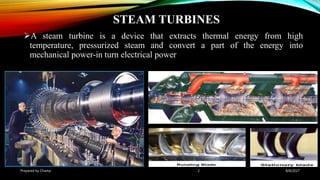
A steam turbine is a device that extracts thermal energy from high
temperature, pressurized steam and convert a part of the energy into
mechanical power-in turn electrical power
Prepared by Champ 2 8/8/2017
On the basis of action of steam, steam turbines are classified as:
Impulse steam turbines
Reaction steam turbines
Prepared by Champ 3
Classification of steam turbines
8/8/2017
Impulse steam turbines
Prepared by Champ 4
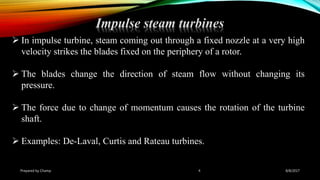
 In impulse turbine, steam coming out through a fixed nozzle at a very high
velocity strikes the blades fixed on the periphery of a rotor.
 The blades change the direction of steam flow without changing its
pressure.
 The force due to change of momentum causes the rotation of the turbine
shaft.
 Examples: De-Laval, Curtis and Rateau turbines.
8/8/2017
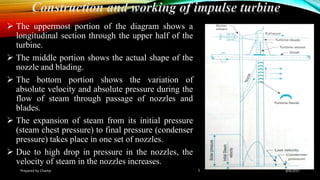
 The uppermost portion of the diagram shows a
longitudinal section through the upper half of the
turbine.
 The middle portion shows the actual shape of the
nozzle and blading.
 The bottom portion shows the variation of
absolute velocity and absolute pressure during the
flow of steam through passage of nozzles and
blades.
 The expansion of steam from its initial pressure
(steam chest pressure) to final pressure (condenser
pressure) takes place in one set of nozzles.
 Due to high drop in pressure in the nozzles, the
velocity of steam in the nozzles increases.
Construction and working of impulse turbine
Prepared by Champ 5 8/8/2017
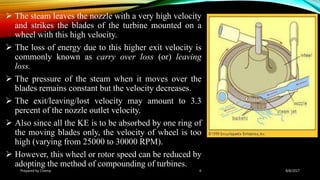
 The steam leaves the nozzle with a very high velocity
and strikes the blades of the turbine mounted on a
wheel with this high velocity.
 The loss of energy due to this higher exit velocity is
commonly known as carry over loss (or) leaving
loss.
 The pressure of the steam when it moves over the
blades remains constant but the velocity decreases.
 The exit/leaving/lost velocity may amount to 3.3
percent of the nozzle outlet velocity.
 Also since all the KE is to be absorbed by one ring of
the moving blades only, the velocity of wheel is too
high (varying from 25000 to 30000 RPM).
 However, this wheel or rotor speed can be reduced by
adopting the method of compounding of turbines.
Prepared by Champ 6 8/8/2017
Prepared by Champ
7
8/8/2017
Please watch this video for working mechanism of
impulse steam turbine:
https://www.youtube.com/watch?v=6xdBOwYHKbQ
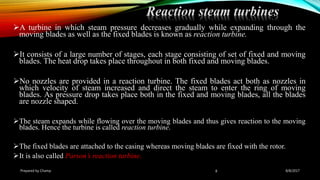
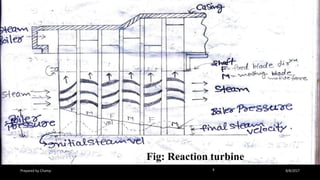
A turbine in which steam pressure decreases gradually while expanding through the
moving blades as well as the fixed blades is known as reaction turbine.
It consists of a large number of stages, each stage consisting of set of fixed and moving
blades. The heat drop takes place throughout in both fixed and moving blades.
No nozzles are provided in a reaction turbine. The fixed blades act both as nozzles in
which velocity of steam increased and direct the steam to enter the ring of moving
blades. As pressure drop takes place both in the fixed and moving blades, all the blades
are nozzle shaped.
The steam expands while flowing over the moving blades and thus gives reaction to the moving
blades. Hence the turbine is called reaction turbine.
The fixed blades are attached to the casing whereas moving blades are fixed with the rotor.
It is also called Parson’s reaction turbine.
Prepared by Champ 8
Reaction steam turbines
8/8/2017
Fig: Reaction turbine
Prepared by Champ 9 8/8/2017
Prepared by Champ
10
8/8/2017
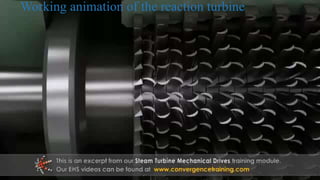
Working animation of the reaction turbine
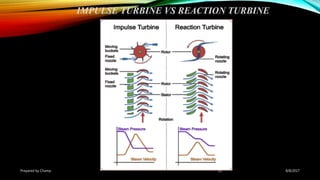
IMPULSE TURBINE VS REACTION TURBINE
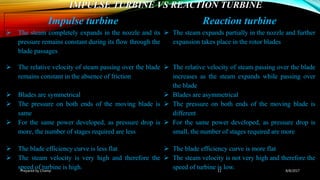
Impulse turbine Reaction turbine
 The steam completely expands in the nozzle and its
pressure remains constant during its flow through the
blade passages
 The steam expands partially in the nozzle and further
expansion takes place in the rotor blades
 The relative velocity of steam passing over the blade
remains constant in the absence of friction
 The relative velocity of steam passing over the blade
increases as the steam expands while passing over
the blade
 Blades are symmetrical  Blades are asymmetrical
 The pressure on both ends of the moving blade is
same
 The pressure on both ends of the moving blade is
different
 For the same power developed, as pressure drop is
more, the number of stages required are less
 For the same power developed, as pressure drop is
small, the number of stages required are more
 The blade efficiency curve is less flat  The blade efficiency curve is more flat
 The steam velocity is very high and therefore the
speed of turbine is high.
 The steam velocity is not very high and therefore the
speed of turbine is low.Prepared by Champ 11 8/8/2017
IMPULSE TURBINE VS REACTION TURBINE
Prepared by Champ 12 8/8/2017
8/8/2017Prepared by Champ 13
References:
 http://www.slideshare.net/sumit2549/sumit-sharma-panchli-shanti-institute-of-
technology-kurali-meerut-btech-me-2nd-year-ppt-on-steam-turbine
 https://en.wikipedia.org/wiki/Steam_turbine
 https://www.youtube.com/watch?v=6xdBOwYHKbQ
 https://www.youtube.com/watch?v=AyAd-gLO9CE
Prepared by Champ 14 8/8/2017

Impulse and reaction steam turbines

  • 1.
    TRIBHUWAN UNIVERSITY INSTITUTE OFENGINEERING THAPATHALI CAMPUS A PRESENTATION ON: IMPULSE AND REACTION STEAM TURBINES Presenter: Sushil Chapai (Champ) 071-BME-440
  • 2.
    STEAM TURBINES A steamturbine is a device that extracts thermal energy from high temperature, pressurized steam and convert a part of the energy into mechanical power-in turn electrical power Prepared by Champ 2 8/8/2017
  • 3.
    On the basisof action of steam, steam turbines are classified as: Impulse steam turbines Reaction steam turbines Prepared by Champ 3 Classification of steam turbines 8/8/2017
  • 4.
    Impulse steam turbines Preparedby Champ 4  In impulse turbine, steam coming out through a fixed nozzle at a very high velocity strikes the blades fixed on the periphery of a rotor.  The blades change the direction of steam flow without changing its pressure.  The force due to change of momentum causes the rotation of the turbine shaft.  Examples: De-Laval, Curtis and Rateau turbines. 8/8/2017
  • 5.
     The uppermostportion of the diagram shows a longitudinal section through the upper half of the turbine.  The middle portion shows the actual shape of the nozzle and blading.  The bottom portion shows the variation of absolute velocity and absolute pressure during the flow of steam through passage of nozzles and blades.  The expansion of steam from its initial pressure (steam chest pressure) to final pressure (condenser pressure) takes place in one set of nozzles.  Due to high drop in pressure in the nozzles, the velocity of steam in the nozzles increases. Construction and working of impulse turbine Prepared by Champ 5 8/8/2017
  • 6.
     The steamleaves the nozzle with a very high velocity and strikes the blades of the turbine mounted on a wheel with this high velocity.  The loss of energy due to this higher exit velocity is commonly known as carry over loss (or) leaving loss.  The pressure of the steam when it moves over the blades remains constant but the velocity decreases.  The exit/leaving/lost velocity may amount to 3.3 percent of the nozzle outlet velocity.  Also since all the KE is to be absorbed by one ring of the moving blades only, the velocity of wheel is too high (varying from 25000 to 30000 RPM).  However, this wheel or rotor speed can be reduced by adopting the method of compounding of turbines. Prepared by Champ 6 8/8/2017
  • 7.
    Prepared by Champ 7 8/8/2017 Pleasewatch this video for working mechanism of impulse steam turbine: https://www.youtube.com/watch?v=6xdBOwYHKbQ
  • 8.
    A turbine inwhich steam pressure decreases gradually while expanding through the moving blades as well as the fixed blades is known as reaction turbine. It consists of a large number of stages, each stage consisting of set of fixed and moving blades. The heat drop takes place throughout in both fixed and moving blades. No nozzles are provided in a reaction turbine. The fixed blades act both as nozzles in which velocity of steam increased and direct the steam to enter the ring of moving blades. As pressure drop takes place both in the fixed and moving blades, all the blades are nozzle shaped. The steam expands while flowing over the moving blades and thus gives reaction to the moving blades. Hence the turbine is called reaction turbine. The fixed blades are attached to the casing whereas moving blades are fixed with the rotor. It is also called Parson’s reaction turbine. Prepared by Champ 8 Reaction steam turbines 8/8/2017
  • 9.
    Fig: Reaction turbine Preparedby Champ 9 8/8/2017
  • 10.
    Prepared by Champ 10 8/8/2017 Workinganimation of the reaction turbine
  • 11.
    IMPULSE TURBINE VSREACTION TURBINE Impulse turbine Reaction turbine  The steam completely expands in the nozzle and its pressure remains constant during its flow through the blade passages  The steam expands partially in the nozzle and further expansion takes place in the rotor blades  The relative velocity of steam passing over the blade remains constant in the absence of friction  The relative velocity of steam passing over the blade increases as the steam expands while passing over the blade  Blades are symmetrical  Blades are asymmetrical  The pressure on both ends of the moving blade is same  The pressure on both ends of the moving blade is different  For the same power developed, as pressure drop is more, the number of stages required are less  For the same power developed, as pressure drop is small, the number of stages required are more  The blade efficiency curve is less flat  The blade efficiency curve is more flat  The steam velocity is very high and therefore the speed of turbine is high.  The steam velocity is not very high and therefore the speed of turbine is low.Prepared by Champ 11 8/8/2017
  • 12.
    IMPULSE TURBINE VSREACTION TURBINE Prepared by Champ 12 8/8/2017
  • 13.
    8/8/2017Prepared by Champ13 References:  http://www.slideshare.net/sumit2549/sumit-sharma-panchli-shanti-institute-of- technology-kurali-meerut-btech-me-2nd-year-ppt-on-steam-turbine  https://en.wikipedia.org/wiki/Steam_turbine  https://www.youtube.com/watch?v=6xdBOwYHKbQ  https://www.youtube.com/watch?v=AyAd-gLO9CE
  • 14.
    Prepared by Champ14 8/8/2017