Modern Steam Turbines
The scientist and engineers, working in research
centers all over the world, concentrated their attention
to produce more power and to improve efficiencies of
turbines. They have listed a number of methods for
this purpose as follows:
1. Reheating of steam,
2. Regenerative feed heating, and
3. Binary vapour plants.
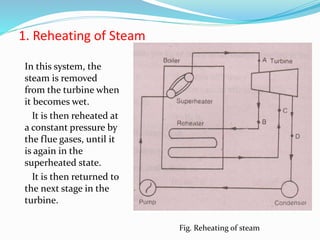
1. Reheating of Steam
In this system, the
steam is removed
from the turbine when
it becomes wet.
It is then reheated at
a constant pressure by
the flue gases, until it
is again in the
superheated state.
It is then returned to
the next stage in the
turbine.
Fig. Reheating of steam
Advantages of Reheating of Steam
The reheating of steam in a turbine has the following
advantages:
1. It increases the work done through the turbine.
2. It increases the efficiency of the turbine.
3. It reduces the erosion of the blades, because of
increase in dryness fraction of steam at exhaust.
4. The amount of water required in the condenser of
the turbine is reduced, due to reduction in the
specific steam consumption.
Reheat Cycle
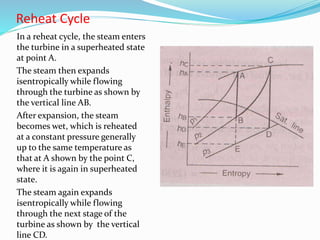
In a reheat cycle, the steam enters
the turbine in a superheated state
at point A.
The steam then expands
isentropically while flowing
through the turbine as shown by
the vertical line AB.
After expansion, the steam
becomes wet, which is reheated
at a constant pressure generally
up to the same temperature as
that at A shown by the point C,
where it is again in superheated
state.
The steam again expands
isentropically while flowing
through the next stage of the
turbine as shown by the vertical
line CD.
Reheat Cycle
Now consider a steam turbine with
a reheating system as shown in Fig.
Let, hA = Enthalpy of steam at A,
hB, hC, hD = Corresponding values at
B,C and D,
hfD = Enthalpy of water at D.
Total heat supplied = Total heat at
A +Heat supplied between B and C
= hA +[(hC -hB )– hfD ]
Work done = Total heat drop
= (hA - hB) + (hC - hD)
and efficiency ɳ =
=
Total heat supplied
Work done
(hA - hB) + (hC - hD)
hA +[(hC -hB )– hfD ]
Multi-stage Turbine
If we make the steam to pass through a number of
stages in order to get more work is known as multi-
stage turbine.
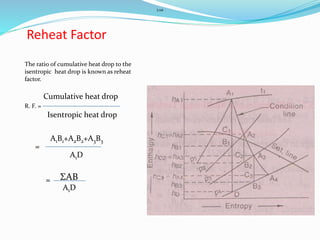
Reheat Factor
The ratio of cumulative heat drop to the
isentropic heat drop is known as reheat
factor.
R. F. =
Cumulative heat drop
Isentropic heat drop
=
A1B1+A2B2+A3B3
A1D
=
ΣAB
ΣAB
A1D
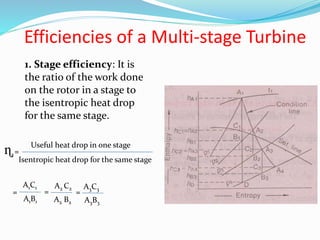
Efficiencies of a Multi-stage Turbine
1. Stage efficiency: It is
the ratio of the work done
on the rotor in a stage to
the isentropic heat drop
for the same stage.
ɳs =
Useful heat drop in one stage
Isentropic heat drop for the same stage
=
A1C1
A1B1
=
A2 C2
A2 B2
A3C3
A3B3
=
Efficiencies of a Multi-stage Turbine
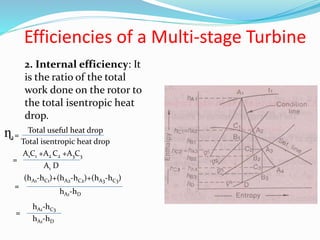
2. Internal efficiency: It
is the ratio of the total
work done on the rotor to
the total isentropic heat
drop.
ɳs =
Total useful heat drop
Total isentropic heat drop
=
A1C1 +A2 C2 +A3C3
A1 D
(hA1-hC1)+(hA2-hC2)+(hA3-hC3)
=
hA1-hD
hA1-hC3
=
hA1-hD
Efficiencies of a Multi-stage Turbine
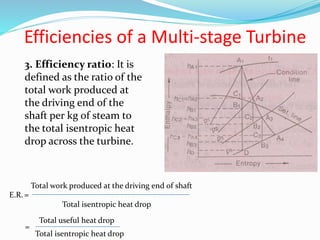
3. Efficiency ratio: It is
defined as the ratio of the
total work produced at
the driving end of the
shaft per kg of steam to
the total isentropic heat
drop across the turbine.
E.R. =
Total work produced at the driving end of shaft
Total isentropic heat drop
=
Total useful heat drop
Total isentropic heat drop
Efficiencies of a Multi-stage Turbine
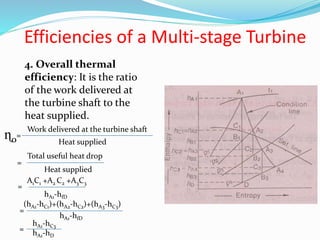
4. Overall thermal
efficiency: It is the ratio
of the work delivered at
the turbine shaft to the
heat supplied.
ɳo=
Work delivered at the turbine shaft
Heat supplied
=
Total useful heat drop
Heat supplied
=
A1C1 +A2 C2 +A3C3
(hA1-hC1)+(hA2-hC2)+(hA3-hC3)
=
hA1-hfD
hA1-hC3
=
hA1-hD
hA1-hfD
Efficiencies of a Multi-stage Turbine
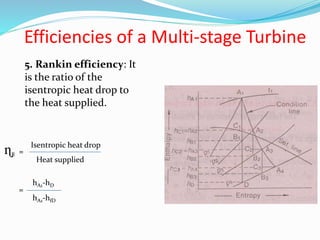
5. Rankin efficiency: It
is the ratio of the
isentropic heat drop to
the heat supplied.
ɳR =
Isentropic heat drop
Heat supplied
=
hA1-hD
hA1-hfD
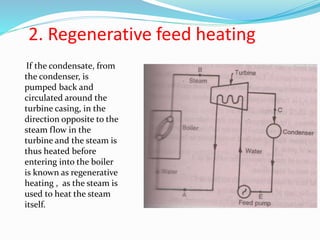
2. Regenerative feed heating
If the condensate, from
the condenser, is
pumped back and
circulated around the
turbine casing, in the
direction opposite to the
steam flow in the
turbine and the steam is
thus heated before
entering into the boiler
is known as regenerative
heating , as the steam is
used to heat the steam
itself.
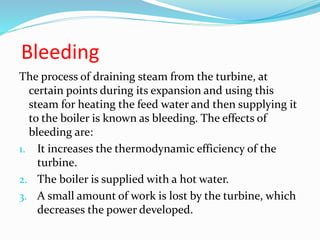
Bleeding
The process of draining steam from the turbine, at
certain points during its expansion and using this
steam for heating the feed water and then supplying it
to the boiler is known as bleeding. The effects of
bleeding are:
1. It increases the thermodynamic efficiency of the
turbine.
2. The boiler is supplied with a hot water.
3. A small amount of work is lost by the turbine, which
decreases the power developed.
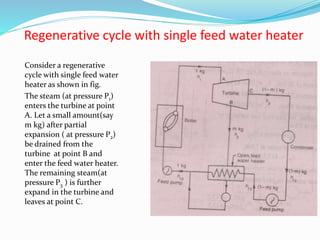
Regenerative cycle with single feed water heater
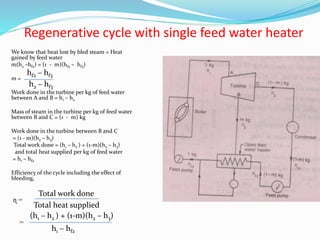
Consider a regenerative
cycle with single feed water
heater as shown in fig.
The steam (at pressure P1)
enters the turbine at point
A. Let a small amount(say
m kg) after partial
expansion ( at pressure P2)
be drained from the
turbine at point B and
enter the feed water heater.
The remaining steam(at
pressure P3 ) is further
expand in the turbine and
leaves at point C.
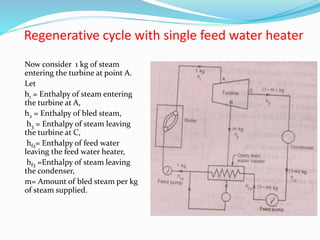
Regenerative cycle with single feed water heater
Now consider 1 kg of steam
entering the turbine at point A.
Let
h1 = Enthalpy of steam entering
the turbine at A,
h2 = Enthalpy of bled steam,
h3 = Enthalpy of steam leaving
the turbine at C,
hf2= Enthalpy of feed water
leaving the feed water heater,
hf3 =Enthalpy of steam leaving
the condenser,
m= Amount of bled steam per kg
of steam supplied.
Regenerative cycle with single feed water heater
We know that heat lost by bled steam = Heat
gained by feed water
m(h2 –hf2) = (1 - m)(hf2 – hf3)
m =
Work done in the turbine per kg of feed water
between A and B = h1 – h2
Mass of steam in the turbine per kg of feed water
between B and C = (1 - m) kg
Work done in the turbine between B and C
= (1 - m)(h2 – h3)
Total work done = (h1 – h2 ) + (1-m)(h2 – h3)
and total heat supplied per kg of feed water
= h1 – hf2
Efficiency of the cycle including the effect of
bleeding,
ɳ =
=
hf2 – hf3
h2 – hf3
Total work done
Total heat supplied
(h1 – h2 ) + (1-m)(h2 – h3)
h1 – hf2
Regenerative cycle with two feed water heater
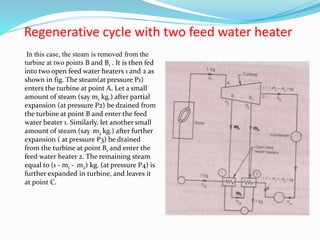
In this case, the steam is removed from the
turbine at two points B and B1 . It is then fed
into two open feed water heaters 1 and 2 as
shown in fig. The steam(at pressure P1)
enters the turbine at point A. Let a small
amount of steam (say m1 kg.) after partial
expansion (at pressure P2) be drained from
the turbine at point B and enter the feed
water heater 1. Similarly, let another small
amount of steam (say m2 kg.) after further
expansion ( at pressure P3) be drained
from the turbine at point B1 and enter the
feed water heater 2. The remaining steam
equal to (1 - m1 - m2) kg. (at pressure P4) is
further expanded in turbine, and leaves it
at point C.
m1 m2
m1
3. Binary Vapour Plants
The maximum possible efficiency of any
steam engine is given by the equation
ɳ =
T1 - T3
T1
=
T3
T1
1 -
Where T1 is the higher Temperature
at which heat is absorbed and T3 is
the lower temperature at which
heat is rejected.
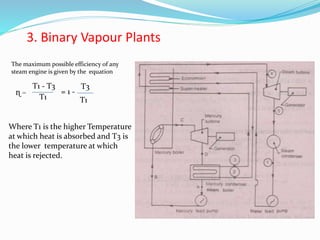
Binary Vapour Cycle
The binary vapour cycle on a T-s
diagram is shown in fig. The line AB
represents the evaporation of liquid
mercury plotted to the same
temperature scale as that of steam .
But the scale for the corresponding
pressure for the mercury is lower. The
mercury vapours at B has a much
higher temperature than the steam at
the same pressure. The mercury
vapours are now expanded
isentropically in a mercury turbine as
represented by the line CD. During
condensation the latent heat is
utilized for evaporating a
corresponding amount of steam.
The steam cycle is represented by 1-2-
3-4-5 as shown in fig. The line 1-2
represents the evaporation by the
condensing mercury. The line 2-3
represents the superheating of steam
by the flue gases. The steam
expanded isentropically through
steam turbine represents by the line
3-4. The condensation of the exhaust
steam is represented by the line 4-5.
The heating of feed water is
represented by the line 5-1.
 modern steam turbine

modern steam turbine

  • 3.
    Modern Steam Turbines Thescientist and engineers, working in research centers all over the world, concentrated their attention to produce more power and to improve efficiencies of turbines. They have listed a number of methods for this purpose as follows: 1. Reheating of steam, 2. Regenerative feed heating, and 3. Binary vapour plants.
  • 4.
    1. Reheating ofSteam In this system, the steam is removed from the turbine when it becomes wet. It is then reheated at a constant pressure by the flue gases, until it is again in the superheated state. It is then returned to the next stage in the turbine. Fig. Reheating of steam
  • 5.
    Advantages of Reheatingof Steam The reheating of steam in a turbine has the following advantages: 1. It increases the work done through the turbine. 2. It increases the efficiency of the turbine. 3. It reduces the erosion of the blades, because of increase in dryness fraction of steam at exhaust. 4. The amount of water required in the condenser of the turbine is reduced, due to reduction in the specific steam consumption.
  • 6.
    Reheat Cycle In areheat cycle, the steam enters the turbine in a superheated state at point A. The steam then expands isentropically while flowing through the turbine as shown by the vertical line AB. After expansion, the steam becomes wet, which is reheated at a constant pressure generally up to the same temperature as that at A shown by the point C, where it is again in superheated state. The steam again expands isentropically while flowing through the next stage of the turbine as shown by the vertical line CD.
  • 7.
    Reheat Cycle Now considera steam turbine with a reheating system as shown in Fig. Let, hA = Enthalpy of steam at A, hB, hC, hD = Corresponding values at B,C and D, hfD = Enthalpy of water at D. Total heat supplied = Total heat at A +Heat supplied between B and C = hA +[(hC -hB )– hfD ] Work done = Total heat drop = (hA - hB) + (hC - hD) and efficiency ɳ = = Total heat supplied Work done (hA - hB) + (hC - hD) hA +[(hC -hB )– hfD ]
  • 8.
    Multi-stage Turbine If wemake the steam to pass through a number of stages in order to get more work is known as multi- stage turbine.
  • 9.
    Reheat Factor The ratioof cumulative heat drop to the isentropic heat drop is known as reheat factor. R. F. = Cumulative heat drop Isentropic heat drop = A1B1+A2B2+A3B3 A1D = ΣAB ΣAB A1D
  • 10.
    Efficiencies of aMulti-stage Turbine 1. Stage efficiency: It is the ratio of the work done on the rotor in a stage to the isentropic heat drop for the same stage. ɳs = Useful heat drop in one stage Isentropic heat drop for the same stage = A1C1 A1B1 = A2 C2 A2 B2 A3C3 A3B3 =
  • 11.
    Efficiencies of aMulti-stage Turbine 2. Internal efficiency: It is the ratio of the total work done on the rotor to the total isentropic heat drop. ɳs = Total useful heat drop Total isentropic heat drop = A1C1 +A2 C2 +A3C3 A1 D (hA1-hC1)+(hA2-hC2)+(hA3-hC3) = hA1-hD hA1-hC3 = hA1-hD
  • 12.
    Efficiencies of aMulti-stage Turbine 3. Efficiency ratio: It is defined as the ratio of the total work produced at the driving end of the shaft per kg of steam to the total isentropic heat drop across the turbine. E.R. = Total work produced at the driving end of shaft Total isentropic heat drop = Total useful heat drop Total isentropic heat drop
  • 13.
    Efficiencies of aMulti-stage Turbine 4. Overall thermal efficiency: It is the ratio of the work delivered at the turbine shaft to the heat supplied. ɳo= Work delivered at the turbine shaft Heat supplied = Total useful heat drop Heat supplied = A1C1 +A2 C2 +A3C3 (hA1-hC1)+(hA2-hC2)+(hA3-hC3) = hA1-hfD hA1-hC3 = hA1-hD hA1-hfD
  • 14.
    Efficiencies of aMulti-stage Turbine 5. Rankin efficiency: It is the ratio of the isentropic heat drop to the heat supplied. ɳR = Isentropic heat drop Heat supplied = hA1-hD hA1-hfD
  • 15.
    2. Regenerative feedheating If the condensate, from the condenser, is pumped back and circulated around the turbine casing, in the direction opposite to the steam flow in the turbine and the steam is thus heated before entering into the boiler is known as regenerative heating , as the steam is used to heat the steam itself.
  • 16.
    Bleeding The process ofdraining steam from the turbine, at certain points during its expansion and using this steam for heating the feed water and then supplying it to the boiler is known as bleeding. The effects of bleeding are: 1. It increases the thermodynamic efficiency of the turbine. 2. The boiler is supplied with a hot water. 3. A small amount of work is lost by the turbine, which decreases the power developed.
  • 17.
    Regenerative cycle withsingle feed water heater Consider a regenerative cycle with single feed water heater as shown in fig. The steam (at pressure P1) enters the turbine at point A. Let a small amount(say m kg) after partial expansion ( at pressure P2) be drained from the turbine at point B and enter the feed water heater. The remaining steam(at pressure P3 ) is further expand in the turbine and leaves at point C.
  • 18.
    Regenerative cycle withsingle feed water heater Now consider 1 kg of steam entering the turbine at point A. Let h1 = Enthalpy of steam entering the turbine at A, h2 = Enthalpy of bled steam, h3 = Enthalpy of steam leaving the turbine at C, hf2= Enthalpy of feed water leaving the feed water heater, hf3 =Enthalpy of steam leaving the condenser, m= Amount of bled steam per kg of steam supplied.
  • 19.
    Regenerative cycle withsingle feed water heater We know that heat lost by bled steam = Heat gained by feed water m(h2 –hf2) = (1 - m)(hf2 – hf3) m = Work done in the turbine per kg of feed water between A and B = h1 – h2 Mass of steam in the turbine per kg of feed water between B and C = (1 - m) kg Work done in the turbine between B and C = (1 - m)(h2 – h3) Total work done = (h1 – h2 ) + (1-m)(h2 – h3) and total heat supplied per kg of feed water = h1 – hf2 Efficiency of the cycle including the effect of bleeding, ɳ = = hf2 – hf3 h2 – hf3 Total work done Total heat supplied (h1 – h2 ) + (1-m)(h2 – h3) h1 – hf2
  • 20.
    Regenerative cycle withtwo feed water heater In this case, the steam is removed from the turbine at two points B and B1 . It is then fed into two open feed water heaters 1 and 2 as shown in fig. The steam(at pressure P1) enters the turbine at point A. Let a small amount of steam (say m1 kg.) after partial expansion (at pressure P2) be drained from the turbine at point B and enter the feed water heater 1. Similarly, let another small amount of steam (say m2 kg.) after further expansion ( at pressure P3) be drained from the turbine at point B1 and enter the feed water heater 2. The remaining steam equal to (1 - m1 - m2) kg. (at pressure P4) is further expanded in turbine, and leaves it at point C. m1 m2 m1
  • 21.
    3. Binary VapourPlants The maximum possible efficiency of any steam engine is given by the equation ɳ = T1 - T3 T1 = T3 T1 1 - Where T1 is the higher Temperature at which heat is absorbed and T3 is the lower temperature at which heat is rejected.
  • 22.
    Binary Vapour Cycle Thebinary vapour cycle on a T-s diagram is shown in fig. The line AB represents the evaporation of liquid mercury plotted to the same temperature scale as that of steam . But the scale for the corresponding pressure for the mercury is lower. The mercury vapours at B has a much higher temperature than the steam at the same pressure. The mercury vapours are now expanded isentropically in a mercury turbine as represented by the line CD. During condensation the latent heat is utilized for evaporating a corresponding amount of steam. The steam cycle is represented by 1-2- 3-4-5 as shown in fig. The line 1-2 represents the evaporation by the condensing mercury. The line 2-3 represents the superheating of steam by the flue gases. The steam expanded isentropically through steam turbine represents by the line 3-4. The condensation of the exhaust steam is represented by the line 4-5. The heating of feed water is represented by the line 5-1.