Steam Turbine
Neeraj Adhikari
Steam turbine and Hydraulic machine (9 hours)
5.1 Steam Nozzles and Types
5.2 Flow of Steam Through Nozzles;
5.3 Steady flow energy equation, Momentum equation
5.4 Principle of Operation of Steam Turbines
5.5 Types of Steam Turbine and Applications
5.6 Impulse and Reaction Turbine: Components and Their Functions,
Working Principles, Efficiency
5.7 Hydraulic machine Types, Working Principle: Hydraulic Ram, Hydraulic
lift, Hydraulic torque converter
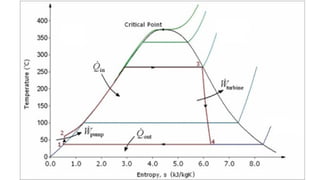
Steam Power Plant
A steam power plant converts the chemical energy of the fossil fuels (coal,
oil, gas) into mechanical / electrical energy.
This is achieved by raising the steam in the boilers, expanding it through the
turbines and coupling the turbines to the generators which convert
mechanical energy to electrical energy.
The working fluid is water which is sometimes in the liquid phase and
sometimes in the vapor phase
Since the fluid is undergoing a cyclic process, there will be no net change in
its internal energy over the cycle, and consequently, the net energy
transferred to the unit mass of the fluid as heat during the cycle must equal
the net energy transfer as work from the fluid.
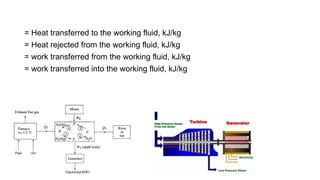
= Heat transferred to the working fluid, kJ/kg
= Heat rejected from the working fluid, kJ/kg
= work transferred from the working fluid, kJ/kg
= work transferred into the working fluid, kJ/kg
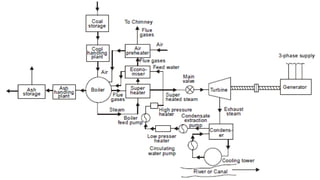
Layout of a modern steam power plant
1. Coal and ash circuit
2. Air and gas circuit
3. Feed water and steam flow circuit
4. Cooling water circuit
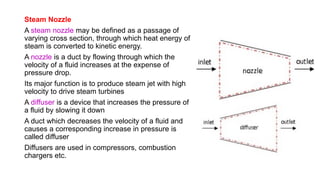
Steam Nozzle
A steam nozzle may be defined as a passage of
varying cross section, through which heat energy of
steam is converted to kinetic energy.
A nozzle is a duct by flowing through which the
velocity of a fluid increases at the expense of
pressure drop.
Its major function is to produce steam jet with high
velocity to drive steam turbines
A diffuser is a device that increases the pressure of
a fluid by slowing it down
A duct which decreases the velocity of a fluid and
causes a corresponding increase in pressure is
called diffuser
Diffusers are used in compressors, combustion
chargers etc.
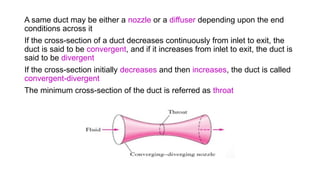
A same duct may be either a nozzle or a diffuser depending upon the end
conditions across it
If the cross-section of a duct decreases continuously from inlet to exit, the
duct is said to be convergent, and if it increases from inlet to exit, the duct is
said to be divergent
If the cross-section initially decreases and then increases, the duct is called
convergent-divergent
The minimum cross-section of the duct is referred as throat
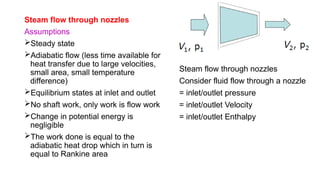
Steam flow through nozzles
Assumptions
Steady state
Adiabatic flow (less time available for
heat transfer due to large velocities,
small area, small temperature
difference)
Equilibrium states at inlet and outlet
No shaft work, only work is flow work
Change in potential energy is
negligible
The work done is equal to the
adiabatic heat drop which in turn is
equal to Rankine area
Steam flow through nozzles
Consider fluid flow through a nozzle
= inlet/outlet pressure
= inlet/outlet Velocity
= inlet/outlet Enthalpy
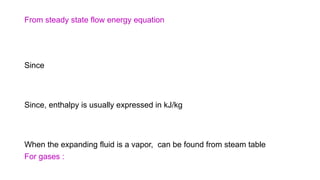
From steady state flow energy equation
Since
Since, enthalpy is usually expressed in kJ/kg
When the expanding fluid is a vapor, can be found from steam table
For gases :
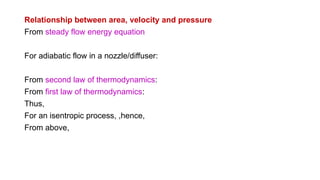
Relationship between area, velocity and pressure
From steady flow energy equation
For adiabatic flow in a nozzle/diffuser:
From second law of thermodynamics:
From first law of thermodynamics:
Thus,
For an isentropic process, ,hence,
From above,
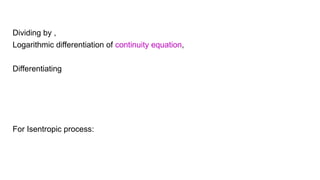
Dividing by ,
Logarithmic differentiation of continuity equation,
Differentiating
For Isentropic process:
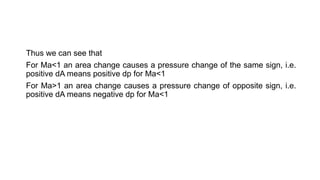
Thus we can see that
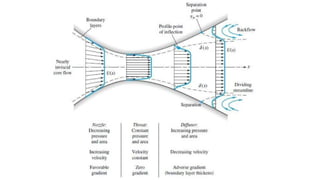
For Ma<1 an area change causes a pressure change of the same sign, i.e.
positive dA means positive dp for Ma<1
For Ma>1 an area change causes a pressure change of opposite sign, i.e.
positive dA means negative dp for Ma<1
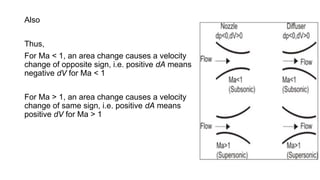
Also
Thus,
For Ma < 1, an area change causes a velocity
change of opposite sign, i.e. positive dA means
negative dV for Ma < 1
For Ma > 1, an area change causes a velocity
change of same sign, i.e. positive dA means
positive dV for Ma > 1
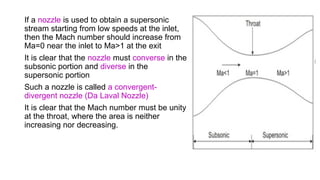
If a nozzle is used to obtain a supersonic
stream starting from low speeds at the inlet,
then the Mach number should increase from
Ma=0 near the inlet to Ma>1 at the exit
It is clear that the nozzle must converse in the
subsonic portion and diverse in the
supersonic portion
Such a nozzle is called a convergent-
divergent nozzle (Da Laval Nozzle)
It is clear that the Mach number must be unity
at the throat, where the area is neither
increasing nor decreasing.
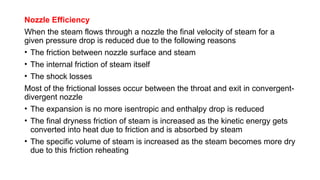
Nozzle Efficiency
When the steam flows through a nozzle the final velocity of steam for a
given pressure drop is reduced due to the following reasons
• The friction between nozzle surface and steam
• The internal friction of steam itself
• The shock losses
Most of the frictional losses occur between the throat and exit in convergent-
divergent nozzle
• The expansion is no more isentropic and enthalpy drop is reduced
• The final dryness friction of steam is increased as the kinetic energy gets
converted into heat due to friction and is absorbed by steam
• The specific volume of steam is increased as the steam becomes more dry
due to this friction reheating
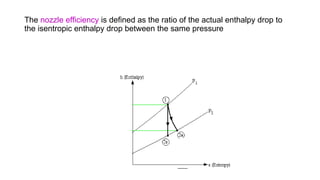
The nozzle efficiency is defined as the ratio of the actual enthalpy drop to
the isentropic enthalpy drop between the same pressure
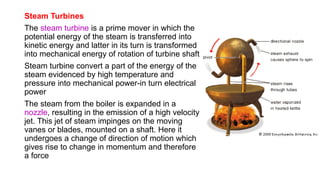
Steam Turbines
The steam turbine is a prime mover in which the
potential energy of the steam is transferred into
kinetic energy and latter in its turn is transformed
into mechanical energy of rotation of turbine shaft
Steam turbine convert a part of the energy of the
steam evidenced by high temperature and
pressure into mechanical power-in turn electrical
power
The steam from the boiler is expanded in a
nozzle, resulting in the emission of a high velocity
jet. This jet of steam impinges on the moving
vanes or blades, mounted on a shaft. Here it
undergoes a change of direction of motion which
gives rise to change in momentum and therefore
a force
Steam Turbine Classification
According to the action of the steam
• Impulse
• Reaction
According to the number of pressure stages
• Single-stage turbines
• Multi-stage turbines
According to the direction of flow
• Axial turbine
• Radial turbine
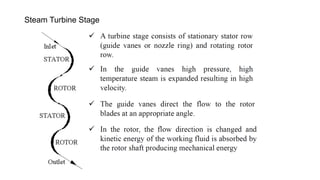
Steam Turbine Stage
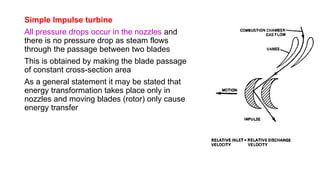
Simple Impulse turbine
All pressure drops occur in the nozzles and
there is no pressure drop as steam flows
through the passage between two blades
This is obtained by making the blade passage
of constant cross-section area
As a general statement it may be stated that
energy transformation takes place only in
nozzles and moving blades (rotor) only cause
energy transfer
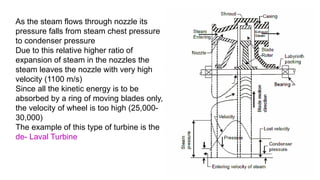
As the steam flows through nozzle its
pressure falls from steam chest pressure
to condenser pressure
Due to this relative higher ratio of
expansion of steam in the nozzles the
steam leaves the nozzle with very high
velocity (1100 m/s)
Since all the kinetic energy is to be
absorbed by a ring of moving blades only,
the velocity of wheel is too high (25,000-
30,000)
The example of this type of turbine is the
de- Laval Turbine
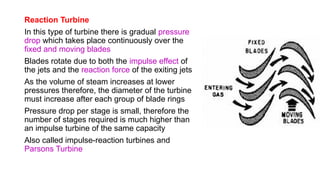
Reaction Turbine
In this type of turbine there is gradual pressure
drop which takes place continuously over the
fixed and moving blades
Blades rotate due to both the impulse effect of
the jets and the reaction force of the exiting jets
As the volume of steam increases at lower
pressures therefore, the diameter of the turbine
must increase after each group of blade rings
Pressure drop per stage is small, therefore the
number of stages required is much higher than
an impulse turbine of the same capacity
Also called impulse-reaction turbines and
Parsons Turbine
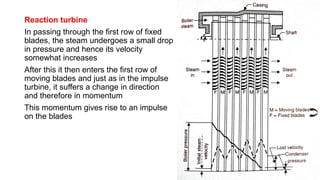
Reaction turbine
In passing through the first row of fixed
blades, the steam undergoes a small drop
in pressure and hence its velocity
somewhat increases
After this it then enters the first row of
moving blades and just as in the impulse
turbine, it suffers a change in direction
and therefore in momentum
This momentum gives rise to an impulse
on the blades
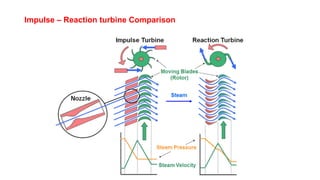
Impulse – Reaction turbine Comparison
Degree of Reaction
Here the subscripts “mb” and ”fb” represent moving blades and fixed blades
respectively
If , R = 0, which is the cause of pure impulse turbines where there is no
enthalpy drop of steam in the moving blades, and all the enthalpy drop of
the stage take place only in nozzles
If , R = 1, which is the case of pure reaction turbine
If equal enthalpy drop occur in the fixed and moving blades, i.e. if If R = ½,
called 50% reaction turbines which are also called Parsons turbines
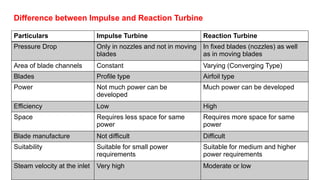
Particulars Impulse Turbine Reaction Turbine
Pressure Drop Only in nozzles and not in moving
blades
In fixed blades (nozzles) as well
as in moving blades
Area of blade channels Constant Varying (Converging Type)
Blades Profile type Airfoil type
Power Not much power can be
developed
Much power can be developed
Efficiency Low High
Space Requires less space for same
power
Requires more space for same
power
Blade manufacture Not difficult Difficult
Suitability Suitable for small power
requirements
Suitable for medium and higher
power requirements
Steam velocity at the inlet Very high Moderate or low
Difference between Impulse and Reaction Turbine
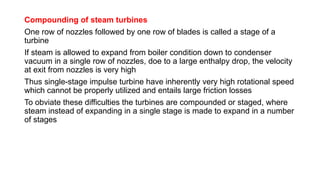
Compounding of steam turbines
One row of nozzles followed by one row of blades is called a stage of a
turbine
If steam is allowed to expand from boiler condition down to condenser
vacuum in a single row of nozzles, doe to a large enthalpy drop, the velocity
at exit from nozzles is very high
Thus single-stage impulse turbine have inherently very high rotational speed
which cannot be properly utilized and entails large friction losses
To obviate these difficulties the turbines are compounded or staged, where
steam instead of expanding in a single stage is made to expand in a number
of stages
Different method of compounding
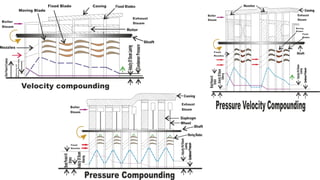
Velocity Compounding
Pressure Compounding
Pressure Velocity Compounding
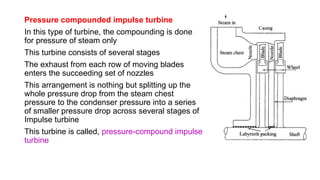
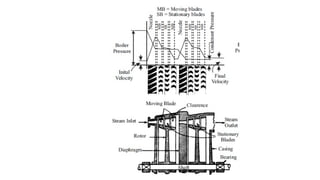
Pressure compounded impulse turbine
In this type of turbine, the compounding is done
for pressure of steam only
This turbine consists of several stages
The exhaust from each row of moving blades
enters the succeeding set of nozzles
This arrangement is nothing but splitting up the
whole pressure drop from the steam chest
pressure to the condenser pressure into a series
of smaller pressure drop across several stages of
Impulse turbine
This turbine is called, pressure-compound impulse
turbine
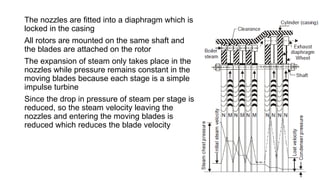
The nozzles are fitted into a diaphragm which is
locked in the casing
All rotors are mounted on the same shaft and
the blades are attached on the rotor
The expansion of steam only takes place in the
nozzles while pressure remains constant in the
moving blades because each stage is a simple
impulse turbine
Since the drop in pressure of steam per stage is
reduced, so the steam velocity leaving the
nozzles and entering the moving blades is
reduced which reduces the blade velocity
Velocity compounded impulse turbine
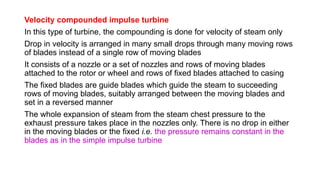
In this type of turbine, the compounding is done for velocity of steam only
Drop in velocity is arranged in many small drops through many moving rows
of blades instead of a single row of moving blades
It consists of a nozzle or a set of nozzles and rows of moving blades
attached to the rotor or wheel and rows of fixed blades attached to casing
The fixed blades are guide blades which guide the steam to succeeding
rows of moving blades, suitably arranged between the moving blades and
set in a reversed manner
The whole expansion of steam from the steam chest pressure to the
exhaust pressure takes place in the nozzles only. There is no drop in either
in the moving blades or the fixed i.e. the pressure remains constant in the
blades as in the simple impulse turbine
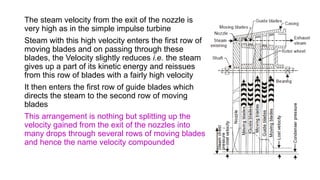
The steam velocity from the exit of the nozzle is
very high as in the simple impulse turbine
Steam with this high velocity enters the first row of
moving blades and on passing through these
blades, the Velocity slightly reduces i.e. the steam
gives up a part of its kinetic energy and reissues
from this row of blades with a fairly high velocity
It then enters the first row of guide blades which
directs the steam to the second row of moving
blades
This arrangement is nothing but splitting up the
velocity gained from the exit of the nozzles into
many drops through several rows of moving blades
and hence the name velocity compounded
Pressure and Velocity Compounded Impulse Turbine
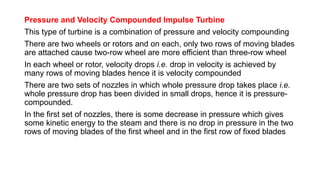
This type of turbine is a combination of pressure and velocity compounding
There are two wheels or rotors and on each, only two rows of moving blades
are attached cause two-row wheel are more efficient than three-row wheel
In each wheel or rotor, velocity drops i.e. drop in velocity is achieved by
many rows of moving blades hence it is velocity compounded
There are two sets of nozzles in which whole pressure drop takes place i.e.
whole pressure drop has been divided in small drops, hence it is pressure-
compounded.
In the first set of nozzles, there is some decrease in pressure which gives
some kinetic energy to the steam and there is no drop in pressure in the two
rows of moving blades of the first wheel and in the first row of fixed blades
Only, there is a velocity drop in moving blades though there is also a slight
drop in velocity due to friction in the fixed blades
In second set of nozzles, the remaining pressure drop takes place but the
velocity here increases and the drop in velocity takes place in the moving
blades of the second wheel or rotor
Compared to the pressure-com-pounded impulse turbine this arrangement
was more popular due to its simple construction
It is, however, very rarely used now due to its low efficiency
Steam Turbine Capacity
The capacities of small turbines and coupled generators vary from 500 to
7500 kW whereas large turbo alternators have capacity varying from 10 to
90 mW. Very large size units have capacities up to 500 mW
Generating units of 200 mW capacity are becoming quite common
The steam consumption of large steam turbines is about 3.5 to 5 kg per kWh
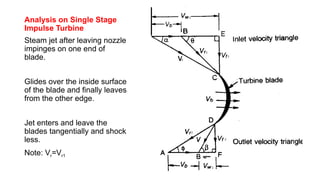
Analysis on Single Stage
Impulse Turbine
Steam jet after leaving nozzle
impinges on one end of
blade.
Glides over the inside surface
of the blade and finally leaves
from the other edge.
Jet enters and leave the
blades tangentially and shock
less.
Note: Vr=Vr1
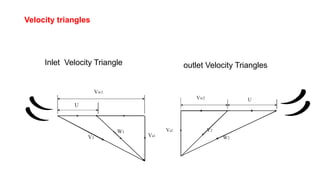
Velocity Triangles
The three velocity vectors namely, blade speed, absolute velocity and
relative velocity in relation to the rotor are used to form a triangle called
velocity triangle
Velocity triangles are used to illustrate the flow in the blading of
turbomachinery
Changes in the flow direction and velocity are easy to understand with the
help of the velocity triangles
Note that the velocity triangles are drawn for the inlet and outlet of the rotor
at certain radii
Velocity triangles
Inlet Velocity Triangle outlet Velocity Triangles
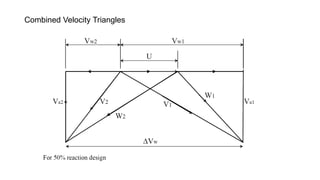
Combined Velocity Triangles
Power Produced
Mass of Steam flowing through Turbine =m kg/s
Change in velocity of whirl= (Vw1+Vw2)
Force in the direction of motion, Fx= m(Vw1+Vw2)
Work done in the direction of motion, Wx= m(Vw1+Vw2)u
Power produced by Turbine, P= m(Vw1+Vw2)u
Axial thrust on the wheel, Fy=m(Vf1 - Vf2)
Efficiency = [m(Vw1+Vw2)u] / [0.5 mV1
2
] = [2(Vw1+Vw2)u] / V1
2
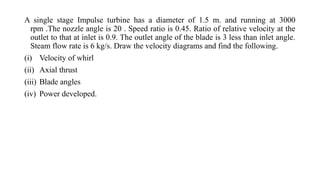
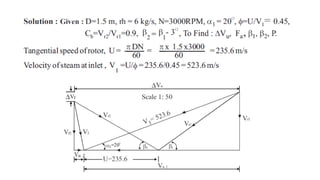
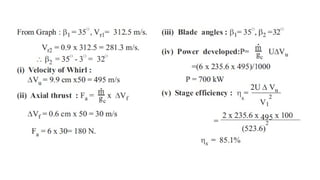
A single stage Impulse turbine has a diameter of 1.5 m. and running at 3000
rpm .The nozzle angle is 20 . Speed ratio is 0.45. Ratio of relative velocity at the
outlet to that at inlet is 0.9. The outlet angle of the blade is 3 less than inlet angle.
Steam flow rate is 6 kg/s. Draw the velocity diagrams and find the following.
(i) Velocity of whirl
(ii) Axial thrust
(iii) Blade angles
(iv) Power developed.
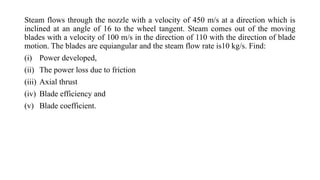
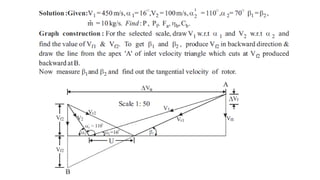
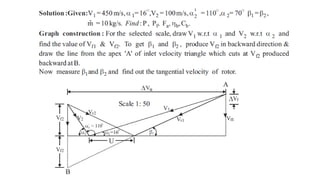
Steam flows through the nozzle with a velocity of 450 m/s at a direction which is
inclined at an angle of 16 to the wheel tangent. Steam comes out of the moving
blades with a velocity of 100 m/s in the direction of 110 with the direction of blade
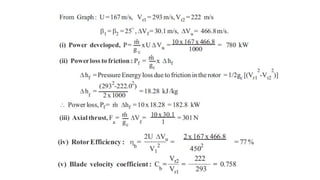
motion. The blades are equiangular and the steam flow rate is10 kg/s. Find:
(i) Power developed,
(ii) The power loss due to friction
(iii) Axial thrust
(iv) Blade efficiency and
(v) Blade coefficient.
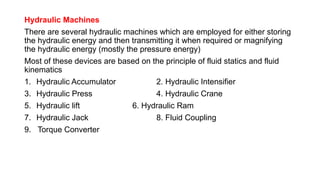
Hydraulic Machines
There are several hydraulic machines which are employed for either storing
the hydraulic energy and then transmitting it when required or magnifying
the hydraulic energy (mostly the pressure energy)
Most of these devices are based on the principle of fluid statics and fluid
kinematics
1. Hydraulic Accumulator 2. Hydraulic Intensifier
3. Hydraulic Press 4. Hydraulic Crane
5. Hydraulic lift 6. Hydraulic Ram
7. Hydraulic Jack 8. Fluid Coupling
9. Torque Converter
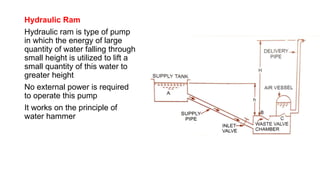
Hydraulic Ram
Hydraulic ram is type of pump
in which the energy of large
quantity of water falling through
small height is utilized to lift a
small quantity of this water to
greater height
No external power is required
to operate this pump
It works on the principle of
water hammer
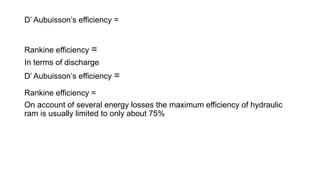
D’ Aubuisson’s efficiency =
Rankine efficiency =
In terms of discharge
D’ Aubuisson’s efficiency =
Rankine efficiency =
On account of several energy losses the maximum efficiency of hydraulic
ram is usually limited to only about 75%
A hydraulic ram is being supplied water at the rate of 0.05 m3/s from a
height of 5 m, and raises 0.005 m3/s to a height of 35 m from the ram. The
length and diameter of the pipe are 120 m and 70 mm respectively. If the co-
efficient of friction is 0.009, calculate D’ Aubuisson’s and Rankine’s
Efficiency.
(77.5% and 75%)
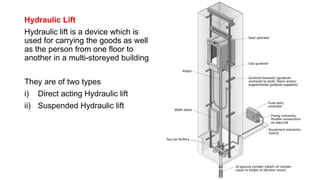
Hydraulic Lift
Hydraulic lift is a device which is
used for carrying the goods as well
as the person from one floor to
another in a multi-storeyed building
They are of two types
i) Direct acting Hydraulic lift
ii) Suspended Hydraulic lift
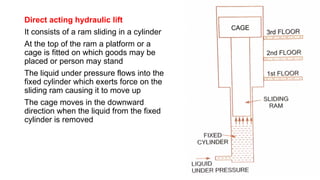
Direct acting hydraulic lift
It consists of a ram sliding in a cylinder
At the top of the ram a platform or a
cage is fitted on which goods may be
placed or person may stand
The liquid under pressure flows into the
fixed cylinder which exerts force on the
sliding ram causing it to move up
The cage moves in the downward
direction when the liquid from the fixed
cylinder is removed
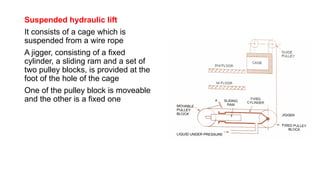
Suspended hydraulic lift
It consists of a cage which is
suspended from a wire rope
A jigger, consisting of a fixed
cylinder, a sliding ram and a set of
two pulley blocks, is provided at the
foot of the hole of the cage
One of the pulley block is moveable
and the other is a fixed one
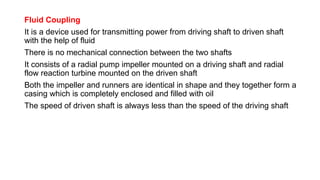
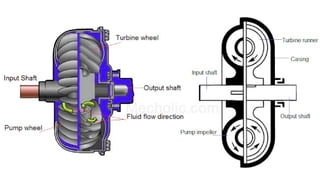
Fluid Coupling
It is a device used for transmitting power from driving shaft to driven shaft
with the help of fluid
There is no mechanical connection between the two shafts
It consists of a radial pump impeller mounted on a driving shaft and radial
flow reaction turbine mounted on the driven shaft
Both the impeller and runners are identical in shape and they together form a
casing which is completely enclosed and filled with oil
The speed of driven shaft is always less than the speed of the driving shaft
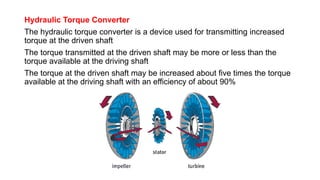
Hydraulic Torque Converter
The hydraulic torque converter is a device used for transmitting increased
torque at the driven shaft
The torque transmitted at the driven shaft may be more or less than the
torque available at the driving shaft
The torque at the driven shaft may be increased about five times the torque
available at the driving shaft with an efficiency of about 90%

Steam turbine theory based on fluid machine

  • 1.
  • 2.
    Steam turbine andHydraulic machine (9 hours) 5.1 Steam Nozzles and Types 5.2 Flow of Steam Through Nozzles; 5.3 Steady flow energy equation, Momentum equation 5.4 Principle of Operation of Steam Turbines 5.5 Types of Steam Turbine and Applications 5.6 Impulse and Reaction Turbine: Components and Their Functions, Working Principles, Efficiency 5.7 Hydraulic machine Types, Working Principle: Hydraulic Ram, Hydraulic lift, Hydraulic torque converter
  • 3.
    Steam Power Plant Asteam power plant converts the chemical energy of the fossil fuels (coal, oil, gas) into mechanical / electrical energy. This is achieved by raising the steam in the boilers, expanding it through the turbines and coupling the turbines to the generators which convert mechanical energy to electrical energy. The working fluid is water which is sometimes in the liquid phase and sometimes in the vapor phase Since the fluid is undergoing a cyclic process, there will be no net change in its internal energy over the cycle, and consequently, the net energy transferred to the unit mass of the fluid as heat during the cycle must equal the net energy transfer as work from the fluid.
  • 4.
    = Heat transferredto the working fluid, kJ/kg = Heat rejected from the working fluid, kJ/kg = work transferred from the working fluid, kJ/kg = work transferred into the working fluid, kJ/kg
  • 7.
    Layout of amodern steam power plant 1. Coal and ash circuit 2. Air and gas circuit 3. Feed water and steam flow circuit 4. Cooling water circuit
  • 8.
    Steam Nozzle A steamnozzle may be defined as a passage of varying cross section, through which heat energy of steam is converted to kinetic energy. A nozzle is a duct by flowing through which the velocity of a fluid increases at the expense of pressure drop. Its major function is to produce steam jet with high velocity to drive steam turbines A diffuser is a device that increases the pressure of a fluid by slowing it down A duct which decreases the velocity of a fluid and causes a corresponding increase in pressure is called diffuser Diffusers are used in compressors, combustion chargers etc.
  • 9.
    A same ductmay be either a nozzle or a diffuser depending upon the end conditions across it If the cross-section of a duct decreases continuously from inlet to exit, the duct is said to be convergent, and if it increases from inlet to exit, the duct is said to be divergent If the cross-section initially decreases and then increases, the duct is called convergent-divergent The minimum cross-section of the duct is referred as throat
  • 11.
    Steam flow throughnozzles Assumptions Steady state Adiabatic flow (less time available for heat transfer due to large velocities, small area, small temperature difference) Equilibrium states at inlet and outlet No shaft work, only work is flow work Change in potential energy is negligible The work done is equal to the adiabatic heat drop which in turn is equal to Rankine area Steam flow through nozzles Consider fluid flow through a nozzle = inlet/outlet pressure = inlet/outlet Velocity = inlet/outlet Enthalpy
  • 12.
    From steady stateflow energy equation Since Since, enthalpy is usually expressed in kJ/kg When the expanding fluid is a vapor, can be found from steam table For gases :
  • 13.
    Relationship between area,velocity and pressure From steady flow energy equation For adiabatic flow in a nozzle/diffuser: From second law of thermodynamics: From first law of thermodynamics: Thus, For an isentropic process, ,hence, From above,
  • 14.
    Dividing by , Logarithmicdifferentiation of continuity equation, Differentiating For Isentropic process:
  • 15.
    Thus we cansee that For Ma<1 an area change causes a pressure change of the same sign, i.e. positive dA means positive dp for Ma<1 For Ma>1 an area change causes a pressure change of opposite sign, i.e. positive dA means negative dp for Ma<1
  • 16.
    Also Thus, For Ma <1, an area change causes a velocity change of opposite sign, i.e. positive dA means negative dV for Ma < 1 For Ma > 1, an area change causes a velocity change of same sign, i.e. positive dA means positive dV for Ma > 1
  • 17.
    If a nozzleis used to obtain a supersonic stream starting from low speeds at the inlet, then the Mach number should increase from Ma=0 near the inlet to Ma>1 at the exit It is clear that the nozzle must converse in the subsonic portion and diverse in the supersonic portion Such a nozzle is called a convergent- divergent nozzle (Da Laval Nozzle) It is clear that the Mach number must be unity at the throat, where the area is neither increasing nor decreasing.
  • 18.
    Nozzle Efficiency When thesteam flows through a nozzle the final velocity of steam for a given pressure drop is reduced due to the following reasons • The friction between nozzle surface and steam • The internal friction of steam itself • The shock losses Most of the frictional losses occur between the throat and exit in convergent- divergent nozzle • The expansion is no more isentropic and enthalpy drop is reduced • The final dryness friction of steam is increased as the kinetic energy gets converted into heat due to friction and is absorbed by steam • The specific volume of steam is increased as the steam becomes more dry due to this friction reheating
  • 19.
    The nozzle efficiencyis defined as the ratio of the actual enthalpy drop to the isentropic enthalpy drop between the same pressure
  • 20.
    Steam Turbines The steamturbine is a prime mover in which the potential energy of the steam is transferred into kinetic energy and latter in its turn is transformed into mechanical energy of rotation of turbine shaft Steam turbine convert a part of the energy of the steam evidenced by high temperature and pressure into mechanical power-in turn electrical power The steam from the boiler is expanded in a nozzle, resulting in the emission of a high velocity jet. This jet of steam impinges on the moving vanes or blades, mounted on a shaft. Here it undergoes a change of direction of motion which gives rise to change in momentum and therefore a force
  • 21.
    Steam Turbine Classification Accordingto the action of the steam • Impulse • Reaction According to the number of pressure stages • Single-stage turbines • Multi-stage turbines According to the direction of flow • Axial turbine • Radial turbine
  • 22.
  • 23.
    Simple Impulse turbine Allpressure drops occur in the nozzles and there is no pressure drop as steam flows through the passage between two blades This is obtained by making the blade passage of constant cross-section area As a general statement it may be stated that energy transformation takes place only in nozzles and moving blades (rotor) only cause energy transfer
  • 24.
    As the steamflows through nozzle its pressure falls from steam chest pressure to condenser pressure Due to this relative higher ratio of expansion of steam in the nozzles the steam leaves the nozzle with very high velocity (1100 m/s) Since all the kinetic energy is to be absorbed by a ring of moving blades only, the velocity of wheel is too high (25,000- 30,000) The example of this type of turbine is the de- Laval Turbine
  • 25.
    Reaction Turbine In thistype of turbine there is gradual pressure drop which takes place continuously over the fixed and moving blades Blades rotate due to both the impulse effect of the jets and the reaction force of the exiting jets As the volume of steam increases at lower pressures therefore, the diameter of the turbine must increase after each group of blade rings Pressure drop per stage is small, therefore the number of stages required is much higher than an impulse turbine of the same capacity Also called impulse-reaction turbines and Parsons Turbine
  • 26.
    Reaction turbine In passingthrough the first row of fixed blades, the steam undergoes a small drop in pressure and hence its velocity somewhat increases After this it then enters the first row of moving blades and just as in the impulse turbine, it suffers a change in direction and therefore in momentum This momentum gives rise to an impulse on the blades
  • 27.
    Impulse – Reactionturbine Comparison
  • 28.
    Degree of Reaction Herethe subscripts “mb” and ”fb” represent moving blades and fixed blades respectively If , R = 0, which is the cause of pure impulse turbines where there is no enthalpy drop of steam in the moving blades, and all the enthalpy drop of the stage take place only in nozzles If , R = 1, which is the case of pure reaction turbine If equal enthalpy drop occur in the fixed and moving blades, i.e. if If R = ½, called 50% reaction turbines which are also called Parsons turbines
  • 29.
    Particulars Impulse TurbineReaction Turbine Pressure Drop Only in nozzles and not in moving blades In fixed blades (nozzles) as well as in moving blades Area of blade channels Constant Varying (Converging Type) Blades Profile type Airfoil type Power Not much power can be developed Much power can be developed Efficiency Low High Space Requires less space for same power Requires more space for same power Blade manufacture Not difficult Difficult Suitability Suitable for small power requirements Suitable for medium and higher power requirements Steam velocity at the inlet Very high Moderate or low Difference between Impulse and Reaction Turbine
  • 30.
    Compounding of steamturbines One row of nozzles followed by one row of blades is called a stage of a turbine If steam is allowed to expand from boiler condition down to condenser vacuum in a single row of nozzles, doe to a large enthalpy drop, the velocity at exit from nozzles is very high Thus single-stage impulse turbine have inherently very high rotational speed which cannot be properly utilized and entails large friction losses To obviate these difficulties the turbines are compounded or staged, where steam instead of expanding in a single stage is made to expand in a number of stages
  • 31.
    Different method ofcompounding Velocity Compounding Pressure Compounding Pressure Velocity Compounding
  • 32.
    Pressure compounded impulseturbine In this type of turbine, the compounding is done for pressure of steam only This turbine consists of several stages The exhaust from each row of moving blades enters the succeeding set of nozzles This arrangement is nothing but splitting up the whole pressure drop from the steam chest pressure to the condenser pressure into a series of smaller pressure drop across several stages of Impulse turbine This turbine is called, pressure-compound impulse turbine
  • 33.
    The nozzles arefitted into a diaphragm which is locked in the casing All rotors are mounted on the same shaft and the blades are attached on the rotor The expansion of steam only takes place in the nozzles while pressure remains constant in the moving blades because each stage is a simple impulse turbine Since the drop in pressure of steam per stage is reduced, so the steam velocity leaving the nozzles and entering the moving blades is reduced which reduces the blade velocity
  • 34.
    Velocity compounded impulseturbine In this type of turbine, the compounding is done for velocity of steam only Drop in velocity is arranged in many small drops through many moving rows of blades instead of a single row of moving blades It consists of a nozzle or a set of nozzles and rows of moving blades attached to the rotor or wheel and rows of fixed blades attached to casing The fixed blades are guide blades which guide the steam to succeeding rows of moving blades, suitably arranged between the moving blades and set in a reversed manner The whole expansion of steam from the steam chest pressure to the exhaust pressure takes place in the nozzles only. There is no drop in either in the moving blades or the fixed i.e. the pressure remains constant in the blades as in the simple impulse turbine
  • 35.
    The steam velocityfrom the exit of the nozzle is very high as in the simple impulse turbine Steam with this high velocity enters the first row of moving blades and on passing through these blades, the Velocity slightly reduces i.e. the steam gives up a part of its kinetic energy and reissues from this row of blades with a fairly high velocity It then enters the first row of guide blades which directs the steam to the second row of moving blades This arrangement is nothing but splitting up the velocity gained from the exit of the nozzles into many drops through several rows of moving blades and hence the name velocity compounded
  • 36.
    Pressure and VelocityCompounded Impulse Turbine This type of turbine is a combination of pressure and velocity compounding There are two wheels or rotors and on each, only two rows of moving blades are attached cause two-row wheel are more efficient than three-row wheel In each wheel or rotor, velocity drops i.e. drop in velocity is achieved by many rows of moving blades hence it is velocity compounded There are two sets of nozzles in which whole pressure drop takes place i.e. whole pressure drop has been divided in small drops, hence it is pressure- compounded. In the first set of nozzles, there is some decrease in pressure which gives some kinetic energy to the steam and there is no drop in pressure in the two rows of moving blades of the first wheel and in the first row of fixed blades
  • 37.
    Only, there isa velocity drop in moving blades though there is also a slight drop in velocity due to friction in the fixed blades In second set of nozzles, the remaining pressure drop takes place but the velocity here increases and the drop in velocity takes place in the moving blades of the second wheel or rotor Compared to the pressure-com-pounded impulse turbine this arrangement was more popular due to its simple construction It is, however, very rarely used now due to its low efficiency
  • 40.
    Steam Turbine Capacity Thecapacities of small turbines and coupled generators vary from 500 to 7500 kW whereas large turbo alternators have capacity varying from 10 to 90 mW. Very large size units have capacities up to 500 mW Generating units of 200 mW capacity are becoming quite common The steam consumption of large steam turbines is about 3.5 to 5 kg per kWh
  • 41.
    Analysis on SingleStage Impulse Turbine Steam jet after leaving nozzle impinges on one end of blade. Glides over the inside surface of the blade and finally leaves from the other edge. Jet enters and leave the blades tangentially and shock less. Note: Vr=Vr1
  • 42.
    Velocity Triangles The threevelocity vectors namely, blade speed, absolute velocity and relative velocity in relation to the rotor are used to form a triangle called velocity triangle Velocity triangles are used to illustrate the flow in the blading of turbomachinery Changes in the flow direction and velocity are easy to understand with the help of the velocity triangles Note that the velocity triangles are drawn for the inlet and outlet of the rotor at certain radii
  • 43.
    Velocity triangles Inlet VelocityTriangle outlet Velocity Triangles
  • 44.
  • 45.
    Power Produced Mass ofSteam flowing through Turbine =m kg/s Change in velocity of whirl= (Vw1+Vw2) Force in the direction of motion, Fx= m(Vw1+Vw2) Work done in the direction of motion, Wx= m(Vw1+Vw2)u Power produced by Turbine, P= m(Vw1+Vw2)u Axial thrust on the wheel, Fy=m(Vf1 - Vf2) Efficiency = [m(Vw1+Vw2)u] / [0.5 mV1 2 ] = [2(Vw1+Vw2)u] / V1 2
  • 46.
    A single stageImpulse turbine has a diameter of 1.5 m. and running at 3000 rpm .The nozzle angle is 20 . Speed ratio is 0.45. Ratio of relative velocity at the outlet to that at inlet is 0.9. The outlet angle of the blade is 3 less than inlet angle. Steam flow rate is 6 kg/s. Draw the velocity diagrams and find the following. (i) Velocity of whirl (ii) Axial thrust (iii) Blade angles (iv) Power developed.
  • 49.
    Steam flows throughthe nozzle with a velocity of 450 m/s at a direction which is inclined at an angle of 16 to the wheel tangent. Steam comes out of the moving blades with a velocity of 100 m/s in the direction of 110 with the direction of blade motion. The blades are equiangular and the steam flow rate is10 kg/s. Find: (i) Power developed, (ii) The power loss due to friction (iii) Axial thrust (iv) Blade efficiency and (v) Blade coefficient.
  • 53.
    Hydraulic Machines There areseveral hydraulic machines which are employed for either storing the hydraulic energy and then transmitting it when required or magnifying the hydraulic energy (mostly the pressure energy) Most of these devices are based on the principle of fluid statics and fluid kinematics 1. Hydraulic Accumulator 2. Hydraulic Intensifier 3. Hydraulic Press 4. Hydraulic Crane 5. Hydraulic lift 6. Hydraulic Ram 7. Hydraulic Jack 8. Fluid Coupling 9. Torque Converter
  • 54.
    Hydraulic Ram Hydraulic ramis type of pump in which the energy of large quantity of water falling through small height is utilized to lift a small quantity of this water to greater height No external power is required to operate this pump It works on the principle of water hammer
  • 55.
    D’ Aubuisson’s efficiency= Rankine efficiency = In terms of discharge D’ Aubuisson’s efficiency = Rankine efficiency = On account of several energy losses the maximum efficiency of hydraulic ram is usually limited to only about 75%
  • 56.
    A hydraulic ramis being supplied water at the rate of 0.05 m3/s from a height of 5 m, and raises 0.005 m3/s to a height of 35 m from the ram. The length and diameter of the pipe are 120 m and 70 mm respectively. If the co- efficient of friction is 0.009, calculate D’ Aubuisson’s and Rankine’s Efficiency. (77.5% and 75%)
  • 57.
    Hydraulic Lift Hydraulic liftis a device which is used for carrying the goods as well as the person from one floor to another in a multi-storeyed building They are of two types i) Direct acting Hydraulic lift ii) Suspended Hydraulic lift
  • 58.
    Direct acting hydrauliclift It consists of a ram sliding in a cylinder At the top of the ram a platform or a cage is fitted on which goods may be placed or person may stand The liquid under pressure flows into the fixed cylinder which exerts force on the sliding ram causing it to move up The cage moves in the downward direction when the liquid from the fixed cylinder is removed
  • 59.
    Suspended hydraulic lift Itconsists of a cage which is suspended from a wire rope A jigger, consisting of a fixed cylinder, a sliding ram and a set of two pulley blocks, is provided at the foot of the hole of the cage One of the pulley block is moveable and the other is a fixed one
  • 60.
    Fluid Coupling It isa device used for transmitting power from driving shaft to driven shaft with the help of fluid There is no mechanical connection between the two shafts It consists of a radial pump impeller mounted on a driving shaft and radial flow reaction turbine mounted on the driven shaft Both the impeller and runners are identical in shape and they together form a casing which is completely enclosed and filled with oil The speed of driven shaft is always less than the speed of the driving shaft
  • 62.
    Hydraulic Torque Converter Thehydraulic torque converter is a device used for transmitting increased torque at the driven shaft The torque transmitted at the driven shaft may be more or less than the torque available at the driving shaft The torque at the driven shaft may be increased about five times the torque available at the driving shaft with an efficiency of about 90%

Editor's Notes

  • #11 https://www.youtube.com/watch?v=R_cCU-BMbRo
  • #13 V  specific volume
  • #41 Alpha -> Angle with the tangent of the wheel at which the steam with velocity V1 enters. This is also called nozzle angle Tita -> Entrance angle of moving blade Phi -> Exit angle of moving blade Beta -> Angle which the discharging steam makes with the tangent of the wheel at the exit of moving blade