NABL 124

NABL

NATIONAL ACCREDITATION
BOARD FOR TESTING AND
CALIBRATION LABORATORIES

SPECIFIC CRITERIA
for CALIBRATION

LABORATORIES IN
THERMAL & OPTICAL
DISCIPLINE

ISSUE NO : 04
ISSUE DATE: 28.03.2008

AMENDMENT NO : 01
AMENDMENT DATE: 27.06.2012
AMENDMENT SHEET
Sl

Page
No.

Clause No.

1

5,17

1, Gen.
Remarks

Date of
Amendment
27.06.2012

Amendment made
BMC changed to
CMC

Reasons

Signature
QO

Signature
Director

Adoption of ILAC
Policy

2

3

4

5

6

7

8

9

10

National Accreditation Board for Testing and Calibration Laboratories
Doc. No: NABL 124
Issue No: 04

Specific Criteria for Calibration Laboratories in Thermal & Optical Discipline
Issue Date: 28.03.2008
Amend No: 01
Amend Date: 27.06.2012

Page No: 1 / 34
PREFACE
This document clarifies NABL’s stand on the accuracy and measurement capability levels.
NABL intends to uphold its policy of granting accreditation to laboratories as per their
requirements of accuracy and measurement capability.
These criteria are applicable to laboratories, which perform repetitive calibrations in various
parameters and desire accreditation from NABL.
These criteria provide guidelines for use by laboratories and those who are associated with the
program of accreditation of calibration laboratories e.g. experts, assessors, officials engaged
with day-to-day activities of accreditation. These criteria cover all areas/ fields of calibration.
This document provides the laboratories with necessary information on the requirements for
assessment/ surveillance and to assist them in carrying out internal audit of their system.
The information in this document has been compiled in three parts.

PART – I
General Guidelines for Accreditation of Calibration Laboratories
This part contains relevant information on general requirements of a laboratory engaged in
Calibration in the field of Thermal & Optical Measurements. The laboratory seeking
accreditation must comply with the requirements of ISO/ IEC 17025: 2005 and this document.

PART – II
Specific Criteria for Accreditation of Calibration Laboratories
This part provides information on special requirements of the laboratories, which are specific to
the parameters covered in the respective fields

PART – III
Guidelines Regarding Accuracy of Standards & Measurement Uncertainty in Calibration
This part contains guidelines of the Specified accuracies of measurement standard and
uncertainties of measurement generally achieved in laboratories using equipment and
instruments of different classes of accuracies/ uncertainties for different parameters under
Thermal & Optical measurements.

National Accreditation Board for Testing and Calibration Laboratories
Doc. No: NABL 124
Issue No: 04

Specific Criteria for Calibration Laboratories in Thermal & Optical Discipline
Issue Date: 28.03.2008
Amend No: 00
Amend Date: --

Page No: 2 / 34
CONTENTS
Sl.

Title

Page No.

Amendment Sheet

1

Preface

2

Contents

3

PART – I
1.

Scope

5

2.

Criteria for Accreditation

6

3.

Organisation

6

4.

Management System

7

5.

Personnel

8

6.

Accommodation and Environmental Conditions

9

7.

Equipment

10

8.

Range, Uncertainty of Measurement and Traceability

11

9.

Calibration Certificate/ Report

11

10.

Proficiency Testing Program

12

PART – II
1.

Scope

13

2.

Range and Uncertainty of Measurement

13

3.

Environmental Conditions

13

4.

Special Requirements of Laboratory

14

5.

Repair and Maintenance

15

6.

Storage and Packaging

15

7.

Safety Precautions

16

National Accreditation Board for Testing and Calibration Laboratories
Doc. No: NABL 124
Issue No: 04

Specific Criteria for Calibration Laboratories in Thermal & Optical Discipline
Issue Date: 28.03.2008
Amend No: 00
Amend Date: --

Page No: 3 / 34
Sl.

Table

Page No.

PART - III
General Remarks and Environmental Conditions

17

1.

Specific Heat and Humidity Measurements

18

2.

Temperature Measurements

19

3.

Optical Measurements

21

4.

Infrared Radiation Measurement

25

5.

Fiber Optics Measurement (For Silica Based Fibers)

27

6.

Fiber Optics Components Measurement

29

7.

Fiber Optics Measurements – Test Parameters

30

Annexure – Scope of Thermal & Optical Measurement

31

National Accreditation Board for Testing and Calibration Laboratories
Doc. No: NABL 124
Issue No: 04

Specific Criteria for Calibration Laboratories in Thermal & Optical Discipline
Issue Date: 28.03.2008
Amend No: 00
Amend Date: --

Page No: 4 / 34
PART – I

GENERAL GUIDELINES FOR ACCREDITATION OF CALIBRATION
LABORATORIES
1.0

SCOPE

1.1

Calibration laboratories are accredited by NABL after it is demonstrated that a
laboratory complies with the requirements of international standard ISO/IEC 17025:
2005. In view of generic nature of the standard the requirements stated there in, need
to be further redefined in specific fields of calibration. This specific criteria lays down
those specific requirements in the field of mechanical calibration. This part of the
document thus amplifies the generic requirements for mechanical calibration and
supplement the requirements of ISO/IEC 17025:2005. Laboratories seeking NABL
accreditation in the field of mechanical calibration must also comply with the
requirements stated in this part.

1.2

Calibration and Measurement Capability (CMC) is one the parameters that is used by
NABL to define the scope of an accredited calibration laboratory, the others being
parameter/quantity measured, standard/master used, calibration method used and
measurement range. The CMC is expressed as "the smallest uncertainty that a
laboratory can achieve when calibrating the best existing device ". It is an expanded
uncertainty estimated at a confidence level of approximately 95% corresponding to a
coverage factor k=2.
Note: Refer NABL 143 on NABL policy on Calibration and Measurement Capability (CMC) and
uncertainty in calibration

The laboratory’s ability to achieve their claimed CMC shall be evaluated based on its
performance during the on-site assessment and by review of proficiency testing results,
wherein the laboratory has participated.
1.3

The definition of CMC implies that within its accreditation a laboratory is not permitted
to report a smaller uncertainty of measurement than the CMC endorsed on its scope of
accreditation. This means that the laboratory shall be required to state a uncertainty not
better than that corresponding to the CMC whenever it is established that the actual
calibration process adds significantly to the uncertainty of measurement. The CMC is
applicable only to the results for which the laboratory claims its status as accredited
laboratory. It is therefore a realistic means for customers to select and compare
accredited laboratories’ capabilities.
1.4

All the parameters for which accreditation is sought must be expressed in S.I. Units,
wherever applicable.

National Accreditation Board for Testing and Calibration Laboratories
Doc. No: NABL 124
Issue No: 04

Specific Criteria for Calibration Laboratories in Thermal & Optical Discipline
Issue Date: 28.03.2008
Amend No: 01
Amend Date:27.06.2012

Page No: 5 / 34
2.0

CRITERIA FOR ACCREDITATION

2.1

Accreditation of a calibration laboratory will require assessment in respect of
organization,

staff,

equipment

and

traceability

of

its

calibration,

laboratory

accommodation and environmental conditions, safety, handling of calibrated equipment
and equipment under calibration, measurement capability and recording system, etc.,
as per ISO/ IEC 17025: 2005 General Requirements for the Competence of Testing
and Calibration Laboratories. Some explanatory notes of this document are given in
the following clauses.

3.0

ORGANISATION

3.1

The Calibration Laboratory shall be organized in such a way that all staff members are
aware of both the extent and the limitations of their area of responsibility.

This

organization shall specify and document the responsibility and authority of the Head of
the Calibration Laboratory/Technical Manager/Quality Manager with direct access to
the top management. All personnel will perform or verify work affecting the quality of
calibrations as per general guidelines and specific criteria laid down for the accredited
parameters. The calibration laboratory shall be organized in such a way so as to
ensure the integrity and training of its staff and operations for ensuring unbiased
Calibration.
3.2

A Deputy Head/Technical Manager may also be nominated to take over the
responsibility in the absence of the Laboratory Head. In case there is no Deputy-incharge, the authorities concerned may appoint a suitable person to look after the
laboratory, under intimation to NABL. The laboratory shall also clearly define authorized
signatory for the calibration certificates/reports issued by the laboratory.

National Accreditation Board for Testing and Calibration Laboratories
Doc. No: NABL 124
Issue No: 04

Specific Criteria for Calibration Laboratories in Thermal & Optical Discipline
Issue Date: 28.03.2008
Amend No: 00
Amend Date:--

Page No: 6 / 34
4.0

MANAGEMENT SYSTEM

4.1

The calibration laboratory shall have a Quality Manual which shall be maintained up-todate and available for scrutiny, in compliance with ISO/ IEC 17025: 2005 and NABL
requirements, with emphasis on following information:
a)

A quality policy statement, including objectives and commitments by the top
management.

b)

A statement on the organization of the calibration laboratory.

c)

Names, qualifications and experience of the persons responsible for managerial,
and scientific/technical activities.

d)

A clearly defined charter of responsibility showing the relationship between
management and support services.

e)

Scope and operation together with information on measurement capability and
traceability of calibration of all measuring instruments to national measurement
standards.

f)

The reference of document number on detailed calibration procedures adopted
in the laboratory, which should be compiled in the form of a manual for the use of
calibration staff.

g)

The reference list of all national/international standards being referred to or used
in the performance of calibration work (copies of such standard specifications
should be available in the laboratory for the use of calibration staff.)

h)

All amendments made in any of the documents must be dated and listed in the
Quality Manual and brought to the notice of NABL.

4.2

The calibration facilities established in accordance with the general guidelines and
specific criteria shall be audited periodically and reviewed by or on behalf of the
management to ensure the continued effectiveness of the system.

National Accreditation Board for Testing and Calibration Laboratories
Doc. No: NABL 124
Issue No: 04

Specific Criteria for Calibration Laboratories in Thermal & Optical Discipline
Issue Date: 28.03.2008
Amend No: 00
Amend Date:--

Page No: 7 / 34
4.3

The calibration laboratory shall clearly specify, document and make known to the
customers, the administrative and other procedures to be followed for getting
calibration done from the laboratory.

The procedure for redressal of technical

complaints should also be clearly specified and documented.
4.4

The laboratory shall have authorized signatories for approving and issuing calibration
certificates for each calibration parameter as mentioned in the scope of accreditation.
Any officer competent to evaluate calibration results critically and occupying a position
involving responsibility for the adequacy of calibration results is eligible for approval by
NABL as an authorized signatory of endorsed calibration documents. Consequently
approved

authorized

signatories

must

demonstrate

understanding

of

these

requirements.

5.0

PERSONNEL

5.1

The calibration laboratory shall have adequate number of qualified competent and
trained personnel as follows:
Laboratory personnel performing calibration: Diploma in Engineering (relevant branch)
or Science graduate (with Physics) with 1 year of relevant experience or ITI with at
least 5 years of relevant experience.
Authorized Signatory: Bachelor of Engineering/Post Graduate in Science (relevant
branch) with 1 year of experience in the field of Thermal/ Optical Measurements and
calibration practices in the relevant parameters or Diploma in Engineering (relevant
branch) with minimum 3 years of experience in the field of Thermal/ Optical
Measurements and calibration practices.

5.2

Arrangements for improvement of qualifications and periodic refresher courses and
practical training should also exist for the staff so as to keep them in touch with latest
developments in the relevant fields.

National Accreditation Board for Testing and Calibration Laboratories
Doc. No: NABL 124
Issue No: 04

Specific Criteria for Calibration Laboratories in Thermal & Optical Discipline
Issue Date: 28.03.2008
Amend No: 00
Amend Date:--

Page No: 8 / 34
5.3

The Head of the calibration laboratory shall be at least a Post Graduate in Physical
Science or Graduate in Electrical/ Electronics/ Instrumentation Engineering or
equivalent with specialised knowledge and adequate experience in precision Thermal/
Optical and other relevant parameter measurements. In exceptional cases, a graduate
in physics or diploma holder in Electrical or Electronics Engineering with long
experience could be accepted.

6.0

ACCOMMODATION AND ENVIRONMENTAL CONDITIONS

6.1

Vibrations
The calibration area shall be adequately free from vibrations generated by central airconditioning plants, vehicular traffic and other sources to ensure consistent and uniform
operational conditions. The laboratory shall take all special/protective precautions like
mounting of sensitive apparatus on vibration free tables and pillars etc., isolated from
the floor, if necessary.

6.2

Acoustic Noise
Acoustic noise level in the laboratory shall be maintained to facilitate proper
performance of calibration work. A threshold noise level of 60 dBA is recommended
unless otherwise stated.

6.3

Illumination
The calibration area shall have adequate level of illumination. Where permissible,
fluorescent lighting is preferred to avoid localized heating and temperature drift. The
recommended level of illumination is 450-700 lux on the working table with glare index
of 19 for the laboratory.

6.4

Environmental Conditions and Monitoring
The environmental conditions for the activity of the laboratory shall be such as not to
adversely affect the required accuracy of measurement. Facilities should be provided
whenever necessary for recording temperature, pressure and humidity values
prevailing during calibration. The atmospheric conditions maintained in the laboratory
during calibration should be reported in the calibration report/certificate.

National Accreditation Board for Testing and Calibration Laboratories
Doc. No: NABL 124
Issue No: 04

Specific Criteria for Calibration Laboratories in Thermal & Optical Discipline
Issue Date: 28.03.2008
Amend No: 00
Amend Date:--

Page No: 9 / 34
6.5

Entry to the Calibration Area
As far as possible, only the staff engaged in the calibration activity shall be permitted
entry inside the calibration area.

7.0

EQUIPMENT
Each calibration laboratory should have measurement standards or equipment of
required accuracy in respect of each parameter covered by it in order to be able to
realize and to substantiate the corresponding measurement capability claimed.
Stability of the standards, accuracy of the values realized through them and
repeatability, should be regularly monitored.
Any bias resulting from ageing of standards should be precisely determined.
Instructions for operating each standard and equipment/instrument should be readily
available for use by the laboratory staff members.

7.2

The standards/measuring equipment of the laboratory should be calibrated at regular
intervals, with higher accuracy standards. The calibration certificates, performance
history sheets in respect of the reference secondary/working standards and measuring
equipment should be held safely by the laboratory.

7.3

Proper record shall be maintained for each standard and equipment with the following
information:
a)
b)

Manufacturers name and address

c)

Type, range, identification and serial number

d)

Date of procurement and commissioning

e)

Details of Calibration

f)

Details of maintenance and repairs

g)

Performance history with dates

h)
7.4

Name of the equipment

Availability of service manual

Details of periodic calibration schedule of new and old standards and measuring
equipment should be worked out in consultation with higher accuracy laboratory and
this schedule should be observed.

National Accreditation Board for Testing and Calibration Laboratories
Doc. No: NABL 124
Issue No: 04

Specific Criteria for Calibration Laboratories in Thermal & Optical Discipline
Issue Date: 28.03.2008
Amend No: 00
Amend Date:--

Page No: 10 / 34
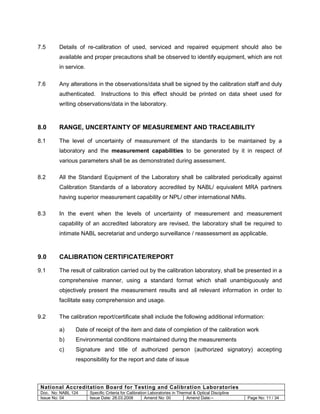
7.5

Details of re-calibration of used, serviced and repaired equipment should also be
available and proper precautions shall be observed to identify equipment, which are not
in service.

7.6

Any alterations in the observations/data shall be signed by the calibration staff and duly
authenticated. Instructions to this effect should be printed on data sheet used for
writing observations/data in the laboratory.

8.0

RANGE, UNCERTAINTY OF MEASUREMENT AND TRACEABILITY

8.1

The level of uncertainty of measurement of the standards to be maintained by a
laboratory and the measurement capabilities to be generated by it in respect of
various parameters shall be as demonstrated during assessment.

8.2

All the Standard Equipment of the Laboratory shall be calibrated periodically against
Calibration Standards of a laboratory accredited by NABL/ equivalent MRA partners
having superior measurement capability or NPL/ other international NMIs.

8.3

In the event when the levels of uncertainty of measurement and measurement
capability of an accredited laboratory are revised, the laboratory shall be required to
intimate NABL secretariat and undergo surveillance / reassessment as applicable.

9.0

CALIBRATION CERTIFICATE/REPORT

9.1

The result of calibration carried out by the calibration laboratory, shall be presented in a
comprehensive manner, using a standard format which shall unambiguously and
objectively present the measurement results and all relevant information in order to
facilitate easy comprehension and usage.

9.2

The calibration report/certificate shall include the following additional information:
a)

Date of receipt of the item and date of completion of the calibration work

b)

Environmental conditions maintained during the measurements

c)

Signature and title of authorized person (authorized signatory) accepting
responsibility for the report and date of issue

National Accreditation Board for Testing and Calibration Laboratories
Doc. No: NABL 124
Issue No: 04

Specific Criteria for Calibration Laboratories in Thermal & Optical Discipline
Issue Date: 28.03.2008
Amend No: 00
Amend Date:--

Page No: 11 / 34
d)

A statement of the accreditation measurement capability relevant to the job
under calibration

e)

A symbol of NABL or statement or both clarifying the status of accreditation of
the laboratory.

f)

The Uncertainty of measurement

g)

An evidence that the measurements are traceable to National/ International
Standards through unbroken chain of Accredited Laboratories.

9.3

The calibration report/ certificate shall not contain any recommendation on the
calibration interval except where this has been agreed with the client. This requirement
may be superseded by legal regulations.

10.0

PROFICIENCY TESTING PROGRAM

10.1

To give further assurance to the accuracy or Uncertainty of measurements, a
laboratory will be required to participate, from time to time, in Proficiency Testing
Programs. The laboratory shall remain prepared to participate in the Proficiency
Testing Program through inter-laboratory, inter-comparison schemes wherever it is
technically feasible. In case any abnormalities, in terms of En number are detected
through these inter-comparisons, appropriate corrective action will be taken, the
standards/equipment shall be replaced/ repaired and re-calibrated with a higher
accuracy standard. Reports on such inter-comparisons should be documented with
reference. The Proficiency Testing practice should be included in the Quality Manual.

National Accreditation Board for Testing and Calibration Laboratories
Doc. No: NABL 124
Issue No: 04

Specific Criteria for Calibration Laboratories in Thermal & Optical Discipline
Issue Date: 28.03.2008
Amend No: 00
Amend Date:--

Page No: 12 / 34
PART- II

SPECIFIC CRITERIA FOR ACCREDITATION OF
CALIBRATION LABORATORIES IN THE FIELD OF
THERMAL & OPTICAL MEASUREMENTS
1.0

SCOPE

1.1

An accredited laboratory shall be classified as calibration laboratory for the accredited
parameters in the field of Thermal & Optical Measurements in accordance with its
measurement capability.

1.2

A calibration laboratory seeking accreditation to offer calibration services in the field of
Thermal & Optical measurements will generally carry out calibration in the following
areas:
a)
b)

Humidity

c)

Temperature

D)

Optical parameters

e)

Infrared

f)

Radiation Measurements

g)
1.3

Specific Heat

Fibre Optics Measurements

The accredited calibration laboratory will be mainly concerned with the measurement of
one or more of the parameters shown in the annexure.

2.0

RANGE AND UNCERTAINTY OF MEASUREMENT

2.1

A calibration laboratory will be accredited according to its Measurement capability
expressed in terms of uncertainty.

3.0

ENVIRONMENTAL CONDITIONS

3.1

The laboratory shall specify limits on the environmental conditions to be achieved in the
laboratory. The condition shall appropriate to the level of accuracy required for the
calibration undertaken by the laboratory.
The environmental conditions shall be monitored at appropriate intervals and
calibrations stopped when environmental conditions fall outside the specified limits.

National Accreditation Board for Testing and Calibration Laboratories
Doc. No: NABL 124
Issue No: 04

Specific Criteria for Calibration Laboratories in Thermal & Optical Discipline
Issue Date: 28.03.2008
Amend No: 00
Amend Date:--

Page No: 13 / 34
4.0

SPECIAL REQUIREMENTS OF LABORATORY

4.1

The calibration laboratory shall make arrangements for regulated and uninterrupted
power supply. The recommended regulation level is ±1% or better on the calibration
bench.

4.2

Relevant IS specification (IS:1248, IS: 4722) regarding total harmonic content and
variation in supply frequency should be followed. Voltage stabilizers of low harmonic
content should be used to comply with this requirement.

4.3

Adequate arrangement shall be made by the laboratory so as to ensure temperature
gradient not exceeding 1.5 °C per hour inside the laboratory in case of power failure.

4.4

The laboratory shall use if necessary, isolation transformers and filters etc. to ensure
minimisation of ground current and effects of mains hum interference

4.5

The power supply to the calibration laboratory shall be directly obtained from the
substation as far as possible and shall not be on the same feeder line which is
supplying power to workshops and other production areas which require operation of
heavy duty machines.

4.6

Effective mains earthing shall be provided in accordance with relevant specification
IS:3043. This shall be checked periodically and stray couplings minimised.

4.7

Special care shall be taken about the location of magnetic field sources like
transformers, looped wires, ferrous materials etc. in order to minimise magnetic
interference in the measurements.

4.8

Adequate screening of the laboratory against electro-magnetic interference shall be
done if necessary. By pass filters should also be provided to minimise conducted
interference effect on the electronic equipment. Special shielding chambers should be
provided in the laboratory for measurements, particularly when signal noise ratio is a
disturbing factor for accurate measurements.

National Accreditation Board for Testing and Calibration Laboratories
Doc. No: NABL 124
Issue No: 04

Specific Criteria for Calibration Laboratories in Thermal & Optical Discipline
Issue Date: 28.03.2008
Amend No: 00
Amend Date:--

Page No: 14 / 34
4.9

The reference standards shall be maintained at temperatures specified for their
maintenance in order to ensure their conformance to the required level of operation and
traceability. The laboratory should have specific facilities required for carrying out the
calibrations of parameters chosen.

4.10

The laboratory shall be sealed against dust and external air pressure. Positive air
pressure shall be maintained inside the laboratory

4.11

Adequate protective measures, like use of transient suppressors etc., shall be taken by
the laboratory to ward off high current spikes and transients emanating from switching
on and off, of the heavy machines, surges in power lines and other such reasons, from
reaching the electronic equipment in general and computer based systems involving
data storage facilities in particular.

4.12

For temperature control enclosures the laboratory shall check temperature variation in
working space using different reference thermocouples (at least five points temperature
probe), at the same time, for arriving at spatial variation.

5.0

REPAIR & MAINTAINENCE

5.1

A separate repair and maintenance facility, adequately equipped with repair facilities
and qualified and experienced manpower, shall be available in house or by any other
means effectively accessible to the calibration laboratory. This facility shall also assist
in identifying the preventive maintenance procedures which should brought to the
attention of the personnel engaged in calibration work for taking necessary precautions.
The repair facility should cover digital and programmable instruments also.

5.2

Every repaired equipment shall invariably be recalibrated through in-house facility or by
higher accuracy laboratory before being used for further calibration work.

6.0

STORAGE & PACKAGING

6.1

The standard/measuring instruments/equipment received by the laboratory for
calibration shall be safely in proper environmental conditions according to the
instructions given by the supplier.

National Accreditation Board for Testing and Calibration Laboratories
Doc. No: NABL 124
Issue No: 04

Specific Criteria for Calibration Laboratories in Thermal & Optical Discipline
Issue Date: 28.03.2008
Amend No: 00
Amend Date:--

Page No: 15 / 34
6.2

The laboratory shall have adequate arrangements for packaging of calibrated
instruments and may assist the user, if necessary, about the procedure and
precautions to be taken by the organisation for packaging and transportation of the
equipment to the calibration laboratory and back.

7.0

SAFETY PRECAUTIONS

7.1

Relevant fire extinguishing equipment for possible fire hazards, should be available in
the corridors or as convenient to the laboratory. Adequate safety measures against
electrical, chemical fire hazards must be available at the workplace. Laboratory
rooms/areas where highly inflammable materials are used/stored should be identified.
Access to the relevant fire equipment should be assured near these rooms/areas.

7.2

Specification SP.31-1986, a special publication in the form of a wall chart, giving the
method of treatment in case of electric shock, should be followed. The chart should be
placed near the power supply switchgear and at other prominent places as prescribed
under Indian Electricity Rules 1956.

National Accreditation Board for Testing and Calibration Laboratories
Doc. No: NABL 124
Issue No: 04

Specific Criteria for Calibration Laboratories in Thermal & Optical Discipline
Issue Date: 28.03.2008
Amend No: 00
Amend Date:--

Page No: 16 / 34
PART III

GUIDELINES REGARDING ACCURACY OF STANDARDS &
MEASUREMENTS UNCERTAINTY IN CALIBRATION FOR
THERMAL & OPTICAL MEASUREMENTS
GENERAL REMARKS
The following pages may be referred as guidelines and not mandatory recommendations for the
laboratories. The accredited calibration laboratories are no longer required to be categorized
into Echelon/ level I, II, III. Part III of this document is aimed to provide guidance to the
laboratories regarding the precautions they should take with respect to Environmental
conditions as appropriate to respective Calibration and Measurement Capability of the
laboratories. The laboratories, on their own, should decide/ determine to have environmental
conditions in their premises, for the Calibration and measurement capability claimed
corresponding to their scope of accreditation applied for. Further to note that:

1)

The measurement capability is expressed as uncertainty (±) at a confidence probability
level of 95%.

2)

The term Uncertainty in these tables pertains to the corresponding measurement
capability of the laboratory in respect of each parameter.

3)

The values of Accuracy/Uncertainty of measurement shown in the following tables are at
95% CL unless stated otherwise.

ENVIRONMENTAL CONDITIONS
Standards atmospheric conditions for calibration in a Thermal & Optical Measurements
Laboratory shall be as follows:
Level
Temperature
Relative humidity

I

II

III

250C ± 0.50C

250C ± 2.50C

250C ± 4.00C

35 - 65%

35 - 65%

not to exceed 70%

National Accreditation Board for Testing and Calibration Laboratories
Doc. No: NABL 124
Issue No: 04

Specific Criteria for Calibration Laboratories in Thermal & Optical Discipline
Issue Date: 28.03.2008
Amend No: 01
Amend Date:27.06.2012

Page No: 17 / 34
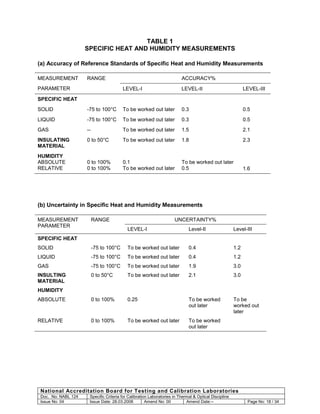
TABLE 1
SPECIFIC HEAT AND HUMIDITY MEASUREMENTS
(a) Accuracy of Reference Standards of Specific Heat and Humidity Measurements
MEASUREMENT

RANGE

PARAMETER

ACCURACY%
LEVEL-I

LEVEL-II

LEVEL-III

SPECIFIC HEAT
SOLID

-75 to 100°C

To be worked out later

0.3

0.5

LIQUID

-75 to 100°C

To be worked out later

0.3

0.5

GAS

--

To be worked out later

1.5

2.1

INSULATING
MATERIAL

0 to 50°C

To be worked out later

1.8

2.3

0 to 100%
0 to 100%

0.1
To be worked out later

To be worked out later
0.5

1.6

HUMIDITY
ABSOLUTE
RELATIVE

(b) Uncertainty in Specific Heat and Humidity Measurements
MEASUREMENT
PARAMETER

RANGE

UNCERTAINTY%
LEVEL-I

Level-II

Level-III

SPECIFIC HEAT
SOLID

-75 to 100°C

To be worked out later

0.4

1.2

LIQUID

-75 to 100°C

To be worked out later

0.4

1.2

GAS

-75 to 100°C

To be worked out later

1.9

3.0

INSULTING
MATERIAL

0 to 50°C

To be worked out later

2.1

3.0

ABSOLUTE

0 to 100%

0.25

To be worked
out later

To be
worked out
later

RELATIVE

0 to 100%

To be worked out later

To be worked
out later

HUMIDITY

National Accreditation Board for Testing and Calibration Laboratories
Doc. No: NABL 124
Issue No: 04

Specific Criteria for Calibration Laboratories in Thermal & Optical Discipline
Issue Date: 28.03.2008
Amend No: 00
Amend Date:--

Page No: 18 / 34
TABLE 2
TEMPERATURE MEASUREMENTS
(a) Accuracy (In 0c) of Reference Standards of Temperature Measurements
Type of
Thermometer

Level-I
Range

Level-II

Accuracy

Range

Level-III

Accuracy

Liquid in Glass 193K300°C

0.02 to 0.05 193K to 0°C 0.1
0 to 300°C
0.04 to 0.1

Platinum
Resistance
Thermometer

13.81
to
630.75°C

0.5x10
to
-3
30.5x10

Thermocouple

-3

-3

Range

Accuracy

0 to 300°C

0.06 to 0.1

193K
to
630°C

0.9x10
to
-3
32x10

--

--

0 to 630°C, 0.25
630 to
to
1554°C
0.7

0 to 1100°C
1100 to
1500°C

0.45
to
1.1

0 to 1100°C

1.0

i) Total
radiation
pyrometry

50-2000°C

0.25-2.5

50-2000°C

0.4-5.0

--

--

ii) Spectral
radiation
pyrometry

9602100°C,
21003000°C

0.25-2.5

9602100°C,
21003000°C

0.4-5.0

--

--

(Pt-10%, Rh Pt)

Pyrometry

2.5-5.0

5.0-9.0

National Accreditation Board for Testing and Calibration Laboratories
Doc. No: NABL 124
Issue No: 04

Specific Criteria for Calibration Laboratories in Thermal & Optical Discipline
Issue Date: 28.03.2008
Amend No: 00
Amend Date:--

Page No: 19 / 34
(b) Uncertainty (In 0c) in Temperature Measurements
Type of
Thermometer

Level-I

Level-II

Level-III

Range

Uncertainty

Range

Uncertainty

Range

Uncertainty

193K300°C

0.02-0.05

193K to 0°C
0 to 300°C

0.15
0.05

0 to 300°C

0.15 to 0.3

PLATINUM
RESISTANCE
THERMOMETER

13.81 K to
630.75°C

0.7x10
to
-3
31x 10

193K
to
630°C

11x10
to
-3
60x10

--

--

THERMOCOUPLE
(PT-10%, RH PT)

0 to 630°C, 0.35 to 0.9

0 to 1100°C,

0.7 to 1.5

0 to 1100°C 1.5

LIQUID IN GLASS

-3

-3

630 to
1554°C

0.35 to 0.9

1100 to
1500°C

0.7 to 1.5

I) TOTAL
RADIATION
PYROMETRY

50-2000°C

0.25-3.0

50-2000°C

0.7-8.0

II) SPECTRAL
RADIATION
PYROMETRY

9602100°C

0.25-3.0

960-2100 C

21003000°C

3.0-7.0

2100-3000 C 8-12

PYROMETRY

0

0.7-8.0

0

National Accreditation Board for Testing and Calibration Laboratories
Doc. No: NABL 124
Issue No: 04

Specific Criteria for Calibration Laboratories in Thermal & Optical Discipline
Issue Date: 28.03.2008
Amend No: 00
Amend Date:--

Page No: 20 / 34
TABLE 3
OPTICAL MEASUREMENTS
(a) Accuracy of Reference Standards of Optical Measurements
Measurement
Parameter

Range

Accuracy%
Level-I

Level-II

Level-III

1.5-2.5

1.7-2.2

2.3-2.7

1.0 to 2.0

1.7 to 2.2

2.3 to 2.7

2

2.25

2.7

2

2.25

2.7

Photometric standards*
LUMINOUS FLUX

1 to >105lm

LUMINOUS INTENSITY

-4

-4

10 to > 10 cd
4

LUMINANCE

1 to > 10 cd/cm

2

-4

ILLUMINANCE

10 to <100 lux

Radiometric & Spectroradiometric Standards
REDIANCE AND

300-400nm

4-3

4.5-3.5

IRRADIANCE

400-1000 nm

3-2.5

3.5-3

300-400 nm

4-3

4.5-3.5

400-2500 nm

3-7

3.5-8

SPECTRAL REFLECTANCE AND 300 to 400 nm
SPECTRAL TRANSMITTANCE
300 to 2000 nm

2.0%

2.2%

2.7%

1.0%

1.5%

2.0%

WAVELENGTH

100 to 2500 nm

As per standards spectral Source

COLOUR
(CHROMATICITY)
(COORDINATES)

Standard

x=0.001

x-0.003

To be worked
out later

D64

y-0.001

y-0.003

To be
worked out
later

COLOUR TEMPERATURE

1800-3400K

10K-15K

11 to 16K

13-20

3.0%

3.8%

4.8%

(nominal)
-5

2

(5x10 -0.5W/cm )
SPECTRAL RADIANCE AND
SPECTRAL IRRADIANCE

(Distribution temp.
2500 K)

COLORIMETRIC STANDARDS

Illuminant

POLARIMETRIC STANDARD
Stokes Parameters
OPTICAL MATERIALS,
COMPONENTS SYSTEMS
* Temperative frequency, voltage and wave form requirements as per IEC/CIE recommendations.
Contd.

National Accreditation Board for Testing and Calibration Laboratories
Doc. No: NABL 124
Issue No: 04

Specific Criteria for Calibration Laboratories in Thermal & Optical Discipline
Issue Date: 28.03.2008
Amend No: 00
Amend Date:--

Page No: 21 / 34
Table 3(a) – contd.
-6

-6

-4

REFRACTIVE INDEX*

300 to 2500nm

1x10

2x10

2.2x10

RADIUS OF **

0.5 to 5nm

1.0µm

3.0µm

5µm

5 to 200mm

2 to 3µm

20µm

100µm

200 to 5000mm

100 µm

500µm

2mm

5 to 20 meters

5mm

10mm

15mm

FLATNESS

upto 300mm dia

λ/200

λ/50

λ/10

SURFACE FIGURE

-do-

λ/50

λ/30

λ/5

CURVATURE
RADIUS OF CURVATURE

RESOLUTION

As per Standard Chart Given At P-30, 31

FOCAL LENGTH
-25 θ to +25D

(I) OPTHALMIC LENS

(II) SCIENTIFIC LENS

To be worked
out later

-0.1D

-0.2D

+0.1D

+0.2D

1mm-1000mm

5µm

20µm

100µm*

1m-20m

10µm

100µm

2mm

Upto 10W

3.0%

3.8%

To be
worked out
later

Upto 1000W

3.0%

4.8%

To be
worked out
later

Upto 10J

10.0%

10.7%

To be
worked out
later

1.5%

2.7%

4.0%

LASER POWER AND ENERGY
(I) CONTINUOUS

(II) PULSED

(300 to 1064nm)
(Mode Locked,
Q-Switched and
Free Running)
FIBRE OPTICS
ATTENUATION***
*

Temperature control to ±0.1°C at STP at Level 1

**

Temperature +0.5 at the working bench

*** Temperative +0.1° + Vibration isolation for

Level-I

±0.25 + -do- for

Level-II

Normal + -do- for

Level-III

National Accreditation Board for Testing and Calibration Laboratories
Doc. No: NABL 124
Issue No: 04

Specific Criteria for Calibration Laboratories in Thermal & Optical Discipline
Issue Date: 28.03.2008
Amend No: 00
Amend Date:--

Page No: 22 / 34
(b) Uncertainty (%) in Optical Measurements
MEASUREMENT PARAMETER

UNCERTAINTY%

Range

Level-I

Level-II

Level-III

1.6-2.25

2-2.5

2.8-3.4

1.6-2.25

2-2.5

2.8-3.4

2.25

2.7

3.5

2.25

2.7

3.5

Photometric Standards
5

Luminous Flux

1 to >10 lm

Luminous Intensity

-4

4

1 to > 10 cd
4

1 to > 10 cd/cm

Luminance

-4

Illuminance

10 to >100 lux

Radiometric and Spectroradiometric Standards
300 to 400nm

4.25-3.25

5-6

-

400 to 1000nm
(nominal)

3.25-2.75

4-3

-

300 to 400nm

4.25-3.25

5-4

-

400 to 2500nm
(Distribution temp.
2500K)

3.25-7.25

4.75

-

Spectral Reflectance
300 to 400nm
and
Spectral Transmitance 400 to 2000nm

2.1%

2.5%

3.4%

1.2%

1.7%

2.5%

Wavelength

As per Standard Spectral Source

+Radiance and
Irradiance

-5

(5x10 to 0.5W/cm)
Spectral Radiance
and
Spectral Irradiance

Colorimetric Standards
Colour

Standard

x-0.002

x-0.004

(Chromaticity
coordinates)

Illuminant
D-64

y-0.002

y-0.004

Colour
Temperature

1800 to 3200K

11.16

13-17.5

17 to 25K

3.4%

4.3%

5.7%

To be
worked out
later

Polarimetric Standards
Stockes
parameters

Contd.

National Accreditation Board for Testing and Calibration Laboratories
Doc. No: NABL 124
Issue No: 04

Specific Criteria for Calibration Laboratories in Thermal & Optical Discipline
Issue Date: 28.03.2008
Amend No: 00
Amend Date:--

Page No: 23 / 34
Table 3(b)—Contd.

Optical Materials, Components & System
Refractive Index

300 to 2500nm

-6

-5

-4

1x10

1x10

1x10

0.5 to 5mm

1.5µm

5µm

8µm

5 to 200mm

5µm

50µm

200µm

200 to 5000mm

200µm

1mm

5mm

5 to 20 metres

10mm

20mm

50mm

* Flatness

Upto 300 mm dia

λ/80

λ/30

λ/8

Surface Figure

-do-

λ/30

λ/10

λ/2

(RI 1.4-1.9)
Radius of
Curvature

Resolution

As per Standard Chart Given P-33, 34

Focal Length
(i) Opthalmic lens

To be worked
out later

-0.15D

-0.25D

+0.15D

+0.25D

1mm-1000mm

10µm

30µm

200µm

1m-20m

20µm

200µm

5mm

Upto 10W

3.4%

4.6%

To be worked
out later

Upto 1000W

(ii) Scientific lens

-25D to +25D

4.0%

6.5%

Upto 10J

10.4%

11.5%

To be worked
out later

2.2%

3.4%

5.0%

Laser Power and Energy
(i) Continuous

(ii) Pulsed

(300 to 1064nm)
(Mode Locked)

To be worked
out later

(Q-switched and
Free Running)

Fibre Optics
Attenuation
* Temperature control as given in Table 3a

National Accreditation Board for Testing and Calibration Laboratories
Doc. No: NABL 124
Issue No: 04

Specific Criteria for Calibration Laboratories in Thermal & Optical Discipline
Issue Date: 28.03.2008
Amend No: 00
Amend Date:--

Page No: 24 / 34
TABLE 4
INFRARED RADIATION MEASUREMENT
Infrared Radiation - Radiometric and Spectroradiometric Standards
Measurement Parameters

Range

Accuracy %
Level-I

Level-II

Level-III

1.

Spectral Irradiance

0.8 to 14µm

5

-

-

2.

Total Irradiance

Infrared
Region

2

-

-

3.

Photomatric Scale:
Spectral Specular
Reflectance

0 to 100% in
2.5 to 25µm
Spectral
Region

2

-

-

4.

Photometric
Scale:
Spectral
Transmittance

0 to 100% in
2.5 to 25µm
Spectral
Region

2

-

-

5.

Wave number
Scale:
Spectral
Transmittance/
Reflectance

2.5 to 25µm

0.2

-

-

Response of
Infrared
Scanners

Variable
Irradiance

-

-

6.

1.0

-

National Accreditation Board for Testing and Calibration Laboratories
Doc. No: NABL 124
Issue No: 04

Specific Criteria for Calibration Laboratories in Thermal & Optical Discipline
Issue Date: 28.03.2008
Amend No: 00
Amend Date:--

Page No: 25 / 34
Chart of Resolving Power Values for Individual Targets
Group

Target

Resolving
Power (lines
per mm)

Group

Target

Resolving Power
(lines per mm)

1

1.00

4

1

16.0

2

1.12

2

17.9

3

1.26

3

20.2

4

1.41

4

22.6

5

1.59

5

25.4

6

1.78

6

28.5

1

2.00

1

32.0

2

2.25

2

35.9

3

2.52

3

40.3

4

2.83

4

45.3

5

3.18

5

50.8

6

3.56

6

57.0

1

4.00

1

64.0

2

4.49

2

71.8

3

5.04

3

80.6

4

5.66

4

90.5

5

6.35

5

102.0

6

7.13

6

114.0

1

8.00

1

128.0

2

8.98

2

144.0

3

10.1

3

161.0

4

11.3

4

181.0

5

12.7

5

203.0

6

14.3

6

228.0

0

1

2

3

5

6

7

National Accreditation Board for Testing and Calibration Laboratories
Doc. No: NABL 124
Issue No: 04

Specific Criteria for Calibration Laboratories in Thermal & Optical Discipline
Issue Date: 28.03.2008
Amend No: 00
Amend Date:--

Page No: 26 / 34
TABLE 5
FIBRE OPTICS MEASUREMENTS (FOR SILICA BASED FIBERS)
Fiber Optics Calibration Parameters
S.No.

Parameter

Remarks

1.

Refractive index of core and
clad

Index range
Spectral range

Accuracy
2.

Spectral Attenuation

Spectral range
Resolution
Min. Increment
Dynamic range of system

3.

Insertion loss
(for couplers, connectors
switches, multiplexers
demultiplexers etc.)
Reference sources
LED:
Wavelength range
Optical Power

0.00001

0.1dB ± 1%

4.

1.4-1.7
632.8nm (HeNe)
800-950 nm
1250-1350nm
1500-1750nm

30µW – 1mW
1mW – 5mW
30µW – 1mW
1mW – 5mW

600-1750mm
10nm
0.2nm
>50dB for SM
>30dB for MM

500-1750nm
nominal ± 5% (Echelon
I)
nominal ± 1%
nominal ± 5% (Echelon II)
nominal ± 3%

Wavelength stability

nominal ± 15 nm

Directivity pattern

cos θ, θ±1°
2

Diode Lasers (DL):
Wavelength range
Optical Power
Wavelength Stability
(single mode DL)

500-1750 nm
nominal ±1%
nominal ±1nm side bands
not more than two
<-40dB

Contd.

National Accreditation Board for Testing and Calibration Laboratories
Doc. No: NABL 124
Issue No: 04

Specific Criteria for Calibration Laboratories in Thermal & Optical Discipline
Issue Date: 28.03.2008
Amend No: 00
Amend Date:--

Page No: 27 / 34
Table 5 – Contd.
S.No.

Parameter

Remarks

5.

Calibrated Detectors
Wavelength response
Responsivity
PIN
ADD

: 1 x 10⁻¹⁰—5x10

Directivity Pattern

Cos θ in horizontal plane
5
Cos θ in vertical plane
±1°

Bandwidth

DC – 5 GHz

Rise time

7.

: 0.5 A/W – 0.95 A/W
: 2 A/W – 50 A/W

Noise Equivalent Power (NEP)

6.

: 500-1750 nm

20 ps

Chromatic dispersion (D)

Spectral Range
min increment
measurement Range
Zero dispersion
wavelength
Zero dispersion slope S
min Fiber length

800-1750 nm
0.2 nm
-50 to 50ps/nm Km
±0.1nm

Spectral Range
Max Fibre length
dead zone of fiber
Resolution in loss
measurement
Resolution in distance
measurement

600-1750 nm
200km
100 m
0.01dB

Back scatter measurement
(SM and MM Fibers)

-15

A/Hz

2

2

0.03 ps/(nm) Km
1 Km

-5

1m+2x10 X
distance measured

8.

Dopants concentration
Impurities in raw materials

--

--

9.

Birefringence

beat length
Accuracy

1 to 2mm
0.1 mm

10.

Tensile Strength

--

--

11.

Bend Radius

--

--

National Accreditation Board for Testing and Calibration Laboratories
Doc. No: NABL 124
Issue No: 04

Specific Criteria for Calibration Laboratories in Thermal & Optical Discipline
Issue Date: 28.03.2008
Amend No: 00
Amend Date:--

Page No: 28 / 34
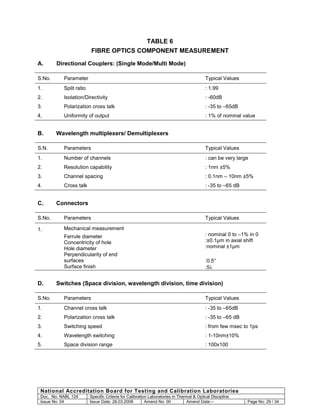
TABLE 6
FIBRE OPTICS COMPONENT MEASUREMENT
A.

Directional Couplers: (Single Mode/Multi Mode)

S.No.

Parameter

Typical Values

1.

Split ratio

: 1.99

2.

Isolation/Directivity

: -60dB

3.

Polarization cross talk

: -35 to –65dB

4,

Uniformity of output

: 1% of nominal value

B.

Wavelength multiplexers/ Demultiplexers

S.N.

Parameters

Typical Values

1.

Number of channels

: can be very large

2.

Resolution capability

: 1nm ±5%

3.

Channel spacing

: 0.1nm – 10nm ±5%

4.

Cross talk

: -35 to –65 dB

C.

Connectors

S.No.
1.

Parameters
Mechanical measurement
Ferrule diameter
Concentricity of hole
Hole diameter
Perpendicularity of end
surfaces
Surface finish

D.

Typical Values
: nominal 0 to –1% in 0
:±0.1µm in axial shift
:nominal ±1µm
:0.5°
:5λ

Switches (Space division, wavelength division, time division)

S.No.

Parameters

Typical Values

1.

Channel cross talk

: -35 to –65dB

2.

Polarization cross talk

: -35 to –65 dB

3.

Switching speed

: from few msec to 1ps

4.

Wavelength switching

: 1-10nm±10%

5.

Space division range

: 100x100

National Accreditation Board for Testing and Calibration Laboratories
Doc. No: NABL 124
Issue No: 04

Specific Criteria for Calibration Laboratories in Thermal & Optical Discipline
Issue Date: 28.03.2008
Amend No: 00
Amend Date:--

Page No: 29 / 34
TABLE 7
FIBRE OPTICS MEASUREMENTS – TEST PARAMETERS
S.No.

Parameters

Typical

1(a)

Geometrical Measurements
Core/clad diameters of
multimode (MM) and single
mode (SM) fibers
(50/125, 62.5/125, 85/125
100/140)

Core/clad dia
Resolution
Repeatability (2σ points) of
Clad dia
Clad ovality
Core dia
Coreovality
Concentricity
Coating dia
(250 µm ± 15 µm, 500µm ± 20µm)

upto 140 µm
:0.2 µm

Mode field diameter for SM
2
fibers (1/e points)
(5% above the base line)

Wavelength range
Mode field range
Repeatability (2σ points)
Clad dia
Clad ovality
Mode field dia
Mode field
Concentricity error
Coating dia
(250 µm ± 15 µm, 500 µm ± 20 µm)

: 600-1750 nm
: 4-10 µm

NA Range
Repeatability (2σ)

: 0.15-0.46
: 0.01

NA (n1 -n2 )½ for
SM fibers

2

NA Range
Repeatability (2σ)

: 0.1
: 0.01

3.

Refractive index profile

Index Range
Measurement at
Index Resolution
Spatial Resolution

: 1.4-1.7
: 632.8 nm (HeNe)
-4
: 1x10
:
<500 nm

4.

Effective cut off wavelength
(2m length for matched clad
fibers and 5m for depressed

Spectral Range
Resolution (λc)
Min. increment

: 600-1750nm
: 10nm
: 0.2nm

5.

Band width (Multi mode fibers)

Spectral Range
Bandwidth
Repeatability (2σ)

: 600-1750nm
: 100 KHz-5 GHz
: <5%

(b)

2.(a)

(b)

Numerical Aperture
(NA) for MM fibers
2

: 1 µm
: 1%
: 1 µm
: 2%
: 2µm
: ± 15 µm

: 1 µm
: 1%
: 0.5 µm
: nominal ± 10%
: ± 15 µm

National Accreditation Board for Testing and Calibration Laboratories
Doc. No: NABL 124
Issue No: 04

Specific Criteria for Calibration Laboratories in Thermal & Optical Discipline
Issue Date: 28.03.2008
Amend No: 00
Amend Date:--

Page No: 30 / 34
Annexure
SCOPE OF THERMAL AND OPTICAL MEASUREMENT
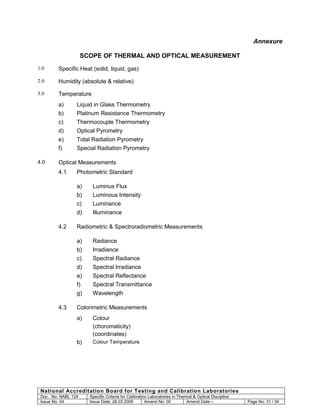
1.0

Specific Heat (solid, liquid, gas)

2.0

Humidity (absolute & relative)

3.0

Temperature
a)
b)
c)

Thermocouple Thermometry

d)

Optical Pyrometry

e)
f)
4.0

Liquid in Glass Thermometry
Platinum Resistance Thermometry

Total Radiation Pyrometry
Special Radiation Pyrometry

Optical Measurements
4.1

Photometric Standard
a)
b)
c)

Luminance

d)
4.2

Luminus Flux
Luminous Intensity
Illuminance

Radiometric & Spectroradiometric Measurements
a)
b)
c)

Irradiance
Spectral Radiance

d)

Spectral Irradiance

e)
f)

Spectral Reflectance
Spectral Transmittance

g)
4.3

Radiance

Wavelength

Colorimetric Measurements
a)

Colour
(choromaticity)
(coordinates)

b)

Colour Temperature

National Accreditation Board for Testing and Calibration Laboratories
Doc. No: NABL 124
Issue No: 04

Specific Criteria for Calibration Laboratories in Thermal & Optical Discipline
Issue Date: 28.03.2008
Amend No: 00
Amend Date:--

Page No: 31 / 34
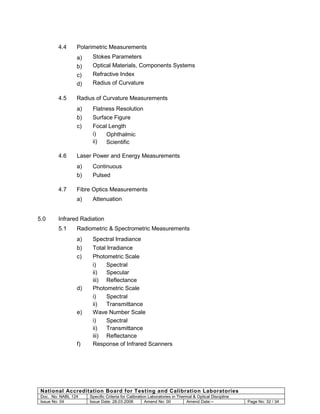
4.4

Polarimetric Measurements
a)
b)

Optical Materials, Components Systems

c)
d)
4.5

Stokes Parameters
Refractive Index
Radius of Curvature

Radius of Curvature Measurements
a)
b)

Surface Figure

c)

4.6

Flatness Resolution
Focal Length
i)
Ophthalmic
ii)
Scientific

Laser Power and Energy Measurements
a)
b)

4.7

Continuous
Pulsed

Fibre Optics Measurements
a)

5.0

Attenuation

Infrared Radiation
5.1

Radiometric & Spectrometric Measurements
a)

Spectral Irradiance

b)
c)

Total Irradiance
Photometric Scale
i)
Spectral
ii)
Specular
iii) Reflectance
Photometric Scale
i)
Spectral
ii)
Transmittance
Wave Number Scale
i)
Spectral
ii)
Transmittance
iii) Reflectance
Response of Infrared Scanners

d)

e)

f)

National Accreditation Board for Testing and Calibration Laboratories
Doc. No: NABL 124
Issue No: 04

Specific Criteria for Calibration Laboratories in Thermal & Optical Discipline
Issue Date: 28.03.2008
Amend No: 00
Amend Date:--

Page No: 32 / 34
6.0

Fibre Optics Measurements (for Silica-based Fibre)
6.1
6.2

Spectral Attenuation

6.3

Insertion Loss

6.4

Chromatic Dispersion

6.5

Back Scatter Measurements (SM and MM Fibres)

6.6

Dopants Concentration

6.7

Birefringence

6.8

Tensile Strength

6.9
7.0

Refractive Index (core and clad)

Bend Radius

Measurements on Fibre Optics Components
7.1

Directional Couplers (Single Mode/Multimode)
a)
b)
c)

Polarization Cross Talk

d)
7.2

Split Ratio
Solation/Directivity
Uniformity of Output

Wavelength Multiplexers/Demultiplexers
a)
b)

Resolution Capability

c)

Channel Spacing

d)
7.3

Number of Channels

Cross Talk

Connectors
a)

Mechanical Measurement

b)
c)

Ferrule Diameters
Concentricity of Hole

d)

Hole Diameter

e)

Perpendicularity of End

f)
g)

Surfaces
Surface Finish

National Accreditation Board for Testing and Calibration Laboratories
Doc. No: NABL 124
Issue No: 04

Specific Criteria for Calibration Laboratories in Thermal & Optical Discipline
Issue Date: 28.03.2008
Amend No: 00
Amend Date:--

Page No: 33 / 34
7.4

Switches (Space Division, Wavelength Division, Time Division)
a)
b)

Polarization Cross Talk

c)
d)

Switching Speed
Wavelength Switching

e)
8.0

Channel Cross Talk

Space Division Range

Test Parameters Fibre Optics Measurements
a)

Geometrical Measurements: Core/clad dismeters of multimode (MM) and single
mode (SM) fibres (50/125, 62.5/125, 85/125, 100/140)

b)
c)

Mode Field Diameter for SM Fibre (I/e2 points) (5% above the base line)
Numerical Aperture for MM Fibres

d)

Numerical Aperture for SM Fibers

e)

Refractive Index Profile

f)
g)

Effective Cut off Wavelength
Band Width (Multimode fibres)

8.1

Calibrated Detector
a)

Wavelength Responsibility

b)
c)

Responsivity PIN, ADD
Noise Equivalent Power (NEP)

d)

Directivity Pattern

e)

Bandwidth

f)

Rise Time

National Accreditation Board for Testing and Calibration Laboratories
Doc. No: NABL 124
Issue No: 04

Specific Criteria for Calibration Laboratories in Thermal & Optical Discipline
Issue Date: 28.03.2008
Amend No: 00
Amend Date:--

Page No: 34 / 34
National Accreditation Board for Testing and Calibration Laboratories
3rd Floor, NISCAIR
14, Satsang Vihar Marg
New Mehrauli Road
New Delhi – 110 067
Tel.: 91-11 26529718 – 20, 26526864
Fax: 91-11 26529716
Website: www.nabl-india.org

NABL 124 Thermal

  • 1.
    NABL 124 NABL NATIONAL ACCREDITATION BOARDFOR TESTING AND CALIBRATION LABORATORIES SPECIFIC CRITERIA for CALIBRATION LABORATORIES IN THERMAL & OPTICAL DISCIPLINE ISSUE NO : 04 ISSUE DATE: 28.03.2008 AMENDMENT NO : 01 AMENDMENT DATE: 27.06.2012
  • 2.
    AMENDMENT SHEET Sl Page No. Clause No. 1 5,17 1,Gen. Remarks Date of Amendment 27.06.2012 Amendment made BMC changed to CMC Reasons Signature QO Signature Director Adoption of ILAC Policy 2 3 4 5 6 7 8 9 10 National Accreditation Board for Testing and Calibration Laboratories Doc. No: NABL 124 Issue No: 04 Specific Criteria for Calibration Laboratories in Thermal & Optical Discipline Issue Date: 28.03.2008 Amend No: 01 Amend Date: 27.06.2012 Page No: 1 / 34
  • 3.
    PREFACE This document clarifiesNABL’s stand on the accuracy and measurement capability levels. NABL intends to uphold its policy of granting accreditation to laboratories as per their requirements of accuracy and measurement capability. These criteria are applicable to laboratories, which perform repetitive calibrations in various parameters and desire accreditation from NABL. These criteria provide guidelines for use by laboratories and those who are associated with the program of accreditation of calibration laboratories e.g. experts, assessors, officials engaged with day-to-day activities of accreditation. These criteria cover all areas/ fields of calibration. This document provides the laboratories with necessary information on the requirements for assessment/ surveillance and to assist them in carrying out internal audit of their system. The information in this document has been compiled in three parts. PART – I General Guidelines for Accreditation of Calibration Laboratories This part contains relevant information on general requirements of a laboratory engaged in Calibration in the field of Thermal & Optical Measurements. The laboratory seeking accreditation must comply with the requirements of ISO/ IEC 17025: 2005 and this document. PART – II Specific Criteria for Accreditation of Calibration Laboratories This part provides information on special requirements of the laboratories, which are specific to the parameters covered in the respective fields PART – III Guidelines Regarding Accuracy of Standards & Measurement Uncertainty in Calibration This part contains guidelines of the Specified accuracies of measurement standard and uncertainties of measurement generally achieved in laboratories using equipment and instruments of different classes of accuracies/ uncertainties for different parameters under Thermal & Optical measurements. National Accreditation Board for Testing and Calibration Laboratories Doc. No: NABL 124 Issue No: 04 Specific Criteria for Calibration Laboratories in Thermal & Optical Discipline Issue Date: 28.03.2008 Amend No: 00 Amend Date: -- Page No: 2 / 34
  • 4.
    CONTENTS Sl. Title Page No. Amendment Sheet 1 Preface 2 Contents 3 PART– I 1. Scope 5 2. Criteria for Accreditation 6 3. Organisation 6 4. Management System 7 5. Personnel 8 6. Accommodation and Environmental Conditions 9 7. Equipment 10 8. Range, Uncertainty of Measurement and Traceability 11 9. Calibration Certificate/ Report 11 10. Proficiency Testing Program 12 PART – II 1. Scope 13 2. Range and Uncertainty of Measurement 13 3. Environmental Conditions 13 4. Special Requirements of Laboratory 14 5. Repair and Maintenance 15 6. Storage and Packaging 15 7. Safety Precautions 16 National Accreditation Board for Testing and Calibration Laboratories Doc. No: NABL 124 Issue No: 04 Specific Criteria for Calibration Laboratories in Thermal & Optical Discipline Issue Date: 28.03.2008 Amend No: 00 Amend Date: -- Page No: 3 / 34
  • 5.
    Sl. Table Page No. PART -III General Remarks and Environmental Conditions 17 1. Specific Heat and Humidity Measurements 18 2. Temperature Measurements 19 3. Optical Measurements 21 4. Infrared Radiation Measurement 25 5. Fiber Optics Measurement (For Silica Based Fibers) 27 6. Fiber Optics Components Measurement 29 7. Fiber Optics Measurements – Test Parameters 30 Annexure – Scope of Thermal & Optical Measurement 31 National Accreditation Board for Testing and Calibration Laboratories Doc. No: NABL 124 Issue No: 04 Specific Criteria for Calibration Laboratories in Thermal & Optical Discipline Issue Date: 28.03.2008 Amend No: 00 Amend Date: -- Page No: 4 / 34
  • 6.
    PART – I GENERALGUIDELINES FOR ACCREDITATION OF CALIBRATION LABORATORIES
  • 7.
    1.0 SCOPE 1.1 Calibration laboratories areaccredited by NABL after it is demonstrated that a laboratory complies with the requirements of international standard ISO/IEC 17025: 2005. In view of generic nature of the standard the requirements stated there in, need to be further redefined in specific fields of calibration. This specific criteria lays down those specific requirements in the field of mechanical calibration. This part of the document thus amplifies the generic requirements for mechanical calibration and supplement the requirements of ISO/IEC 17025:2005. Laboratories seeking NABL accreditation in the field of mechanical calibration must also comply with the requirements stated in this part. 1.2 Calibration and Measurement Capability (CMC) is one the parameters that is used by NABL to define the scope of an accredited calibration laboratory, the others being parameter/quantity measured, standard/master used, calibration method used and measurement range. The CMC is expressed as "the smallest uncertainty that a laboratory can achieve when calibrating the best existing device ". It is an expanded uncertainty estimated at a confidence level of approximately 95% corresponding to a coverage factor k=2. Note: Refer NABL 143 on NABL policy on Calibration and Measurement Capability (CMC) and uncertainty in calibration The laboratory’s ability to achieve their claimed CMC shall be evaluated based on its performance during the on-site assessment and by review of proficiency testing results, wherein the laboratory has participated. 1.3 The definition of CMC implies that within its accreditation a laboratory is not permitted to report a smaller uncertainty of measurement than the CMC endorsed on its scope of accreditation. This means that the laboratory shall be required to state a uncertainty not better than that corresponding to the CMC whenever it is established that the actual calibration process adds significantly to the uncertainty of measurement. The CMC is applicable only to the results for which the laboratory claims its status as accredited laboratory. It is therefore a realistic means for customers to select and compare accredited laboratories’ capabilities. 1.4 All the parameters for which accreditation is sought must be expressed in S.I. Units, wherever applicable. National Accreditation Board for Testing and Calibration Laboratories Doc. No: NABL 124 Issue No: 04 Specific Criteria for Calibration Laboratories in Thermal & Optical Discipline Issue Date: 28.03.2008 Amend No: 01 Amend Date:27.06.2012 Page No: 5 / 34
  • 8.
    2.0 CRITERIA FOR ACCREDITATION 2.1 Accreditationof a calibration laboratory will require assessment in respect of organization, staff, equipment and traceability of its calibration, laboratory accommodation and environmental conditions, safety, handling of calibrated equipment and equipment under calibration, measurement capability and recording system, etc., as per ISO/ IEC 17025: 2005 General Requirements for the Competence of Testing and Calibration Laboratories. Some explanatory notes of this document are given in the following clauses. 3.0 ORGANISATION 3.1 The Calibration Laboratory shall be organized in such a way that all staff members are aware of both the extent and the limitations of their area of responsibility. This organization shall specify and document the responsibility and authority of the Head of the Calibration Laboratory/Technical Manager/Quality Manager with direct access to the top management. All personnel will perform or verify work affecting the quality of calibrations as per general guidelines and specific criteria laid down for the accredited parameters. The calibration laboratory shall be organized in such a way so as to ensure the integrity and training of its staff and operations for ensuring unbiased Calibration. 3.2 A Deputy Head/Technical Manager may also be nominated to take over the responsibility in the absence of the Laboratory Head. In case there is no Deputy-incharge, the authorities concerned may appoint a suitable person to look after the laboratory, under intimation to NABL. The laboratory shall also clearly define authorized signatory for the calibration certificates/reports issued by the laboratory. National Accreditation Board for Testing and Calibration Laboratories Doc. No: NABL 124 Issue No: 04 Specific Criteria for Calibration Laboratories in Thermal & Optical Discipline Issue Date: 28.03.2008 Amend No: 00 Amend Date:-- Page No: 6 / 34
  • 9.
    4.0 MANAGEMENT SYSTEM 4.1 The calibrationlaboratory shall have a Quality Manual which shall be maintained up-todate and available for scrutiny, in compliance with ISO/ IEC 17025: 2005 and NABL requirements, with emphasis on following information: a) A quality policy statement, including objectives and commitments by the top management. b) A statement on the organization of the calibration laboratory. c) Names, qualifications and experience of the persons responsible for managerial, and scientific/technical activities. d) A clearly defined charter of responsibility showing the relationship between management and support services. e) Scope and operation together with information on measurement capability and traceability of calibration of all measuring instruments to national measurement standards. f) The reference of document number on detailed calibration procedures adopted in the laboratory, which should be compiled in the form of a manual for the use of calibration staff. g) The reference list of all national/international standards being referred to or used in the performance of calibration work (copies of such standard specifications should be available in the laboratory for the use of calibration staff.) h) All amendments made in any of the documents must be dated and listed in the Quality Manual and brought to the notice of NABL. 4.2 The calibration facilities established in accordance with the general guidelines and specific criteria shall be audited periodically and reviewed by or on behalf of the management to ensure the continued effectiveness of the system. National Accreditation Board for Testing and Calibration Laboratories Doc. No: NABL 124 Issue No: 04 Specific Criteria for Calibration Laboratories in Thermal & Optical Discipline Issue Date: 28.03.2008 Amend No: 00 Amend Date:-- Page No: 7 / 34
  • 10.
    4.3 The calibration laboratoryshall clearly specify, document and make known to the customers, the administrative and other procedures to be followed for getting calibration done from the laboratory. The procedure for redressal of technical complaints should also be clearly specified and documented. 4.4 The laboratory shall have authorized signatories for approving and issuing calibration certificates for each calibration parameter as mentioned in the scope of accreditation. Any officer competent to evaluate calibration results critically and occupying a position involving responsibility for the adequacy of calibration results is eligible for approval by NABL as an authorized signatory of endorsed calibration documents. Consequently approved authorized signatories must demonstrate understanding of these requirements. 5.0 PERSONNEL 5.1 The calibration laboratory shall have adequate number of qualified competent and trained personnel as follows: Laboratory personnel performing calibration: Diploma in Engineering (relevant branch) or Science graduate (with Physics) with 1 year of relevant experience or ITI with at least 5 years of relevant experience. Authorized Signatory: Bachelor of Engineering/Post Graduate in Science (relevant branch) with 1 year of experience in the field of Thermal/ Optical Measurements and calibration practices in the relevant parameters or Diploma in Engineering (relevant branch) with minimum 3 years of experience in the field of Thermal/ Optical Measurements and calibration practices. 5.2 Arrangements for improvement of qualifications and periodic refresher courses and practical training should also exist for the staff so as to keep them in touch with latest developments in the relevant fields. National Accreditation Board for Testing and Calibration Laboratories Doc. No: NABL 124 Issue No: 04 Specific Criteria for Calibration Laboratories in Thermal & Optical Discipline Issue Date: 28.03.2008 Amend No: 00 Amend Date:-- Page No: 8 / 34
  • 11.
    5.3 The Head ofthe calibration laboratory shall be at least a Post Graduate in Physical Science or Graduate in Electrical/ Electronics/ Instrumentation Engineering or equivalent with specialised knowledge and adequate experience in precision Thermal/ Optical and other relevant parameter measurements. In exceptional cases, a graduate in physics or diploma holder in Electrical or Electronics Engineering with long experience could be accepted. 6.0 ACCOMMODATION AND ENVIRONMENTAL CONDITIONS 6.1 Vibrations The calibration area shall be adequately free from vibrations generated by central airconditioning plants, vehicular traffic and other sources to ensure consistent and uniform operational conditions. The laboratory shall take all special/protective precautions like mounting of sensitive apparatus on vibration free tables and pillars etc., isolated from the floor, if necessary. 6.2 Acoustic Noise Acoustic noise level in the laboratory shall be maintained to facilitate proper performance of calibration work. A threshold noise level of 60 dBA is recommended unless otherwise stated. 6.3 Illumination The calibration area shall have adequate level of illumination. Where permissible, fluorescent lighting is preferred to avoid localized heating and temperature drift. The recommended level of illumination is 450-700 lux on the working table with glare index of 19 for the laboratory. 6.4 Environmental Conditions and Monitoring The environmental conditions for the activity of the laboratory shall be such as not to adversely affect the required accuracy of measurement. Facilities should be provided whenever necessary for recording temperature, pressure and humidity values prevailing during calibration. The atmospheric conditions maintained in the laboratory during calibration should be reported in the calibration report/certificate. National Accreditation Board for Testing and Calibration Laboratories Doc. No: NABL 124 Issue No: 04 Specific Criteria for Calibration Laboratories in Thermal & Optical Discipline Issue Date: 28.03.2008 Amend No: 00 Amend Date:-- Page No: 9 / 34
  • 12.
    6.5 Entry to theCalibration Area As far as possible, only the staff engaged in the calibration activity shall be permitted entry inside the calibration area. 7.0 EQUIPMENT Each calibration laboratory should have measurement standards or equipment of required accuracy in respect of each parameter covered by it in order to be able to realize and to substantiate the corresponding measurement capability claimed. Stability of the standards, accuracy of the values realized through them and repeatability, should be regularly monitored. Any bias resulting from ageing of standards should be precisely determined. Instructions for operating each standard and equipment/instrument should be readily available for use by the laboratory staff members. 7.2 The standards/measuring equipment of the laboratory should be calibrated at regular intervals, with higher accuracy standards. The calibration certificates, performance history sheets in respect of the reference secondary/working standards and measuring equipment should be held safely by the laboratory. 7.3 Proper record shall be maintained for each standard and equipment with the following information: a) b) Manufacturers name and address c) Type, range, identification and serial number d) Date of procurement and commissioning e) Details of Calibration f) Details of maintenance and repairs g) Performance history with dates h) 7.4 Name of the equipment Availability of service manual Details of periodic calibration schedule of new and old standards and measuring equipment should be worked out in consultation with higher accuracy laboratory and this schedule should be observed. National Accreditation Board for Testing and Calibration Laboratories Doc. No: NABL 124 Issue No: 04 Specific Criteria for Calibration Laboratories in Thermal & Optical Discipline Issue Date: 28.03.2008 Amend No: 00 Amend Date:-- Page No: 10 / 34
  • 13.
    7.5 Details of re-calibrationof used, serviced and repaired equipment should also be available and proper precautions shall be observed to identify equipment, which are not in service. 7.6 Any alterations in the observations/data shall be signed by the calibration staff and duly authenticated. Instructions to this effect should be printed on data sheet used for writing observations/data in the laboratory. 8.0 RANGE, UNCERTAINTY OF MEASUREMENT AND TRACEABILITY 8.1 The level of uncertainty of measurement of the standards to be maintained by a laboratory and the measurement capabilities to be generated by it in respect of various parameters shall be as demonstrated during assessment. 8.2 All the Standard Equipment of the Laboratory shall be calibrated periodically against Calibration Standards of a laboratory accredited by NABL/ equivalent MRA partners having superior measurement capability or NPL/ other international NMIs. 8.3 In the event when the levels of uncertainty of measurement and measurement capability of an accredited laboratory are revised, the laboratory shall be required to intimate NABL secretariat and undergo surveillance / reassessment as applicable. 9.0 CALIBRATION CERTIFICATE/REPORT 9.1 The result of calibration carried out by the calibration laboratory, shall be presented in a comprehensive manner, using a standard format which shall unambiguously and objectively present the measurement results and all relevant information in order to facilitate easy comprehension and usage. 9.2 The calibration report/certificate shall include the following additional information: a) Date of receipt of the item and date of completion of the calibration work b) Environmental conditions maintained during the measurements c) Signature and title of authorized person (authorized signatory) accepting responsibility for the report and date of issue National Accreditation Board for Testing and Calibration Laboratories Doc. No: NABL 124 Issue No: 04 Specific Criteria for Calibration Laboratories in Thermal & Optical Discipline Issue Date: 28.03.2008 Amend No: 00 Amend Date:-- Page No: 11 / 34
  • 14.
    d) A statement ofthe accreditation measurement capability relevant to the job under calibration e) A symbol of NABL or statement or both clarifying the status of accreditation of the laboratory. f) The Uncertainty of measurement g) An evidence that the measurements are traceable to National/ International Standards through unbroken chain of Accredited Laboratories. 9.3 The calibration report/ certificate shall not contain any recommendation on the calibration interval except where this has been agreed with the client. This requirement may be superseded by legal regulations. 10.0 PROFICIENCY TESTING PROGRAM 10.1 To give further assurance to the accuracy or Uncertainty of measurements, a laboratory will be required to participate, from time to time, in Proficiency Testing Programs. The laboratory shall remain prepared to participate in the Proficiency Testing Program through inter-laboratory, inter-comparison schemes wherever it is technically feasible. In case any abnormalities, in terms of En number are detected through these inter-comparisons, appropriate corrective action will be taken, the standards/equipment shall be replaced/ repaired and re-calibrated with a higher accuracy standard. Reports on such inter-comparisons should be documented with reference. The Proficiency Testing practice should be included in the Quality Manual. National Accreditation Board for Testing and Calibration Laboratories Doc. No: NABL 124 Issue No: 04 Specific Criteria for Calibration Laboratories in Thermal & Optical Discipline Issue Date: 28.03.2008 Amend No: 00 Amend Date:-- Page No: 12 / 34
  • 15.
    PART- II SPECIFIC CRITERIAFOR ACCREDITATION OF CALIBRATION LABORATORIES IN THE FIELD OF THERMAL & OPTICAL MEASUREMENTS
  • 16.
    1.0 SCOPE 1.1 An accredited laboratoryshall be classified as calibration laboratory for the accredited parameters in the field of Thermal & Optical Measurements in accordance with its measurement capability. 1.2 A calibration laboratory seeking accreditation to offer calibration services in the field of Thermal & Optical measurements will generally carry out calibration in the following areas: a) b) Humidity c) Temperature D) Optical parameters e) Infrared f) Radiation Measurements g) 1.3 Specific Heat Fibre Optics Measurements The accredited calibration laboratory will be mainly concerned with the measurement of one or more of the parameters shown in the annexure. 2.0 RANGE AND UNCERTAINTY OF MEASUREMENT 2.1 A calibration laboratory will be accredited according to its Measurement capability expressed in terms of uncertainty. 3.0 ENVIRONMENTAL CONDITIONS 3.1 The laboratory shall specify limits on the environmental conditions to be achieved in the laboratory. The condition shall appropriate to the level of accuracy required for the calibration undertaken by the laboratory. The environmental conditions shall be monitored at appropriate intervals and calibrations stopped when environmental conditions fall outside the specified limits. National Accreditation Board for Testing and Calibration Laboratories Doc. No: NABL 124 Issue No: 04 Specific Criteria for Calibration Laboratories in Thermal & Optical Discipline Issue Date: 28.03.2008 Amend No: 00 Amend Date:-- Page No: 13 / 34
  • 17.
    4.0 SPECIAL REQUIREMENTS OFLABORATORY 4.1 The calibration laboratory shall make arrangements for regulated and uninterrupted power supply. The recommended regulation level is ±1% or better on the calibration bench. 4.2 Relevant IS specification (IS:1248, IS: 4722) regarding total harmonic content and variation in supply frequency should be followed. Voltage stabilizers of low harmonic content should be used to comply with this requirement. 4.3 Adequate arrangement shall be made by the laboratory so as to ensure temperature gradient not exceeding 1.5 °C per hour inside the laboratory in case of power failure. 4.4 The laboratory shall use if necessary, isolation transformers and filters etc. to ensure minimisation of ground current and effects of mains hum interference 4.5 The power supply to the calibration laboratory shall be directly obtained from the substation as far as possible and shall not be on the same feeder line which is supplying power to workshops and other production areas which require operation of heavy duty machines. 4.6 Effective mains earthing shall be provided in accordance with relevant specification IS:3043. This shall be checked periodically and stray couplings minimised. 4.7 Special care shall be taken about the location of magnetic field sources like transformers, looped wires, ferrous materials etc. in order to minimise magnetic interference in the measurements. 4.8 Adequate screening of the laboratory against electro-magnetic interference shall be done if necessary. By pass filters should also be provided to minimise conducted interference effect on the electronic equipment. Special shielding chambers should be provided in the laboratory for measurements, particularly when signal noise ratio is a disturbing factor for accurate measurements. National Accreditation Board for Testing and Calibration Laboratories Doc. No: NABL 124 Issue No: 04 Specific Criteria for Calibration Laboratories in Thermal & Optical Discipline Issue Date: 28.03.2008 Amend No: 00 Amend Date:-- Page No: 14 / 34
  • 18.
    4.9 The reference standardsshall be maintained at temperatures specified for their maintenance in order to ensure their conformance to the required level of operation and traceability. The laboratory should have specific facilities required for carrying out the calibrations of parameters chosen. 4.10 The laboratory shall be sealed against dust and external air pressure. Positive air pressure shall be maintained inside the laboratory 4.11 Adequate protective measures, like use of transient suppressors etc., shall be taken by the laboratory to ward off high current spikes and transients emanating from switching on and off, of the heavy machines, surges in power lines and other such reasons, from reaching the electronic equipment in general and computer based systems involving data storage facilities in particular. 4.12 For temperature control enclosures the laboratory shall check temperature variation in working space using different reference thermocouples (at least five points temperature probe), at the same time, for arriving at spatial variation. 5.0 REPAIR & MAINTAINENCE 5.1 A separate repair and maintenance facility, adequately equipped with repair facilities and qualified and experienced manpower, shall be available in house or by any other means effectively accessible to the calibration laboratory. This facility shall also assist in identifying the preventive maintenance procedures which should brought to the attention of the personnel engaged in calibration work for taking necessary precautions. The repair facility should cover digital and programmable instruments also. 5.2 Every repaired equipment shall invariably be recalibrated through in-house facility or by higher accuracy laboratory before being used for further calibration work. 6.0 STORAGE & PACKAGING 6.1 The standard/measuring instruments/equipment received by the laboratory for calibration shall be safely in proper environmental conditions according to the instructions given by the supplier. National Accreditation Board for Testing and Calibration Laboratories Doc. No: NABL 124 Issue No: 04 Specific Criteria for Calibration Laboratories in Thermal & Optical Discipline Issue Date: 28.03.2008 Amend No: 00 Amend Date:-- Page No: 15 / 34
  • 19.
    6.2 The laboratory shallhave adequate arrangements for packaging of calibrated instruments and may assist the user, if necessary, about the procedure and precautions to be taken by the organisation for packaging and transportation of the equipment to the calibration laboratory and back. 7.0 SAFETY PRECAUTIONS 7.1 Relevant fire extinguishing equipment for possible fire hazards, should be available in the corridors or as convenient to the laboratory. Adequate safety measures against electrical, chemical fire hazards must be available at the workplace. Laboratory rooms/areas where highly inflammable materials are used/stored should be identified. Access to the relevant fire equipment should be assured near these rooms/areas. 7.2 Specification SP.31-1986, a special publication in the form of a wall chart, giving the method of treatment in case of electric shock, should be followed. The chart should be placed near the power supply switchgear and at other prominent places as prescribed under Indian Electricity Rules 1956. National Accreditation Board for Testing and Calibration Laboratories Doc. No: NABL 124 Issue No: 04 Specific Criteria for Calibration Laboratories in Thermal & Optical Discipline Issue Date: 28.03.2008 Amend No: 00 Amend Date:-- Page No: 16 / 34
  • 20.
    PART III GUIDELINES REGARDINGACCURACY OF STANDARDS & MEASUREMENTS UNCERTAINTY IN CALIBRATION FOR THERMAL & OPTICAL MEASUREMENTS
  • 21.
    GENERAL REMARKS The followingpages may be referred as guidelines and not mandatory recommendations for the laboratories. The accredited calibration laboratories are no longer required to be categorized into Echelon/ level I, II, III. Part III of this document is aimed to provide guidance to the laboratories regarding the precautions they should take with respect to Environmental conditions as appropriate to respective Calibration and Measurement Capability of the laboratories. The laboratories, on their own, should decide/ determine to have environmental conditions in their premises, for the Calibration and measurement capability claimed corresponding to their scope of accreditation applied for. Further to note that: 1) The measurement capability is expressed as uncertainty (±) at a confidence probability level of 95%. 2) The term Uncertainty in these tables pertains to the corresponding measurement capability of the laboratory in respect of each parameter. 3) The values of Accuracy/Uncertainty of measurement shown in the following tables are at 95% CL unless stated otherwise. ENVIRONMENTAL CONDITIONS Standards atmospheric conditions for calibration in a Thermal & Optical Measurements Laboratory shall be as follows: Level Temperature Relative humidity I II III 250C ± 0.50C 250C ± 2.50C 250C ± 4.00C 35 - 65% 35 - 65% not to exceed 70% National Accreditation Board for Testing and Calibration Laboratories Doc. No: NABL 124 Issue No: 04 Specific Criteria for Calibration Laboratories in Thermal & Optical Discipline Issue Date: 28.03.2008 Amend No: 01 Amend Date:27.06.2012 Page No: 17 / 34
  • 22.
    TABLE 1 SPECIFIC HEATAND HUMIDITY MEASUREMENTS (a) Accuracy of Reference Standards of Specific Heat and Humidity Measurements MEASUREMENT RANGE PARAMETER ACCURACY% LEVEL-I LEVEL-II LEVEL-III SPECIFIC HEAT SOLID -75 to 100°C To be worked out later 0.3 0.5 LIQUID -75 to 100°C To be worked out later 0.3 0.5 GAS -- To be worked out later 1.5 2.1 INSULATING MATERIAL 0 to 50°C To be worked out later 1.8 2.3 0 to 100% 0 to 100% 0.1 To be worked out later To be worked out later 0.5 1.6 HUMIDITY ABSOLUTE RELATIVE (b) Uncertainty in Specific Heat and Humidity Measurements MEASUREMENT PARAMETER RANGE UNCERTAINTY% LEVEL-I Level-II Level-III SPECIFIC HEAT SOLID -75 to 100°C To be worked out later 0.4 1.2 LIQUID -75 to 100°C To be worked out later 0.4 1.2 GAS -75 to 100°C To be worked out later 1.9 3.0 INSULTING MATERIAL 0 to 50°C To be worked out later 2.1 3.0 ABSOLUTE 0 to 100% 0.25 To be worked out later To be worked out later RELATIVE 0 to 100% To be worked out later To be worked out later HUMIDITY National Accreditation Board for Testing and Calibration Laboratories Doc. No: NABL 124 Issue No: 04 Specific Criteria for Calibration Laboratories in Thermal & Optical Discipline Issue Date: 28.03.2008 Amend No: 00 Amend Date:-- Page No: 18 / 34
  • 23.
    TABLE 2 TEMPERATURE MEASUREMENTS (a)Accuracy (In 0c) of Reference Standards of Temperature Measurements Type of Thermometer Level-I Range Level-II Accuracy Range Level-III Accuracy Liquid in Glass 193K300°C 0.02 to 0.05 193K to 0°C 0.1 0 to 300°C 0.04 to 0.1 Platinum Resistance Thermometer 13.81 to 630.75°C 0.5x10 to -3 30.5x10 Thermocouple -3 -3 Range Accuracy 0 to 300°C 0.06 to 0.1 193K to 630°C 0.9x10 to -3 32x10 -- -- 0 to 630°C, 0.25 630 to to 1554°C 0.7 0 to 1100°C 1100 to 1500°C 0.45 to 1.1 0 to 1100°C 1.0 i) Total radiation pyrometry 50-2000°C 0.25-2.5 50-2000°C 0.4-5.0 -- -- ii) Spectral radiation pyrometry 9602100°C, 21003000°C 0.25-2.5 9602100°C, 21003000°C 0.4-5.0 -- -- (Pt-10%, Rh Pt) Pyrometry 2.5-5.0 5.0-9.0 National Accreditation Board for Testing and Calibration Laboratories Doc. No: NABL 124 Issue No: 04 Specific Criteria for Calibration Laboratories in Thermal & Optical Discipline Issue Date: 28.03.2008 Amend No: 00 Amend Date:-- Page No: 19 / 34
  • 24.
    (b) Uncertainty (In0c) in Temperature Measurements Type of Thermometer Level-I Level-II Level-III Range Uncertainty Range Uncertainty Range Uncertainty 193K300°C 0.02-0.05 193K to 0°C 0 to 300°C 0.15 0.05 0 to 300°C 0.15 to 0.3 PLATINUM RESISTANCE THERMOMETER 13.81 K to 630.75°C 0.7x10 to -3 31x 10 193K to 630°C 11x10 to -3 60x10 -- -- THERMOCOUPLE (PT-10%, RH PT) 0 to 630°C, 0.35 to 0.9 0 to 1100°C, 0.7 to 1.5 0 to 1100°C 1.5 LIQUID IN GLASS -3 -3 630 to 1554°C 0.35 to 0.9 1100 to 1500°C 0.7 to 1.5 I) TOTAL RADIATION PYROMETRY 50-2000°C 0.25-3.0 50-2000°C 0.7-8.0 II) SPECTRAL RADIATION PYROMETRY 9602100°C 0.25-3.0 960-2100 C 21003000°C 3.0-7.0 2100-3000 C 8-12 PYROMETRY 0 0.7-8.0 0 National Accreditation Board for Testing and Calibration Laboratories Doc. No: NABL 124 Issue No: 04 Specific Criteria for Calibration Laboratories in Thermal & Optical Discipline Issue Date: 28.03.2008 Amend No: 00 Amend Date:-- Page No: 20 / 34
  • 25.
    TABLE 3 OPTICAL MEASUREMENTS (a)Accuracy of Reference Standards of Optical Measurements Measurement Parameter Range Accuracy% Level-I Level-II Level-III 1.5-2.5 1.7-2.2 2.3-2.7 1.0 to 2.0 1.7 to 2.2 2.3 to 2.7 2 2.25 2.7 2 2.25 2.7 Photometric standards* LUMINOUS FLUX 1 to >105lm LUMINOUS INTENSITY -4 -4 10 to > 10 cd 4 LUMINANCE 1 to > 10 cd/cm 2 -4 ILLUMINANCE 10 to <100 lux Radiometric & Spectroradiometric Standards REDIANCE AND 300-400nm 4-3 4.5-3.5 IRRADIANCE 400-1000 nm 3-2.5 3.5-3 300-400 nm 4-3 4.5-3.5 400-2500 nm 3-7 3.5-8 SPECTRAL REFLECTANCE AND 300 to 400 nm SPECTRAL TRANSMITTANCE 300 to 2000 nm 2.0% 2.2% 2.7% 1.0% 1.5% 2.0% WAVELENGTH 100 to 2500 nm As per standards spectral Source COLOUR (CHROMATICITY) (COORDINATES) Standard x=0.001 x-0.003 To be worked out later D64 y-0.001 y-0.003 To be worked out later COLOUR TEMPERATURE 1800-3400K 10K-15K 11 to 16K 13-20 3.0% 3.8% 4.8% (nominal) -5 2 (5x10 -0.5W/cm ) SPECTRAL RADIANCE AND SPECTRAL IRRADIANCE (Distribution temp. 2500 K) COLORIMETRIC STANDARDS Illuminant POLARIMETRIC STANDARD Stokes Parameters OPTICAL MATERIALS, COMPONENTS SYSTEMS * Temperative frequency, voltage and wave form requirements as per IEC/CIE recommendations. Contd. National Accreditation Board for Testing and Calibration Laboratories Doc. No: NABL 124 Issue No: 04 Specific Criteria for Calibration Laboratories in Thermal & Optical Discipline Issue Date: 28.03.2008 Amend No: 00 Amend Date:-- Page No: 21 / 34
  • 26.
    Table 3(a) –contd. -6 -6 -4 REFRACTIVE INDEX* 300 to 2500nm 1x10 2x10 2.2x10 RADIUS OF ** 0.5 to 5nm 1.0µm 3.0µm 5µm 5 to 200mm 2 to 3µm 20µm 100µm 200 to 5000mm 100 µm 500µm 2mm 5 to 20 meters 5mm 10mm 15mm FLATNESS upto 300mm dia λ/200 λ/50 λ/10 SURFACE FIGURE -do- λ/50 λ/30 λ/5 CURVATURE RADIUS OF CURVATURE RESOLUTION As per Standard Chart Given At P-30, 31 FOCAL LENGTH -25 θ to +25D (I) OPTHALMIC LENS (II) SCIENTIFIC LENS To be worked out later -0.1D -0.2D +0.1D +0.2D 1mm-1000mm 5µm 20µm 100µm* 1m-20m 10µm 100µm 2mm Upto 10W 3.0% 3.8% To be worked out later Upto 1000W 3.0% 4.8% To be worked out later Upto 10J 10.0% 10.7% To be worked out later 1.5% 2.7% 4.0% LASER POWER AND ENERGY (I) CONTINUOUS (II) PULSED (300 to 1064nm) (Mode Locked, Q-Switched and Free Running) FIBRE OPTICS ATTENUATION*** * Temperature control to ±0.1°C at STP at Level 1 ** Temperature +0.5 at the working bench *** Temperative +0.1° + Vibration isolation for Level-I ±0.25 + -do- for Level-II Normal + -do- for Level-III National Accreditation Board for Testing and Calibration Laboratories Doc. No: NABL 124 Issue No: 04 Specific Criteria for Calibration Laboratories in Thermal & Optical Discipline Issue Date: 28.03.2008 Amend No: 00 Amend Date:-- Page No: 22 / 34
  • 27.
    (b) Uncertainty (%)in Optical Measurements MEASUREMENT PARAMETER UNCERTAINTY% Range Level-I Level-II Level-III 1.6-2.25 2-2.5 2.8-3.4 1.6-2.25 2-2.5 2.8-3.4 2.25 2.7 3.5 2.25 2.7 3.5 Photometric Standards 5 Luminous Flux 1 to >10 lm Luminous Intensity -4 4 1 to > 10 cd 4 1 to > 10 cd/cm Luminance -4 Illuminance 10 to >100 lux Radiometric and Spectroradiometric Standards 300 to 400nm 4.25-3.25 5-6 - 400 to 1000nm (nominal) 3.25-2.75 4-3 - 300 to 400nm 4.25-3.25 5-4 - 400 to 2500nm (Distribution temp. 2500K) 3.25-7.25 4.75 - Spectral Reflectance 300 to 400nm and Spectral Transmitance 400 to 2000nm 2.1% 2.5% 3.4% 1.2% 1.7% 2.5% Wavelength As per Standard Spectral Source +Radiance and Irradiance -5 (5x10 to 0.5W/cm) Spectral Radiance and Spectral Irradiance Colorimetric Standards Colour Standard x-0.002 x-0.004 (Chromaticity coordinates) Illuminant D-64 y-0.002 y-0.004 Colour Temperature 1800 to 3200K 11.16 13-17.5 17 to 25K 3.4% 4.3% 5.7% To be worked out later Polarimetric Standards Stockes parameters Contd. National Accreditation Board for Testing and Calibration Laboratories Doc. No: NABL 124 Issue No: 04 Specific Criteria for Calibration Laboratories in Thermal & Optical Discipline Issue Date: 28.03.2008 Amend No: 00 Amend Date:-- Page No: 23 / 34
  • 28.
    Table 3(b)—Contd. Optical Materials,Components & System Refractive Index 300 to 2500nm -6 -5 -4 1x10 1x10 1x10 0.5 to 5mm 1.5µm 5µm 8µm 5 to 200mm 5µm 50µm 200µm 200 to 5000mm 200µm 1mm 5mm 5 to 20 metres 10mm 20mm 50mm * Flatness Upto 300 mm dia λ/80 λ/30 λ/8 Surface Figure -do- λ/30 λ/10 λ/2 (RI 1.4-1.9) Radius of Curvature Resolution As per Standard Chart Given P-33, 34 Focal Length (i) Opthalmic lens To be worked out later -0.15D -0.25D +0.15D +0.25D 1mm-1000mm 10µm 30µm 200µm 1m-20m 20µm 200µm 5mm Upto 10W 3.4% 4.6% To be worked out later Upto 1000W (ii) Scientific lens -25D to +25D 4.0% 6.5% Upto 10J 10.4% 11.5% To be worked out later 2.2% 3.4% 5.0% Laser Power and Energy (i) Continuous (ii) Pulsed (300 to 1064nm) (Mode Locked) To be worked out later (Q-switched and Free Running) Fibre Optics Attenuation * Temperature control as given in Table 3a National Accreditation Board for Testing and Calibration Laboratories Doc. No: NABL 124 Issue No: 04 Specific Criteria for Calibration Laboratories in Thermal & Optical Discipline Issue Date: 28.03.2008 Amend No: 00 Amend Date:-- Page No: 24 / 34
  • 29.
    TABLE 4 INFRARED RADIATIONMEASUREMENT Infrared Radiation - Radiometric and Spectroradiometric Standards Measurement Parameters Range Accuracy % Level-I Level-II Level-III 1. Spectral Irradiance 0.8 to 14µm 5 - - 2. Total Irradiance Infrared Region 2 - - 3. Photomatric Scale: Spectral Specular Reflectance 0 to 100% in 2.5 to 25µm Spectral Region 2 - - 4. Photometric Scale: Spectral Transmittance 0 to 100% in 2.5 to 25µm Spectral Region 2 - - 5. Wave number Scale: Spectral Transmittance/ Reflectance 2.5 to 25µm 0.2 - - Response of Infrared Scanners Variable Irradiance - - 6. 1.0 - National Accreditation Board for Testing and Calibration Laboratories Doc. No: NABL 124 Issue No: 04 Specific Criteria for Calibration Laboratories in Thermal & Optical Discipline Issue Date: 28.03.2008 Amend No: 00 Amend Date:-- Page No: 25 / 34
  • 30.
    Chart of ResolvingPower Values for Individual Targets Group Target Resolving Power (lines per mm) Group Target Resolving Power (lines per mm) 1 1.00 4 1 16.0 2 1.12 2 17.9 3 1.26 3 20.2 4 1.41 4 22.6 5 1.59 5 25.4 6 1.78 6 28.5 1 2.00 1 32.0 2 2.25 2 35.9 3 2.52 3 40.3 4 2.83 4 45.3 5 3.18 5 50.8 6 3.56 6 57.0 1 4.00 1 64.0 2 4.49 2 71.8 3 5.04 3 80.6 4 5.66 4 90.5 5 6.35 5 102.0 6 7.13 6 114.0 1 8.00 1 128.0 2 8.98 2 144.0 3 10.1 3 161.0 4 11.3 4 181.0 5 12.7 5 203.0 6 14.3 6 228.0 0 1 2 3 5 6 7 National Accreditation Board for Testing and Calibration Laboratories Doc. No: NABL 124 Issue No: 04 Specific Criteria for Calibration Laboratories in Thermal & Optical Discipline Issue Date: 28.03.2008 Amend No: 00 Amend Date:-- Page No: 26 / 34
  • 31.
    TABLE 5 FIBRE OPTICSMEASUREMENTS (FOR SILICA BASED FIBERS) Fiber Optics Calibration Parameters S.No. Parameter Remarks 1. Refractive index of core and clad Index range Spectral range Accuracy 2. Spectral Attenuation Spectral range Resolution Min. Increment Dynamic range of system 3. Insertion loss (for couplers, connectors switches, multiplexers demultiplexers etc.) Reference sources LED: Wavelength range Optical Power 0.00001 0.1dB ± 1% 4. 1.4-1.7 632.8nm (HeNe) 800-950 nm 1250-1350nm 1500-1750nm 30µW – 1mW 1mW – 5mW 30µW – 1mW 1mW – 5mW 600-1750mm 10nm 0.2nm >50dB for SM >30dB for MM 500-1750nm nominal ± 5% (Echelon I) nominal ± 1% nominal ± 5% (Echelon II) nominal ± 3% Wavelength stability nominal ± 15 nm Directivity pattern cos θ, θ±1° 2 Diode Lasers (DL): Wavelength range Optical Power Wavelength Stability (single mode DL) 500-1750 nm nominal ±1% nominal ±1nm side bands not more than two <-40dB Contd. National Accreditation Board for Testing and Calibration Laboratories Doc. No: NABL 124 Issue No: 04 Specific Criteria for Calibration Laboratories in Thermal & Optical Discipline Issue Date: 28.03.2008 Amend No: 00 Amend Date:-- Page No: 27 / 34
  • 32.
    Table 5 –Contd. S.No. Parameter Remarks 5. Calibrated Detectors Wavelength response Responsivity PIN ADD : 1 x 10⁻¹⁰—5x10 Directivity Pattern Cos θ in horizontal plane 5 Cos θ in vertical plane ±1° Bandwidth DC – 5 GHz Rise time 7. : 0.5 A/W – 0.95 A/W : 2 A/W – 50 A/W Noise Equivalent Power (NEP) 6. : 500-1750 nm 20 ps Chromatic dispersion (D) Spectral Range min increment measurement Range Zero dispersion wavelength Zero dispersion slope S min Fiber length 800-1750 nm 0.2 nm -50 to 50ps/nm Km ±0.1nm Spectral Range Max Fibre length dead zone of fiber Resolution in loss measurement Resolution in distance measurement 600-1750 nm 200km 100 m 0.01dB Back scatter measurement (SM and MM Fibers) -15 A/Hz 2 2 0.03 ps/(nm) Km 1 Km -5 1m+2x10 X distance measured 8. Dopants concentration Impurities in raw materials -- -- 9. Birefringence beat length Accuracy 1 to 2mm 0.1 mm 10. Tensile Strength -- -- 11. Bend Radius -- -- National Accreditation Board for Testing and Calibration Laboratories Doc. No: NABL 124 Issue No: 04 Specific Criteria for Calibration Laboratories in Thermal & Optical Discipline Issue Date: 28.03.2008 Amend No: 00 Amend Date:-- Page No: 28 / 34
  • 33.
    TABLE 6 FIBRE OPTICSCOMPONENT MEASUREMENT A. Directional Couplers: (Single Mode/Multi Mode) S.No. Parameter Typical Values 1. Split ratio : 1.99 2. Isolation/Directivity : -60dB 3. Polarization cross talk : -35 to –65dB 4, Uniformity of output : 1% of nominal value B. Wavelength multiplexers/ Demultiplexers S.N. Parameters Typical Values 1. Number of channels : can be very large 2. Resolution capability : 1nm ±5% 3. Channel spacing : 0.1nm – 10nm ±5% 4. Cross talk : -35 to –65 dB C. Connectors S.No. 1. Parameters Mechanical measurement Ferrule diameter Concentricity of hole Hole diameter Perpendicularity of end surfaces Surface finish D. Typical Values : nominal 0 to –1% in 0 :±0.1µm in axial shift :nominal ±1µm :0.5° :5λ Switches (Space division, wavelength division, time division) S.No. Parameters Typical Values 1. Channel cross talk : -35 to –65dB 2. Polarization cross talk : -35 to –65 dB 3. Switching speed : from few msec to 1ps 4. Wavelength switching : 1-10nm±10% 5. Space division range : 100x100 National Accreditation Board for Testing and Calibration Laboratories Doc. No: NABL 124 Issue No: 04 Specific Criteria for Calibration Laboratories in Thermal & Optical Discipline Issue Date: 28.03.2008 Amend No: 00 Amend Date:-- Page No: 29 / 34
  • 34.
    TABLE 7 FIBRE OPTICSMEASUREMENTS – TEST PARAMETERS S.No. Parameters Typical 1(a) Geometrical Measurements Core/clad diameters of multimode (MM) and single mode (SM) fibers (50/125, 62.5/125, 85/125 100/140) Core/clad dia Resolution Repeatability (2σ points) of Clad dia Clad ovality Core dia Coreovality Concentricity Coating dia (250 µm ± 15 µm, 500µm ± 20µm) upto 140 µm :0.2 µm Mode field diameter for SM 2 fibers (1/e points) (5% above the base line) Wavelength range Mode field range Repeatability (2σ points) Clad dia Clad ovality Mode field dia Mode field Concentricity error Coating dia (250 µm ± 15 µm, 500 µm ± 20 µm) : 600-1750 nm : 4-10 µm NA Range Repeatability (2σ) : 0.15-0.46 : 0.01 NA (n1 -n2 )½ for SM fibers 2 NA Range Repeatability (2σ) : 0.1 : 0.01 3. Refractive index profile Index Range Measurement at Index Resolution Spatial Resolution : 1.4-1.7 : 632.8 nm (HeNe) -4 : 1x10 : <500 nm 4. Effective cut off wavelength (2m length for matched clad fibers and 5m for depressed Spectral Range Resolution (λc) Min. increment : 600-1750nm : 10nm : 0.2nm 5. Band width (Multi mode fibers) Spectral Range Bandwidth Repeatability (2σ) : 600-1750nm : 100 KHz-5 GHz : <5% (b) 2.(a) (b) Numerical Aperture (NA) for MM fibers 2 : 1 µm : 1% : 1 µm : 2% : 2µm : ± 15 µm : 1 µm : 1% : 0.5 µm : nominal ± 10% : ± 15 µm National Accreditation Board for Testing and Calibration Laboratories Doc. No: NABL 124 Issue No: 04 Specific Criteria for Calibration Laboratories in Thermal & Optical Discipline Issue Date: 28.03.2008 Amend No: 00 Amend Date:-- Page No: 30 / 34
  • 35.
    Annexure SCOPE OF THERMALAND OPTICAL MEASUREMENT 1.0 Specific Heat (solid, liquid, gas) 2.0 Humidity (absolute & relative) 3.0 Temperature a) b) c) Thermocouple Thermometry d) Optical Pyrometry e) f) 4.0 Liquid in Glass Thermometry Platinum Resistance Thermometry Total Radiation Pyrometry Special Radiation Pyrometry Optical Measurements 4.1 Photometric Standard a) b) c) Luminance d) 4.2 Luminus Flux Luminous Intensity Illuminance Radiometric & Spectroradiometric Measurements a) b) c) Irradiance Spectral Radiance d) Spectral Irradiance e) f) Spectral Reflectance Spectral Transmittance g) 4.3 Radiance Wavelength Colorimetric Measurements a) Colour (choromaticity) (coordinates) b) Colour Temperature National Accreditation Board for Testing and Calibration Laboratories Doc. No: NABL 124 Issue No: 04 Specific Criteria for Calibration Laboratories in Thermal & Optical Discipline Issue Date: 28.03.2008 Amend No: 00 Amend Date:-- Page No: 31 / 34
  • 36.
    4.4 Polarimetric Measurements a) b) Optical Materials,Components Systems c) d) 4.5 Stokes Parameters Refractive Index Radius of Curvature Radius of Curvature Measurements a) b) Surface Figure c) 4.6 Flatness Resolution Focal Length i) Ophthalmic ii) Scientific Laser Power and Energy Measurements a) b) 4.7 Continuous Pulsed Fibre Optics Measurements a) 5.0 Attenuation Infrared Radiation 5.1 Radiometric & Spectrometric Measurements a) Spectral Irradiance b) c) Total Irradiance Photometric Scale i) Spectral ii) Specular iii) Reflectance Photometric Scale i) Spectral ii) Transmittance Wave Number Scale i) Spectral ii) Transmittance iii) Reflectance Response of Infrared Scanners d) e) f) National Accreditation Board for Testing and Calibration Laboratories Doc. No: NABL 124 Issue No: 04 Specific Criteria for Calibration Laboratories in Thermal & Optical Discipline Issue Date: 28.03.2008 Amend No: 00 Amend Date:-- Page No: 32 / 34
  • 37.
    6.0 Fibre Optics Measurements(for Silica-based Fibre) 6.1 6.2 Spectral Attenuation 6.3 Insertion Loss 6.4 Chromatic Dispersion 6.5 Back Scatter Measurements (SM and MM Fibres) 6.6 Dopants Concentration 6.7 Birefringence 6.8 Tensile Strength 6.9 7.0 Refractive Index (core and clad) Bend Radius Measurements on Fibre Optics Components 7.1 Directional Couplers (Single Mode/Multimode) a) b) c) Polarization Cross Talk d) 7.2 Split Ratio Solation/Directivity Uniformity of Output Wavelength Multiplexers/Demultiplexers a) b) Resolution Capability c) Channel Spacing d) 7.3 Number of Channels Cross Talk Connectors a) Mechanical Measurement b) c) Ferrule Diameters Concentricity of Hole d) Hole Diameter e) Perpendicularity of End f) g) Surfaces Surface Finish National Accreditation Board for Testing and Calibration Laboratories Doc. No: NABL 124 Issue No: 04 Specific Criteria for Calibration Laboratories in Thermal & Optical Discipline Issue Date: 28.03.2008 Amend No: 00 Amend Date:-- Page No: 33 / 34
  • 38.
    7.4 Switches (Space Division,Wavelength Division, Time Division) a) b) Polarization Cross Talk c) d) Switching Speed Wavelength Switching e) 8.0 Channel Cross Talk Space Division Range Test Parameters Fibre Optics Measurements a) Geometrical Measurements: Core/clad dismeters of multimode (MM) and single mode (SM) fibres (50/125, 62.5/125, 85/125, 100/140) b) c) Mode Field Diameter for SM Fibre (I/e2 points) (5% above the base line) Numerical Aperture for MM Fibres d) Numerical Aperture for SM Fibers e) Refractive Index Profile f) g) Effective Cut off Wavelength Band Width (Multimode fibres) 8.1 Calibrated Detector a) Wavelength Responsibility b) c) Responsivity PIN, ADD Noise Equivalent Power (NEP) d) Directivity Pattern e) Bandwidth f) Rise Time National Accreditation Board for Testing and Calibration Laboratories Doc. No: NABL 124 Issue No: 04 Specific Criteria for Calibration Laboratories in Thermal & Optical Discipline Issue Date: 28.03.2008 Amend No: 00 Amend Date:-- Page No: 34 / 34
  • 39.
    National Accreditation Boardfor Testing and Calibration Laboratories 3rd Floor, NISCAIR 14, Satsang Vihar Marg New Mehrauli Road New Delhi – 110 067 Tel.: 91-11 26529718 – 20, 26526864 Fax: 91-11 26529716 Website: www.nabl-india.org