TURBINE GOVERNING SYSTEM 1
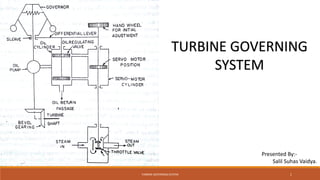
TURBINE GOVERNING
SYSTEM
Presented By:-
Salil Suhas Vaidya.
TURBINE GOVERNING SYSTEM 2
Turbine Governing
Objective & Function:
• The variation in load during the operation
of a steam turbine can have a significant
impact on its performance. Therefore,
turbine governing is the procedure of
controlling the flow rate of steam to a
steam turbine so as to maintain its speed of
rotation as constant.
 Controls the turbine speed during start-up
or in no load condition to permit the unit
to be synchronized with the grid.
 Controls the turbine load when running in
parallel with the grid/generating sets.
 All protective functions to ensure the safe
operation of the unit.
Types of Governing:
1. Throttle Governing:
In throttle governing the pressure of
steam is reduced at the turbine entry thereby
decreasing the availability of energy.
2. Nozzle Governing:
In nozzle governing the flow rate of steam
is regulated by opening and shutting of sets of
nozzles rather than regulating its pressure.
3. By-Pass Governing:
Occasionally the turbine is overloaded for
short durations. During such operation, bypass
valves are opened and fresh steam is
introduced into the later stages of the turbine.
This generates more energy to satisfy the
increased load.
TURBINE GOVERNING SYSTEM 3
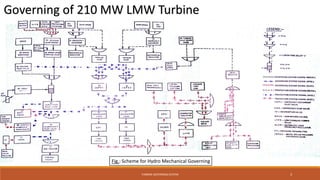
Governing of 210 MW LMW Turbine
Fig.: Scheme for Hydro Mechanical Governing
TURBINE GOVERNING SYSTEM 4
Elements of Turbine Governing
1. Speed Governor:
is directly coupled to turbine rotor
through coupling & hydraulically coupled to
speed governor pilot block located front
pedestal.
Function of Speed Governor is to sense
any speed due to difference between power
generated by Turbine & Load on it.
Change in speed can vary from (4±1)%
2. Follow Pilot Valve:
It follows the governor sleeve in case of
change of speed & maintains the gap between
governor sleeve & nozzle tip to move
summation pilot valve accordingly.
3. Load Speed Control Pilot Valve:
For initial charging of protection oil in
governing system through emergency
governor pilot valve to open ESV, IV & control
valve.
4. Summation Pilot Valve:
to receive movement signals from follow
pilot valve & gives command to intermediate
pilot valves to open or close the control valves.
5. Intermediate Pilot Valve:
To amplify hydraulic signal from
summation pilot valve, differentiator, electro-
hydraulic transducer & emergency governor
pilot valve & transmit to control valve
servomotor.
6. Control Valve Servomotor:
It receives signal from intermediate pilot
valve & actuate HPT & IPT control valves.
7. Load Limiter:
To limit the load raising beyond set point
by limiting the opening of control valve by
speed governor.
TURBINE GOVERNING SYSTEM 5
Elements of Turbine Governing
8. Differentiator:
It prevents undue speed rise in case of
more than 50% load throw off which causes
anticipatory closure of control valve of HPT
and IPT.
9. Electro Hydraulic Transducer:
It converts electric signal of 2 seconds
diverted from generator circuit breaker (when
opens) into hydraulic signal & momentarily
closes the control valve for 2 seconds to avoid
over speeding of turbine
10. Initial Steam Pressure Unloading Gear:
When main steam pressure falls below
(90±2)% of rated value it throttles the control
valve & when main steam pressure falls below
70% of rated completely closes the control
valve.
11. Emergency Governor:
It consist of two centrifugal strikers which
operates and trip the turbine in case of 11-12%
of over speed by closing ESV, IV, HPT & IPT
control valves.
12. Turbine Shut Down Switch:
To trip turbine manually (locally) or from
Unit Control Board (UCB).
13. Emergency Governor Pilot Valve:
It receives emergency signal from
emergency governor which operates turbine
shut down switch to trip turbine.
14. Load Limiter:
It trips the turbine at 14 to 15% over
speed if emergency governor fails to operate.
TURBINE GOVERNING SYSTEM 6
Advantages
The integrated electronic and hydraulic control systems offer significant advantages listed below:
a. Exact load frequency drop with high sensitivity.
b. Reliable operation in case of isolated Power Grids.
c. Dependable control during load rejection.
d. Low transient and low steady state speed deviations under all operational conditions.
e. Excellent operational reliability and dependability.
f. Safe operation of the Turboset in conjunction with turbine stress evaluation (TSE).
g. A sequence timing device which adjusts the relative opening of HP and IP control valves and
thus avoids heating of HP exhaust at reduces loads.
h. Two load shedding relays which act for anticipatory closure of control valves in the event of
large load dump.
i. An extraction valve relay which actuates NRVs in extraction lines as demanded by load
situation.
TURBINE GOVERNING SYSTEM 7
Protection System
Hydraulic Protection (Trip):
The protection system has been designed
to protect Turboset from any mishaps by the
fast closing of Stop and Control Valves and
thus tripping the set.
The hydraulic trips are listed below:
1. Over Speed Trip
2. Low Vacuum Trip
3. Thrust Bearing Trip
4. Local Manual Trip
Electrical Protection (Trip):
The electrical trips act through remote
trip solenoids for tripping the set. All the
protections act for closing of ESVs, IVs, HPCVs
and IPCVs through Main Trip valves.
Electrical Trips are listed below:
1. Manual Remote Trip
2. Low Lube Oil Trip
3. Low Vacuum Trip
4. Trips due to other causes e.g. Generator
Protection.
TURBINE GOVERNING SYSTEM 8

Turbine Governing System

  • 1.
    TURBINE GOVERNING SYSTEM1 TURBINE GOVERNING SYSTEM Presented By:- Salil Suhas Vaidya.
  • 2.
    TURBINE GOVERNING SYSTEM2 Turbine Governing Objective & Function: • The variation in load during the operation of a steam turbine can have a significant impact on its performance. Therefore, turbine governing is the procedure of controlling the flow rate of steam to a steam turbine so as to maintain its speed of rotation as constant.  Controls the turbine speed during start-up or in no load condition to permit the unit to be synchronized with the grid.  Controls the turbine load when running in parallel with the grid/generating sets.  All protective functions to ensure the safe operation of the unit. Types of Governing: 1. Throttle Governing: In throttle governing the pressure of steam is reduced at the turbine entry thereby decreasing the availability of energy. 2. Nozzle Governing: In nozzle governing the flow rate of steam is regulated by opening and shutting of sets of nozzles rather than regulating its pressure. 3. By-Pass Governing: Occasionally the turbine is overloaded for short durations. During such operation, bypass valves are opened and fresh steam is introduced into the later stages of the turbine. This generates more energy to satisfy the increased load.
  • 3.
    TURBINE GOVERNING SYSTEM3 Governing of 210 MW LMW Turbine Fig.: Scheme for Hydro Mechanical Governing
  • 4.
    TURBINE GOVERNING SYSTEM4 Elements of Turbine Governing 1. Speed Governor: is directly coupled to turbine rotor through coupling & hydraulically coupled to speed governor pilot block located front pedestal. Function of Speed Governor is to sense any speed due to difference between power generated by Turbine & Load on it. Change in speed can vary from (4±1)% 2. Follow Pilot Valve: It follows the governor sleeve in case of change of speed & maintains the gap between governor sleeve & nozzle tip to move summation pilot valve accordingly. 3. Load Speed Control Pilot Valve: For initial charging of protection oil in governing system through emergency governor pilot valve to open ESV, IV & control valve. 4. Summation Pilot Valve: to receive movement signals from follow pilot valve & gives command to intermediate pilot valves to open or close the control valves. 5. Intermediate Pilot Valve: To amplify hydraulic signal from summation pilot valve, differentiator, electro- hydraulic transducer & emergency governor pilot valve & transmit to control valve servomotor. 6. Control Valve Servomotor: It receives signal from intermediate pilot valve & actuate HPT & IPT control valves. 7. Load Limiter: To limit the load raising beyond set point by limiting the opening of control valve by speed governor.
  • 5.
    TURBINE GOVERNING SYSTEM5 Elements of Turbine Governing 8. Differentiator: It prevents undue speed rise in case of more than 50% load throw off which causes anticipatory closure of control valve of HPT and IPT. 9. Electro Hydraulic Transducer: It converts electric signal of 2 seconds diverted from generator circuit breaker (when opens) into hydraulic signal & momentarily closes the control valve for 2 seconds to avoid over speeding of turbine 10. Initial Steam Pressure Unloading Gear: When main steam pressure falls below (90±2)% of rated value it throttles the control valve & when main steam pressure falls below 70% of rated completely closes the control valve. 11. Emergency Governor: It consist of two centrifugal strikers which operates and trip the turbine in case of 11-12% of over speed by closing ESV, IV, HPT & IPT control valves. 12. Turbine Shut Down Switch: To trip turbine manually (locally) or from Unit Control Board (UCB). 13. Emergency Governor Pilot Valve: It receives emergency signal from emergency governor which operates turbine shut down switch to trip turbine. 14. Load Limiter: It trips the turbine at 14 to 15% over speed if emergency governor fails to operate.
  • 6.
    TURBINE GOVERNING SYSTEM6 Advantages The integrated electronic and hydraulic control systems offer significant advantages listed below: a. Exact load frequency drop with high sensitivity. b. Reliable operation in case of isolated Power Grids. c. Dependable control during load rejection. d. Low transient and low steady state speed deviations under all operational conditions. e. Excellent operational reliability and dependability. f. Safe operation of the Turboset in conjunction with turbine stress evaluation (TSE). g. A sequence timing device which adjusts the relative opening of HP and IP control valves and thus avoids heating of HP exhaust at reduces loads. h. Two load shedding relays which act for anticipatory closure of control valves in the event of large load dump. i. An extraction valve relay which actuates NRVs in extraction lines as demanded by load situation.
  • 7.
    TURBINE GOVERNING SYSTEM7 Protection System Hydraulic Protection (Trip): The protection system has been designed to protect Turboset from any mishaps by the fast closing of Stop and Control Valves and thus tripping the set. The hydraulic trips are listed below: 1. Over Speed Trip 2. Low Vacuum Trip 3. Thrust Bearing Trip 4. Local Manual Trip Electrical Protection (Trip): The electrical trips act through remote trip solenoids for tripping the set. All the protections act for closing of ESVs, IVs, HPCVs and IPCVs through Main Trip valves. Electrical Trips are listed below: 1. Manual Remote Trip 2. Low Lube Oil Trip 3. Low Vacuum Trip 4. Trips due to other causes e.g. Generator Protection.
  • 8.