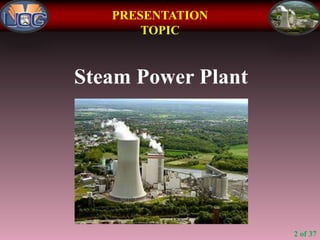
Steam Power Plant
PRESENTATION
TOPIC
2 of 37
Prepared by: Mahboob Ahmad
Muhammad Usman
Hanzala Younis
Obaid Ali Qamar
Muhammad Ali
Mian Mujahid Maqbool
Supervised by:
Engr. Hafiz Muhammad Aamir
Institute of Chemical Engineering and Technology University of Gujrat
GUJRAT
3 of 37
 Introduction
 History
 Requirements for Plant
 Water Treatment
 Flow Diagram
 Basic Elements/Components
 Basic Principle
 T-S Diagram of Rankine Cycle
 Thermal Efficiency and Overall Efficiency
 Advantages and Disadvantages
PRESENTATION LAYOUT
4 of 37
INTRODUCTION
 Two important area of application of thermodynamics are
power generation and refrigeration.
 Both power generation and refrigeration are usually
accomplished by a system that operates on a
thermodynamics cycle.
 Thermodynamics cycle are divided into two generation
categories:
1) Power Cycles
2) Refrigeration Cycles
5 of 37
INTRODUCTION
 The devices or systems used to produce net power output
are called engines and the thermodynamics cycles they
operate on are called power cycles.
 The devices or systems used to produce refrigeration are
called refrigerators, air conditioner or heat pumps and the
thermodynamics cycles they operate on are called
refrigeration cycles.
6 of 37
INTRODUCTION
 Thermodynamics cycles can be categorized as:
1) Power or Refrigeration Cycles
2) Gas Cycles or Vapor Cycles: In gas cycles, working
fluid remains in gaseous phase throughout cycle while in
vapor cycles working fluid exists in vapor phase during one
part and in liquid phase during another part of cycle.
3) Closed Cycles or Open Cycles: In closed cycles,
working fluid is returned to its initial state at end of cycle and
is recirculated while in open cycles working fluid is renewed
at the end of each cycle instead of being circulated.
7 of 37
INTRODUCTION
 A steam-electric power station is a power station in which
the electric generators steam is driven.
 Water is heated, turns into steam and spins a steam turbine
which drives an electrical generator. After it passes through
the turbine, the steam is condensed in a condenser.
 Steam power station is also called thermal power station
8 of 37
INTRODUCTION
 A steam/thermal power station uses heat energy generated
from burning coal to produce electrical energy. This type
of power station is widely used around the world.
 From the turbine the steam is cooled back to water in the
Condenser, the resulting water is fed back into the boiler to
repeat the cycle.
9 of 37
HISTORY
The initially developed reciprocating steam engineer has been used to
produce mechanical power since the 18th Century, with notable
improvements being made by James Watt. When the first commercially
developed central electrical power stations were established in 1882
at Pearl Street Station in New York and Holborn Viaduct power
station in London, reciprocating steam engines were used. The
development of the steam turbine in 1884 provided larger and more
efficient machine designs for central generating stations. By 1892 the
turbine was considered a better alternative to reciprocating
engines;[2] turbines offered higher speeds, more compact machinery,
and stable speed regulation allowing for parallel synchronous operation
of generators on a common bus. After about 1905, turbines entirely
replaced reciprocating engines in large central power stations
10 of 37
REQUIREMENTS FOR PLANT
 Water is used as a raw material in steam power station.
 Coal is used as a fuel in steam power station.
11 of 37
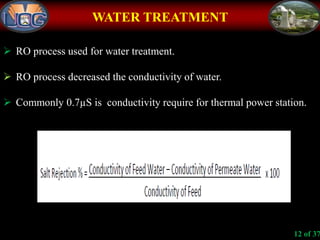
WATER TREATMENT
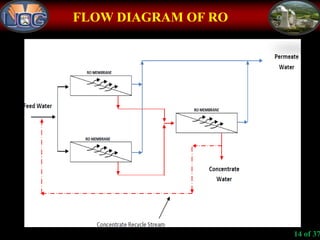
 RO process used for water treatment.
 RO process decreased the conductivity of water.
 Commonly 0.7µS is conductivity require for thermal power station.
12 of 37
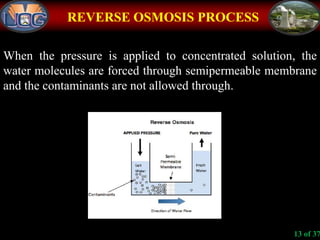
REVERSE OSMOSIS PROCESS
When the pressure is applied to concentrated solution, the
water molecules are forced through semipermeable membrane
and the contaminants are not allowed through.
13 of 37
FLOW DIAGRAM OF RO
14 of 37
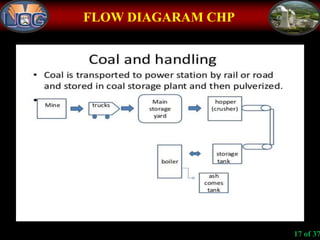
COAL HANDLING
 What is CHP?
CHP stand for coal handling plant which properly handles the coal from receipt to
transferring it to bunkers.
 Objective of CHP:
To supply the quanta processed coal to bunkers of coal mills for boiler operation.
To stack the coal to coal yard
 Transportation of coal:
1. Railways 2. Roadways 3. Ropeways
15 of 37
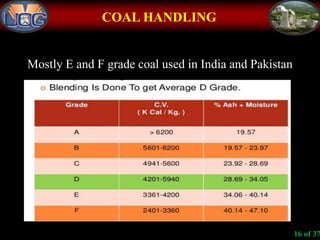
COAL HANDLING
Mostly E and F grade coal used in India and Pakistan
16 of 37
FLOW DIAGARAM CHP
17 of 37
BASIC ELEMENTS/COMPONENTS
 Boiler
 Super heater
 Economizer
 Steam turbine
 Condenser
 Alternator
 Feed water pump
18 of 37
BASIC ELEMENTS/COMPONENTS
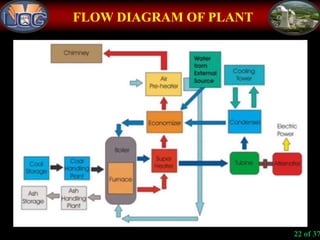
Boiler:
The mixture of pulverized coal and air (usually preheated air) is taken into boiler and
then burnt in the combustion zone. On ignition of fuel a large fireball is formed at the
center of the boiler and large amount of heat energy is radiated from it.
Super heater:
The super heater tubes are hanged at the hottest part of the boiler. The saturated steam
produced in the boiler tubes is superheated to about 540 °C in the super heater. The
superheated high pressure steam is then fed to the steam turbine.
Economizer:
An economizer is essentially a feed water heater which heats the water before supplying
to the boiler.
19 of 37
BASIC ELEMENTS/COMPONENTS
 Air pre-heater:
The primary air fan takes air from the atmosphere and it is then warmed in the air pre-
heater. Pre-heated air is injected with coal in the boiler. The advantage of pre-heating
the air is that it improves the coal combustion.
 Steam turbine:
High pressure super heated steam is fed to the steam turbine which causes turbine
blades to rotate. Energy in the steam is converted into mechanical energy in the steam
turbine which acts as the prime mover.
 Condenser:
The exhausted steam is condensed in the condenser by means of cold water
circulation. Here, the steam loses it's pressure as well as temperature and it is converted
back into water.
20 of 37
BASIC ELEMENTS/COMPONENTS
Alternator:
The steam turbine is coupled to an alternator. When the turbine rotates
the alternator, electrical energy is generated. This generated electrical
voltage is then stepped up with the help of a transformer and then
transmitted where it is to be utilized.
Feed water pump:
The condensed water is again fed to the boiler by a feed water pump.
Some water may be lost during the cycle, which is suitably supplied from
an external water source.
21 of 37
FLOW DIAGRAM OF PLANT
22 of 37
BASIC PRINCIPLE
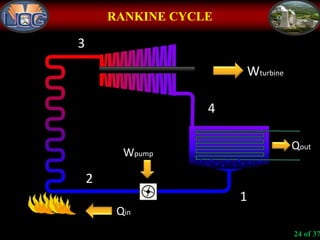
 Actually, steam power plant is working on the principle of
Rankine Cycle.
 The Rankine Cycle is an idealized thermodynamic cycle of
a heat engine that converts heat into mechanical work.
 The heat is supplied externally to a closed loop, which
usually uses water as the working fluid.
23 of 37
24 of 37
RANKINE CYCLE
Wturbine
Wpump
Qout
Qin
1
2
3
4
25 of 37
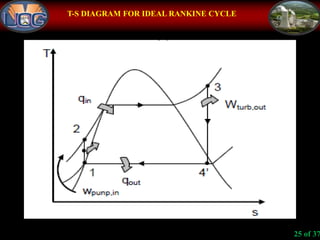
T-S DIAGRAM FOR IDEAL RANKINE CYCLE
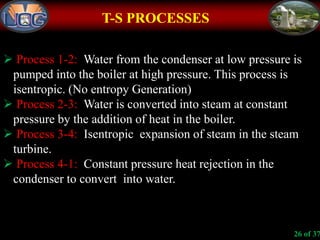
T-S PROCESSES
 Process 1-2: Water from the condenser at low pressure is
pumped into the boiler at high pressure. This process is
isentropic. (No entropy Generation)
 Process 2-3: Water is converted into steam at constant
pressure by the addition of heat in the boiler.
 Process 3-4: Isentropic expansion of steam in the steam
turbine.
 Process 4-1: Constant pressure heat rejection in the
condenser to convert into water.
26 of 37
27 of 37
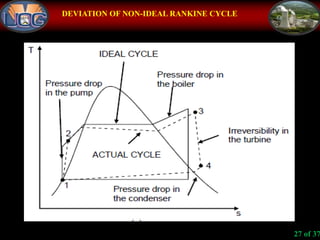
DEVIATION OF NON-IDEAL RANKINE CYCLE
EFFICIENCY OF BOTH CYCLES
 Ideal Cycle Efficiency = 63.8%
 Actual Cycle Efficiency = 42%
Why Actual Cycle is less efficient than Ideal..???
Because of following Irreversibilities:
 Heat Losses
 Fluid Friction
 Mechanical Loss
 Pump Operation (Formation of Cavities)
28 of 37
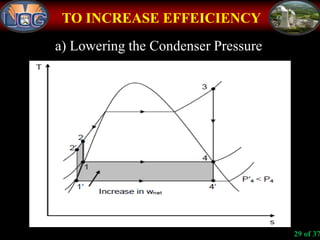
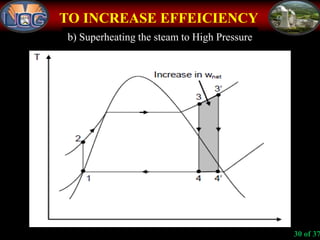
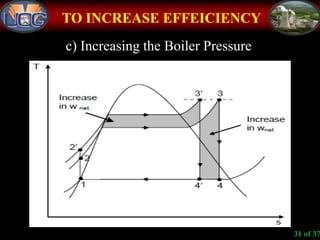
TO INCREASE EFFEICIENCY
29 of 37
a) Lowering the Condenser Pressure
TO INCREASE EFFEICIENCY
30 of 37
b) Superheating the steam to High Pressure
TO INCREASE EFFEICIENCY
31 of 37
c) Increasing the Boiler Pressure
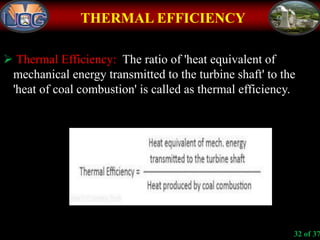
THERMAL EFFICIENCY
 Thermal Efficiency: The ratio of 'heat equivalent of
mechanical energy transmitted to the turbine shaft' to the
'heat of coal combustion' is called as thermal efficiency.
32 of 37
OVERALL EFFEICIENCY
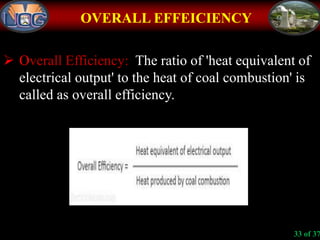
 Overall Efficiency: The ratio of 'heat equivalent of
electrical output' to the heat of coal combustion' is
called as overall efficiency.
33 of 37
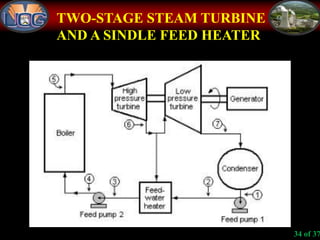
TWO-STAGE STEAM TURBINE
AND A SINDLE FEED HEATER
34 of 37
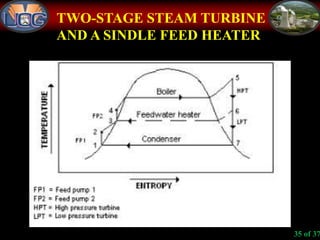
TWO-STAGE STEAM TURBINE
AND A SINDLE FEED HEATER
35 of 37
ADVANTAGES
 Less initial cost as compared to other generating stations.
 It requires less land as compared to hydro power plant.
 The fuel (i.e. coal) is cheaper.
 The cost of generation is lesser than that of diesel power
plants.
36 of 37
DISADVANTAGES
 It pollutes the atmosphere due to the production of large
amount of smoke. This is one of the causes of global
warming.
 The overall efficiency of a thermal power station is low
(less than 30%).
THANKS FOR ATTENTION
37 of 37

Steam power plant

  • 2.
  • 3.
    Prepared by: MahboobAhmad Muhammad Usman Hanzala Younis Obaid Ali Qamar Muhammad Ali Mian Mujahid Maqbool Supervised by: Engr. Hafiz Muhammad Aamir Institute of Chemical Engineering and Technology University of Gujrat GUJRAT 3 of 37
  • 4.
     Introduction  History Requirements for Plant  Water Treatment  Flow Diagram  Basic Elements/Components  Basic Principle  T-S Diagram of Rankine Cycle  Thermal Efficiency and Overall Efficiency  Advantages and Disadvantages PRESENTATION LAYOUT 4 of 37
  • 5.
    INTRODUCTION  Two importantarea of application of thermodynamics are power generation and refrigeration.  Both power generation and refrigeration are usually accomplished by a system that operates on a thermodynamics cycle.  Thermodynamics cycle are divided into two generation categories: 1) Power Cycles 2) Refrigeration Cycles 5 of 37
  • 6.
    INTRODUCTION  The devicesor systems used to produce net power output are called engines and the thermodynamics cycles they operate on are called power cycles.  The devices or systems used to produce refrigeration are called refrigerators, air conditioner or heat pumps and the thermodynamics cycles they operate on are called refrigeration cycles. 6 of 37
  • 7.
    INTRODUCTION  Thermodynamics cyclescan be categorized as: 1) Power or Refrigeration Cycles 2) Gas Cycles or Vapor Cycles: In gas cycles, working fluid remains in gaseous phase throughout cycle while in vapor cycles working fluid exists in vapor phase during one part and in liquid phase during another part of cycle. 3) Closed Cycles or Open Cycles: In closed cycles, working fluid is returned to its initial state at end of cycle and is recirculated while in open cycles working fluid is renewed at the end of each cycle instead of being circulated. 7 of 37
  • 8.
    INTRODUCTION  A steam-electricpower station is a power station in which the electric generators steam is driven.  Water is heated, turns into steam and spins a steam turbine which drives an electrical generator. After it passes through the turbine, the steam is condensed in a condenser.  Steam power station is also called thermal power station 8 of 37
  • 9.
    INTRODUCTION  A steam/thermalpower station uses heat energy generated from burning coal to produce electrical energy. This type of power station is widely used around the world.  From the turbine the steam is cooled back to water in the Condenser, the resulting water is fed back into the boiler to repeat the cycle. 9 of 37
  • 10.
    HISTORY The initially developedreciprocating steam engineer has been used to produce mechanical power since the 18th Century, with notable improvements being made by James Watt. When the first commercially developed central electrical power stations were established in 1882 at Pearl Street Station in New York and Holborn Viaduct power station in London, reciprocating steam engines were used. The development of the steam turbine in 1884 provided larger and more efficient machine designs for central generating stations. By 1892 the turbine was considered a better alternative to reciprocating engines;[2] turbines offered higher speeds, more compact machinery, and stable speed regulation allowing for parallel synchronous operation of generators on a common bus. After about 1905, turbines entirely replaced reciprocating engines in large central power stations 10 of 37
  • 11.
    REQUIREMENTS FOR PLANT Water is used as a raw material in steam power station.  Coal is used as a fuel in steam power station. 11 of 37
  • 12.
    WATER TREATMENT  ROprocess used for water treatment.  RO process decreased the conductivity of water.  Commonly 0.7µS is conductivity require for thermal power station. 12 of 37
  • 13.
    REVERSE OSMOSIS PROCESS Whenthe pressure is applied to concentrated solution, the water molecules are forced through semipermeable membrane and the contaminants are not allowed through. 13 of 37
  • 14.
    FLOW DIAGRAM OFRO 14 of 37
  • 15.
    COAL HANDLING  Whatis CHP? CHP stand for coal handling plant which properly handles the coal from receipt to transferring it to bunkers.  Objective of CHP: To supply the quanta processed coal to bunkers of coal mills for boiler operation. To stack the coal to coal yard  Transportation of coal: 1. Railways 2. Roadways 3. Ropeways 15 of 37
  • 16.
    COAL HANDLING Mostly Eand F grade coal used in India and Pakistan 16 of 37
  • 17.
  • 18.
    BASIC ELEMENTS/COMPONENTS  Boiler Super heater  Economizer  Steam turbine  Condenser  Alternator  Feed water pump 18 of 37
  • 19.
    BASIC ELEMENTS/COMPONENTS Boiler: The mixtureof pulverized coal and air (usually preheated air) is taken into boiler and then burnt in the combustion zone. On ignition of fuel a large fireball is formed at the center of the boiler and large amount of heat energy is radiated from it. Super heater: The super heater tubes are hanged at the hottest part of the boiler. The saturated steam produced in the boiler tubes is superheated to about 540 °C in the super heater. The superheated high pressure steam is then fed to the steam turbine. Economizer: An economizer is essentially a feed water heater which heats the water before supplying to the boiler. 19 of 37
  • 20.
    BASIC ELEMENTS/COMPONENTS  Airpre-heater: The primary air fan takes air from the atmosphere and it is then warmed in the air pre- heater. Pre-heated air is injected with coal in the boiler. The advantage of pre-heating the air is that it improves the coal combustion.  Steam turbine: High pressure super heated steam is fed to the steam turbine which causes turbine blades to rotate. Energy in the steam is converted into mechanical energy in the steam turbine which acts as the prime mover.  Condenser: The exhausted steam is condensed in the condenser by means of cold water circulation. Here, the steam loses it's pressure as well as temperature and it is converted back into water. 20 of 37
  • 21.
    BASIC ELEMENTS/COMPONENTS Alternator: The steamturbine is coupled to an alternator. When the turbine rotates the alternator, electrical energy is generated. This generated electrical voltage is then stepped up with the help of a transformer and then transmitted where it is to be utilized. Feed water pump: The condensed water is again fed to the boiler by a feed water pump. Some water may be lost during the cycle, which is suitably supplied from an external water source. 21 of 37
  • 22.
    FLOW DIAGRAM OFPLANT 22 of 37
  • 23.
    BASIC PRINCIPLE  Actually,steam power plant is working on the principle of Rankine Cycle.  The Rankine Cycle is an idealized thermodynamic cycle of a heat engine that converts heat into mechanical work.  The heat is supplied externally to a closed loop, which usually uses water as the working fluid. 23 of 37
  • 24.
    24 of 37 RANKINECYCLE Wturbine Wpump Qout Qin 1 2 3 4
  • 25.
    25 of 37 T-SDIAGRAM FOR IDEAL RANKINE CYCLE
  • 26.
    T-S PROCESSES  Process1-2: Water from the condenser at low pressure is pumped into the boiler at high pressure. This process is isentropic. (No entropy Generation)  Process 2-3: Water is converted into steam at constant pressure by the addition of heat in the boiler.  Process 3-4: Isentropic expansion of steam in the steam turbine.  Process 4-1: Constant pressure heat rejection in the condenser to convert into water. 26 of 37
  • 27.
    27 of 37 DEVIATIONOF NON-IDEAL RANKINE CYCLE
  • 28.
    EFFICIENCY OF BOTHCYCLES  Ideal Cycle Efficiency = 63.8%  Actual Cycle Efficiency = 42% Why Actual Cycle is less efficient than Ideal..??? Because of following Irreversibilities:  Heat Losses  Fluid Friction  Mechanical Loss  Pump Operation (Formation of Cavities) 28 of 37
  • 29.
    TO INCREASE EFFEICIENCY 29of 37 a) Lowering the Condenser Pressure
  • 30.
    TO INCREASE EFFEICIENCY 30of 37 b) Superheating the steam to High Pressure
  • 31.
    TO INCREASE EFFEICIENCY 31of 37 c) Increasing the Boiler Pressure
  • 32.
    THERMAL EFFICIENCY  ThermalEfficiency: The ratio of 'heat equivalent of mechanical energy transmitted to the turbine shaft' to the 'heat of coal combustion' is called as thermal efficiency. 32 of 37
  • 33.
    OVERALL EFFEICIENCY  OverallEfficiency: The ratio of 'heat equivalent of electrical output' to the heat of coal combustion' is called as overall efficiency. 33 of 37
  • 34.
    TWO-STAGE STEAM TURBINE ANDA SINDLE FEED HEATER 34 of 37
  • 35.
    TWO-STAGE STEAM TURBINE ANDA SINDLE FEED HEATER 35 of 37
  • 36.
    ADVANTAGES  Less initialcost as compared to other generating stations.  It requires less land as compared to hydro power plant.  The fuel (i.e. coal) is cheaper.  The cost of generation is lesser than that of diesel power plants. 36 of 37
  • 37.
    DISADVANTAGES  It pollutesthe atmosphere due to the production of large amount of smoke. This is one of the causes of global warming.  The overall efficiency of a thermal power station is low (less than 30%). THANKS FOR ATTENTION 37 of 37

Editor's Notes

  • #13 TDS (PPM) = Conductivity x 0.68 This solution was titrated with EDTA (Na2H2) solution poured drop by drop Total hardness = (volume used of EDTA / volume of sample taken) x 100 Salt Passage % = (1--‐ Salt Rejection%)
  • #14  The temperature to which steam can be superheated is limited by metallurgical consideration. Salt Passage % = (1--‐ Salt Rejection%)
  • #22  huge amount of heat is lost in various stages of the plant. Major part of heat is lost in the condenser. That is why the efficiency of thermal plants is quite low. Thermal efficiency of modern thermal power stations is about 30%. It means, if 100 calories of heat are produced by coal combustion, the mechanical energy equivalent of 30 calories will be available at the turbine shaft.
  • #33 The temperature to which steam can be superheated is limited by metallurgical consideration.
  • #34 Drawback of lowering the condenser pressure is increase in the moisture content of the steam at the final stages of the turbine. The presence of large quantities of moisture is highly undesirable in turbines because it decreases the turbine efficiency and erodes the turbine blades.
  • #37 The temperature to which steam can be superheated is limited by metallurgical consideration.
  • #38 A huge amount of heat is lost in various stages of the plant. Major part of heat is lost in the condenser. That is why the efficiency of thermal plants is quite low. Thermal efficiency of modern thermal power stations is about 30%. It means, if 100 calories of heat are produced by coal combustion, the mechanical energy equivalent of 30 calories will be available at the turbine shaft.