concentrated Solar Powerplant:
a revolution in electricity generation

 Presented By
 Rasmin kumar sahu
 Electrical & Electronics Engineering

Technical Seminar
On
3/18/2022 1
3/18/2022 2
Introduction
Why Solar?
Creation Of Solar Power
The Technology
Applications
Technological Obstacles
Technological Breakthroughs
Additional Benefits
Conclusions
OVERVIEW
INTRODUCTION
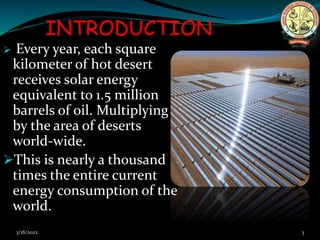
 Every year, each square
kilometer of hot desert
receives solar energy
equivalent to 1.5 million
barrels of oil. Multiplying
by the area of deserts
world-wide.
This is nearly a thousand
times the entire current
energy consumption of the
world.
3/18/2022 3
WHY SOLAR ?
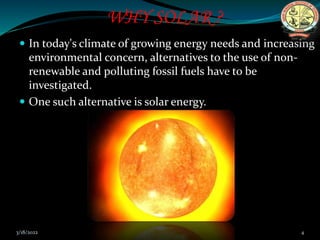
 In today's climate of growing energy needs and increasing
environmental concern, alternatives to the use of non-
renewable and polluting fossil fuels have to be
investigated.
 One such alternative is solar energy.
3/18/2022 4
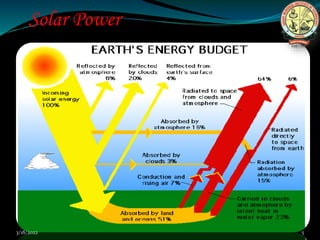
Solar Power
3/18/2022 5
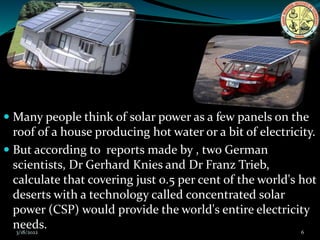
 Many people think of solar power as a few panels on the
roof of a house producing hot water or a bit of electricity.
 But according to reports made by , two German
scientists, Dr Gerhard Knies and Dr Franz Trieb,
calculate that covering just 0.5 per cent of the world's hot
deserts with a technology called concentrated solar
power (CSP) would provide the world's entire electricity
needs.
3/18/2022 6
CREATION OF SOLAR POWER
 Concentrated solar power plants produce electric power by
converting the sun's energy into high-temperature heat using
various mirror configurations.
 Mirrors concentrate the sun's rays on a pipe or vessel
containing some sort of gas or liquid that heats up to around
400{+o}C and is used to power conventional steam turbines.
3/18/2022 7
THE TECHNOLOGY
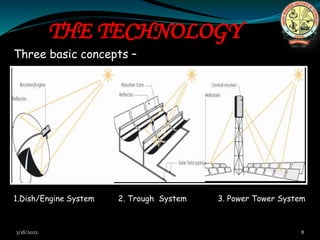
Three basic concepts –
3/18/2022 8
1.Dish/Engine System 2. Trough System 3. Power Tower System
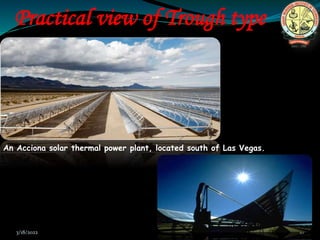
TROUGH SYSTEM
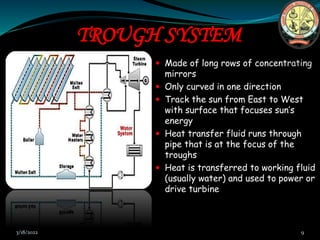
 Made of long rows of concentrating
mirrors
 Only curved in one direction
 Track the sun from East to West
with surface that focuses sun’s
energy
 Heat transfer fluid runs through
pipe that is at the focus of the
troughs
 Heat is transferred to working fluid
(usually water) and used to power or
drive turbine
3/18/2022 9
Practical view of Trough type
An Acciona solar thermal power plant, located south of Las Vegas.
3/18/2022 10
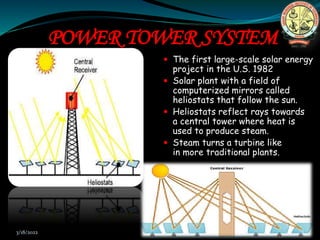
POWER TOWER SYSTEM
 The first large-scale solar energy
project in the U.S. 1982
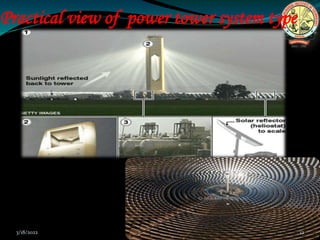
 Solar plant with a field of
computerized mirrors called
heliostats that follow the sun.
 Heliostats reflect rays towards
a central tower where heat is
used to produce steam.
 Steam turns a turbine like
in more traditional plants.
3/18/2022 11
Practical view of power tower system type
3/18/2022 12
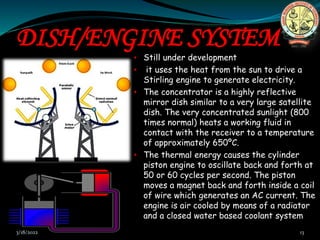
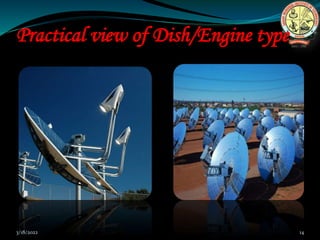
DISH/ENGINE SYSTEM
• Still under development
• it uses the heat from the sun to drive a
Stirling engine to generate electricity.
• The concentrator is a highly reflective
mirror dish similar to a very large satellite
dish. The very concentrated sunlight (800
times normal) heats a working fluid in
contact with the receiver to a temperature
of approximately 650ºC.
• The thermal energy causes the cylinder
piston engine to oscillate back and forth at
50 or 60 cycles per second. The piston
moves a magnet back and forth inside a coil
of wire which generates an AC current. The
engine is air cooled by means of a radiator
and a closed water based coolant system
3/18/2022 13
Practical view of Dish/Engine type
3/18/2022 14
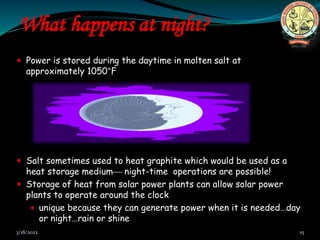
What happens at night?
 Power is stored during the daytime in molten salt at
approximately 1050°F
 Salt sometimes used to heat graphite which would be used as a
heat storage medium night-time operations are possible!
 Storage of heat from solar power plants can allow solar power
plants to operate around the clock
 unique because they can generate power when it is needed…day
or night…rain or shine
3/18/2022 15
APPLICATIONS
 Centralized large-scale (up to 200MWe installed capacity)
electricity generation where small and medium sized
producers are connected to large transmission grids.
 Remote applications (from 10kWe installed capacity) which
can be used to provide heat and electricity in small villages.
 Industrial applications where sectors such as food, textile,
chemical, etc. will be provided with clean energy in the form
of steam, heat or electricity to replace all or part of the
fossil fuels needed during their manufacturing processes.
3/18/2022 16
Technological Obstacles
 Needs back up or storage system
 Storage: the solar thermal plans would need just
16 hours of storage to continuously generate
electricity
 Low efficiency
 increasing efficiency by 20-30% could significantly
reduce the cost of electricity
3/18/2022 17
Technological Breakthroughs
 Future solar collectors will be mass-produced using…
 lower cost flat mirrors, rather than curved troughs
 and sit low to the ground reducing wind loads
 Fast construction (1-2 years)
 Because CSP systems use conventional steam
turbines, hybrid configurations of trough solar and
natural gas turbines (oil and coal are possible too) can
be built for continuous electrical power on rainy days
and short winter days.
3/18/2022 18
Additional Benefits
 The peak demand period - during the hottest part
of the day, when air conditioners are running in
the office and home - coincides with the period of
time when the solar thermal power plant is at
peak production
 Steam is emitted rather than greenhouse gases
3/18/2022 19
Conclusion
Solar thermal energy could lead the India into a
renewable future.
Cost reduction of producing solar thermal energy could
make this the most viable type
of available energy.
3/18/2022 20
21
3/18/2022
3/18/2022 22

concentrated solar powerplant

  • 1.
    concentrated Solar Powerplant: arevolution in electricity generation   Presented By  Rasmin kumar sahu  Electrical & Electronics Engineering  Technical Seminar On 3/18/2022 1
  • 2.
    3/18/2022 2 Introduction Why Solar? CreationOf Solar Power The Technology Applications Technological Obstacles Technological Breakthroughs Additional Benefits Conclusions OVERVIEW
  • 3.
    INTRODUCTION  Every year,each square kilometer of hot desert receives solar energy equivalent to 1.5 million barrels of oil. Multiplying by the area of deserts world-wide. This is nearly a thousand times the entire current energy consumption of the world. 3/18/2022 3
  • 4.
    WHY SOLAR ? In today's climate of growing energy needs and increasing environmental concern, alternatives to the use of non- renewable and polluting fossil fuels have to be investigated.  One such alternative is solar energy. 3/18/2022 4
  • 5.
  • 6.
     Many peoplethink of solar power as a few panels on the roof of a house producing hot water or a bit of electricity.  But according to reports made by , two German scientists, Dr Gerhard Knies and Dr Franz Trieb, calculate that covering just 0.5 per cent of the world's hot deserts with a technology called concentrated solar power (CSP) would provide the world's entire electricity needs. 3/18/2022 6
  • 7.
    CREATION OF SOLARPOWER  Concentrated solar power plants produce electric power by converting the sun's energy into high-temperature heat using various mirror configurations.  Mirrors concentrate the sun's rays on a pipe or vessel containing some sort of gas or liquid that heats up to around 400{+o}C and is used to power conventional steam turbines. 3/18/2022 7
  • 8.
    THE TECHNOLOGY Three basicconcepts – 3/18/2022 8 1.Dish/Engine System 2. Trough System 3. Power Tower System
  • 9.
    TROUGH SYSTEM  Madeof long rows of concentrating mirrors  Only curved in one direction  Track the sun from East to West with surface that focuses sun’s energy  Heat transfer fluid runs through pipe that is at the focus of the troughs  Heat is transferred to working fluid (usually water) and used to power or drive turbine 3/18/2022 9
  • 10.
    Practical view ofTrough type An Acciona solar thermal power plant, located south of Las Vegas. 3/18/2022 10
  • 11.
    POWER TOWER SYSTEM The first large-scale solar energy project in the U.S. 1982  Solar plant with a field of computerized mirrors called heliostats that follow the sun.  Heliostats reflect rays towards a central tower where heat is used to produce steam.  Steam turns a turbine like in more traditional plants. 3/18/2022 11
  • 12.
    Practical view ofpower tower system type 3/18/2022 12
  • 13.
    DISH/ENGINE SYSTEM • Stillunder development • it uses the heat from the sun to drive a Stirling engine to generate electricity. • The concentrator is a highly reflective mirror dish similar to a very large satellite dish. The very concentrated sunlight (800 times normal) heats a working fluid in contact with the receiver to a temperature of approximately 650ºC. • The thermal energy causes the cylinder piston engine to oscillate back and forth at 50 or 60 cycles per second. The piston moves a magnet back and forth inside a coil of wire which generates an AC current. The engine is air cooled by means of a radiator and a closed water based coolant system 3/18/2022 13
  • 14.
    Practical view ofDish/Engine type 3/18/2022 14
  • 15.
    What happens atnight?  Power is stored during the daytime in molten salt at approximately 1050°F  Salt sometimes used to heat graphite which would be used as a heat storage medium night-time operations are possible!  Storage of heat from solar power plants can allow solar power plants to operate around the clock  unique because they can generate power when it is needed…day or night…rain or shine 3/18/2022 15
  • 16.
    APPLICATIONS  Centralized large-scale(up to 200MWe installed capacity) electricity generation where small and medium sized producers are connected to large transmission grids.  Remote applications (from 10kWe installed capacity) which can be used to provide heat and electricity in small villages.  Industrial applications where sectors such as food, textile, chemical, etc. will be provided with clean energy in the form of steam, heat or electricity to replace all or part of the fossil fuels needed during their manufacturing processes. 3/18/2022 16
  • 17.
    Technological Obstacles  Needsback up or storage system  Storage: the solar thermal plans would need just 16 hours of storage to continuously generate electricity  Low efficiency  increasing efficiency by 20-30% could significantly reduce the cost of electricity 3/18/2022 17
  • 18.
    Technological Breakthroughs  Futuresolar collectors will be mass-produced using…  lower cost flat mirrors, rather than curved troughs  and sit low to the ground reducing wind loads  Fast construction (1-2 years)  Because CSP systems use conventional steam turbines, hybrid configurations of trough solar and natural gas turbines (oil and coal are possible too) can be built for continuous electrical power on rainy days and short winter days. 3/18/2022 18
  • 19.
    Additional Benefits  Thepeak demand period - during the hottest part of the day, when air conditioners are running in the office and home - coincides with the period of time when the solar thermal power plant is at peak production  Steam is emitted rather than greenhouse gases 3/18/2022 19
  • 20.
    Conclusion Solar thermal energycould lead the India into a renewable future. Cost reduction of producing solar thermal energy could make this the most viable type of available energy. 3/18/2022 20
  • 21.
  • 22.