PREPARED BY:
VIREN PATEL ENROLL NO-130280109087
THERMAL
POWER PLANT
ELECTRICAL ENGINEERING
DEPARTMENT
AHMEDABAD
INTRODUCTION
A Thermal Power Plant converts the heat energy of coal into
electrical energy. Coal is burnt in a boiler which converts water
into steam. The expansion of steam in turbine produces
mechanical power which drives the alternator coupled to the
turbine.Thermal Power Plants contribute maximum to the
generation of Power for any country . Thermal Power Plants
constitute 75.43% of the total installed captive and non-captive
power generation in India . In thermal generating stations coal,
oil, natural gas etc. are employed as primary sources of energy.
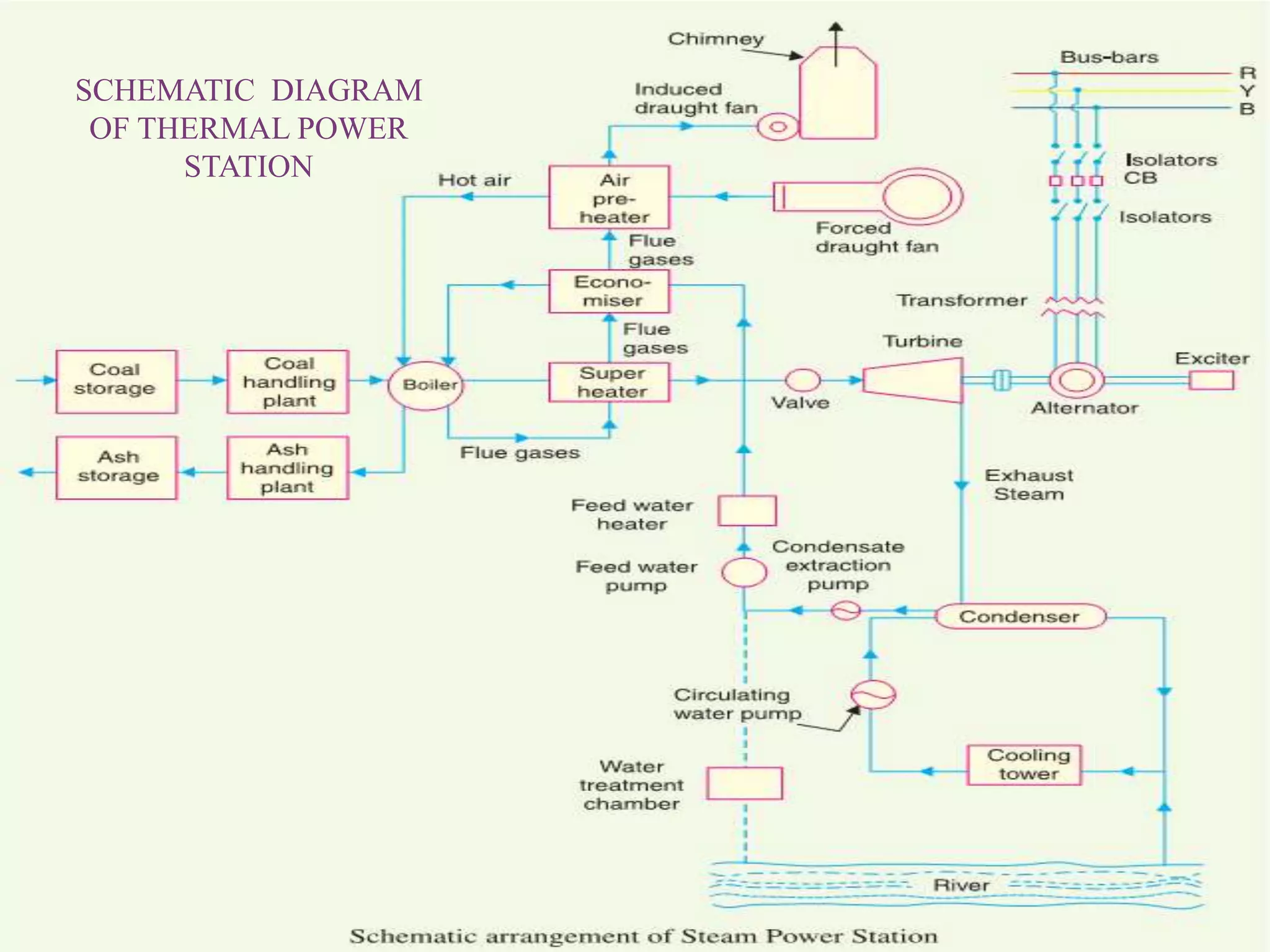
SCHEMATIC DIAGRAM
OF THERMAL POWER
STATION
1. Cooling tower 10. Steam Control valve 19. Superheater
2. Cooling water pump 11. High pressure steam turbine 20. Forced draught (draft) fan
3. transmission line (3-phase) 12. Deaerator 21. Reheater
4. Step-up transformer (3-phase) 13. Feed water heater 22. Combustion air intake
5. Electrical generator (3-phase)14. Coal conveyor 23. Economiser
6. Low pressure steam turbine 15. Coal hopper 24. Air preheater
7. Condensate pump 16. Coal pulveriser 25. Precipitator
8. Surface condenser 17. Boiler steam drum 26. Induced draught (draft) fan
9. Intermediate pressure steam
turbine
18. Bottom ash hopper 27. Flue gas stack
Diagram of a typical coal-fired
thermal power station
Main and Auxiliary equipments
1. Coal handling plant
2. Pulverizing plant
3. Draft fans
4. Boiler
5. Ash handling plant
6. Turbine
7. Condenser
8. Cooling towers and ponds
9. Feed water heater
10. Economiser
11. Superheater and Reheater
12. Air preheater
Coal handling plant
•The function of coal handling plant is automatic feeding of coal to the
boiler furnace.
• A thermal power plant burns enormous amounts of coal.
•A 200MW plant may require around 2000 tons of coal daily
Pulverising plant
In modern thermal power plant , coal is pulverised
i.e. ground to dust like size and carried to the
furnace in a stream of hot air. Pulverising is a
means of exposing a large surface area to the action
of oxygen and consequently helping combustion.
Pulverising mills are further classified as:
1. Contact mill
2. Ball mill
3. Impact mill
Draft system
• The circulation of air is
caused by a difference in
pressure, known as Draft.
• Draft is a differential
pressure b/w atmosphere and
inside the boiler.
• It is necessary to cause the
flow of gases through boiler
setting
• It may be –
1. Natural draft
2. Mechanical draft
Boiler
• A boiler or steam generator is a closed vessel in which water
under pressure, is converted into steam.
• It is one of the major components of a thermal power plant
• Always designed to absorb maximum amount of heat released in
the process of combustion
Boilers are of two types-
1. Fire tube boiler
2. Water tube boiler
Superheater and reheater
Most of the modern boilers are having super heater and reheater arrangement.
Superheater :
Superheater is a component of a steam-generating unit in which steam, after it
has left the boiler drum, is heated above its saturation temperature. The amount
of superheat added to the steam is influenced by the location, arrangement, and
amount of super heater surface installed, as well as the rating of the boiler. The
super heater may consist of one or more stages of tube banks arranged to
effectively transfer heat from the products of combustion. Super heaters are
classified as convection , radiant or combination of these.
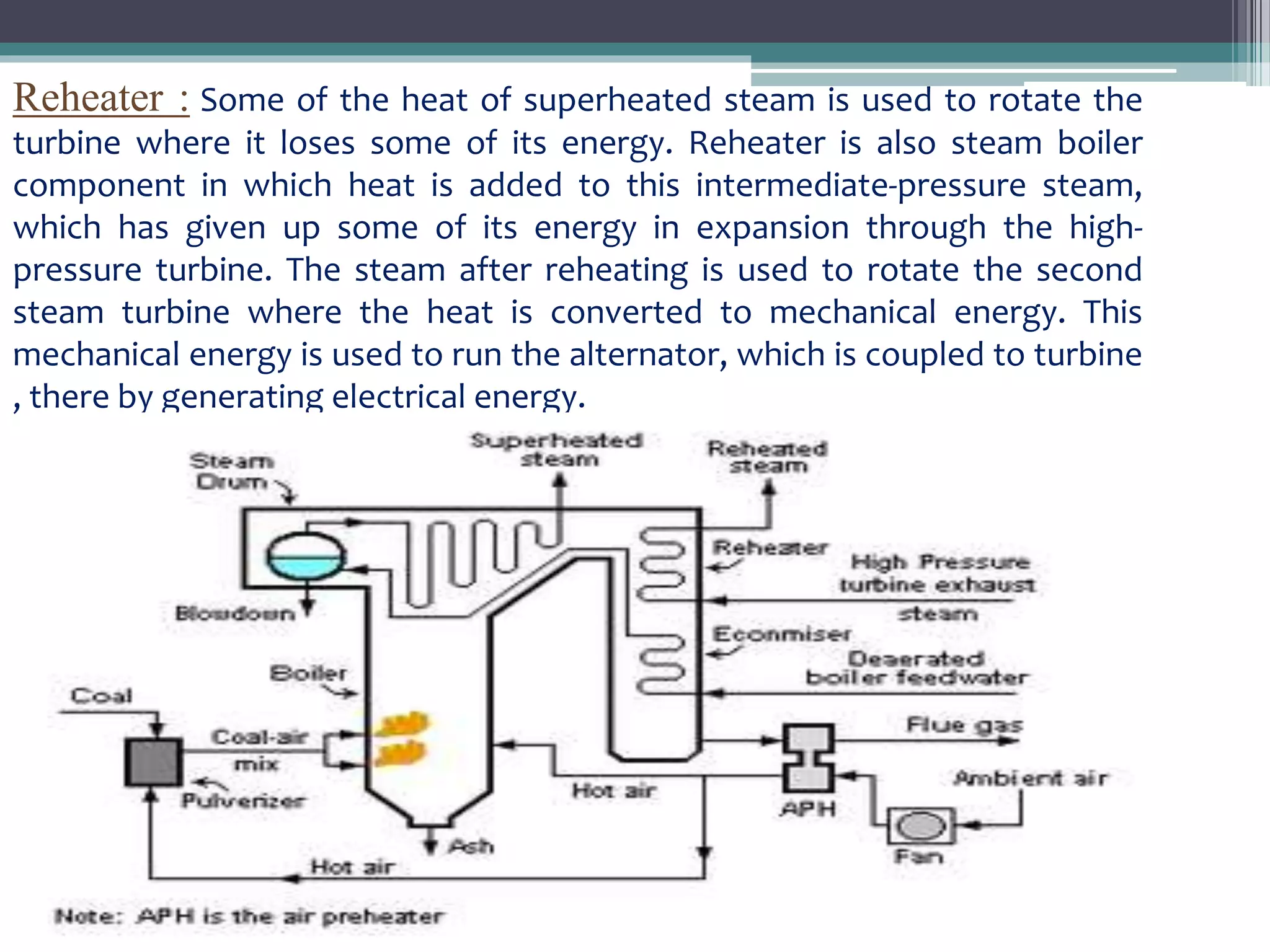
Reheater : Some of the heat of superheated steam is used to rotate the
turbine where it loses some of its energy. Reheater is also steam boiler
component in which heat is added to this intermediate-pressure steam,
which has given up some of its energy in expansion through the high-
pressure turbine. The steam after reheating is used to rotate the second
steam turbine where the heat is converted to mechanical energy. This
mechanical energy is used to run the alternator, which is coupled to turbine
, there by generating electrical energy.
Steam turbine
A steam turbine converts heat energy of steam into mechanical energy
and drives the generator. It uses the principle that steam when issuing
from a small opening attains a high velocity. This velocity attained during
expansion depends on the initial and final heat content of the steam. This
difference b/w initial and final heat content repesents the heat energy
converted into kinetic energy.
These are of two types :-
Impulse turbine
Reaction turbine
Ash handling plant
The percentage of ash in coal varies from 5% in good quality
coal to about 40% in poor quality coal
Power plants generally use poor quality of coal , thus amount
of ash produced by it is pretty large
A modern 2000MW plant produces about 5000 tons of ash
daily
The stations use some conveyor arrangement to carry ash to
dump sites directly or for carrying and loading it to trucks and
wagons which transport it to the site of disposal
Condenser
Steam after rotating steam turbine comes to condenser. Condenser
refers here to the shell and tube heat exchanger (or surface
condenser) installed at the outlet of every steam turbine in Thermal
power stations of utility companies generally.
These condensers are heat exchangers which convert steam from its
gaseous to its liquid state, also known as phase transition.
In so doing, the latent heat of steam is given out inside the
condenser. Where water is in short supply an air cooled condenser is
often used.
An air cooled condenser is however significantly more expensive and
cannot achieve as low a steam turbine backpressure (and therefore
less efficient) as a surface condenser.
The purpose is to condense the outlet (or exhaust) steam from steam
turbine to obtain maximum efficiency and also to get the condensed
steam in the form of pure water, otherwise known as condensate, back
to steam generator or (boiler) as boiler feed water.
Cooling towers and ponds
o A condenser needs huge quantity of water to condense the steam .
o Typically a 2000MW plant needs about 1500MGallon of water.
oMost plants use a closed cooling system where warm water coming from
condenser is cooled and reused
oSmall plants use spray ponds and medium and large plants use cooling towers.
oCooling tower is a steel or concrete hyperbolic structure having a reservoir at the
base for storage of cooled water
oHeight of the cooling tower may be 150 m or so and diameter at the base is 150 m
Feed water heater
Advantages of heating water before feeding back to the boiler:-
a) Feed water heating improves overall plant efficiency.
b) The dissolved oxygen and carbon dioxide which would otherwise
cause boiler corrosion are removed in feed water heater
c) Thermal stresses due to cold water entering the boiler drum are
avoided.
d) Quantity of steam produced by the boiler is increased.
e) Some other impurities carried by the steam and condensate, due
to corrosion of boiler and condenser are precipitated outside the
boiler.
Economiser
Flue gases coming out of the boiler carry lot of heat. An
economiser extracts a part of this heat from flue gases
and uses it for heating feed water. This use of
economiser results in saving coal consumption and
higher boiler efficiency
Air preheater
After flue gases leave economiser, some further heat
can be extracted from them and used to heat incoming
heat. Cooling of flue gases by 20 degree centigrade
increases the plant efficiency by 1%.
Air preheaters may be of three types
Plate type
Tubular type
Regenerative type
Advantages
(i) The fuel (i.e., coal) used is quite cheap.
(ii) Less initial cost as compared to other generating stations.
(iii) It can be installed at any place irrespective of the existence of coal.
The coal can be transported to the site of the plant by rail or road.
(iv) It requires less space as compared to the hydroelectric power station.
(v) The cost of generation is lesser than that of the diesel power station
Disadvantages
(i) It pollutes the atmosphere due to the production of large amount of
smoke and fumes
Advantages & Disadvantages of thermal power
plant
Thermal power plants in GUJARAT
1. Mundra ultra mega power plant(ADANI)- 4620MW
2. Mundra ultra mega power plant(TATA)- 4000MW
3. Wanakbori- 1470MW
4. Gandhinagar- 870MW
5. Ukai- 850MW
6. Dhuvaran - 534MW
7. Sabarmati - 400MW
References
1. Generation of electrical power- V.K.Mehta
2. www.google.com
3. www.slideshare.com
Thermal power plant

Thermal power plant

  • 1.
    PREPARED BY: VIREN PATELENROLL NO-130280109087 THERMAL POWER PLANT ELECTRICAL ENGINEERING DEPARTMENT AHMEDABAD
  • 2.
    INTRODUCTION A Thermal PowerPlant converts the heat energy of coal into electrical energy. Coal is burnt in a boiler which converts water into steam. The expansion of steam in turbine produces mechanical power which drives the alternator coupled to the turbine.Thermal Power Plants contribute maximum to the generation of Power for any country . Thermal Power Plants constitute 75.43% of the total installed captive and non-captive power generation in India . In thermal generating stations coal, oil, natural gas etc. are employed as primary sources of energy.
  • 3.
  • 4.
    1. Cooling tower10. Steam Control valve 19. Superheater 2. Cooling water pump 11. High pressure steam turbine 20. Forced draught (draft) fan 3. transmission line (3-phase) 12. Deaerator 21. Reheater 4. Step-up transformer (3-phase) 13. Feed water heater 22. Combustion air intake 5. Electrical generator (3-phase)14. Coal conveyor 23. Economiser 6. Low pressure steam turbine 15. Coal hopper 24. Air preheater 7. Condensate pump 16. Coal pulveriser 25. Precipitator 8. Surface condenser 17. Boiler steam drum 26. Induced draught (draft) fan 9. Intermediate pressure steam turbine 18. Bottom ash hopper 27. Flue gas stack Diagram of a typical coal-fired thermal power station
  • 5.
    Main and Auxiliaryequipments 1. Coal handling plant 2. Pulverizing plant 3. Draft fans 4. Boiler 5. Ash handling plant 6. Turbine 7. Condenser 8. Cooling towers and ponds 9. Feed water heater 10. Economiser 11. Superheater and Reheater 12. Air preheater
  • 6.
    Coal handling plant •Thefunction of coal handling plant is automatic feeding of coal to the boiler furnace. • A thermal power plant burns enormous amounts of coal. •A 200MW plant may require around 2000 tons of coal daily
  • 7.
    Pulverising plant In modernthermal power plant , coal is pulverised i.e. ground to dust like size and carried to the furnace in a stream of hot air. Pulverising is a means of exposing a large surface area to the action of oxygen and consequently helping combustion. Pulverising mills are further classified as: 1. Contact mill 2. Ball mill 3. Impact mill
  • 8.
    Draft system • Thecirculation of air is caused by a difference in pressure, known as Draft. • Draft is a differential pressure b/w atmosphere and inside the boiler. • It is necessary to cause the flow of gases through boiler setting • It may be – 1. Natural draft 2. Mechanical draft
  • 9.
    Boiler • A boileror steam generator is a closed vessel in which water under pressure, is converted into steam. • It is one of the major components of a thermal power plant • Always designed to absorb maximum amount of heat released in the process of combustion Boilers are of two types- 1. Fire tube boiler 2. Water tube boiler
  • 10.
    Superheater and reheater Mostof the modern boilers are having super heater and reheater arrangement. Superheater : Superheater is a component of a steam-generating unit in which steam, after it has left the boiler drum, is heated above its saturation temperature. The amount of superheat added to the steam is influenced by the location, arrangement, and amount of super heater surface installed, as well as the rating of the boiler. The super heater may consist of one or more stages of tube banks arranged to effectively transfer heat from the products of combustion. Super heaters are classified as convection , radiant or combination of these.
  • 11.
    Reheater : Someof the heat of superheated steam is used to rotate the turbine where it loses some of its energy. Reheater is also steam boiler component in which heat is added to this intermediate-pressure steam, which has given up some of its energy in expansion through the high- pressure turbine. The steam after reheating is used to rotate the second steam turbine where the heat is converted to mechanical energy. This mechanical energy is used to run the alternator, which is coupled to turbine , there by generating electrical energy.
  • 12.
    Steam turbine A steamturbine converts heat energy of steam into mechanical energy and drives the generator. It uses the principle that steam when issuing from a small opening attains a high velocity. This velocity attained during expansion depends on the initial and final heat content of the steam. This difference b/w initial and final heat content repesents the heat energy converted into kinetic energy. These are of two types :- Impulse turbine Reaction turbine
  • 13.
    Ash handling plant Thepercentage of ash in coal varies from 5% in good quality coal to about 40% in poor quality coal Power plants generally use poor quality of coal , thus amount of ash produced by it is pretty large A modern 2000MW plant produces about 5000 tons of ash daily The stations use some conveyor arrangement to carry ash to dump sites directly or for carrying and loading it to trucks and wagons which transport it to the site of disposal
  • 14.
    Condenser Steam after rotatingsteam turbine comes to condenser. Condenser refers here to the shell and tube heat exchanger (or surface condenser) installed at the outlet of every steam turbine in Thermal power stations of utility companies generally. These condensers are heat exchangers which convert steam from its gaseous to its liquid state, also known as phase transition. In so doing, the latent heat of steam is given out inside the condenser. Where water is in short supply an air cooled condenser is often used. An air cooled condenser is however significantly more expensive and cannot achieve as low a steam turbine backpressure (and therefore less efficient) as a surface condenser. The purpose is to condense the outlet (or exhaust) steam from steam turbine to obtain maximum efficiency and also to get the condensed steam in the form of pure water, otherwise known as condensate, back to steam generator or (boiler) as boiler feed water.
  • 16.
    Cooling towers andponds o A condenser needs huge quantity of water to condense the steam . o Typically a 2000MW plant needs about 1500MGallon of water. oMost plants use a closed cooling system where warm water coming from condenser is cooled and reused oSmall plants use spray ponds and medium and large plants use cooling towers. oCooling tower is a steel or concrete hyperbolic structure having a reservoir at the base for storage of cooled water oHeight of the cooling tower may be 150 m or so and diameter at the base is 150 m
  • 17.
    Feed water heater Advantagesof heating water before feeding back to the boiler:- a) Feed water heating improves overall plant efficiency. b) The dissolved oxygen and carbon dioxide which would otherwise cause boiler corrosion are removed in feed water heater c) Thermal stresses due to cold water entering the boiler drum are avoided. d) Quantity of steam produced by the boiler is increased. e) Some other impurities carried by the steam and condensate, due to corrosion of boiler and condenser are precipitated outside the boiler.
  • 18.
    Economiser Flue gases comingout of the boiler carry lot of heat. An economiser extracts a part of this heat from flue gases and uses it for heating feed water. This use of economiser results in saving coal consumption and higher boiler efficiency
  • 19.
    Air preheater After fluegases leave economiser, some further heat can be extracted from them and used to heat incoming heat. Cooling of flue gases by 20 degree centigrade increases the plant efficiency by 1%. Air preheaters may be of three types Plate type Tubular type Regenerative type
  • 20.
    Advantages (i) The fuel(i.e., coal) used is quite cheap. (ii) Less initial cost as compared to other generating stations. (iii) It can be installed at any place irrespective of the existence of coal. The coal can be transported to the site of the plant by rail or road. (iv) It requires less space as compared to the hydroelectric power station. (v) The cost of generation is lesser than that of the diesel power station Disadvantages (i) It pollutes the atmosphere due to the production of large amount of smoke and fumes Advantages & Disadvantages of thermal power plant
  • 21.
    Thermal power plantsin GUJARAT 1. Mundra ultra mega power plant(ADANI)- 4620MW 2. Mundra ultra mega power plant(TATA)- 4000MW 3. Wanakbori- 1470MW 4. Gandhinagar- 870MW 5. Ukai- 850MW 6. Dhuvaran - 534MW 7. Sabarmati - 400MW
  • 22.
    References 1. Generation ofelectrical power- V.K.Mehta 2. www.google.com 3. www.slideshare.com

Editor's Notes

  • #10 Flue gas – gas which comes out after burning a fuel and it contains a lot of sulphur.