
1
Schneider Process Automation Power
Industry Solutions`
Power plant basics – An overview
By Rodney Berg
Page 1
Confidential Property of
Schneider Electric |
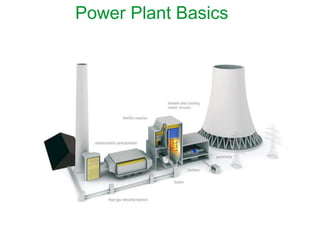
Power Plant Basics
3
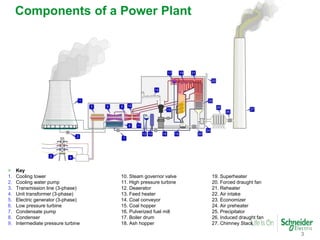
Components of a Power Plant
> Key
1. Cooling tower 10. Steam governor valve 19. Superheater
2. Cooling water pump 11. High pressure turbine 20. Forced draught fan
3. Transmission line (3-phase) 12. Deaerator 21. Reheater
4. Unit transformer (3-phase) 13. Feed heater 22. Air intake
5. Electric generator (3-phase) 14. Coal conveyor 23. Economizer
6. Low pressure turbine 15. Coal hopper 24. Air preheater
7. Condensate pump 16. Pulverized fuel mill 25. Precipitator
8. Condenser 17. Boiler drum 26. Induced draught fan
9. Intermediate pressure turbine 18. Ash hopper 27. Chimney Stack
4
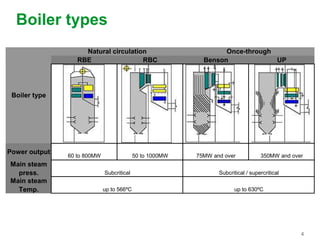
Boiler types
RBE RBC Benson UP
Power output
60 to 800MW 50 to 1000MW 75MW and over 350MW and over
Main steam
press.
Main steam
Temp.
Boiler type
Natural circulation Once-through
Subcritical Subcritical / supercritical
up to 566ºC up to 630ºC
5
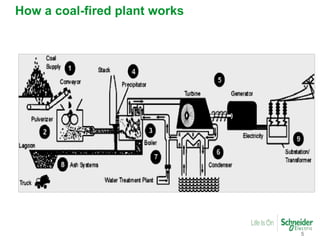
How a coal-fired plant works
6
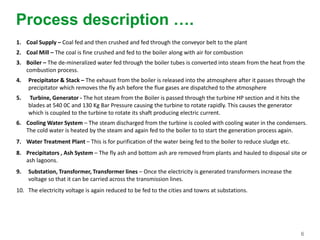
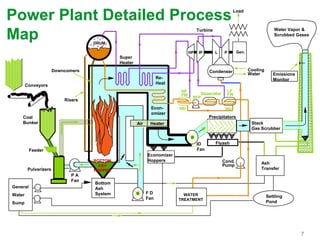
Process description ….
1. Coal Supply – Coal fed and then crushed and fed through the conveyor belt to the plant
2. Coal Mill – The coal is fine crushed and fed to the boiler along with air for combustion
3. Boiler – The de-mineralized water fed through the boiler tubes is converted into steam from the heat from the
combustion process.
4. Precipitator & Stack – The exhaust from the boiler is released into the atmosphere after it passes through the
precipitator which removes the fly ash before the flue gases are dispatched to the atmosphere
5. Turbine, Generator - The hot steam from the Boiler is passed through the turbine HP section and it hits the
blades at 540 0C and 130 Kg Bar Pressure causing the turbine to rotate rapidly. This causes the generator
which is coupled to the turbine to rotate its shaft producing electric current.
6. Cooling Water System – The steam discharged from the turbine is cooled with cooling water in the condensers.
The cold water is heated by the steam and again fed to the boiler to to start the generation process again.
7. Water Treatment Plant – This is for purification of the water being fed to the boiler to reduce sludge etc.
8. Precipitators , Ash System – The fly ash and bottom ash are removed from plants and hauled to disposal site or
ash lagoons.
9. Substation, Transformer, Transformer lines – Once the electricity is generated transformers increase the
voltage so that it can be carried across the transmission lines.
10. The electricity voltage is again reduced to be fed to the cities and towns at substations.
7
Bottom
Ash
System
Economizer
Hoppers
F D
Fan
BOTTOM
ASH
HOPPER
Coal
Bunker
Conveyors
Pulverizers
Load
Gen.HP IP L P
Turbine
Econ-
omizer
Re-
Heat
Super
Heater
DRUM
Condenser
P A
Fan
ID
Fan
HP
FW
Htr
LP
FW
Htr
Ash
Transfer
Precipitators
Stack
Gas Scrubber
Emissions
Monitor
Flyash
Cond.
Pump
BFP
Deaerator
Cooling
Water
Feeder
Downcomers
Risers
Air Heater
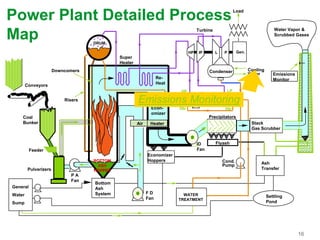
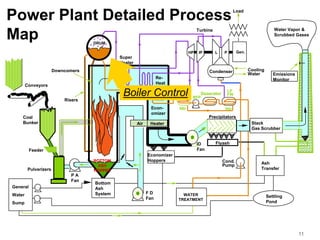
Power Plant Detailed Process
Map
Water Vapor &
Scrubbed Gases
General
Water
Sump
WATER
TREATMENT
Settling
Pond
8
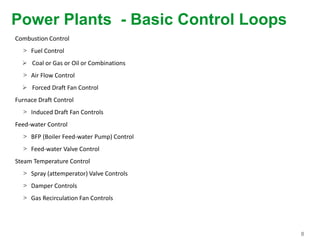
Power Plants - Basic Control Loops
Combustion Control
> Fuel Control
 Coal or Gas or Oil or Combinations
> Air Flow Control
 Forced Draft Fan Control
Furnace Draft Control
> Induced Draft Fan Controls
Feed-water Control
> BFP (Boiler Feed-water Pump) Control
> Feed-water Valve Control
Steam Temperature Control
> Spray (attemperator) Valve Controls
> Damper Controls
> Gas Recirculation Fan Controls
9
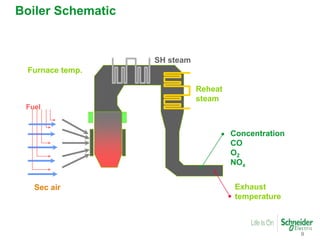
Boiler Schematic
Fuel
Sec air
Reheat
steam
SH steam
Concentration
CO
O2
NOx
Furnace temp.
Exhaust
temperature
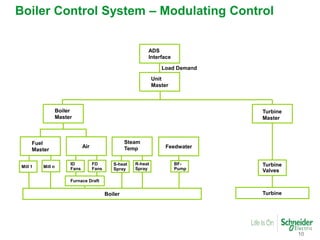
10
ADS
Interface
Unit
Master
Boiler
Master
Fuel
Master
Air
Steam
Temp Feedwater
Boiler Turbine
Turbine
Master
Mill 1 Mill n
ID
Fans
FD
Fans
Furnace Draft
S-heat
Spray
R-heat
Spray
BF-
Pump
Turbine
Valves
Load Demand
Boiler Control System – Modulating Control
11
Bottom
Ash
System
Economizer
Hoppers
F D
Fan
BOTTOM
ASH
HOPPER
Coal
Bunker
Conveyors
Pulverizers
Load
Gen.HP IP L P
Turbine
Econ-
omizer
Re-
Heat
Super
Heater
DRUM
Condenser
P A
Fan
ID
Fan
HP
FW
Htr
LP
FW
Htr
Ash
Transfer
Precipitators
Stack
Gas Scrubber
Emissions
Monitor
Flyash
Cond.
Pump
BFP
Deaerator
Cooling
Water
Feeder
Downcomers
Risers
Air Heater
Power Plant Detailed Process
Map
Water Vapor &
Scrubbed Gases
General
Water
Sump
WATER
TREATMENT
Settling
Pond
Boiler Control
12
Boiler Controls
Following are the major control areas in a Boiler
> Supply of water to the boiler,
> Combustion of fuel in the furnace,
> Steam pressure
> Steam temperature, and
> Furnace pressure, are all a part
Now as a Instrumentation and controls supplier we should be able to do the
above with our DCS system
13
Power Plant Operation Modes
Normal Mode
• This is also known as the turbine-leading-boiler mode or (Boiler-lagging). As its name implies, it is
normally the preferred mode of operation, as it is designed to serve the needs of the power grid.
• If this mode is selected, the unit’s operator specifies generator electrical output as the set-point:
the operator sets the target electric power output [say, in MW, or in % of Full Power (FP)], and
the target rate of change of power [e.g., in % FP/s].
• The control program (running in the station computer) is called the Unit Power Regulator (UPR).
• The UPR continuously compares the actual generator power to the setpoint.
Alternate Mode
• This is also known as the boiler-leading-turbine mode (or turbine-lagging). This is not normally
the preferred mode of operation, but is used under certain circumstances, especially if the
reactor power has to be strictly controlled.
• If this mode is selected, the unit’s operator specifies reactor power as the setpoint: the operator
sets the target reactor power output [say, in % of reactor Full Power (FP)], and the target rate of
change of reactor power [e.g., in % FP/s].
• The RRS continuously compares the actual reactor power to the setpoint.
• If there is a difference, there is a “reactor-power error”.
Invensys proprietary
14
Power Plants – Advanced Control
Loops
Advanced Control
> Like Boiler Optimization
> Soot Blower Optimization
> NOx Reduction
> Data Acquisition Systems
Plant Performance Calculations
> Boiler and Turbine Efficiency Calculations
> Energy Management (Load Dispatch) Systems
> Load Shedding schemes
> Energy control and Management Systems
15
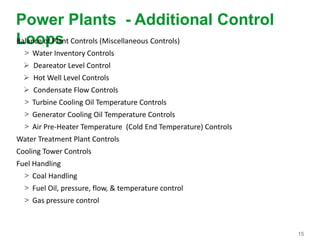
Power Plants - Additional Control
LoopsBalance of Plant Controls (Miscellaneous Controls)
> Water Inventory Controls
 Deareator Level Control
 Hot Well Level Controls
 Condensate Flow Controls
> Turbine Cooling Oil Temperature Controls
> Generator Cooling Oil Temperature Controls
> Air Pre-Heater Temperature (Cold End Temperature) Controls
Water Treatment Plant Controls
Cooling Tower Controls
Fuel Handling
> Coal Handling
> Fuel Oil, pressure, flow, & temperature control
> Gas pressure control
16
Bottom
Ash
System
Economizer
Hoppers
F D
Fan
BOTTOM
ASH
HOPPER
Coal
Bunker
Conveyors
Pulverizers
Load
Gen.HP IP L P
Turbine
Econ-
omizer
Re-
Heat
Super
Heater
DRUM
Condenser
P A
Fan
ID
Fan
HP
FW
Htr
LP
FW
Htr
Ash
Transfer
Precipitators
Stack
Gas Scrubber
Emissions
Monitor
Flyash
Cond.
Pump
BFP
Deaerator
Cooling
Water
Feeder
Downcomers
Risers
Air Heater
Power Plant Detailed Process
Map
Water Vapor &
Scrubbed Gases
General
Water
Sump
WATER
TREATMENT
Settling
Pond
Emissions Monitoring
17
Power Plants - Emission Control
Systems
Power Plant Emissions
> Particulate Matter
Fly-ash
> Sulfur Oxides
SO2 - Sulfur Dioxide
> Nitrogen Oxides
NOx - Nitrogen oxides
18
Power Plant Emissions
Control of Power Plant Emissions
> ESP’s - Electrostatic Precipitators
> FF’s - Fabric Filters (Bag Houses)
> FGD’s - Flue Gas Desulfurization Systems (Scrubbers)
> SCR’s - Selective Catalytic Reduction
19
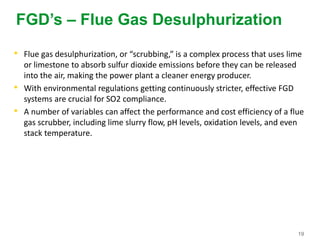
FGD’s – Flue Gas Desulphurization
• Flue gas desulphurization, or “scrubbing,” is a complex process that uses lime
or limestone to absorb sulfur dioxide emissions before they can be released
into the air, making the power plant a cleaner energy producer.
• With environmental regulations getting continuously stricter, effective FGD
systems are crucial for SO2 compliance.
• A number of variables can affect the performance and cost efficiency of a flue
gas scrubber, including lime slurry flow, pH levels, oxidation levels, and even
stack temperature.
20
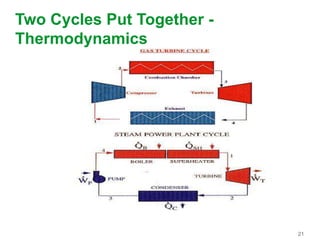
Combined Cycle Power Plant
A combined cycle is a combination of two or more thermal cycles
within a single power plant, where the intention is to increase the
efficiency over that of the single cycles
That is, 2 stand alone inefficient (~30%) energy cycles put
together in the right way yields
1 reasonably efficient (~60%) energy cycle.
21
Two Cycles Put Together -
Thermodynamics
22
Why Combined Cycle Power Plants?
• Highest efficiency of any power plant (approaching 60%)
• Lowest emissions of any current fossil fuel power plant
• Lowest installed and operational costs for power generation
• High levels of operational flexibility
• Shorter lead times than conventional fossil-fuel-fired steam plant
• Suitability for highly efficient co-production schemes
• Option of using coal and other fuels via gasification
23
3Identifying, Types and
Offering
24
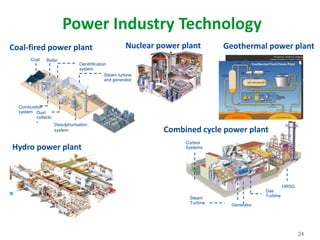
Power Industry Technology
Coal-fired power plant
Coal Boiler
Steam turbine
and generator
Dust
collecto
r
Combustion
system
Desulphurisation
system
Denitrification
system
HRSG
Gas
Turbine
Control
Systems
Generator
Steam
Turbine
Combined cycle power plant
Hydro power plant
Nuclear power plant Geothermal power plant
25
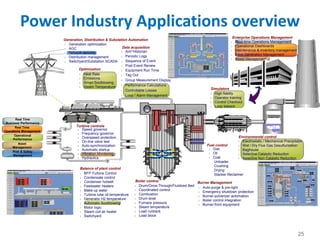
l Drum/Once-Through/Fluidized Bed
l Coordinated control
l Combustion
l Drum level
l Furnace pressure
l Steam temperature
l Load runback
l Load block
Enterprise Operations Management
l Real-time Operations Management
l Operational Dashboards
l Maintenance & inventory management
l Fleet Generation Management
l Asset Management
Environmental control
l Electrostatic / Mechanical Precipitator
l Wet / Dry Flue Gas Desulfurization
l Baghouse
l Selective Catalytic Reduction
l Selective Non Catalytic Reduction
Burner Management
l Auto-purge & pre-light
l Emergency shutdown protection
l Burner-pulverizer automation
l Boiler control integration
l Burner-front equipment
Balance of plant control
l BFP Turbine Control
l Condensate control
l Condenser hotwell
l Feedwater heaters
l Make-up water
l Turbine lube oil temperature
l Generator H2 temperature
l Automatic Sootblowing
l Motor logic
l Steam coil air heater
l Switchyard
Boiler control
Turbine controls
l Speed governor
l Frequency governor
l Overspeed protection
l On-line valve test
l Auto-synchronization
l Automatic startup
l Vibration Monitoring
l Hydraulics
Fuel control
l Gas
l Oil
l Coal
Unloader
Crushing
Drying
Stacker Reclaimer
Simulators
l High fidelity
l Operator training
l Control Checkout
l Loop tieback
Data acquisition
l Generation optimization
l AGC
l Network security
l Distribution management
l Switchyard/Substation SCADA
Optimization
l Heat Rate
l Emissions
l Smart Sootblowing
l Steam Temperature
Generation, Distribution & Substation Automation
l Aim*Historian
l Periodic Logs
l Sequence of Event
l Post Event Review
l Equipment Run Time
l Tag Out
l Group Measurement Display
l Performance Calculations
l Controllable Losses
l Loop / Alarm Management
Power Industry Applications overview
Asset
Management
Risk & Safety
Management
Operational
Performance
Real Time
Operations Management
Real Time
Business Performance
26
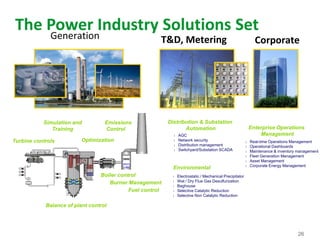
The Power Industry Solutions Set
Generation T&D, Metering Corporate
l AGC
l Network security
l Distribution management
l Switchyard/Substation SCADA
Distribution & Substation
Automation Enterprise Operations
Management
l Real-time Operations Management
l Operational Dashboards
l Maintenance & inventory management
l Fleet Generation Management
l Asset Management
l Corporate Energy Management
Environmental
l Electrostatic / Mechanical Precipitator
l Wet / Dry Flue Gas Desulfurization
l Baghouse
l Selective Catalytic Reduction
l Selective Non Catalytic Reduction
Burner Management
Balance of plant control
Boiler control
Turbine controls
Fuel control
Simulation and
Training
Optimization
Emissions
Control
27
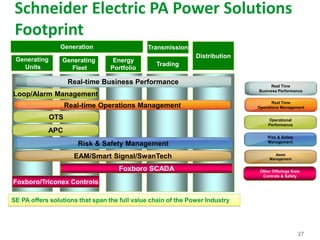
Schneider Electric PA Power Solutions
Footprint
Generating
Units
Energy
Portfolio
OTS
APC
Risk & Safety Management
Foxboro/Triconex Controls
Generation Transmission
Distribution
Foxboro SCADA
EAM/Smart Signal/SwanTech
Real-time Operations Management
Loop/Alarm Management
Real-time Business Performance
Generating
Fleet
Trading
SE PA offers solutions that span the full value chain of the Power Industry
Asset
Management
Risk & Safety
Management
Operational
Performance
Real Time
Operations Management
Real Time
Business Performance
Other Offerings from
Controls & Safety
28
SE PA Solutions for Power
1. I/A Series Distributed Control System
2. Safety Solutions
-Triconex In Power Plant
3. Fleet Generation Management System
4. PADO – Performance Monitoring and
Diagnostic Optimization and PRISM
Offerings
5. Advanced Process Controls – Connoisseur
for the Power Industry
6. Operator Training Simulator
7. Invensys Life Cycle Management Program

Schneider process automation power industry solutions

  • 1.
    1 Schneider Process AutomationPower Industry Solutions` Power plant basics – An overview By Rodney Berg Page 1 Confidential Property of Schneider Electric |
  • 2.
  • 3.
    3 Components of aPower Plant > Key 1. Cooling tower 10. Steam governor valve 19. Superheater 2. Cooling water pump 11. High pressure turbine 20. Forced draught fan 3. Transmission line (3-phase) 12. Deaerator 21. Reheater 4. Unit transformer (3-phase) 13. Feed heater 22. Air intake 5. Electric generator (3-phase) 14. Coal conveyor 23. Economizer 6. Low pressure turbine 15. Coal hopper 24. Air preheater 7. Condensate pump 16. Pulverized fuel mill 25. Precipitator 8. Condenser 17. Boiler drum 26. Induced draught fan 9. Intermediate pressure turbine 18. Ash hopper 27. Chimney Stack
  • 4.
    4 Boiler types RBE RBCBenson UP Power output 60 to 800MW 50 to 1000MW 75MW and over 350MW and over Main steam press. Main steam Temp. Boiler type Natural circulation Once-through Subcritical Subcritical / supercritical up to 566ºC up to 630ºC
  • 5.
    5 How a coal-firedplant works
  • 6.
    6 Process description …. 1.Coal Supply – Coal fed and then crushed and fed through the conveyor belt to the plant 2. Coal Mill – The coal is fine crushed and fed to the boiler along with air for combustion 3. Boiler – The de-mineralized water fed through the boiler tubes is converted into steam from the heat from the combustion process. 4. Precipitator & Stack – The exhaust from the boiler is released into the atmosphere after it passes through the precipitator which removes the fly ash before the flue gases are dispatched to the atmosphere 5. Turbine, Generator - The hot steam from the Boiler is passed through the turbine HP section and it hits the blades at 540 0C and 130 Kg Bar Pressure causing the turbine to rotate rapidly. This causes the generator which is coupled to the turbine to rotate its shaft producing electric current. 6. Cooling Water System – The steam discharged from the turbine is cooled with cooling water in the condensers. The cold water is heated by the steam and again fed to the boiler to to start the generation process again. 7. Water Treatment Plant – This is for purification of the water being fed to the boiler to reduce sludge etc. 8. Precipitators , Ash System – The fly ash and bottom ash are removed from plants and hauled to disposal site or ash lagoons. 9. Substation, Transformer, Transformer lines – Once the electricity is generated transformers increase the voltage so that it can be carried across the transmission lines. 10. The electricity voltage is again reduced to be fed to the cities and towns at substations.
  • 7.
    7 Bottom Ash System Economizer Hoppers F D Fan BOTTOM ASH HOPPER Coal Bunker Conveyors Pulverizers Load Gen.HP IPL P Turbine Econ- omizer Re- Heat Super Heater DRUM Condenser P A Fan ID Fan HP FW Htr LP FW Htr Ash Transfer Precipitators Stack Gas Scrubber Emissions Monitor Flyash Cond. Pump BFP Deaerator Cooling Water Feeder Downcomers Risers Air Heater Power Plant Detailed Process Map Water Vapor & Scrubbed Gases General Water Sump WATER TREATMENT Settling Pond
  • 8.
    8 Power Plants -Basic Control Loops Combustion Control > Fuel Control  Coal or Gas or Oil or Combinations > Air Flow Control  Forced Draft Fan Control Furnace Draft Control > Induced Draft Fan Controls Feed-water Control > BFP (Boiler Feed-water Pump) Control > Feed-water Valve Control Steam Temperature Control > Spray (attemperator) Valve Controls > Damper Controls > Gas Recirculation Fan Controls
  • 9.
    9 Boiler Schematic Fuel Sec air Reheat steam SHsteam Concentration CO O2 NOx Furnace temp. Exhaust temperature
  • 10.
    10 ADS Interface Unit Master Boiler Master Fuel Master Air Steam Temp Feedwater Boiler Turbine Turbine Master Mill1 Mill n ID Fans FD Fans Furnace Draft S-heat Spray R-heat Spray BF- Pump Turbine Valves Load Demand Boiler Control System – Modulating Control
  • 11.
    11 Bottom Ash System Economizer Hoppers F D Fan BOTTOM ASH HOPPER Coal Bunker Conveyors Pulverizers Load Gen.HP IPL P Turbine Econ- omizer Re- Heat Super Heater DRUM Condenser P A Fan ID Fan HP FW Htr LP FW Htr Ash Transfer Precipitators Stack Gas Scrubber Emissions Monitor Flyash Cond. Pump BFP Deaerator Cooling Water Feeder Downcomers Risers Air Heater Power Plant Detailed Process Map Water Vapor & Scrubbed Gases General Water Sump WATER TREATMENT Settling Pond Boiler Control
  • 12.
    12 Boiler Controls Following arethe major control areas in a Boiler > Supply of water to the boiler, > Combustion of fuel in the furnace, > Steam pressure > Steam temperature, and > Furnace pressure, are all a part Now as a Instrumentation and controls supplier we should be able to do the above with our DCS system
  • 13.
    13 Power Plant OperationModes Normal Mode • This is also known as the turbine-leading-boiler mode or (Boiler-lagging). As its name implies, it is normally the preferred mode of operation, as it is designed to serve the needs of the power grid. • If this mode is selected, the unit’s operator specifies generator electrical output as the set-point: the operator sets the target electric power output [say, in MW, or in % of Full Power (FP)], and the target rate of change of power [e.g., in % FP/s]. • The control program (running in the station computer) is called the Unit Power Regulator (UPR). • The UPR continuously compares the actual generator power to the setpoint. Alternate Mode • This is also known as the boiler-leading-turbine mode (or turbine-lagging). This is not normally the preferred mode of operation, but is used under certain circumstances, especially if the reactor power has to be strictly controlled. • If this mode is selected, the unit’s operator specifies reactor power as the setpoint: the operator sets the target reactor power output [say, in % of reactor Full Power (FP)], and the target rate of change of reactor power [e.g., in % FP/s]. • The RRS continuously compares the actual reactor power to the setpoint. • If there is a difference, there is a “reactor-power error”. Invensys proprietary
  • 14.
    14 Power Plants –Advanced Control Loops Advanced Control > Like Boiler Optimization > Soot Blower Optimization > NOx Reduction > Data Acquisition Systems Plant Performance Calculations > Boiler and Turbine Efficiency Calculations > Energy Management (Load Dispatch) Systems > Load Shedding schemes > Energy control and Management Systems
  • 15.
    15 Power Plants -Additional Control LoopsBalance of Plant Controls (Miscellaneous Controls) > Water Inventory Controls  Deareator Level Control  Hot Well Level Controls  Condensate Flow Controls > Turbine Cooling Oil Temperature Controls > Generator Cooling Oil Temperature Controls > Air Pre-Heater Temperature (Cold End Temperature) Controls Water Treatment Plant Controls Cooling Tower Controls Fuel Handling > Coal Handling > Fuel Oil, pressure, flow, & temperature control > Gas pressure control
  • 16.
    16 Bottom Ash System Economizer Hoppers F D Fan BOTTOM ASH HOPPER Coal Bunker Conveyors Pulverizers Load Gen.HP IPL P Turbine Econ- omizer Re- Heat Super Heater DRUM Condenser P A Fan ID Fan HP FW Htr LP FW Htr Ash Transfer Precipitators Stack Gas Scrubber Emissions Monitor Flyash Cond. Pump BFP Deaerator Cooling Water Feeder Downcomers Risers Air Heater Power Plant Detailed Process Map Water Vapor & Scrubbed Gases General Water Sump WATER TREATMENT Settling Pond Emissions Monitoring
  • 17.
    17 Power Plants -Emission Control Systems Power Plant Emissions > Particulate Matter Fly-ash > Sulfur Oxides SO2 - Sulfur Dioxide > Nitrogen Oxides NOx - Nitrogen oxides
  • 18.
    18 Power Plant Emissions Controlof Power Plant Emissions > ESP’s - Electrostatic Precipitators > FF’s - Fabric Filters (Bag Houses) > FGD’s - Flue Gas Desulfurization Systems (Scrubbers) > SCR’s - Selective Catalytic Reduction
  • 19.
    19 FGD’s – FlueGas Desulphurization • Flue gas desulphurization, or “scrubbing,” is a complex process that uses lime or limestone to absorb sulfur dioxide emissions before they can be released into the air, making the power plant a cleaner energy producer. • With environmental regulations getting continuously stricter, effective FGD systems are crucial for SO2 compliance. • A number of variables can affect the performance and cost efficiency of a flue gas scrubber, including lime slurry flow, pH levels, oxidation levels, and even stack temperature.
  • 20.
    20 Combined Cycle PowerPlant A combined cycle is a combination of two or more thermal cycles within a single power plant, where the intention is to increase the efficiency over that of the single cycles That is, 2 stand alone inefficient (~30%) energy cycles put together in the right way yields 1 reasonably efficient (~60%) energy cycle.
  • 21.
    21 Two Cycles PutTogether - Thermodynamics
  • 22.
    22 Why Combined CyclePower Plants? • Highest efficiency of any power plant (approaching 60%) • Lowest emissions of any current fossil fuel power plant • Lowest installed and operational costs for power generation • High levels of operational flexibility • Shorter lead times than conventional fossil-fuel-fired steam plant • Suitability for highly efficient co-production schemes • Option of using coal and other fuels via gasification
  • 23.
  • 24.
    24 Power Industry Technology Coal-firedpower plant Coal Boiler Steam turbine and generator Dust collecto r Combustion system Desulphurisation system Denitrification system HRSG Gas Turbine Control Systems Generator Steam Turbine Combined cycle power plant Hydro power plant Nuclear power plant Geothermal power plant
  • 25.
    25 l Drum/Once-Through/Fluidized Bed lCoordinated control l Combustion l Drum level l Furnace pressure l Steam temperature l Load runback l Load block Enterprise Operations Management l Real-time Operations Management l Operational Dashboards l Maintenance & inventory management l Fleet Generation Management l Asset Management Environmental control l Electrostatic / Mechanical Precipitator l Wet / Dry Flue Gas Desulfurization l Baghouse l Selective Catalytic Reduction l Selective Non Catalytic Reduction Burner Management l Auto-purge & pre-light l Emergency shutdown protection l Burner-pulverizer automation l Boiler control integration l Burner-front equipment Balance of plant control l BFP Turbine Control l Condensate control l Condenser hotwell l Feedwater heaters l Make-up water l Turbine lube oil temperature l Generator H2 temperature l Automatic Sootblowing l Motor logic l Steam coil air heater l Switchyard Boiler control Turbine controls l Speed governor l Frequency governor l Overspeed protection l On-line valve test l Auto-synchronization l Automatic startup l Vibration Monitoring l Hydraulics Fuel control l Gas l Oil l Coal Unloader Crushing Drying Stacker Reclaimer Simulators l High fidelity l Operator training l Control Checkout l Loop tieback Data acquisition l Generation optimization l AGC l Network security l Distribution management l Switchyard/Substation SCADA Optimization l Heat Rate l Emissions l Smart Sootblowing l Steam Temperature Generation, Distribution & Substation Automation l Aim*Historian l Periodic Logs l Sequence of Event l Post Event Review l Equipment Run Time l Tag Out l Group Measurement Display l Performance Calculations l Controllable Losses l Loop / Alarm Management Power Industry Applications overview Asset Management Risk & Safety Management Operational Performance Real Time Operations Management Real Time Business Performance
  • 26.
    26 The Power IndustrySolutions Set Generation T&D, Metering Corporate l AGC l Network security l Distribution management l Switchyard/Substation SCADA Distribution & Substation Automation Enterprise Operations Management l Real-time Operations Management l Operational Dashboards l Maintenance & inventory management l Fleet Generation Management l Asset Management l Corporate Energy Management Environmental l Electrostatic / Mechanical Precipitator l Wet / Dry Flue Gas Desulfurization l Baghouse l Selective Catalytic Reduction l Selective Non Catalytic Reduction Burner Management Balance of plant control Boiler control Turbine controls Fuel control Simulation and Training Optimization Emissions Control
  • 27.
    27 Schneider Electric PAPower Solutions Footprint Generating Units Energy Portfolio OTS APC Risk & Safety Management Foxboro/Triconex Controls Generation Transmission Distribution Foxboro SCADA EAM/Smart Signal/SwanTech Real-time Operations Management Loop/Alarm Management Real-time Business Performance Generating Fleet Trading SE PA offers solutions that span the full value chain of the Power Industry Asset Management Risk & Safety Management Operational Performance Real Time Operations Management Real Time Business Performance Other Offerings from Controls & Safety
  • 28.
    28 SE PA Solutionsfor Power 1. I/A Series Distributed Control System 2. Safety Solutions -Triconex In Power Plant 3. Fleet Generation Management System 4. PADO – Performance Monitoring and Diagnostic Optimization and PRISM Offerings 5. Advanced Process Controls – Connoisseur for the Power Industry 6. Operator Training Simulator 7. Invensys Life Cycle Management Program