ED 104 Statistics with
Computer Applications
University of Antique
Sibalom, Antique - 22 February 2021
Chapter 2- Data Presentation and Organization
Large data are hard to comprehend unless organized. The most useful method of
presenting data is by constructing statistical charts and graphs, in this lesson we will be able
to learn the following:
1. Summarise and present data by constructing charts and graphs;
2. Organize data by constructing frequency distribution table;
Lesson 1. Data Presentation
Data can be presented in several ways— textual, tabular, and graphical presentations.
In the textual form, the researcher uses the sentences to convey the information
contained in the data. This is incorporated with important figures only. Textual form of
presentation can be seen in news reports. For example, an excerpt from news article:
“The new COVID positives increased the region’s cumulative total to 6,884 with 3,194 active
cases. Bacolod City still logged the highest number of new cases with 106 while Negros Occidental has
53. Iloilo City has 45; Iloilo Province, 25; Capiz, 20; Aklan has two; and one each in Antique and
Guitars. Local cases totalled 238, of whom 11 are locally stranded individuals (LSIs), twi are returning
overseas Filipinos, and another two are authorised persons outside of residence.” (Source: http://
www.pna.gov.ph/articles/1115061)
In the tabular form, the data are presented in rows and columns. This systematic
arrangement of data is called a statistical table. Through this presentation, data can easily be
understood. In addition, you can easily compare and contrast the data.
A good statistical table has four essential parts:
ED 104 - DR. MAGBANUA 1
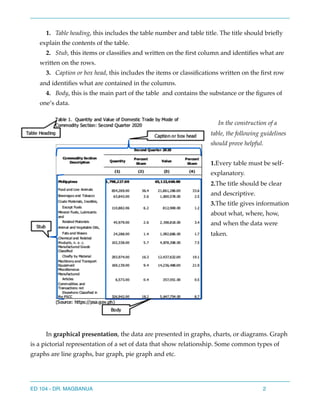
1. Table heading, this includes the table number and table title. The title should briefly
explain the contents of the table.
2. Stub, this items or classifies and written on the first column and identifies what are
written on the rows.
3. Caption or box head, this includes the items or classifications written on the first row
and identifies what are contained in the columns.
4. Body, this is the main part of the table and contains the substance or the figures of
one’s data.
In the construction of a
table, the following guidelines
should prove helpful.
1.Every table must be self-
explanatory.
2.The title should be clear
and descriptive.
3.The title gives information
about what, where, how,
and when the data were
taken.
In graphical presentation, the data are presented in graphs, charts, or diagrams. Graph
is a pictorial representation of a set of data that show relationship. Some common types of
graphs are line graphs, bar graph, pie graph and etc.
ED 104 - DR. MAGBANUA 2
Types of Graphs
Line Graph
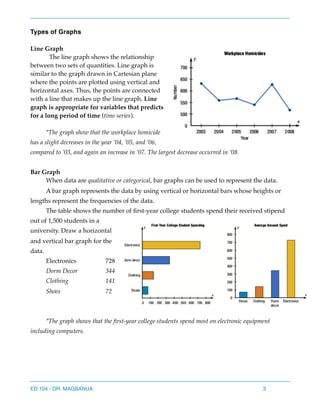
The line graph shows the relationship
between two sets of quantities. Line graph is
similar to the graph drawn in Cartesian plane
where the points are plotted using vertical and
horizontal axes. Thus, the points are connected
with a line that makes up the line graph. Line
graph is appropriate for variables that predicts
for a long period of time (time series).
*The graph show that the workplace homicide
has a slight decreases in the year ’04, ’05, and ’06,
compared to ’03, and again an increase in ’07. The largest decrease occurred in ’08.
Bar Graph
When data are qualitative or categorical, bar graphs can be used to represent the data.
A bar graph represents the data by using vertical or horizontal bars whose heights or
lengths represent the frequencies of the data.
The table shows the number of first-year college students spend their received stipend
out of 1,500 students in a
university. Draw a horizontal
and vertical bar graph for the
data.
Electronics 728
Dorm Decor 344
Clothing 141
Shoes 72
*The graph shows that the first-year college students spend most on electronic equipment
including computers.
ED 104 - DR. MAGBANUA 3
Pie Graph
Pie graphs are used purposively to show the
relationship of the parts to the whole by visually comparing
the sizes of the sections. Percentages or proportions can be
used. The variable is nominal or categorical.
A pie graph s a circle that is divided into sections or
wedges according to the percentage of frequencies in each
category of the distribution.
To analyze the nature of the data shown in the pie
graph, look at the size of the sections in the pie graph. For
example, are any sections relatively large compared to the
rest?
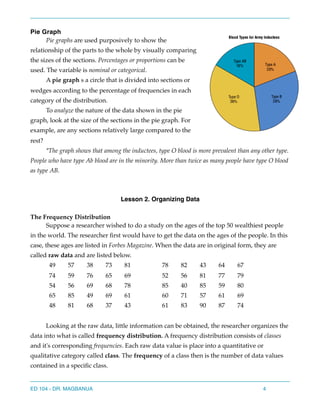
*The graph shows that among the inductees, type O blood is more prevalent than any other type.
People who have type Ab blood are in the minority. More than twice as many people have type O blood
as type AB.
Lesson 2. Organizing Data
The Frequency Distribution
Suppose a researcher wished to do a study on the ages of the top 50 wealthiest people
in the world. The researcher first would have to get the data on the ages of the people. In this
case, these ages are listed in Forbes Magazine. When the data are in original form, they are
called raw data and are listed below.
49 57 38 73 81 78 82 43 64 67
74 59 76 65 69 52 56 81 77 79
54 56 69 68 78 85 40 85 59 80
65 85 49 69 61 60 71 57 61 69
48 81 68 37 43 61 83 90 87 74
Looking at the raw data, little information can be obtained, the researcher organizes the
data into what is called frequency distribution. A frequency distribution consists of classes
and it's corresponding frequencies. Each raw data value is place into a quantitative or
qualitative category called class. The frequency of a class then is the number of data values
contained in a specific class.
ED 104 - DR. MAGBANUA 4
Types of frequency distributions that are most often used are the categorical frequency
distribution, ungrouped frequency distribution and the grouped frequency distribution.
The categorical frequency distribution is used for data that can be placed in specific
categories, such as nominal - or ordinal-level data. For example, data such as political
affiliation, religious affiliation, or major field of study would use categorical frequency
distributions.
Example: Twenty-five officer inductees were given a blood test to determine their blood
type. Construct a frequency distribution using the data set below.
A B B AB O
O O B AB B
B B O A O
A O O O AB
AB A O B A
Solution:
Since the data are categorical, discrete classes can be used. There are four blood types:
A, B, O, and AB. These types will be used as the classes for the distribution.
Step 1. Make a table as shown
Step 2. Tally the data and place the result in column B.
Step 3. Count the tallies and place the result in column C.
Step 4. Find the percentage of values in each class by using the formula %= ! %
where ! = frequency of the class and ! = total number of values.
Step 5. Find the total for column C (frequency) and D (percent). The completed table is
shown below.
A
Class
B
Tally
C
Frequency
D
Percent
A
B
O
AB
f
n
⋅ 100
f n
ED 104 - DR. MAGBANUA 5
*For the sample, more people have type O
blood than any other type
When the raw data are measured on a quantitative scale, with interval or ratio,
categories or classes must be designed for the data values before a frequency distribution can
be formulated. The data are grouped into classes that more that one unit in width, called a
grouped frequency distribution.
The procedure in constructing grouped frequency distribution.
Step 1. Determine the number of classes. There should be between 5 and 20 classes, to have
enough classes to present a clear description of the collected data.
Step 2. Determine the size of each class. That is, finding the range (Highest value-Lowest
value) of the data divided by the number of classes determined in step 1.
It is preferably but not absolutely necessary that the class width be an odd
number. This ensures that the midpoint of each class has the same place value as the
data. The class midpoint ! is obtained by adding the lower and upper boundaries
and dividing by 2. The classes must be mutually exclusive or have non overlapping
class limits so that data cannot be placed into two classes. The classes must be
continuous, even if there are no values in a class. It should also be exhaustive that can
accommodate all the data. Finally, classes must be equal in width. This is to avoid
distortion view of the data.
Step 3. Determine the starting point for the first class. Can start with the lowest value in the
data or others are using a number divisible by the class size less than or equal to the lowest
value in the data. Then, identify the class limits using the class width or size in Step2.
Step 4. Tally the number of values that occur in each class.
Step 5. Prepare a table of the distribution using actual counts and/or percentages (relative
frequencies)
Let us construct a frequency distribution using the data above — ages of wealthiest
people
49 57 38 73 81 78 82 43 64 67
74 59 76 65 69 52 56 81 77 79
54 56 69 68 78 85 40 85 59 80
65 85 49 69 61 60 71 57 61 69
48 81 68 37 43 61 83 90 87 74
Solution:
Step 1. Say we wanted to have 8 categories of ages.
Xm
ED 104 - DR. MAGBANUA 6
Step 2. Range = 90 - 37= 53 ⇒ ! . Class width/class size is 7
Step 3. Since 37 is the lowest age, we will start at 35 which is divisible by 7 and lower
than 37 and create the class limits with class size 7.
Step 4. Tally each age in each class limits it belongs.
Step 5. Then you are ready to complete the table.
Below is the distribution of categories of ages of wealthiest person
*Now, the observations can
be made from looking at the
frequency distribution. In this table,
majority of the wealthy people in the
study are over 55 years old.
The classes in this distribution are 35-41, 42-48, etc. These values are called class limits.
In the class limit 35-41, the lower class limit is 35; it represents the smallest data value that
can be included in the class, while the upper class limit is 41; it represents the largest data
value that can be included in the class.
The class boundaries are used to separate the classes so that there are no gaps in the
frequency distribution. The gaps are due to the limits; for example there is a gap between 41
and 42.
In finding the boundaries, we subtract 0.5 from the lower class limit of 35-41 and
adding 0.5 to upper class limit of 35-41. To compute, lower limit - 0.5→! →
lower boundary; Upper limit +0.5→ ! →upper boundary. Complete the table that
follows:
Class limits Class boundaries Class limits Class boundaries
35 — 41 34.5 - 41.5 63 - 69 __________
42 — 48 41.5 - 48. 5 70 - 76 __________
49 — 55 __________ 77 - 83 __________
56 — 62 __________ 84 - 90 __________
53
8
= 6.625 ∼ 7
35 − 0.5 = 34.5
41 + 0.5 = 41.5
ED 104 - DR. MAGBANUA 7
The midpoint can be identified in each class limits. Using the definition above, the
midpoint of the class limit 35 - 41 would be ! . Following the same
process, complete the table below.
Class limits ! Class limits !
35 — 41 38 63 — 69 __________
42 — 48 45 70 - 76 __________
49 — 55 __________ 77 - 83 __________
56 — 62 __________ 84 - 90 __________
*Generally, this is the frequency distribution table format.
The percent can be computed by the frequency of each class limits divided by the total
frequency, then the result will be multiplied by 100. Say, in the class limit 35 — 41, the
frequency is 3 and the total frequency is 50, the percent therefore is ! %.
Lesson 3. Histogram, Frequency Polygons, and Ogives
After you organized data into a frequency distribution, you can present them in
graphical form. The purpose of graphs in statistics is to convey the data to the viewers in
pictorial form. It is easier for most people to comprehend the meaning of data presented
graphically than data presented numerically in tables or frequency distributions.
The three most commonly used graphs in research are
1. Histogram
2. The frequency polygon
3. The cumulative frequency graph, or ogive.
Xm =
35 + 41
2
= 38
Xm Xm
Class limits Tally Frequency (f) Percent
3
50
= 0.06x100 = 6
ED 104 - DR. MAGBANUA 8
Histogram
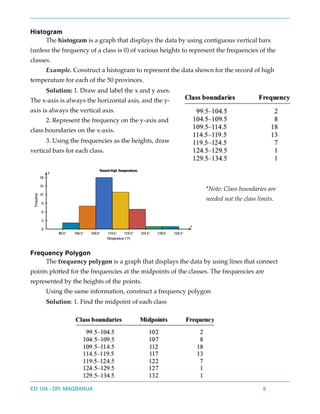
The histogram is a graph that displays the data by using contiguous vertical bars
(unless the frequency of a class is 0) of various heights to represent the frequencies of the
classes.
Example. Construct a histogram to represent the data shown for the record of high
temperature for each of the 50 provinces.
Solution: 1. Draw and label the x and y axes.
The x-axis is always the horizontal axis, and the y-
axis is always the vertical axis.
2. Represent the frequency on the y-axis and
class boundaries on the x-axis.
3. Using the frequencies as the heights, draw
vertical bars for each class.
*Note: Class boundaries are
needed not the class limits.
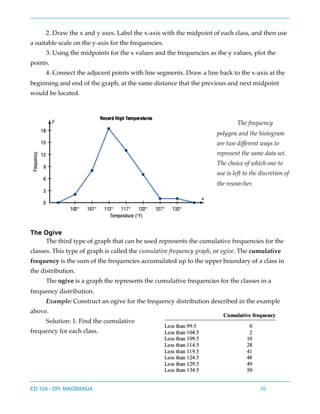
Frequency Polygon
The frequency polygon is a graph that displays the data by using lines that connect
points plotted for the frequencies at the midpoints of the classes. The frequencies are
represented by the heights of the points.
Using the same information, construct a frequency polygon
Solution: 1. Find the midpoint of each class
ED 104 - DR. MAGBANUA 9
2. Draw the x and y axes. Label the x-axis with the midpoint of each class, and then use
a suitable scale on the y-axis for the frequencies.
3. Using the midpoints for the x values and the frequencies as the y values, plot the
points.
4. Connect the adjacent points with line segments. Draw a line back to the x-axis at the
beginning and end of the graph, at the same distance that the previous and next midpoint
would be located.
The frequency
polygon and the histogram
are two different ways to
represent the same data set.
The choice of which one to
use is left to the discretion of
the researcher.
The Ogive
The third type of graph that can be used represents the cumulative frequencies for the
classes. This type of graph is called the cumulative frequency graph, or ogive. The cumulative
frequency is the sum of the frequencies accumulated up to the upper boundary of a class in
the distribution.
The ogive is a graph the represents the cumulative frequencies for the classes in a
frequency distribution.
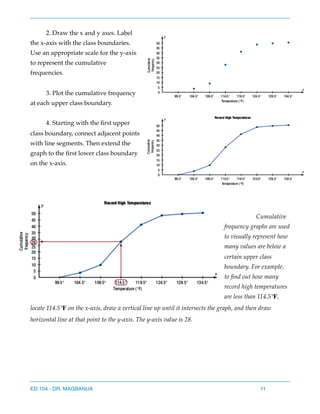
Example: Construct an ogive for the frequency distribution described in the example
above.
Solution: 1. Find the cumulative
frequency for each class.
ED 104 - DR. MAGBANUA 10
2. Draw the x and y axes. Label
the x-axis with the class boundaries.
Use an appropriate scale for the y-axis
to represent the cumulative
frequencies.
3. Plot the cumulative frequency
at each upper class boundary.
4. Starting with the first upper
class boundary, connect adjacent points
with line segments. Then extend the
graph to the first lower class boundary
on the x-axis.
Cumulative
frequency graphs are used
to visually represent how
many values are below a
certain upper class
boundary. For example,
to find out how many
record high temperatures
are less than 114.5°𝐅,
locate 114.5°𝐅 on the x-axis, draw a vertical line up until it intersects the graph, and then draw
horizontal line at that point to the y-axis. The y-axis value is 28.
ED 104 - DR. MAGBANUA 11
Exercise 01.
A. Using the graph below, answer the questions that follow.
1. What are the variables in the graph?
2. Are the variables qualitative or quantitative?
3. Are the variables discrete or continuous?
4. Could a pie chart be used to display the data?
B. State which graph would most appropriately represent the given situation.
1. The number of students enrolled at a local college for each year during the last 5 years.
2. The frequency of each type of crime committed in a city during the year.
3. The means of transportation the students use to get to school.
4. The percentage of votes each of the candidates received in the last election.
5. The record temperatures of a city for the last 30 years.
ED 104 - DR. MAGBANUA 12

2. week 2 data presentation and organization

  • 1.
    ED 104 Statisticswith Computer Applications University of Antique Sibalom, Antique - 22 February 2021 Chapter 2- Data Presentation and Organization Large data are hard to comprehend unless organized. The most useful method of presenting data is by constructing statistical charts and graphs, in this lesson we will be able to learn the following: 1. Summarise and present data by constructing charts and graphs; 2. Organize data by constructing frequency distribution table; Lesson 1. Data Presentation Data can be presented in several ways— textual, tabular, and graphical presentations. In the textual form, the researcher uses the sentences to convey the information contained in the data. This is incorporated with important figures only. Textual form of presentation can be seen in news reports. For example, an excerpt from news article: “The new COVID positives increased the region’s cumulative total to 6,884 with 3,194 active cases. Bacolod City still logged the highest number of new cases with 106 while Negros Occidental has 53. Iloilo City has 45; Iloilo Province, 25; Capiz, 20; Aklan has two; and one each in Antique and Guitars. Local cases totalled 238, of whom 11 are locally stranded individuals (LSIs), twi are returning overseas Filipinos, and another two are authorised persons outside of residence.” (Source: http:// www.pna.gov.ph/articles/1115061) In the tabular form, the data are presented in rows and columns. This systematic arrangement of data is called a statistical table. Through this presentation, data can easily be understood. In addition, you can easily compare and contrast the data. A good statistical table has four essential parts: ED 104 - DR. MAGBANUA 1
  • 2.
    1. Table heading,this includes the table number and table title. The title should briefly explain the contents of the table. 2. Stub, this items or classifies and written on the first column and identifies what are written on the rows. 3. Caption or box head, this includes the items or classifications written on the first row and identifies what are contained in the columns. 4. Body, this is the main part of the table and contains the substance or the figures of one’s data. In the construction of a table, the following guidelines should prove helpful. 1.Every table must be self- explanatory. 2.The title should be clear and descriptive. 3.The title gives information about what, where, how, and when the data were taken. In graphical presentation, the data are presented in graphs, charts, or diagrams. Graph is a pictorial representation of a set of data that show relationship. Some common types of graphs are line graphs, bar graph, pie graph and etc. ED 104 - DR. MAGBANUA 2
  • 3.
    Types of Graphs LineGraph The line graph shows the relationship between two sets of quantities. Line graph is similar to the graph drawn in Cartesian plane where the points are plotted using vertical and horizontal axes. Thus, the points are connected with a line that makes up the line graph. Line graph is appropriate for variables that predicts for a long period of time (time series). *The graph show that the workplace homicide has a slight decreases in the year ’04, ’05, and ’06, compared to ’03, and again an increase in ’07. The largest decrease occurred in ’08. Bar Graph When data are qualitative or categorical, bar graphs can be used to represent the data. A bar graph represents the data by using vertical or horizontal bars whose heights or lengths represent the frequencies of the data. The table shows the number of first-year college students spend their received stipend out of 1,500 students in a university. Draw a horizontal and vertical bar graph for the data. Electronics 728 Dorm Decor 344 Clothing 141 Shoes 72 *The graph shows that the first-year college students spend most on electronic equipment including computers. ED 104 - DR. MAGBANUA 3
  • 4.
    Pie Graph Pie graphsare used purposively to show the relationship of the parts to the whole by visually comparing the sizes of the sections. Percentages or proportions can be used. The variable is nominal or categorical. A pie graph s a circle that is divided into sections or wedges according to the percentage of frequencies in each category of the distribution. To analyze the nature of the data shown in the pie graph, look at the size of the sections in the pie graph. For example, are any sections relatively large compared to the rest? *The graph shows that among the inductees, type O blood is more prevalent than any other type. People who have type Ab blood are in the minority. More than twice as many people have type O blood as type AB. Lesson 2. Organizing Data The Frequency Distribution Suppose a researcher wished to do a study on the ages of the top 50 wealthiest people in the world. The researcher first would have to get the data on the ages of the people. In this case, these ages are listed in Forbes Magazine. When the data are in original form, they are called raw data and are listed below. 49 57 38 73 81 78 82 43 64 67 74 59 76 65 69 52 56 81 77 79 54 56 69 68 78 85 40 85 59 80 65 85 49 69 61 60 71 57 61 69 48 81 68 37 43 61 83 90 87 74 Looking at the raw data, little information can be obtained, the researcher organizes the data into what is called frequency distribution. A frequency distribution consists of classes and it's corresponding frequencies. Each raw data value is place into a quantitative or qualitative category called class. The frequency of a class then is the number of data values contained in a specific class. ED 104 - DR. MAGBANUA 4
  • 5.
    Types of frequencydistributions that are most often used are the categorical frequency distribution, ungrouped frequency distribution and the grouped frequency distribution. The categorical frequency distribution is used for data that can be placed in specific categories, such as nominal - or ordinal-level data. For example, data such as political affiliation, religious affiliation, or major field of study would use categorical frequency distributions. Example: Twenty-five officer inductees were given a blood test to determine their blood type. Construct a frequency distribution using the data set below. A B B AB O O O B AB B B B O A O A O O O AB AB A O B A Solution: Since the data are categorical, discrete classes can be used. There are four blood types: A, B, O, and AB. These types will be used as the classes for the distribution. Step 1. Make a table as shown Step 2. Tally the data and place the result in column B. Step 3. Count the tallies and place the result in column C. Step 4. Find the percentage of values in each class by using the formula %= ! % where ! = frequency of the class and ! = total number of values. Step 5. Find the total for column C (frequency) and D (percent). The completed table is shown below. A Class B Tally C Frequency D Percent A B O AB f n ⋅ 100 f n ED 104 - DR. MAGBANUA 5
  • 6.
    *For the sample,more people have type O blood than any other type When the raw data are measured on a quantitative scale, with interval or ratio, categories or classes must be designed for the data values before a frequency distribution can be formulated. The data are grouped into classes that more that one unit in width, called a grouped frequency distribution. The procedure in constructing grouped frequency distribution. Step 1. Determine the number of classes. There should be between 5 and 20 classes, to have enough classes to present a clear description of the collected data. Step 2. Determine the size of each class. That is, finding the range (Highest value-Lowest value) of the data divided by the number of classes determined in step 1. It is preferably but not absolutely necessary that the class width be an odd number. This ensures that the midpoint of each class has the same place value as the data. The class midpoint ! is obtained by adding the lower and upper boundaries and dividing by 2. The classes must be mutually exclusive or have non overlapping class limits so that data cannot be placed into two classes. The classes must be continuous, even if there are no values in a class. It should also be exhaustive that can accommodate all the data. Finally, classes must be equal in width. This is to avoid distortion view of the data. Step 3. Determine the starting point for the first class. Can start with the lowest value in the data or others are using a number divisible by the class size less than or equal to the lowest value in the data. Then, identify the class limits using the class width or size in Step2. Step 4. Tally the number of values that occur in each class. Step 5. Prepare a table of the distribution using actual counts and/or percentages (relative frequencies) Let us construct a frequency distribution using the data above — ages of wealthiest people 49 57 38 73 81 78 82 43 64 67 74 59 76 65 69 52 56 81 77 79 54 56 69 68 78 85 40 85 59 80 65 85 49 69 61 60 71 57 61 69 48 81 68 37 43 61 83 90 87 74 Solution: Step 1. Say we wanted to have 8 categories of ages. Xm ED 104 - DR. MAGBANUA 6
  • 7.
    Step 2. Range= 90 - 37= 53 ⇒ ! . Class width/class size is 7 Step 3. Since 37 is the lowest age, we will start at 35 which is divisible by 7 and lower than 37 and create the class limits with class size 7. Step 4. Tally each age in each class limits it belongs. Step 5. Then you are ready to complete the table. Below is the distribution of categories of ages of wealthiest person *Now, the observations can be made from looking at the frequency distribution. In this table, majority of the wealthy people in the study are over 55 years old. The classes in this distribution are 35-41, 42-48, etc. These values are called class limits. In the class limit 35-41, the lower class limit is 35; it represents the smallest data value that can be included in the class, while the upper class limit is 41; it represents the largest data value that can be included in the class. The class boundaries are used to separate the classes so that there are no gaps in the frequency distribution. The gaps are due to the limits; for example there is a gap between 41 and 42. In finding the boundaries, we subtract 0.5 from the lower class limit of 35-41 and adding 0.5 to upper class limit of 35-41. To compute, lower limit - 0.5→! → lower boundary; Upper limit +0.5→ ! →upper boundary. Complete the table that follows: Class limits Class boundaries Class limits Class boundaries 35 — 41 34.5 - 41.5 63 - 69 __________ 42 — 48 41.5 - 48. 5 70 - 76 __________ 49 — 55 __________ 77 - 83 __________ 56 — 62 __________ 84 - 90 __________ 53 8 = 6.625 ∼ 7 35 − 0.5 = 34.5 41 + 0.5 = 41.5 ED 104 - DR. MAGBANUA 7
  • 8.
    The midpoint canbe identified in each class limits. Using the definition above, the midpoint of the class limit 35 - 41 would be ! . Following the same process, complete the table below. Class limits ! Class limits ! 35 — 41 38 63 — 69 __________ 42 — 48 45 70 - 76 __________ 49 — 55 __________ 77 - 83 __________ 56 — 62 __________ 84 - 90 __________ *Generally, this is the frequency distribution table format. The percent can be computed by the frequency of each class limits divided by the total frequency, then the result will be multiplied by 100. Say, in the class limit 35 — 41, the frequency is 3 and the total frequency is 50, the percent therefore is ! %. Lesson 3. Histogram, Frequency Polygons, and Ogives After you organized data into a frequency distribution, you can present them in graphical form. The purpose of graphs in statistics is to convey the data to the viewers in pictorial form. It is easier for most people to comprehend the meaning of data presented graphically than data presented numerically in tables or frequency distributions. The three most commonly used graphs in research are 1. Histogram 2. The frequency polygon 3. The cumulative frequency graph, or ogive. Xm = 35 + 41 2 = 38 Xm Xm Class limits Tally Frequency (f) Percent 3 50 = 0.06x100 = 6 ED 104 - DR. MAGBANUA 8
  • 9.
    Histogram The histogram isa graph that displays the data by using contiguous vertical bars (unless the frequency of a class is 0) of various heights to represent the frequencies of the classes. Example. Construct a histogram to represent the data shown for the record of high temperature for each of the 50 provinces. Solution: 1. Draw and label the x and y axes. The x-axis is always the horizontal axis, and the y- axis is always the vertical axis. 2. Represent the frequency on the y-axis and class boundaries on the x-axis. 3. Using the frequencies as the heights, draw vertical bars for each class. *Note: Class boundaries are needed not the class limits. Frequency Polygon The frequency polygon is a graph that displays the data by using lines that connect points plotted for the frequencies at the midpoints of the classes. The frequencies are represented by the heights of the points. Using the same information, construct a frequency polygon Solution: 1. Find the midpoint of each class ED 104 - DR. MAGBANUA 9
  • 10.
    2. Draw thex and y axes. Label the x-axis with the midpoint of each class, and then use a suitable scale on the y-axis for the frequencies. 3. Using the midpoints for the x values and the frequencies as the y values, plot the points. 4. Connect the adjacent points with line segments. Draw a line back to the x-axis at the beginning and end of the graph, at the same distance that the previous and next midpoint would be located. The frequency polygon and the histogram are two different ways to represent the same data set. The choice of which one to use is left to the discretion of the researcher. The Ogive The third type of graph that can be used represents the cumulative frequencies for the classes. This type of graph is called the cumulative frequency graph, or ogive. The cumulative frequency is the sum of the frequencies accumulated up to the upper boundary of a class in the distribution. The ogive is a graph the represents the cumulative frequencies for the classes in a frequency distribution. Example: Construct an ogive for the frequency distribution described in the example above. Solution: 1. Find the cumulative frequency for each class. ED 104 - DR. MAGBANUA 10
  • 11.
    2. Draw thex and y axes. Label the x-axis with the class boundaries. Use an appropriate scale for the y-axis to represent the cumulative frequencies. 3. Plot the cumulative frequency at each upper class boundary. 4. Starting with the first upper class boundary, connect adjacent points with line segments. Then extend the graph to the first lower class boundary on the x-axis. Cumulative frequency graphs are used to visually represent how many values are below a certain upper class boundary. For example, to find out how many record high temperatures are less than 114.5°𝐅, locate 114.5°𝐅 on the x-axis, draw a vertical line up until it intersects the graph, and then draw horizontal line at that point to the y-axis. The y-axis value is 28. ED 104 - DR. MAGBANUA 11
  • 12.
    Exercise 01. A. Usingthe graph below, answer the questions that follow. 1. What are the variables in the graph? 2. Are the variables qualitative or quantitative? 3. Are the variables discrete or continuous? 4. Could a pie chart be used to display the data? B. State which graph would most appropriately represent the given situation. 1. The number of students enrolled at a local college for each year during the last 5 years. 2. The frequency of each type of crime committed in a city during the year. 3. The means of transportation the students use to get to school. 4. The percentage of votes each of the candidates received in the last election. 5. The record temperatures of a city for the last 30 years. ED 104 - DR. MAGBANUA 12