PHOTON
CONCEPT OF
LIGHT
•The Photon Theory of Light
•Light is composed of photons. Based on the
photon theory of light, a photon is a discrete
bundle of electromagnetic energy moving at
the speed of light, has no rest mass but has
momentum and carries energy. This energy is
given to an electron upon their collision,
which causes it to move up to the next energy
level.
•The photoelectric effect refers to the ejection
of electrons from a surface of a metal in
response to light directed to the metal. Albert
Einstein proposed that light consisted of
individual photons, which interacted with the
electrons in the surface of the metal. For each
frequency or color of the incident light, each
photon carried energy.
•More electrons are ejected upon the increase
in incident light. Increasing the frequency of
light would increase the energy of the ejected
electrons. The energy carried by a photon is
directly proportional to its frequency. The
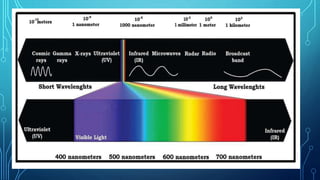
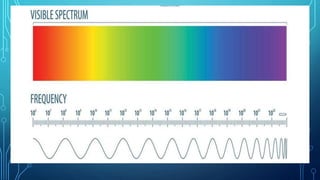
arrangement of the visible spectrum of light
shows that red color has the least frequency,
which means it also has the least energy.
•Color Spectra
Colors are not innate to objects. They give off
light that appears as colors. Colors only exist
in the human visual system and is determined
by frequencies. When light reaches the eye, it
falls into a receptor cell at the back of the eye
or retina and gives signals to the brain, which
interprets the image with colors.
•The Colors in Light
Sunlight separates into different
colors, called visible spectrum, as it
passes through a prism. The
spectrum consists of colors of the
rainbow: red, orange, yellow, green,
blue, indigo and violet colors.
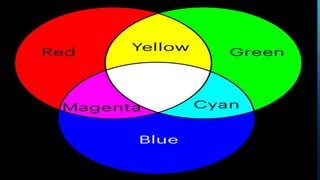
•Red, Green, and Blue are the
basic colors in light and
therefore film. The secondary
colors, Yellow, Cyan, and
Magenta, are combinations of
these. You can mix tertiary
colors (orange, violet, etc) and
all other colors from there as
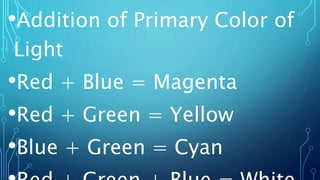
•Addition of Primary Color of
Light
•Red + Blue = Magenta
•Red + Green = Yellow
•Blue + Green = Cyan
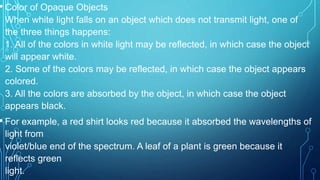
• Color of Opaque Objects
When white light falls on an object which does not transmit light, one of
the three things happens:
1. All of the colors in white light may be reflected, in which case the object
will appear white.
2. Some of the colors may be reflected, in which case the object appears
colored.
3. All the colors are absorbed by the object, in which case the object
appears black.
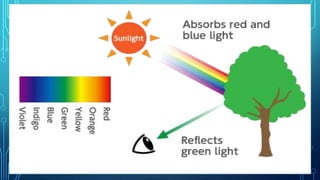
• For example, a red shirt looks red because it absorbed the wavelengths of
light from
violet/blue end of the spectrum. A leaf of a plant is green because it
reflects green
light.
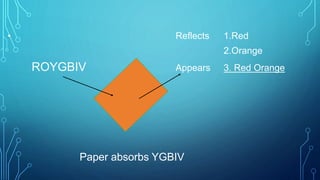
• Reflects 1.Red
2.Orange
ROYGBIV Appears 3. Red Orange
Paper absorbs YGBIV
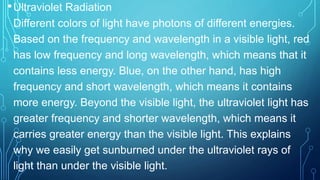
•Ultraviolet Radiation
Different colors of light have photons of different energies.
Based on the frequency and wavelength in a visible light, red
has low frequency and long wavelength, which means that it
contains less energy. Blue, on the other hand, has high
frequency and short wavelength, which means it contains
more energy. Beyond the visible light, the ultraviolet light has
greater frequency and shorter wavelength, which means it
carries greater energy than the visible light. This explains
why we easily get sunburned under the ultraviolet rays of
light than under the visible light.
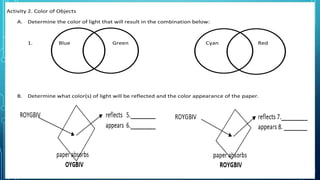
Activity 2. Color of Objects
A. Determine the color of light that will result in the combination below:
1. Blue Green Cyan Red
B. Determine what color(s) of light will be reflected and the color appearance of the paper.
HOW LIGHT ACTS
AS WAVE AND A
PARTICLE
THE EXPERIMENTAL
EVIDENCE
SHOWING THAT
ELECTRONS CAN
BEHAVE LIKE
WAVES.
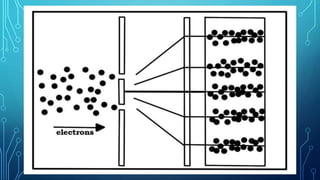
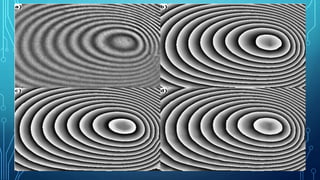
•DOUBLE-SLIT THOUGHT-
EXPERIMENT In Feynman's double-
slit thought-experiment, a specific
material is randomly directed at a
wall which has two small slits that
can be opened and closed at will-
some of the material gets blocked
and some passes through the slits,
•Based on the pattern that is detected beyond the wall
on a backstop- which is fitted with a detector- one can
discern whether the material coming through behaves
as either a wave or particle.
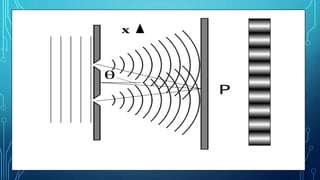
When particles are fired at the wall with both slits
open, they are more likely to hit the backstop in one
particular area, whereas waves interfere with each
other and hit the backstop at a number of different
points with differing strength, creating what is known
as an interference pattern.
•In 1965, Feynman popularized that
electrons- historically thought to be
particles- would actually produce
the pattern of a wave in the double-
split experiment. Unlike sound
waves and water waves, Feynman
highlighted that when electrons are
fired at the wall one at a time, an
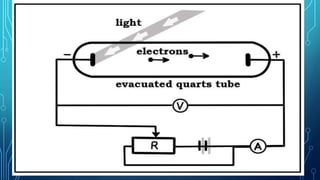
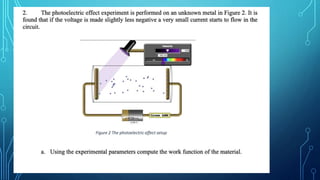
•THE PHOTOELECTRIC (EFFECT) EXPERIMENT
Photoelectric effect, phenomenon in which
electrically charged particles are released from or
within a material when it absorbs electromagnetic
radiation. The effect is often defined as the
ejection of electrons from a metal plate when
light falls on it. In a broader definition, the
radiant energy may be infrared, visible, or
ultraviolet light, X-rays, or gamma rays; the
material may be a solid, liquid, or gas; and the
•The photoelectric effect was discovered in 1887
by the German physicist Heinrich Rudolf Hertz.
In connection with work on radio waves, Hertz
observed that, when ultraviolet light shines on
two metal electrodes with a voltage applied
across them, the light changes the voltage at
which sparking takes place. This relation
between light and electricity (hence photoelectric)
was clarified in 1902 by another German
physicist, Philipp Lenard.
•He demonstrated that
electrically charged particles are
liberated from a metal surface
when it is illuminated and that
these particles are identical to
electrons, which had been
discovered by the British
physicist Joseph John Thomson
•Further research showed that the photoelectric effect
represents an interaction between light and matter that
cannot be explained by classical physics, which describes
light as an electromagnetic wave. One inexplicable
observation was that the maximum kinetic energy of the
released electrons did not vary with the intensity of the
light, as expected according to the wave theory, but was
proportional instead to the frequency of the light. What
the light intensity did determine was the number of
electrons released from the metal (measured as an
electric current). Another puzzling observation was that
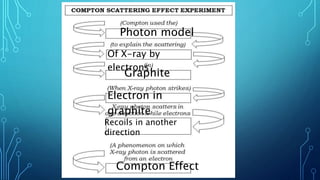
•THE COMPTON SCATTERING
EXPERIMENT
•The Compton effect is the inelastic
scattering of a photon (usually X-ray
or γ-ray) by an electron; when the
target electron is moving, the
Compton-scattered radiation is also
Doppler-broadened, and its energy
•Measurements of Compton profiles of materials
give information on the electron momentum
density, projected along the scattering direction.
The technique is particularly sensitive to the
most external electronic wave functions, which
describe slowly moving electrons and are
responsible of the chemical bond. A closely
related method which provides similar
information is the study of the angular
correlation in positron annihilation. When a
•By classical theory, when an electromagnetic wave is
scattered off atoms, the wavelength of the scattered
radiation is expected to be the same as the wavelength
of the incident radiation. Contrary to this prediction of
classical physics, observations show that when X-rays
are scattered off some materials, such as graphite, the
scattered X-rays have different wavelengths from the
wavelength of the incident X-rays. This classically
unexplainable phenomenon was studied experimentally
by Arthur H. Compton and his collaborators, and
Compton gave its explanation in 1923.
•Arthur Compton (1892–1962) showed
that this behavior could be explained
by assuming that the X-rays were
photons (light quantum). When
photons are scattered off electrons,
part of their energy is transferred to
the electrons. The loss of energy is
translated into a reduction of
•To explain the shift in wavelengths measured in
the experiment, Compton used Einstein’s idea of
light as a particle. The Compton effect has a very
important place in the history of physics because
it shows that electromagnetic radiation cannot be
explained as a purely wave phenomenon. The
explanation of the Compton effect gave a
convincing argument to the physics community
that electromagnetic waves can indeed behave
like a stream of photons, which placed the
Beam of
electrons
Glows when electron
strikes
Fringe Pattern
Exhibiting interference
effects
Television like
screen
Double-slit
Electron are emitted from
Light shines on it
Light being udes
Sufficiently high
frequency
Light
Photoelectrons
Photon model
Of X-ray by
electrons
Graphite
Electron in
graphite
Recoils in another
direction
Compton Effect
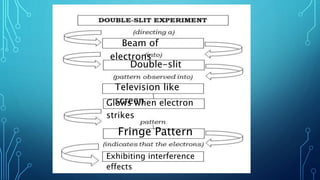
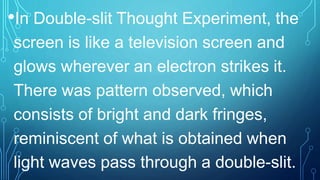
•In Double-slit Thought Experiment, the
screen is like a television screen and
glows wherever an electron strikes it.
There was pattern observed, which
consists of bright and dark fringes,
reminiscent of what is obtained when
light waves pass through a double-slit.
•The fringe patterns
indicate that the electrons
are exhibiting the
interference effects
associated with waves.
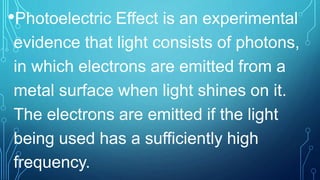
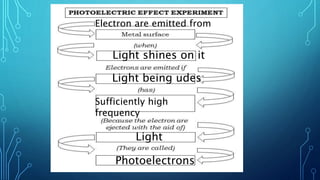
•Photoelectric Effect is an experimental
evidence that light consists of photons,
in which electrons are emitted from a
metal surface when light shines on it.
The electrons are emitted if the light
being used has a sufficiently high
frequency.
•When the
electrons are
ejected with the
aid if light, they
•Compton Scattering Effect
Experiment was conducted by
the American physicist Arthur H.
Compton.
•Compton used the photon
model the scattering of X-rays
•The phenomenon in which
an X-ray photon is
scattered from an electron,
with the scattered photon
having a smaller frequency
than the incident photon, is
•It involves the transport of energy
without the transport of matter and
can be described as a disturbance
that travels through a medium.
•a. Light b. Sound c. Waves
•.Who suggested that, like light,
electrons could act as both
particles and waves?
a. Louise de Broglie
b. Richard Feynman
c.Arthur Compton
What phenomenon states that when a metal
surface is exposed to a monochromatic
electromagnetic wave of sufficiently short
wavelength (or equivalently, above a threshold
frequency), the incident radiation is absorbed and
the exposed surface emits electrons?
a. Double Slit-thought Experiment
b. Compton Scattering Experiment
c. Photoelectric(effect) Experiment
•Who gave the first experimental
proof of the existence of radio waves
in 1887; he also discovered the
photoelectric effect?
a. Feynman’s Double-slit
b. Louise de Broglie
c. Heinrich Rudolf Hertz
•Which principle says that sometimes
electrons have the properties of
particles and sometimes the properties
of waves, but never both together?
a. Complementarity Principle
b. Uncertainty Principle
c. Wave functions
•Which phenomenon X-ray photon is scattered
from an electron with the scattered from an
electron, with the scattered photon having a
smaller frequency than the incident photon?
a. Compton effect
•b.Photoelectric
•c. Double-slit
•. Electromagnetic waves are
composed of particle-like entities
called ______.
a. Photoelectrons
•b. Photons
•c. Collector
An electron emitted from an atom by
interaction with a photon, especially
an electron emitted from a solid
surface by the action of light.
a. Photoelectrons
b. Photons
c. Collector
DISPERSION,
SCATTERING
INTERFERENCE AND
DIFFRACTION OF
LIGHT
•Dispersion is the separation
of white light into its seven
color components when
there is a refraction or
bending of light.
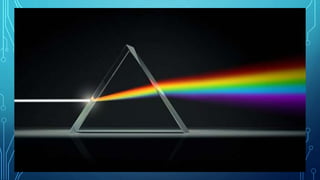
•When white light passes
through a prism, it will
refract two times making
the separation of the colors
noticeable.
•A Prism is a piece of glass
or transparent material
usually triangular in shape.
It allows visible light to
pass through.
•Isaac Newton first investigated
dispersion by allowing white light to
pass through a glass prism. He also
found that if the dispersed white
light were allowed to pass through
another upside-down prism, white
light was produced.
•In 1637, Rene Descartes first gave a
detailed explanation of the formation of
rainbow by mathematically tracing the
path of light in a spherical drop of water.
In the primary rainbow, the outer color is
red and the inner color is violet. For the
secondary rainbow, the colors are
reversed.
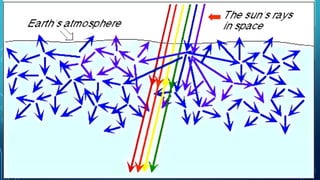
•Light scattering is the
ability of particles to
absorb light and scatter
it in all directions
•Scattering of light components
depends on the size of the particles
or scatterers; small particles scatter
components of short wavelengths
(high frequency) while larger
particles scatter longer wavelengths
(low frequency).
•Our atmosphere is composed of tiny
particles that scatter the color
components of white light and has an
abundance in nitrogen and oxygen
particles, which can scatter higher
frequency. They scatter violet the most,
followed by blue, green, and so on.
•This selective scattering is called
the Rayleigh scattering. Our
eyes are more sensitive to blue
frequencies of light, which is why
we see the sky as blue.
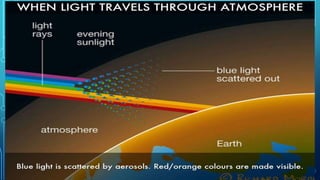
•At sunset, sunlight travels farther
through the atmosphere. Longer
distance would mean that much of the
blue light (having shorter wavelengths)
have been scattered. Leaving only
yellow, orange and red (having longer
wavelengths) to be scattered resulting to
a red-orange sunrise or sunset.
•Mie Scattering, happens when
electromagnetic wave incident
on the particles and after
reflections, all range of
wavelengths get reflected
back equally to the
Example of this is the clouds. Clouds appear
white because the water droplets in the
clouds are larger than the wavelength of
light which scatter all the colors of light
equally. Clouds that contain too much water
droplets like rain clouds are less effective
scatterers and more effective absorbers of
light. Thus, rain clouds appear dark.
•ACTIVITY 4: Scatter-Hunting
DIRECTION: Determine if the underlined word or phrase
exemplified in each statement is Rayleigh or Mie Scattering.
_________________ 1. Joshua observes the yellow sky one-
day morning.
___________________2. Jean enjoys watching the white and
fluffy clouds by the window.
___________________3. Caroline is in a hurry to go home as
the clouds appear dark.
___________________4. Jill and Joven feels very happy
seeing the red-orange light during sunrise.
___________________5. Ping shields her eyes from the glare
of sunlight.
•___________________6. One reason why tourists visit
“Boracay Beach” is to witness the red-orange sunset.
___________________7. Karen witnesses the presence of
crepuscular rays near her bedroom.
___________________8. Carole enjoys seeing the white
clouds having dark bottoms over her balcony.
___________________9. Vanessa burns the dried leaves
under the tree and observes that the rays of the sun pass
through the smoke.
___________________10. The sky is very clear today! I love to
see the blue sky.
Photon Concept of Light.pptx

Photon Concept of Light.pptx

  • 1.
  • 2.
    •The Photon Theoryof Light •Light is composed of photons. Based on the photon theory of light, a photon is a discrete bundle of electromagnetic energy moving at the speed of light, has no rest mass but has momentum and carries energy. This energy is given to an electron upon their collision, which causes it to move up to the next energy level.
  • 3.
    •The photoelectric effectrefers to the ejection of electrons from a surface of a metal in response to light directed to the metal. Albert Einstein proposed that light consisted of individual photons, which interacted with the electrons in the surface of the metal. For each frequency or color of the incident light, each photon carried energy.
  • 6.
    •More electrons areejected upon the increase in incident light. Increasing the frequency of light would increase the energy of the ejected electrons. The energy carried by a photon is directly proportional to its frequency. The arrangement of the visible spectrum of light shows that red color has the least frequency, which means it also has the least energy.
  • 7.
    •Color Spectra Colors arenot innate to objects. They give off light that appears as colors. Colors only exist in the human visual system and is determined by frequencies. When light reaches the eye, it falls into a receptor cell at the back of the eye or retina and gives signals to the brain, which interprets the image with colors.
  • 9.
    •The Colors inLight Sunlight separates into different colors, called visible spectrum, as it passes through a prism. The spectrum consists of colors of the rainbow: red, orange, yellow, green, blue, indigo and violet colors.
  • 10.
    •Red, Green, andBlue are the basic colors in light and therefore film. The secondary colors, Yellow, Cyan, and Magenta, are combinations of these. You can mix tertiary colors (orange, violet, etc) and all other colors from there as
  • 11.
    •Addition of PrimaryColor of Light •Red + Blue = Magenta •Red + Green = Yellow •Blue + Green = Cyan
  • 13.
    • Color ofOpaque Objects When white light falls on an object which does not transmit light, one of the three things happens: 1. All of the colors in white light may be reflected, in which case the object will appear white. 2. Some of the colors may be reflected, in which case the object appears colored. 3. All the colors are absorbed by the object, in which case the object appears black. • For example, a red shirt looks red because it absorbed the wavelengths of light from violet/blue end of the spectrum. A leaf of a plant is green because it reflects green light.
  • 14.
    • Reflects 1.Red 2.Orange ROYGBIVAppears 3. Red Orange Paper absorbs YGBIV
  • 15.
    •Ultraviolet Radiation Different colorsof light have photons of different energies. Based on the frequency and wavelength in a visible light, red has low frequency and long wavelength, which means that it contains less energy. Blue, on the other hand, has high frequency and short wavelength, which means it contains more energy. Beyond the visible light, the ultraviolet light has greater frequency and shorter wavelength, which means it carries greater energy than the visible light. This explains why we easily get sunburned under the ultraviolet rays of light than under the visible light.
  • 16.
    Activity 2. Colorof Objects A. Determine the color of light that will result in the combination below: 1. Blue Green Cyan Red B. Determine what color(s) of light will be reflected and the color appearance of the paper.
  • 17.
    HOW LIGHT ACTS ASWAVE AND A PARTICLE
  • 18.
  • 19.
    •DOUBLE-SLIT THOUGHT- EXPERIMENT InFeynman's double- slit thought-experiment, a specific material is randomly directed at a wall which has two small slits that can be opened and closed at will- some of the material gets blocked and some passes through the slits,
  • 20.
    •Based on thepattern that is detected beyond the wall on a backstop- which is fitted with a detector- one can discern whether the material coming through behaves as either a wave or particle. When particles are fired at the wall with both slits open, they are more likely to hit the backstop in one particular area, whereas waves interfere with each other and hit the backstop at a number of different points with differing strength, creating what is known as an interference pattern.
  • 21.
    •In 1965, Feynmanpopularized that electrons- historically thought to be particles- would actually produce the pattern of a wave in the double- split experiment. Unlike sound waves and water waves, Feynman highlighted that when electrons are fired at the wall one at a time, an
  • 24.
    •THE PHOTOELECTRIC (EFFECT)EXPERIMENT Photoelectric effect, phenomenon in which electrically charged particles are released from or within a material when it absorbs electromagnetic radiation. The effect is often defined as the ejection of electrons from a metal plate when light falls on it. In a broader definition, the radiant energy may be infrared, visible, or ultraviolet light, X-rays, or gamma rays; the material may be a solid, liquid, or gas; and the
  • 25.
    •The photoelectric effectwas discovered in 1887 by the German physicist Heinrich Rudolf Hertz. In connection with work on radio waves, Hertz observed that, when ultraviolet light shines on two metal electrodes with a voltage applied across them, the light changes the voltage at which sparking takes place. This relation between light and electricity (hence photoelectric) was clarified in 1902 by another German physicist, Philipp Lenard.
  • 26.
    •He demonstrated that electricallycharged particles are liberated from a metal surface when it is illuminated and that these particles are identical to electrons, which had been discovered by the British physicist Joseph John Thomson
  • 27.
    •Further research showedthat the photoelectric effect represents an interaction between light and matter that cannot be explained by classical physics, which describes light as an electromagnetic wave. One inexplicable observation was that the maximum kinetic energy of the released electrons did not vary with the intensity of the light, as expected according to the wave theory, but was proportional instead to the frequency of the light. What the light intensity did determine was the number of electrons released from the metal (measured as an electric current). Another puzzling observation was that
  • 30.
    •THE COMPTON SCATTERING EXPERIMENT •TheCompton effect is the inelastic scattering of a photon (usually X-ray or γ-ray) by an electron; when the target electron is moving, the Compton-scattered radiation is also Doppler-broadened, and its energy
  • 31.
    •Measurements of Comptonprofiles of materials give information on the electron momentum density, projected along the scattering direction. The technique is particularly sensitive to the most external electronic wave functions, which describe slowly moving electrons and are responsible of the chemical bond. A closely related method which provides similar information is the study of the angular correlation in positron annihilation. When a
  • 32.
    •By classical theory,when an electromagnetic wave is scattered off atoms, the wavelength of the scattered radiation is expected to be the same as the wavelength of the incident radiation. Contrary to this prediction of classical physics, observations show that when X-rays are scattered off some materials, such as graphite, the scattered X-rays have different wavelengths from the wavelength of the incident X-rays. This classically unexplainable phenomenon was studied experimentally by Arthur H. Compton and his collaborators, and Compton gave its explanation in 1923.
  • 33.
    •Arthur Compton (1892–1962)showed that this behavior could be explained by assuming that the X-rays were photons (light quantum). When photons are scattered off electrons, part of their energy is transferred to the electrons. The loss of energy is translated into a reduction of
  • 34.
    •To explain theshift in wavelengths measured in the experiment, Compton used Einstein’s idea of light as a particle. The Compton effect has a very important place in the history of physics because it shows that electromagnetic radiation cannot be explained as a purely wave phenomenon. The explanation of the Compton effect gave a convincing argument to the physics community that electromagnetic waves can indeed behave like a stream of photons, which placed the
  • 35.
    Beam of electrons Glows whenelectron strikes Fringe Pattern Exhibiting interference effects Television like screen Double-slit
  • 36.
    Electron are emittedfrom Light shines on it Light being udes Sufficiently high frequency Light Photoelectrons
  • 37.
    Photon model Of X-rayby electrons Graphite Electron in graphite Recoils in another direction Compton Effect
  • 38.
    •In Double-slit ThoughtExperiment, the screen is like a television screen and glows wherever an electron strikes it. There was pattern observed, which consists of bright and dark fringes, reminiscent of what is obtained when light waves pass through a double-slit.
  • 39.
    •The fringe patterns indicatethat the electrons are exhibiting the interference effects associated with waves.
  • 41.
    •Photoelectric Effect isan experimental evidence that light consists of photons, in which electrons are emitted from a metal surface when light shines on it. The electrons are emitted if the light being used has a sufficiently high frequency.
  • 42.
    •When the electrons are ejectedwith the aid if light, they
  • 43.
    •Compton Scattering Effect Experimentwas conducted by the American physicist Arthur H. Compton. •Compton used the photon model the scattering of X-rays
  • 44.
    •The phenomenon inwhich an X-ray photon is scattered from an electron, with the scattered photon having a smaller frequency than the incident photon, is
  • 45.
    •It involves thetransport of energy without the transport of matter and can be described as a disturbance that travels through a medium. •a. Light b. Sound c. Waves
  • 46.
    •.Who suggested that,like light, electrons could act as both particles and waves? a. Louise de Broglie b. Richard Feynman c.Arthur Compton
  • 47.
    What phenomenon statesthat when a metal surface is exposed to a monochromatic electromagnetic wave of sufficiently short wavelength (or equivalently, above a threshold frequency), the incident radiation is absorbed and the exposed surface emits electrons? a. Double Slit-thought Experiment b. Compton Scattering Experiment c. Photoelectric(effect) Experiment
  • 48.
    •Who gave thefirst experimental proof of the existence of radio waves in 1887; he also discovered the photoelectric effect? a. Feynman’s Double-slit b. Louise de Broglie c. Heinrich Rudolf Hertz
  • 49.
    •Which principle saysthat sometimes electrons have the properties of particles and sometimes the properties of waves, but never both together? a. Complementarity Principle b. Uncertainty Principle c. Wave functions
  • 50.
    •Which phenomenon X-rayphoton is scattered from an electron with the scattered from an electron, with the scattered photon having a smaller frequency than the incident photon? a. Compton effect •b.Photoelectric •c. Double-slit
  • 51.
    •. Electromagnetic wavesare composed of particle-like entities called ______. a. Photoelectrons •b. Photons •c. Collector
  • 52.
    An electron emittedfrom an atom by interaction with a photon, especially an electron emitted from a solid surface by the action of light. a. Photoelectrons b. Photons c. Collector
  • 53.
  • 54.
    •Dispersion is theseparation of white light into its seven color components when there is a refraction or bending of light.
  • 55.
    •When white lightpasses through a prism, it will refract two times making the separation of the colors noticeable.
  • 56.
    •A Prism isa piece of glass or transparent material usually triangular in shape. It allows visible light to pass through.
  • 58.
    •Isaac Newton firstinvestigated dispersion by allowing white light to pass through a glass prism. He also found that if the dispersed white light were allowed to pass through another upside-down prism, white light was produced.
  • 60.
    •In 1637, ReneDescartes first gave a detailed explanation of the formation of rainbow by mathematically tracing the path of light in a spherical drop of water. In the primary rainbow, the outer color is red and the inner color is violet. For the secondary rainbow, the colors are reversed.
  • 61.
    •Light scattering isthe ability of particles to absorb light and scatter it in all directions
  • 62.
    •Scattering of lightcomponents depends on the size of the particles or scatterers; small particles scatter components of short wavelengths (high frequency) while larger particles scatter longer wavelengths (low frequency).
  • 63.
    •Our atmosphere iscomposed of tiny particles that scatter the color components of white light and has an abundance in nitrogen and oxygen particles, which can scatter higher frequency. They scatter violet the most, followed by blue, green, and so on.
  • 64.
    •This selective scatteringis called the Rayleigh scattering. Our eyes are more sensitive to blue frequencies of light, which is why we see the sky as blue.
  • 66.
    •At sunset, sunlighttravels farther through the atmosphere. Longer distance would mean that much of the blue light (having shorter wavelengths) have been scattered. Leaving only yellow, orange and red (having longer wavelengths) to be scattered resulting to a red-orange sunrise or sunset.
  • 68.
    •Mie Scattering, happenswhen electromagnetic wave incident on the particles and after reflections, all range of wavelengths get reflected back equally to the
  • 69.
    Example of thisis the clouds. Clouds appear white because the water droplets in the clouds are larger than the wavelength of light which scatter all the colors of light equally. Clouds that contain too much water droplets like rain clouds are less effective scatterers and more effective absorbers of light. Thus, rain clouds appear dark.
  • 70.
    •ACTIVITY 4: Scatter-Hunting DIRECTION:Determine if the underlined word or phrase exemplified in each statement is Rayleigh or Mie Scattering. _________________ 1. Joshua observes the yellow sky one- day morning. ___________________2. Jean enjoys watching the white and fluffy clouds by the window. ___________________3. Caroline is in a hurry to go home as the clouds appear dark. ___________________4. Jill and Joven feels very happy seeing the red-orange light during sunrise. ___________________5. Ping shields her eyes from the glare of sunlight.
  • 71.
    •___________________6. One reasonwhy tourists visit “Boracay Beach” is to witness the red-orange sunset. ___________________7. Karen witnesses the presence of crepuscular rays near her bedroom. ___________________8. Carole enjoys seeing the white clouds having dark bottoms over her balcony. ___________________9. Vanessa burns the dried leaves under the tree and observes that the rays of the sun pass through the smoke. ___________________10. The sky is very clear today! I love to see the blue sky.