Static
Electricity
What Is Static
  Electricity?
      • A stationary electrical
        charge that is built up on
        the surface of a material
Two kinds of charges
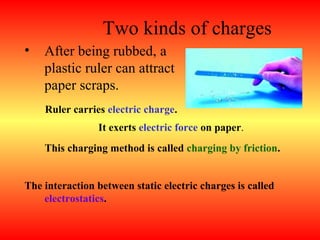
•   After being rubbed, a
    plastic ruler can attract
    paper scraps.
    Ruler carries electric charge.
                It exerts electric force on paper.
    This charging method is called charging by friction.


The interaction between static electric charges is called
    electrostatics.
Where do charges come from?

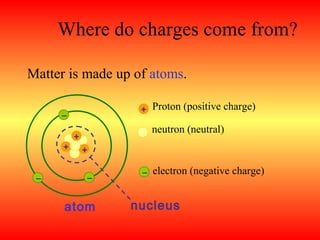
Matter is made up of atoms.

                       + Proton (positive charge)
     –
                         neutron (neutral)
          +
      +       +

                       – electron (negative charge)
 –                –


      atom            nucleus
Where do charges come from?

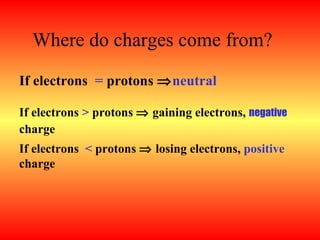
If electrons = protons ⇒neutral

If electrons > protons ⇒ gaining electrons, negative
charge
If electrons < protons ⇒ losing electrons, positive
charge
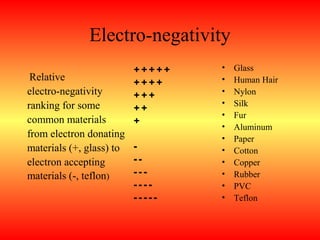
Electro-negativity
                       +++++    •   Glass
 Relative                       •   Human Hair
                       ++++
electro-negativity     +++
                                •   Nylon
ranking for some                •   Silk
                       ++
                                •   Fur
common materials       +        •   Aluminum
from electron donating          •   Paper
materials (+, glass) to -       •   Cotton
electron accepting      --      •   Copper
materials (-, teflon)   ---     •   Rubber
                        ----    •   PVC
                        -----   •   Teflon
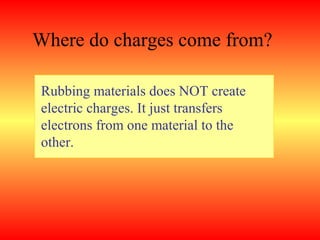
Where do charges come from?

Rubbing materials does NOT create
electric charges. It just transfers
electrons from one material to the
other.
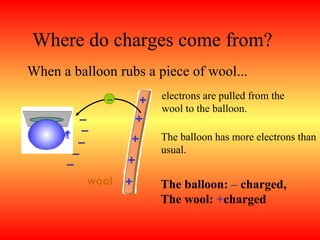
Where do charges come from?
When a balloon rubs a piece of wool...
                          electrons are pulled from the
             –        +
                          wool to the balloon.
         –           +
         –
        –         +       The balloon has more electrons than
       –                  usual.
      –          +
          wool   +        The balloon: – charged,
                          The wool: +charged
Insulators and conductors

 Insulators: materials that do NOT
 allow electrons to flow through them
 easily.

Insulators can be easily charged by friction as the extra
electrons gained CANNOT easily escape.
4 Insulators and conductors

Conductors: materials that allow electrons to flow
through them easily.


Conductors CANNOT be easily charged by friction as
the extra electrons gained can easily escape.
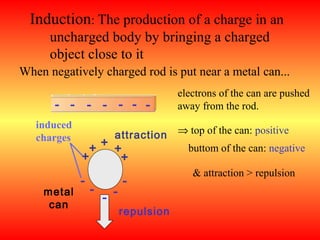
Induction: The production of a charge in an
      uncharged body by bringing a charged
      object close to it
When negatively charged rod is put near a metal can...
                                       electrons of the can are pushed
       - - - - - - -                   away from the rod.
   induced
                       attraction      ⇒ top of the can: positive
   charges
              ++ +                       buttom of the can: negative
             +    +
                                          & attraction > repulsion
             -             -
    metal        -     -
                     -
     can
                           repulsion
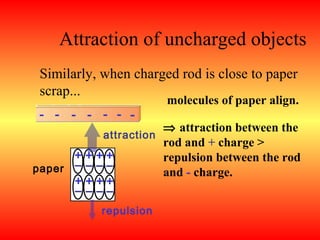
Attraction of uncharged objects
 Similarly, when charged rod is close to paper
 scrap...
                       molecules of paper align.
 - - - - - - -
                       ⇒ attraction between the
            attraction
        ++++           rod and + charge >
        ––––           repulsion between the rod
paper   ++++           and - charge.
        ––––

           repulsion
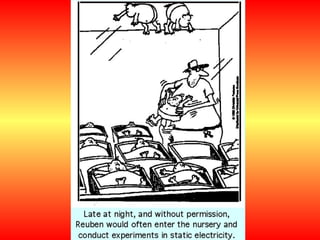
Static Discharge
Human body can not feel less than
2,000 volts of static discharge

Static charge built up by scuffing
shoes on a carpet can exceed 20,000
volts?
Gas Station Fires
• Carol said a static gas pump fire is blamed for
  burning her daughter so badly she needed skin
  grafts on her legs.

• Carol had put the gas pump nozzle on automatic
  and re-entered her car to write a check. When her
  then-12-year-old daughter, wearing a sweater and
  jacket that may have created static electricity,
  reached for the nozzle, flames suddenly ignited her
  clothing.
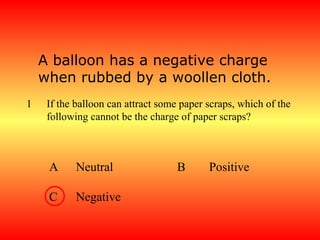
A balloon has a negative charge
    when rubbed by a woollen cloth.
1    If the balloon can attract some paper scraps, which of the
     following cannot be the charge of paper scraps?


     A     Neutral                  B      Positive

     C     Negative
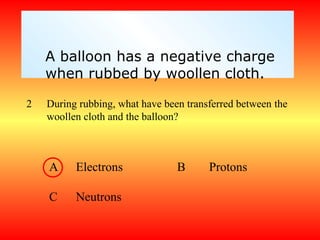
A balloon has a negative charge
    when rubbed by woollen cloth.

2   During rubbing, what have been transferred between the
    woollen cloth and the balloon?


    A     Electrons              B      Protons

    C     Neutrons
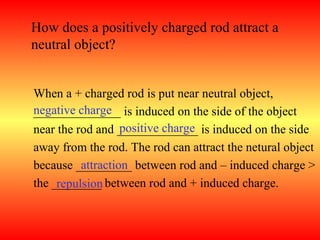
How does a positively charged rod attract a
neutral object?


When a + charged rod is put near neutral object,
negative charge
______________ is induced on the side of the object
                 positive charge
near the rod and _____________ is induced on the side
away from the rod. The rod can attract the netural object
          attraction
because _________ between rod and – induced charge >
the ________ between rod and + induced charge.
     repulsion
Grounding
 What is grounding?

 An object is grounded when it is connected
 to the earth through a connecting wire.

If a charged conductor is grounded, it will
become neutral.
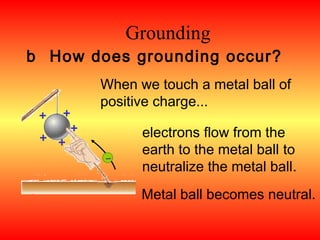
Grounding
b How does grounding occur?
             When we touch a metal ball of
             positive charge...
 +   +
         +         electrons flow from the
 + +
             –
                   earth to the metal ball to
                   neutralize the metal ball.
                   Metal ball becomes neutral.
Grounding
    How does grounding occur?
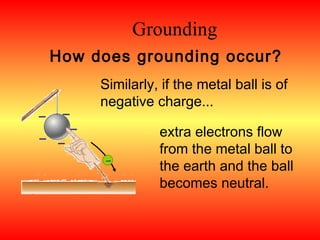
             Similarly, if the metal ball is of
             negative charge...
–    –
         –             extra electrons flow
–   –
                       from the metal ball to
              –
                       the earth and the ball
                       becomes neutral.
Why do gasoline tankers usually have metal
chains at the back?

 When cars run, their tires and bodies are usually
             friction
 charged by _______. For gasoline tankers, if the
                                       sparks
 accumulated charge is large enough, _______can be
                explosion
 produced and _________ will occur if gasoline vapor is
 ignited. Those metal chains conduct the charge on the
                           ground
 bodies of tankers to the _______ and avoid the danger.
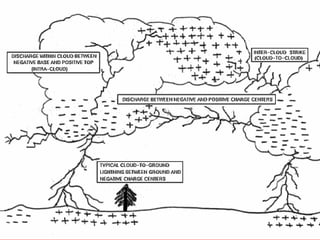
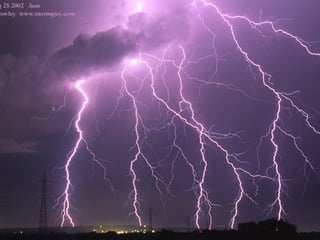
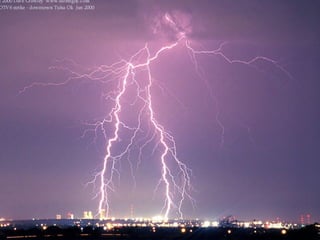
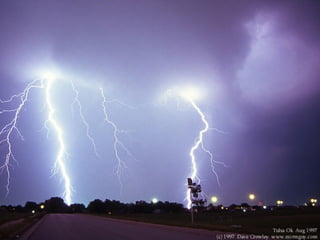
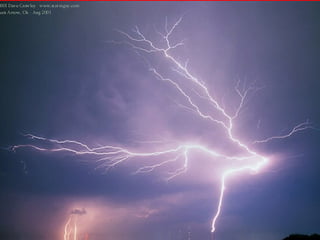
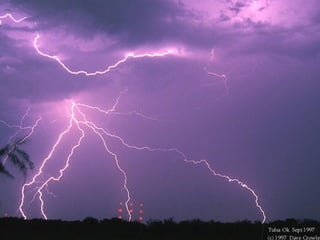
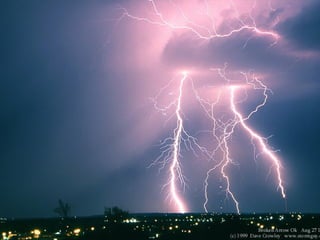
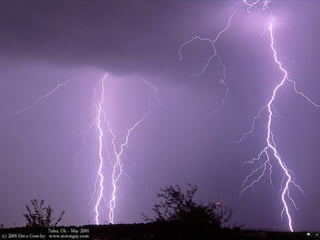
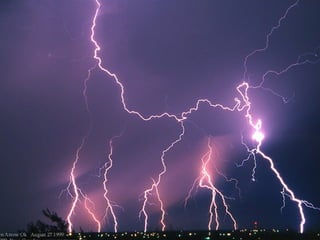
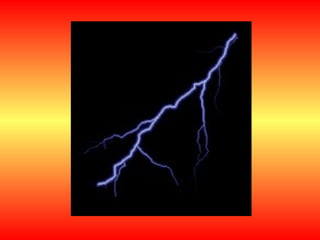
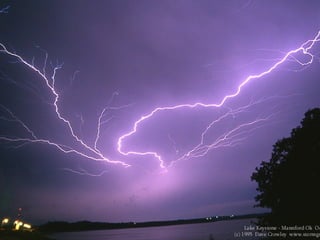
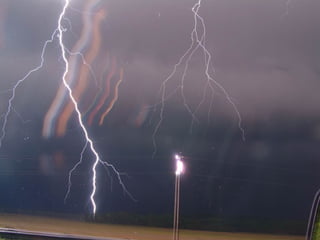
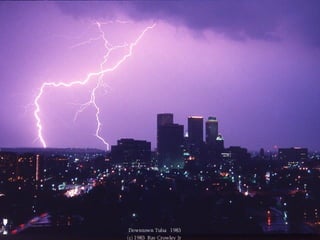
Lightning
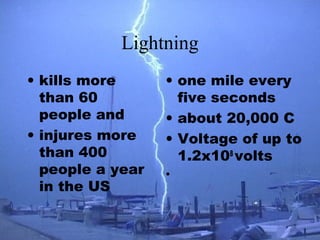
• kills more      • one mile every
  than 60           five seconds
  people and      • about 20,000 C
• injures more    • Voltage of up to
  than 400          1.2x10⁸ volts
  people a year   •
  in the US
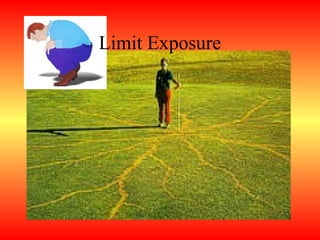
Limit Exposure
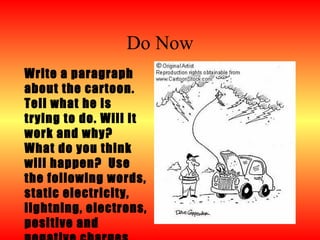
Do Now
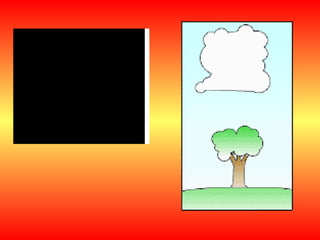
Write a paragraph
about the cartoon.
Tell what he is
trying to do. Will it
work and why?
What do you think
will happen? Use
the following words,
static electricity,
lightning, electrons,
positive and
The End

Lsitrik statis

  • 1.
  • 2.
    What Is Static Electricity? • A stationary electrical charge that is built up on the surface of a material
  • 3.
    Two kinds ofcharges • After being rubbed, a plastic ruler can attract paper scraps. Ruler carries electric charge. It exerts electric force on paper. This charging method is called charging by friction. The interaction between static electric charges is called electrostatics.
  • 4.
    Where do chargescome from? Matter is made up of atoms. + Proton (positive charge) – neutron (neutral) + + + – electron (negative charge) – – atom nucleus
  • 5.
    Where do chargescome from? If electrons = protons ⇒neutral If electrons > protons ⇒ gaining electrons, negative charge If electrons < protons ⇒ losing electrons, positive charge
  • 6.
    Electro-negativity +++++ • Glass Relative • Human Hair ++++ electro-negativity +++ • Nylon ranking for some • Silk ++ • Fur common materials + • Aluminum from electron donating • Paper materials (+, glass) to - • Cotton electron accepting -- • Copper materials (-, teflon) --- • Rubber ---- • PVC ----- • Teflon
  • 7.
    Where do chargescome from? Rubbing materials does NOT create electric charges. It just transfers electrons from one material to the other.
  • 8.
    Where do chargescome from? When a balloon rubs a piece of wool... electrons are pulled from the – + wool to the balloon. – + – – + The balloon has more electrons than – usual. – + wool + The balloon: – charged, The wool: +charged
  • 9.
    Insulators and conductors Insulators: materials that do NOT allow electrons to flow through them easily. Insulators can be easily charged by friction as the extra electrons gained CANNOT easily escape.
  • 10.
    4 Insulators andconductors Conductors: materials that allow electrons to flow through them easily. Conductors CANNOT be easily charged by friction as the extra electrons gained can easily escape.
  • 11.
    Induction: The productionof a charge in an uncharged body by bringing a charged object close to it When negatively charged rod is put near a metal can... electrons of the can are pushed - - - - - - - away from the rod. induced attraction ⇒ top of the can: positive charges ++ + buttom of the can: negative + + & attraction > repulsion - - metal - - - can repulsion
  • 12.
    Attraction of unchargedobjects Similarly, when charged rod is close to paper scrap... molecules of paper align. - - - - - - - ⇒ attraction between the attraction ++++ rod and + charge > –––– repulsion between the rod paper ++++ and - charge. –––– repulsion
  • 14.
    Static Discharge Human bodycan not feel less than 2,000 volts of static discharge Static charge built up by scuffing shoes on a carpet can exceed 20,000 volts?
  • 16.
    Gas Station Fires •Carol said a static gas pump fire is blamed for burning her daughter so badly she needed skin grafts on her legs. • Carol had put the gas pump nozzle on automatic and re-entered her car to write a check. When her then-12-year-old daughter, wearing a sweater and jacket that may have created static electricity, reached for the nozzle, flames suddenly ignited her clothing.
  • 17.
    A balloon hasa negative charge when rubbed by a woollen cloth. 1 If the balloon can attract some paper scraps, which of the following cannot be the charge of paper scraps? A Neutral B Positive C Negative
  • 18.
    A balloon hasa negative charge when rubbed by woollen cloth. 2 During rubbing, what have been transferred between the woollen cloth and the balloon? A Electrons B Protons C Neutrons
  • 19.
    How does apositively charged rod attract a neutral object? When a + charged rod is put near neutral object, negative charge ______________ is induced on the side of the object positive charge near the rod and _____________ is induced on the side away from the rod. The rod can attract the netural object attraction because _________ between rod and – induced charge > the ________ between rod and + induced charge. repulsion
  • 20.
    Grounding What isgrounding? An object is grounded when it is connected to the earth through a connecting wire. If a charged conductor is grounded, it will become neutral.
  • 21.
    Grounding b How doesgrounding occur? When we touch a metal ball of positive charge... + + + electrons flow from the + + – earth to the metal ball to neutralize the metal ball. Metal ball becomes neutral.
  • 22.
    Grounding How does grounding occur? Similarly, if the metal ball is of negative charge... – – – extra electrons flow – – from the metal ball to – the earth and the ball becomes neutral.
  • 23.
    Why do gasolinetankers usually have metal chains at the back? When cars run, their tires and bodies are usually friction charged by _______. For gasoline tankers, if the sparks accumulated charge is large enough, _______can be explosion produced and _________ will occur if gasoline vapor is ignited. Those metal chains conduct the charge on the ground bodies of tankers to the _______ and avoid the danger.
  • 24.
    Lightning • kills more • one mile every than 60 five seconds people and • about 20,000 C • injures more • Voltage of up to than 400 1.2x10⁸ volts people a year • in the US
  • 45.
  • 46.
    Do Now Write aparagraph about the cartoon. Tell what he is trying to do. Will it work and why? What do you think will happen? Use the following words, static electricity, lightning, electrons, positive and
  • 47.