BUOYANCY
BUOYANCY
• Upward net force on objects within a
liquid
• Occurs because pressure in a fluid
increases with depth
• Since the bottom is deeper, more
force is pushing up than force on the
bottom pushing down
• Net upward force pushes objects up
ARCHIMEDES PRINCIPLE
• The buoyant force on an object is equal to the weight of the fluid displaced by the
object
FB = Fw = mg
ρ = M/V
M = ρV
FB = ρVg
It is NOT the object that exerts the buoyant force, it is the fluid that the object displaces
that causes it
FB = ρfluidgVsubmerged
• The difference between the buoyant
force and the object’s weight
determines whether an object sinks or
floats.
Sink or Float
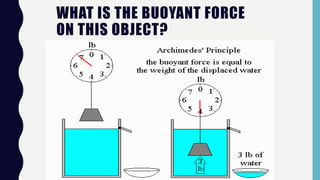
WHAT IS THE BUOYANT FORCE
ON THIS OBJECT?
EXAMPLE
• A 70kg statue lies at the bottom of the sea. Its volume is 3.0 x 10⁻² m3. How much force
is needed to lift it?
• When a crown of mass 14.7kg is submerged in water, an accurate scale reads only
13.4kg. Is the crown gold?
FLOATING
• An object floats on a fluid if its density is less
than that of the fluid
• When floating FB = FW
• ρfVdispg = ρoVog
• ρfVdisp = ρoVo
• Fraction of an object submerged is given by
the ratio of the density of the object to the
fluid
EXAMPLE
• A rectangular block of wood (1.0m x 2.0m x 0.25m) floats so that 0.15 cm of its height
is above the water level.
a) find the density of the wood
b) find the mass of the wood

Buoyancy (2).pptx

  • 1.
  • 2.
    BUOYANCY • Upward netforce on objects within a liquid • Occurs because pressure in a fluid increases with depth • Since the bottom is deeper, more force is pushing up than force on the bottom pushing down • Net upward force pushes objects up
  • 4.
    ARCHIMEDES PRINCIPLE • Thebuoyant force on an object is equal to the weight of the fluid displaced by the object FB = Fw = mg ρ = M/V M = ρV FB = ρVg It is NOT the object that exerts the buoyant force, it is the fluid that the object displaces that causes it FB = ρfluidgVsubmerged
  • 5.
    • The differencebetween the buoyant force and the object’s weight determines whether an object sinks or floats. Sink or Float
  • 6.
    WHAT IS THEBUOYANT FORCE ON THIS OBJECT?
  • 7.
    EXAMPLE • A 70kgstatue lies at the bottom of the sea. Its volume is 3.0 x 10⁻² m3. How much force is needed to lift it? • When a crown of mass 14.7kg is submerged in water, an accurate scale reads only 13.4kg. Is the crown gold?
  • 8.
    FLOATING • An objectfloats on a fluid if its density is less than that of the fluid • When floating FB = FW • ρfVdispg = ρoVog • ρfVdisp = ρoVo • Fraction of an object submerged is given by the ratio of the density of the object to the fluid
  • 9.
    EXAMPLE • A rectangularblock of wood (1.0m x 2.0m x 0.25m) floats so that 0.15 cm of its height is above the water level. a) find the density of the wood b) find the mass of the wood