It’s electric
(don’t worry, I won’t play the
                        song)
Electrons

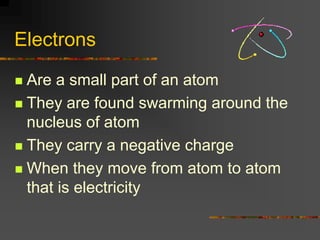
 Are a small part of an atom
 They are found swarming around the
  nucleus of atom
 They carry a negative charge

 When they move from atom to atom
  that is electricity
Protons and Neutrons
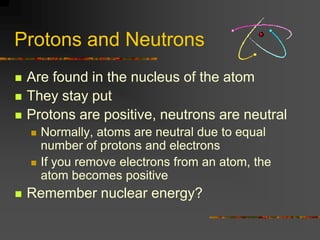
   Are found in the nucleus of the atom
   They stay put
   Protons are positive, neutrons are neutral
       Normally, atoms are neutral due to equal
        number of protons and electrons
       If you remove electrons from an atom, the
        atom becomes positive
   Remember nuclear energy?
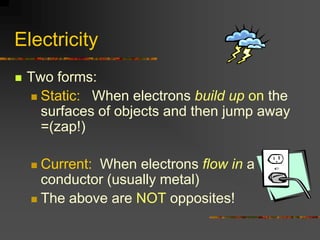
Electricity
   Two forms:
     Static: When electrons build up on the
      surfaces of objects and then jump away
      =(zap!)

     Current: When electrons flow in a
      conductor (usually metal)
     The above are NOT opposites!
Charge
   Is a force that affects parts of atoms
   Things can have a positive charge, a negative
    charge
   Neutral means zero charge
   Like charges repel
   Unlike charges attract
       “opposites attract”
                                               Electroscope
                                              Balloon on wall
                                                 Rolling tube
                                                         H2O
Electric field

 The space around an object
 that is electrified or charged
 and exerts a force on other
 objects.
                          Fluorescent tube
                          and van de Graff
Friction method

   By rubbing 2 different materials together,
    electrons can sometimes build up on one
    material
   All the electrons on that material try to get
    away from each other as best as they can
   When they jump away= electric discharge.
                                         Van de Graaf generator
Positive / negative charges

 Objects with a negative charge have
  an excess of ___________on their
  surface
 Objects with a positive charge have
  a(n) _________ of electrons on their
  surface
Conduction

 When charges can flow from one
  object to another during contact or
  when they are close enough
 They need to touch: conduction=
  contact
Induction
   When electric charges are rearranged

   No contact is needed, things only come
    near each other
   link


                                       Balloon on the wall
links
   Electrophorus
   Induction
   Fun with a Van de Graaf Generator

Electric static

  • 1.
    It’s electric (don’t worry,I won’t play the song)
  • 2.
    Electrons  Are asmall part of an atom  They are found swarming around the nucleus of atom  They carry a negative charge  When they move from atom to atom that is electricity
  • 3.
    Protons and Neutrons  Are found in the nucleus of the atom  They stay put  Protons are positive, neutrons are neutral  Normally, atoms are neutral due to equal number of protons and electrons  If you remove electrons from an atom, the atom becomes positive  Remember nuclear energy?
  • 4.
    Electricity  Two forms:  Static: When electrons build up on the surfaces of objects and then jump away =(zap!)  Current: When electrons flow in a conductor (usually metal)  The above are NOT opposites!
  • 5.
    Charge  Is a force that affects parts of atoms  Things can have a positive charge, a negative charge  Neutral means zero charge  Like charges repel  Unlike charges attract  “opposites attract” Electroscope Balloon on wall Rolling tube H2O
  • 6.
    Electric field  Thespace around an object that is electrified or charged and exerts a force on other objects. Fluorescent tube and van de Graff
  • 7.
    Friction method  By rubbing 2 different materials together, electrons can sometimes build up on one material  All the electrons on that material try to get away from each other as best as they can  When they jump away= electric discharge. Van de Graaf generator
  • 8.
    Positive / negativecharges  Objects with a negative charge have an excess of ___________on their surface  Objects with a positive charge have a(n) _________ of electrons on their surface
  • 9.
    Conduction  When chargescan flow from one object to another during contact or when they are close enough  They need to touch: conduction= contact
  • 10.
    Induction  When electric charges are rearranged  No contact is needed, things only come near each other  link Balloon on the wall
  • 11.
    links  Electrophorus  Induction  Fun with a Van de Graaf Generator