Chemical Equations andChemical Equations and
ReactionsReactions
March 24, 2015March 24, 2015
ObjectivesObjectives
1.1. Explain the difference betweenExplain the difference between
elemental and chemical formulaelemental and chemical formula
2.2. Recognize all the parts of a chemicalRecognize all the parts of a chemical
equationequation
3.3. Describe how compounds are differentDescribe how compounds are different
than the materials that compose itthan the materials that compose it
Chemical BondingChemical Bonding
The attraction between two atoms thatThe attraction between two atoms that
holds them togetherholds them together
Chemical changes occur because of breaking andChemical changes occur because of breaking and
rearrangementrearrangement
Chemical change = chemical reactionChemical change = chemical reaction
Chemical EquationChemical Equation
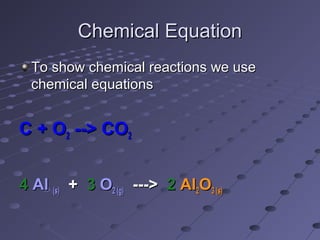
To show chemical reactions we useTo show chemical reactions we use
chemical equationschemical equations
C + OC + O22 --> CO--> CO22
44 AlAl (s)(s) ++ 33 OO2 (g)2 (g) --->---> 22 AlAl22OO3 (s)3 (s)
Parts of Chemical EquationParts of Chemical Equation
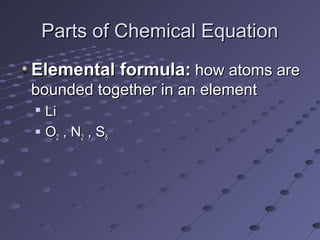
Elemental formula:Elemental formula: how atoms arehow atoms are
bounded together in an elementbounded together in an element

LiLi
 OO22 , N, N22 , S, S88
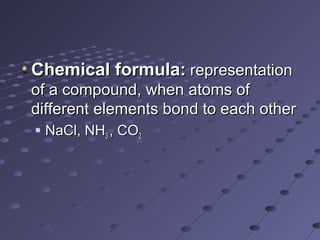
Chemical formula:Chemical formula: representationrepresentation
of a compound, when atoms ofof a compound, when atoms of
different elements bond to each otherdifferent elements bond to each other
 NaCl, NHNaCl, NH33 , CO, CO22
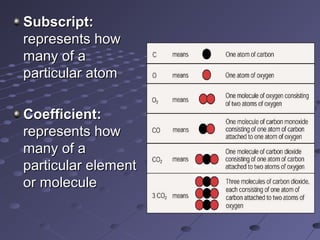
Subscript:Subscript:
represents howrepresents how
many of amany of a
particular atomparticular atom
Coefficient:Coefficient:
represents howrepresents how
many of amany of a
particular elementparticular element
or moleculeor molecule
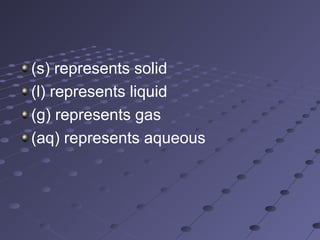
(s) represents solid
(l) represents liquid
(g) represents gas
(aq) represents aqueous
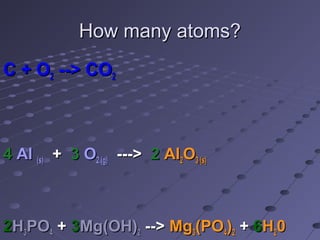
How many atoms?How many atoms?
C + OC + O22 --> CO--> CO22
44 AlAl (s)(s) ++ 33 OO2 (g)2 (g) --->---> 22 AlAl22OO3 (s)3 (s)
22HH33POPO44 ++ 33Mg(OH)Mg(OH)22 -->--> MgMg33(PO(PO44))22 ++ 66HH2200
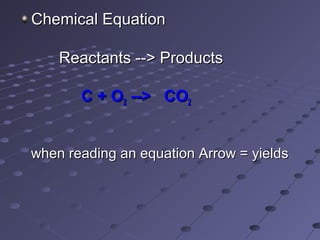
Chemical EquationChemical Equation
Reactants --> ProductsReactants --> Products
C + OC + O22 --> CO--> CO22
when reading an equation Arrow = yieldswhen reading an equation Arrow = yields
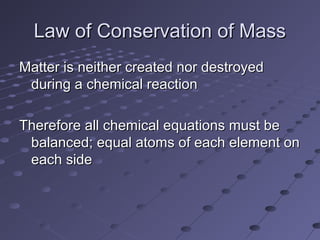
Law of Conservation of MassLaw of Conservation of Mass
Matter is neither created nor destroyedMatter is neither created nor destroyed
during a chemical reactionduring a chemical reaction
Therefore all chemical equations must beTherefore all chemical equations must be
balanced; equal atoms of each element onbalanced; equal atoms of each element on
each sideeach side
Balancing equation rulesBalancing equation rules
You may change the coefficients in frontYou may change the coefficients in front
You may NOT change the subscriptsYou may NOT change the subscripts
Changing the subscript changes theChanging the subscript changes the
compoundcompound
Steps of balancingSteps of balancing
1.1. Write the correct formulas for theWrite the correct formulas for the
equation. Once written do not changeequation. Once written do not change
the formula’sthe formula’s
2.2. Find the number of atoms on the left sideFind the number of atoms on the left side
of each element and compare it againstof each element and compare it against
the number of atoms of the samethe number of atoms of the same
elements on the right sideelements on the right side
4.4. Check your answer to see if:Check your answer to see if:

The numbers of atoms on bothThe numbers of atoms on both
sides of the equation are nowsides of the equation are now
balanced.balanced.

The coefficients are in the lowestThe coefficients are in the lowest
possible whole number ratios.possible whole number ratios.
(reduced)(reduced)
Helpful hintsHelpful hints
Take one element at a time working left toTake one element at a time working left to
right,right,
Leave H for next to last and O lastLeave H for next to last and O last
IF everything balances except for O, andIF everything balances except for O, and
there is no way to balance O with a wholethere is no way to balance O with a whole
number, double all the coefficients and trynumber, double all the coefficients and try
again.again.
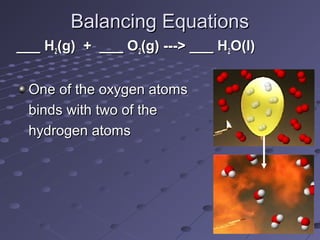
Balancing EquationsBalancing Equations
___ H___ H22(g) + ___ O(g) + ___ O22(g) ---> ___ H(g) ---> ___ H22O(l)O(l)
One of the oxygen atomsOne of the oxygen atoms
binds with two of thebinds with two of the
hydrogen atomshydrogen atoms
Done ActivitiesDone Activities
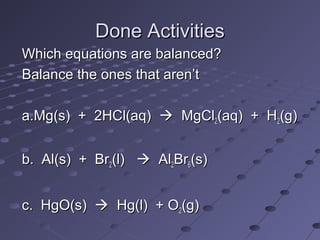
Which equations are balanced?Which equations are balanced?
Balance the ones that aren’tBalance the ones that aren’t
a.Mg(s) + 2HCl(aq)a.Mg(s) + 2HCl(aq)  MgClMgCl22(aq) + H(aq) + H22(g)(g)
b. Al(s) + Brb. Al(s) + Br22(l)(l)  AlAl22BrBr66(s)(s)
c. HgO(s)c. HgO(s)  Hg(l) + OHg(l) + O22(g)(g)
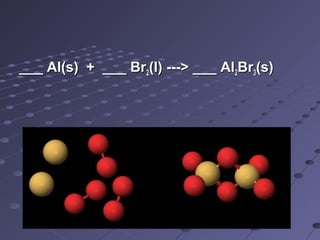
___ Al(s) + ___ Br___ Al(s) + ___ Br22(l) ---> ___ Al(l) ---> ___ Al22BrBr33(s)(s)
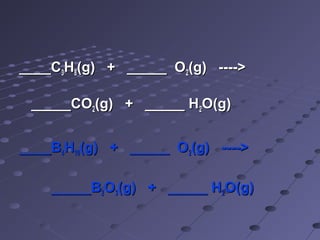
____C____C33HH88(g) + _____ O(g) + _____ O22(g) ---->(g) ---->
_____CO_____CO22(g) + _____ H(g) + _____ H22O(g)O(g)
____B____B44HH1010(g) + _____ O(g) + _____ O22(g) ---->(g) ---->
_____B_____B22OO33(g) + _____ H(g) + _____ H22O(g)O(g)

Chemical reactions

  • 1.
    Chemical Equations andChemicalEquations and ReactionsReactions March 24, 2015March 24, 2015
  • 2.
    ObjectivesObjectives 1.1. Explain thedifference betweenExplain the difference between elemental and chemical formulaelemental and chemical formula 2.2. Recognize all the parts of a chemicalRecognize all the parts of a chemical equationequation 3.3. Describe how compounds are differentDescribe how compounds are different than the materials that compose itthan the materials that compose it
  • 3.
    Chemical BondingChemical Bonding Theattraction between two atoms thatThe attraction between two atoms that holds them togetherholds them together Chemical changes occur because of breaking andChemical changes occur because of breaking and rearrangementrearrangement Chemical change = chemical reactionChemical change = chemical reaction
  • 4.
    Chemical EquationChemical Equation Toshow chemical reactions we useTo show chemical reactions we use chemical equationschemical equations C + OC + O22 --> CO--> CO22 44 AlAl (s)(s) ++ 33 OO2 (g)2 (g) --->---> 22 AlAl22OO3 (s)3 (s)
  • 5.
    Parts of ChemicalEquationParts of Chemical Equation Elemental formula:Elemental formula: how atoms arehow atoms are bounded together in an elementbounded together in an element  LiLi  OO22 , N, N22 , S, S88
  • 6.
    Chemical formula:Chemical formula:representationrepresentation of a compound, when atoms ofof a compound, when atoms of different elements bond to each otherdifferent elements bond to each other  NaCl, NHNaCl, NH33 , CO, CO22
  • 7.
    Subscript:Subscript: represents howrepresents how manyof amany of a particular atomparticular atom Coefficient:Coefficient: represents howrepresents how many of amany of a particular elementparticular element or moleculeor molecule
  • 8.
    (s) represents solid (l)represents liquid (g) represents gas (aq) represents aqueous
  • 9.
    How many atoms?Howmany atoms? C + OC + O22 --> CO--> CO22 44 AlAl (s)(s) ++ 33 OO2 (g)2 (g) --->---> 22 AlAl22OO3 (s)3 (s) 22HH33POPO44 ++ 33Mg(OH)Mg(OH)22 -->--> MgMg33(PO(PO44))22 ++ 66HH2200
  • 10.
    Chemical EquationChemical Equation Reactants--> ProductsReactants --> Products C + OC + O22 --> CO--> CO22 when reading an equation Arrow = yieldswhen reading an equation Arrow = yields
  • 11.
    Law of Conservationof MassLaw of Conservation of Mass Matter is neither created nor destroyedMatter is neither created nor destroyed during a chemical reactionduring a chemical reaction Therefore all chemical equations must beTherefore all chemical equations must be balanced; equal atoms of each element onbalanced; equal atoms of each element on each sideeach side
  • 12.
    Balancing equation rulesBalancingequation rules You may change the coefficients in frontYou may change the coefficients in front You may NOT change the subscriptsYou may NOT change the subscripts Changing the subscript changes theChanging the subscript changes the compoundcompound
  • 13.
    Steps of balancingStepsof balancing 1.1. Write the correct formulas for theWrite the correct formulas for the equation. Once written do not changeequation. Once written do not change the formula’sthe formula’s 2.2. Find the number of atoms on the left sideFind the number of atoms on the left side of each element and compare it againstof each element and compare it against the number of atoms of the samethe number of atoms of the same elements on the right sideelements on the right side
  • 14.
    4.4. Check youranswer to see if:Check your answer to see if:  The numbers of atoms on bothThe numbers of atoms on both sides of the equation are nowsides of the equation are now balanced.balanced.  The coefficients are in the lowestThe coefficients are in the lowest possible whole number ratios.possible whole number ratios. (reduced)(reduced)
  • 15.
    Helpful hintsHelpful hints Takeone element at a time working left toTake one element at a time working left to right,right, Leave H for next to last and O lastLeave H for next to last and O last IF everything balances except for O, andIF everything balances except for O, and there is no way to balance O with a wholethere is no way to balance O with a whole number, double all the coefficients and trynumber, double all the coefficients and try again.again.
  • 16.
    Balancing EquationsBalancing Equations ___H___ H22(g) + ___ O(g) + ___ O22(g) ---> ___ H(g) ---> ___ H22O(l)O(l) One of the oxygen atomsOne of the oxygen atoms binds with two of thebinds with two of the hydrogen atomshydrogen atoms
  • 17.
    Done ActivitiesDone Activities Whichequations are balanced?Which equations are balanced? Balance the ones that aren’tBalance the ones that aren’t a.Mg(s) + 2HCl(aq)a.Mg(s) + 2HCl(aq)  MgClMgCl22(aq) + H(aq) + H22(g)(g) b. Al(s) + Brb. Al(s) + Br22(l)(l)  AlAl22BrBr66(s)(s) c. HgO(s)c. HgO(s)  Hg(l) + OHg(l) + O22(g)(g)
  • 18.
    ___ Al(s) +___ Br___ Al(s) + ___ Br22(l) ---> ___ Al(l) ---> ___ Al22BrBr33(s)(s)
  • 19.
    ____C____C33HH88(g) + _____O(g) + _____ O22(g) ---->(g) ----> _____CO_____CO22(g) + _____ H(g) + _____ H22O(g)O(g) ____B____B44HH1010(g) + _____ O(g) + _____ O22(g) ---->(g) ----> _____B_____B22OO33(g) + _____ H(g) + _____ H22O(g)O(g)