An Introduction To  Venture Capital Anand Lunia Executive Director & CFO, SEEDfund [email_address]
What is Venture Capital
Private Equity & Venture Capital “ Private Equity ” means capital to companies not quoted on a stock market ,in exchange for an equity participation. Venture Capital  (VC) is a sub-class of Private Equity  characterized by investments made for the purpose of developing, launching, and expanding new products or service offerings.
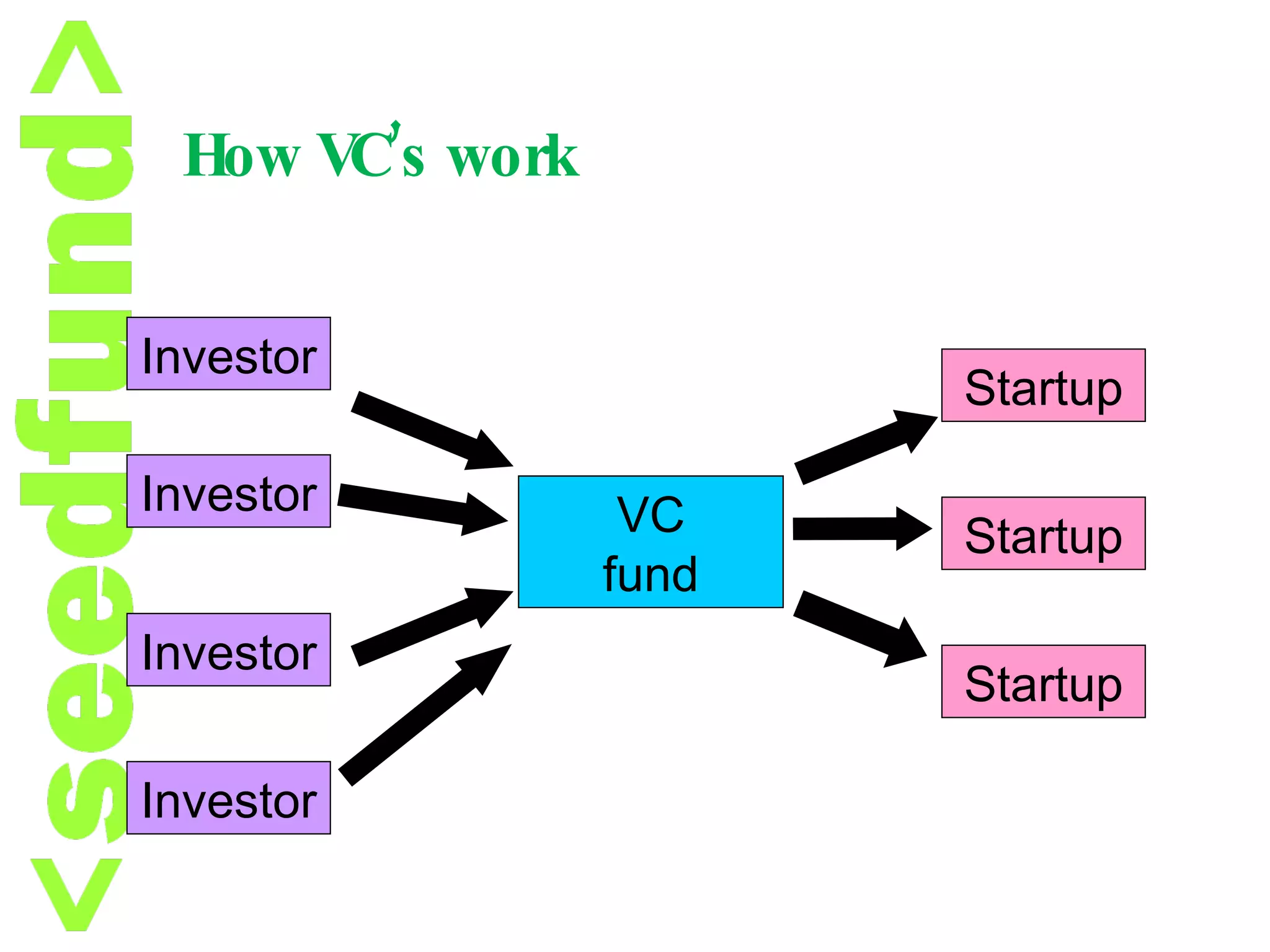
How VC’s work Investor Investor Investor VC fund Investor Startup Startup Startup
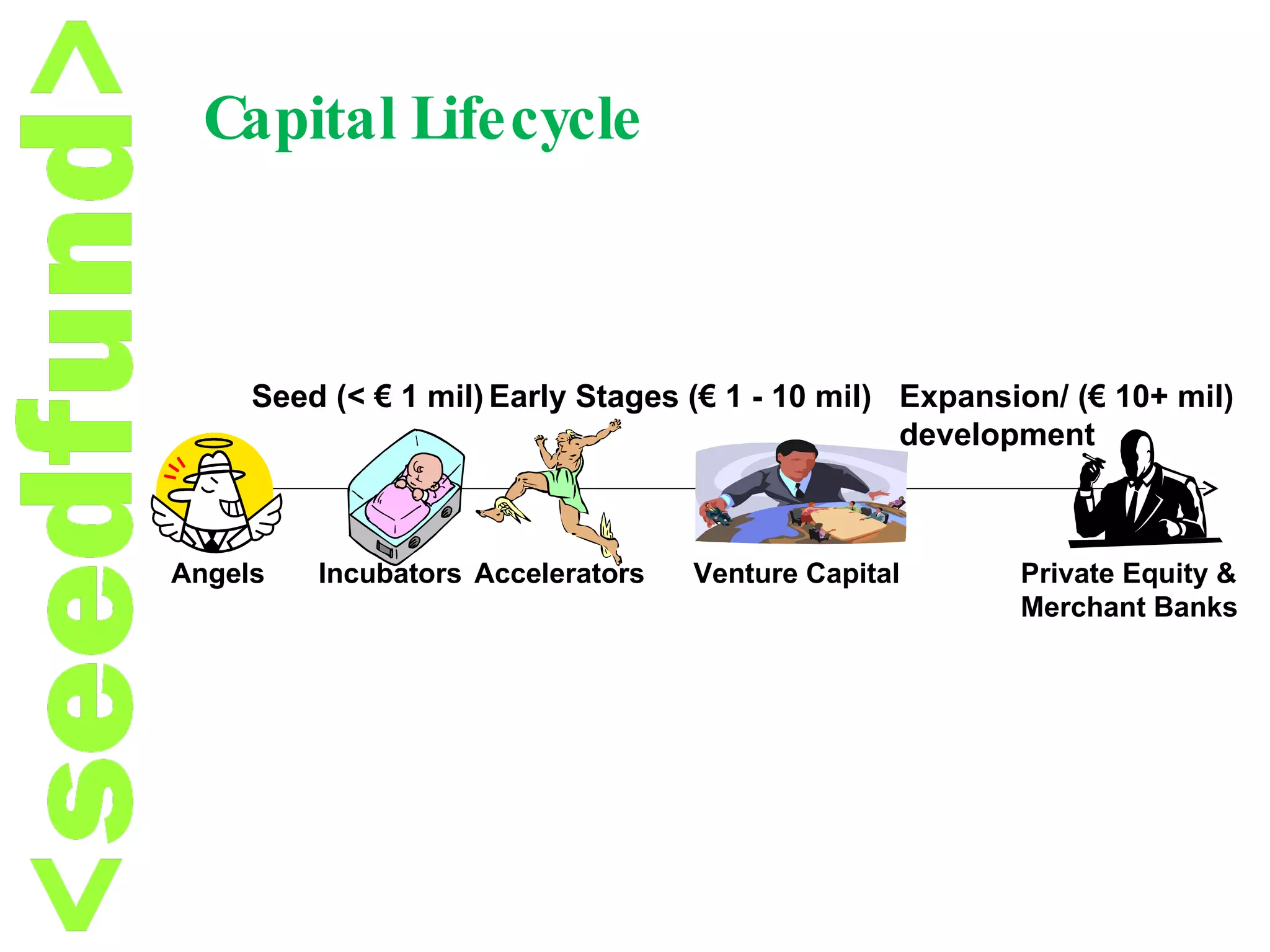
Capital Lifecycle Seed (< € 1 mil) Early Stages (€ 1 - 10 mil) Expansion/ (€ 10+ mil) development Angels Incubators Accelerators Venture Capital Private Equity & Merchant Banks
What Venture Capitalists do ... Sift through thousands of (good and bad) investment propositions
What Venture Capitalists do ... Sift through thousands of (good and bad) investment propositions Identify a few valid initiatives and finance them  in exchange for private equity (usually a minority stake) structure the deal
What Venture Capitalists do ... Sift through thousands of (good and bad) investment propositions Identify a few valid initiatives and finance them  Support the entrepreneurs in succeeding. E.g.:  providing financial advice in headhunting and setting up advisory boards in contacting customers, channels, …  in steering and positioning the company in managing PRs activities in managing IP and legal issues
What Venture Capitalists do ... Sift through thousands of (good and bad) investment propositions Identify a few valid initiatives and finance them  Support the entrepreneurs in succeeding. E.g.:  Look after value creation further round of financing merger and acquisition, IPO, …
Attributes of a Great VC •  Bets on people not trends •  Driven by the big idea •  Looking for a ‘Winner’ •  Not afraid of failure •  Understand how to manage a portfolio of risk •  Serves as a fantastic coach •  Does her best work outside of the board room •  Not waiting for validation from other VCs
Deciding whom to give money
In the VC’s Mind •  Is this the right team? •  What’s the entrepreneur's motivation? •  Is this a billion dollar opportunity? •  Is it a game changer? •  How competitive is the space? •  How defensible is the product? •  How much is this thing going to take? •  How long to maximize value and exit?
In the VC’s mind IRR (Internal Rate of Return) Company’s Current and Future Valuation Comparables (P/E,P/S,…), “Number of”, DCF, …  What’s The Best Strategy To Create Value Which are the achievable milestones and what’s the financing needed ? When is the break-even expected ? With which margins and revenues. Exit Strategy Trade sale, IPO, N th +1 round of financing, ..  Minimizing Risks Diluting the investment Liquidation Preference rights
Stages of Investment
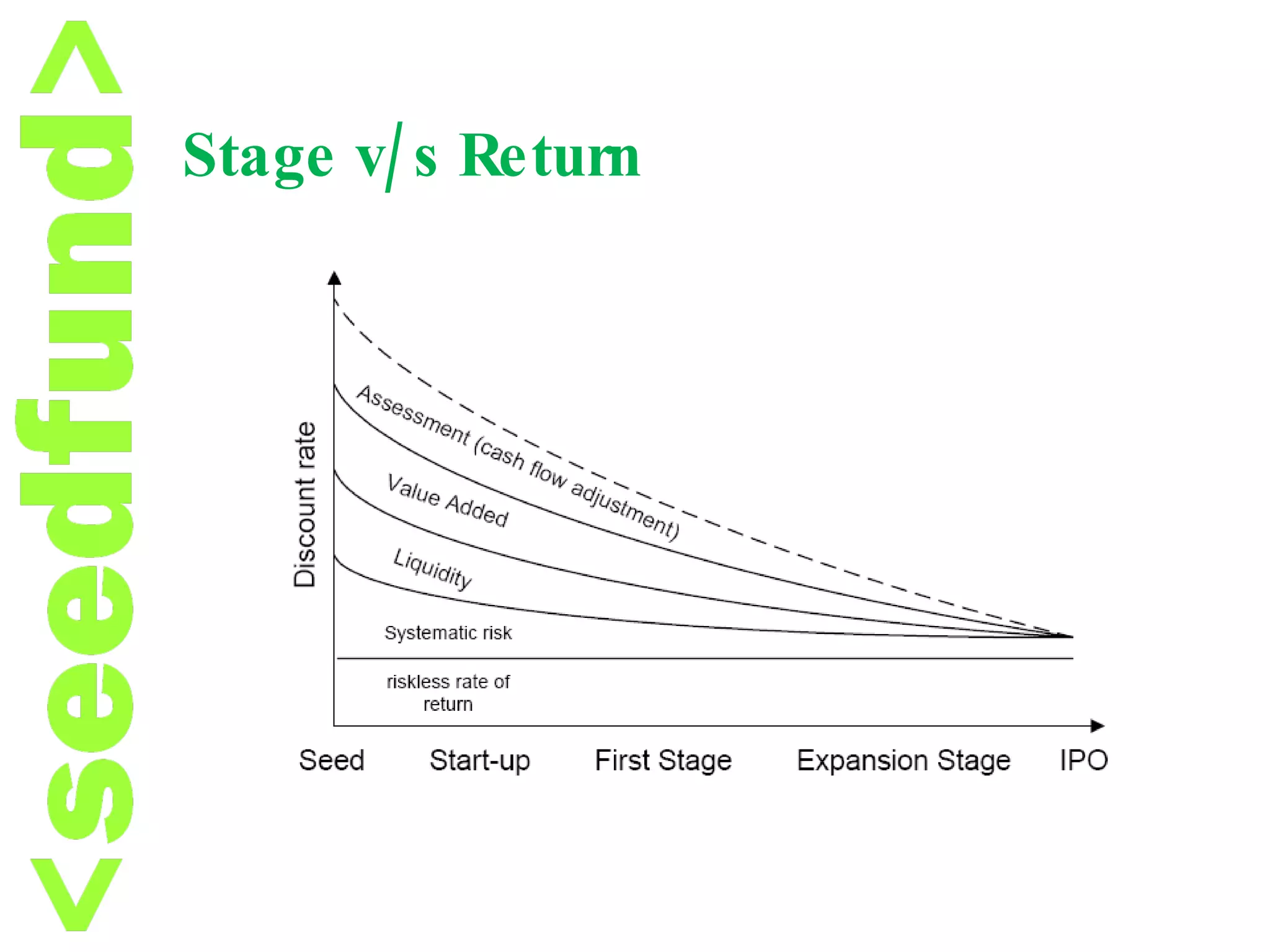
Stage v/s Return
Assessing the Entrepreneur •  Understanding motivations •  Determining commitment level and willingness to sacrifice •  Gauging ego •  Appetite for risk •  Domain expertise •  Leadership abilities and vision
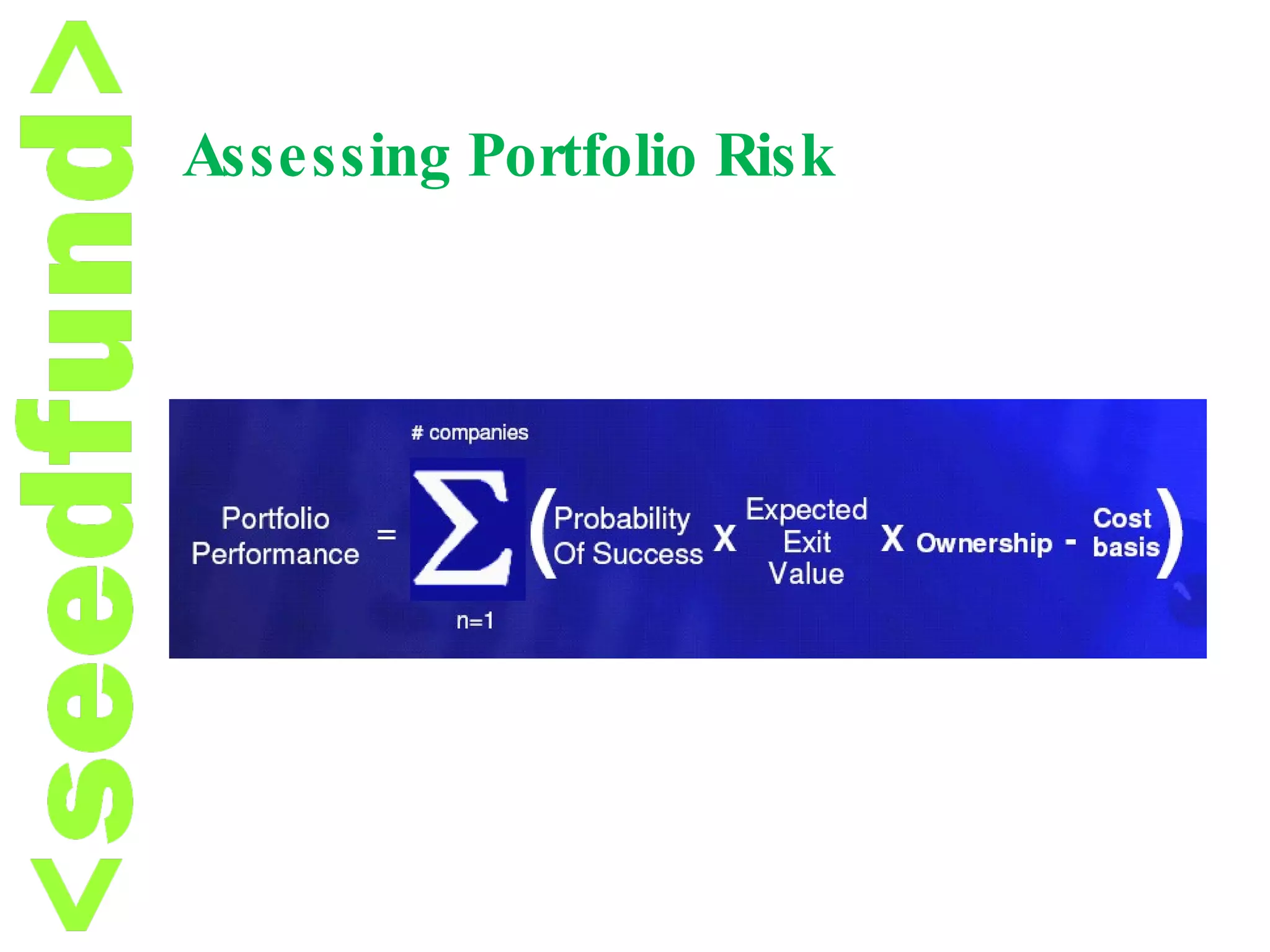
Assessing Portfolio Risk
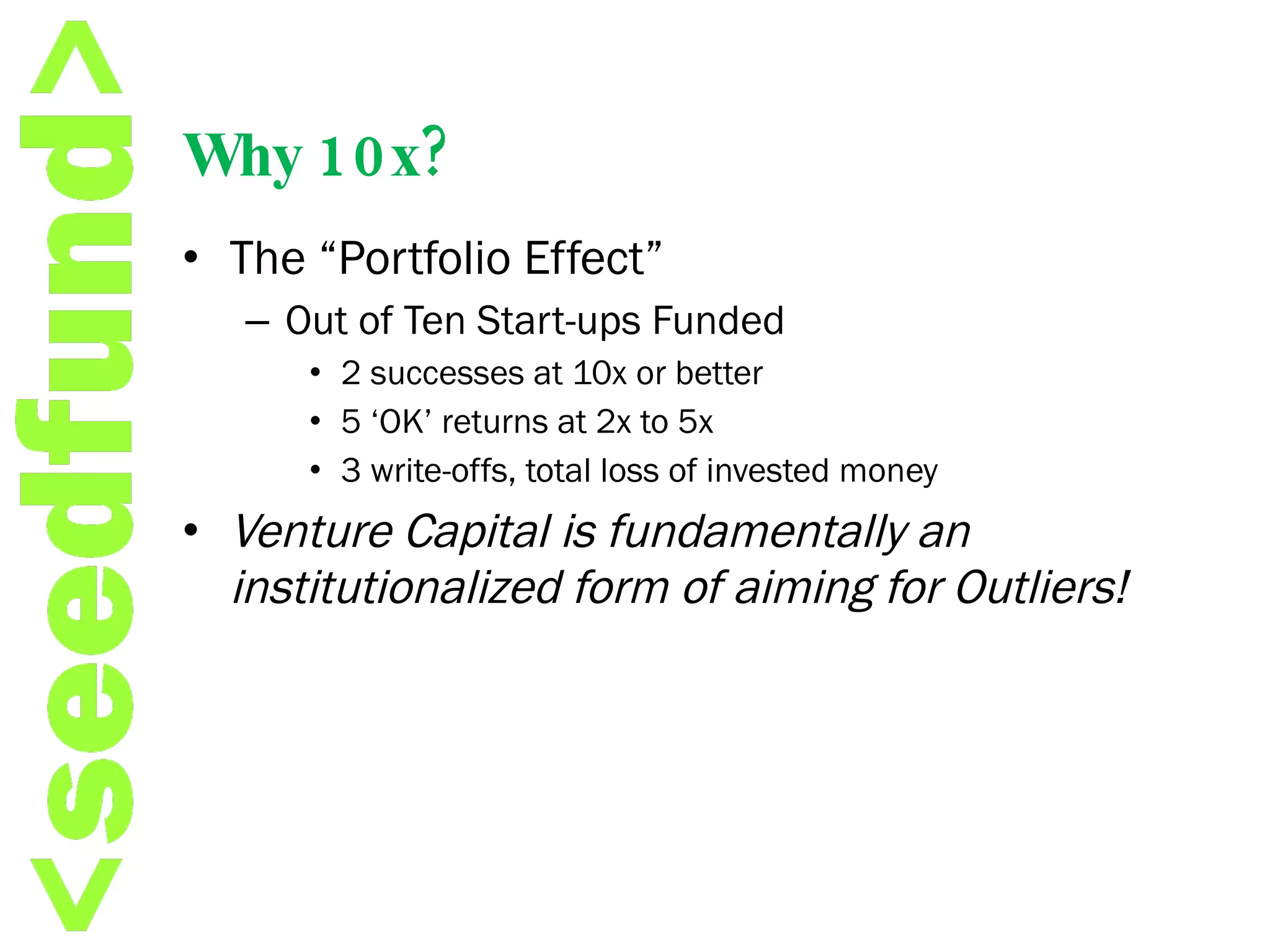
Why 10x? The “Portfolio Effect” Out of Ten Start-ups Funded 2 successes at 10x or better 5 ‘OK’ returns at 2x to 5x 3 write-offs, total loss of invested money Venture Capital is fundamentally an institutionalized form of aiming for Outliers!
Which VC to go with?
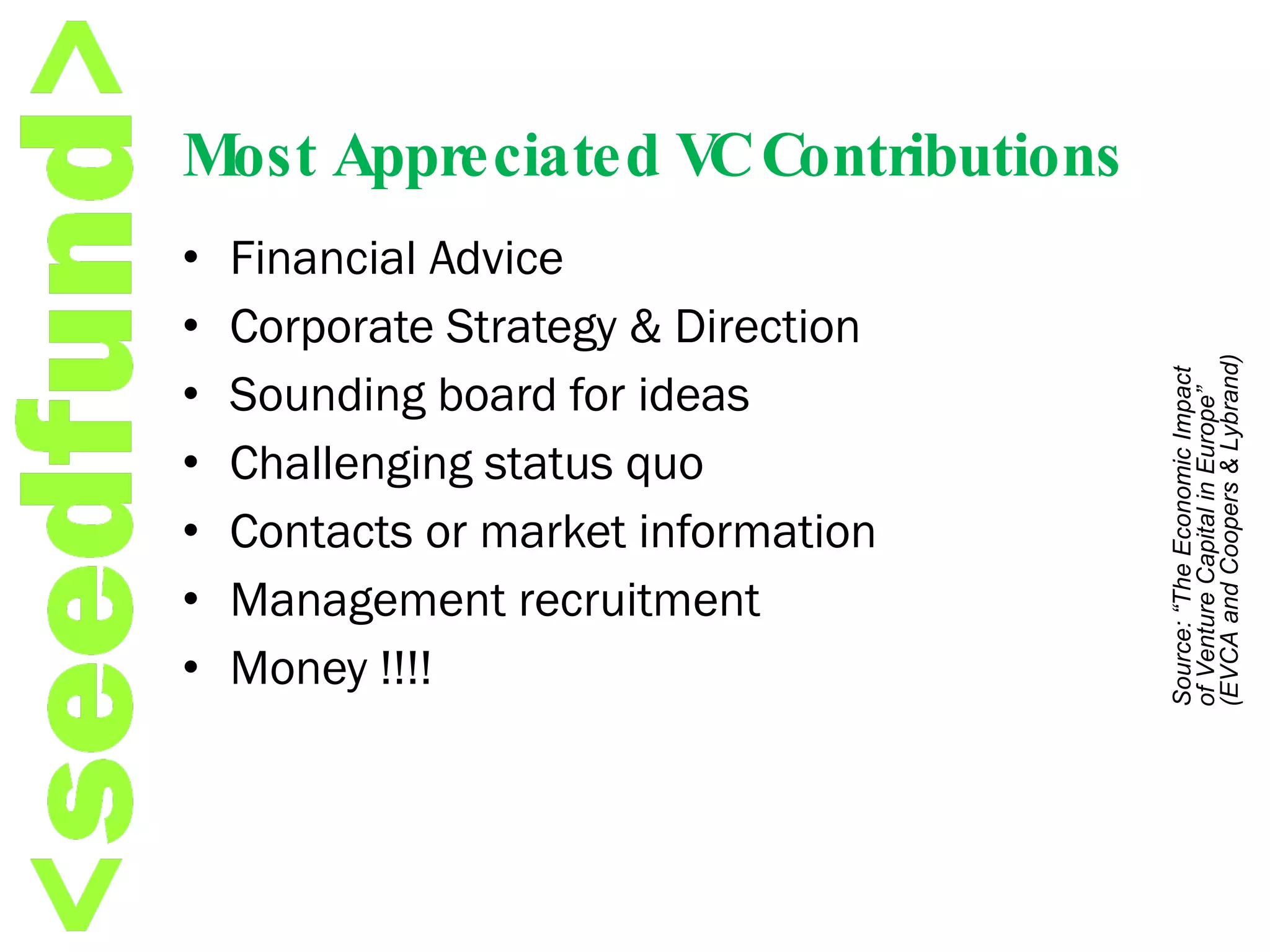
Most Appreciated VC Contributions Financial Advice  Corporate Strategy & Direction  Sounding board for ideas  Challenging status quo  Contacts or market information  Management recruitment  Money !!!! Source: “The Economic Impact of Venture Capital in Europe”  (EVCA and Coopers & Lybrand)
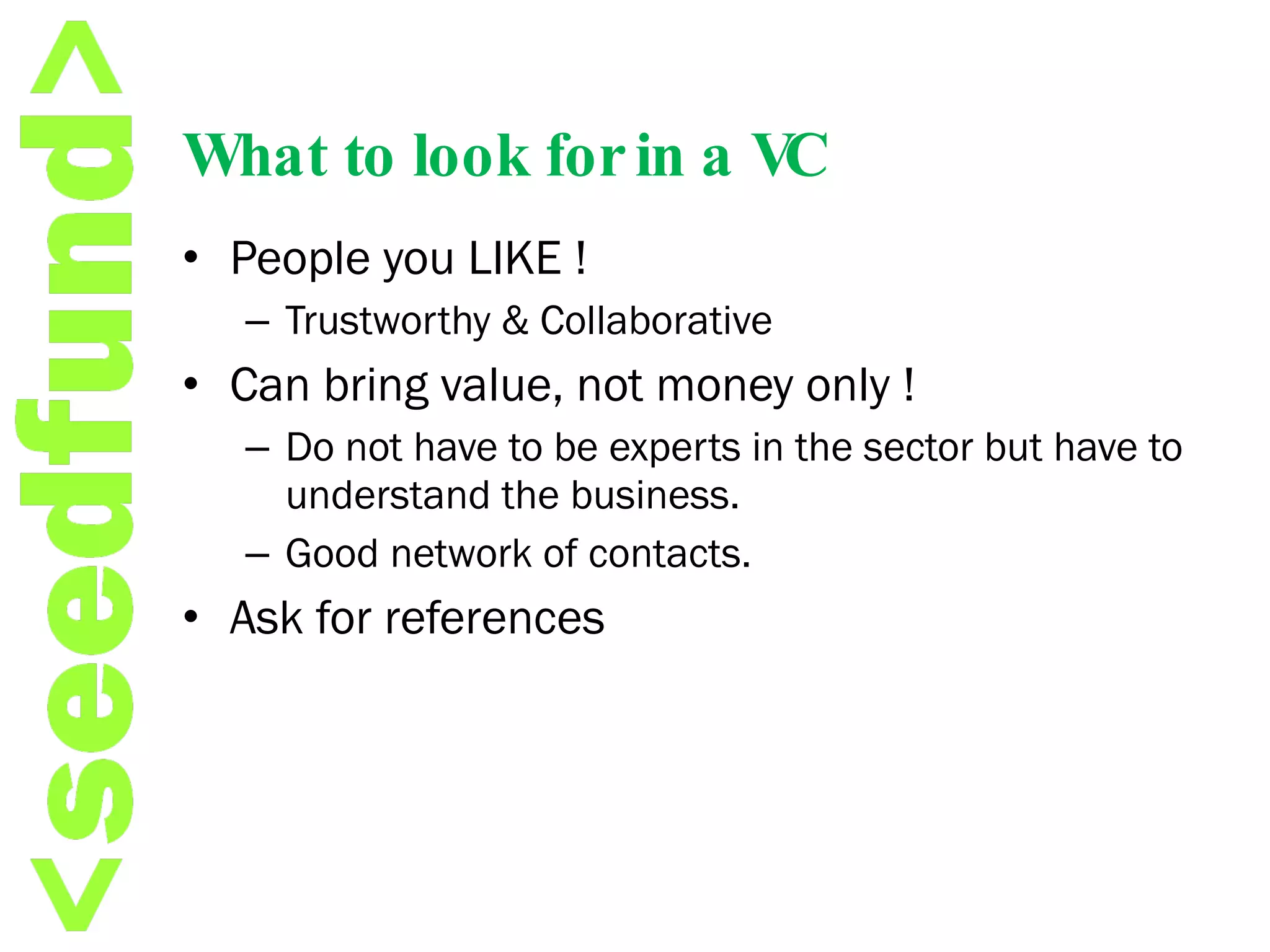
What to look for in a VC People you LIKE ! Trustworthy & Collaborative Can bring value, not money only ! Do not have to be experts in the sector but have to understand the business. Good network of contacts. Ask for references
What VCs are Not Good at •  Long term research investments •  Sustainability •  Evolutionary development •  Asset maximization •  Billion $ capital requirements
Want to raise VC money?
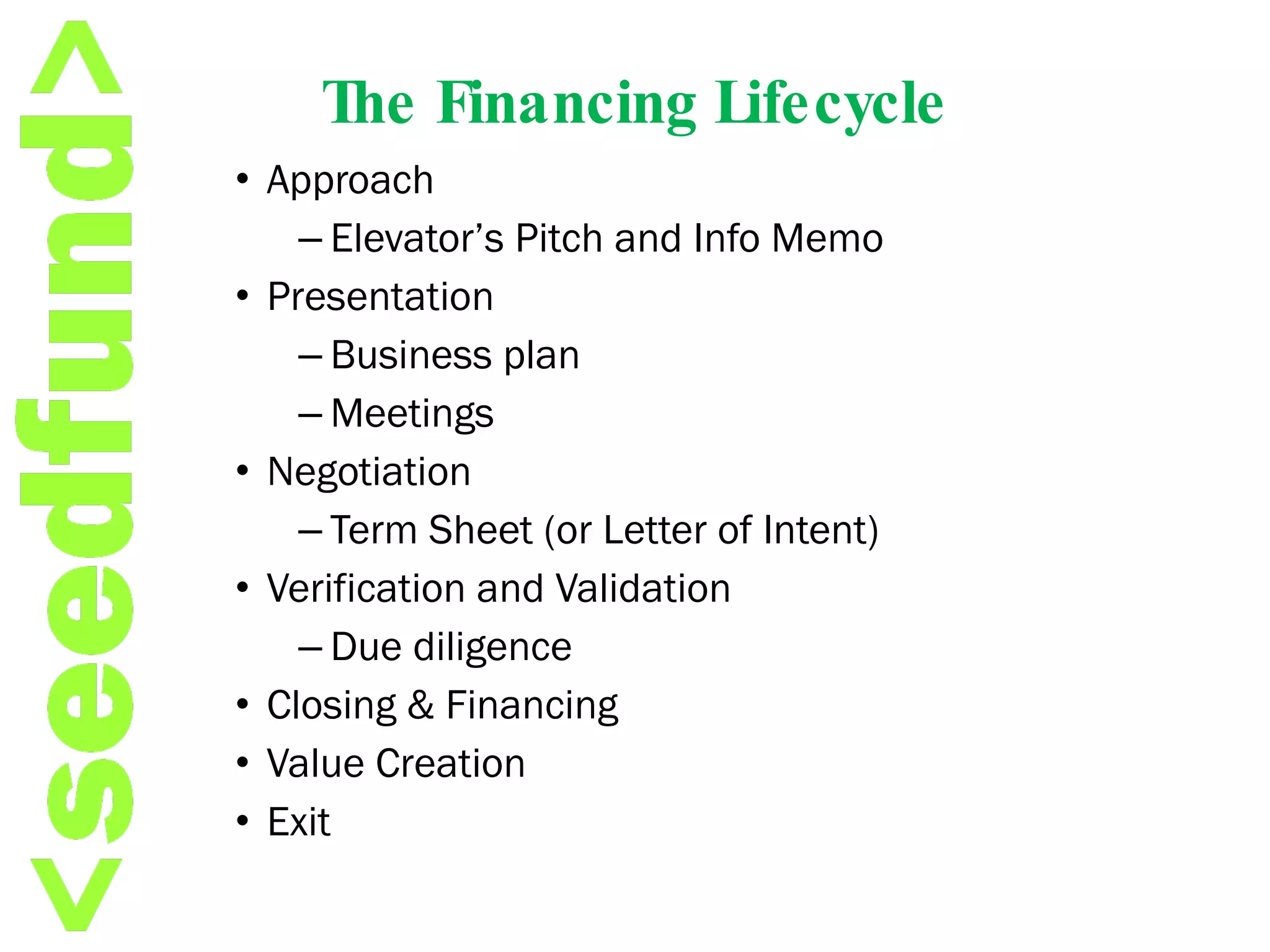
The Financing Lifecycle Approach Elevator’s Pitch and Info Memo Presentation Business plan Meetings Negotiation  Term Sheet (or Letter of Intent) Verification and Validation Due diligence Closing & Financing Value Creation Exit
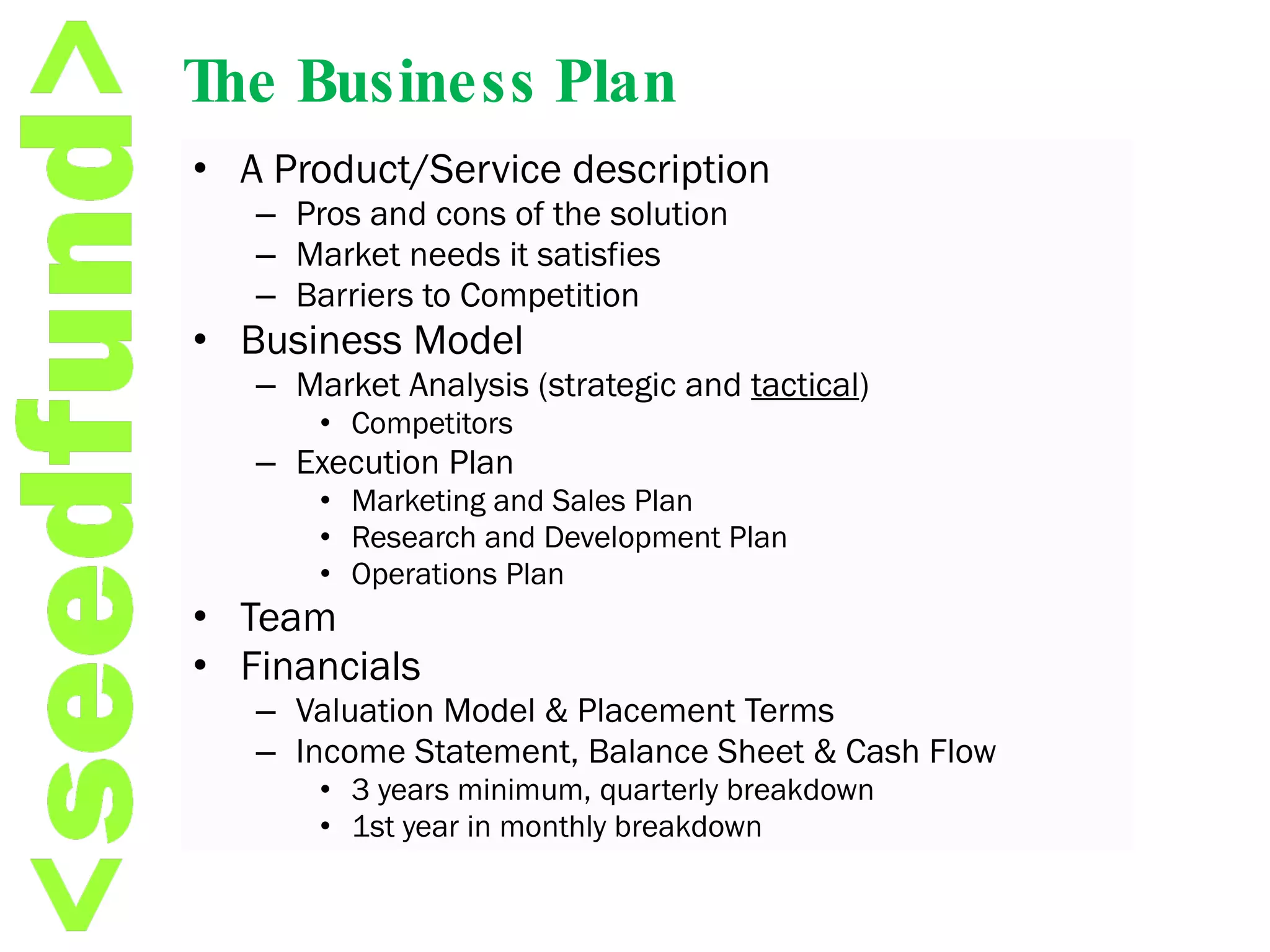
The Business Plan A Product/Service description Pros and cons of the solution Market needs it satisfies Barriers to Competition Business Model Market Analysis (strategic and  tactical ) Competitors Execution Plan  Marketing and Sales Plan Research and Development Plan Operations Plan Team Financials Valuation Model & Placement Terms Income Statement, Balance Sheet & Cash Flow 3 years minimum, quarterly breakdown 1st year in monthly breakdown
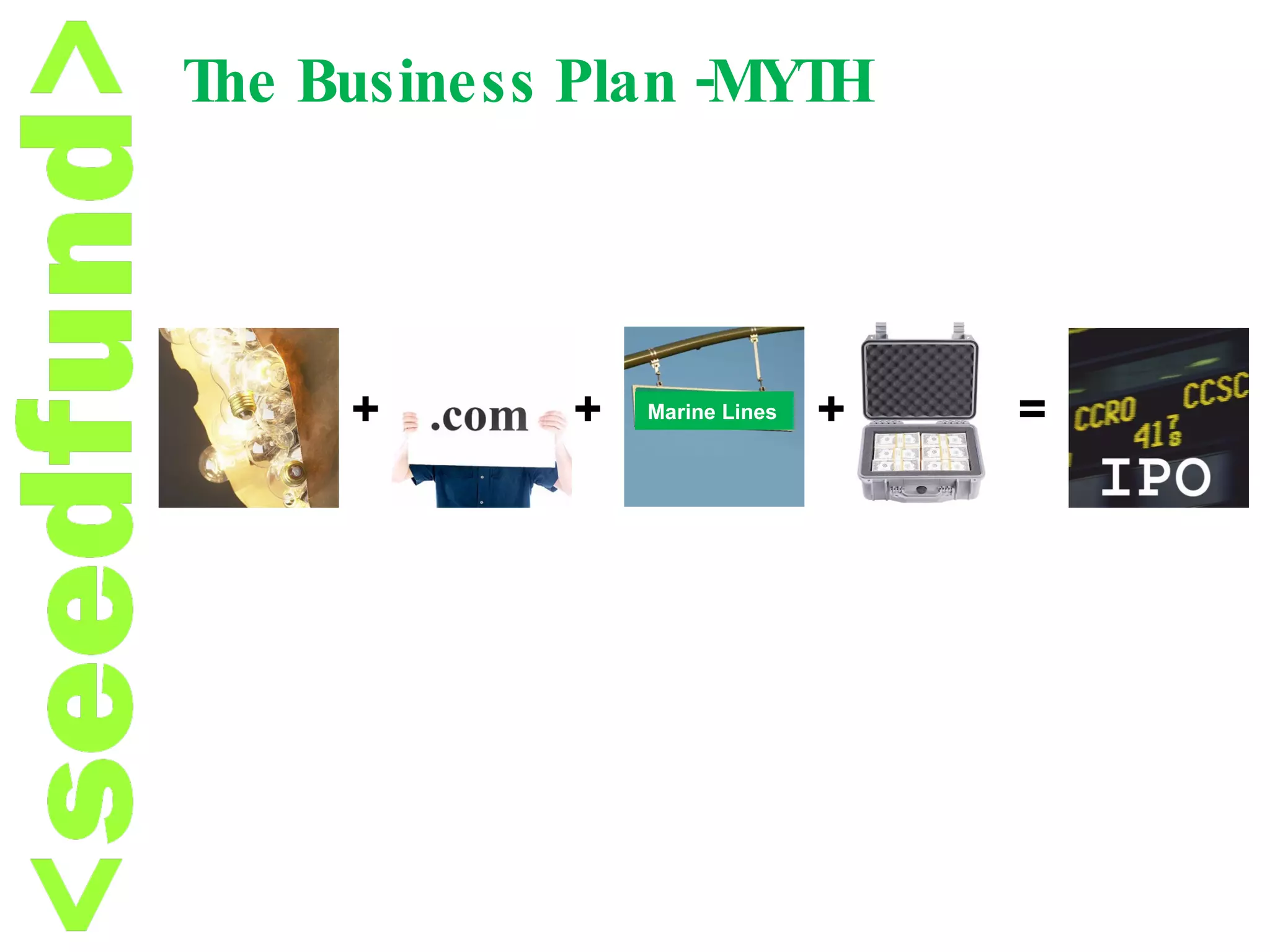
The Business Plan -MYTH + + + = Marine Lines
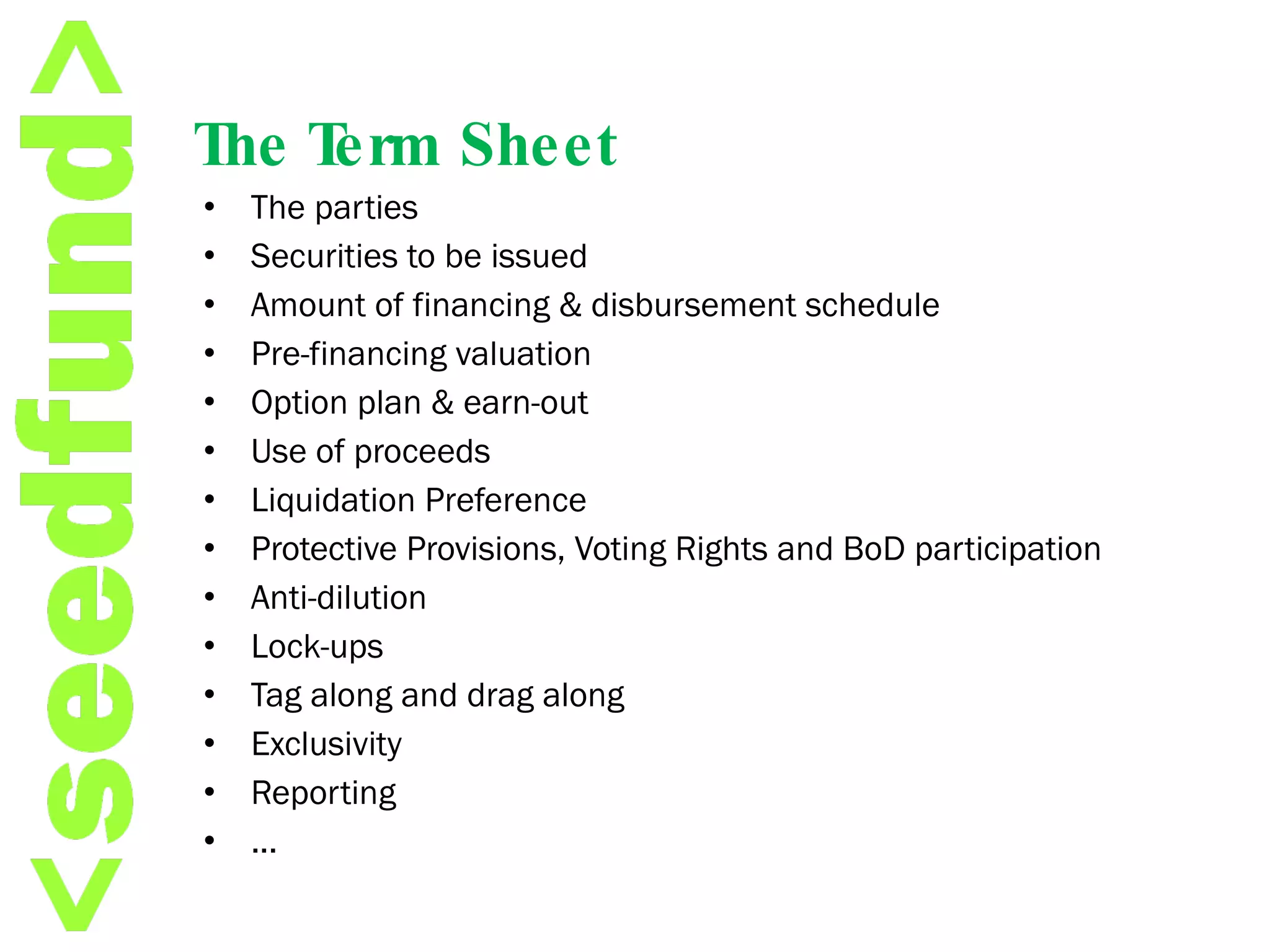
The Term Sheet The parties Securities to be issued Amount of financing & disbursement schedule Pre-financing valuation Option plan & earn-out Use of proceeds Liquidation Preference Protective Provisions, Voting Rights and BoD participation Anti-dilution Lock-ups  Tag along and drag along Exclusivity Reporting ...
Board Seats and Reserved Matters Corporate boards: Not involved in day-to-day operations Hold extreme control in major corporate events (sale, mergers, acquisitions, IPOs, bankruptcy) Lead VC in each round takes seat(s) Reserved matters (veto or approval): Any sale, acquisition, merger, liquidation Budget approval Executive removal/appointment Strategic or business plan changes
Other Typical VC Rights Right of first refusal  on sale of shares Tag-along rights : follow founder sale on pro rata basis Drag-along rights:  force sale of company Liquidation preference : multiple of investment No-compete  conditions on founders Right to participate  in subsequent rounds (usually follow-on) Later VC rights often supercede earlier Anti-Dilution Protection Recompute VC shares based on subsequent “down round” so that issuing more shares does not “dilute” the value of VC’s holding
Trends in VC investing
What’s Going to be Hot •  Virtualization •  Mobility services •  Location based services •  Enterprise services & software •  Internet gaming and entertainment •  Gen Y lifestyle products & services
Thank You

Starting Up:Introduction to venture Capital: by Anand Lunia

  • 1.
    An Introduction To Venture Capital Anand Lunia Executive Director & CFO, SEEDfund [email_address]
  • 2.
  • 3.
    Private Equity &Venture Capital “ Private Equity ” means capital to companies not quoted on a stock market ,in exchange for an equity participation. Venture Capital (VC) is a sub-class of Private Equity characterized by investments made for the purpose of developing, launching, and expanding new products or service offerings.
  • 4.
    How VC’s workInvestor Investor Investor VC fund Investor Startup Startup Startup
  • 5.
    Capital Lifecycle Seed(< € 1 mil) Early Stages (€ 1 - 10 mil) Expansion/ (€ 10+ mil) development Angels Incubators Accelerators Venture Capital Private Equity & Merchant Banks
  • 6.
    What Venture Capitalistsdo ... Sift through thousands of (good and bad) investment propositions
  • 7.
    What Venture Capitalistsdo ... Sift through thousands of (good and bad) investment propositions Identify a few valid initiatives and finance them in exchange for private equity (usually a minority stake) structure the deal
  • 8.
    What Venture Capitalistsdo ... Sift through thousands of (good and bad) investment propositions Identify a few valid initiatives and finance them Support the entrepreneurs in succeeding. E.g.: providing financial advice in headhunting and setting up advisory boards in contacting customers, channels, … in steering and positioning the company in managing PRs activities in managing IP and legal issues
  • 9.
    What Venture Capitalistsdo ... Sift through thousands of (good and bad) investment propositions Identify a few valid initiatives and finance them Support the entrepreneurs in succeeding. E.g.: Look after value creation further round of financing merger and acquisition, IPO, …
  • 10.
    Attributes of aGreat VC • Bets on people not trends • Driven by the big idea • Looking for a ‘Winner’ • Not afraid of failure • Understand how to manage a portfolio of risk • Serves as a fantastic coach • Does her best work outside of the board room • Not waiting for validation from other VCs
  • 11.
    Deciding whom togive money
  • 12.
    In the VC’sMind • Is this the right team? • What’s the entrepreneur's motivation? • Is this a billion dollar opportunity? • Is it a game changer? • How competitive is the space? • How defensible is the product? • How much is this thing going to take? • How long to maximize value and exit?
  • 13.
    In the VC’smind IRR (Internal Rate of Return) Company’s Current and Future Valuation Comparables (P/E,P/S,…), “Number of”, DCF, … What’s The Best Strategy To Create Value Which are the achievable milestones and what’s the financing needed ? When is the break-even expected ? With which margins and revenues. Exit Strategy Trade sale, IPO, N th +1 round of financing, .. Minimizing Risks Diluting the investment Liquidation Preference rights
  • 14.
  • 15.
  • 16.
    Assessing the Entrepreneur• Understanding motivations • Determining commitment level and willingness to sacrifice • Gauging ego • Appetite for risk • Domain expertise • Leadership abilities and vision
  • 17.
  • 18.
    Why 10x? The“Portfolio Effect” Out of Ten Start-ups Funded 2 successes at 10x or better 5 ‘OK’ returns at 2x to 5x 3 write-offs, total loss of invested money Venture Capital is fundamentally an institutionalized form of aiming for Outliers!
  • 19.
    Which VC togo with?
  • 20.
    Most Appreciated VCContributions Financial Advice Corporate Strategy & Direction Sounding board for ideas Challenging status quo Contacts or market information Management recruitment Money !!!! Source: “The Economic Impact of Venture Capital in Europe” (EVCA and Coopers & Lybrand)
  • 21.
    What to lookfor in a VC People you LIKE ! Trustworthy & Collaborative Can bring value, not money only ! Do not have to be experts in the sector but have to understand the business. Good network of contacts. Ask for references
  • 22.
    What VCs areNot Good at • Long term research investments • Sustainability • Evolutionary development • Asset maximization • Billion $ capital requirements
  • 23.
    Want to raiseVC money?
  • 24.
    The Financing LifecycleApproach Elevator’s Pitch and Info Memo Presentation Business plan Meetings Negotiation Term Sheet (or Letter of Intent) Verification and Validation Due diligence Closing & Financing Value Creation Exit
  • 25.
    The Business PlanA Product/Service description Pros and cons of the solution Market needs it satisfies Barriers to Competition Business Model Market Analysis (strategic and tactical ) Competitors Execution Plan Marketing and Sales Plan Research and Development Plan Operations Plan Team Financials Valuation Model & Placement Terms Income Statement, Balance Sheet & Cash Flow 3 years minimum, quarterly breakdown 1st year in monthly breakdown
  • 26.
    The Business Plan-MYTH + + + = Marine Lines
  • 27.
    The Term SheetThe parties Securities to be issued Amount of financing & disbursement schedule Pre-financing valuation Option plan & earn-out Use of proceeds Liquidation Preference Protective Provisions, Voting Rights and BoD participation Anti-dilution Lock-ups Tag along and drag along Exclusivity Reporting ...
  • 28.
    Board Seats andReserved Matters Corporate boards: Not involved in day-to-day operations Hold extreme control in major corporate events (sale, mergers, acquisitions, IPOs, bankruptcy) Lead VC in each round takes seat(s) Reserved matters (veto or approval): Any sale, acquisition, merger, liquidation Budget approval Executive removal/appointment Strategic or business plan changes
  • 29.
    Other Typical VCRights Right of first refusal on sale of shares Tag-along rights : follow founder sale on pro rata basis Drag-along rights: force sale of company Liquidation preference : multiple of investment No-compete conditions on founders Right to participate in subsequent rounds (usually follow-on) Later VC rights often supercede earlier Anti-Dilution Protection Recompute VC shares based on subsequent “down round” so that issuing more shares does not “dilute” the value of VC’s holding
  • 30.
    Trends in VCinvesting
  • 31.
    What’s Going tobe Hot • Virtualization • Mobility services • Location based services • Enterprise services & software • Internet gaming and entertainment • Gen Y lifestyle products & services
  • 32.

Editor's Notes

  • #5 The first thing to understand about VC’s is that they’re not investing their own money. Venture capitalists start by raising money from a bunch of investors, and then distribute it to various startups. But the investors are expecting to get their money back, generally within 10 years of committing it to the fund.