An Introduction To  Venture Capital Anand  [email_address] Shailesh [email_address]
Agenda Saturday, July 23 rd , 2011 The Billion Dollar Club? What is Venture Capital? Valuation Methodologies Valuation in Venture Capital Structuring a Fund Case Study: MMT
The Billion Dollar Club
The Billion Dollar Club Airbnb  is  definitely in the club . The crowdsourced marketplace for turning your apartment into a hotel for a night grew  800 percent  last year in nights booked to 800,000. There are currently 60,000 listings, and bookings keep growing by 40 to 50 percent a month.  Sublets are next .
The Billion Dollar Club Square  is also  in the club . It is raising at least $50 million. Square passed 500,000 card readers and  1 million transactions  in May, and is processing more than  $3 million a day  in mobile payments. COO  Keith  Rabois   told us at Disrupt NYC that Square will do $1 billion in transactions this year, and he thinks it could ultimately do  better financially than  Paypal  (where he was an early executive). 
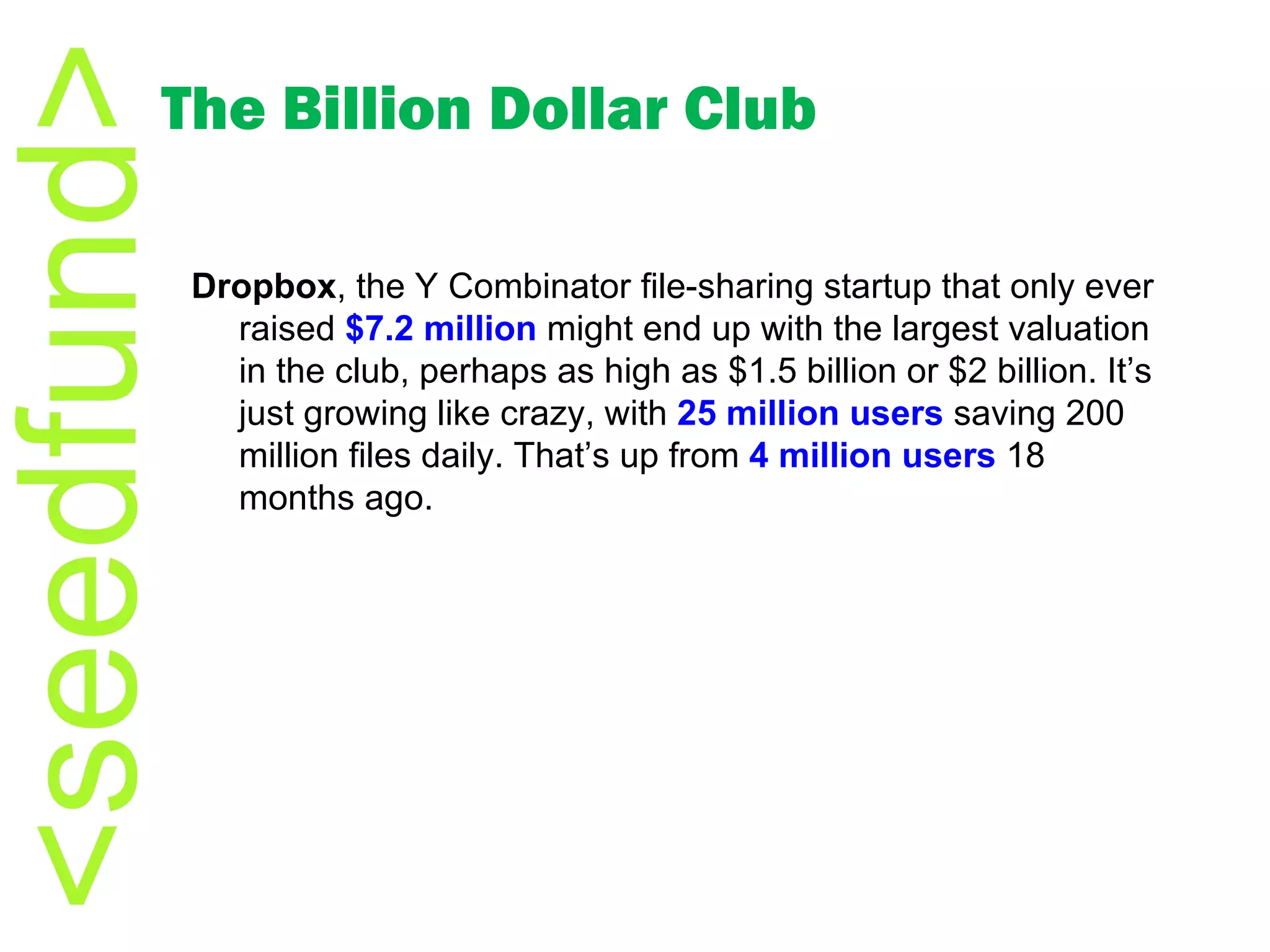
The Billion Dollar Club Dropbox , the Y Combinator file-sharing startup that only ever raised  $7.2 million  might end up with the largest valuation in the club, perhaps as high as $1.5 billion or $2 billion. It’s just growing like crazy, with  25 million users  saving 200 million files daily. That’s up from  4 million users  18 months ago.
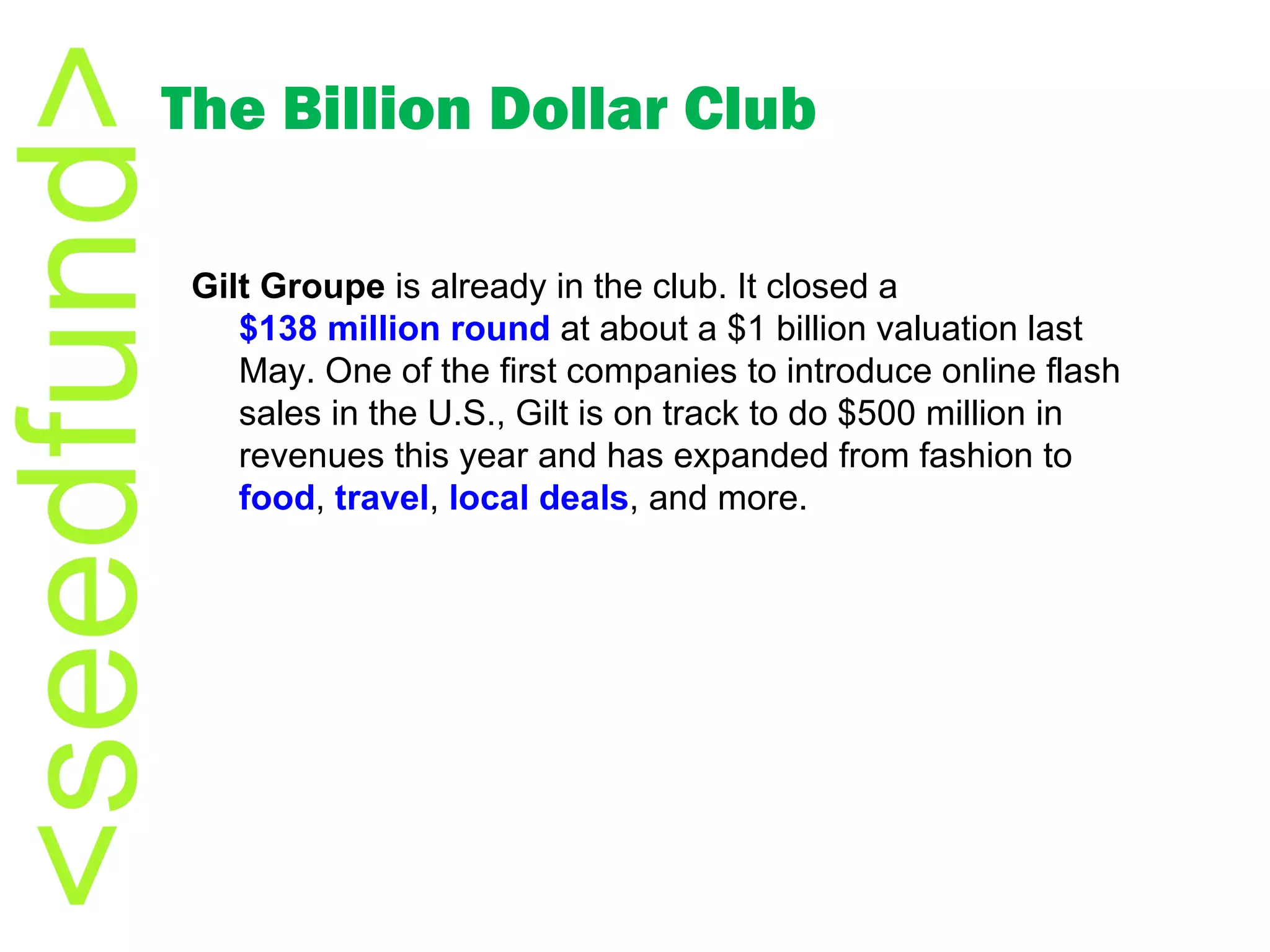
The Billion Dollar Club Gilt Groupe  is already in the club. It closed a  $138 million round  at about a $1 billion valuation last May. One of the first companies to introduce online flash sales in the U.S., Gilt is on track to do $500 million in revenues this year and has expanded from fashion to  food ,  travel ,  local deals , and more.
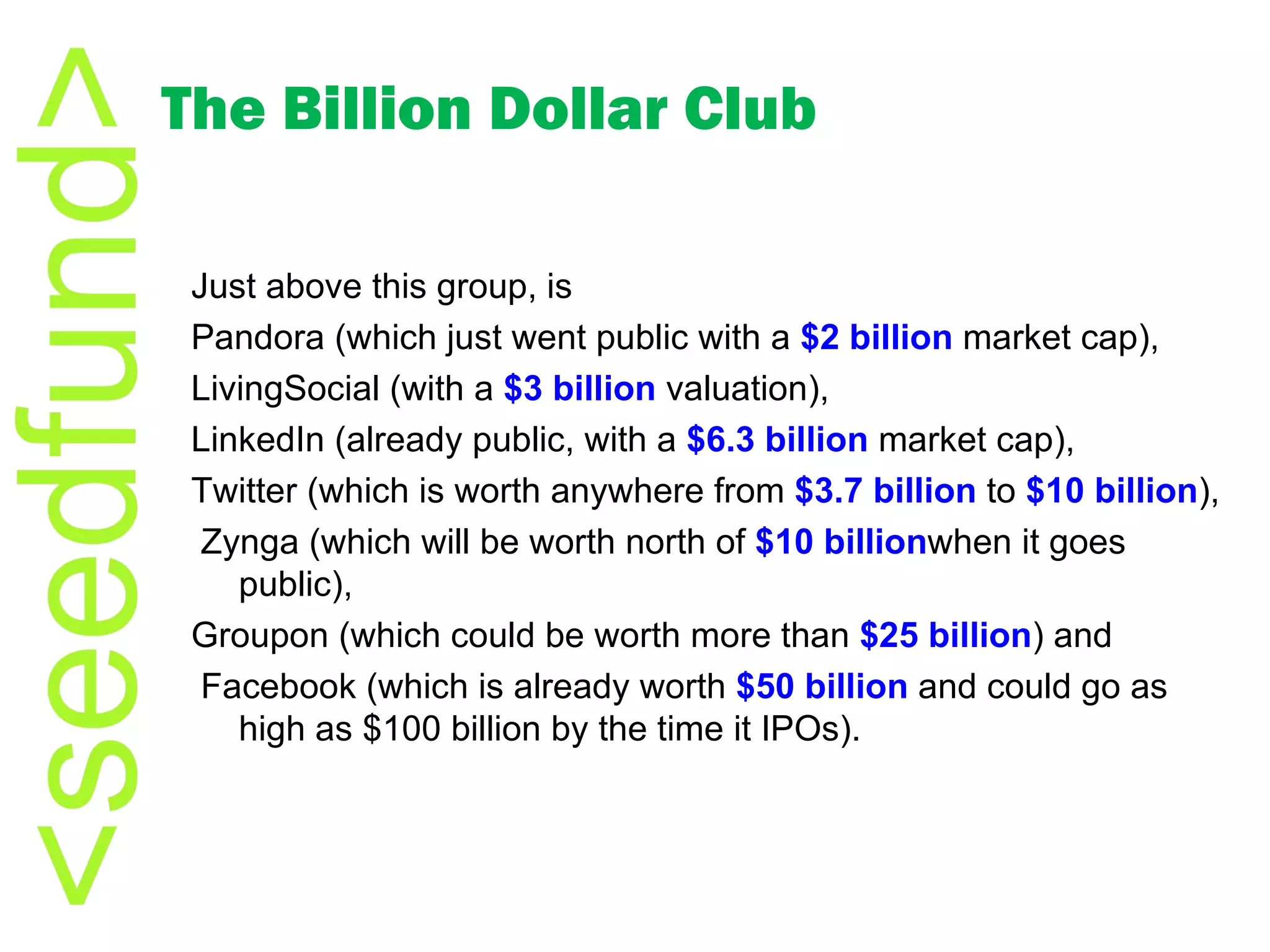
The Billion Dollar Club Just above this group, is  Pandora (which just went public with a  $2 billion  market cap),  LivingSocial (with a  $3 billion  valuation),  LinkedIn (already public, with a  $6.3 billion  market cap),  Twitter (which is worth anywhere from  $3.7 billion  to  $10 billion ), Zynga (which will be worth north of  $10  billion when it goes public),  Groupon (which could be worth more than  $25 billion ) and Facebook (which is already worth  $50 billion  and could go as high as $100 billion by the time it IPOs).
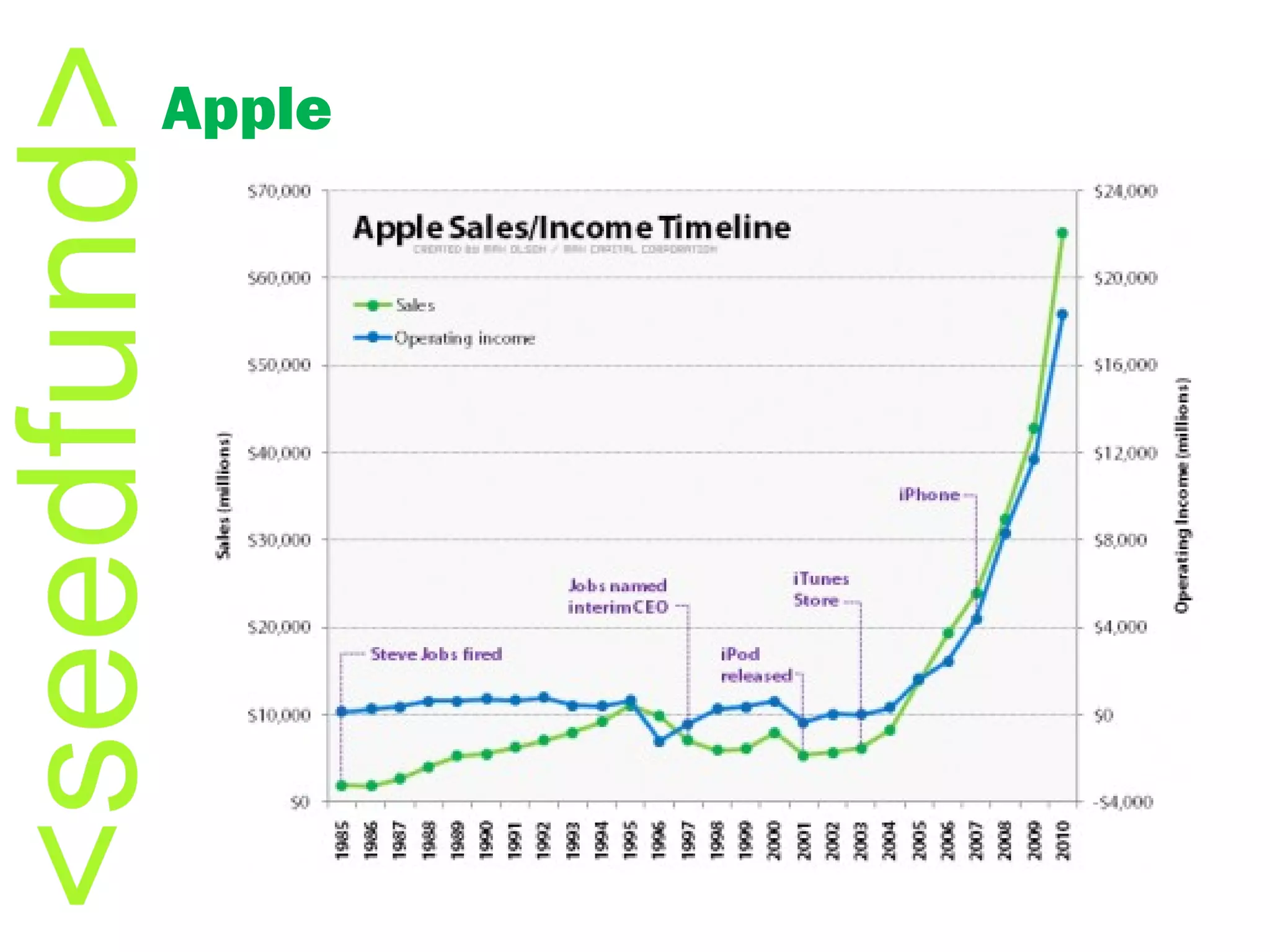
Apple
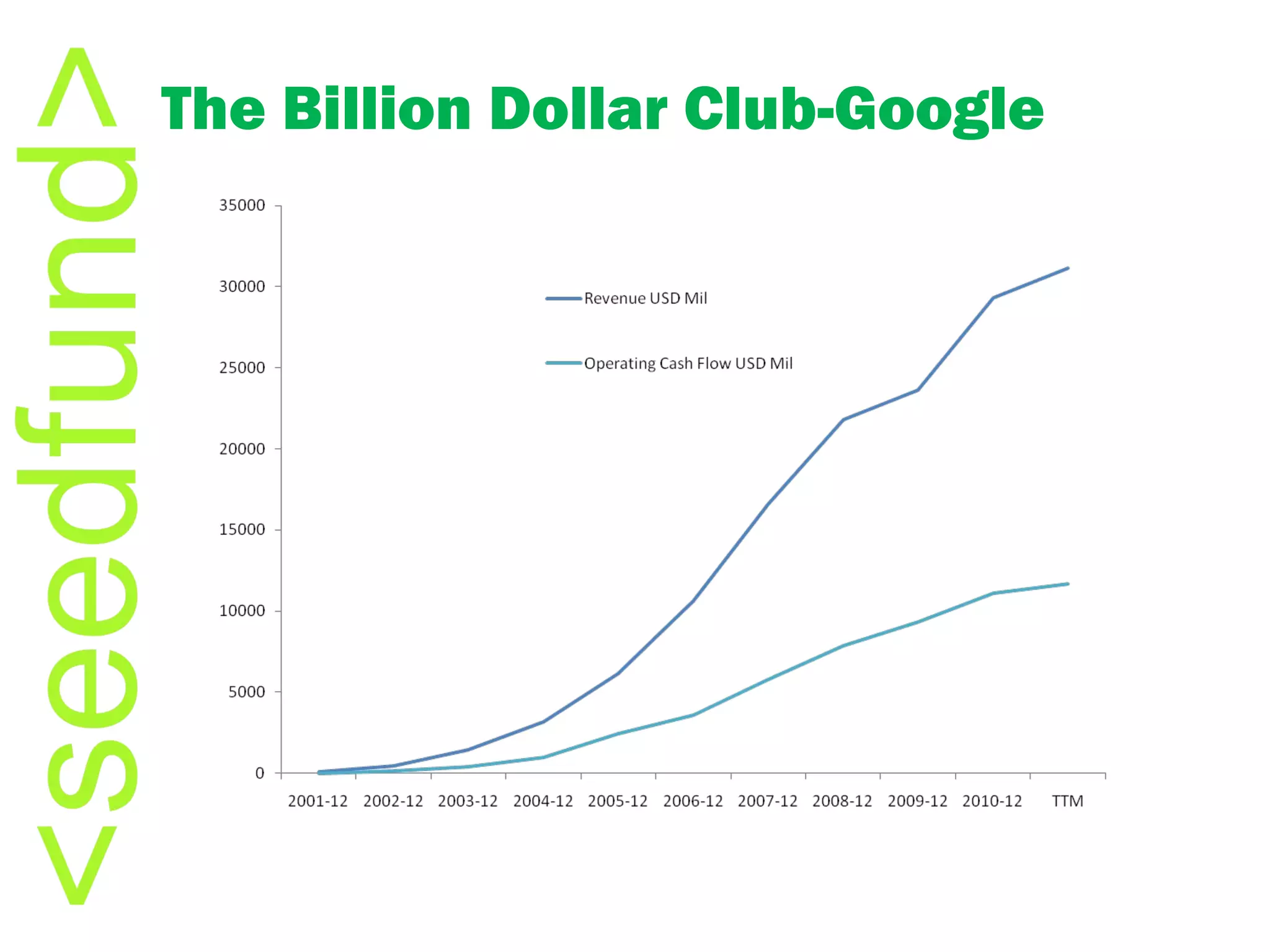
The Billion Dollar Club-Google
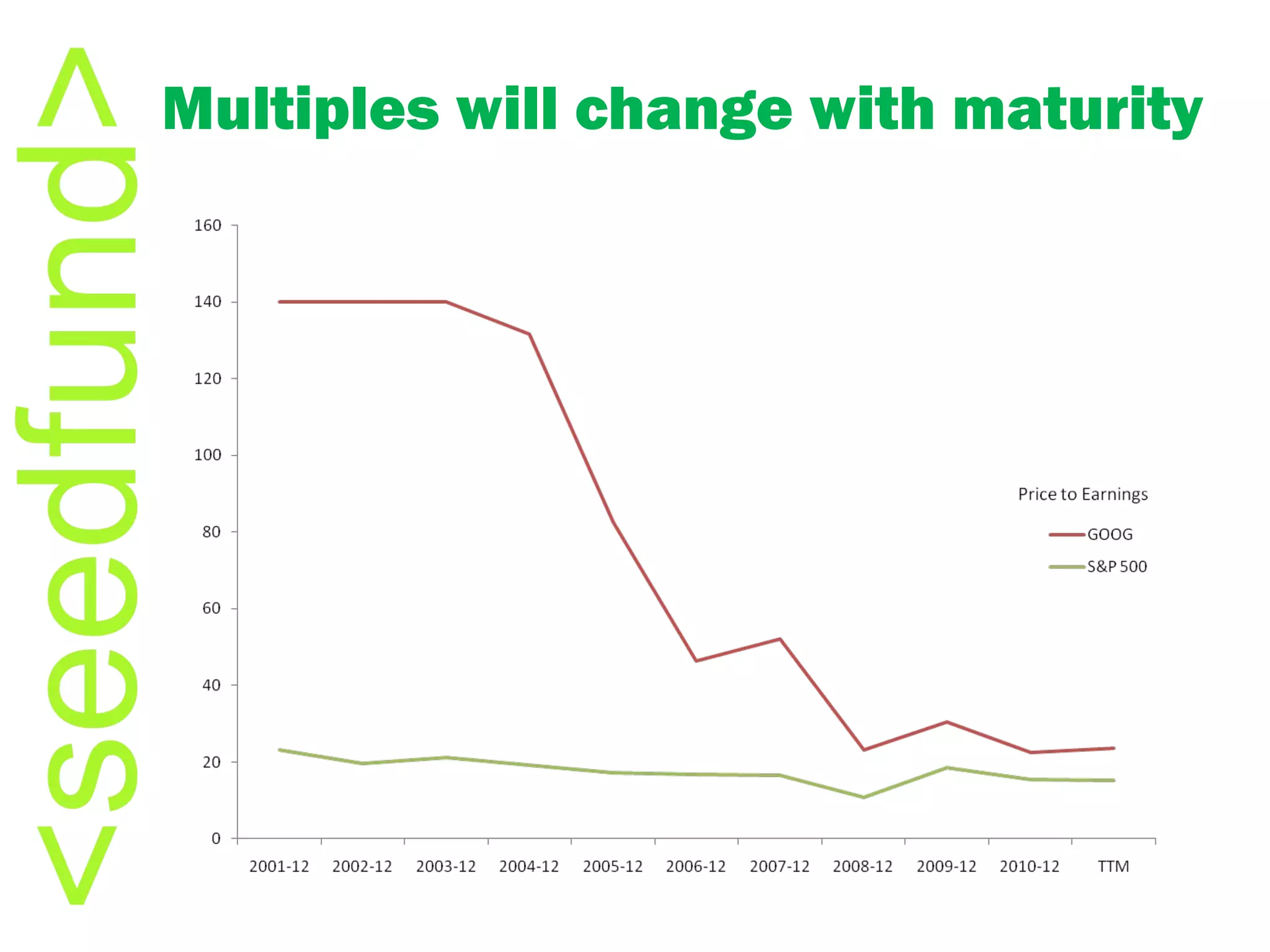
Multiples will change with maturity
What is Venture Capital?
Private Equity & Venture Capital “ Private Equity ” means capital to companies not quoted on a stock market, in exchange for an equity participation Venture Capital  (VC) is a sub-class of Private Equity characterized by investments made for the purpose of developing, launching, and expanding new products or service offerings
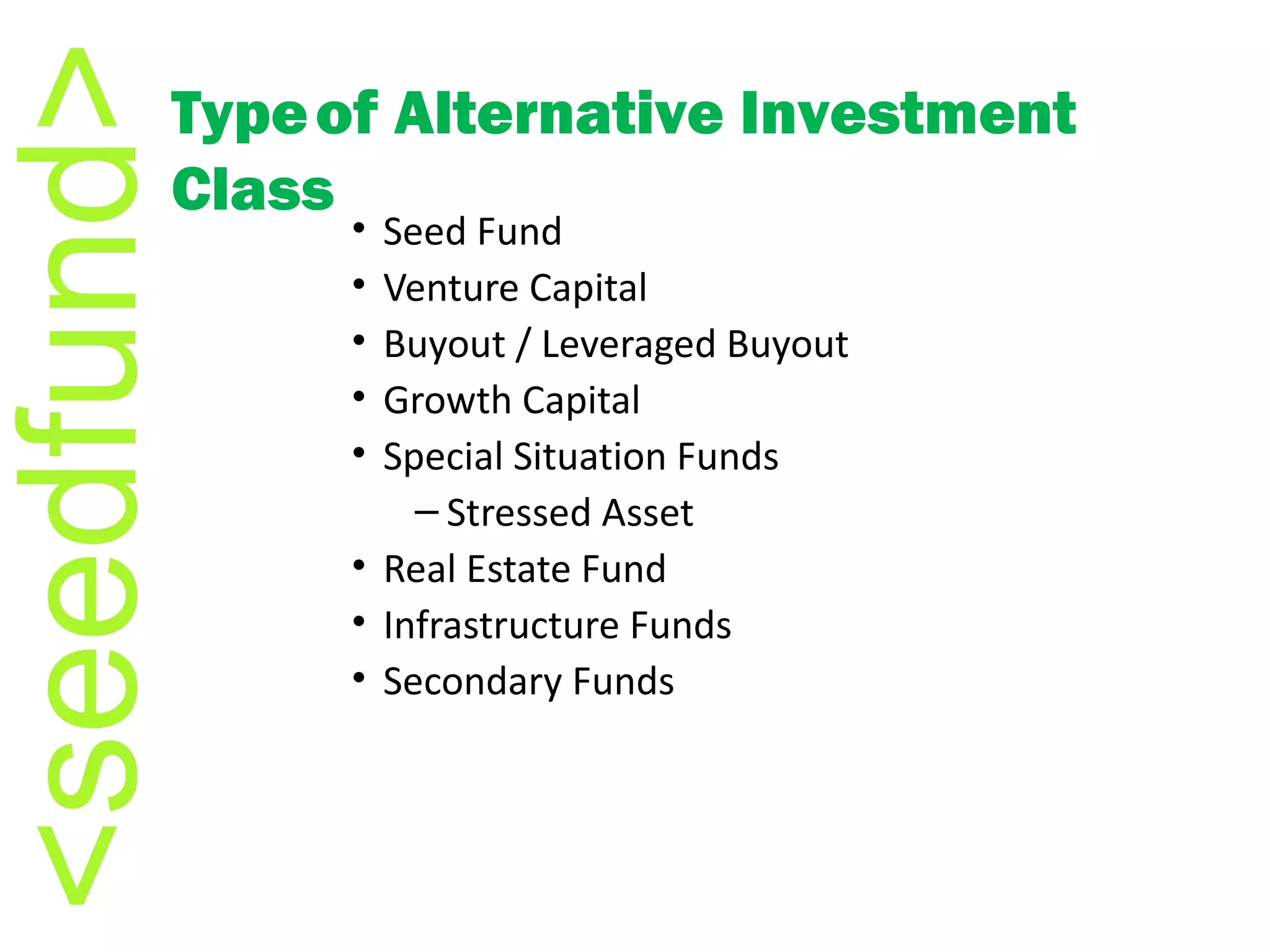
Seed Fund Venture Capital  Buyout / Leveraged Buyout  Growth Capital Special Situation Funds Stressed Asset Real Estate Fund Infrastructure Funds Secondary Funds Type   of Alternative Investment Class
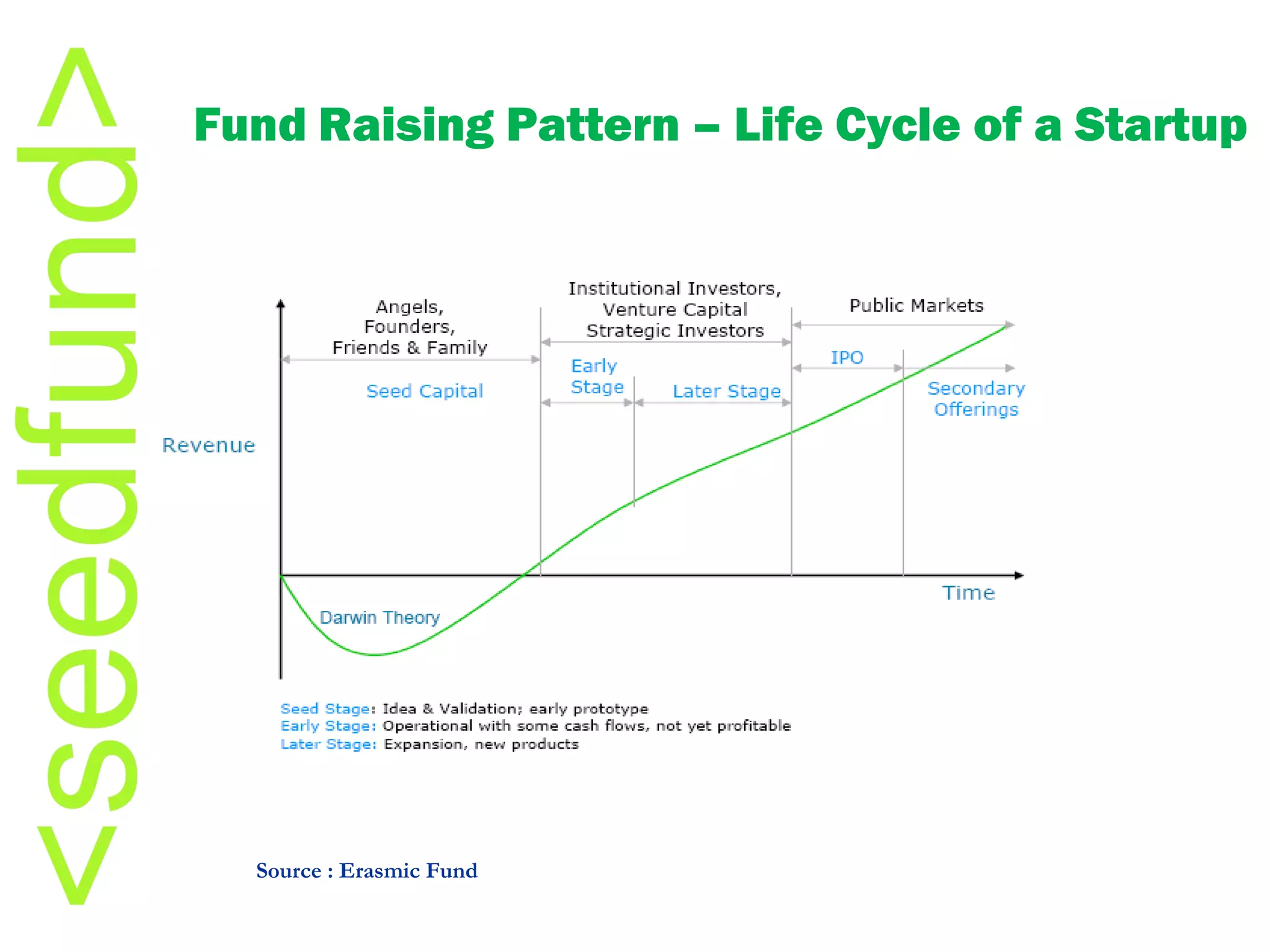
Source : Erasmic Fund Fund   Raising Pattern – Life Cycle of a Startup
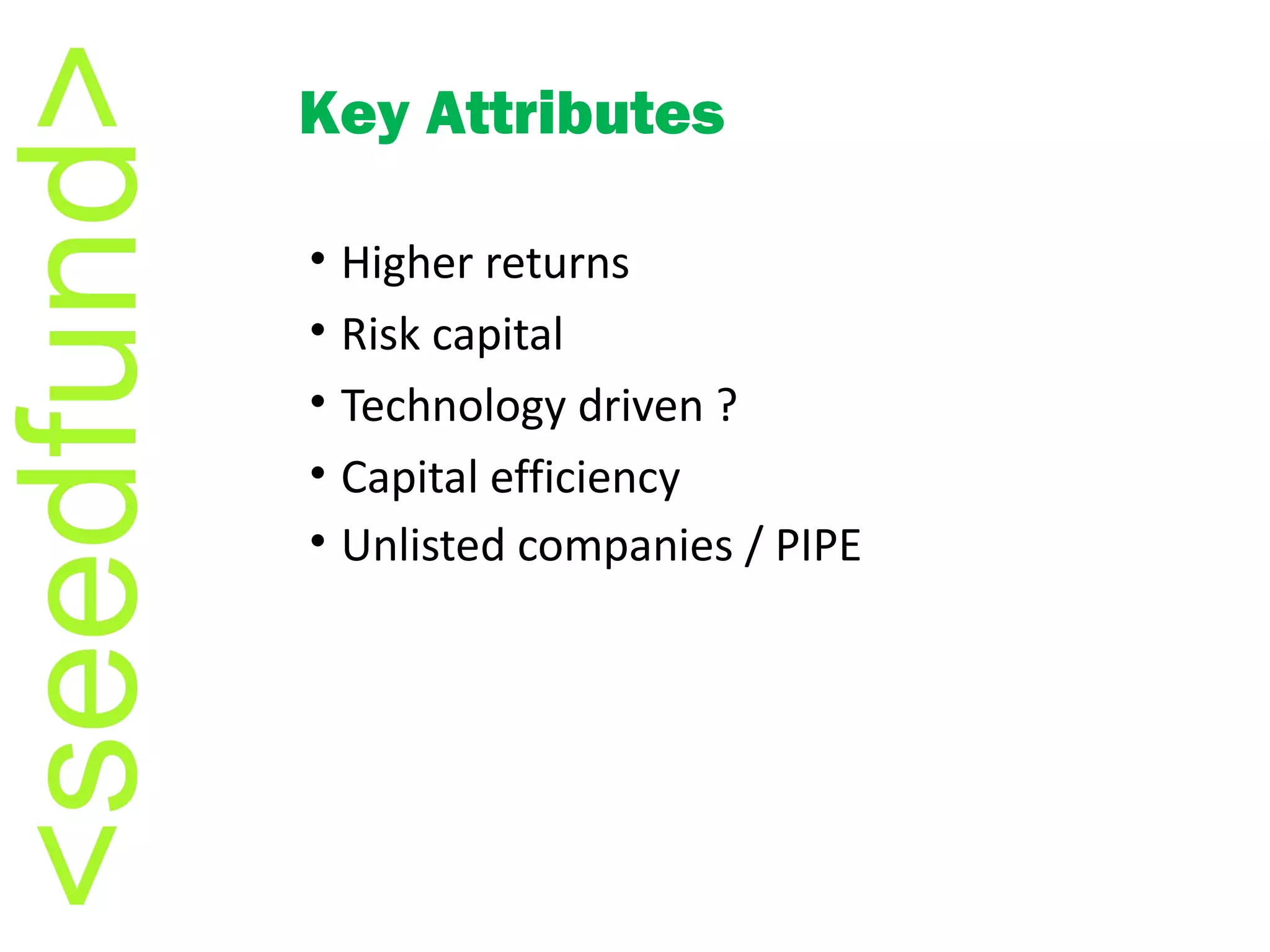
Higher returns Risk capital Technology driven ? Capital efficiency  Unlisted companies / PIPE Key Attributes
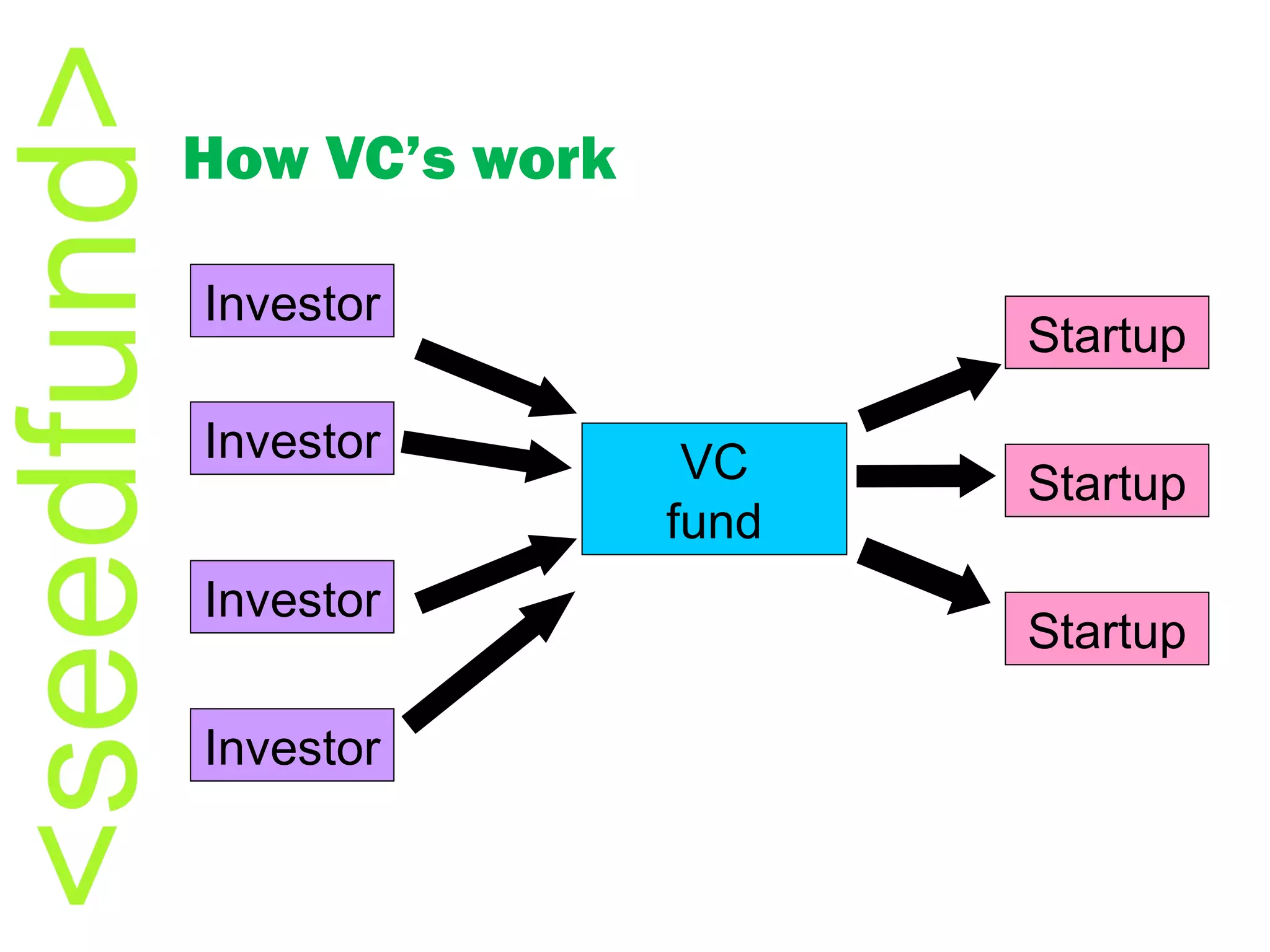
How VC ’s work Investor Investor Investor VC fund Investor Startup Startup Startup
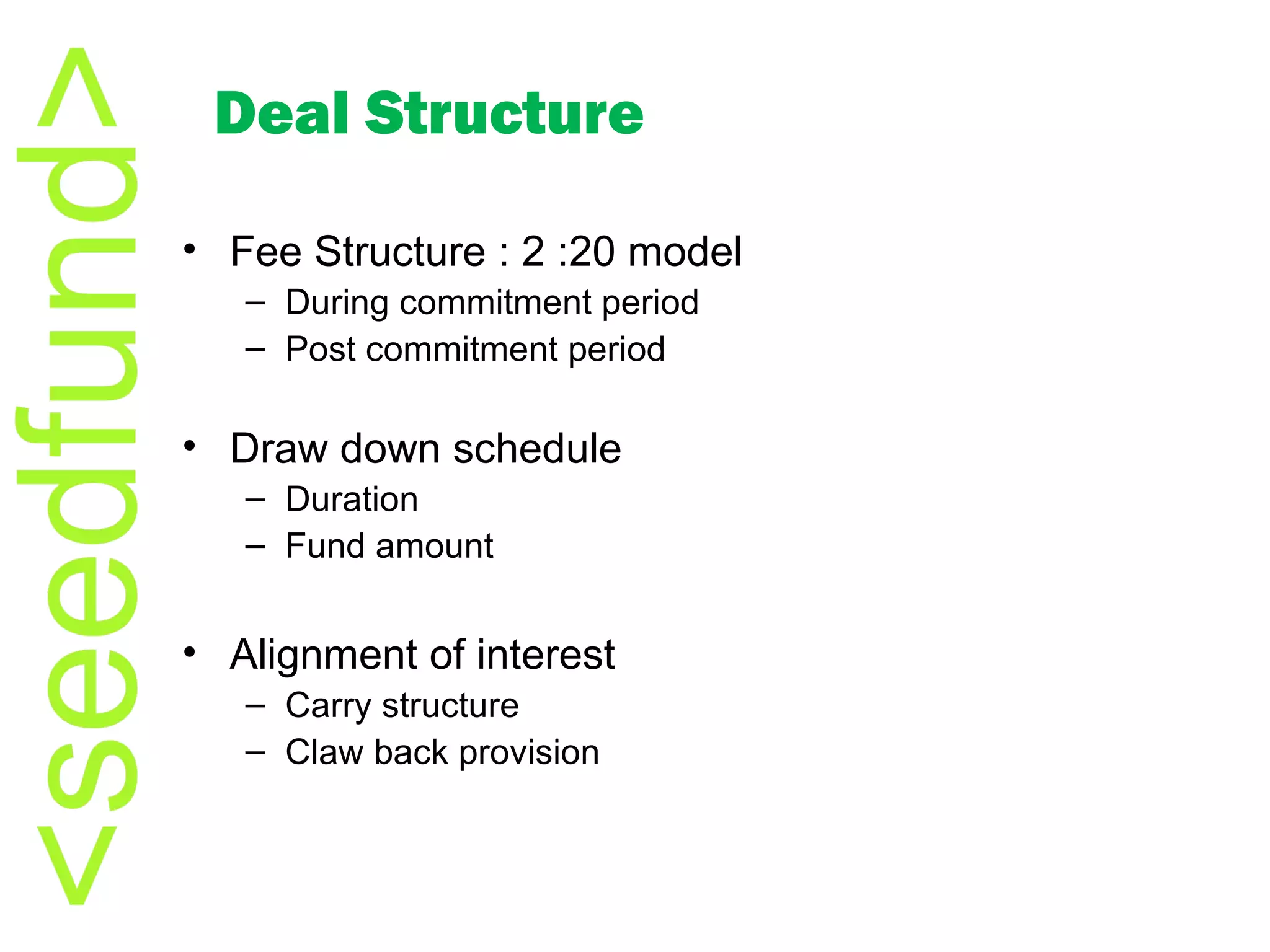
Fee Structure : 2 :20 model During commitment period Post commitment period Draw down schedule Duration Fund amount Alignment of interest Carry structure Claw back provision Deal Structure
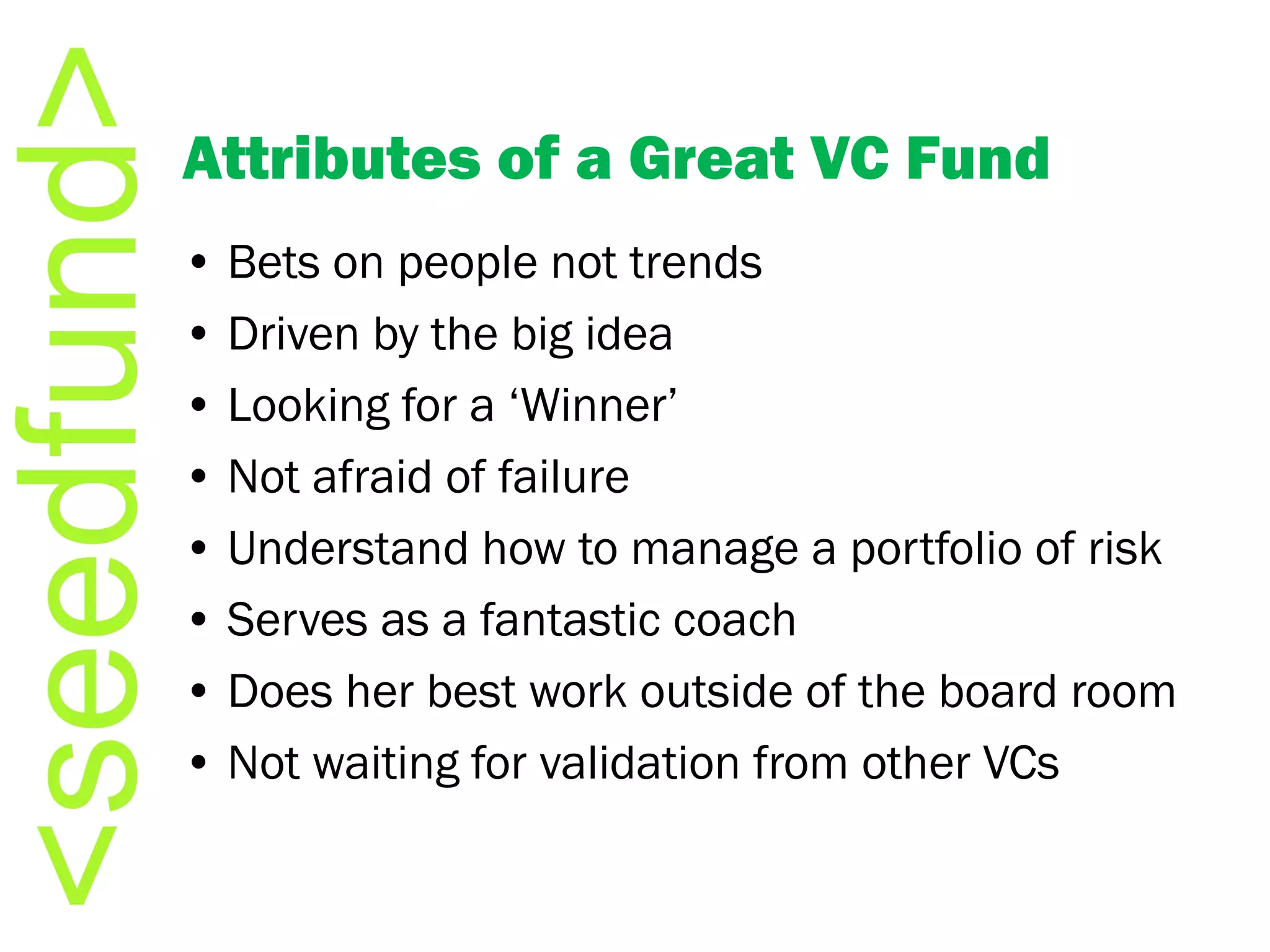
Attributes of a Great VC Fund •  Bets on people not trends •  Driven by the big idea •  Looking for a ‘Winner’ •  Not afraid of failure •  Understand how to manage a portfolio of risk •  Serves as a fantastic coach •  Does her best work outside of the board room •  Not waiting for validation from other VCs
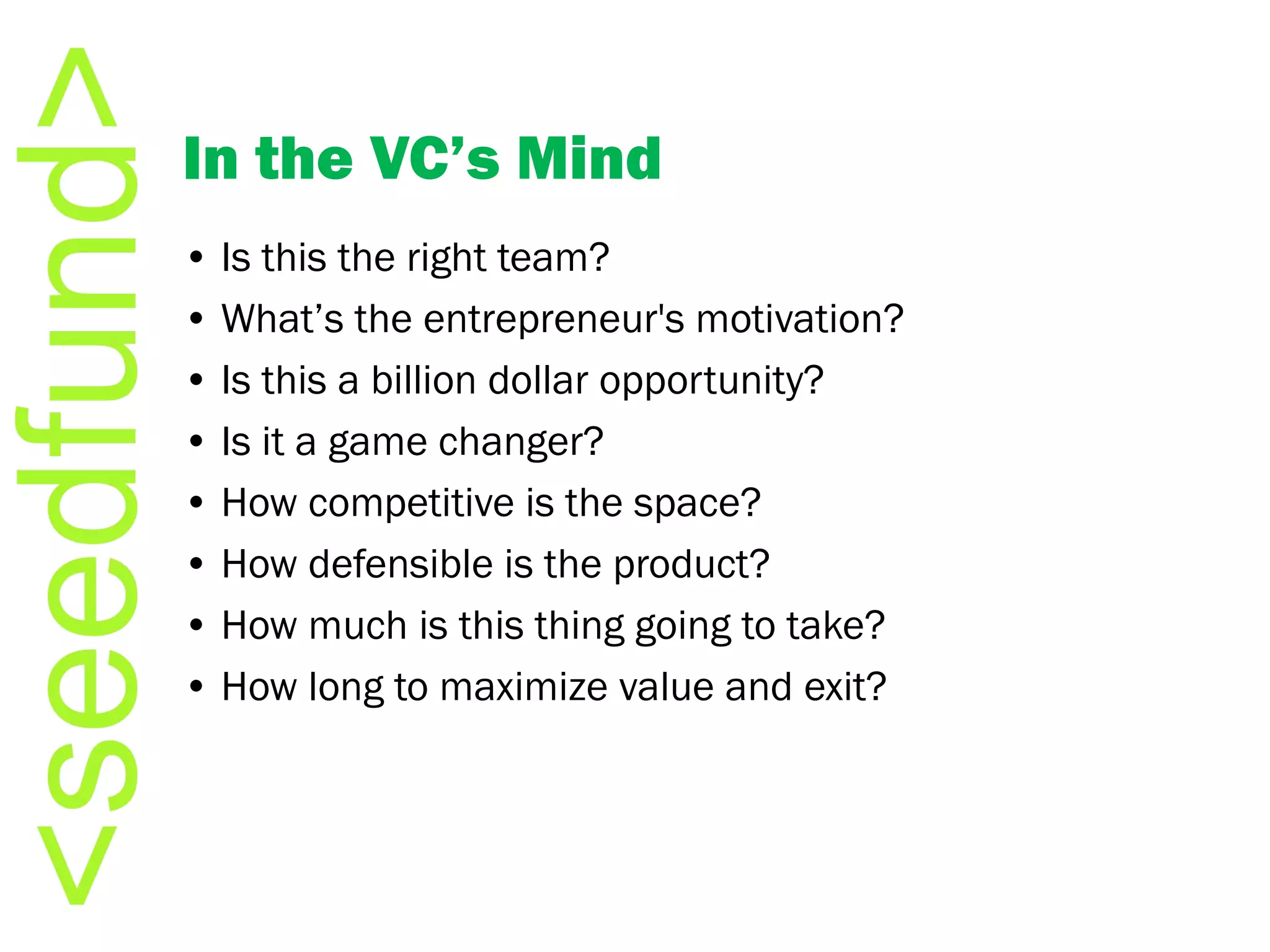
In the VC’s Mind •  Is this the right team? •  What’s the entrepreneur's motivation? •  Is this a billion dollar opportunity? •  Is it a game changer? •  How competitive is the space? •  How defensible is the product? •  How much is this thing going to take? •  How long to maximize value and exit?
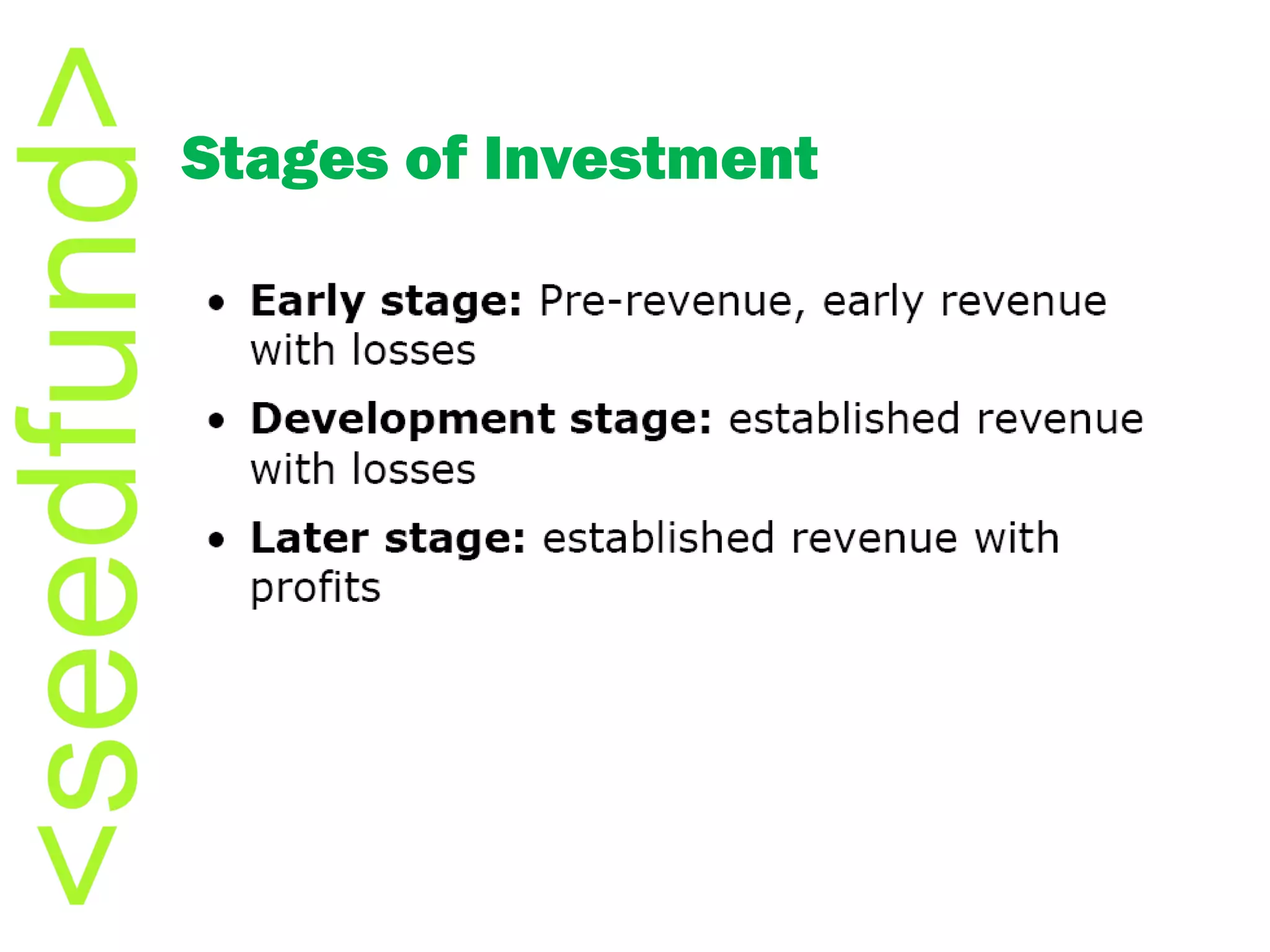
Stages of Investment
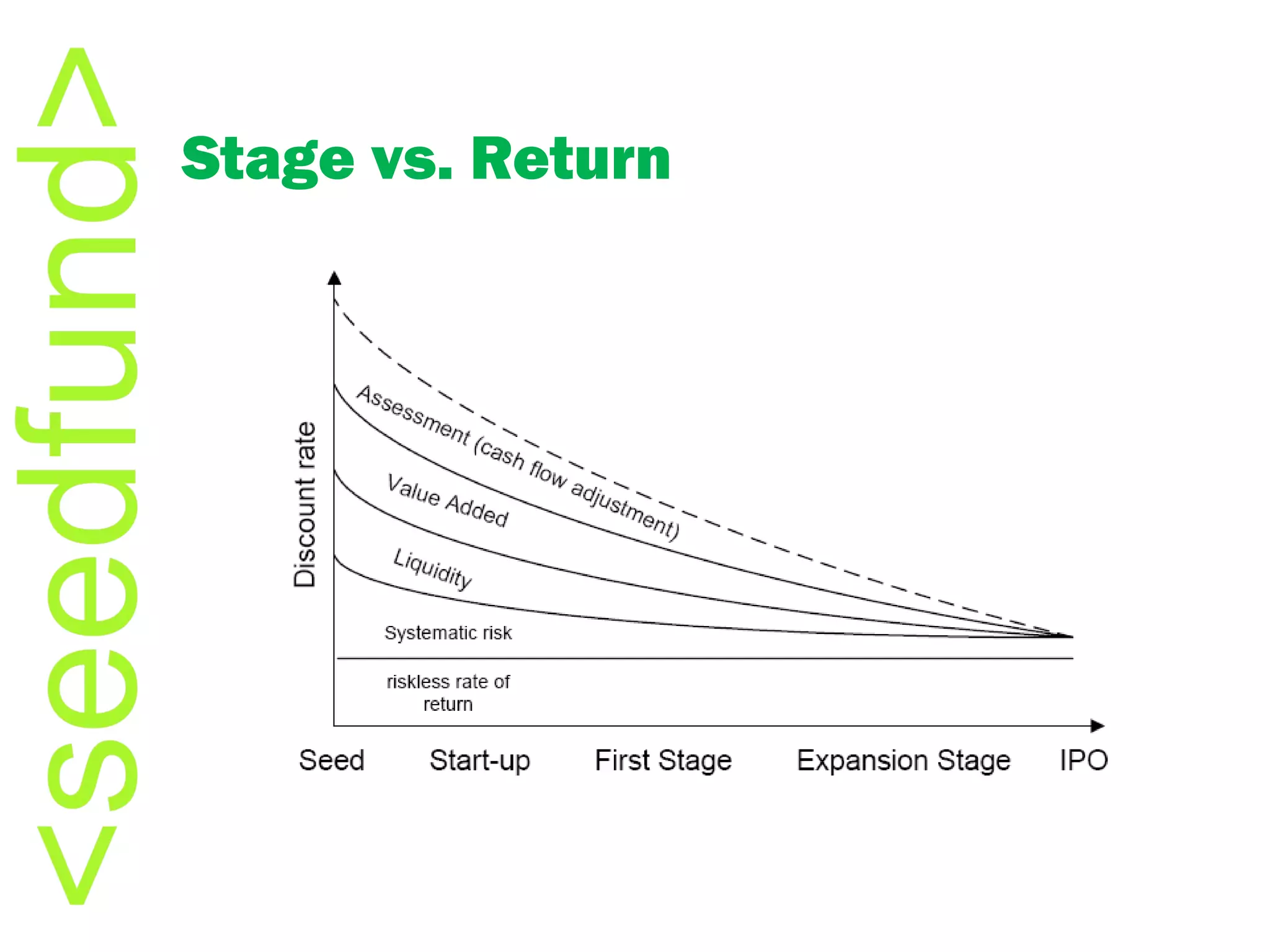
Stage vs. Return
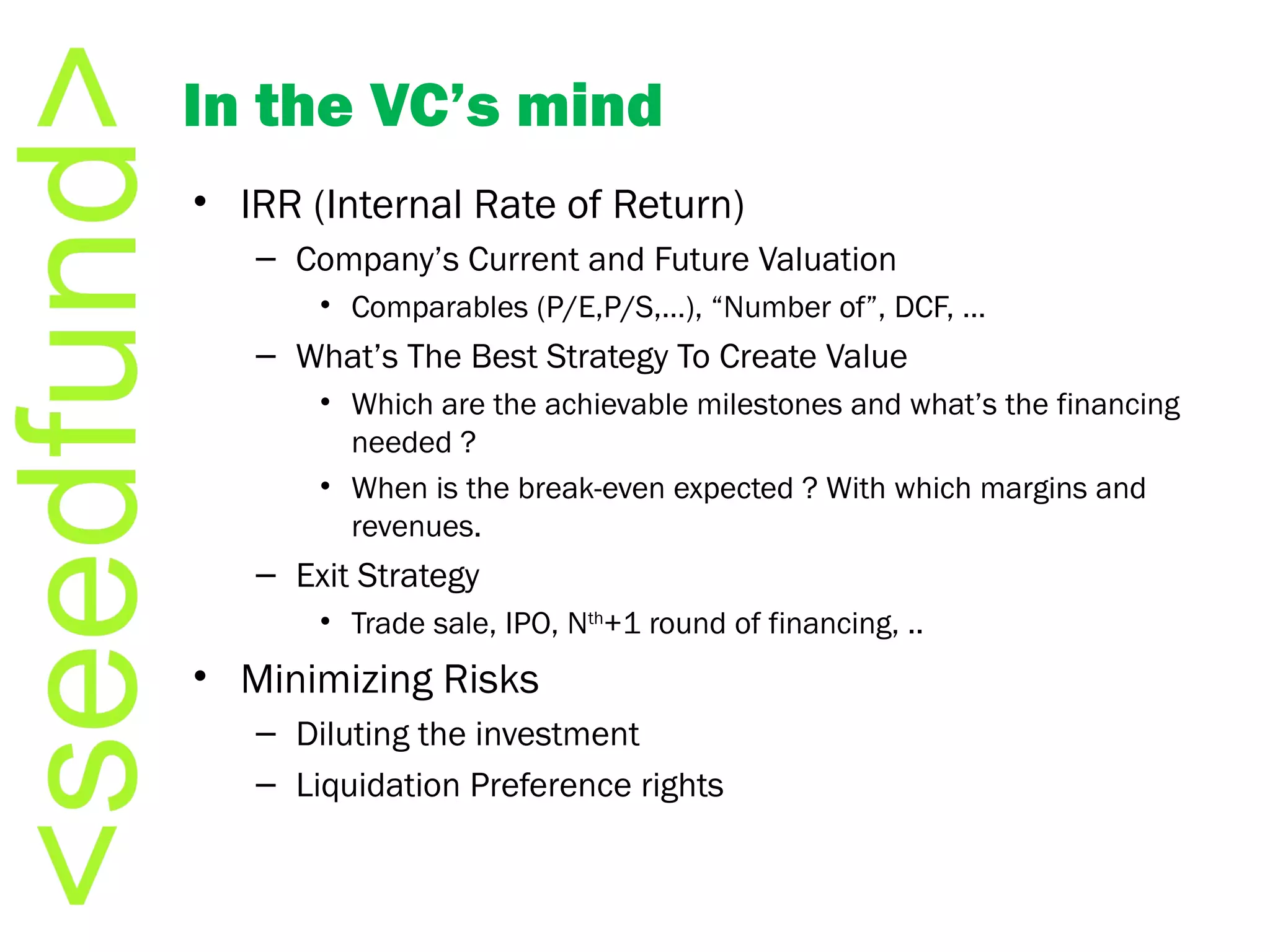
In the VC ’s mind IRR (Internal Rate of Return) Company ’s Current and Future Valuation Comparables (P/E,P/S,…),  “Number of”, DCF, …  What ’s The Best Strategy To Create Value Which are the achievable milestones and what ’s the financing needed ? When is the break-even expected ? With which margins and revenues. Exit Strategy Trade sale, IPO, N th +1 round of financing, ..  Minimizing Risks Diluting the investment Liquidation Preference rights
Valuation Methodologies
Factors Captured in Valuation Time Value of Money  – Value of dollar today vs. tomorrow Risk of Cash Flows  – Certainty of cash flows Growth Potential of Cash flows  – Future potential of business
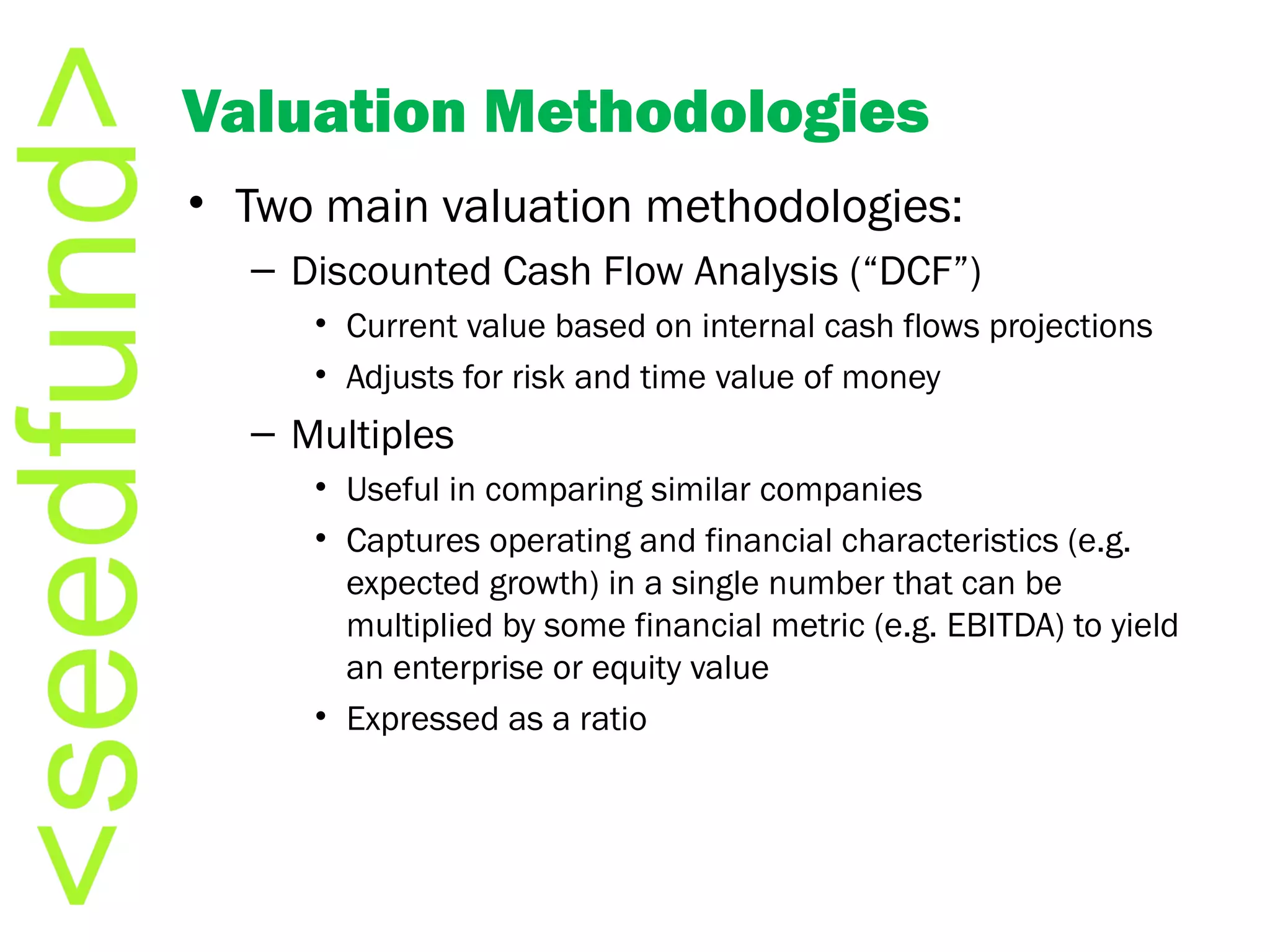
Valuation Methodologies Two main valuation methodologies: Discounted Cash Flow Analysis (“DCF”) Current value based on internal cash flows projections Adjusts for risk and time value of money Multiples Useful in comparing similar companies  Captures operating and financial characteristics (e.g. expected growth) in a single number that can be multiplied by some financial metric (e.g. EBITDA) to yield an enterprise or equity value Expressed as a ratio
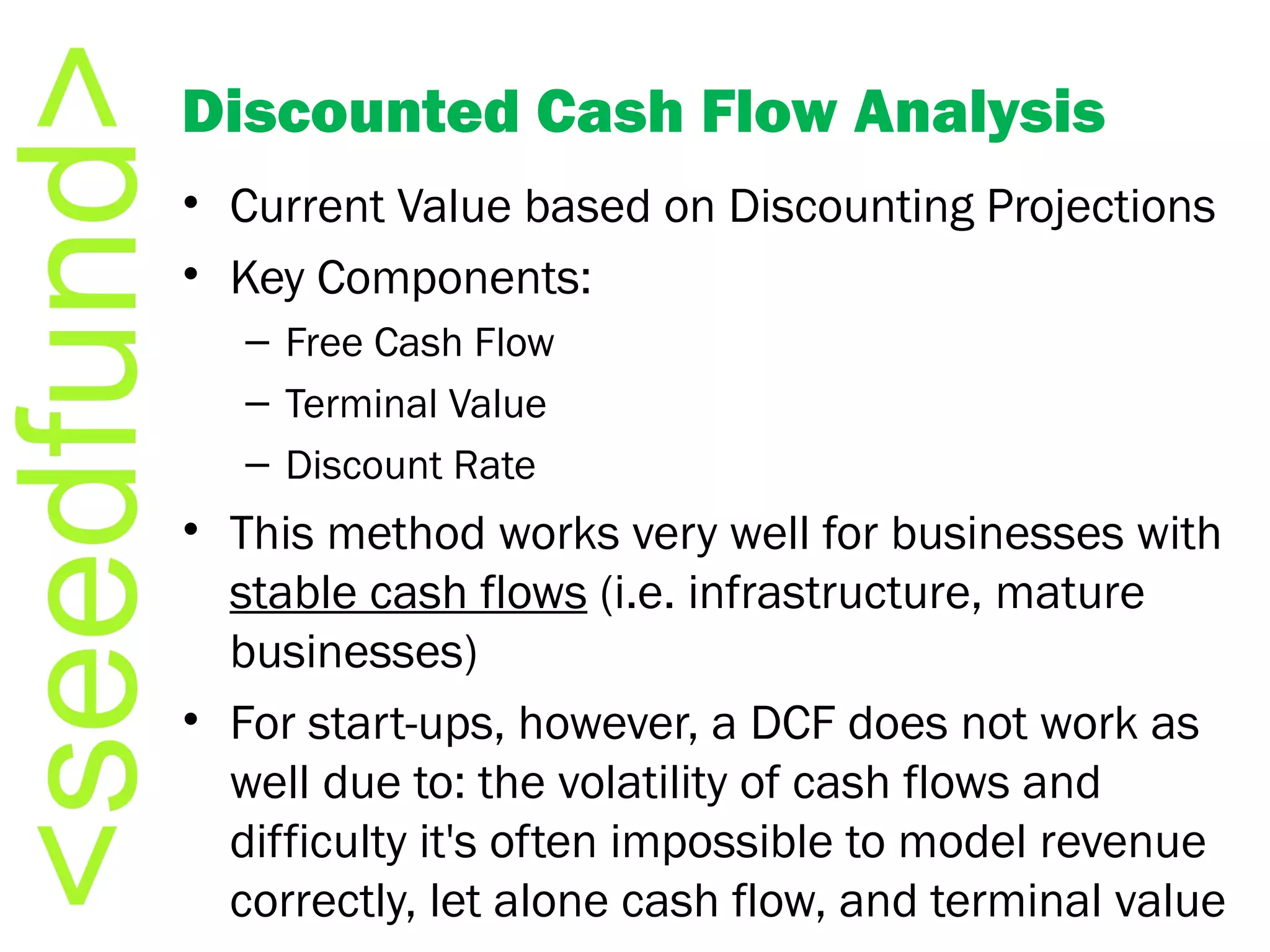
Discounted Cash Flow Analysis Current Value based on Discounting Projections Key Components: Free Cash Flow Terminal Value Discount Rate This method works very well for businesses with  stable cash flows  (i.e. infrastructure, mature businesses) For start-ups, however, a DCF does not work as well due to: the volatility of cash flows and difficulty it's often impossible to model revenue correctly, let alone cash flow, and terminal value
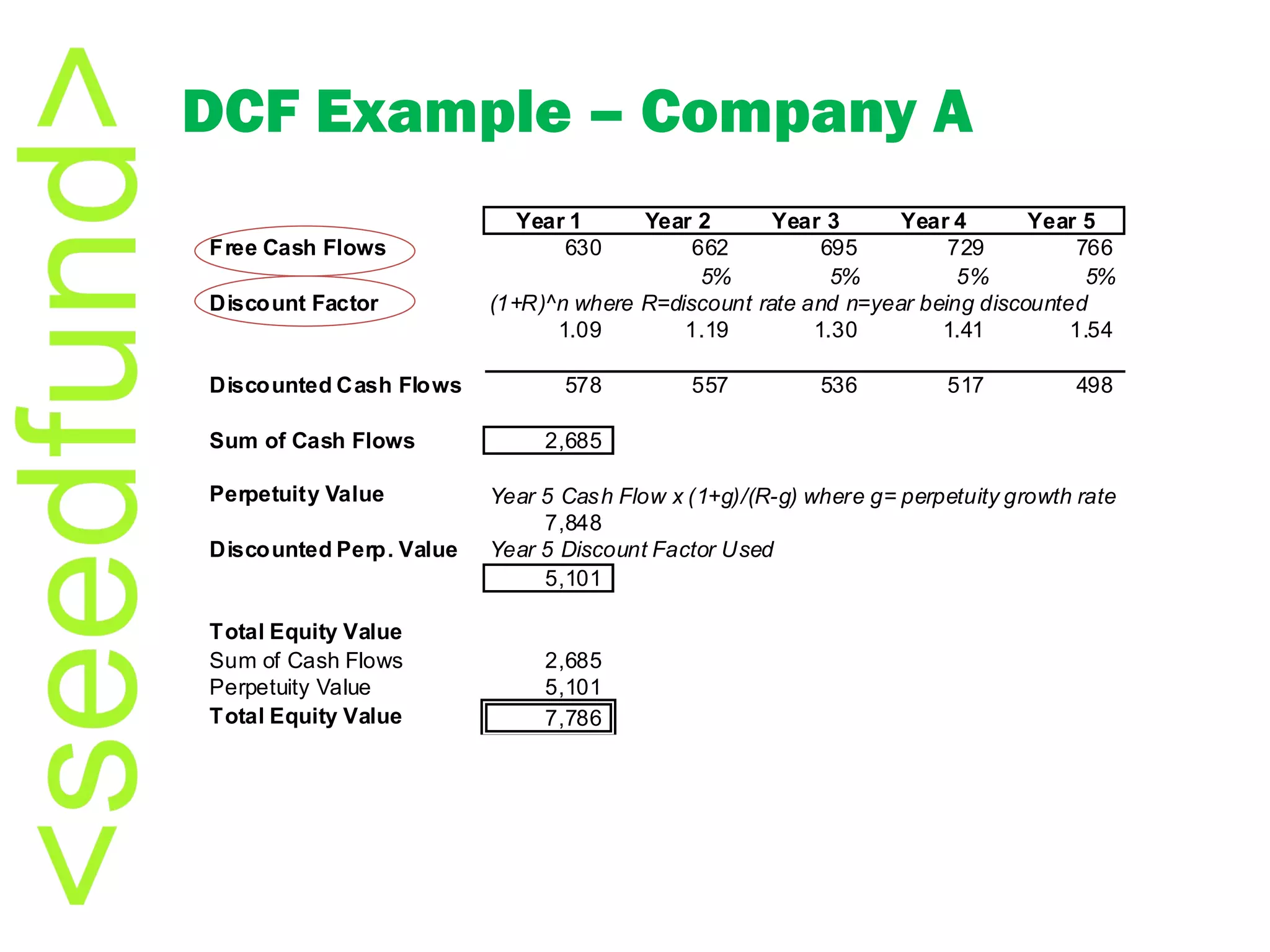
DCF Example – Company A
Multiples Multiples can be applied to a company’s financial metrics from two sources: Comparable Companies: Implied value in the public markets by analyzing similar companies' trading and operating metrics Depends on the level of comparability of the selected publicly traded companies Does not include a "control premium"   Precedent Transaction Analysis: Multiples derived from comparable precedent M&A transactions Reliability depends on the number of precedent transactions and their levels of comparability  Market cycles and volatility impact on historical Individual buyer synergies and structure of transaction will also impact multiples
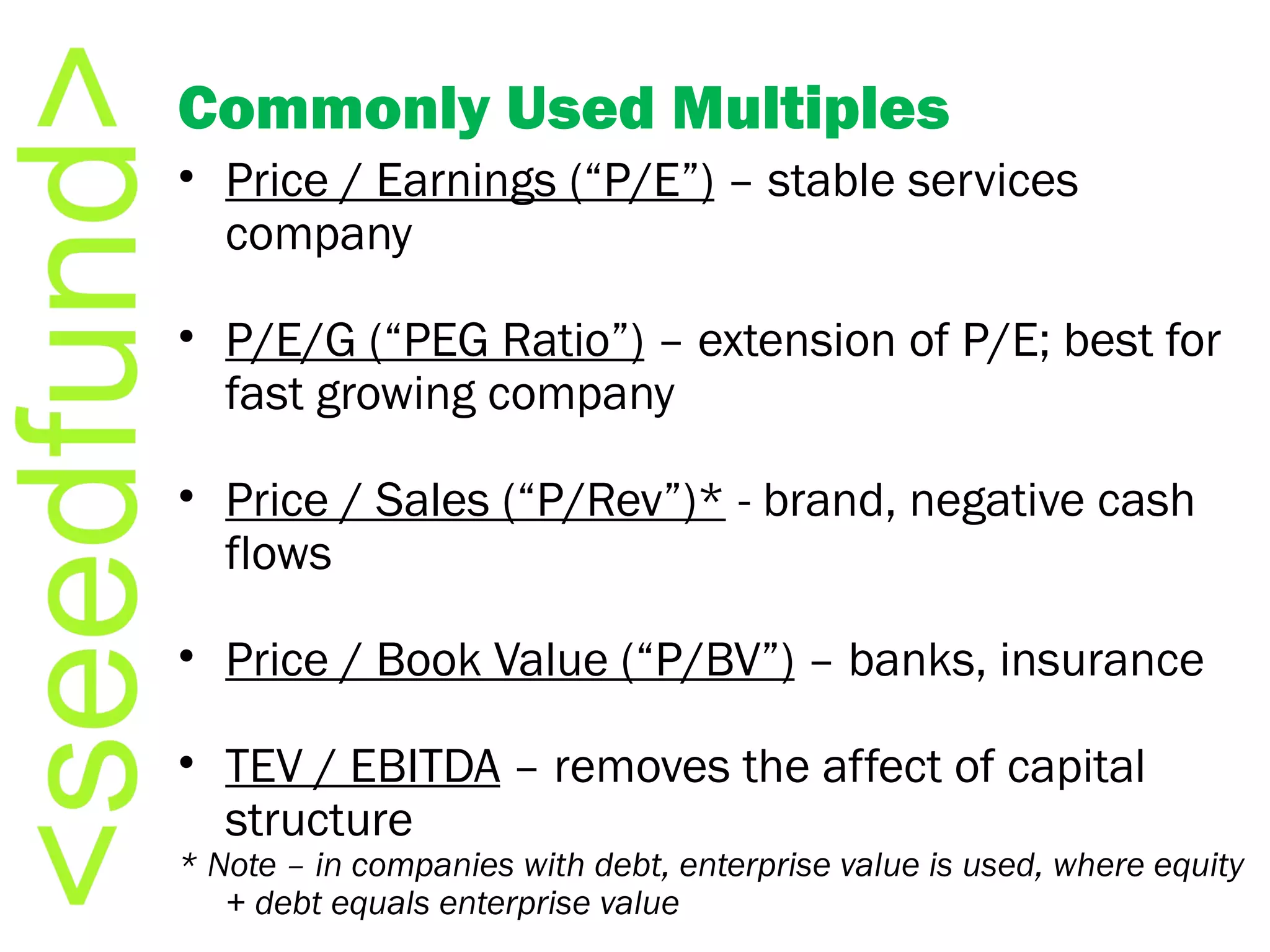
Commonly Used Multiples Price / Earnings (“P/E”)  – stable services company P/E/G (“PEG Ratio”)  – extension of P/E; best for fast growing company Price / Sales (“P/Rev”)*  - brand, negative cash flows Price / Book Value (“P/BV”)  – banks, insurance TEV / EBITDA  – removes the affect of capital structure * Note – in companies with debt, enterprise value is used, where equity + debt equals enterprise value
Valuation in Venture Capital
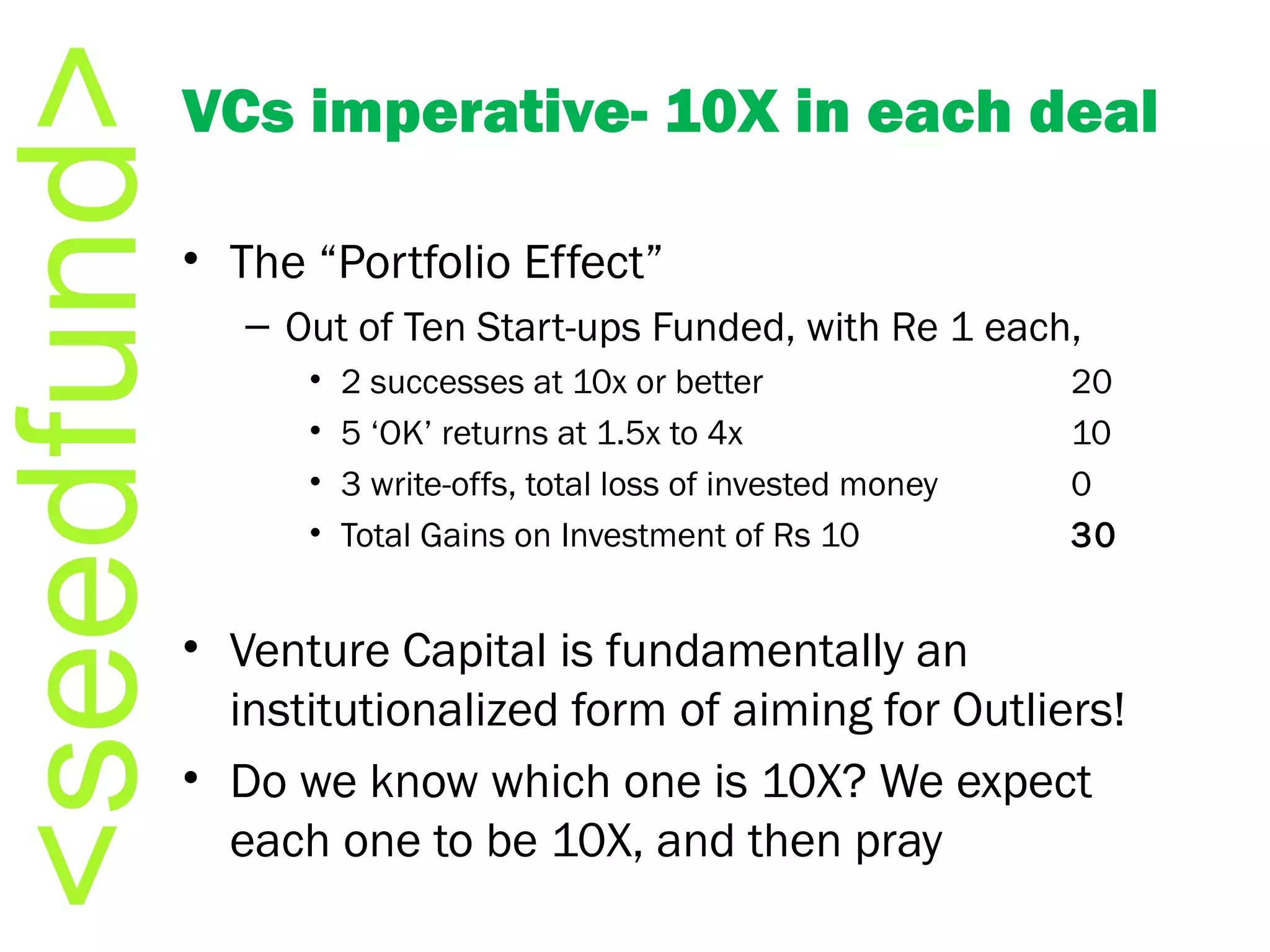
VCs imperative- 10X in each deal The “Portfolio Effect” Out of Ten Start-ups Funded, with Re 1 each,  2 successes at 10x or better 20 5 ‘OK’ returns at 1.5x to 4x 10 3 write-offs, total loss of invested money  0 Total Gains on Investment of Rs 10 30 Venture Capital is fundamentally an institutionalized form of aiming for Outliers! Do we know which one is 10X? We expect each one to be 10X, and then pray
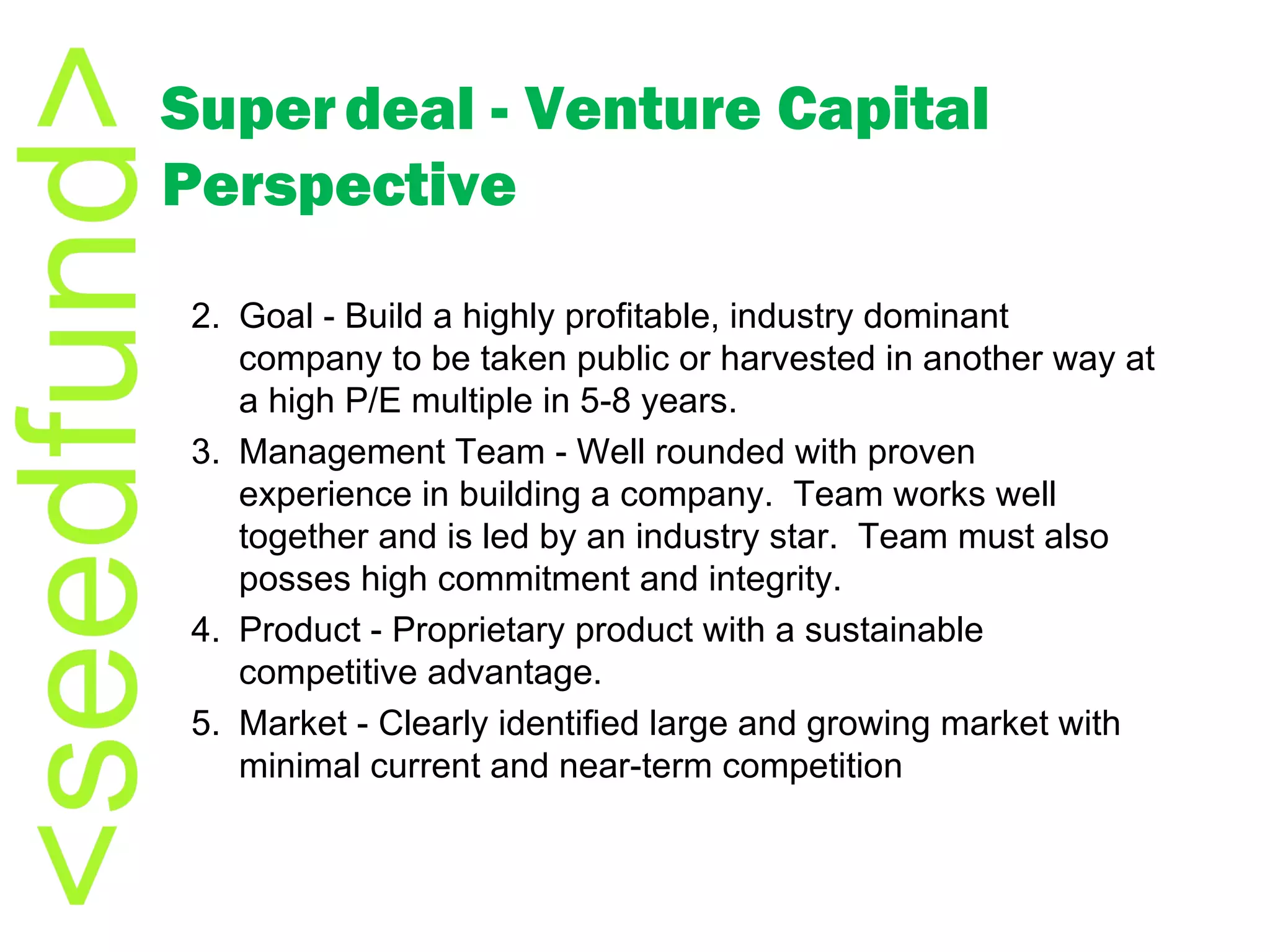
Super   deal - Venture Capital Perspective Goal - Build a highly profitable, industry dominant company to be taken public or harvested in another way at a high P/E multiple in 5-8 years. Management Team - Well rounded with proven experience in building a company.  Team works well together and is led by an industry star.  Team must also posses high commitment and integrity. Product - Proprietary product with a sustainable competitive advantage. Market - Clearly identified large and growing market with minimal current and near-term competition
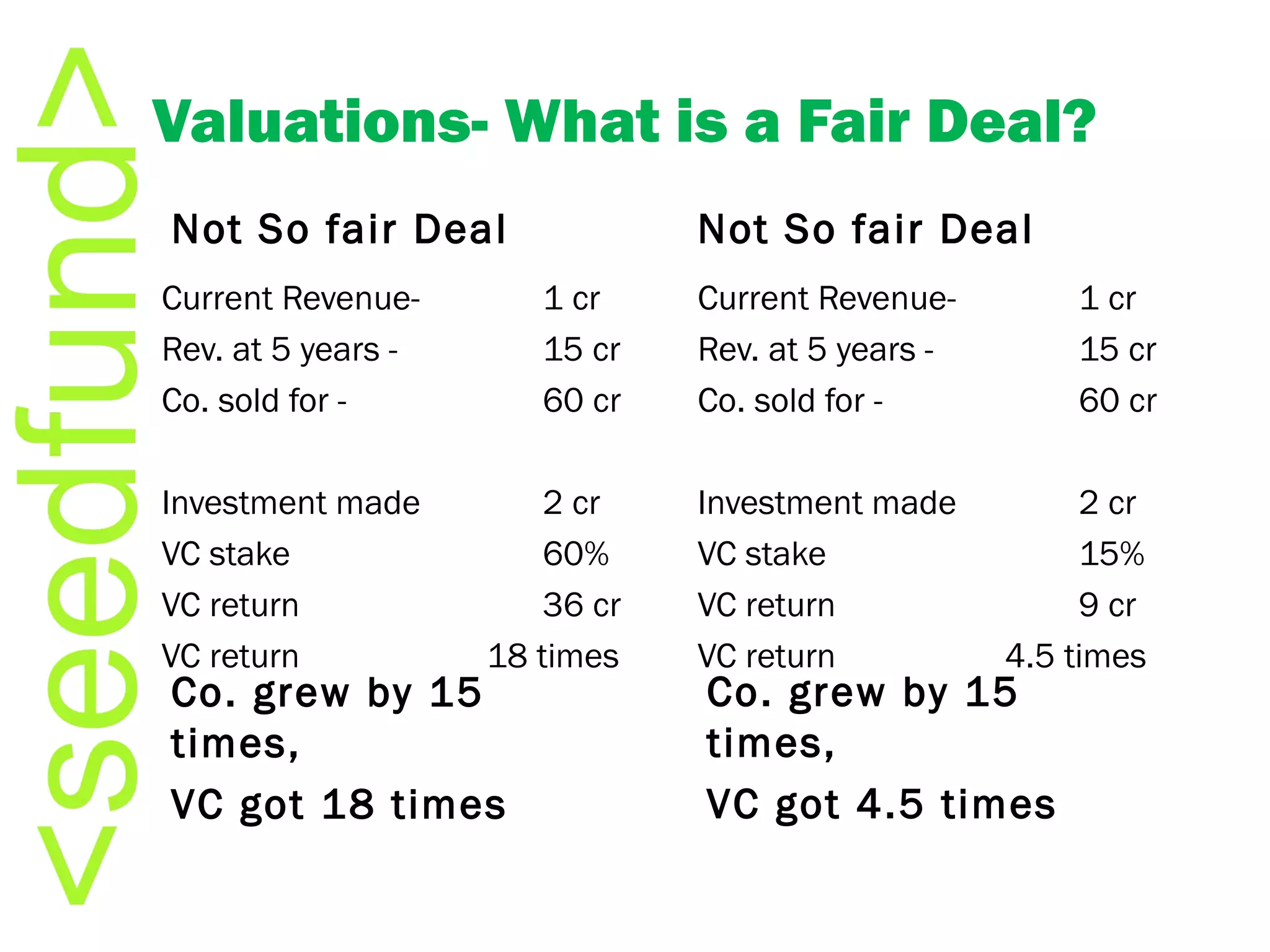
Valuations- What is a Fair Deal? Not So fair Deal Current Revenue-  1 cr Rev. at 5 years -  15 cr Co. sold for -  60 cr Investment made 2 cr VC stake 60% VC return 36 cr VC return   18 times Not So fair Deal Current Revenue-  1 cr Rev. at 5 years -  15 cr Co. sold for -  60 cr Investment made 2 cr VC stake 15% VC return 9 cr VC return   4.5 times Co. grew by 15 times,  VC got 18 times Co. grew by 15 times,  VC got 4.5 times
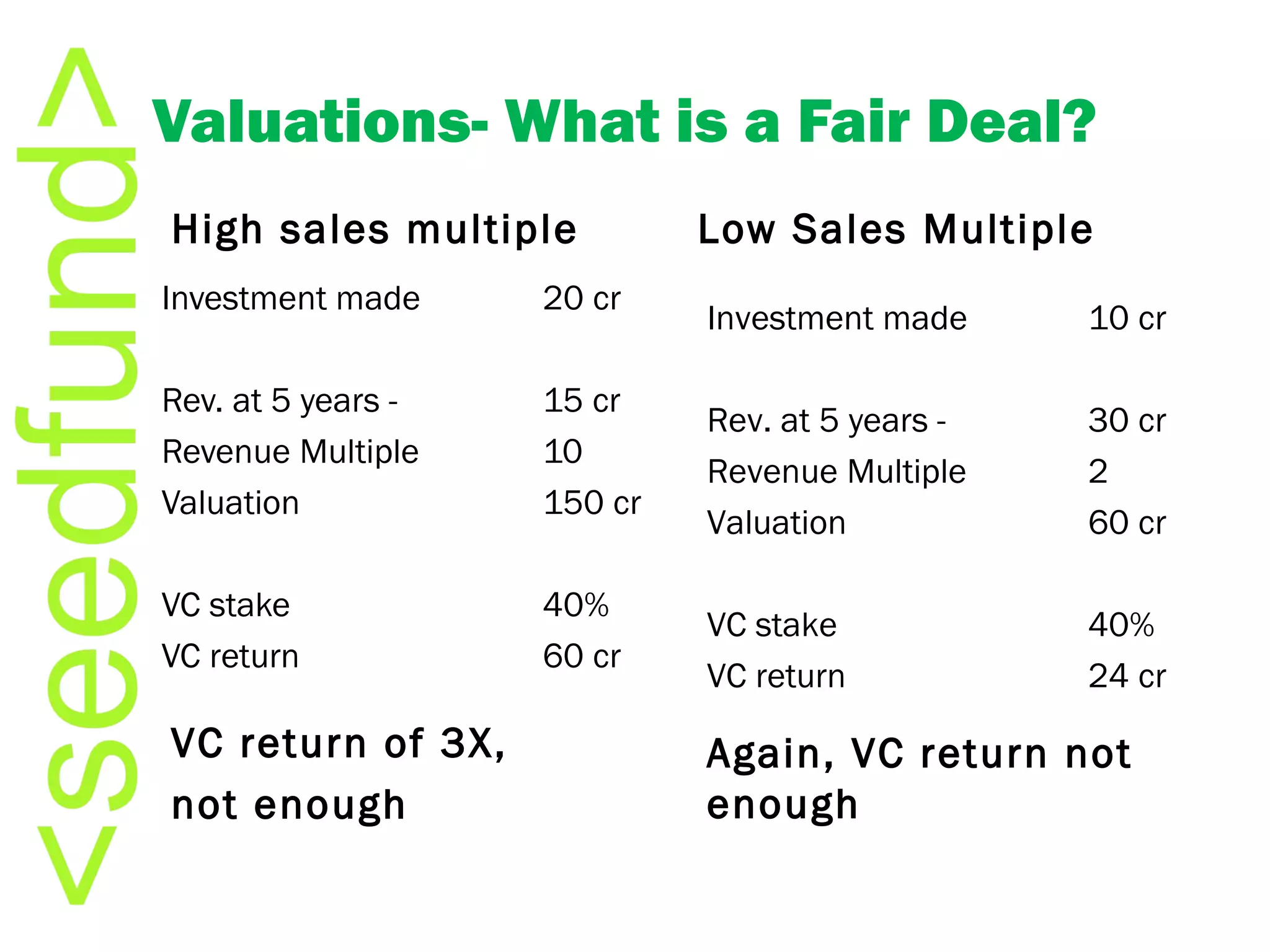
Valuations- What is a Fair Deal? High sales multiple Investment made 20 cr Rev. at 5 years -  15 cr Revenue Multiple 10 Valuation 150 cr VC stake 40% VC return 60 cr Low Sales Multiple VC return of 3X,  not enough Again, VC return not enough Investment made 10 cr Rev. at 5 years -  30 cr Revenue Multiple 2 Valuation 60 cr VC stake 40% VC return 24 cr
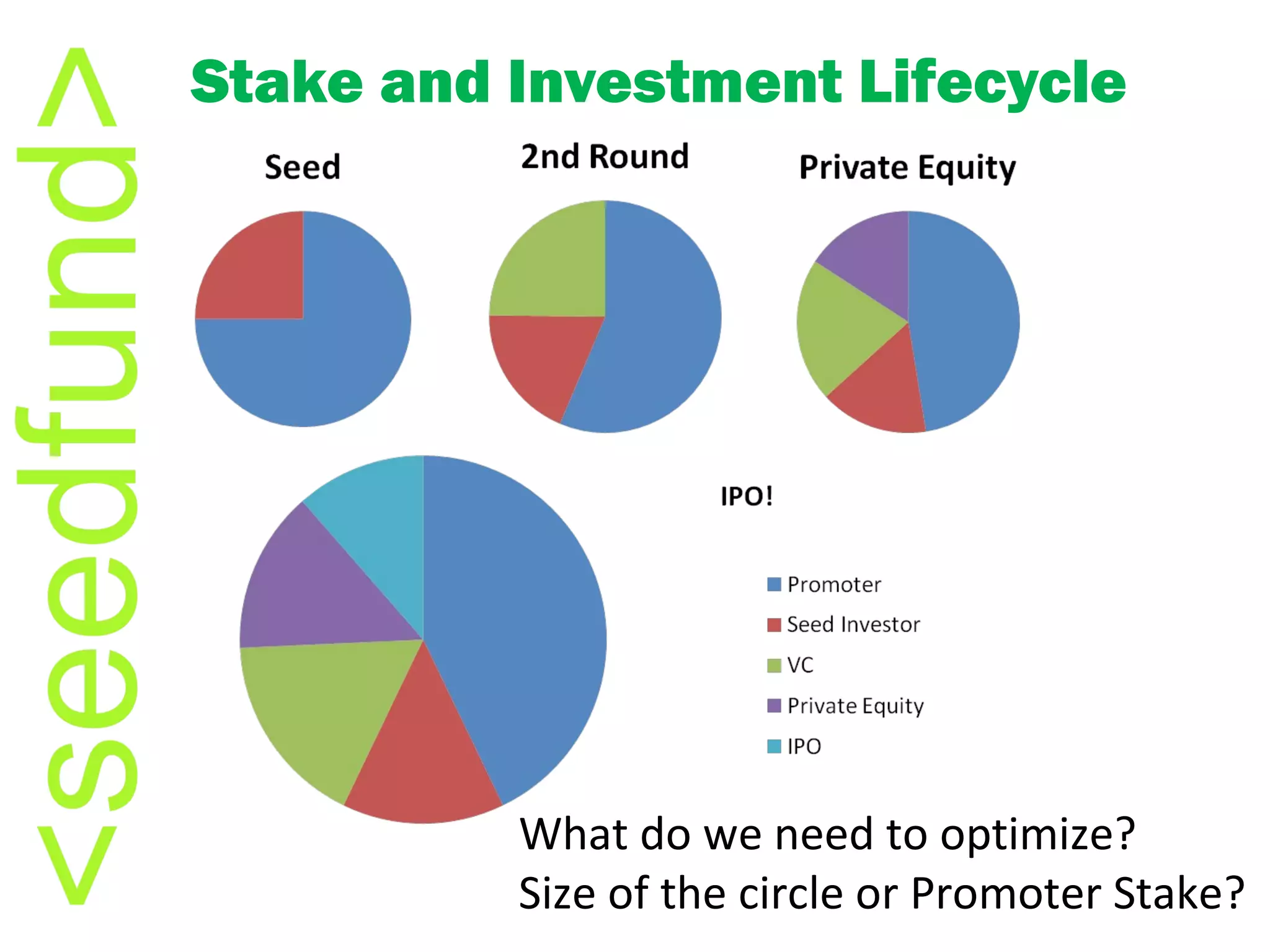
Stake and Investment Lifecycle What do we need to optimize?  Size of the circle or Promoter Stake?
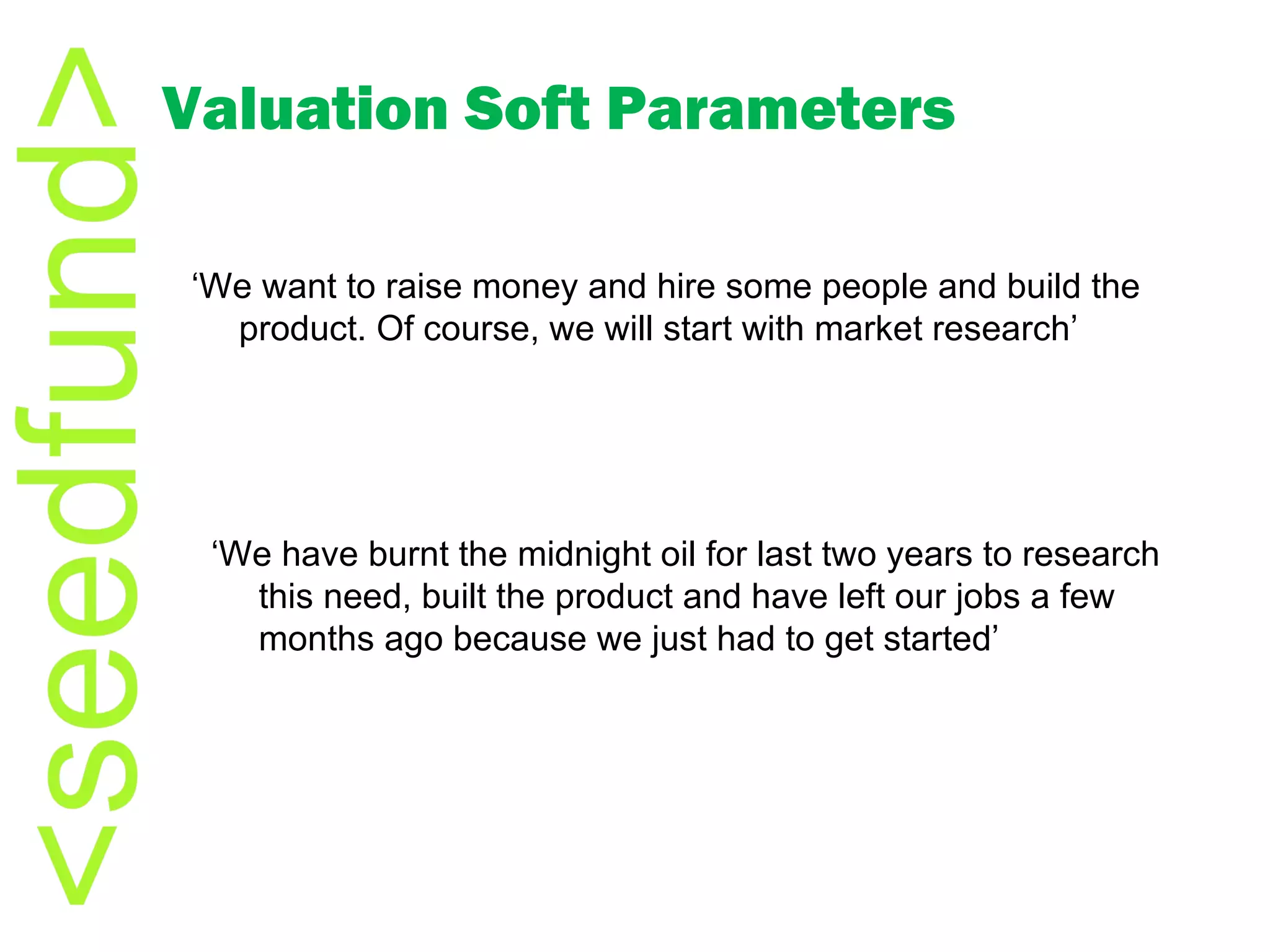
Valuation Soft Parameters ‘ We want to raise money and hire some people and build the product. Of course, we will start with market research’ ‘ We have burnt the midnight oil for last two years to research this need, built the product and have left our jobs a few months ago because we just had to get started’
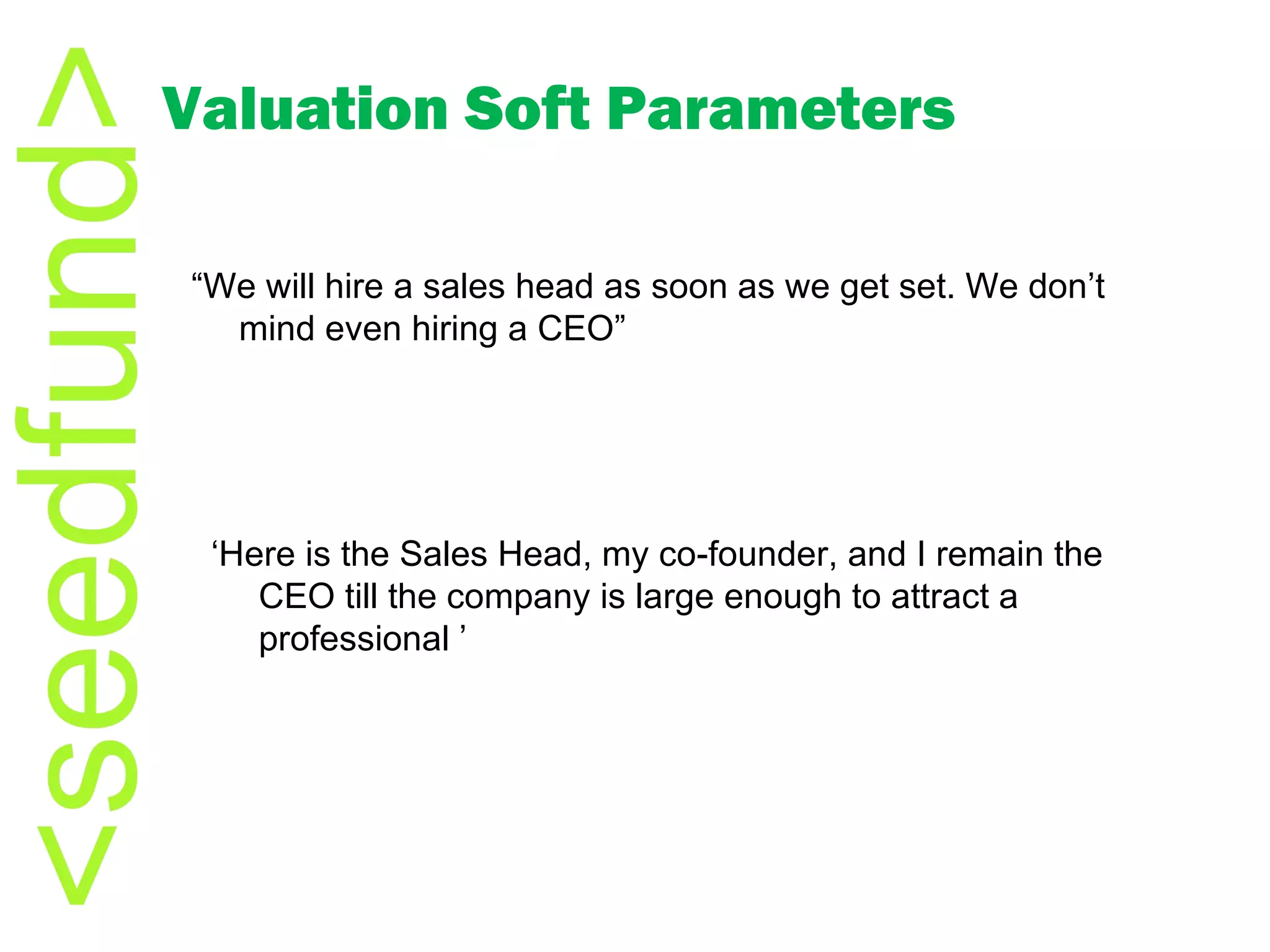
Valuation Soft Parameters “ We will hire a sales head as soon as we get set. We don’t mind even hiring a CEO” ‘ Here is the Sales Head, my co-founder, and I remain the CEO till the company is large enough to attract a professional ’
Deal Structuring
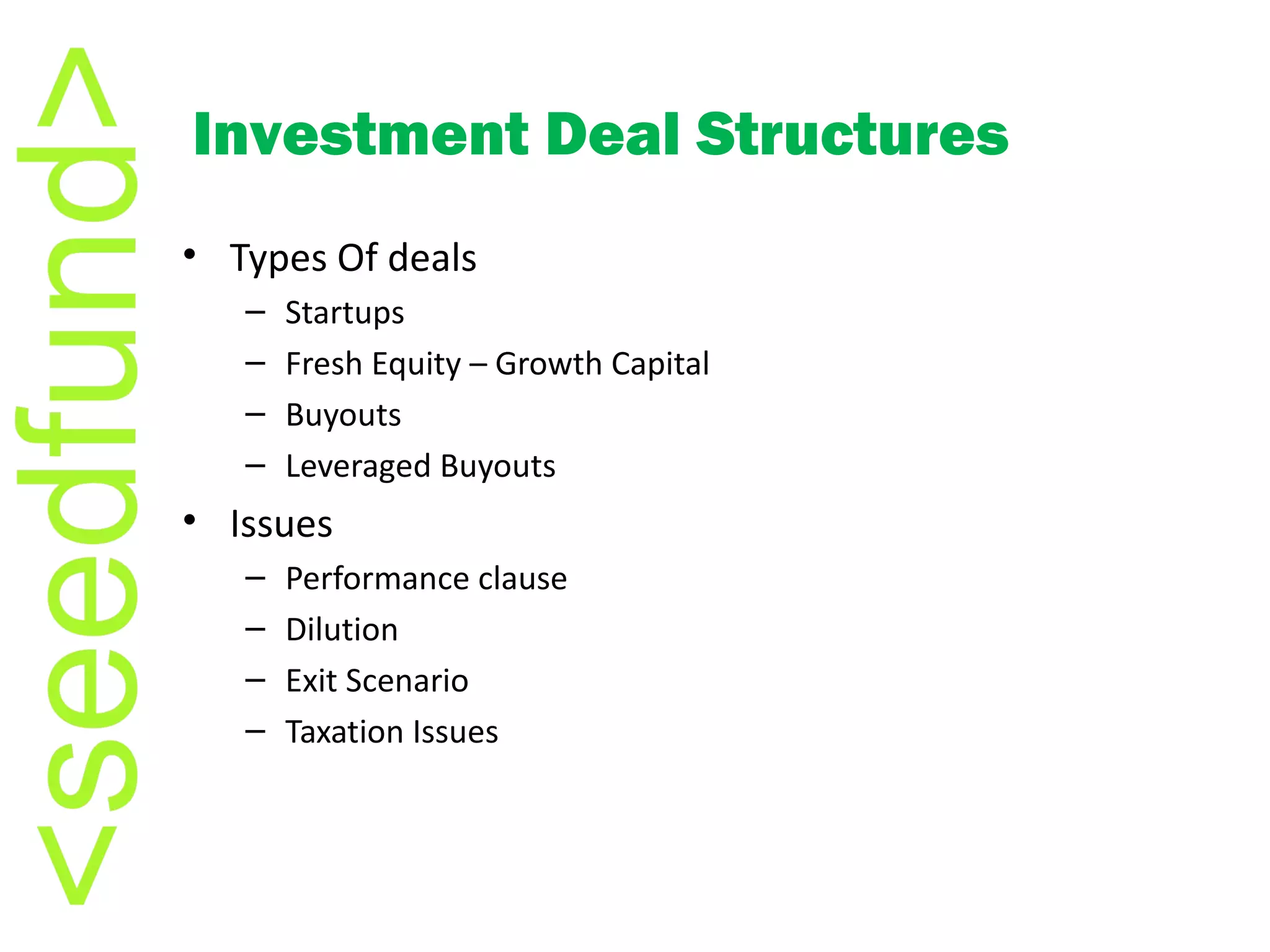
Types Of deals Startups Fresh Equity – Growth Capital Buyouts  Leveraged Buyouts Issues Performance clause Dilution Exit Scenario Taxation Issues Investment Deal Structures
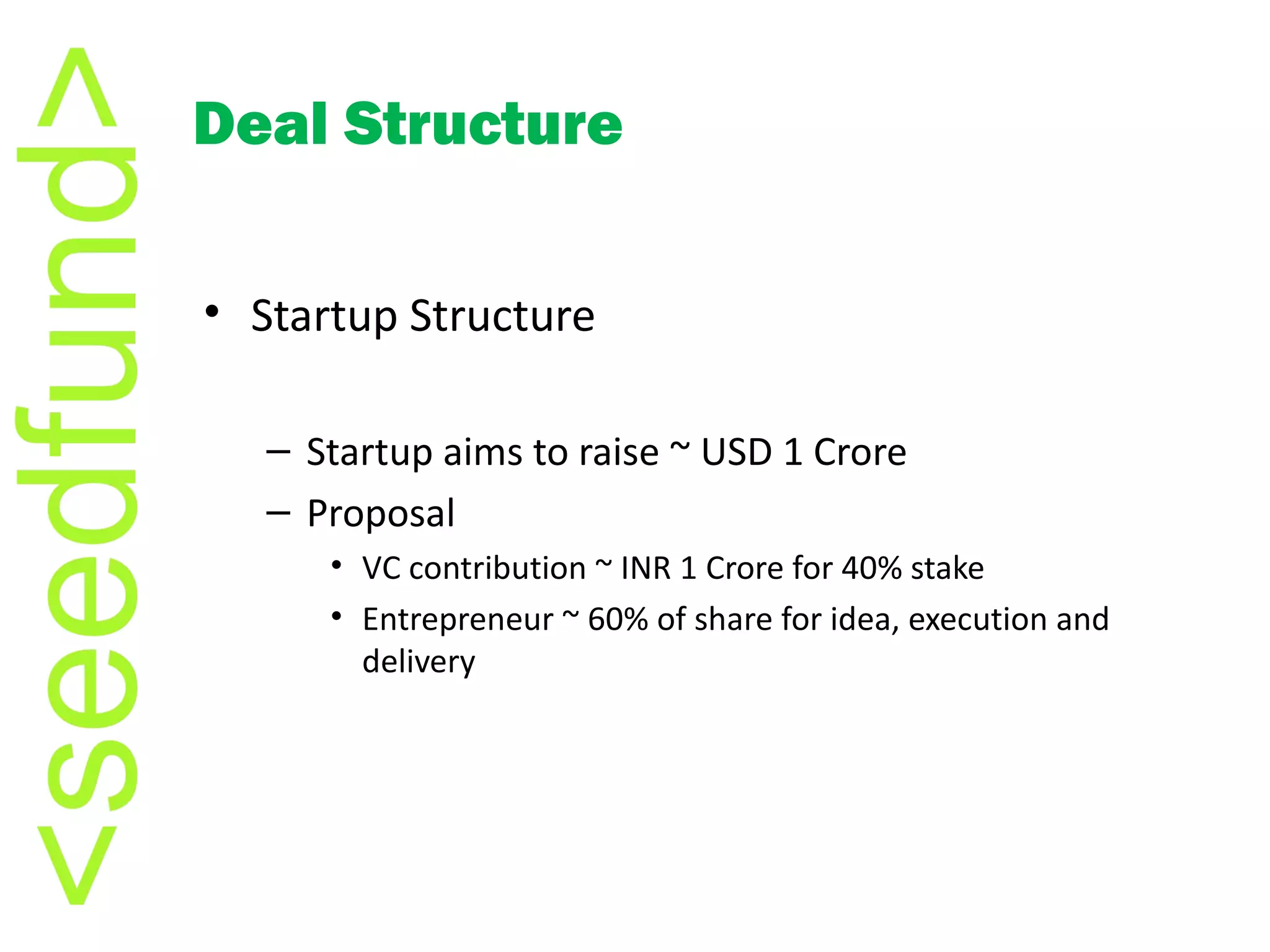
Startup Structure Startup aims to raise ~ USD 1 Crore Proposal VC contribution ~ INR 1 Crore for 40% stake Entrepreneur ~ 60% of share for idea, execution and delivery Deal Structure
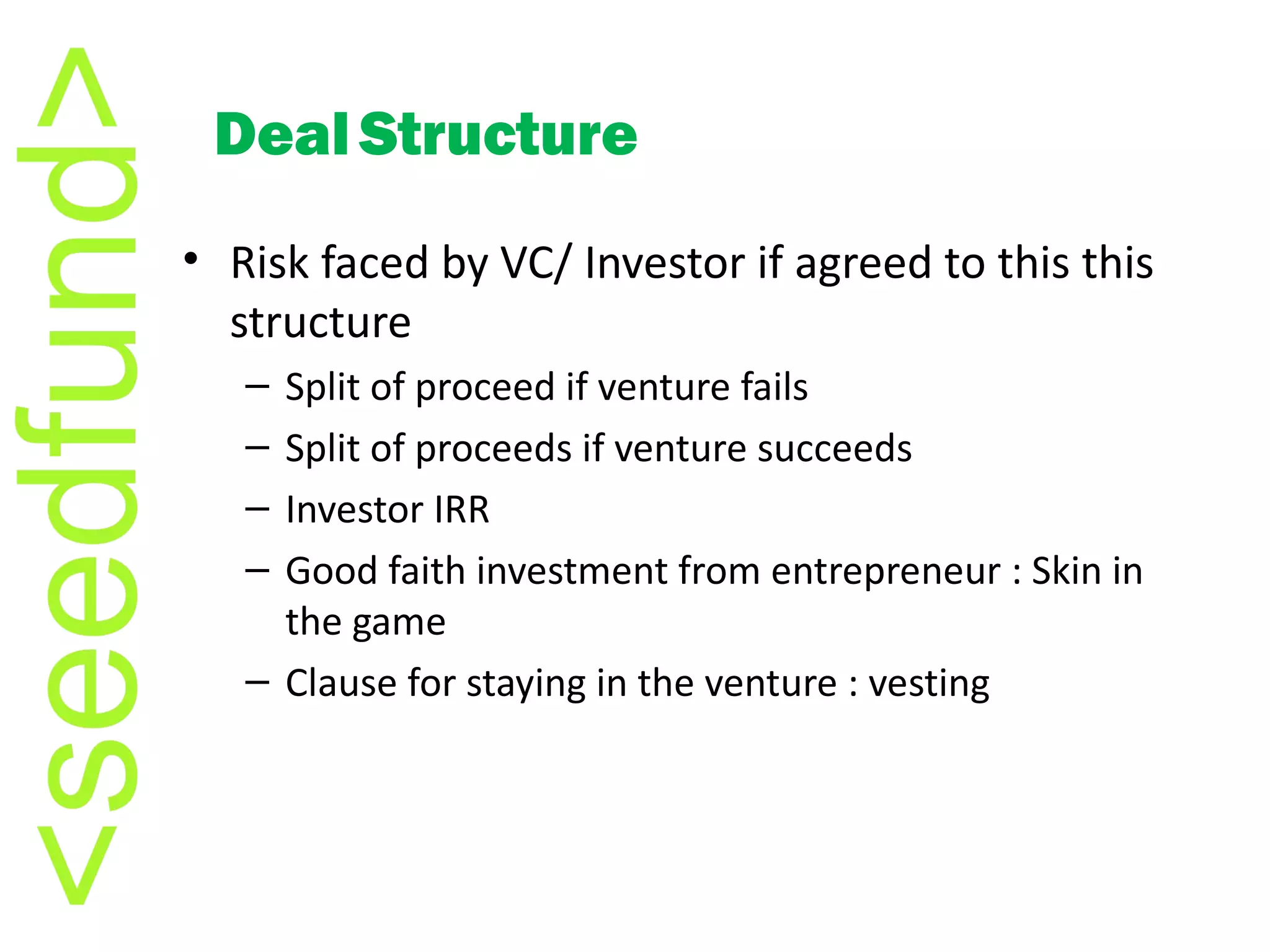
Risk faced by VC/ Investor if agreed to this this structure Split of proceed if venture fails Split of proceeds if venture succeeds Investor IRR Good faith investment from entrepreneur : Skin in the game Clause for staying in the venture : vesting Deal   Structure
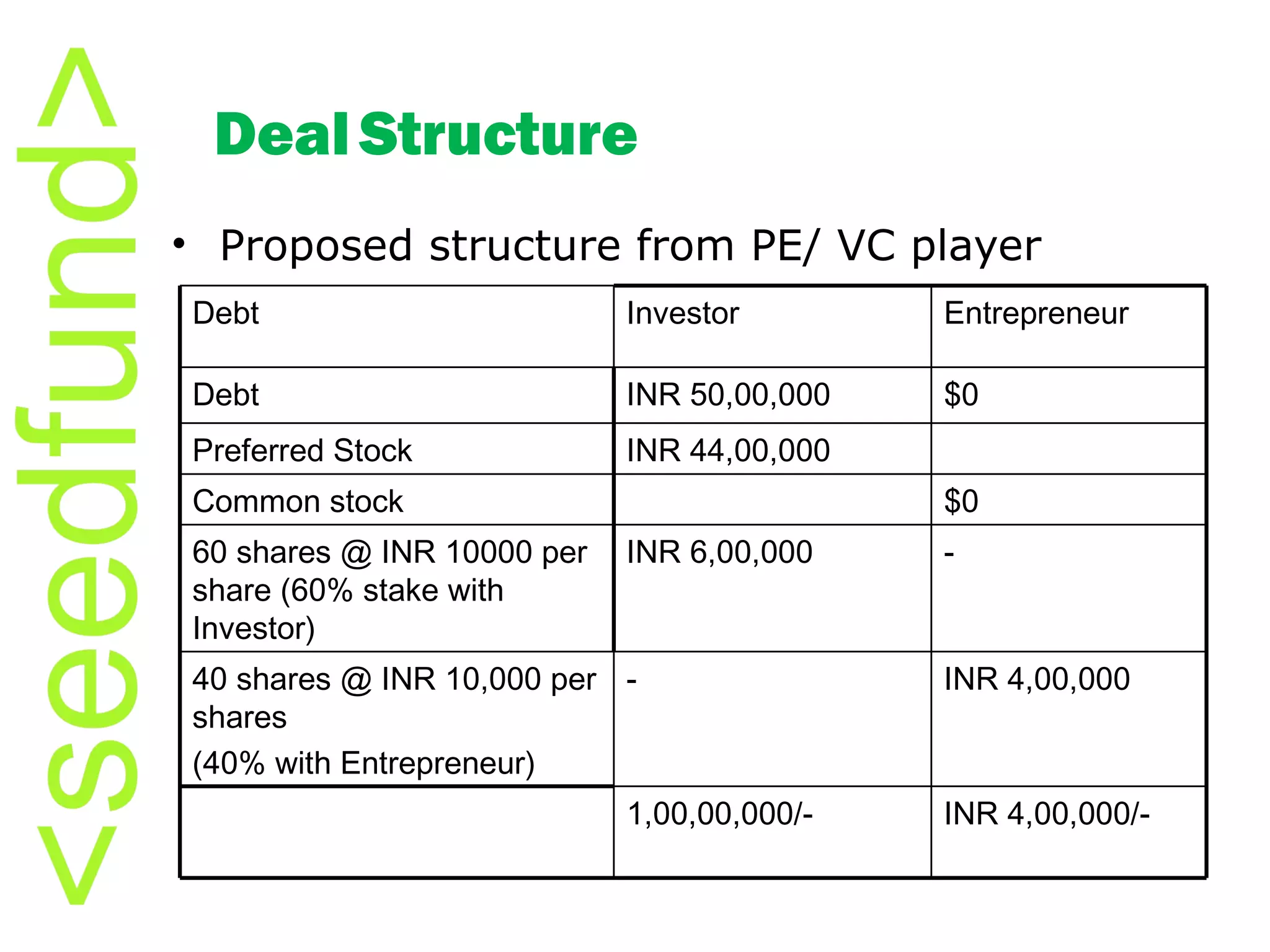
Proposed structure from PE/ VC player Deal   Structure Debt Investor Entrepreneur Debt INR 50,00,000 $0 Preferred Stock INR 44,00,000 Common stock $0 60 shares @ INR 10000 per share (60% stake with Investor) INR 6,00,000 - 40 shares @ INR 10,000 per shares (40% with Entrepreneur) - INR 4,00,000 1,00,00,000/- INR 4,00,000/-
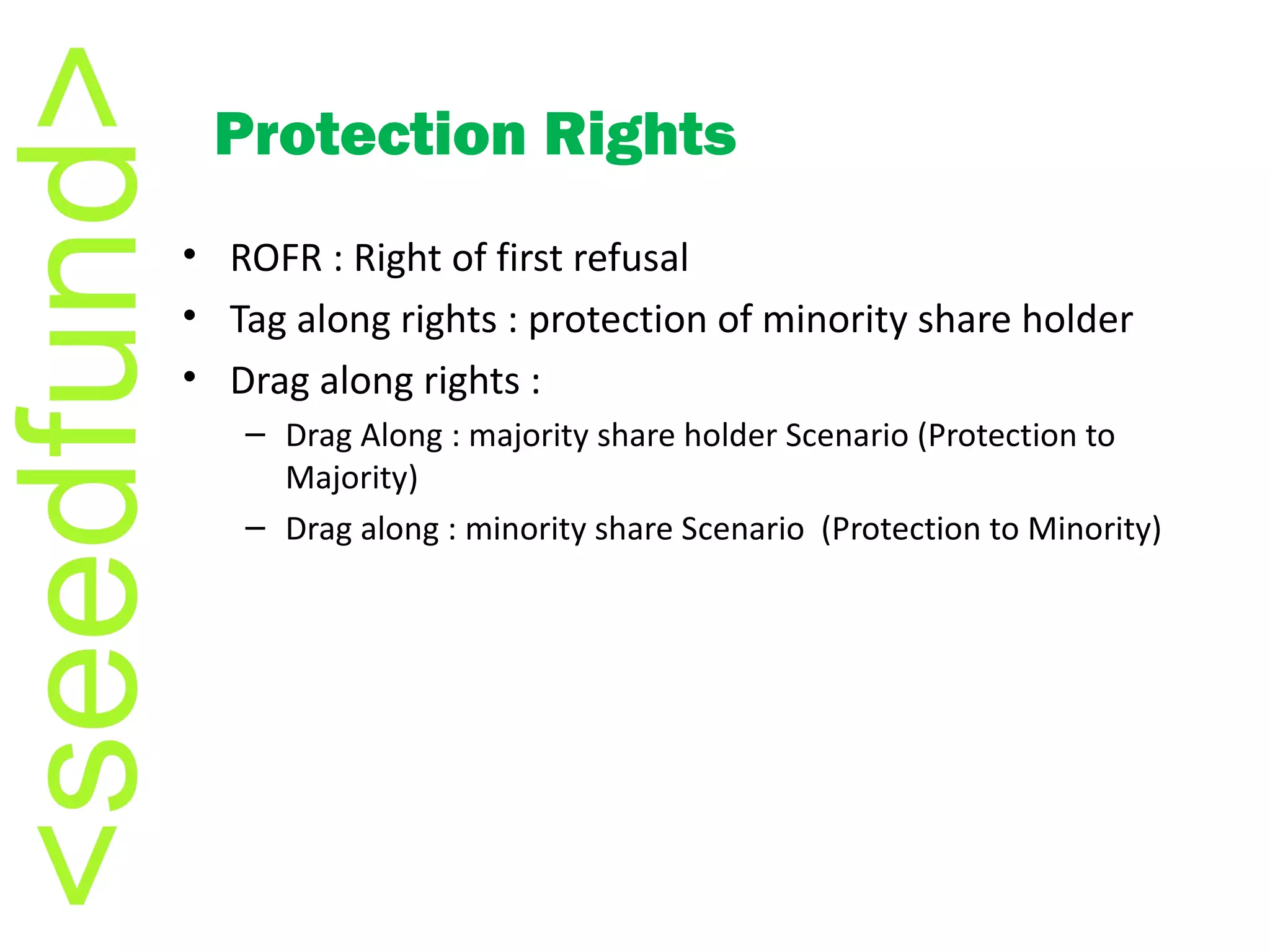
ROFR : Right of first refusal Tag along rights : protection of minority share holder Drag along rights :  Drag Along : majority share holder Scenario (Protection to Majority) Drag along : minority share Scenario  (Protection to Minority) Protection Rights
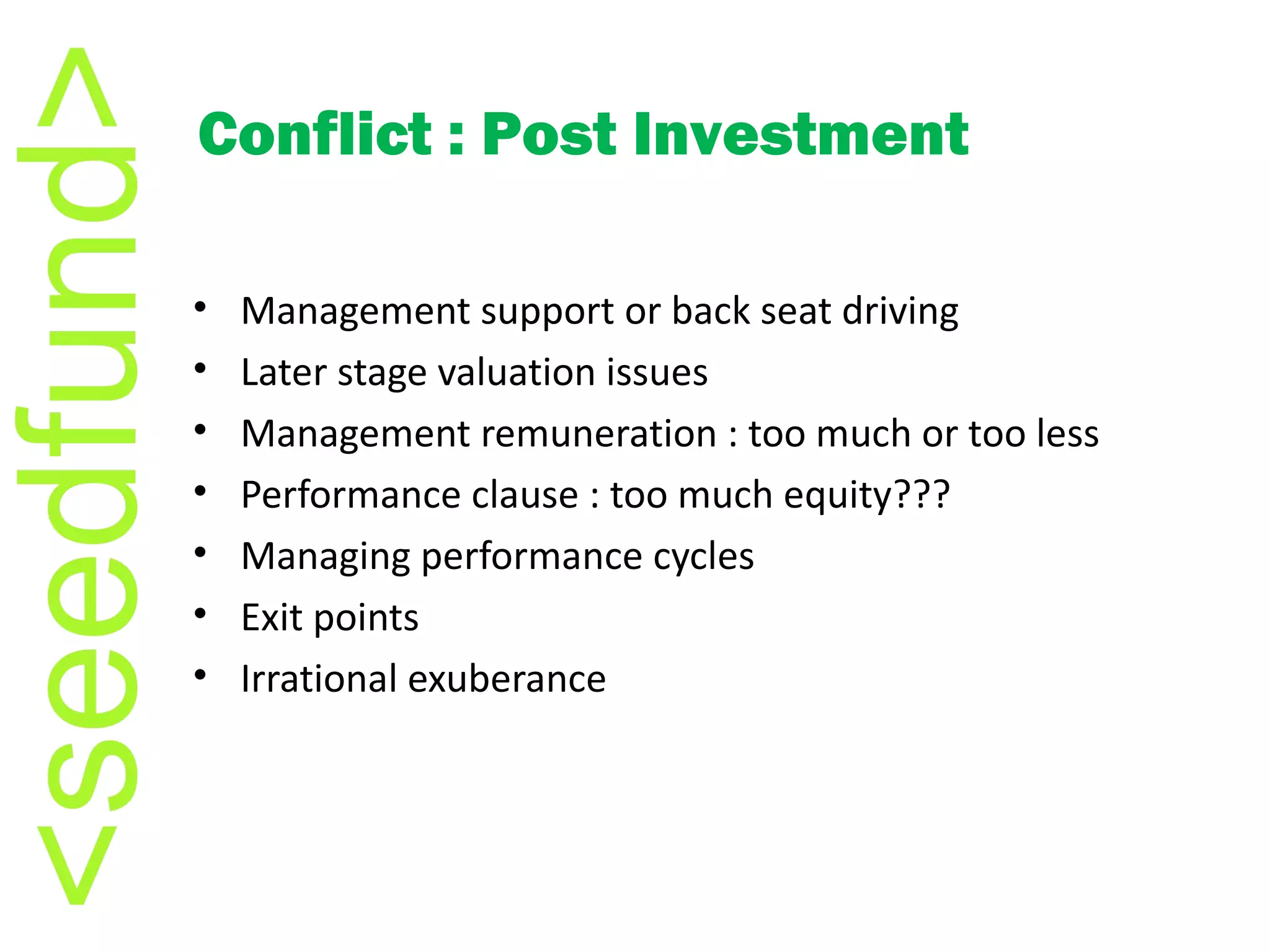
Management support or back seat driving Later stage valuation issues Management remuneration : too much or too less Performance clause : too much equity??? Managing performance cycles Exit points Irrational exuberance  Conflict : Post Investment
Case Study: MMT
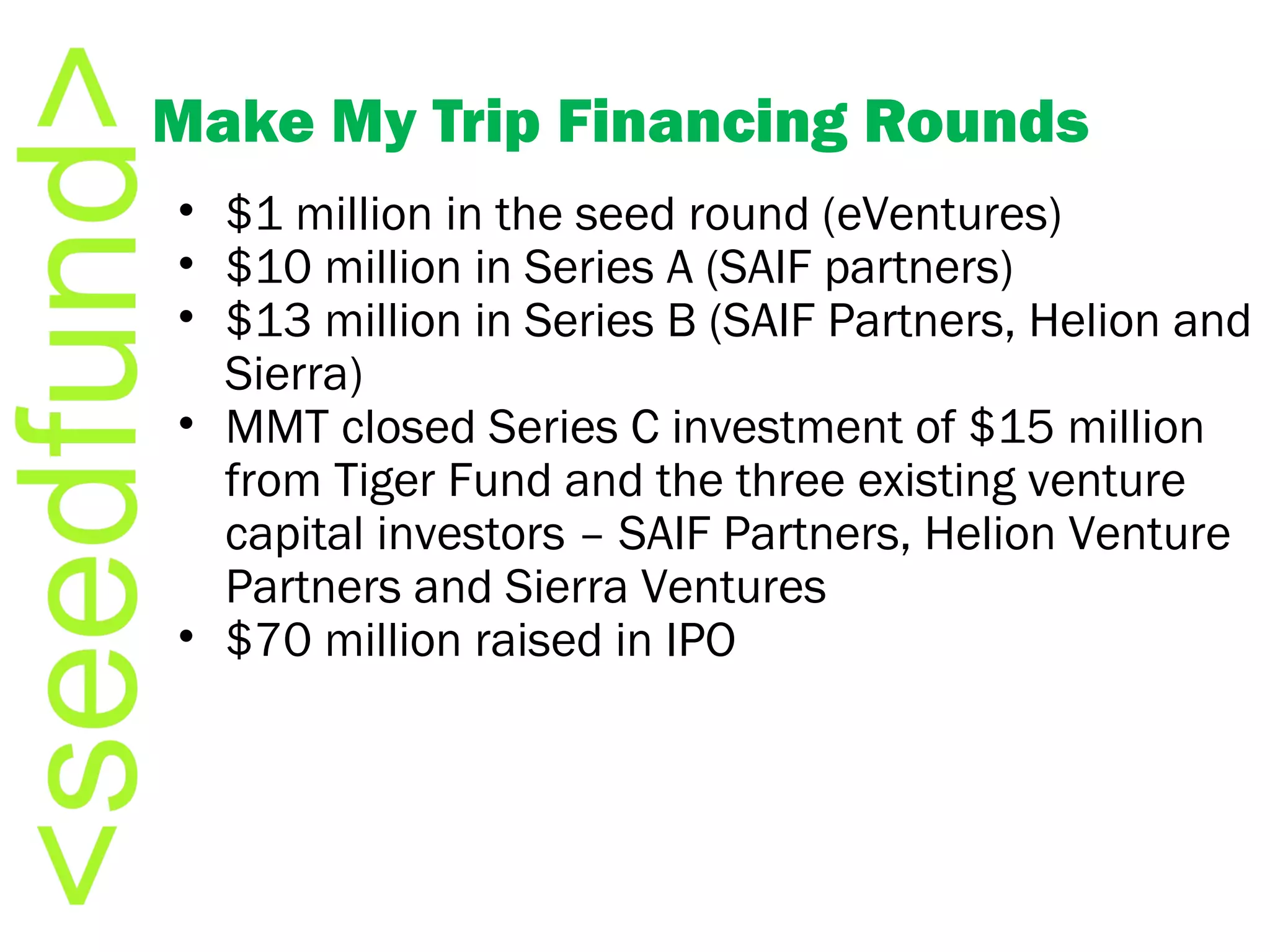
Make My Trip Financing Rounds $1 million in the seed round (eVentures) $10 million in Series A (SAIF partners) $13 million in Series B (SAIF Partners, Helion and Sierra) MMT closed Series C investment of $15 million from Tiger Fund and the three existing venture capital investors – SAIF Partners, Helion Venture Partners and Sierra Ventures $70 million raised in IPO
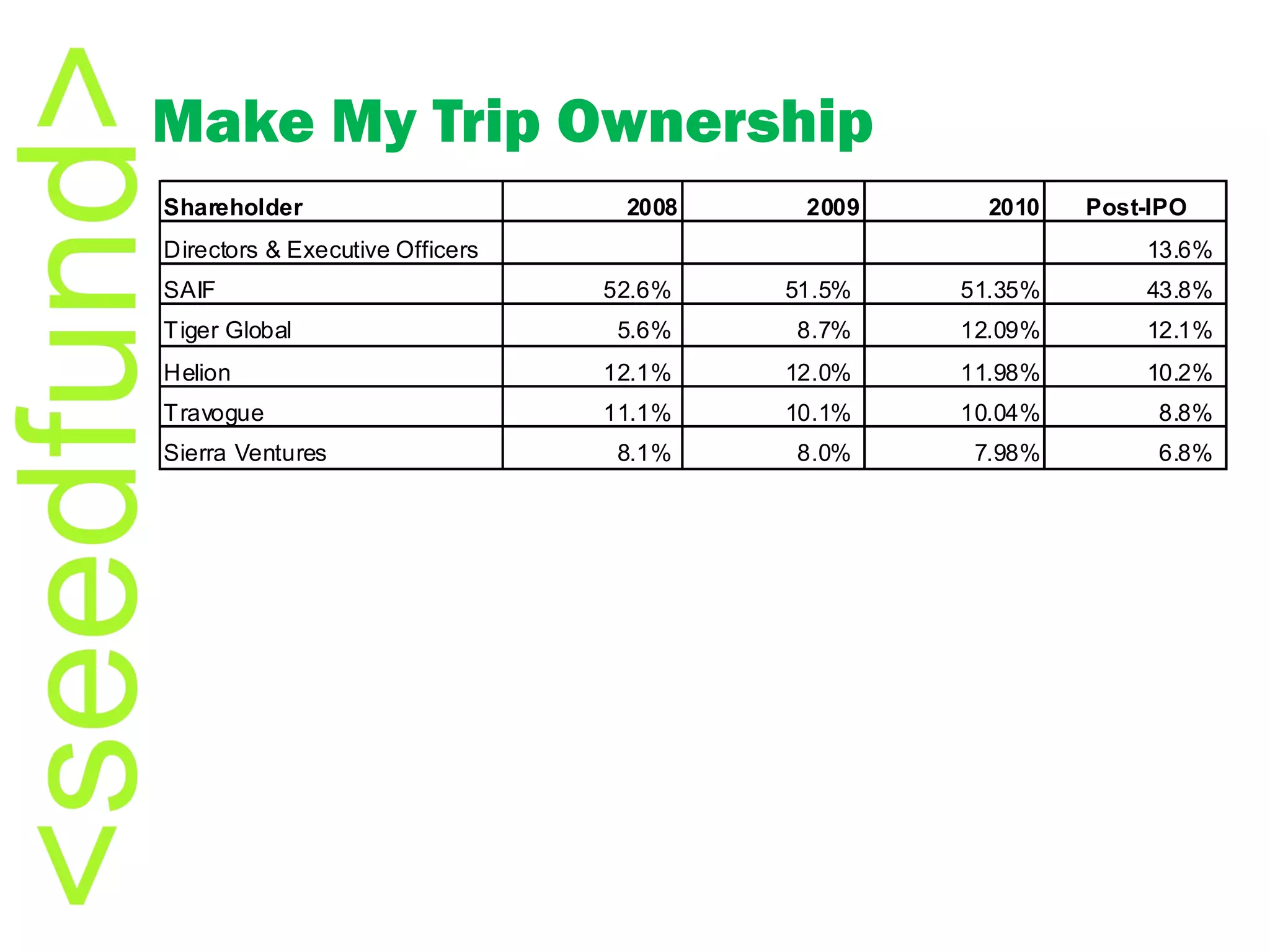
Make My Trip Ownership

Valuation Workshop by Anand Lunia and Shailesh V Singh 23 Jul 2011 v2

  • 1.
    An Introduction To Venture Capital Anand [email_address] Shailesh [email_address]
  • 2.
    Agenda Saturday, July23 rd , 2011 The Billion Dollar Club? What is Venture Capital? Valuation Methodologies Valuation in Venture Capital Structuring a Fund Case Study: MMT
  • 3.
  • 4.
    The Billion DollarClub Airbnb  is  definitely in the club . The crowdsourced marketplace for turning your apartment into a hotel for a night grew  800 percent  last year in nights booked to 800,000. There are currently 60,000 listings, and bookings keep growing by 40 to 50 percent a month.  Sublets are next .
  • 5.
    The Billion DollarClub Square  is also  in the club . It is raising at least $50 million. Square passed 500,000 card readers and  1 million transactions  in May, and is processing more than  $3 million a day  in mobile payments. COO  Keith Rabois   told us at Disrupt NYC that Square will do $1 billion in transactions this year, and he thinks it could ultimately do  better financially than Paypal  (where he was an early executive). 
  • 6.
    The Billion DollarClub Dropbox , the Y Combinator file-sharing startup that only ever raised  $7.2 million  might end up with the largest valuation in the club, perhaps as high as $1.5 billion or $2 billion. It’s just growing like crazy, with  25 million users  saving 200 million files daily. That’s up from  4 million users  18 months ago.
  • 7.
    The Billion DollarClub Gilt Groupe  is already in the club. It closed a  $138 million round  at about a $1 billion valuation last May. One of the first companies to introduce online flash sales in the U.S., Gilt is on track to do $500 million in revenues this year and has expanded from fashion to  food ,  travel ,  local deals , and more.
  • 8.
    The Billion DollarClub Gilt Groupe  is already in the club. It closed a  $138 million round  at about a $1 billion valuation last May. One of the first companies to introduce online flash sales in the U.S., Gilt is on track to do $500 million in revenues this year and has expanded from fashion to  food ,  travel ,  local deals , and more.
  • 9.
    The Billion DollarClub Just above this group, is Pandora (which just went public with a  $2 billion  market cap), LivingSocial (with a  $3 billion  valuation), LinkedIn (already public, with a  $6.3 billion  market cap), Twitter (which is worth anywhere from  $3.7 billion  to  $10 billion ), Zynga (which will be worth north of  $10 billion when it goes public), Groupon (which could be worth more than  $25 billion ) and Facebook (which is already worth  $50 billion  and could go as high as $100 billion by the time it IPOs).
  • 10.
  • 11.
    The Billion DollarClub-Google
  • 12.
    Multiples will changewith maturity
  • 13.
  • 14.
    Private Equity &Venture Capital “ Private Equity ” means capital to companies not quoted on a stock market, in exchange for an equity participation Venture Capital (VC) is a sub-class of Private Equity characterized by investments made for the purpose of developing, launching, and expanding new products or service offerings
  • 15.
    Seed Fund VentureCapital Buyout / Leveraged Buyout Growth Capital Special Situation Funds Stressed Asset Real Estate Fund Infrastructure Funds Secondary Funds Type of Alternative Investment Class
  • 16.
    Source : ErasmicFund Fund Raising Pattern – Life Cycle of a Startup
  • 17.
    Higher returns Riskcapital Technology driven ? Capital efficiency Unlisted companies / PIPE Key Attributes
  • 18.
    How VC ’swork Investor Investor Investor VC fund Investor Startup Startup Startup
  • 19.
    Fee Structure :2 :20 model During commitment period Post commitment period Draw down schedule Duration Fund amount Alignment of interest Carry structure Claw back provision Deal Structure
  • 20.
    Attributes of aGreat VC Fund • Bets on people not trends • Driven by the big idea • Looking for a ‘Winner’ • Not afraid of failure • Understand how to manage a portfolio of risk • Serves as a fantastic coach • Does her best work outside of the board room • Not waiting for validation from other VCs
  • 21.
    In the VC’sMind • Is this the right team? • What’s the entrepreneur's motivation? • Is this a billion dollar opportunity? • Is it a game changer? • How competitive is the space? • How defensible is the product? • How much is this thing going to take? • How long to maximize value and exit?
  • 22.
  • 23.
  • 24.
    In the VC’s mind IRR (Internal Rate of Return) Company ’s Current and Future Valuation Comparables (P/E,P/S,…), “Number of”, DCF, … What ’s The Best Strategy To Create Value Which are the achievable milestones and what ’s the financing needed ? When is the break-even expected ? With which margins and revenues. Exit Strategy Trade sale, IPO, N th +1 round of financing, .. Minimizing Risks Diluting the investment Liquidation Preference rights
  • 25.
  • 26.
    Factors Captured inValuation Time Value of Money – Value of dollar today vs. tomorrow Risk of Cash Flows – Certainty of cash flows Growth Potential of Cash flows – Future potential of business
  • 27.
    Valuation Methodologies Twomain valuation methodologies: Discounted Cash Flow Analysis (“DCF”) Current value based on internal cash flows projections Adjusts for risk and time value of money Multiples Useful in comparing similar companies Captures operating and financial characteristics (e.g. expected growth) in a single number that can be multiplied by some financial metric (e.g. EBITDA) to yield an enterprise or equity value Expressed as a ratio
  • 28.
    Discounted Cash FlowAnalysis Current Value based on Discounting Projections Key Components: Free Cash Flow Terminal Value Discount Rate This method works very well for businesses with stable cash flows (i.e. infrastructure, mature businesses) For start-ups, however, a DCF does not work as well due to: the volatility of cash flows and difficulty it's often impossible to model revenue correctly, let alone cash flow, and terminal value
  • 29.
    DCF Example –Company A
  • 30.
    Multiples Multiples canbe applied to a company’s financial metrics from two sources: Comparable Companies: Implied value in the public markets by analyzing similar companies' trading and operating metrics Depends on the level of comparability of the selected publicly traded companies Does not include a "control premium" Precedent Transaction Analysis: Multiples derived from comparable precedent M&A transactions Reliability depends on the number of precedent transactions and their levels of comparability Market cycles and volatility impact on historical Individual buyer synergies and structure of transaction will also impact multiples
  • 31.
    Commonly Used MultiplesPrice / Earnings (“P/E”) – stable services company P/E/G (“PEG Ratio”) – extension of P/E; best for fast growing company Price / Sales (“P/Rev”)* - brand, negative cash flows Price / Book Value (“P/BV”) – banks, insurance TEV / EBITDA – removes the affect of capital structure * Note – in companies with debt, enterprise value is used, where equity + debt equals enterprise value
  • 32.
  • 33.
    VCs imperative- 10Xin each deal The “Portfolio Effect” Out of Ten Start-ups Funded, with Re 1 each, 2 successes at 10x or better 20 5 ‘OK’ returns at 1.5x to 4x 10 3 write-offs, total loss of invested money 0 Total Gains on Investment of Rs 10 30 Venture Capital is fundamentally an institutionalized form of aiming for Outliers! Do we know which one is 10X? We expect each one to be 10X, and then pray
  • 34.
    Super deal - Venture Capital Perspective Goal - Build a highly profitable, industry dominant company to be taken public or harvested in another way at a high P/E multiple in 5-8 years. Management Team - Well rounded with proven experience in building a company. Team works well together and is led by an industry star. Team must also posses high commitment and integrity. Product - Proprietary product with a sustainable competitive advantage. Market - Clearly identified large and growing market with minimal current and near-term competition
  • 35.
    Valuations- What isa Fair Deal? Not So fair Deal Current Revenue- 1 cr Rev. at 5 years - 15 cr Co. sold for - 60 cr Investment made 2 cr VC stake 60% VC return 36 cr VC return 18 times Not So fair Deal Current Revenue- 1 cr Rev. at 5 years - 15 cr Co. sold for - 60 cr Investment made 2 cr VC stake 15% VC return 9 cr VC return 4.5 times Co. grew by 15 times, VC got 18 times Co. grew by 15 times, VC got 4.5 times
  • 36.
    Valuations- What isa Fair Deal? High sales multiple Investment made 20 cr Rev. at 5 years - 15 cr Revenue Multiple 10 Valuation 150 cr VC stake 40% VC return 60 cr Low Sales Multiple VC return of 3X, not enough Again, VC return not enough Investment made 10 cr Rev. at 5 years - 30 cr Revenue Multiple 2 Valuation 60 cr VC stake 40% VC return 24 cr
  • 37.
    Stake and InvestmentLifecycle What do we need to optimize? Size of the circle or Promoter Stake?
  • 38.
    Valuation Soft Parameters‘ We want to raise money and hire some people and build the product. Of course, we will start with market research’ ‘ We have burnt the midnight oil for last two years to research this need, built the product and have left our jobs a few months ago because we just had to get started’
  • 39.
    Valuation Soft Parameters“ We will hire a sales head as soon as we get set. We don’t mind even hiring a CEO” ‘ Here is the Sales Head, my co-founder, and I remain the CEO till the company is large enough to attract a professional ’
  • 40.
  • 41.
    Types Of dealsStartups Fresh Equity – Growth Capital Buyouts Leveraged Buyouts Issues Performance clause Dilution Exit Scenario Taxation Issues Investment Deal Structures
  • 42.
    Startup Structure Startupaims to raise ~ USD 1 Crore Proposal VC contribution ~ INR 1 Crore for 40% stake Entrepreneur ~ 60% of share for idea, execution and delivery Deal Structure
  • 43.
    Risk faced byVC/ Investor if agreed to this this structure Split of proceed if venture fails Split of proceeds if venture succeeds Investor IRR Good faith investment from entrepreneur : Skin in the game Clause for staying in the venture : vesting Deal Structure
  • 44.
    Proposed structure fromPE/ VC player Deal Structure Debt Investor Entrepreneur Debt INR 50,00,000 $0 Preferred Stock INR 44,00,000 Common stock $0 60 shares @ INR 10000 per share (60% stake with Investor) INR 6,00,000 - 40 shares @ INR 10,000 per shares (40% with Entrepreneur) - INR 4,00,000 1,00,00,000/- INR 4,00,000/-
  • 45.
    ROFR : Rightof first refusal Tag along rights : protection of minority share holder Drag along rights : Drag Along : majority share holder Scenario (Protection to Majority) Drag along : minority share Scenario (Protection to Minority) Protection Rights
  • 46.
    Management support orback seat driving Later stage valuation issues Management remuneration : too much or too less Performance clause : too much equity??? Managing performance cycles Exit points Irrational exuberance Conflict : Post Investment
  • 47.
  • 48.
    Make My TripFinancing Rounds $1 million in the seed round (eVentures) $10 million in Series A (SAIF partners) $13 million in Series B (SAIF Partners, Helion and Sierra) MMT closed Series C investment of $15 million from Tiger Fund and the three existing venture capital investors – SAIF Partners, Helion Venture Partners and Sierra Ventures $70 million raised in IPO
  • 49.
    Make My TripOwnership

Editor's Notes

  • #19 The first thing to understand about VC ’s is that they’re not investing their own money. Venture capitalists start by raising money from a bunch of investors, and then distribute it to various startups. But the investors are expecting to get their money back, generally within 10 years of committing it to the fund.