Venture Capital Fundraising Methodology October 28, 2009
What Is Venture Capital?
What Is Venture Capital? Private equity class specialized in funding and building early stage, high growth potential enterprises
Typical VC Fund Structure General Partners invest capital on behalf of Limited Partners LPs include endowments, pension funds, charities, corporations, individuals, and fund of funds GP contributes personal capital as well GP earns 2% annual management fees & 20% carried interest, i.e., share of profits Capital called as needed, with primary investing done in first 5 yrs of 10 yr fund cycle Quality fund returns 3x capital, or 18-20% IRR 1/3 of deals will likely fail, 1/3 will return amount invested, and 1/3 will drive majority of returns
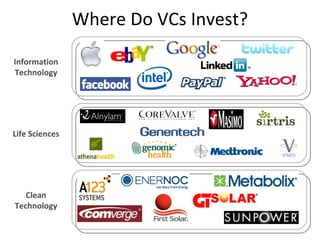
Where Do VCs Invest? Life Sciences Clean Technology Information Technology
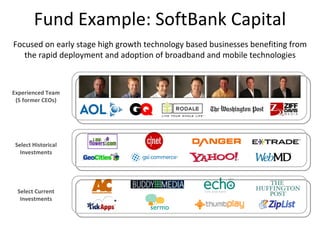
Fund Example: SoftBank Capital Select Current Investments Experienced Team (5 former CEOs) Focused on early stage high growth technology based businesses benefiting from the rapid deployment and adoption of broadband and mobile technologies Select Historical Investments
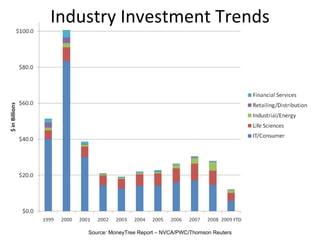
Industry Investment Trends Source: MoneyTree Report – NVCA/PWC/Thomson Reuters
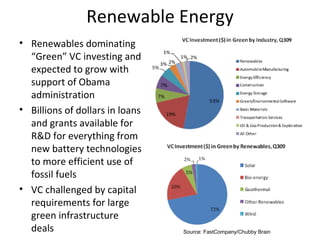
Renewable Energy Renewables dominating “Green” VC investing and expected to grow with support of Obama administration Billions of dollars in loans and grants available for R&D for everything from new battery technologies to more efficient use of fossil fuels VC challenged by capital requirements for large green infrastructure deals Source: FastCompany/Chubby Brain
Fundraising Process You set the valuation.  I’ll set the terms.* *Don’t be fooled by the cover price
Why Raise Venture Capital? Guidance & Support Board participants; Interim executives Product management, business development and financial planning support Access Industry contacts Leverage portfolio  Credibility Stamp of approval with customers, partners and vendors Cash But at a high cost of capital, so Guidance, Access and Credibility should justify that cost
Typical Company Profile Team Ranges from a single, 1 st -time entrepreneur to a full team of seasoned entrepreneurs Stage of Development Ranges from pre-revenue to approaching profitability VCs sit between angel and growth/buyout investors, though some funds cross over into these stages Size of Round Definitions vary, normalized range from $2M-$15M Deals frequently syndicated between multiple funds to strengthen board and diversify risk
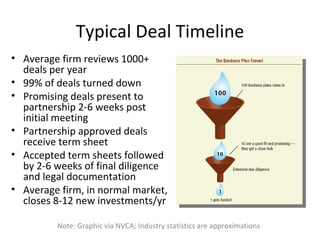
Typical Deal Timeline Average firm reviews 1000+ deals per year 99% of deals turned down Promising deals present to partnership 2-6 weeks post initial meeting Partnership approved deals receive term sheet Accepted term sheets followed by 2-6 weeks of final diligence and legal documentation Average firm, in normal market, closes 8-12 new investments/yr Note: Graphic via NVCA; Industry statistics are approximations
Deal Evaluation Focus varies by firm, but key elements include: Concept What is the product or service? Why will customers buy it? Opportunity What is the market size and penetration strategy? What is the competitive landscape?  Team Can they execute on development, sales and support?
Financial Projections Focus on key revenue and expense drivers Sensitivities important given model immaturity Viability of margins long term How much additional capital required? What is the potential dilution from later rounds? Focus on model details varies based on stage Seed stage may not yield revenue for 18-24 mos. Later stage deals may consider debt financing, requiring covenant maintenance
Term Sheet Price Pre vs. Post $ Valuation Option Pool implications Liquidation Preference Liquidation: Sale of company as opposed to IPO Multiples and Dividends Participation: Full, Capped and Non-Participating Stacked vs. pari passu Impact on management ownership and resulting motivation Board Configuration Option Pool: Pre vs. Post $ Dilution Anti-Dilution Rights: Weighted Avg. thru Full Ratchet Pro Rata Rights for future rounds Protective Provisions Term Sheet summary at www.AsktheVC.com
Term Sheet (cont’d) Board of Directors Investor Seats and Observers Founder and Independent Seats Protective Provisions Veto rights for overall preferreds or by class On changing rights of preferred class, selling existing or raising additional shares, change of control, board composition, raising debt Anti-Dilution Full Ratchet, Broad or Narrow-Based Wghtd Avg See term sheet series at  www.AsktheVC.com
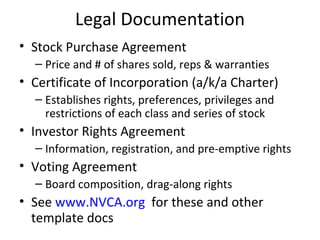
Legal Documentation Stock Purchase Agreement Price and # of shares sold, reps & warranties Certificate of Incorporation (a/k/a Charter) Establishes rights, preferences, privileges and restrictions of each class and series of stock Investor Rights Agreement Information, registration, and pre-emptive rights Voting Agreement Board composition, drag-along rights See  www.NVCA.org   for these and other template docs
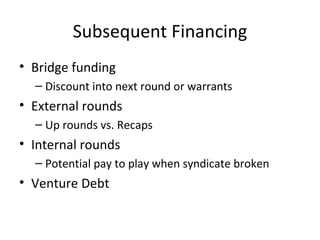
Subsequent Financing Bridge funding Discount into next round or warrants External rounds Up rounds vs. Recaps Internal rounds Potential pay to play when syndicate broken Venture Debt
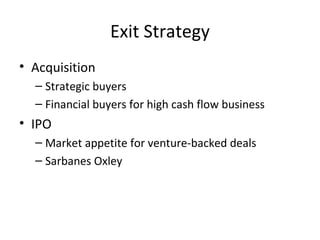
Exit Strategy Acquisition Strategic buyers Financial buyers for high cash flow business IPO Market appetite for venture-backed deals Sarbanes Oxley
www.SoftBank.com @joevc -  www.twitter.com/joevc www.JoeMedved.com

Venture Capital 101

  • 1.
    Venture Capital FundraisingMethodology October 28, 2009
  • 2.
  • 3.
    What Is VentureCapital? Private equity class specialized in funding and building early stage, high growth potential enterprises
  • 4.
    Typical VC FundStructure General Partners invest capital on behalf of Limited Partners LPs include endowments, pension funds, charities, corporations, individuals, and fund of funds GP contributes personal capital as well GP earns 2% annual management fees & 20% carried interest, i.e., share of profits Capital called as needed, with primary investing done in first 5 yrs of 10 yr fund cycle Quality fund returns 3x capital, or 18-20% IRR 1/3 of deals will likely fail, 1/3 will return amount invested, and 1/3 will drive majority of returns
  • 5.
    Where Do VCsInvest? Life Sciences Clean Technology Information Technology
  • 6.
    Fund Example: SoftBankCapital Select Current Investments Experienced Team (5 former CEOs) Focused on early stage high growth technology based businesses benefiting from the rapid deployment and adoption of broadband and mobile technologies Select Historical Investments
  • 7.
    Industry Investment TrendsSource: MoneyTree Report – NVCA/PWC/Thomson Reuters
  • 8.
    Renewable Energy Renewablesdominating “Green” VC investing and expected to grow with support of Obama administration Billions of dollars in loans and grants available for R&D for everything from new battery technologies to more efficient use of fossil fuels VC challenged by capital requirements for large green infrastructure deals Source: FastCompany/Chubby Brain
  • 9.
    Fundraising Process Youset the valuation. I’ll set the terms.* *Don’t be fooled by the cover price
  • 10.
    Why Raise VentureCapital? Guidance & Support Board participants; Interim executives Product management, business development and financial planning support Access Industry contacts Leverage portfolio Credibility Stamp of approval with customers, partners and vendors Cash But at a high cost of capital, so Guidance, Access and Credibility should justify that cost
  • 11.
    Typical Company ProfileTeam Ranges from a single, 1 st -time entrepreneur to a full team of seasoned entrepreneurs Stage of Development Ranges from pre-revenue to approaching profitability VCs sit between angel and growth/buyout investors, though some funds cross over into these stages Size of Round Definitions vary, normalized range from $2M-$15M Deals frequently syndicated between multiple funds to strengthen board and diversify risk
  • 12.
    Typical Deal TimelineAverage firm reviews 1000+ deals per year 99% of deals turned down Promising deals present to partnership 2-6 weeks post initial meeting Partnership approved deals receive term sheet Accepted term sheets followed by 2-6 weeks of final diligence and legal documentation Average firm, in normal market, closes 8-12 new investments/yr Note: Graphic via NVCA; Industry statistics are approximations
  • 13.
    Deal Evaluation Focusvaries by firm, but key elements include: Concept What is the product or service? Why will customers buy it? Opportunity What is the market size and penetration strategy? What is the competitive landscape? Team Can they execute on development, sales and support?
  • 14.
    Financial Projections Focuson key revenue and expense drivers Sensitivities important given model immaturity Viability of margins long term How much additional capital required? What is the potential dilution from later rounds? Focus on model details varies based on stage Seed stage may not yield revenue for 18-24 mos. Later stage deals may consider debt financing, requiring covenant maintenance
  • 15.
    Term Sheet PricePre vs. Post $ Valuation Option Pool implications Liquidation Preference Liquidation: Sale of company as opposed to IPO Multiples and Dividends Participation: Full, Capped and Non-Participating Stacked vs. pari passu Impact on management ownership and resulting motivation Board Configuration Option Pool: Pre vs. Post $ Dilution Anti-Dilution Rights: Weighted Avg. thru Full Ratchet Pro Rata Rights for future rounds Protective Provisions Term Sheet summary at www.AsktheVC.com
  • 16.
    Term Sheet (cont’d)Board of Directors Investor Seats and Observers Founder and Independent Seats Protective Provisions Veto rights for overall preferreds or by class On changing rights of preferred class, selling existing or raising additional shares, change of control, board composition, raising debt Anti-Dilution Full Ratchet, Broad or Narrow-Based Wghtd Avg See term sheet series at www.AsktheVC.com
  • 17.
    Legal Documentation StockPurchase Agreement Price and # of shares sold, reps & warranties Certificate of Incorporation (a/k/a Charter) Establishes rights, preferences, privileges and restrictions of each class and series of stock Investor Rights Agreement Information, registration, and pre-emptive rights Voting Agreement Board composition, drag-along rights See www.NVCA.org for these and other template docs
  • 18.
    Subsequent Financing Bridgefunding Discount into next round or warrants External rounds Up rounds vs. Recaps Internal rounds Potential pay to play when syndicate broken Venture Debt
  • 19.
    Exit Strategy AcquisitionStrategic buyers Financial buyers for high cash flow business IPO Market appetite for venture-backed deals Sarbanes Oxley
  • 20.
    www.SoftBank.com @joevc - www.twitter.com/joevc www.JoeMedved.com

Editor's Notes

  • #6 - Focus by sector, stage and geography
  • #8 IT/Consumer had massive investment in late 90s. Volume and distribution has dropped significantly over time. Life Sciences has been more stable over time Industrial/Energy spiked more recently, although lack of capital efficiency scared some off in 2009 - Retailing/Distribution has practically disappeared as a category - Financial Services has dropped as well
  • #17 Anti-Dilution Full Ratchet reprices the existing preferred to match the price of the new investors, which can cause a spiraling price effect that wipes out management and common If Series A invested $5M in the last round, those shares must represent $5M of value in the new deal, so a $5M pre on the next round would give all of the value to the Series A shareholders Weighted average approach results in a more reasonable price adjustment New Conversion Price = Old Conversion Price * ((Common Outstanding + Common Issuable at Old Price)/(Common Outstanding + Common Issuable at New Price)) With Narrow-Based, Common Outstanding can include just preferred class, all preferreds, and common With Broad-Based, Common Outstanding can include all preferreds converted, common, options and warrants, which is better for Company