VCIC ® Team Prep Session VC 101 This PPT was created for organizers of internal events to help prepare student teams to compete.
What is a VC’s Job? Return 20-25% to LPs
VC’s Job Duties Fundraising Sourcing deals Investing Growing ventures Exiting
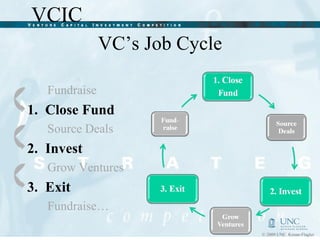
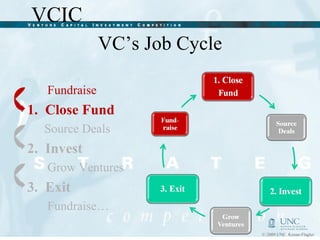
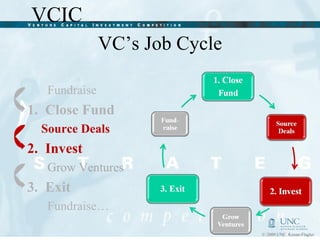
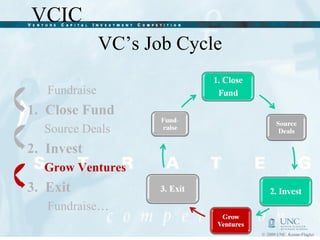
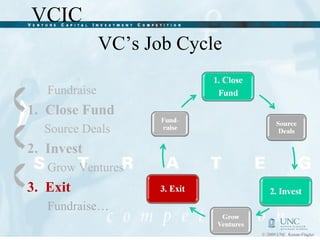
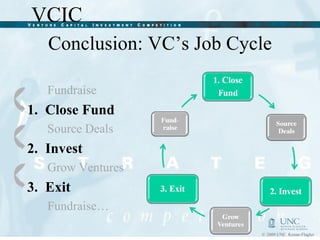
VC’s Job Cycle Fundraise  Close Fund Source Deals Invest Grow Ventures Exit Fundraise…
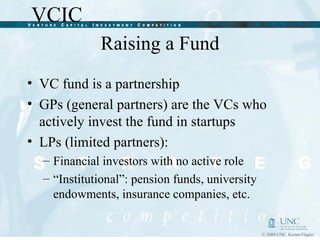
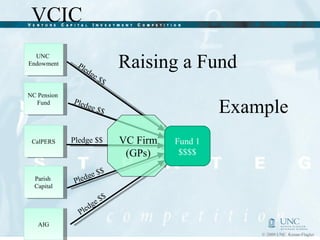
Raising a Fund VC fund is a partnership GPs (general partners) are the VCs who actively invest the fund in startups LPs (limited partners): Financial investors with no active role “ Institutional”: pension funds, university endowments, insurance companies, etc.
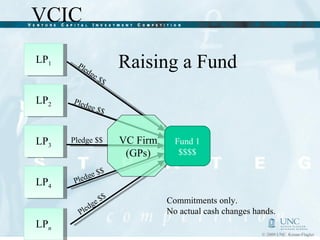
Raising a Fund LP 2 LP 3 LP 4 VC Firm (GPs) Fund 1 $$$$ LP 1 LP n Pledge $$  Commitments only.  No actual cash changes hands. Pledge $$  Pledge $$  Pledge $$  Pledge $$
Raising a Fund CalPERS Parish  Capital VC Firm (GPs) Fund 1 $$$$ UNC  Endowment AIG Pledge $$  Pledge $$  Pledge $$  Pledge $$  Pledge $$  Example NC Pension  Fund
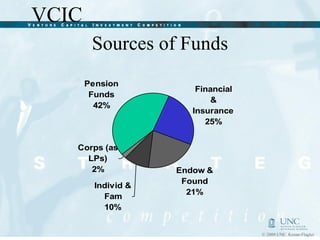
Sources of Funds
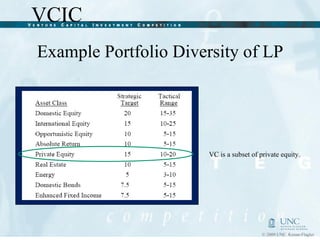
Example Portfolio Diversity of LP VC is a subset of private equity.
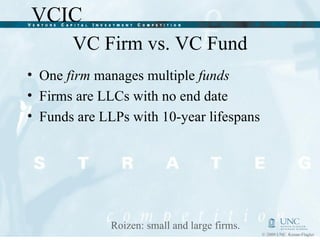
VC Firm vs. VC Fund One  firm  manages multiple  funds Firms are LLCs with no end date Funds are LLPs with 10-year lifespans Roizen: small and large firms.
Fund Size Large:  New Enterprise XIII, $2.2B,12 GPs Kleiner Perkins XIII, $700M Local RTP, for example:  Intersouth IV, $275M Southern Capitol II, $15M
New Enterprise Associates hauls in nearly $2.5B for new fund 10/19/09 : BALTIMORE, MD -  New Enterprise Associates has secured commitments for $2,457,680,000 for its NEA 13 fund, targeted at $2.5 billion, according to a regulatory filing. NEA, which focuses on IT and healthcare investments, currently has $8.5 billion under management in 12 funds.  more... Imagine you are a start-up that needs $1M in funding. Can this firm help you?
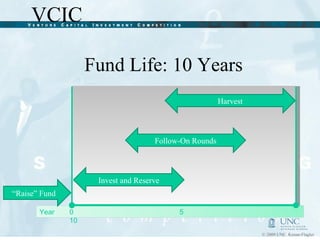
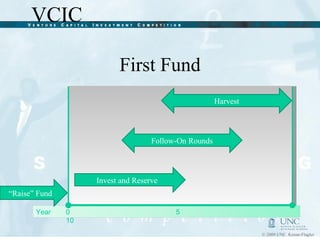
Fund Life: 10 Years Invest and Reserve Follow-On Rounds Harvest “ Raise” Fund Year 0 5 10
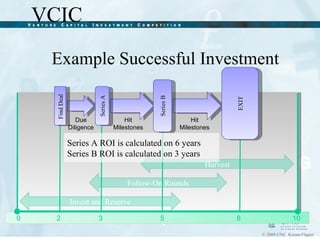
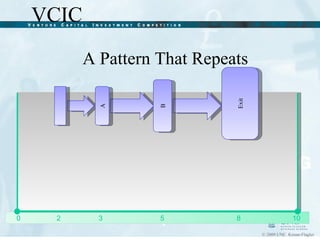
Example Successful Investment Invest and Reserve Follow-On Rounds Harvest Series A Due Diligence Hit Milestones Hit Milestones Series B EXIT Find Deal  Series A ROI is calculated on 6 years Series B ROI is calculated on 3 years 0 2 3 5 8 10
A Pattern That Repeats A B Exit 0 2 3 5 8 10
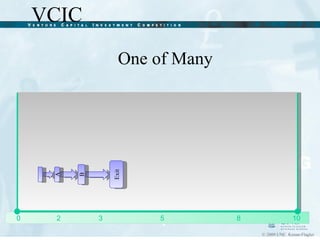
One of Many A B Exit 0 2 3 5 8 10
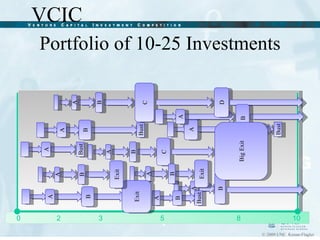
Portfolio of 10-25 Investments A B A B A B A B C A B A B Bust A Bust B A Bust A Bust A B C A D B Exit Exit Big Exit Exit 0 2 3 5 8 10
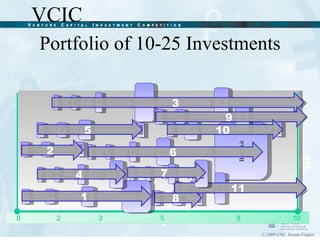
Portfolio of 10-25 Investments Big Exit A B A B A B A B C A B A B Bust A Bust B A Bust A Bust A B C A D B 3 2 5 6 8 9 11 10 Exit Exit Exit 4 1 7 0 2 3 5 8 10
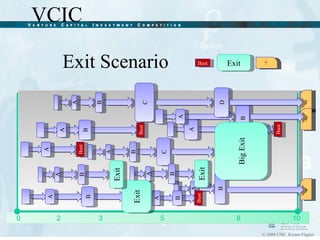
Exit Scenario A B A B A B A B C A B A B Bust A Bust B A Bust A Bust A B C A D B Exit Exit Big Exit Exit ? ? ? Bust Exit ? 0 2 3 5 8 10
First Fund Invest and Reserve Follow-On Rounds Harvest “ Raise” Fund Year 0 5 10
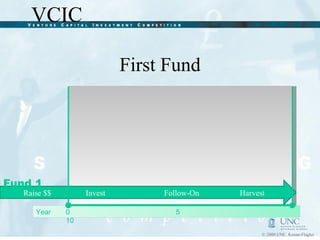
First Fund Raise $$  Invest  Follow-On  Harvest  Fund 1 Year 0 5 10
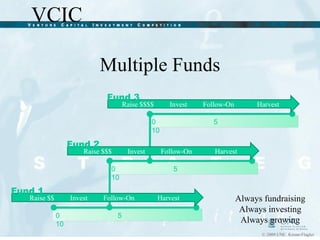
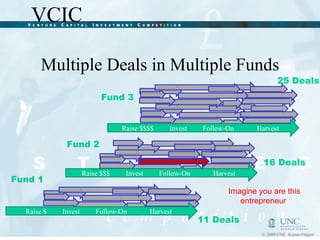
Multiple Funds Raise $$  Invest  Follow-On  Harvest  Raise $$$$  Invest  Follow-On  Harvest  Raise $$$  Invest  Follow-On  Harvest  Always fundraising Always investing Always growing Fund 1 Fund 3 Fund 2 0 5 10 0 5 10 0 5 10
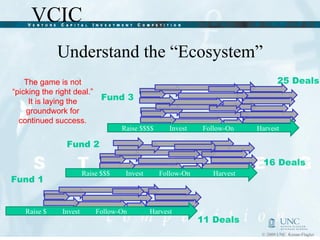
Multiple Deals in Multiple Funds Fund 1 Fund 3 Fund 2 Imagine you are this entrepreneur  Raise $  Invest  Follow-On  Harvest  Raise $$$  Invest  Follow-On  Harvest  Raise $$$$  Invest  Follow-On  Harvest  11 Deals 16 Deals 25 Deals
VC’s Job Cycle Fundraise  Close Fund Source Deals Invest Grow Ventures Exit Fundraise…
Source Deals: Focus
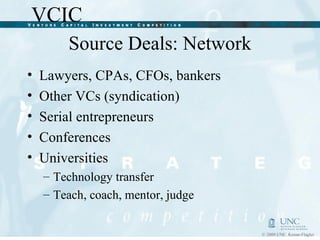
Source Deals: Network Lawyers, CPAs, CFOs, bankers Other VCs (syndication) Serial entrepreneurs Conferences Universities  Technology transfer Teach, coach, mentor, judge
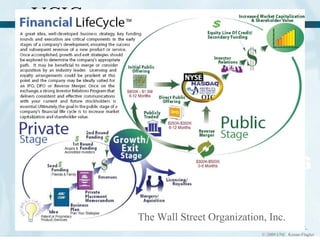
The Wall Street Organization, Inc.
 
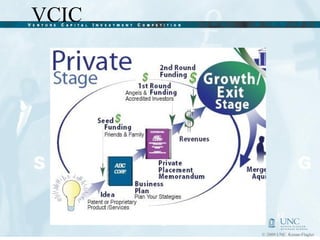
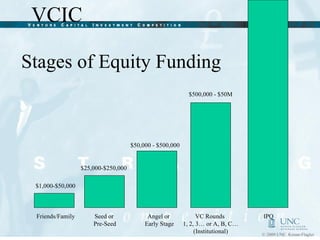
Stages of Equity Funding Friends/Family $1,000-$50,000 Seed or  Pre-Seed $25,000-$250,000 Angel or  Early Stage $50,000 - $500,000 VC Rounds  1, 2, 3… or A, B, C… (Institutional) $500,000 - $50M IPO
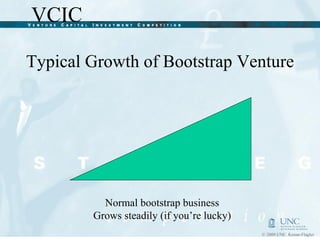
Typical Growth of Bootstrap Venture Normal bootstrap business Grows steadily (if you’re lucky)
Rounds An investment / stock issuance occurs in something called a “round” VCs purchase preferred shares, which means they have rights over “common” Most ventures need multiple rounds  (Series A, Series B, etc.) Each round dilutes previous shareholders Valuation occurs at the moment of a round (other times difficult to value illiquid asset)
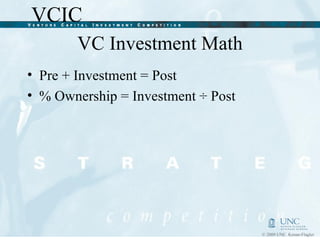
VC Investment Math Pre + Investment = Post % Ownership = Investment ÷ Post
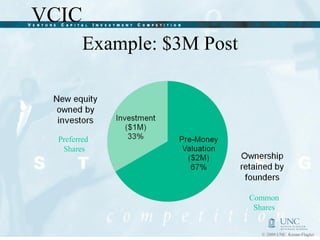
Example: $3M Post Preferred  Shares Common Shares
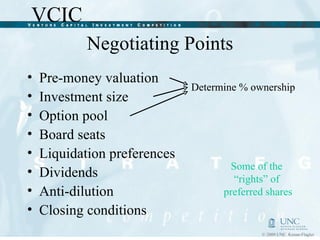
Negotiating Points Pre-money valuation Investment size Option pool Board seats Liquidation preferences Dividends Anti-dilution Closing conditions Determine % ownership Some of the  “rights” of  preferred shares
VC’s Job Cycle Fundraise  Close Fund Source Deals Invest Grow Ventures Exit Fundraise …
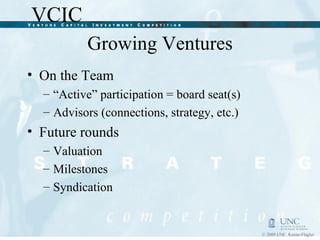
Growing Ventures On the Team “ Active” participation = board seat(s) Advisors (connections, strategy, etc.) Future rounds Valuation  Milestones Syndication
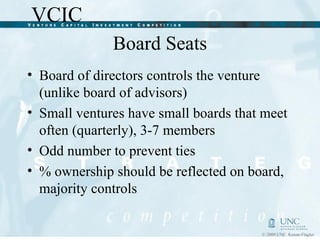
Board Seats Board of directors controls the venture (unlike board of advisors) Small ventures have small boards that meet often (quarterly), 3-7 members Odd number to prevent ties % ownership should be reflected on board, majority controls
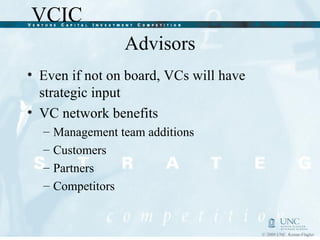
Advisors Even if not on board, VCs will have strategic input VC network benefits Management team additions Customers Partners Competitors
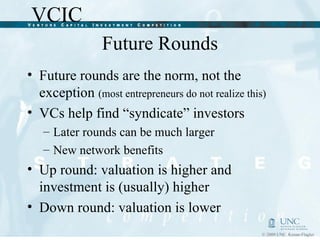
Future Rounds Future rounds are the norm, not the exception  (most entrepreneurs do not realize this) VCs help find “syndicate” investors Later rounds can be much larger New network benefits Up round: valuation is higher and investment is (usually) higher Down round: valuation is lower
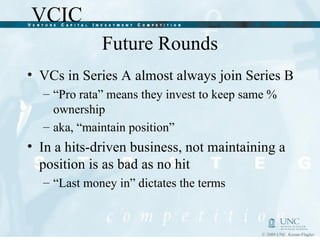
Future Rounds VCs in Series A almost always join Series B “ Pro rata” means they invest to keep same % ownership aka, “maintain position” In a hits-driven business, not maintaining a position is as bad as no hit “ Last money in” dictates the terms
Series A and B Conflict Series A investor, like the entrepreneur, wants a high pre-money valuation for Series B Series B wants lower pre-money valuation A VC who is in both rounds is trying to find middle ground VCs are generally trying to find a “fair market price” to avoid a future conflicts
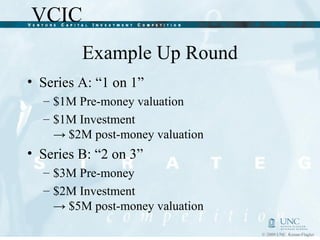
Example Up Round Series A: “1 on 1” $1M Pre-money valuation $1M Investment  -> $2M post-money valuation Series B: “2 on 3” $3M Pre-money $2M Investment  -> $5M post-money valuation
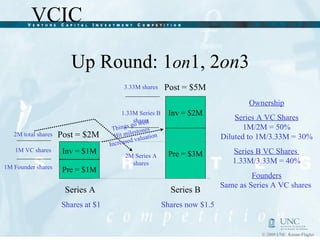
Up Round: 1 on 1, 2 on 3 Inv = $1M Series A Series B Post = $5M Pre = $1M Post = $2M Inv = $2M Pre = $3M Shares at $1 Shares now $1.5 1M VC shares 1M Founder shares 2M total shares 1.33M Series B shares 2M Series A shares 3.33M shares Ownership Series A VC Shares 1M/2M = 50% Diluted to 1M/3.33M = 30% Series B VC Shares  1.33M/3.33M = 40% Founders Same as Series A VC shares  Things go well Hit milestones Increased valuation
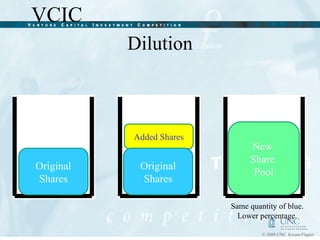
Dilution Original Shares Added Shares New  Share  Pool Original Shares Same quantity of blue.  Lower percentage.
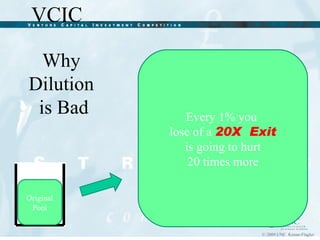
Why  Dilution  is Bad Original Pool Every 1% you  lose of a  20X  Exit is going to hurt 20 times more
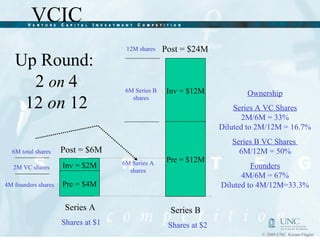
Up Round:  2  on  4 12  on  12 Inv = $2M Series A Series B Post = $24M Pre = $4M Post = $6M Inv = $12M Pre = $12M Shares at $1 Shares at $2 2M VC shares 4M founders shares 6M total shares 6M Series B shares 6M Series A shares 12M shares Ownership Series A VC Shares 2M/6M = 33% Diluted to 2M/12M = 16.7% Series B VC Shares  6M/12M = 50% Founders 4M/6M = 67% Diluted to 4M/12M=33.3%
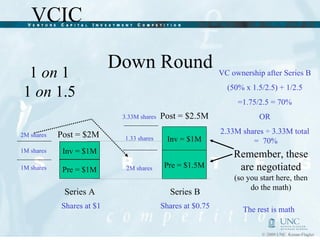
Down Round Inv = $1M Series A Series B Post = $2.5M Pre = $1M Post = $2M Inv = $1M Pre = $1.5M 1M shares 1M shares 2M shares 1.33 shares 2M shares 3.33M shares Shares at $1 Shares at $0.75 Remember, these are negotiated (so you start here, then do the math) The rest is math VC ownership after Series B (50% x 1.5/2.5) + 1/2.5 =1.75/2.5 = 70% OR 2.33M shares ÷ 3.33M total  =  70% 1  on  1 1  on  1.5
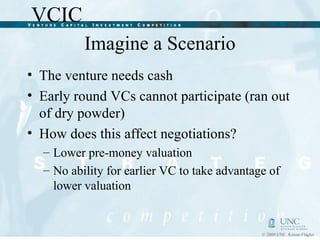
Imagine a Scenario The venture needs   cash Early round VCs cannot participate (ran out of dry powder) How does this affect negotiations? Lower pre-money valuation No ability for earlier VC to take advantage of lower valuation
Capitalization Table A table that shows the ownership structure of a venture Includes all shareholders and all classes of shares Also called “cap chart” Sign up at www.LearnVC.com for cap chart examples
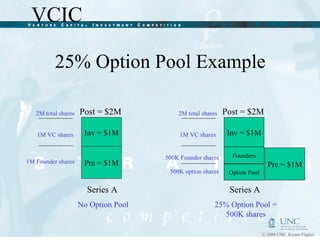
Option Pool Negotiated, but the norm is to take it out of the founders’ side (or ‘hide’) Result: can severely dilute founders
25% Option Pool Example Inv = $1M Series A Pre = $1M Post = $2M No Option Pool 1M VC shares 1M Founder shares 2M total shares Inv = $1M Series A Founders Post = $2M 25% Option Pool = 500K shares 1M VC shares 500K Founder shares 2M total shares 500K option shares Option Pool Pre = $1M
Future Rounds Impact on ROI VCs want to “maintain their position” Keep same % of ownership to exit Requires “dry powder” for future rounds Probably need syndication  Trying to avoid dilution You  must  estimate future funding/dilution to estimate your ROI
VC’s Job Cycle Fundraise  Close Fund Source Deals Invest Grow Ventures Exit Fundraise…
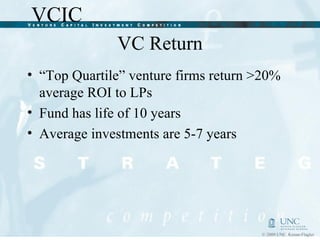
VC Return “ Top Quartile” venture firms return >20% average ROI to LPs Fund has life of 10 years Average investments are 5-7 years
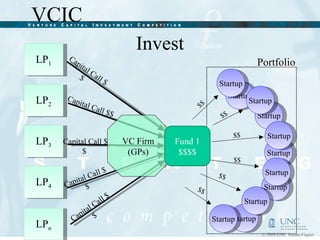
Invest Startup Startup Startup Startup Startup Startup Startup Startup Startup Startup Startup Portfolio VC Firm (GPs) $$ $$ $$ $$ $$ $$ Fund 1 $$$$ Capital Call $$  Capital Call $$  Capital Call $$  Capital Call $$  Capital Call $$  LP 2 LP 3 LP 4 LP 1 LP n
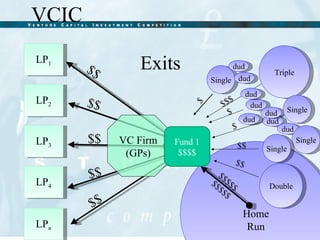
Exits Single Home Run dud dud dud Triple VC Firm (GPs) Fund 1 $$$$ $$ $$ $$ dud dud dud dud Single Single Double dud $$$$$$$$$$ $$ $$ $$$ $ $ $ $$ $$ Single LP 2 LP 3 LP 4 LP 1 LP n
Examples 150M fund Fees: 3M/year (salaries, rent, travel) Carry: 12 portfolio ventures at $10M avg. investment To get 20% ROI, we need ~$450M  (20% of 150M = $30M x 10 years) That’s two ventures going 20X!!
Getting to 20% ROI Rule of thumb: 3X on entire fund However, each investment is not 10 years Money not “put to work” until a capital call Exit could happen before end of fund You could reach 20% with only 1.5X
How do GPs/VCs Make Money? Management fee (~2%/year to cover expenses) for 10 years “ Carry” % of capital gain that VCs keep 20% benchmark Requires liquidity event(s)
Conclusion: VC’s Job Cycle Fundraise  Close Fund Source Deals Invest Grow Ventures Exit Fundraise…
Understand the “Ecosystem” Fund 1 Fund 3 Fund 2 The game is not “picking the right deal.” It is laying the groundwork for continued success. Raise $  Invest  Follow-On  Harvest  Raise $$$  Invest  Follow-On  Harvest  Raise $$$$  Invest  Follow-On  Harvest  11 Deals 16 Deals 25 Deals

Vcic Prep Session Vc 101

  • 1.
    VCIC ® TeamPrep Session VC 101 This PPT was created for organizers of internal events to help prepare student teams to compete.
  • 2.
    What is aVC’s Job? Return 20-25% to LPs
  • 3.
    VC’s Job DutiesFundraising Sourcing deals Investing Growing ventures Exiting
  • 4.
    VC’s Job CycleFundraise Close Fund Source Deals Invest Grow Ventures Exit Fundraise…
  • 5.
    VC’s Job CycleFundraise Close Fund Source Deals Invest Grow Ventures Exit Fundraise…
  • 6.
    Raising a FundVC fund is a partnership GPs (general partners) are the VCs who actively invest the fund in startups LPs (limited partners): Financial investors with no active role “ Institutional”: pension funds, university endowments, insurance companies, etc.
  • 7.
    Raising a FundLP 2 LP 3 LP 4 VC Firm (GPs) Fund 1 $$$$ LP 1 LP n Pledge $$ Commitments only. No actual cash changes hands. Pledge $$ Pledge $$ Pledge $$ Pledge $$
  • 8.
    Raising a FundCalPERS Parish Capital VC Firm (GPs) Fund 1 $$$$ UNC Endowment AIG Pledge $$ Pledge $$ Pledge $$ Pledge $$ Pledge $$ Example NC Pension Fund
  • 9.
  • 10.
    Example Portfolio Diversityof LP VC is a subset of private equity.
  • 11.
    VC Firm vs.VC Fund One firm manages multiple funds Firms are LLCs with no end date Funds are LLPs with 10-year lifespans Roizen: small and large firms.
  • 12.
    Fund Size Large: New Enterprise XIII, $2.2B,12 GPs Kleiner Perkins XIII, $700M Local RTP, for example: Intersouth IV, $275M Southern Capitol II, $15M
  • 13.
    New Enterprise Associateshauls in nearly $2.5B for new fund 10/19/09 : BALTIMORE, MD - New Enterprise Associates has secured commitments for $2,457,680,000 for its NEA 13 fund, targeted at $2.5 billion, according to a regulatory filing. NEA, which focuses on IT and healthcare investments, currently has $8.5 billion under management in 12 funds.  more... Imagine you are a start-up that needs $1M in funding. Can this firm help you?
  • 14.
    Fund Life: 10Years Invest and Reserve Follow-On Rounds Harvest “ Raise” Fund Year 0 5 10
  • 15.
    Example Successful InvestmentInvest and Reserve Follow-On Rounds Harvest Series A Due Diligence Hit Milestones Hit Milestones Series B EXIT Find Deal Series A ROI is calculated on 6 years Series B ROI is calculated on 3 years 0 2 3 5 8 10
  • 16.
    A Pattern ThatRepeats A B Exit 0 2 3 5 8 10
  • 17.
    One of ManyA B Exit 0 2 3 5 8 10
  • 18.
    Portfolio of 10-25Investments A B A B A B A B C A B A B Bust A Bust B A Bust A Bust A B C A D B Exit Exit Big Exit Exit 0 2 3 5 8 10
  • 19.
    Portfolio of 10-25Investments Big Exit A B A B A B A B C A B A B Bust A Bust B A Bust A Bust A B C A D B 3 2 5 6 8 9 11 10 Exit Exit Exit 4 1 7 0 2 3 5 8 10
  • 20.
    Exit Scenario AB A B A B A B C A B A B Bust A Bust B A Bust A Bust A B C A D B Exit Exit Big Exit Exit ? ? ? Bust Exit ? 0 2 3 5 8 10
  • 21.
    First Fund Investand Reserve Follow-On Rounds Harvest “ Raise” Fund Year 0 5 10
  • 22.
    First Fund Raise$$ Invest Follow-On Harvest Fund 1 Year 0 5 10
  • 23.
    Multiple Funds Raise$$ Invest Follow-On Harvest Raise $$$$ Invest Follow-On Harvest Raise $$$ Invest Follow-On Harvest Always fundraising Always investing Always growing Fund 1 Fund 3 Fund 2 0 5 10 0 5 10 0 5 10
  • 24.
    Multiple Deals inMultiple Funds Fund 1 Fund 3 Fund 2 Imagine you are this entrepreneur Raise $ Invest Follow-On Harvest Raise $$$ Invest Follow-On Harvest Raise $$$$ Invest Follow-On Harvest 11 Deals 16 Deals 25 Deals
  • 25.
    VC’s Job CycleFundraise Close Fund Source Deals Invest Grow Ventures Exit Fundraise…
  • 26.
  • 27.
    Source Deals: NetworkLawyers, CPAs, CFOs, bankers Other VCs (syndication) Serial entrepreneurs Conferences Universities Technology transfer Teach, coach, mentor, judge
  • 28.
    The Wall StreetOrganization, Inc.
  • 29.
  • 30.
    Stages of EquityFunding Friends/Family $1,000-$50,000 Seed or Pre-Seed $25,000-$250,000 Angel or Early Stage $50,000 - $500,000 VC Rounds 1, 2, 3… or A, B, C… (Institutional) $500,000 - $50M IPO
  • 31.
    Typical Growth ofBootstrap Venture Normal bootstrap business Grows steadily (if you’re lucky)
  • 32.
    Rounds An investment/ stock issuance occurs in something called a “round” VCs purchase preferred shares, which means they have rights over “common” Most ventures need multiple rounds (Series A, Series B, etc.) Each round dilutes previous shareholders Valuation occurs at the moment of a round (other times difficult to value illiquid asset)
  • 33.
    VC Investment MathPre + Investment = Post % Ownership = Investment ÷ Post
  • 34.
    Example: $3M PostPreferred Shares Common Shares
  • 35.
    Negotiating Points Pre-moneyvaluation Investment size Option pool Board seats Liquidation preferences Dividends Anti-dilution Closing conditions Determine % ownership Some of the “rights” of preferred shares
  • 36.
    VC’s Job CycleFundraise Close Fund Source Deals Invest Grow Ventures Exit Fundraise …
  • 37.
    Growing Ventures Onthe Team “ Active” participation = board seat(s) Advisors (connections, strategy, etc.) Future rounds Valuation Milestones Syndication
  • 38.
    Board Seats Boardof directors controls the venture (unlike board of advisors) Small ventures have small boards that meet often (quarterly), 3-7 members Odd number to prevent ties % ownership should be reflected on board, majority controls
  • 39.
    Advisors Even ifnot on board, VCs will have strategic input VC network benefits Management team additions Customers Partners Competitors
  • 40.
    Future Rounds Futurerounds are the norm, not the exception (most entrepreneurs do not realize this) VCs help find “syndicate” investors Later rounds can be much larger New network benefits Up round: valuation is higher and investment is (usually) higher Down round: valuation is lower
  • 41.
    Future Rounds VCsin Series A almost always join Series B “ Pro rata” means they invest to keep same % ownership aka, “maintain position” In a hits-driven business, not maintaining a position is as bad as no hit “ Last money in” dictates the terms
  • 42.
    Series A andB Conflict Series A investor, like the entrepreneur, wants a high pre-money valuation for Series B Series B wants lower pre-money valuation A VC who is in both rounds is trying to find middle ground VCs are generally trying to find a “fair market price” to avoid a future conflicts
  • 43.
    Example Up RoundSeries A: “1 on 1” $1M Pre-money valuation $1M Investment -> $2M post-money valuation Series B: “2 on 3” $3M Pre-money $2M Investment -> $5M post-money valuation
  • 44.
    Up Round: 1on 1, 2 on 3 Inv = $1M Series A Series B Post = $5M Pre = $1M Post = $2M Inv = $2M Pre = $3M Shares at $1 Shares now $1.5 1M VC shares 1M Founder shares 2M total shares 1.33M Series B shares 2M Series A shares 3.33M shares Ownership Series A VC Shares 1M/2M = 50% Diluted to 1M/3.33M = 30% Series B VC Shares 1.33M/3.33M = 40% Founders Same as Series A VC shares Things go well Hit milestones Increased valuation
  • 45.
    Dilution Original SharesAdded Shares New Share Pool Original Shares Same quantity of blue. Lower percentage.
  • 46.
    Why Dilution is Bad Original Pool Every 1% you lose of a 20X Exit is going to hurt 20 times more
  • 47.
    Up Round: 2 on 4 12 on 12 Inv = $2M Series A Series B Post = $24M Pre = $4M Post = $6M Inv = $12M Pre = $12M Shares at $1 Shares at $2 2M VC shares 4M founders shares 6M total shares 6M Series B shares 6M Series A shares 12M shares Ownership Series A VC Shares 2M/6M = 33% Diluted to 2M/12M = 16.7% Series B VC Shares 6M/12M = 50% Founders 4M/6M = 67% Diluted to 4M/12M=33.3%
  • 48.
    Down Round Inv= $1M Series A Series B Post = $2.5M Pre = $1M Post = $2M Inv = $1M Pre = $1.5M 1M shares 1M shares 2M shares 1.33 shares 2M shares 3.33M shares Shares at $1 Shares at $0.75 Remember, these are negotiated (so you start here, then do the math) The rest is math VC ownership after Series B (50% x 1.5/2.5) + 1/2.5 =1.75/2.5 = 70% OR 2.33M shares ÷ 3.33M total = 70% 1 on 1 1 on 1.5
  • 49.
    Imagine a ScenarioThe venture needs cash Early round VCs cannot participate (ran out of dry powder) How does this affect negotiations? Lower pre-money valuation No ability for earlier VC to take advantage of lower valuation
  • 50.
    Capitalization Table Atable that shows the ownership structure of a venture Includes all shareholders and all classes of shares Also called “cap chart” Sign up at www.LearnVC.com for cap chart examples
  • 51.
    Option Pool Negotiated,but the norm is to take it out of the founders’ side (or ‘hide’) Result: can severely dilute founders
  • 52.
    25% Option PoolExample Inv = $1M Series A Pre = $1M Post = $2M No Option Pool 1M VC shares 1M Founder shares 2M total shares Inv = $1M Series A Founders Post = $2M 25% Option Pool = 500K shares 1M VC shares 500K Founder shares 2M total shares 500K option shares Option Pool Pre = $1M
  • 53.
    Future Rounds Impacton ROI VCs want to “maintain their position” Keep same % of ownership to exit Requires “dry powder” for future rounds Probably need syndication Trying to avoid dilution You must estimate future funding/dilution to estimate your ROI
  • 54.
    VC’s Job CycleFundraise Close Fund Source Deals Invest Grow Ventures Exit Fundraise…
  • 55.
    VC Return “Top Quartile” venture firms return >20% average ROI to LPs Fund has life of 10 years Average investments are 5-7 years
  • 56.
    Invest Startup StartupStartup Startup Startup Startup Startup Startup Startup Startup Startup Portfolio VC Firm (GPs) $$ $$ $$ $$ $$ $$ Fund 1 $$$$ Capital Call $$ Capital Call $$ Capital Call $$ Capital Call $$ Capital Call $$ LP 2 LP 3 LP 4 LP 1 LP n
  • 57.
    Exits Single HomeRun dud dud dud Triple VC Firm (GPs) Fund 1 $$$$ $$ $$ $$ dud dud dud dud Single Single Double dud $$$$$$$$$$ $$ $$ $$$ $ $ $ $$ $$ Single LP 2 LP 3 LP 4 LP 1 LP n
  • 58.
    Examples 150M fundFees: 3M/year (salaries, rent, travel) Carry: 12 portfolio ventures at $10M avg. investment To get 20% ROI, we need ~$450M (20% of 150M = $30M x 10 years) That’s two ventures going 20X!!
  • 59.
    Getting to 20%ROI Rule of thumb: 3X on entire fund However, each investment is not 10 years Money not “put to work” until a capital call Exit could happen before end of fund You could reach 20% with only 1.5X
  • 60.
    How do GPs/VCsMake Money? Management fee (~2%/year to cover expenses) for 10 years “ Carry” % of capital gain that VCs keep 20% benchmark Requires liquidity event(s)
  • 61.
    Conclusion: VC’s JobCycle Fundraise Close Fund Source Deals Invest Grow Ventures Exit Fundraise…
  • 62.
    Understand the “Ecosystem”Fund 1 Fund 3 Fund 2 The game is not “picking the right deal.” It is laying the groundwork for continued success. Raise $ Invest Follow-On Harvest Raise $$$ Invest Follow-On Harvest Raise $$$$ Invest Follow-On Harvest 11 Deals 16 Deals 25 Deals