


Angel Investors Your New Business Financial Supporter Mingles  Tsoi 2008.12.10
Disclaimer & Notice This document has been prepared by Mingles Tsoi (“Mingles”) solely for use in the visual presentation to a private group of audience. It is not intended for general distribution to the public and may not be reproduced or redistributed. The information contained in this document has not been independently verified.  No representation or warranty express or implied is made as to, and no reliance should be placed on, the fairness, accuracy, completeness or veracity of the information or opinions contained herein. This document has been prepared solely for the purpose of presenting some ideas and guidelines of the subject theme for the seminar, workshop or training session, by assisting the audience in understanding the subject in a general knowledge level.  This document is furnished in confidence for your reference only and for no other purposes. The content of this document cannot be released to the third party unless it is given a written consent by Mingles. Mingles reserves the right to claim for any compensation arising from the loss caused by the user's breach of this term.
The   Context  of   Raising  Capital
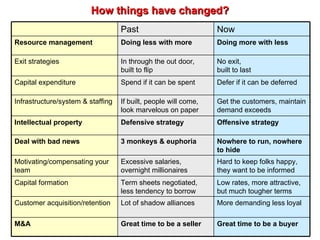
How things have changed? Now Past Great time to be a buyer Great time to be a seller M&A More demanding less loyal Lot of shadow alliances Customer acquisition/retention Low rates, more attractive, but much tougher terms Term sheets negotiated, less tendency to borrow Capital formation Hard to keep folks happy, they want to be informed Excessive salaries, overnight millionaires Motivating/compensating your team Nowhere to run, nowhere to hide 3 monkeys & euphoria Deal with bad news Offensive strategy Defensive strategy Intellectual property Get the customers, maintain demand exceeds If built, people will come, look marvelous on paper Infrastructure/system & staffing Defer if it can be deferred Spend if it can be spent Capital expenditure No exit, built to last In through the out door, built to flip Exit strategies Doing more with less Doing less with more Resource management
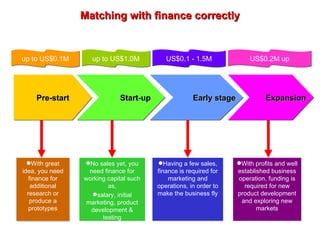
Matching with finance correctly With great idea, you need finance for additional research or produce a prototypes Expansion  Early stage   Start-up   Pre-start No sales yet, you need finance for working capital such as, salary, initial marketing, product development & testing Having a few sales, finance is required for marketing and operations, in order to make the business fly With profits and well established business operation, funding is required for new product development and exploring new markets up to US$0.1M up to US$1.0M US$0.1 - 1.5M US$0.2M up
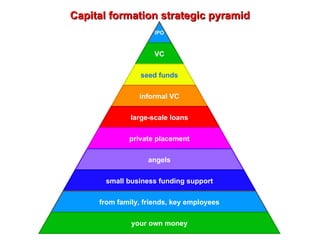
Capital formation strategic pyramid IPO VC seed funds informal VC large-scale loans private placement angels small business funding support from family, friends, key employees your own money
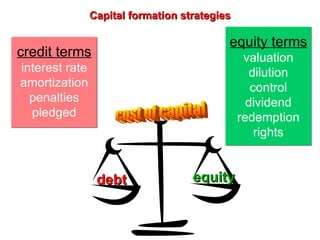
Capital formation strategies debt equity cost of capital credit terms interest rate amortization penalties pledged equity terms valuation dilution control dividend redemption rights
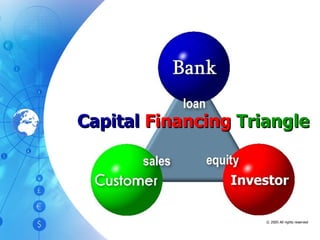
Capital   Financing   Triangle © 2005 All rights reserved
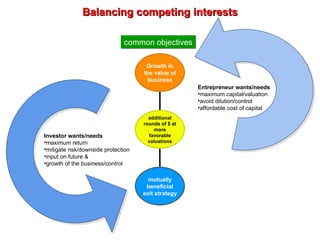
Balancing competing interests Entrepreneur wants/needs maximum capital/valuation avoid dilution/control affordable cost of capital Investor wants/needs maximum return mitigate risk/downside protection input on future & growth of the business/control mutually beneficial exit strategy Growth in the value of business additional rounds of $ at more favorable valuations common objectives
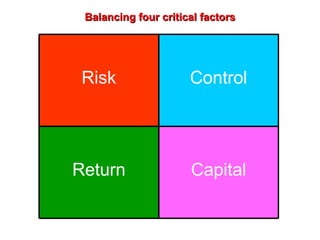
Balancing four critical factors Capital Return Control Risk
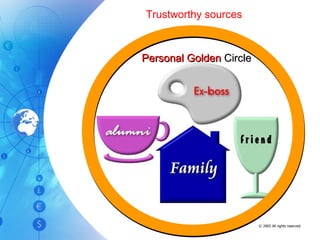
Personal  Golden  Circle © 2005 All rights reserved Trustworthy sources
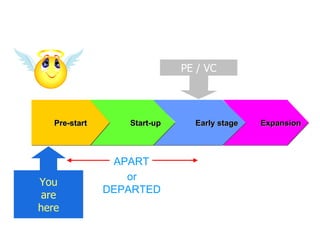
You are here or DEPARTED APART PE / V C Expansion  Early stage   Start-up   Pre-start
What is Angel Investors An angel investor or angel (aka a business angel or informal investor in Europe) is an Affluent individual who provides capital for a business start-up, usually in exchange for  convertible debt  or  ownership equity . A small but increasing number of angel investors  organize themselves  into angel groups  or  angel networks  to share research and pool their investment capital.
The Original Story of Angel The term "angel" originally comes from England where it was used to describe wealthy individuals who  provided money for theatrical productions . In 1978, William Wetzel, a professor at the University of New Hampshire and founder of its Center for Venture Research, completed a pioneering study on how entrepreneurs raised seed capital in the USA, and He began using the term "angel" to describe the investors that supported them.
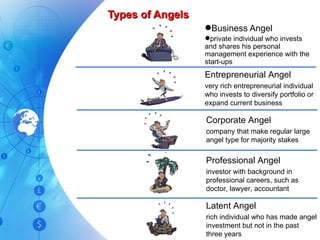
Types of Angels Business Angel private individual who invests and shares his personal management experience with the start-ups Entrepreneurial Angel very rich entrepreneurial individual who invests to diversify portfolio or expand current business Corporate Angel company that make regular large angel type for majority stakes Professional Angel investor with background in professional careers, such as doctor, lawyer, accountant  Latent Angel rich individual who has made angel investment but not in the past three years
Business Angels have a Role in Filling the equity gap in the start-up phase; Investing in companies at a stage where VCs are no longer active; Being an integral part of the chain of integrated finance tools; Contributing to the culture of entrepreneurship in the region; Agglomerating the existing investment capital in a region.
Differences between business angels and formal venture capital? Business angels invest their own assets and contribute their managerial skills, whereas venture capitalists invest the funds of others. Business angels also invest lower amounts than venture capitalists. They tend to be involved in the early stages of a business’s lifecycle and their expectations in terms of ROI are more modest. Business angels make their decisions of the future growth of a new business as venture capitalists are looking to the post records of already existing companies.
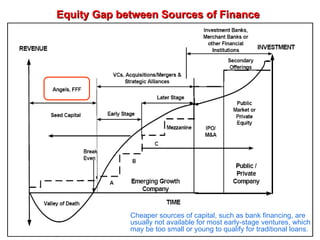
Equity Gap between Sources of Finance Cheaper sources of capital, such as bank financing, are usually not available for most early-stage ventures, which may be too small or young to qualify for traditional loans.
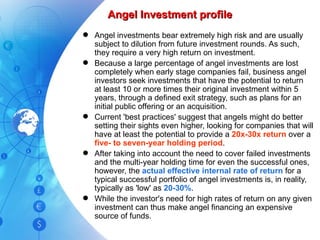
Angel Investment profile Angel investments bear extremely high risk and are usually subject to dilution from future investment rounds. As such, they require a very high return on investment. Because a large percentage of angel investments are lost completely when early stage companies fail, business angel investors seek investments that have the potential to return at least 10 or more times their original investment within 5 years, through a defined exit strategy, such as plans for an initial public offering or an acquisition. Current 'best practices' suggest that angels might do better setting their sights even higher, looking for companies that will have at least the potential to provide a  20x-30x return  over a  five- to seven-year holding period . After taking into account the need to cover failed investments and the multi-year holding time for even the successful ones, however, the  actual effective internal rate of return  for a typical successful portfolio of angel investments is, in reality, typically as 'low' as  20-30% . While the investor's need for high rates of return on any given investment can thus make angel financing an expensive source of funds.
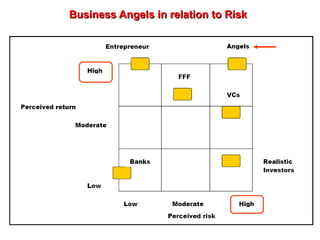
Business Angels in relation to Risk
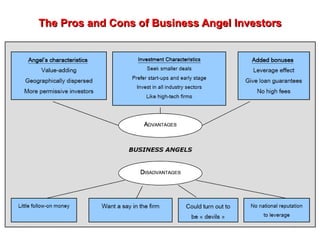
The Pros and Cons of Business Angel Investors
For   Angel Investors
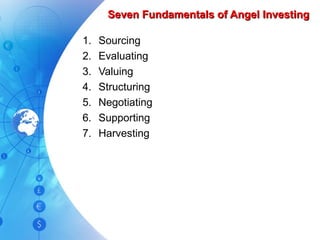
Seven Fundamentals of Angel Investing Sourcing Evaluating Valuing Structuring Negotiating Supporting Harvesting
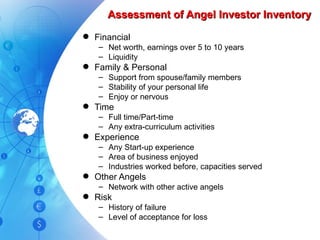
Assessment of Angel Investor Inventory Financial Net worth, earnings over 5 to 10 years Liquidity Family & Personal Support from spouse/family members Stability of your personal life Enjoy or nervous Time Full time/Part-time Any extra-curriculum activities Experience Any Start-up experience Area of business enjoyed Industries worked before, capacities served Other Angels Network with other active angels Risk History of failure Level of acceptance for loss
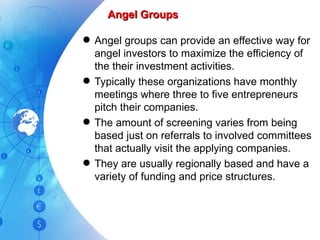
Angel Groups Angel groups can provide an effective way for angel investors to maximize the efficiency of the their investment activities.  Typically these organizations have monthly meetings where three to five entrepreneurs pitch their companies. The amount of screening varies from being based just on referrals to involved committees that actually visit the applying companies. They are usually regionally based and have a variety of funding and price structures.
 
Top 10 Questions all Angel Investors Concern How much can I make? How much can I lose? What is my exit strategy from this deal? Who else says this deal is viable? Does the founder already have resources at risk? What other value can I bring to the table? Can I trust the management team? Is this company’s target market large, growing and reachable? Does the company have a sustainable advantage, either operational effectiveness or strategic positioning? Is the company’s business, revenue, and profit model credible, verifiable, efficient and sustainable?
Five  b asic  r equirements  from inve stors Market large and rapidly expanding  People that can get the job done Idea   /   technology be commercialized Strategy   with strong unfair advantage Price per share   be reasonable
Real story from an Angel Result August 12, 1998 , Amazon acquired Sunnyvale-based  Junglee , an XML-based data-mining startup priced for 1.6 million shares of Amazon stock Sold at  US$ 210 million Background June 1996 , Tsuyoshi Taira attended the symposium of TiE (The Indian Entrepreneurs) met four Indian undergraduates from Stanford U. core product, a sophisticated search engine Taira acted as angels with: 4 friends from Taiwan, US$ 400,000 1 friend from Japan, US$ 100,000 a few ABC, US$ 250,000 Seed Fund  US$ 0.75 million Annualized ROI = 128 X Return on Investment = 279 X
For Start-up  Entrepreneurs
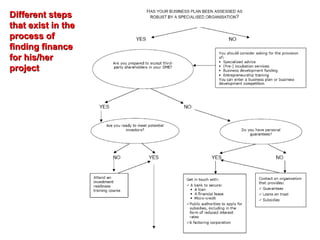
Different steps that exist in the process of finding finance for his/her project
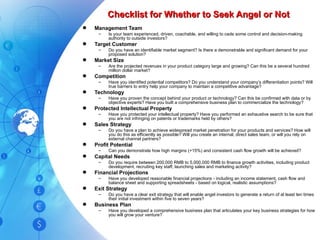
Checklist for Whether to Seek Angel or Not Management Team Is your team experienced, driven, coachable, and willing to cede some control and decision-making authority to outside investors? Target Customer Do you have an identifiable market segment? Is there a demonstrable and significant demand for your proposed solution? Market Size Are the projected revenues in your product category large and growing? Can this be a several hundred million dollar market? Competition Have you identified potential competitors? Do you understand your company’s differentiation points? Will true barriers to entry help your company to maintain a competitive advantage? Technology Have you proven the concept behind your product or technology? Can this be confirmed with data or by objective experts? Have you built a comprehensive business plan to commercialize the technology? Protected Intellectual Property Have you protected your intellectual property? Have you performed an exhaustive search to be sure that you are not infringing on patents or trademarks held by others? Sales Strategy Do you have a plan to achieve widespread market penetration for your products and services? How will you do this as efficiently as possible? Will you create an internal, direct sales team, or will you rely on external channel partners? Profit Potential Can you demonstrate how high margins (+15%) and consistent cash flow growth will be achieved? Capital Needs Do you require between 200,000 RMB to 5,000,000 RMB to finance growth activities, including product development, recruiting key staff, launching sales and marketing activity? Financial Projections Have you developed reasonable financial projections - including an income statement, cash flow and balance sheet and supporting spreadsheets - based on logical, realistic assumptions? Exit Strategy Do you have a clear exit strategy that will enable angel investors to generate a return of at least ten times their initial investment within five to seven years? Business Plan Have you developed a comprehensive business plan that articulates your key business strategies for how you will grow your venture?
What kind of enterprises need venture funding? Not all companies are suited to receive venture capital, and some will do better with loans or other forms of financing. According to Katarina Bonde, Managing Director of KUBI, the following companies can benefit from seed capital: Companies with business ideas with significant commercial potential; Companies with enough growth or profit potential to generate a good return on investments; Companies in dynamic and changing industries; Companies built on technical innovations; Founders who can share control of the company.
Common mistakes entrepreneurs make in the search of capital Preparing inadequately Searching capital too dispersive Misjudging the time to close a deal Falling in love with your business plan Spending too much time raising money Failing to understand the investor’s real needs Taking your projections too seriously Confusing product development with the need Failing to recognize the strength of mgt. team Providing business plans too excessive details Wasting the time of investors Lacking of analysis Acting at the wrong timing Afraid of sharing idea without telling the whole story Underestimate strategic benefits from investors Wrongly recognizing valuation is a science than an art Mistakenly beleive ownership equal controls
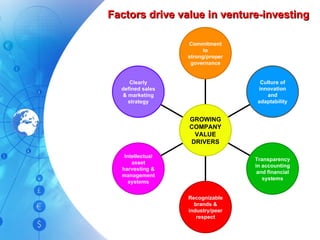
Factors drive value in venture-investing Clearly defined sales & marketing strategy Intellectual asset harvesting & management systems Recognizable brands & industry/peer respect Transparency in accounting and financial systems Culture of innovation and adaptability Commitment to strong/proper governance GROWING COMPANY VALUE DRIVERS
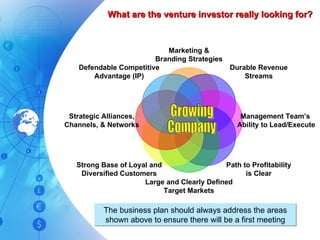
What are the venture investor really looking for? The business plan should always address the areas shown above to ensure there will be a first meeting Marketing & Branding Strategies Durable Revenue Streams Management Team’s  Ability to Lead/Execute Path to Profitability is Clear Large and Clearly Defined Target Markets Strong Base of Loyal and Diversified Customers Strategic Alliances, Channels, & Networks Defendable Competitive Advantage (IP) Growing Company
Suggestion  for  Change
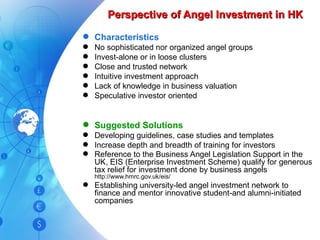
Perspective of Angel Investment in HK Characteristics No sophisticated nor organized angel groups Invest-alone or in loose clusters Close and trusted network Intuitive investment approach Lack of knowledge in business valuation Speculative investor oriented Suggested Solutions Developing guidelines, case studies and templates Increase depth and breadth of training for investors Reference to the Business Angel Legislation Support in the UK, EIS (Enterprise Investment Scheme) qualify for generous tax relief for investment done by business angels  http://www.hmrc.gov.uk/eis/ Establishing university-led angel investment network to finance and mentor innovative student-and alumni-initiated companies
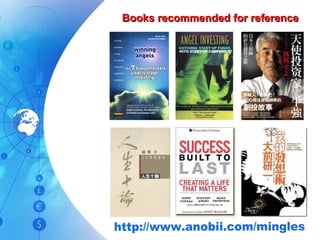
Books recommended for reference http://www.anobii.com/mingles
Mingles  Tsoi Start-up consultant www.entrepreneur.hk mingles.tsoi [email_address]

Angel Investors

  • 1.
    Angel Investors YourNew Business Financial Supporter Mingles Tsoi 2008.12.10
  • 2.
    Disclaimer & NoticeThis document has been prepared by Mingles Tsoi (“Mingles”) solely for use in the visual presentation to a private group of audience. It is not intended for general distribution to the public and may not be reproduced or redistributed. The information contained in this document has not been independently verified. No representation or warranty express or implied is made as to, and no reliance should be placed on, the fairness, accuracy, completeness or veracity of the information or opinions contained herein. This document has been prepared solely for the purpose of presenting some ideas and guidelines of the subject theme for the seminar, workshop or training session, by assisting the audience in understanding the subject in a general knowledge level. This document is furnished in confidence for your reference only and for no other purposes. The content of this document cannot be released to the third party unless it is given a written consent by Mingles. Mingles reserves the right to claim for any compensation arising from the loss caused by the user's breach of this term.
  • 3.
    The Context of Raising Capital
  • 4.
    How things havechanged? Now Past Great time to be a buyer Great time to be a seller M&A More demanding less loyal Lot of shadow alliances Customer acquisition/retention Low rates, more attractive, but much tougher terms Term sheets negotiated, less tendency to borrow Capital formation Hard to keep folks happy, they want to be informed Excessive salaries, overnight millionaires Motivating/compensating your team Nowhere to run, nowhere to hide 3 monkeys & euphoria Deal with bad news Offensive strategy Defensive strategy Intellectual property Get the customers, maintain demand exceeds If built, people will come, look marvelous on paper Infrastructure/system & staffing Defer if it can be deferred Spend if it can be spent Capital expenditure No exit, built to last In through the out door, built to flip Exit strategies Doing more with less Doing less with more Resource management
  • 5.
    Matching with financecorrectly With great idea, you need finance for additional research or produce a prototypes Expansion Early stage Start-up Pre-start No sales yet, you need finance for working capital such as, salary, initial marketing, product development & testing Having a few sales, finance is required for marketing and operations, in order to make the business fly With profits and well established business operation, funding is required for new product development and exploring new markets up to US$0.1M up to US$1.0M US$0.1 - 1.5M US$0.2M up
  • 6.
    Capital formation strategicpyramid IPO VC seed funds informal VC large-scale loans private placement angels small business funding support from family, friends, key employees your own money
  • 7.
    Capital formation strategiesdebt equity cost of capital credit terms interest rate amortization penalties pledged equity terms valuation dilution control dividend redemption rights
  • 8.
    Capital Financing Triangle © 2005 All rights reserved
  • 9.
    Balancing competing interestsEntrepreneur wants/needs maximum capital/valuation avoid dilution/control affordable cost of capital Investor wants/needs maximum return mitigate risk/downside protection input on future & growth of the business/control mutually beneficial exit strategy Growth in the value of business additional rounds of $ at more favorable valuations common objectives
  • 10.
    Balancing four criticalfactors Capital Return Control Risk
  • 11.
    Personal Golden Circle © 2005 All rights reserved Trustworthy sources
  • 12.
    You are hereor DEPARTED APART PE / V C Expansion Early stage Start-up Pre-start
  • 13.
    What is AngelInvestors An angel investor or angel (aka a business angel or informal investor in Europe) is an Affluent individual who provides capital for a business start-up, usually in exchange for convertible debt or ownership equity . A small but increasing number of angel investors organize themselves into angel groups or angel networks to share research and pool their investment capital.
  • 14.
    The Original Storyof Angel The term "angel" originally comes from England where it was used to describe wealthy individuals who provided money for theatrical productions . In 1978, William Wetzel, a professor at the University of New Hampshire and founder of its Center for Venture Research, completed a pioneering study on how entrepreneurs raised seed capital in the USA, and He began using the term "angel" to describe the investors that supported them.
  • 15.
    Types of AngelsBusiness Angel private individual who invests and shares his personal management experience with the start-ups Entrepreneurial Angel very rich entrepreneurial individual who invests to diversify portfolio or expand current business Corporate Angel company that make regular large angel type for majority stakes Professional Angel investor with background in professional careers, such as doctor, lawyer, accountant Latent Angel rich individual who has made angel investment but not in the past three years
  • 16.
    Business Angels havea Role in Filling the equity gap in the start-up phase; Investing in companies at a stage where VCs are no longer active; Being an integral part of the chain of integrated finance tools; Contributing to the culture of entrepreneurship in the region; Agglomerating the existing investment capital in a region.
  • 17.
    Differences between businessangels and formal venture capital? Business angels invest their own assets and contribute their managerial skills, whereas venture capitalists invest the funds of others. Business angels also invest lower amounts than venture capitalists. They tend to be involved in the early stages of a business’s lifecycle and their expectations in terms of ROI are more modest. Business angels make their decisions of the future growth of a new business as venture capitalists are looking to the post records of already existing companies.
  • 18.
    Equity Gap betweenSources of Finance Cheaper sources of capital, such as bank financing, are usually not available for most early-stage ventures, which may be too small or young to qualify for traditional loans.
  • 19.
    Angel Investment profileAngel investments bear extremely high risk and are usually subject to dilution from future investment rounds. As such, they require a very high return on investment. Because a large percentage of angel investments are lost completely when early stage companies fail, business angel investors seek investments that have the potential to return at least 10 or more times their original investment within 5 years, through a defined exit strategy, such as plans for an initial public offering or an acquisition. Current 'best practices' suggest that angels might do better setting their sights even higher, looking for companies that will have at least the potential to provide a 20x-30x return over a five- to seven-year holding period . After taking into account the need to cover failed investments and the multi-year holding time for even the successful ones, however, the actual effective internal rate of return for a typical successful portfolio of angel investments is, in reality, typically as 'low' as 20-30% . While the investor's need for high rates of return on any given investment can thus make angel financing an expensive source of funds.
  • 20.
    Business Angels inrelation to Risk
  • 21.
    The Pros andCons of Business Angel Investors
  • 22.
    For Angel Investors
  • 23.
    Seven Fundamentals ofAngel Investing Sourcing Evaluating Valuing Structuring Negotiating Supporting Harvesting
  • 24.
    Assessment of AngelInvestor Inventory Financial Net worth, earnings over 5 to 10 years Liquidity Family & Personal Support from spouse/family members Stability of your personal life Enjoy or nervous Time Full time/Part-time Any extra-curriculum activities Experience Any Start-up experience Area of business enjoyed Industries worked before, capacities served Other Angels Network with other active angels Risk History of failure Level of acceptance for loss
  • 25.
    Angel Groups Angelgroups can provide an effective way for angel investors to maximize the efficiency of the their investment activities. Typically these organizations have monthly meetings where three to five entrepreneurs pitch their companies. The amount of screening varies from being based just on referrals to involved committees that actually visit the applying companies. They are usually regionally based and have a variety of funding and price structures.
  • 26.
  • 27.
    Top 10 Questionsall Angel Investors Concern How much can I make? How much can I lose? What is my exit strategy from this deal? Who else says this deal is viable? Does the founder already have resources at risk? What other value can I bring to the table? Can I trust the management team? Is this company’s target market large, growing and reachable? Does the company have a sustainable advantage, either operational effectiveness or strategic positioning? Is the company’s business, revenue, and profit model credible, verifiable, efficient and sustainable?
  • 28.
    Five basic r equirements from inve stors Market large and rapidly expanding People that can get the job done Idea / technology be commercialized Strategy with strong unfair advantage Price per share be reasonable
  • 29.
    Real story froman Angel Result August 12, 1998 , Amazon acquired Sunnyvale-based Junglee , an XML-based data-mining startup priced for 1.6 million shares of Amazon stock Sold at US$ 210 million Background June 1996 , Tsuyoshi Taira attended the symposium of TiE (The Indian Entrepreneurs) met four Indian undergraduates from Stanford U. core product, a sophisticated search engine Taira acted as angels with: 4 friends from Taiwan, US$ 400,000 1 friend from Japan, US$ 100,000 a few ABC, US$ 250,000 Seed Fund US$ 0.75 million Annualized ROI = 128 X Return on Investment = 279 X
  • 30.
    For Start-up Entrepreneurs
  • 31.
    Different steps thatexist in the process of finding finance for his/her project
  • 32.
    Checklist for Whetherto Seek Angel or Not Management Team Is your team experienced, driven, coachable, and willing to cede some control and decision-making authority to outside investors? Target Customer Do you have an identifiable market segment? Is there a demonstrable and significant demand for your proposed solution? Market Size Are the projected revenues in your product category large and growing? Can this be a several hundred million dollar market? Competition Have you identified potential competitors? Do you understand your company’s differentiation points? Will true barriers to entry help your company to maintain a competitive advantage? Technology Have you proven the concept behind your product or technology? Can this be confirmed with data or by objective experts? Have you built a comprehensive business plan to commercialize the technology? Protected Intellectual Property Have you protected your intellectual property? Have you performed an exhaustive search to be sure that you are not infringing on patents or trademarks held by others? Sales Strategy Do you have a plan to achieve widespread market penetration for your products and services? How will you do this as efficiently as possible? Will you create an internal, direct sales team, or will you rely on external channel partners? Profit Potential Can you demonstrate how high margins (+15%) and consistent cash flow growth will be achieved? Capital Needs Do you require between 200,000 RMB to 5,000,000 RMB to finance growth activities, including product development, recruiting key staff, launching sales and marketing activity? Financial Projections Have you developed reasonable financial projections - including an income statement, cash flow and balance sheet and supporting spreadsheets - based on logical, realistic assumptions? Exit Strategy Do you have a clear exit strategy that will enable angel investors to generate a return of at least ten times their initial investment within five to seven years? Business Plan Have you developed a comprehensive business plan that articulates your key business strategies for how you will grow your venture?
  • 33.
    What kind ofenterprises need venture funding? Not all companies are suited to receive venture capital, and some will do better with loans or other forms of financing. According to Katarina Bonde, Managing Director of KUBI, the following companies can benefit from seed capital: Companies with business ideas with significant commercial potential; Companies with enough growth or profit potential to generate a good return on investments; Companies in dynamic and changing industries; Companies built on technical innovations; Founders who can share control of the company.
  • 34.
    Common mistakes entrepreneursmake in the search of capital Preparing inadequately Searching capital too dispersive Misjudging the time to close a deal Falling in love with your business plan Spending too much time raising money Failing to understand the investor’s real needs Taking your projections too seriously Confusing product development with the need Failing to recognize the strength of mgt. team Providing business plans too excessive details Wasting the time of investors Lacking of analysis Acting at the wrong timing Afraid of sharing idea without telling the whole story Underestimate strategic benefits from investors Wrongly recognizing valuation is a science than an art Mistakenly beleive ownership equal controls
  • 35.
    Factors drive valuein venture-investing Clearly defined sales & marketing strategy Intellectual asset harvesting & management systems Recognizable brands & industry/peer respect Transparency in accounting and financial systems Culture of innovation and adaptability Commitment to strong/proper governance GROWING COMPANY VALUE DRIVERS
  • 36.
    What are theventure investor really looking for? The business plan should always address the areas shown above to ensure there will be a first meeting Marketing & Branding Strategies Durable Revenue Streams Management Team’s Ability to Lead/Execute Path to Profitability is Clear Large and Clearly Defined Target Markets Strong Base of Loyal and Diversified Customers Strategic Alliances, Channels, & Networks Defendable Competitive Advantage (IP) Growing Company
  • 37.
  • 38.
    Perspective of AngelInvestment in HK Characteristics No sophisticated nor organized angel groups Invest-alone or in loose clusters Close and trusted network Intuitive investment approach Lack of knowledge in business valuation Speculative investor oriented Suggested Solutions Developing guidelines, case studies and templates Increase depth and breadth of training for investors Reference to the Business Angel Legislation Support in the UK, EIS (Enterprise Investment Scheme) qualify for generous tax relief for investment done by business angels http://www.hmrc.gov.uk/eis/ Establishing university-led angel investment network to finance and mentor innovative student-and alumni-initiated companies
  • 39.
    Books recommended forreference http://www.anobii.com/mingles
  • 40.
    Mingles TsoiStart-up consultant www.entrepreneur.hk mingles.tsoi [email_address]