


Financing Your Invention Curtis V Palmer, President / CEO TechBirmingham
Thinking About Pursuing VC Funding?
Where Does VC Money Come From? Insurance Companies, Educational Endowments, Pension Funds and Wealthy Individuals VC invests pools of money allocated to “Alternative Investments”.  Perhaps 5% to 10% of the portfolio might be allocated to Alternative Investments. The portfolio owners seek to obtain high returns from these more risky Alternative Investments.
How are Venture Capital Funds Organized? Most VC Funds are Limited Partnerships Venture Capital Fund Limited Partners Pension Funds, Educational Endowments, Foundations, Insurance Companies, Wealthy Individuals General Partners These are the “Venture Capitalists” you will deal with.  They may have been Entrepreneurs in a prior life or they might be financial types. The General Partners use an Offering Memorandum to raise a fund of a given size from the Limited Partners by convincing them that the GPs have a unique strategy or expertise in a particular sector or sectors of the market.  Fund raising can take a year or more. If the GPs are successful they will convince enough Limited Partners to invest enough money to achieve the size fund offered.  When this happens there is a first “close” of the fund.
What Do Venture Capitalists Do? GPs have to Source Deals Referrals from trusted sources (other funds, entrepreneurs they have invested in before, lawyers, accountants etc.) Make Investment Decisions GPs pick the ones they think will be the “winners” They might look at 50 or 100 opportunities for each one they invest in
Managing the VC Investment GP/VCs have a fiduciary duty to the LPs to “manage” the investment This means they usually sit on the Board of Directors Given this time commitment a VC might only be able to handle 6 to 10 portfolio investment companies at a time
VCs Want “Exits” GP/VCs win only if they can get their money out of the investment Acquisition, IPO, etc. Even the most successful funds rarely have even 1/3 of their portfolio investments become successful
Fund Investment Cycle 10 Year Fund Life Funds plan to harvest winners in 5 to 7 years or less Initial Portfolio Investments For Early Stage Funds it is typical for the Fund to invest $1 and keep $2-$3 in “dry powder”
Things For You to Think About Does Your Idea Fit the Needs of the VC? They need to see Big Returns.  If your Plan can justify this and you need lots of capital to achieve your Plan then VC may be the way to go. You may be able to grow a successful company and make a lot of money without having to scale to the size that will interest Venture Capital.
More Things to Think About Are You Ready For Venture Capital? VCs have a relatively short time fuse to success - a 10 year Fund and the need to show some “Winners” early in order to raise the Next Fund Result:  You have to be ready to move quickly, there will not be much time to recover from errors in the plan or execution
Even More To Think About Prepared to Become a Minority Stockholder? In order to generate returns for their Limited Partners the GP/VCs have to invest a large amount and this usually means they will obtain a significant percentage of the company over time Having a small piece of a Big Pie can make you rich but you have to be mentally prepared to become a Minority Stockholder
So You STILL Want VC Funding?
Making Your VC Pitch K.I.S.S ~ *Really* Simple! Target Your Audience Lowest Common Denominator Keep It Short (too!) Answer detail/curveballs quickly and move on Show commitment and enthusiasm
VC Pitch Pointers Use best presenter Have egghead in room Give firm answers Look at everyone in room Do your homework
VC Strategy Get money when you don’t need it Practice and Test your pitch PRACTICE and TEST your pitch Be “introduced” when possible One strike… 15 seconds Assume >= 6 months
Questions to Expect from a VC Is the IP protected? Is team assembled? Where do you fit… physically, on food chain Customer requirements When will you manufacture/develop? How much $ will it cost to build it? In volume? How much money will you make “us”?
BizPlan As A Financing Document
How a VC Reads your Plan First Reading: Like a Resume Make The Cut, So That You Get An Opportunity To Tell Your Story Second Reading: Justify The Investment Third Reading:  Commit To A Plan  That You And The Investors Can Live With. REMEMBER:  If you don’t make the FIRST CUT, #2 and #3 never happen.
Making the First Cut An Idea Too Good To Ignore A Financial Promise Too Good To Turn Down A Team Good Enough To Believe In An Action Plan That’s Credible and Focused Format and Style That Show Passion  Sanity Details That Give Assurance of Insight, Commitment and Follow Through
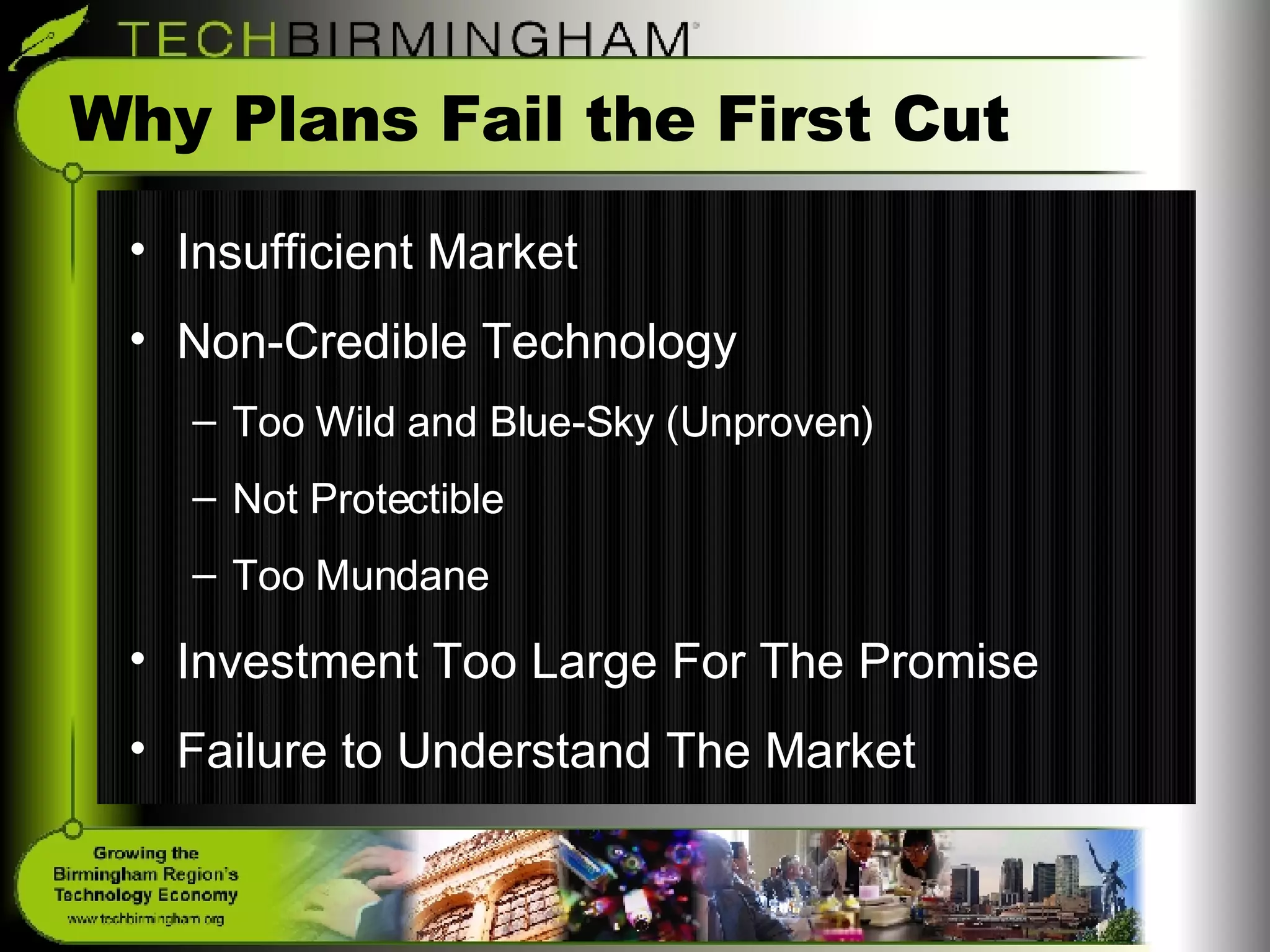
Why Plans Fail the First Cut Insufficient Market Non-Credible Technology Too Wild and Blue-Sky (Unproven) Not Protectible Too Mundane Investment Too Large For The Promise Failure to Understand The Market
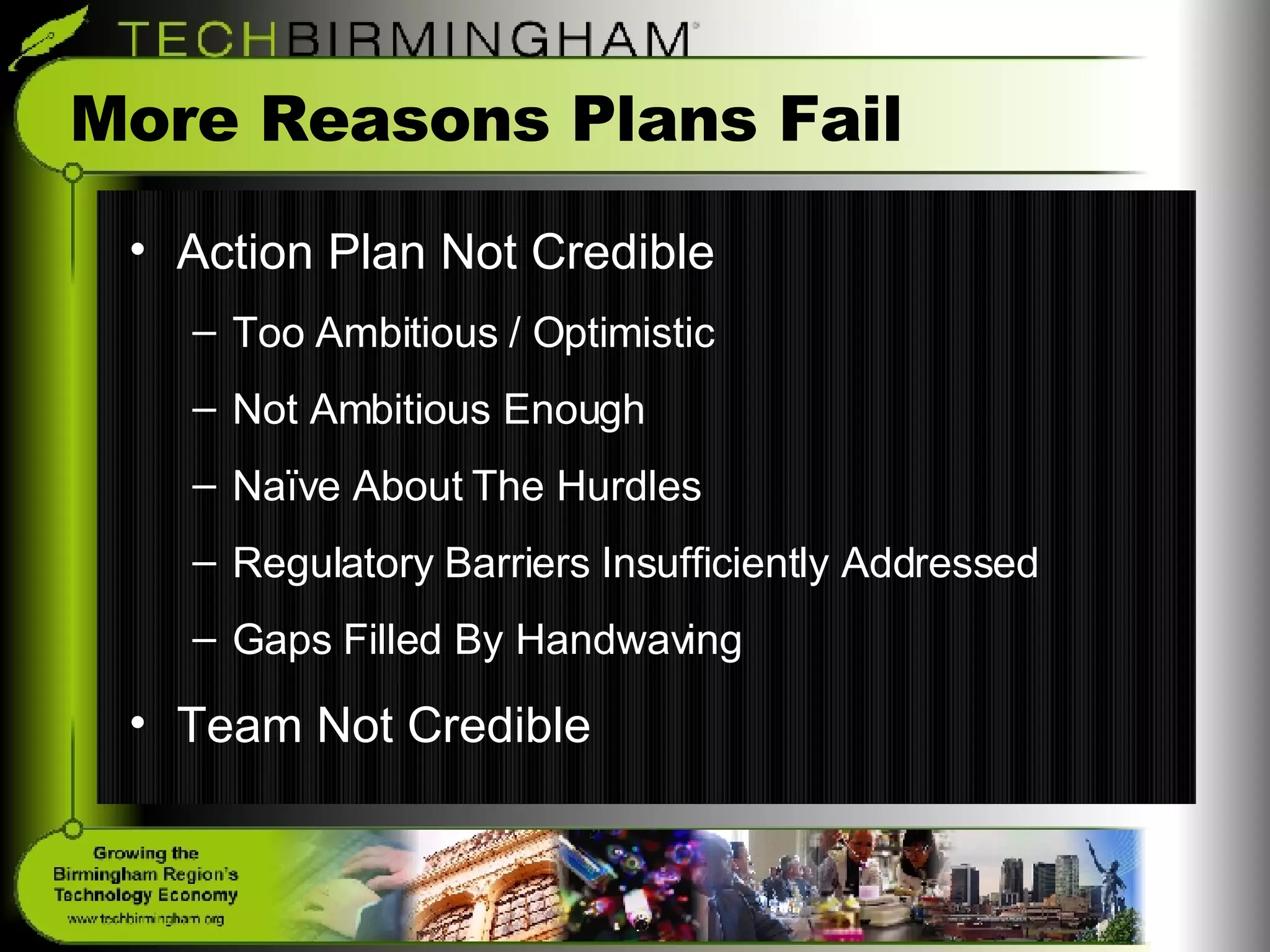
More Reasons Plans Fail Action Plan Not Credible Too Ambitious / Optimistic Not Ambitious Enough Naïve About The Hurdles Regulatory Barriers Insufficiently Addressed Gaps Filled By Handwaving Team Not Credible
“Cosmetic” Reasons for Failing Filled With Market Or Technology-Specific Jargon i.e.,  WHAT IS THE BUSINESS? Naïve Projections Misspellings, Poor Grammar, Poor Quality Printing Too Long “ Forget Marketing, My Technology Is Best” Poor Grammar, Spelling, or General Writing Style
Valuation as a Driver of Financing
Valuation What’s My Invention Really Worth? ANSWER: At Any  Given Time Your Company Is Worth What Someone Will  Pay  For It At That Time
What Determines Valuation Supply Demand When Market Liquidity Metrics for Valuation
Valuation ~ Macro Drivers Which Way Is The Tide Going? A Rising Tide Lifts All Boats But, A Falling Tide Strands Them Overall State of the Economy e.g. Purchasing Cycles:  Will Customers Purchase Today? Condition of Public Equity Markets
Valuation ~ Positioning Negotiation Skill? Having or Appearing to Have Alternatives  Getting A Bidding War Going? The Train Is Leaving The Station You Are Known By The Company You Keep Customers, Partners, Advisors
Other Ways To Achieve Funding
Debt Financing SBA Loan Home Equity Loan Personal Loan Export Financing Customer Financing Supplier Financing Equipment Leasing Purchase order financing Factoring Micro-loans Credit Cards Seller Financing Franchise financing
Equity Financing Friends, Family, and other Fools Venture Capital Strategic Corporate Investors Angel Investors Strategic Partnership Sweat Equity Compensation
Miscellaneous Financing Licensing / Royalties Barter SBIR Grant Other Government Grants Contests
Inventor’s Funding: Many Options Your Personal Funds Friends, Family, and other Fools Personal Credit Cards, Home Equity Loan, and/or Other Borrowings Business Angels Corporate Direct Investment Venture Capital
My Way ;-)
Minimize Funding Requirements Get paid to build the product Easier to start with a service (funding) Provisional payments in advance and upon fulfillment You have no funding now, why start with a strategy that requires something you do NOT have?
Pull… don’t Push Customer Need (Demand) Inventor Company Purchases $ Purchases $ Market Pull Customer Need (Demand)? Inventor Company Invention Search? Market Push
Benefits of Customer First Free and better market research Learn through relationships and services Companies know their markets Learn through partners and customers Develop value on someone else’s nickel Built-in market for your invention
Common Sense Approach Start with Buyers Why? “You can build solutions but not buyers…” Execution Intelligence Wins Know the Market Talk to : potential customers, potential competitors, partners, advisors, investors/creditors, “multipliers” 2.  Identify a compelling need Talk to : potential customers, potential competitors, partners, advisors, investors/creditors, “multipliers” 3.  Generate customers Talk to : potential customers, potential competitors, partners, advisors, investors/creditors, “multipliers” 4.  Sell solution 5.  Build & deliver solution
Curtis V Palmer [email_address] www.TechBirmingham.com

Financing Your Invention

  • 1.
    Financing Your InventionCurtis V Palmer, President / CEO TechBirmingham
  • 2.
  • 3.
    Where Does VCMoney Come From? Insurance Companies, Educational Endowments, Pension Funds and Wealthy Individuals VC invests pools of money allocated to “Alternative Investments”. Perhaps 5% to 10% of the portfolio might be allocated to Alternative Investments. The portfolio owners seek to obtain high returns from these more risky Alternative Investments.
  • 4.
    How are VentureCapital Funds Organized? Most VC Funds are Limited Partnerships Venture Capital Fund Limited Partners Pension Funds, Educational Endowments, Foundations, Insurance Companies, Wealthy Individuals General Partners These are the “Venture Capitalists” you will deal with. They may have been Entrepreneurs in a prior life or they might be financial types. The General Partners use an Offering Memorandum to raise a fund of a given size from the Limited Partners by convincing them that the GPs have a unique strategy or expertise in a particular sector or sectors of the market. Fund raising can take a year or more. If the GPs are successful they will convince enough Limited Partners to invest enough money to achieve the size fund offered. When this happens there is a first “close” of the fund.
  • 5.
    What Do VentureCapitalists Do? GPs have to Source Deals Referrals from trusted sources (other funds, entrepreneurs they have invested in before, lawyers, accountants etc.) Make Investment Decisions GPs pick the ones they think will be the “winners” They might look at 50 or 100 opportunities for each one they invest in
  • 6.
    Managing the VCInvestment GP/VCs have a fiduciary duty to the LPs to “manage” the investment This means they usually sit on the Board of Directors Given this time commitment a VC might only be able to handle 6 to 10 portfolio investment companies at a time
  • 7.
    VCs Want “Exits”GP/VCs win only if they can get their money out of the investment Acquisition, IPO, etc. Even the most successful funds rarely have even 1/3 of their portfolio investments become successful
  • 8.
    Fund Investment Cycle10 Year Fund Life Funds plan to harvest winners in 5 to 7 years or less Initial Portfolio Investments For Early Stage Funds it is typical for the Fund to invest $1 and keep $2-$3 in “dry powder”
  • 9.
    Things For Youto Think About Does Your Idea Fit the Needs of the VC? They need to see Big Returns. If your Plan can justify this and you need lots of capital to achieve your Plan then VC may be the way to go. You may be able to grow a successful company and make a lot of money without having to scale to the size that will interest Venture Capital.
  • 10.
    More Things toThink About Are You Ready For Venture Capital? VCs have a relatively short time fuse to success - a 10 year Fund and the need to show some “Winners” early in order to raise the Next Fund Result: You have to be ready to move quickly, there will not be much time to recover from errors in the plan or execution
  • 11.
    Even More ToThink About Prepared to Become a Minority Stockholder? In order to generate returns for their Limited Partners the GP/VCs have to invest a large amount and this usually means they will obtain a significant percentage of the company over time Having a small piece of a Big Pie can make you rich but you have to be mentally prepared to become a Minority Stockholder
  • 12.
    So You STILLWant VC Funding?
  • 13.
    Making Your VCPitch K.I.S.S ~ *Really* Simple! Target Your Audience Lowest Common Denominator Keep It Short (too!) Answer detail/curveballs quickly and move on Show commitment and enthusiasm
  • 14.
    VC Pitch PointersUse best presenter Have egghead in room Give firm answers Look at everyone in room Do your homework
  • 15.
    VC Strategy Getmoney when you don’t need it Practice and Test your pitch PRACTICE and TEST your pitch Be “introduced” when possible One strike… 15 seconds Assume >= 6 months
  • 16.
    Questions to Expectfrom a VC Is the IP protected? Is team assembled? Where do you fit… physically, on food chain Customer requirements When will you manufacture/develop? How much $ will it cost to build it? In volume? How much money will you make “us”?
  • 17.
    BizPlan As AFinancing Document
  • 18.
    How a VCReads your Plan First Reading: Like a Resume Make The Cut, So That You Get An Opportunity To Tell Your Story Second Reading: Justify The Investment Third Reading: Commit To A Plan That You And The Investors Can Live With. REMEMBER: If you don’t make the FIRST CUT, #2 and #3 never happen.
  • 19.
    Making the FirstCut An Idea Too Good To Ignore A Financial Promise Too Good To Turn Down A Team Good Enough To Believe In An Action Plan That’s Credible and Focused Format and Style That Show Passion Sanity Details That Give Assurance of Insight, Commitment and Follow Through
  • 20.
    Why Plans Failthe First Cut Insufficient Market Non-Credible Technology Too Wild and Blue-Sky (Unproven) Not Protectible Too Mundane Investment Too Large For The Promise Failure to Understand The Market
  • 21.
    More Reasons PlansFail Action Plan Not Credible Too Ambitious / Optimistic Not Ambitious Enough Naïve About The Hurdles Regulatory Barriers Insufficiently Addressed Gaps Filled By Handwaving Team Not Credible
  • 22.
    “Cosmetic” Reasons forFailing Filled With Market Or Technology-Specific Jargon i.e., WHAT IS THE BUSINESS? Naïve Projections Misspellings, Poor Grammar, Poor Quality Printing Too Long “ Forget Marketing, My Technology Is Best” Poor Grammar, Spelling, or General Writing Style
  • 23.
    Valuation as aDriver of Financing
  • 24.
    Valuation What’s MyInvention Really Worth? ANSWER: At Any Given Time Your Company Is Worth What Someone Will Pay For It At That Time
  • 25.
    What Determines ValuationSupply Demand When Market Liquidity Metrics for Valuation
  • 26.
    Valuation ~ MacroDrivers Which Way Is The Tide Going? A Rising Tide Lifts All Boats But, A Falling Tide Strands Them Overall State of the Economy e.g. Purchasing Cycles: Will Customers Purchase Today? Condition of Public Equity Markets
  • 27.
    Valuation ~ PositioningNegotiation Skill? Having or Appearing to Have Alternatives Getting A Bidding War Going? The Train Is Leaving The Station You Are Known By The Company You Keep Customers, Partners, Advisors
  • 28.
    Other Ways ToAchieve Funding
  • 29.
    Debt Financing SBALoan Home Equity Loan Personal Loan Export Financing Customer Financing Supplier Financing Equipment Leasing Purchase order financing Factoring Micro-loans Credit Cards Seller Financing Franchise financing
  • 30.
    Equity Financing Friends,Family, and other Fools Venture Capital Strategic Corporate Investors Angel Investors Strategic Partnership Sweat Equity Compensation
  • 31.
    Miscellaneous Financing Licensing/ Royalties Barter SBIR Grant Other Government Grants Contests
  • 32.
    Inventor’s Funding: ManyOptions Your Personal Funds Friends, Family, and other Fools Personal Credit Cards, Home Equity Loan, and/or Other Borrowings Business Angels Corporate Direct Investment Venture Capital
  • 33.
  • 34.
    Minimize Funding RequirementsGet paid to build the product Easier to start with a service (funding) Provisional payments in advance and upon fulfillment You have no funding now, why start with a strategy that requires something you do NOT have?
  • 35.
    Pull… don’t PushCustomer Need (Demand) Inventor Company Purchases $ Purchases $ Market Pull Customer Need (Demand)? Inventor Company Invention Search? Market Push
  • 36.
    Benefits of CustomerFirst Free and better market research Learn through relationships and services Companies know their markets Learn through partners and customers Develop value on someone else’s nickel Built-in market for your invention
  • 37.
    Common Sense ApproachStart with Buyers Why? “You can build solutions but not buyers…” Execution Intelligence Wins Know the Market Talk to : potential customers, potential competitors, partners, advisors, investors/creditors, “multipliers” 2. Identify a compelling need Talk to : potential customers, potential competitors, partners, advisors, investors/creditors, “multipliers” 3. Generate customers Talk to : potential customers, potential competitors, partners, advisors, investors/creditors, “multipliers” 4. Sell solution 5. Build & deliver solution
  • 38.
    Curtis V Palmer[email_address] www.TechBirmingham.com