Introduction to Venture Capital EE 203 Stanford University March 6th, 2007 Will Price Hummer Winblad Venture Partners
Introduction Will Price, Principal  Harvard College, AB Northwestern University, MBA Investment banking, product mgt, start-up CEO  [email_address] http://willprice.blogspot.com Hummer Winblad Venture Partners $1bn AUM early-stage software firm
What Is Venture Capital? Venture capitalists: Raise  pools of capital from institutional and individual investors Finance  new and rapidly growing companies;  Purchase  preferred equity securities and  take board positions ;  Add value  to the company through active participation;  Take  higher  risks  with the expectation of higher rewards;  Have a  long-term  orientation  Make $$$  by via M&A or IPO liquidity events
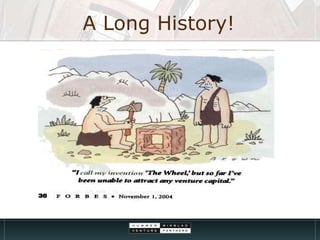
A Long History!
Impact on Economy Infrastructure Intel, Cisco, 3Com, Juniper, Apple, EMC, Sun, Wind River Software ORCL, MSFT, SEBL, EA, Lotus, Kana, Omniture, Sybase Internet GOOG, YHOO, Ebay, AOL, Skype, Netscape, AMZN, Youtube… Healthcare Genentech, Amgen, Alza, Affymetrix  Services Fedex, Staples VCs partner with entrepreneurs to build the companies of tomorrow
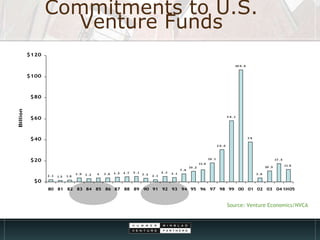
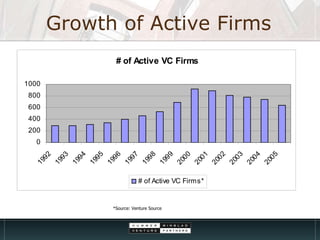
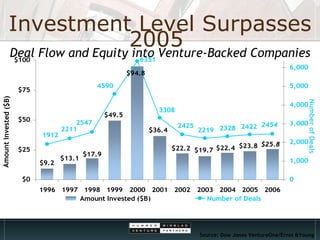
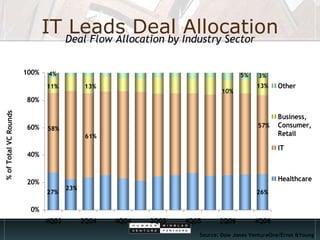
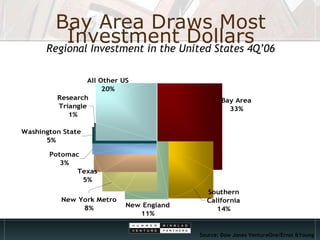
Snapshot 2006 US Deal Stats $25.8bn invested 2,454 deals $10.5m per deal By Sector 57% IT 26% HC By Geography Bay Area 33%  CA 47% New England 11% Players 600 Active Firms 8,000 professionals Huge Growth in Asset Class (LP commitments) 1980 $2.1 bn 1990 $3.4 bn 1999 $106 bn 2005 ~$20 bn Internationalization Ongoing India, China, EU, Israel
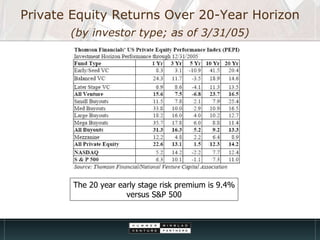
Private Equity Returns Over 20-Year Horizon   (by investor type; as of 3/31/05) The 20 year early stage risk premium is 9.4% versus S&P 500
Economics of VC Firm Management Fees (typically 2-2.5% of AUM) Charge a management fee to cover the costs of managing the committed capital.  Carried Interest (typically 20-25%) "Carried interest" is the term used to denote the profit split of proceeds to the general partner. Example $100m fund  4x return and 2 and 20% $2m per year in management fee (($100m x 4) - $100m) * 20% = $60m in carried interest
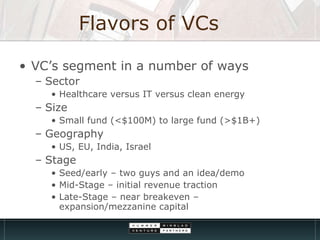
Flavors of VCs VC’s segment in a number of ways Sector  Healthcare versus IT versus clean energy Size  Small fund (<$100M) to large fund (>$1B+) Geography US, EU, India, Israel  Stage Seed/early – two guys and an idea/demo Mid-Stage – initial revenue traction Late-Stage – near breakeven – expansion/mezzanine capital
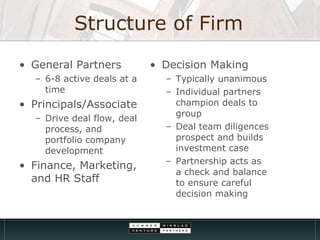
Structure of Firm General Partners 6-8 active deals at a time Principals/Associate Drive deal flow, deal process, and portfolio company development Finance, Marketing, and HR Staff Decision Making Typically unanimous Individual partners champion deals to group Deal team diligences prospect and builds investment case Partnership acts as a check and balance to ensure careful decision making
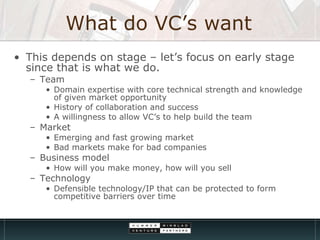
What do VC’s want This depends on stage – let’s focus on early stage since that is what we do. Team  Domain expertise with core technical strength and knowledge of given market opportunity History of collaboration and success A willingness to allow VC’s to help build the team Market  Emerging and fast growing market Bad markets make for bad companies  Business model How will you make money, how will you sell Technology  Defensible technology/IP that can be protected to form competitive barriers over time
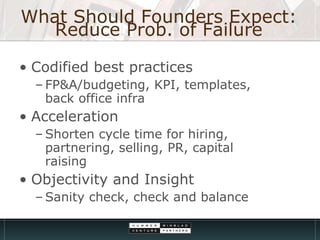
What Should Founders Expect: Reduce Prob. of Failure Codified best practices FP&A/budgeting, KPI, templates, back office infra Acceleration Shorten cycle time for hiring, partnering, selling, PR, capital raising Objectivity and Insight Sanity check, check and balance
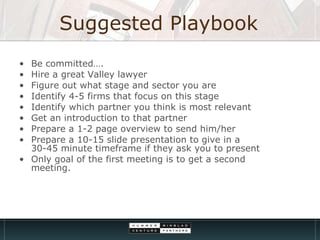
Suggested Playbook Be committed…. Hire a great Valley lawyer Figure out what stage and sector you are Identify 4-5 firms that focus on this stage Identify which partner you think is most relevant Get an introduction to that partner Prepare a 1-2 page overview to send him/her Prepare a 10-15 slide presentation to give in a 30-45 minute timeframe if they ask you to present Only goal of the first meeting is to get a second meeting.
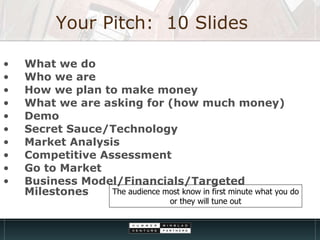
What we do Who we are How we plan to make money What we are asking for (how much money) Demo Secret Sauce/Technology Market Analysis Competitive Assessment Go to Market Business Model/Financials/Targeted Milestones Your Pitch:  10 Slides The audience most know in first minute what you do or they will tune out
Pat your head and rub your tummy…Hard to Do! Pat your head  Spec out 1.0 and focus on a customer need Narrow the focus to broaden the appeal Rub your tummy  Paint a picture and product roadmap that is a company not a feature
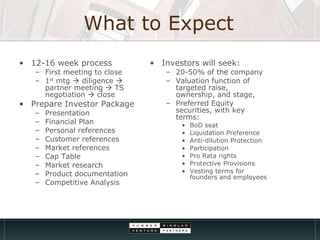
What to Expect 12-16 week process First meeting to close 1 st  mtg    diligence    partner meeting    TS negotiation    close Prepare Investor Package Presentation Financial Plan Personal references Customer references Market references Cap Table Market research Product documentation Competitive Analysis Investors will seek: 20-50% of the company Valuation function of targeted raise, ownership, and stage,  Preferred Equity securities, with key terms: BoD seat Liquidation Preference Anti-dilution Protection Participation Pro Rata rights Protective Provisions Vesting terms for founders and employees
What to Consider Is the idea sufficiently baked? Optimal time is 6 months of iteration Pick your co-founders very carefully Test fit with VC Personality, values, knowledge of market Optimize for best deal not best price Consider the downstream effects of the financing High-post moneys can by Pyrrhic victories if company misfires Angel financing can be a mixed blessing – be careful
Approaching VC’s Investing is a people business, and getting a meeting is all about “who you know” Best way to approach a VC is some form of introduction If you don’t know a VC, find someone who knows you who does and get them to introduce you Entrepreneur, professor, attorney… Sending a plan to  [email_address]  is a waste of time
Tips Don’t take rejection personally, the odds are against you. Every VC is “interested” – force them to do work to test their level of interest. Don’t waste time trying to change the mind of someone who says “no”. Don’t shop to multiple partners in a firm if the first rejects you. Don’t ignore the junior partners – they can really help. There are lots of VC firms, focus on a firm that has some connection to you.
Resources http:// feeds.feedburner.com/venturecapital www.feld.com www.askavc.com http://www.venturebeat.com
Hummer Winblad Venture Partners First Fund Exclusively for Software Investing Founded September 1989 8 investment professionals Fund V:  $420M (raised 2001) All Stages, focus on early stage including seed Usually Part of First Round of Venture Funding Usually Lead or Co-Lead
Hummer Winblad Highlights 104 investments in 17 years 51 liquidity events in 17 years 17 IPOs, 34 acquisitions 10 were 10X or more returns 4 liquidity events in 2006  Acquisitions: Marketwire, Akimbi, Employease IPO: Omniture (OMTR)  $670M  Market cap (1/3/07) Currently - 30 active boards
Q&A
History General Georges Doroit  is considered to be the father of venture capital industry.  In  1946 he founded American Research and Development (ARD)  Corporation, whose biggest success was Digital Equipment Corporation.  When Digital Equipment went public in 1968 it provided ARD with  101% IRR. ARD's US$70,000 investment in Digital Corporation in 1959 had a market value of US$37mn in 1968.  528x!! The first Bay Area venture-backed startup is generally considered to be  Fairchild Semiconductor , funded in  1959  by Venrock Associates (Rockefeller) The 1979 Employee Retirement Income Security Act  (ERISA)  allowed pension funds to invest in private equity for the first time
Overview Institutional investor will allocate ~  2% to 3% of their institutional portfolio  to alternative assets  such as private equity or venture capital 50% of VC capital comes from institutional public and private pension funds 50% comes from endowments, foundations, insurance companies, banks, individuals Venture firms come in various sizes From small seed specialist firms of only a few million dollars under management… To firms with over a billion dollars in invested capital around the world Specialization is a function of market size!!  The common denominator in that the venture capitalist is  Wants to make $$$$$$$$$$$$ for their LPs Has an active and vested interest in guiding and growing the companies they invest in
Commitments to U.S. Venture Funds Source: Venture Economics/NVCA
Growth of Active Firms *Source: Venture Source
Investment Level Surpasses 2005  Deal Flow and Equity into Venture-Backed Companies Amount Invested ($B) Number of Deals Source: Dow Jones VentureOne/Ernst &Young
IT Leads Deal Allocation Deal Flow Allocation by Industry Sector % of Total VC Rounds 27% 58% 11% 23% 13% 26% 57% 13% 61% 3% 10% 4% Source: Dow Jones VentureOne/Ernst &Young 5%
Bay Area Draws Most Investment Dollars Regional Investment in the United States 4Q’06 Source: Dow Jones VentureOne/Ernst &Young

Introduction to-venture-capital-9229

  • 1.
    Introduction to VentureCapital EE 203 Stanford University March 6th, 2007 Will Price Hummer Winblad Venture Partners
  • 2.
    Introduction Will Price,Principal Harvard College, AB Northwestern University, MBA Investment banking, product mgt, start-up CEO [email_address] http://willprice.blogspot.com Hummer Winblad Venture Partners $1bn AUM early-stage software firm
  • 3.
    What Is VentureCapital? Venture capitalists: Raise pools of capital from institutional and individual investors Finance new and rapidly growing companies; Purchase preferred equity securities and take board positions ; Add value to the company through active participation; Take higher risks with the expectation of higher rewards; Have a long-term orientation Make $$$ by via M&A or IPO liquidity events
  • 4.
  • 5.
    Impact on EconomyInfrastructure Intel, Cisco, 3Com, Juniper, Apple, EMC, Sun, Wind River Software ORCL, MSFT, SEBL, EA, Lotus, Kana, Omniture, Sybase Internet GOOG, YHOO, Ebay, AOL, Skype, Netscape, AMZN, Youtube… Healthcare Genentech, Amgen, Alza, Affymetrix Services Fedex, Staples VCs partner with entrepreneurs to build the companies of tomorrow
  • 6.
    Snapshot 2006 USDeal Stats $25.8bn invested 2,454 deals $10.5m per deal By Sector 57% IT 26% HC By Geography Bay Area 33% CA 47% New England 11% Players 600 Active Firms 8,000 professionals Huge Growth in Asset Class (LP commitments) 1980 $2.1 bn 1990 $3.4 bn 1999 $106 bn 2005 ~$20 bn Internationalization Ongoing India, China, EU, Israel
  • 7.
    Private Equity ReturnsOver 20-Year Horizon (by investor type; as of 3/31/05) The 20 year early stage risk premium is 9.4% versus S&P 500
  • 8.
    Economics of VCFirm Management Fees (typically 2-2.5% of AUM) Charge a management fee to cover the costs of managing the committed capital. Carried Interest (typically 20-25%) &quot;Carried interest&quot; is the term used to denote the profit split of proceeds to the general partner. Example $100m fund 4x return and 2 and 20% $2m per year in management fee (($100m x 4) - $100m) * 20% = $60m in carried interest
  • 9.
    Flavors of VCsVC’s segment in a number of ways Sector Healthcare versus IT versus clean energy Size Small fund (<$100M) to large fund (>$1B+) Geography US, EU, India, Israel Stage Seed/early – two guys and an idea/demo Mid-Stage – initial revenue traction Late-Stage – near breakeven – expansion/mezzanine capital
  • 10.
    Structure of FirmGeneral Partners 6-8 active deals at a time Principals/Associate Drive deal flow, deal process, and portfolio company development Finance, Marketing, and HR Staff Decision Making Typically unanimous Individual partners champion deals to group Deal team diligences prospect and builds investment case Partnership acts as a check and balance to ensure careful decision making
  • 11.
    What do VC’swant This depends on stage – let’s focus on early stage since that is what we do. Team Domain expertise with core technical strength and knowledge of given market opportunity History of collaboration and success A willingness to allow VC’s to help build the team Market Emerging and fast growing market Bad markets make for bad companies Business model How will you make money, how will you sell Technology Defensible technology/IP that can be protected to form competitive barriers over time
  • 12.
    What Should FoundersExpect: Reduce Prob. of Failure Codified best practices FP&A/budgeting, KPI, templates, back office infra Acceleration Shorten cycle time for hiring, partnering, selling, PR, capital raising Objectivity and Insight Sanity check, check and balance
  • 13.
    Suggested Playbook Becommitted…. Hire a great Valley lawyer Figure out what stage and sector you are Identify 4-5 firms that focus on this stage Identify which partner you think is most relevant Get an introduction to that partner Prepare a 1-2 page overview to send him/her Prepare a 10-15 slide presentation to give in a 30-45 minute timeframe if they ask you to present Only goal of the first meeting is to get a second meeting.
  • 14.
    What we doWho we are How we plan to make money What we are asking for (how much money) Demo Secret Sauce/Technology Market Analysis Competitive Assessment Go to Market Business Model/Financials/Targeted Milestones Your Pitch: 10 Slides The audience most know in first minute what you do or they will tune out
  • 15.
    Pat your headand rub your tummy…Hard to Do! Pat your head Spec out 1.0 and focus on a customer need Narrow the focus to broaden the appeal Rub your tummy Paint a picture and product roadmap that is a company not a feature
  • 16.
    What to Expect12-16 week process First meeting to close 1 st mtg  diligence  partner meeting  TS negotiation  close Prepare Investor Package Presentation Financial Plan Personal references Customer references Market references Cap Table Market research Product documentation Competitive Analysis Investors will seek: 20-50% of the company Valuation function of targeted raise, ownership, and stage, Preferred Equity securities, with key terms: BoD seat Liquidation Preference Anti-dilution Protection Participation Pro Rata rights Protective Provisions Vesting terms for founders and employees
  • 17.
    What to ConsiderIs the idea sufficiently baked? Optimal time is 6 months of iteration Pick your co-founders very carefully Test fit with VC Personality, values, knowledge of market Optimize for best deal not best price Consider the downstream effects of the financing High-post moneys can by Pyrrhic victories if company misfires Angel financing can be a mixed blessing – be careful
  • 18.
    Approaching VC’s Investingis a people business, and getting a meeting is all about “who you know” Best way to approach a VC is some form of introduction If you don’t know a VC, find someone who knows you who does and get them to introduce you Entrepreneur, professor, attorney… Sending a plan to [email_address] is a waste of time
  • 19.
    Tips Don’t takerejection personally, the odds are against you. Every VC is “interested” – force them to do work to test their level of interest. Don’t waste time trying to change the mind of someone who says “no”. Don’t shop to multiple partners in a firm if the first rejects you. Don’t ignore the junior partners – they can really help. There are lots of VC firms, focus on a firm that has some connection to you.
  • 20.
    Resources http:// feeds.feedburner.com/venturecapitalwww.feld.com www.askavc.com http://www.venturebeat.com
  • 21.
    Hummer Winblad VenturePartners First Fund Exclusively for Software Investing Founded September 1989 8 investment professionals Fund V:  $420M (raised 2001) All Stages, focus on early stage including seed Usually Part of First Round of Venture Funding Usually Lead or Co-Lead
  • 22.
    Hummer Winblad Highlights104 investments in 17 years 51 liquidity events in 17 years 17 IPOs, 34 acquisitions 10 were 10X or more returns 4 liquidity events in 2006 Acquisitions: Marketwire, Akimbi, Employease IPO: Omniture (OMTR) $670M  Market cap (1/3/07) Currently - 30 active boards
  • 23.
  • 24.
    History General GeorgesDoroit is considered to be the father of venture capital industry. In 1946 he founded American Research and Development (ARD) Corporation, whose biggest success was Digital Equipment Corporation. When Digital Equipment went public in 1968 it provided ARD with 101% IRR. ARD's US$70,000 investment in Digital Corporation in 1959 had a market value of US$37mn in 1968. 528x!! The first Bay Area venture-backed startup is generally considered to be Fairchild Semiconductor , funded in 1959 by Venrock Associates (Rockefeller) The 1979 Employee Retirement Income Security Act (ERISA) allowed pension funds to invest in private equity for the first time
  • 25.
    Overview Institutional investorwill allocate ~ 2% to 3% of their institutional portfolio to alternative assets such as private equity or venture capital 50% of VC capital comes from institutional public and private pension funds 50% comes from endowments, foundations, insurance companies, banks, individuals Venture firms come in various sizes From small seed specialist firms of only a few million dollars under management… To firms with over a billion dollars in invested capital around the world Specialization is a function of market size!! The common denominator in that the venture capitalist is Wants to make $$$$$$$$$$$$ for their LPs Has an active and vested interest in guiding and growing the companies they invest in
  • 26.
    Commitments to U.S.Venture Funds Source: Venture Economics/NVCA
  • 27.
    Growth of ActiveFirms *Source: Venture Source
  • 28.
    Investment Level Surpasses2005 Deal Flow and Equity into Venture-Backed Companies Amount Invested ($B) Number of Deals Source: Dow Jones VentureOne/Ernst &Young
  • 29.
    IT Leads DealAllocation Deal Flow Allocation by Industry Sector % of Total VC Rounds 27% 58% 11% 23% 13% 26% 57% 13% 61% 3% 10% 4% Source: Dow Jones VentureOne/Ernst &Young 5%
  • 30.
    Bay Area DrawsMost Investment Dollars Regional Investment in the United States 4Q’06 Source: Dow Jones VentureOne/Ernst &Young

Editor's Notes

  • #22 Very active investors: 25 ‘A’ round deals since 2002