Funding a start-up:  How to raise your first round Jayan Ramankutty Founder/CEO YuMe Networks BITSAA.org, June 25 th  2006
Outline Investment Sources State of the VC Industry Funding Process & Decision Making Seed-Stage Valuation Entrepreneur’s checklist Preparing for the next step
Investment Sources Angel Investors Wealthy individuals with industry background Usually a small investment (< $1M) in a very early-stage company (demo, 2-3 employees) Financial VCs Most common type of VC, an investment firm, capital raised from institutions and individuals Fund sizes: ~$25M to 10’s of billions Exit through - IPOs, Mergers and Acquisitions (M&A) Strategic VCs Typically a (small) division of a large technology company. Examples: Intel, Cisco, Siemens, AT&T Corporate funding for strategic investment Not exclusively or primarily concerned with return on investment
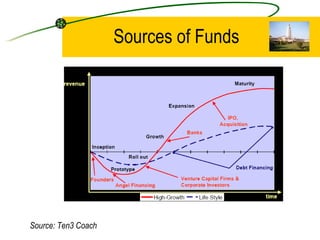
Sources of Funds Source: Ten3 Coach
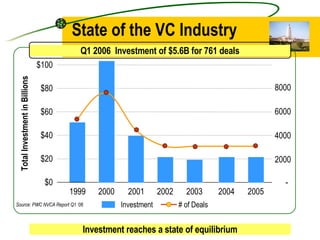
State of the VC Industry Source: PWC NVCA Report Q1 ‘06 $0 $100 $80 $60 $40 $20 Total Investment in Billions Investment # of Deals 1999 - 8000 6000 4000 2000 Q1 2006  Investment of $5.6B for 761 deals 2000 2001 2002 2003 2004 2005 Investment reaches a state of equilibrium
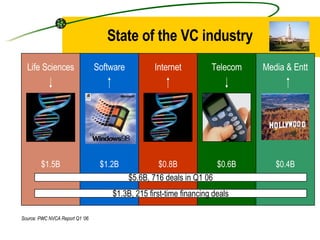
State of the VC industry Life Sciences $1.5B $5.6B, 716 deals in Q1 06 Software $1.2B Internet $0.8B Telecom $0.6B Media & Entt $0.4B $1.3B, 215 first-time financing deals Source: PWC NVCA Report Q1 ‘06
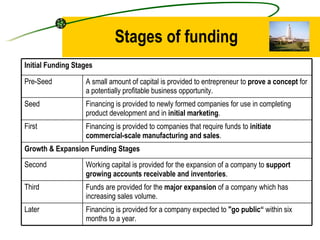
Stages of funding Financing is provided for a company expected to  &quot;go public“  within six months to a year. Later Funds are provided for the  major expansion  of a company which has increasing sales volume. Third Working capital is provided for the expansion of a company to  support growing accounts receivable and inventories . Second Growth & Expansion Funding Stages Financing is provided to companies that require funds to  initiate commercial-scale manufacturing and sales . First Financing is provided to newly formed companies for use in completing product development and in  initial marketing . Seed A small amount of capital is provided to entrepreneur to  prove a concept  for a potentially profitable business opportunity. Pre-Seed Initial Funding Stages
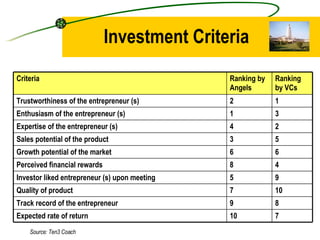
Investment Criteria Source: Ten3 Coach Expected rate of return Track record of the entrepreneur Quality of product Investor liked entrepreneur (s) upon meeting Perceived financial rewards Growth potential of the market Sales potential of the product Expertise of the entrepreneur (s) Enthusiasm of the entrepreneur (s) Trustworthiness of the entrepreneur (s) Criteria 7 10 8 9 10 7 9 5 4 8 6 6 5 3 2 4 3 1 1 2 Ranking by VCs Ranking by Angels
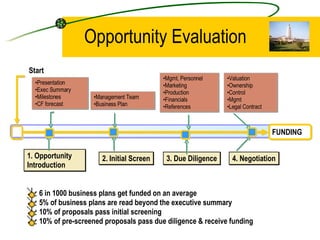
Opportunity Evaluation 6 in 1000 business plans get funded on an average 5% of business plans are read beyond the executive summary 10% of proposals pass initial screening 10% of pre-screened proposals pass due diligence & receive funding 2. Initial Screen 1. Opportunity Introduction Start 3. Due Diligence Management Team Business Plan Valuation Ownership Control Mgmt Legal Contract 4. Negotiation Presentation Exec Summary Milestones CF forecast FUNDING Mgmt, Personnel Marketing Production Financials References
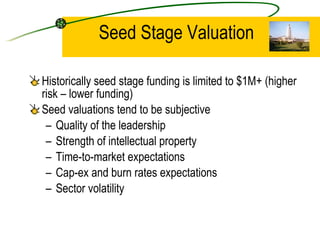
Seed Stage Valuation Historically seed stage funding is limited to $1M+ (higher risk – lower funding) Seed valuations tend to be subjective Quality of the leadership Strength of intellectual property Time-to-market expectations Cap-ex and burn rates expectations Sector volatility
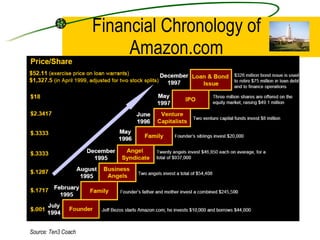
Financial Chronology of Amazon.com Source: Ten3 Coach
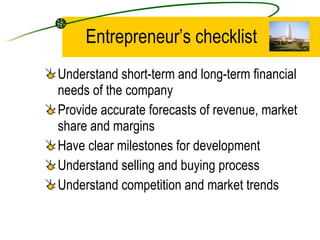
Entrepreneur’s checklist Understand short-term and long-term financial needs of the company Provide accurate forecasts of revenue, market share and margins Have clear milestones for development Understand selling and buying process Understand competition and market trends
Preparing for the next step First “big” round of financing (> $3M) Financing dependent on progress made with seed capital Before Series-A Assemble a quality team Meet development milestones and targets Develop “proof of concept”
Upcoming BITSAA events
Plan E Educational Events Mission Provide a forum for building relationships between aspiring and successful BITSian entrepreneurs  Stimulate entrepreneurial thinking amongst BITSians Objectives Conduct ten or more educational cum networking events by May 2007  Attract five BITSian startup ideas for an idea pitching event by May 2007
Plan E Educational Events Event Format Each event will have one theme/topic and will have one to two speakers or three to four panelists to cover enough breadth as well as potentially differing viewpoints Next Event Topic From idea to success: The Pinnacle Systems Story: From start to $350 million and a successful exit Speaker Ajay Chopra, Venture Consultant - Trinity Ventures, Founder - Pinnacle Systems Date Jul 15, 2006

"Funding a Startup" by Jayan Ramankutty

  • 1.
    Funding a start-up: How to raise your first round Jayan Ramankutty Founder/CEO YuMe Networks BITSAA.org, June 25 th 2006
  • 2.
    Outline Investment SourcesState of the VC Industry Funding Process & Decision Making Seed-Stage Valuation Entrepreneur’s checklist Preparing for the next step
  • 3.
    Investment Sources AngelInvestors Wealthy individuals with industry background Usually a small investment (< $1M) in a very early-stage company (demo, 2-3 employees) Financial VCs Most common type of VC, an investment firm, capital raised from institutions and individuals Fund sizes: ~$25M to 10’s of billions Exit through - IPOs, Mergers and Acquisitions (M&A) Strategic VCs Typically a (small) division of a large technology company. Examples: Intel, Cisco, Siemens, AT&T Corporate funding for strategic investment Not exclusively or primarily concerned with return on investment
  • 4.
    Sources of FundsSource: Ten3 Coach
  • 5.
    State of theVC Industry Source: PWC NVCA Report Q1 ‘06 $0 $100 $80 $60 $40 $20 Total Investment in Billions Investment # of Deals 1999 - 8000 6000 4000 2000 Q1 2006 Investment of $5.6B for 761 deals 2000 2001 2002 2003 2004 2005 Investment reaches a state of equilibrium
  • 6.
    State of theVC industry Life Sciences $1.5B $5.6B, 716 deals in Q1 06 Software $1.2B Internet $0.8B Telecom $0.6B Media & Entt $0.4B $1.3B, 215 first-time financing deals Source: PWC NVCA Report Q1 ‘06
  • 7.
    Stages of fundingFinancing is provided for a company expected to &quot;go public“ within six months to a year. Later Funds are provided for the major expansion of a company which has increasing sales volume. Third Working capital is provided for the expansion of a company to support growing accounts receivable and inventories . Second Growth & Expansion Funding Stages Financing is provided to companies that require funds to initiate commercial-scale manufacturing and sales . First Financing is provided to newly formed companies for use in completing product development and in initial marketing . Seed A small amount of capital is provided to entrepreneur to prove a concept for a potentially profitable business opportunity. Pre-Seed Initial Funding Stages
  • 8.
    Investment Criteria Source:Ten3 Coach Expected rate of return Track record of the entrepreneur Quality of product Investor liked entrepreneur (s) upon meeting Perceived financial rewards Growth potential of the market Sales potential of the product Expertise of the entrepreneur (s) Enthusiasm of the entrepreneur (s) Trustworthiness of the entrepreneur (s) Criteria 7 10 8 9 10 7 9 5 4 8 6 6 5 3 2 4 3 1 1 2 Ranking by VCs Ranking by Angels
  • 9.
    Opportunity Evaluation 6in 1000 business plans get funded on an average 5% of business plans are read beyond the executive summary 10% of proposals pass initial screening 10% of pre-screened proposals pass due diligence & receive funding 2. Initial Screen 1. Opportunity Introduction Start 3. Due Diligence Management Team Business Plan Valuation Ownership Control Mgmt Legal Contract 4. Negotiation Presentation Exec Summary Milestones CF forecast FUNDING Mgmt, Personnel Marketing Production Financials References
  • 10.
    Seed Stage ValuationHistorically seed stage funding is limited to $1M+ (higher risk – lower funding) Seed valuations tend to be subjective Quality of the leadership Strength of intellectual property Time-to-market expectations Cap-ex and burn rates expectations Sector volatility
  • 11.
    Financial Chronology ofAmazon.com Source: Ten3 Coach
  • 12.
    Entrepreneur’s checklist Understandshort-term and long-term financial needs of the company Provide accurate forecasts of revenue, market share and margins Have clear milestones for development Understand selling and buying process Understand competition and market trends
  • 13.
    Preparing for thenext step First “big” round of financing (> $3M) Financing dependent on progress made with seed capital Before Series-A Assemble a quality team Meet development milestones and targets Develop “proof of concept”
  • 14.
  • 15.
    Plan E EducationalEvents Mission Provide a forum for building relationships between aspiring and successful BITSian entrepreneurs Stimulate entrepreneurial thinking amongst BITSians Objectives Conduct ten or more educational cum networking events by May 2007 Attract five BITSian startup ideas for an idea pitching event by May 2007
  • 16.
    Plan E EducationalEvents Event Format Each event will have one theme/topic and will have one to two speakers or three to four panelists to cover enough breadth as well as potentially differing viewpoints Next Event Topic From idea to success: The Pinnacle Systems Story: From start to $350 million and a successful exit Speaker Ajay Chopra, Venture Consultant - Trinity Ventures, Founder - Pinnacle Systems Date Jul 15, 2006