

Ways to Raise Capital
For Your Startup
By Melissa Fisher, Managing Partner
www.PeakRoadPartners.com
1
@MelissaFisher7
www.linkedin.com/in/melissafisher7
MelissaFisher7@gmail.com
Entrepreneur
Conference
• What investor options are there?
• Is my industry appealing to venture investors?
• Is my business appealing to venture investors; and
• if so, various ways for attracting capital for your business?
IN TODAY’S SESSION WE WILL TACKLE:
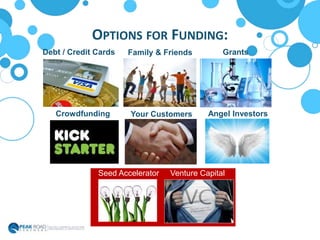
OPTIONS FOR FUNDING:
Debt / Credit Cards Family & Friends
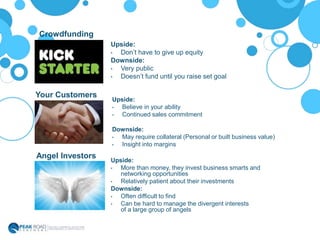
Crowdfunding Your Customers
Grants
Seed Accelerator Venture Capital
Angel Investors
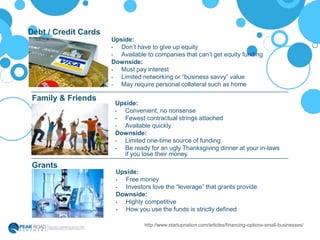
Upside:
• Don’t have to give up equity
• Available to companies that can’t get equity funding
Downside:
• Must pay interest
• Limited networking or “business savvy” value
• May require personal collateral such as home
Debt / Credit Cards
Family & Friends
Grants
http://www.startupnation.com/articles/financing-options-small-businesses/
Upside:
• Convenient, no nonsense
• Fewest contractual strings attached
• Available quickly
Downside:
• Limited one-time source of funding
• Be ready for an ugly Thanksgiving dinner at your in-laws
if you lose their money
Upside:
• Free money
• Investors love the “leverage” that grants provide
Downside:
• Highly competitive
• How you use the funds is strictly defined
Upside:
• Don’t have to give up equity
Downside:
• Very public
• Doesn’t fund until you raise set goal
Crowdfunding
Your Customers
Upside:
• Believe in your ability
• Continued sales commitment
Downside:
• May require collateral (Personal or built business value)
• Insight into margins
Angel Investors Upside:
• More than money, they invest business smarts and
networking opportunities
• Relatively patient about their investments
Downside:
• Often difficult to find
• Can be hard to manage the divergent interests
of a large group of angels
5 Phases: awareness, application, program, demo day, post demo day
Upside:
• Access to resources, mentoring, fundraise-readiness and collaboration
• If government funded they take no equity
Downside:
• Must be a “fast growth” startup business
• May have to give up equity %
• Must “graduate” within a short period of time.
Seed Accelerator
Upside:
• Invest smarts and networking in addition to money
• Typically have more money if you need more to grow
Downside:
• Must be a “fast growth” startup business
• Must be interested in selling the business or going public within 3-5 yrs
• Must be prepared to share control
Venture Capital
JOHN BORTHWICK
“Remember that funding is a means to an
end, not an end in of itself. The end is
building a product, building a community
and building a business. Raising money can
be a challenge – just remember it’s not the
end. It’s the beginning, it’s the starting point.
Now you have to build.”
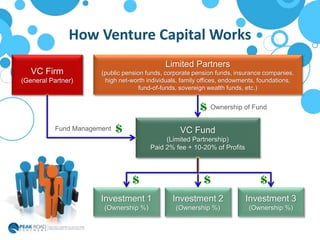
How Venture Capital Works
VC Firm
(General Partner)
VC Fund
(Limited Partnership)
Paid 2% fee + 10-20% of Profits
Limited Partners
(public pension funds, corporate pension funds, insurance companies,
high net-worth individuals, family offices, endowments, foundations,
fund-of-funds, sovereign wealth funds, etc.)
Investment 1
(Ownership %)
Investment 2
(Ownership %)
Investment 3
(Ownership %)
Fund Management
Ownership of Fund
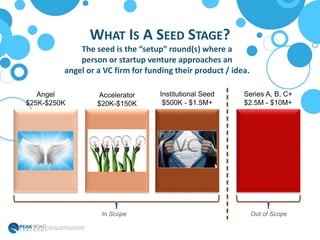
WHAT IS A SEED STAGE?
Series A, B, C+
$2.5M - $10M+
Out of ScopeIn Scope
Institutional Seed
$500K - $1.5M+
Accelerator
$20K-$150K
Angel
$25K-$250K
The seed is the “setup” round(s) where a
person or startup venture approaches an
angel or a VC firm for funding their product / idea.
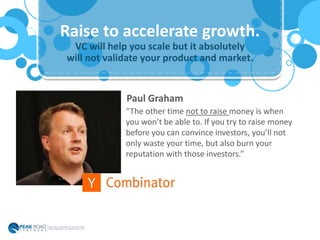
VC will help you scale but it absolutely
will not validate your product and market.
Raise to accelerate growth.
“The other time not to raise money is when
you won’t be able to. If you try to raise money
before you can convince investors, you’ll not
only waste your time, but also burn your
reputation with those investors.”
Paul Graham
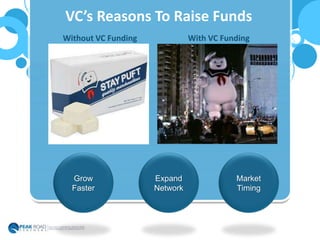
VC’s Reasons To Raise Funds
With VC FundingWithout VC Funding
Market
Timing
Expand
Network
Grow
Faster
1. Use your network
2. Set your fundraising goal
3. Welcome feedback
4. Be penny-pinching
5. Be bold & bootstrap
Remember that an investor invests in your business to share your profits.
So make your idea attractable and sellable.
Getting your business funded starts with having a reasonable plan.
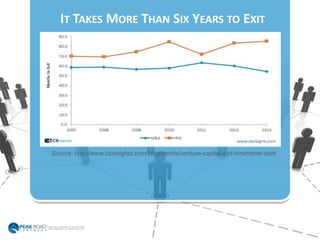
IT TAKES MORE THAN SIX YEARS TO EXIT
Source: http://www.cbinsights.com/blog/trends/venture-capital-exit-timeframe-tech
WHAT YOU CAN EXPECT
Fast – Scary – Thrilling
HUGE EXITS ARE RARE
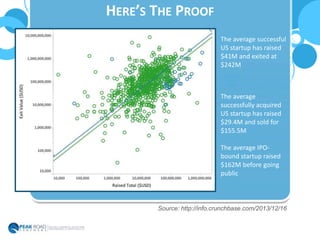
HERE’S THE PROOF
The average successful
US startup has raised
$41M and exited at
$242M
The average
successfully acquired
US startup has raised
$29.4M and sold for
$155.5M
The average IPO-
bound startup raised
$162M before going
public
Source: http://info.crunchbase.com/2013/12/16
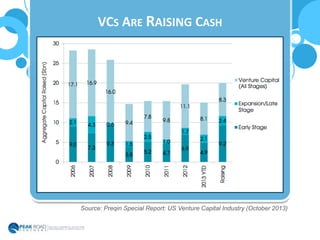
VCS ARE RAISING CASH
Source: Preqin Special Report: US Venture Capital Industry (October 2013)
SEED DEAL VOLUME REMAINS STEADY
Source: http://www.cbinsights.com/blog/trends/2013-seed-venture-capital
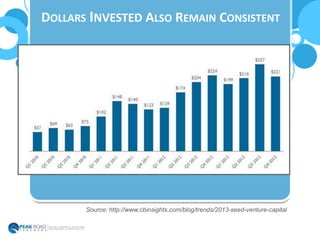
DOLLARS INVESTED ALSO REMAIN CONSISTENT
Source: http://www.cbinsights.com/blog/trends/2013-seed-venture-capital
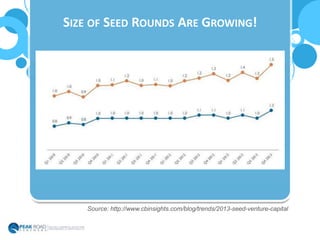
SIZE OF SEED ROUNDS ARE GROWING!
Source: http://www.cbinsights.com/blog/trends/2013-seed-venture-capital
INVESTORS FOCUSING ON NEW FRONTIERS
Cloud Compute
Social Platforms Digital Currency
WearablesConnected HomeContext Compute
Connected Cars UAVs
Mobile ServicesPrivate Space Bioinformatics Industrial Internet
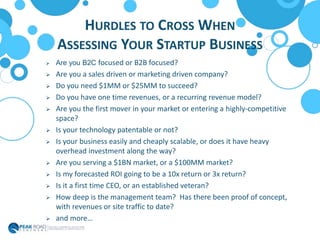
HURDLES TO CROSS WHEN
ASSESSING YOUR STARTUP BUSINESS
 Are you B2C focused or B2B focused?
 Are you a sales driven or marketing driven company?
 Do you need $1MM or $25MM to succeed?
 Do you have one time revenues, or a recurring revenue model?
 Are you the first mover in your market or entering a highly-competitive
space?
 Is your technology patentable or not?
 Is your business easily and cheaply scalable, or does it have heavy
overhead investment along the way?
 Are you serving a $1BN market, or a $100MM market?
 Is my forecasted ROI going to be a 10x return or 3x return?
 Is it a first time CEO, or an established veteran?
 How deep is the management team? Has there been proof of concept,
with revenues or site traffic to date?
 and more…
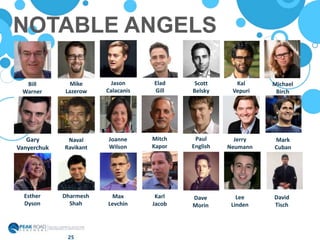
NOTABLE ANGELS
25
Bill
Warner
Gary
Vanyerchuk
Esther
Dyson
Mike
Lazerow
Naval
Ravikant
Dharmesh
Shah
Jason
Calacanis
Joanne
Wilson
Max
Levchin
Elad
Gill
Mitch
Kapor
Karl
Jacob
Scott
Belsky
Paul
English
Dave
Morin
Michael
Birch
David
Tisch
Mark
Cuban
Kal
Vepuri
Jerry
Neumann
Lee
Linden
ACCELERATORS
A three to six month “startup boot camp” that provides
mentoring, office space and access to capital in
exchange for 3-6% of common stock.
NOTABLE SEED FUNDS
Seed funds tend to invest $50K - $750K in an
institutional seed round which is usually up to
$1.5M. These funds invest together as a syndicate.
VCs w/ SEED DEALS
VCs typically lead $3M-$10M+ Series A rounds but some
invest $50K - $1M in seeds to back great founders and / or
learn about emerging tech.
CORPORATE VCs
Corporations often have funds that invest in startups for
strategic and / or financial reasons. These funds typically
focus on Seed and Series A.
“Try not to fall in love with a firm – focus
more attention on the partner leading the
deal. Ultimately that partner will be the
person you have to deal with so raising from
a great firm but putting someone on your
board that you don’t love won’t end up
working out.”
30
Ben Lerer
Raising any amount of capital is never easy.
You’ll hear “no” more than you’ll hear “yes.”
For many of you it will be a long but rewarding process.
IN SUMMARY
 VC is just one financing option to consider
 Investors come in difference sizes and flavors
 Raise to accelerate growth
 Prepare, work your ass off and hustle
 Take advantage of resources on the web
 The real work begins after you raise

Raising Capital For Your Startup

  • 1.
    Ways to RaiseCapital For Your Startup By Melissa Fisher, Managing Partner www.PeakRoadPartners.com 1 @MelissaFisher7 www.linkedin.com/in/melissafisher7 MelissaFisher7@gmail.com Entrepreneur Conference
  • 2.
    • What investoroptions are there? • Is my industry appealing to venture investors? • Is my business appealing to venture investors; and • if so, various ways for attracting capital for your business? IN TODAY’S SESSION WE WILL TACKLE:
  • 3.
    OPTIONS FOR FUNDING: Debt/ Credit Cards Family & Friends Crowdfunding Your Customers Grants Seed Accelerator Venture Capital Angel Investors
  • 4.
    Upside: • Don’t haveto give up equity • Available to companies that can’t get equity funding Downside: • Must pay interest • Limited networking or “business savvy” value • May require personal collateral such as home Debt / Credit Cards Family & Friends Grants http://www.startupnation.com/articles/financing-options-small-businesses/ Upside: • Convenient, no nonsense • Fewest contractual strings attached • Available quickly Downside: • Limited one-time source of funding • Be ready for an ugly Thanksgiving dinner at your in-laws if you lose their money Upside: • Free money • Investors love the “leverage” that grants provide Downside: • Highly competitive • How you use the funds is strictly defined
  • 5.
    Upside: • Don’t haveto give up equity Downside: • Very public • Doesn’t fund until you raise set goal Crowdfunding Your Customers Upside: • Believe in your ability • Continued sales commitment Downside: • May require collateral (Personal or built business value) • Insight into margins Angel Investors Upside: • More than money, they invest business smarts and networking opportunities • Relatively patient about their investments Downside: • Often difficult to find • Can be hard to manage the divergent interests of a large group of angels
  • 6.
    5 Phases: awareness,application, program, demo day, post demo day Upside: • Access to resources, mentoring, fundraise-readiness and collaboration • If government funded they take no equity Downside: • Must be a “fast growth” startup business • May have to give up equity % • Must “graduate” within a short period of time. Seed Accelerator
  • 7.
    Upside: • Invest smartsand networking in addition to money • Typically have more money if you need more to grow Downside: • Must be a “fast growth” startup business • Must be interested in selling the business or going public within 3-5 yrs • Must be prepared to share control Venture Capital
  • 8.
    JOHN BORTHWICK “Remember thatfunding is a means to an end, not an end in of itself. The end is building a product, building a community and building a business. Raising money can be a challenge – just remember it’s not the end. It’s the beginning, it’s the starting point. Now you have to build.”
  • 9.
    How Venture CapitalWorks VC Firm (General Partner) VC Fund (Limited Partnership) Paid 2% fee + 10-20% of Profits Limited Partners (public pension funds, corporate pension funds, insurance companies, high net-worth individuals, family offices, endowments, foundations, fund-of-funds, sovereign wealth funds, etc.) Investment 1 (Ownership %) Investment 2 (Ownership %) Investment 3 (Ownership %) Fund Management Ownership of Fund
  • 10.
    WHAT IS ASEED STAGE? Series A, B, C+ $2.5M - $10M+ Out of ScopeIn Scope Institutional Seed $500K - $1.5M+ Accelerator $20K-$150K Angel $25K-$250K The seed is the “setup” round(s) where a person or startup venture approaches an angel or a VC firm for funding their product / idea.
  • 11.
    VC will helpyou scale but it absolutely will not validate your product and market. Raise to accelerate growth. “The other time not to raise money is when you won’t be able to. If you try to raise money before you can convince investors, you’ll not only waste your time, but also burn your reputation with those investors.” Paul Graham
  • 12.
    VC’s Reasons ToRaise Funds With VC FundingWithout VC Funding Market Timing Expand Network Grow Faster
  • 13.
    1. Use yournetwork 2. Set your fundraising goal 3. Welcome feedback 4. Be penny-pinching 5. Be bold & bootstrap Remember that an investor invests in your business to share your profits. So make your idea attractable and sellable. Getting your business funded starts with having a reasonable plan.
  • 14.
    IT TAKES MORETHAN SIX YEARS TO EXIT Source: http://www.cbinsights.com/blog/trends/venture-capital-exit-timeframe-tech
  • 15.
    WHAT YOU CANEXPECT Fast – Scary – Thrilling
  • 17.
  • 18.
    HERE’S THE PROOF Theaverage successful US startup has raised $41M and exited at $242M The average successfully acquired US startup has raised $29.4M and sold for $155.5M The average IPO- bound startup raised $162M before going public Source: http://info.crunchbase.com/2013/12/16
  • 19.
    VCS ARE RAISINGCASH Source: Preqin Special Report: US Venture Capital Industry (October 2013)
  • 20.
    SEED DEAL VOLUMEREMAINS STEADY Source: http://www.cbinsights.com/blog/trends/2013-seed-venture-capital
  • 21.
    DOLLARS INVESTED ALSOREMAIN CONSISTENT Source: http://www.cbinsights.com/blog/trends/2013-seed-venture-capital
  • 22.
    SIZE OF SEEDROUNDS ARE GROWING! Source: http://www.cbinsights.com/blog/trends/2013-seed-venture-capital
  • 23.
    INVESTORS FOCUSING ONNEW FRONTIERS Cloud Compute Social Platforms Digital Currency WearablesConnected HomeContext Compute Connected Cars UAVs Mobile ServicesPrivate Space Bioinformatics Industrial Internet
  • 24.
    HURDLES TO CROSSWHEN ASSESSING YOUR STARTUP BUSINESS  Are you B2C focused or B2B focused?  Are you a sales driven or marketing driven company?  Do you need $1MM or $25MM to succeed?  Do you have one time revenues, or a recurring revenue model?  Are you the first mover in your market or entering a highly-competitive space?  Is your technology patentable or not?  Is your business easily and cheaply scalable, or does it have heavy overhead investment along the way?  Are you serving a $1BN market, or a $100MM market?  Is my forecasted ROI going to be a 10x return or 3x return?  Is it a first time CEO, or an established veteran?  How deep is the management team? Has there been proof of concept, with revenues or site traffic to date?  and more…
  • 25.
  • 26.
    ACCELERATORS A three tosix month “startup boot camp” that provides mentoring, office space and access to capital in exchange for 3-6% of common stock.
  • 27.
    NOTABLE SEED FUNDS Seedfunds tend to invest $50K - $750K in an institutional seed round which is usually up to $1.5M. These funds invest together as a syndicate.
  • 28.
    VCs w/ SEEDDEALS VCs typically lead $3M-$10M+ Series A rounds but some invest $50K - $1M in seeds to back great founders and / or learn about emerging tech.
  • 29.
    CORPORATE VCs Corporations oftenhave funds that invest in startups for strategic and / or financial reasons. These funds typically focus on Seed and Series A.
  • 30.
    “Try not tofall in love with a firm – focus more attention on the partner leading the deal. Ultimately that partner will be the person you have to deal with so raising from a great firm but putting someone on your board that you don’t love won’t end up working out.” 30 Ben Lerer
  • 31.
    Raising any amountof capital is never easy. You’ll hear “no” more than you’ll hear “yes.” For many of you it will be a long but rewarding process. IN SUMMARY  VC is just one financing option to consider  Investors come in difference sizes and flavors  Raise to accelerate growth  Prepare, work your ass off and hustle  Take advantage of resources on the web  The real work begins after you raise

Editor's Notes

  • #3 Of all the consulting inquiries I receive at Peak Road Partners, fund raising is by far the biggest need of these startups.  And, the problem is, not all startups are viable for venture funding for a variety of reasons, which we will discuss.    In today’s session we will tackle: 1. What investor options you have for your startup 2. is my industry appealing to venture investors; 3. is my business appealing to venture investors; and if so, various ways for attracting capital for your business.
  • #5 Investors are typically segmented by life-cycle stage of the business:  angel investors or friends and family typically get a business off the ground from a piece of paper to a working prototype;
  • #7 Seed accelerators are fixed-term, cohort-based programs, that include mentorship and educational components and culminate in a public pitch event or demo day.[1] While traditional business incubators are often government-funded, generally take no equity, and focus on biotech, medical technology, clean tech [2] or product-centric companies, accelerators can be either privately or publicly funded and focus on a wide range of industries. The main differences between business incubators and accelerators are:[3] The application process is open to anyone, but highly competitive. Y Combinator and TechStars have application acceptance rates between 1% and 3%. A seed investment in the startups is usually made, in exchange for equity. Typically, the investment is between US$20,000 and US$50,000 (or GB£10,000 and GB£50,000 in Europe[4]) The focus is on small teams, not on individual founders. Accelerators consider that one person is insufficient to handle all the work associated with a startup. The startups must "graduate" by a given deadline, typically after 3 months. During this time, they receive intensive mentoring and training, and they are expected to iterate rapidly. Virtually all accelerators end their programs with a "Demo Day", where the startups present to investors.[5] Startups are accepted and supported in cohort batches or classes (the accelerator isn't an on-demand resource[6]). The peer support and feedback that the classes provide is an important advantage. If the accelerator doesn't offer a common workspace, the teams will meet periodically. The primary value to the entrepreneur is derived from the mentoring, connections, and the recognition of being chosen to be a part of the accelerator. The business model is based on generating venture style returns, not rent, or fees for services. Seed accelerators do not necessarily need to include a physical space, but many do. The process that startups go through in the accelerator can be separated into five distinct phases: awareness, application, program, demo day, post demo day.[
  • #8 Series A venture capitalists will put in $1-$5MM after there has been a preliminary proof of concept, based on revenues, pipeline, site traffic or some other metric; and Series B venture capitalists will put in $10-$50MM to hit the accelerator after the model is finely tuned and scaling.  So, when you are approaching the investment community, make sure you have thoroughly researched not only their industry focus, but their stage of business focus as well.
  • #11 Each investor views the world differently so this guide is far from definitive. I couldn’t include every accelerator, angel or VC. I’m not a lawyer so consult with one before you raise. The focus for today’s talk is “seed funding” but many lessons apply for Series A. These slides are used for a class I teach at General Assembly.
  • #14 1.  Use your network Your network is your biggest and best asset to meet investors. It’s like a Pandora’s box that needs to be explored properly at the right time in the right way. So make your network work for you. Attend and participate in startup meetups and talks held in your area; this will help you connect and meet investors and other entrepreneurs in a jiffy. Remember, opportunity never comes to you; you need to seize it! 2.  Set your fundraising goal Before meeting an investor, ensure that you have done your homework. Make sure you have researched and figured out an amount that you believe will develop your business and be a good investment for the investor. For example, plan the amount you’ll need to shell out on basic office infrastructure, salaries, marketing, and product development; otherwise, you might end up wasting a lot of money. Only raise the amount that you need to execute your business in the right way. Don’t indulge in extravagant activities at this time: eat moderately, rather than starving or overeating. 3.  Welcome feedback  When you meet an investor, stay open to feedback. Don’t indulge in arguing or be rude. On the other hand, don’t try to please them so much that things get out of hand. If they reject you, don’t leave coldly; instead, make sure to be polite and ask for their feedback. Accept it, improve it, follow up, and try approaching for a second round of discussions. 4.  Be penny-pinching  Investors often believe that startups waste money. So make sure you allocate cash properly for your product development, organization building, and advertising. Always remember that you are a startup, who needs to scale, so never be extravagant with your accounts. 5.  Be bold to bootstrap  Yes, I really mean it. All investors would admire you for bootstrapping your venture to a certain extent. This demonstrates your commitment towards your business and is widely appreciated among seed funders and angel investors. Early-stage venture funds always trust startups that have already raised angel money, and they will keep investing with you. Finally, remember that an investor invests in your business to share your profits. So make your idea attractable and sellable. Getting your business funded starts with having a reasonable plan.
  • #25 But, even if your industry is in one of the more active venture markets, there are still numerous hurdles to cross in assessing your specific business.    So, as you can see, lots of hurdles to get over to get an investors' attention for your business. Now, lets assume you are one of the lucky 5-10 in 200 that has a venture backable business.  How do you typically phase in investment.  You can't simply show up at a big Silicon Valley venture firm with your piece of paper idea and say cut me a $10MM check.   
  • #26 Alexis Ohanian David Rose San Francisco Bill Tai Ariel Poler Othman Laraki Semil Shah Marc Benioff David Sacks Jennifer Lum Joe Caruso Nicole Stata Jennifer Lum Dave Balter Andy Palmer Will Herman Gene Hammond Wayne Chang David Chang Clark Landry Paige Craig Vivi Nivo Troy Carter Ashton Kutcher Paul Bricault David Lerner Jared Hecht Steve Martocci Josh Stylman Peter Hershberg
  • #29 Matrix
  • #30 CAA Samsung
  • #31  Once the term sheets start flowing in, how do you ultimately decide who to move forward with? 
  • #32 At the end of the day, you need to follow your gut.  Who is going to be the best partner for my business, bringing a Rolodex of relationships to the table?  Who is going to be the most pleasant to work with around the board table, especially when things start to go wrong (as they always do)?  Who has the deepest pockets to invest additional monies in follow-on rounds?  Who is giving me the best valuation?  Whose term sheets are more or less onerous than others in terms of liquidation preferences and anti-dilution ratchets?  So, hopefully, what you are hearing is, not all venture capital is the same shade of green, and it is important you do your homework upfront, to avoid misery down the road.  And, if you are not clear you are making a good decision on your own, ask an advisor to help you. But, overriding all of this, if you can figure out a way to fund your business, with no outside capital, that is the preferred model.    It preserves the founder's 100% control of the company's equity, board control and the timing of a sale (or not), at terms 100% satisfactory to the founder.    Don't get romanced by the idea of raising venture capital, because it certainly has its strings attached, given the reasons already stated.   But, if you think you have the next big idea at the scale of a Google, Facebook or Groupon, the venture community will be your best partners, having funded several of those similar businesses and navigated the various pitfalls along the way.