Venture Capital Master-class
July 21, 2012
Master‐class Contents

Basics of Private Capital                         2


Evolution of Private Capital in India             6


Venture Capital: Historic Deal Value and Volume   7


Issues and Challenges                             9


                                                      2
What is Private Equity?

                         Private Equity                                  Public equity
                                                                         Stock market 
                                                                             listed
                                                                          companies
               Buy‐outs,               Venture capital
         Later stage financing,       Early stage/Angel 
             Secondaries                   financing


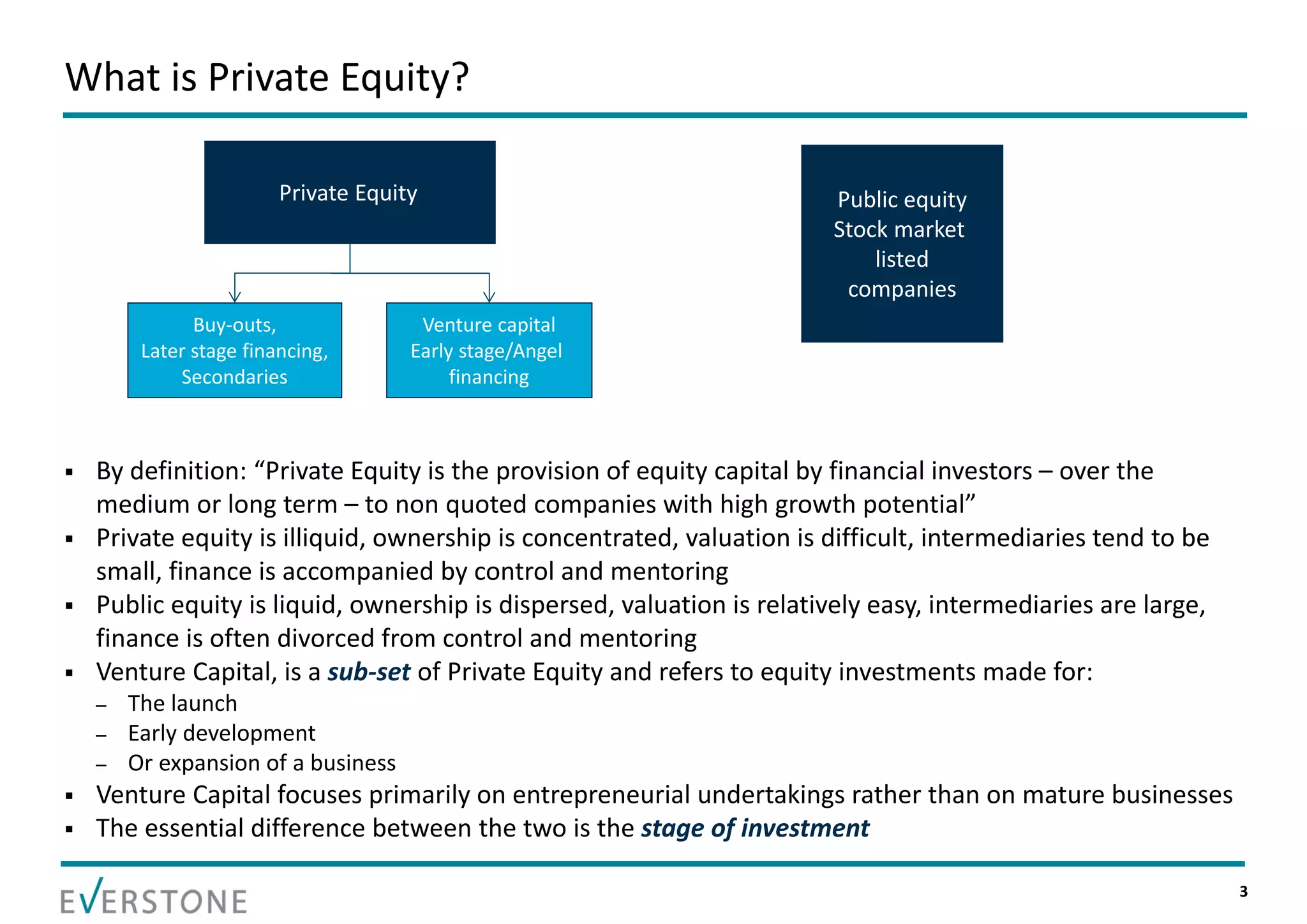
   By definition: “Private Equity is the provision of equity capital by financial investors – over the 
    medium or long term – to non quoted companies with high growth potential”
   Private equity is illiquid, ownership is concentrated, valuation is difficult, intermediaries tend to be 
    small, finance is accompanied by control and mentoring
   Public equity is liquid, ownership is dispersed, valuation is relatively easy, intermediaries are large, 
    finance is often divorced from control and mentoring 
   Venture Capital, is a sub‐set of Private Equity and refers to equity investments made for:
    –   The launch
    –   Early development
    –   Or expansion of a business
   Venture Capital focuses primarily on entrepreneurial undertakings rather than on mature businesses
   The essential difference between the two is the stage of investment

                                                                                                                3
Corporate Development and Private Equity 
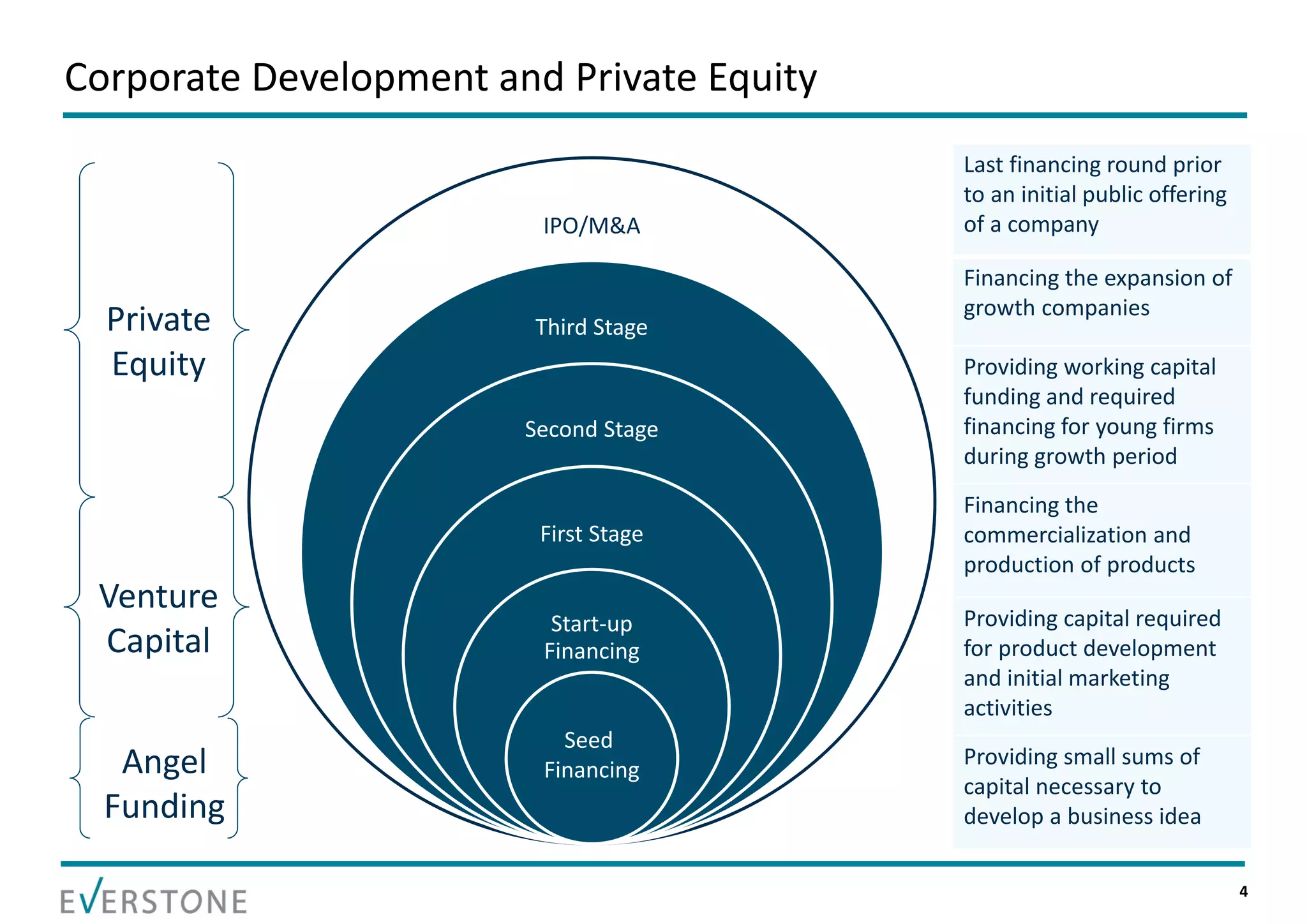
                                            Last financing round prior 
                                            to an initial public offering 
                         IPO/M&A            of a company

                                            Financing the expansion of 
                                            growth companies
  Private                Third Stage
  Equity                                    Providing working capital 
                                            funding and required 
                        Second Stage        financing for young firms 
                                            during growth period
                                            Financing the 
                         First Stage        commercialization and 
                                            production of products
 Venture                                    Providing capital required 
                          Start‐up 
 Capital                 Financing          for product development 
                                            and initial marketing 
                                            activities
                           Seed 
   Angel                 Financing
                                            Providing small sums of 
                                            capital necessary to 
  Funding                                   develop a business idea

                                                                             4
Company Lifecycle and Investment Sizes
                                                                                         Slow
                                                                                         Growth
                                                                  Late                • Buy‐out/restructuring 
                                                                  Growth                opportunities
                                                              • Size > $20 mm
                                                              • Ready for the next 
                                                                growth orbit


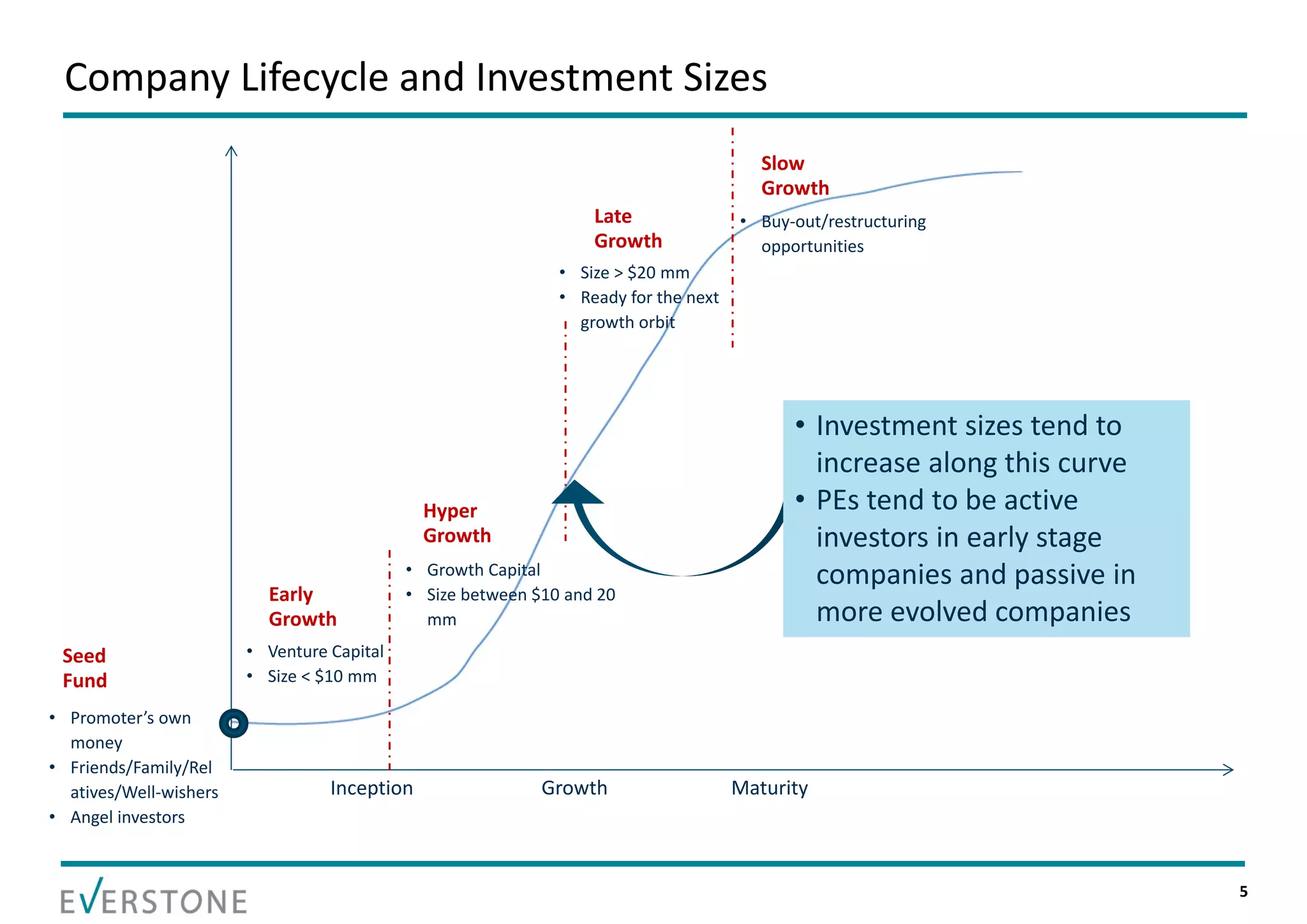
                                                                                            • Investment sizes tend to
                                                                                              increase along this curve
                                              Hyper                                         • PEs tend to be active 
                                              Growth                                          investors in early stage 
                                            • Growth Capital                                  companies and passive in 
                          Early             • Size between $10 and 20 
                          Growth              mm                                              more evolved companies
 Seed                   • Venture Capital
 Fund                   • Size < $10 mm

• Promoter’s own 
  money
• Friends/Family/Rel
  atives/Well‐wishers             Inception                 Growth                    Maturity
• Angel investors


                                                                                                                          5
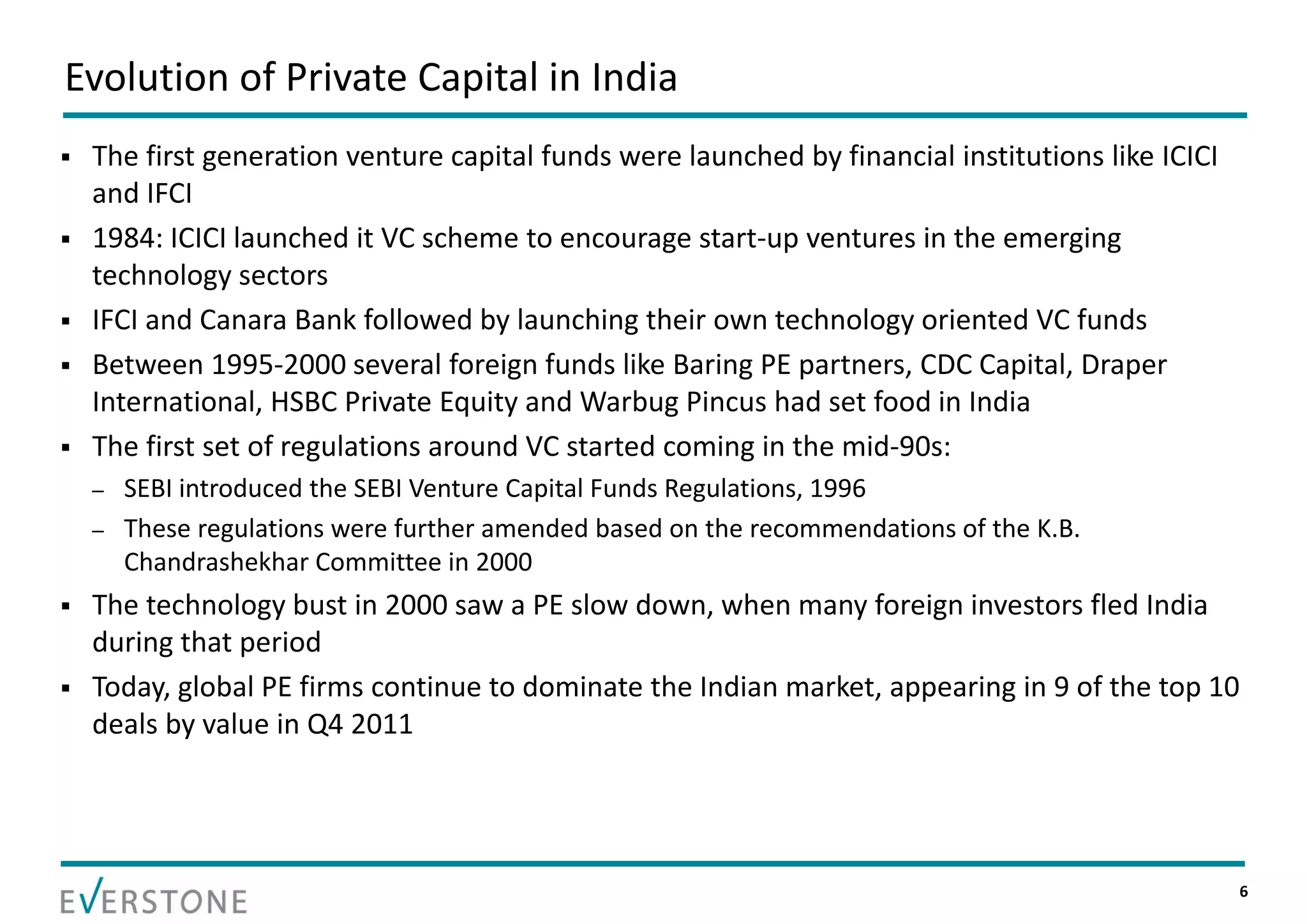
Evolution of Private Capital in India
   The first generation venture capital funds were launched by financial institutions like ICICI 
    and IFCI
   1984: ICICI launched it VC scheme to encourage start‐up ventures in the emerging 
    technology sectors
   IFCI and Canara Bank followed by launching their own technology oriented VC funds
   Between 1995‐2000 several foreign funds like Baring PE partners, CDC Capital, Draper 
    International, HSBC Private Equity and Warbug Pincus had set food in India
   The first set of regulations around VC started coming in the mid‐90s:
    –   SEBI introduced the SEBI Venture Capital Funds Regulations, 1996
    –   These regulations were further amended based on the recommendations of the K.B. 
        Chandrashekhar Committee in 2000
   The technology bust in 2000 saw a PE slow down, when many foreign investors fled India 
    during that period
   Today, global PE firms continue to dominate the Indian market, appearing in 9 of the top 10 
    deals by value in Q4 2011


                                                                                                     6
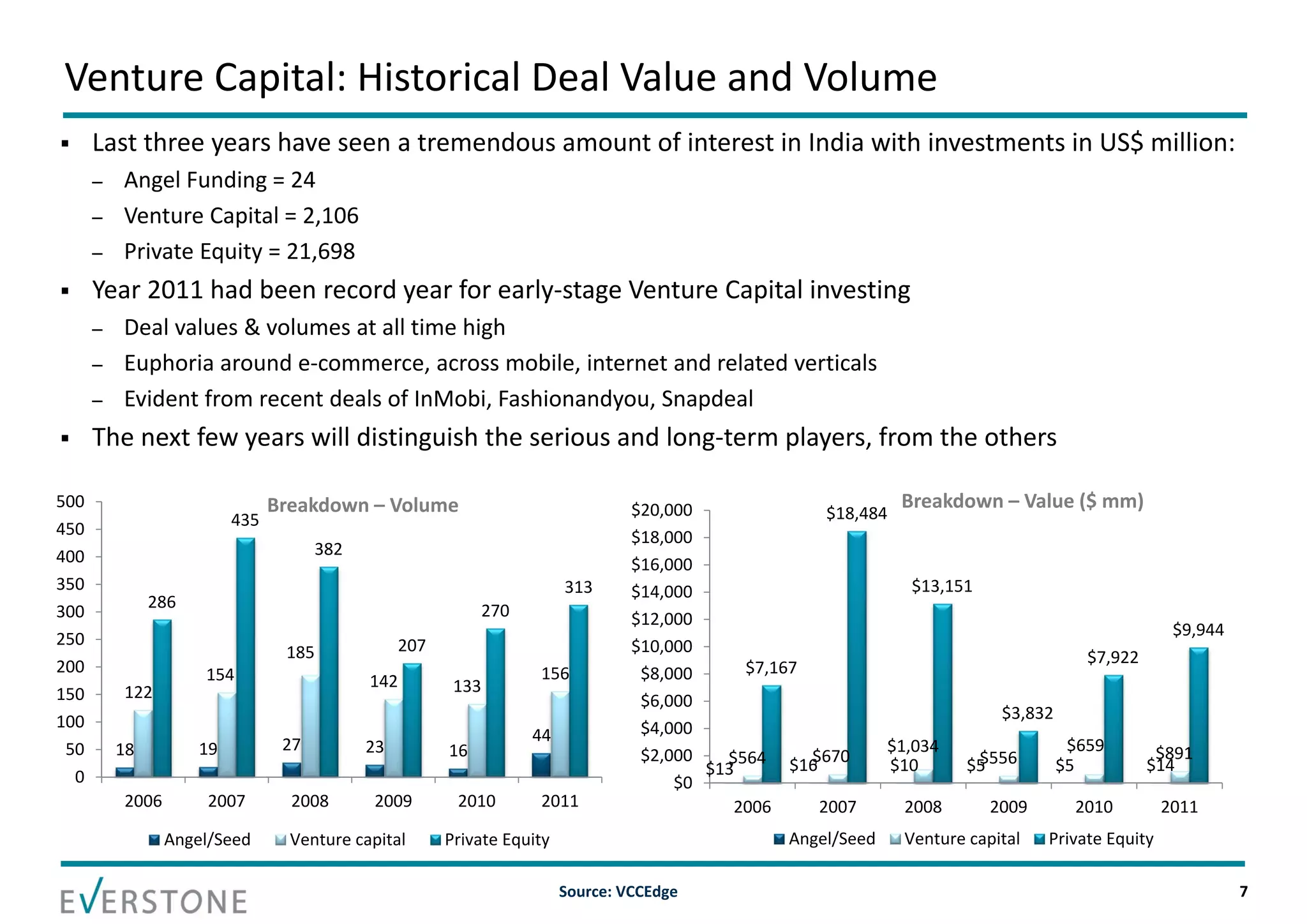
Venture Capital: Historical Deal Value and Volume
     Last three years have seen a tremendous amount of interest in India with investments in US$ million:
      –   Angel Funding = 24
      –   Venture Capital = 2,106
      –   Private Equity = 21,698
     Year 2011 had been record year for early‐stage Venture Capital investing
      –   Deal values & volumes at all time high
      –   Euphoria around e‐commerce, across mobile, internet and related verticals
      –   Evident from recent deals of InMobi, Fashionandyou, Snapdeal
     The next few years will distinguish the serious and long‐term players, from the others

500                             Breakdown – Volume                               $20,000                       Breakdown – Value ($ mm)
                          435                                                                         $18,484
450                                                                              $18,000
400                                   382
                                                                                 $16,000
350                                                                     313      $14,000                         $13,151
               286                                          270
300                                                                              $12,000
                                                                                                                                                $9,944
250                                              207                             $10,000
                                 185                                                                                                  $7,922
200                  154                                           156            $8,000     $7,167
                                            142         133
150       122                                                                     $6,000
100                                                                                                                        $3,832
                                                                  44              $4,000
 50       18         19          27         23         16                                                    $1,034                $659       $891
                                                                                  $2,000   $564 $16 $670                 $556
                                                                                         $13                  $10      $5         $5         $14
  0                                                                                   $0
          2006        2007        2008      2009        2010       2011                     2006     2007       2008      2009       2010      2011
                 Angel/Seed       Venture capital      Private Equity                              Angel/Seed   Venture capital   Private Equity

                                                                        Source: VCCEdge                                                                  7
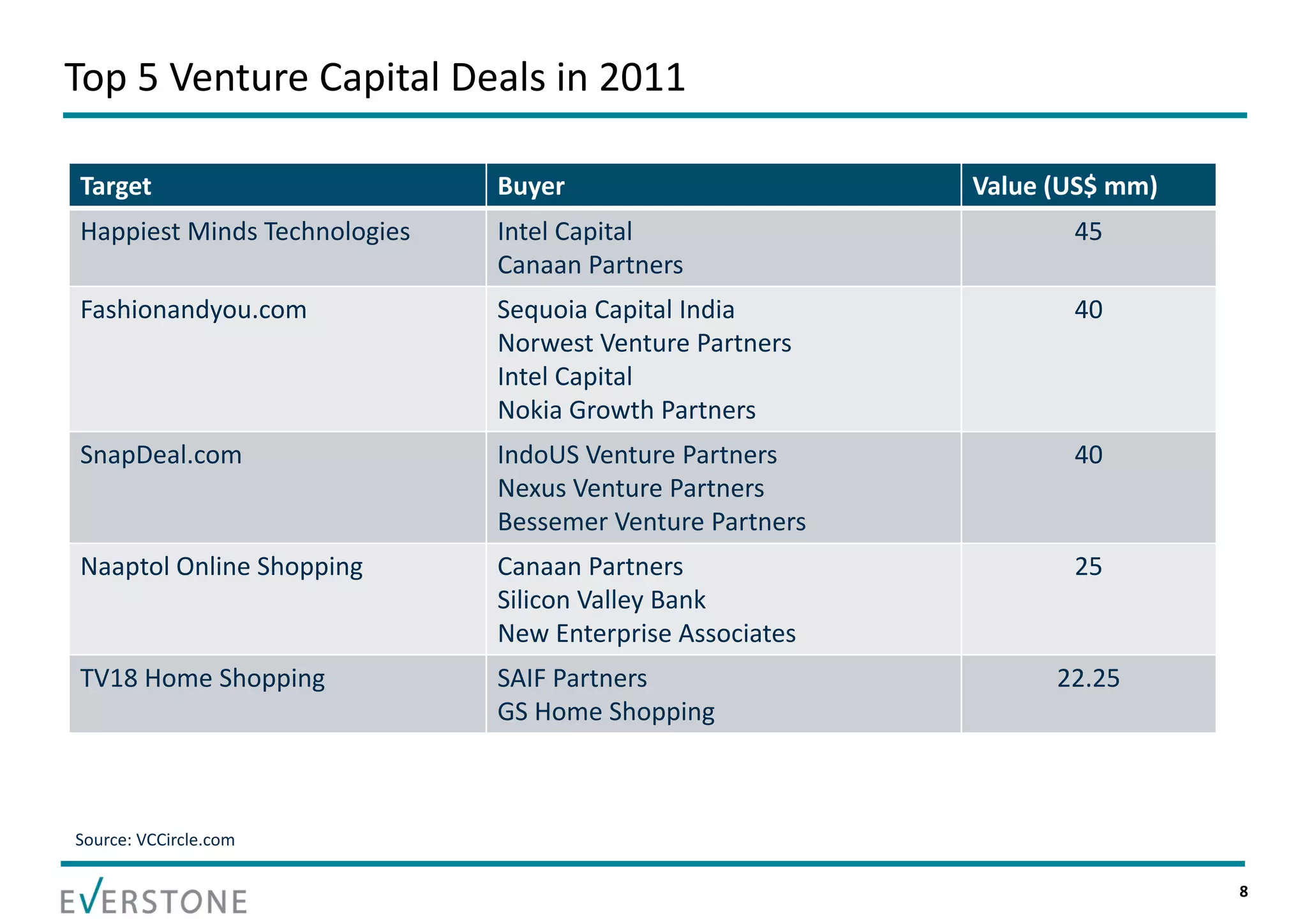
Top 5 Venture Capital Deals in 2011

Target                        Buyer                       Value (US$ mm)
Happiest Minds Technologies   Intel Capital                      45
                              Canaan Partners
Fashionandyou.com             Sequoia Capital India              40
                              Norwest Venture Partners
                              Intel Capital
                              Nokia Growth Partners
SnapDeal.com                  IndoUS Venture Partners            40
                              Nexus Venture Partners
                              Bessemer Venture Partners
Naaptol Online Shopping       Canaan Partners                    25
                              Silicon Valley Bank
                              New Enterprise Associates
TV18 Home Shopping            SAIF Partners                     22.25
                              GS Home Shopping


Source: VCCircle.com

                                                                           8
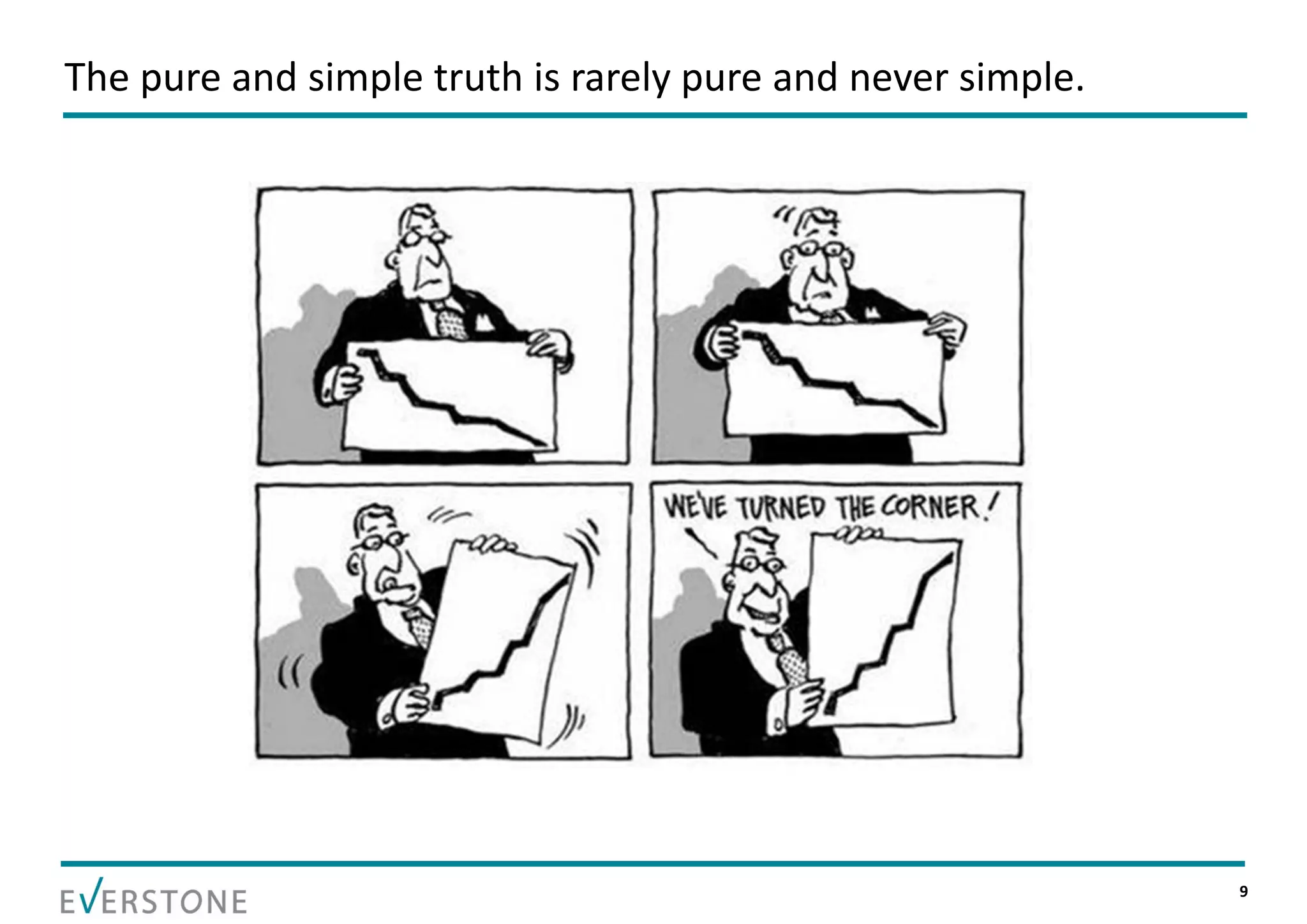
The pure and simple truth is rarely pure and never simple. 


                                                              9
The Engagement

   Pre‐investment phase

   Post‐investment phase

   Managing exit


                            10
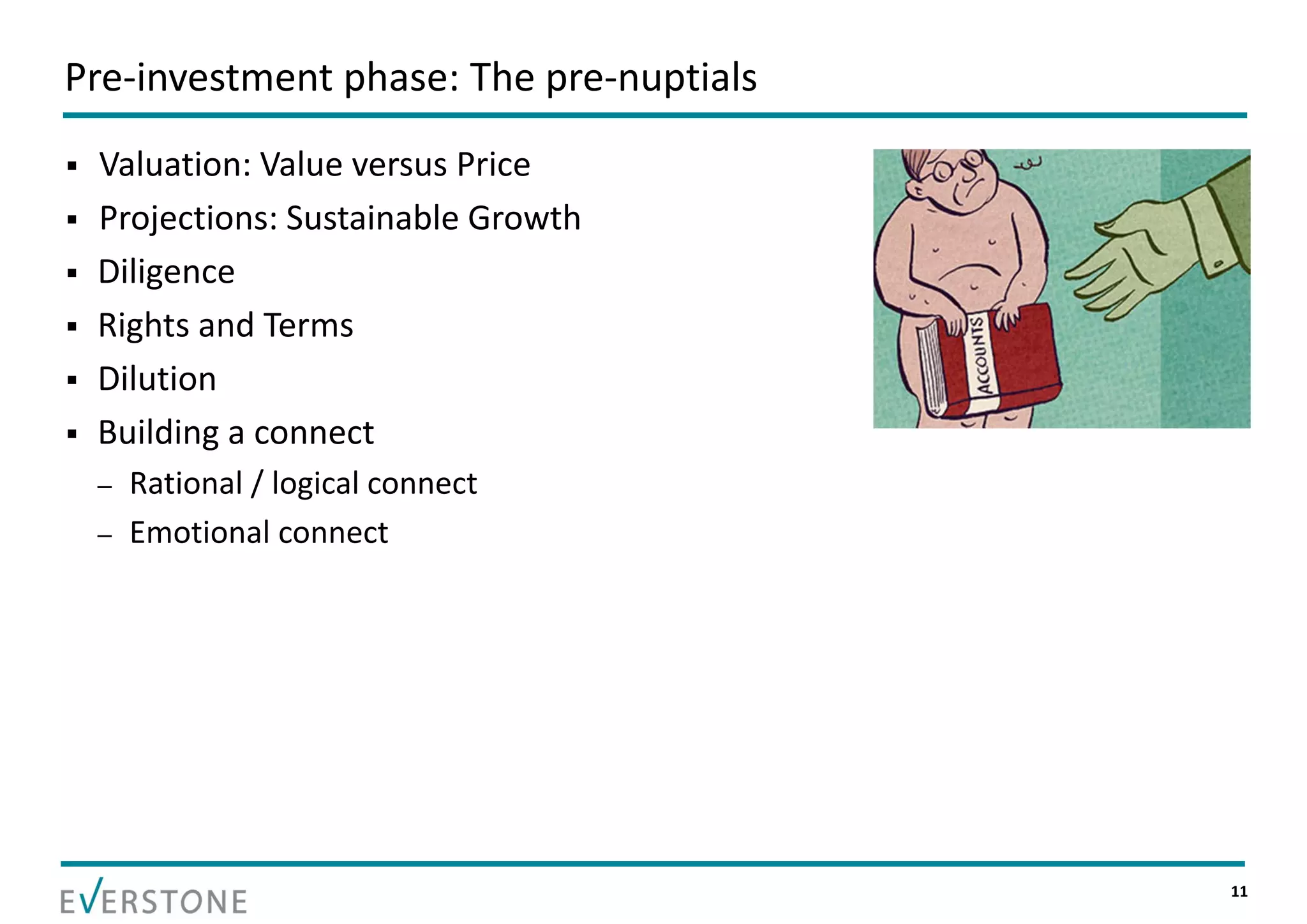
Pre‐investment phase: The pre‐nuptials
   Valuation: Value versus Price
   Projections: Sustainable Growth
   Diligence
   Rights and Terms
   Dilution
   Building a connect 
    –   Rational / logical connect
    –   Emotional connect


                                         11
Post‐investment phase: A Successful Partnership

   Shared Vision

   Maintaining your business statistics

   Managing conflicts of interest

   Creating a governance framework

   Diverting or Diversification

   Finally, “No Surprises”


                                                  12
Managing exit

   Managing Duration Mismatch

   Market timing is important

   IPO can take a minimum one year time frame


                                                 13
Tips for a successful partnership

   Do not choose a VC player based on brand reputation but look at the VC firm’s fit 
    with the organisation
   Valuation is not everything. Long term alignment and comfort are equally 
    important
   Carefully understand the VC firm’s ‘Value Add’ model and see if the same aligns 
    well with your organisation need
   Do not rush through the process
   Share your successes but also be transparent about the weaknesses / 
    improvement areas. Nasty surprises in the short term (post investment) will do a 
    lot of damage to the relationship.
   Do not ‘outsource’ assignments to the VC firm. They are not the ‘pilots’ of the 
    business
   Promoters expect VC’s to take quick decisions
   VC should not end up as an option of last resort for promoters when they are 
    unable to tap the public or debt markets

                                                                                         14
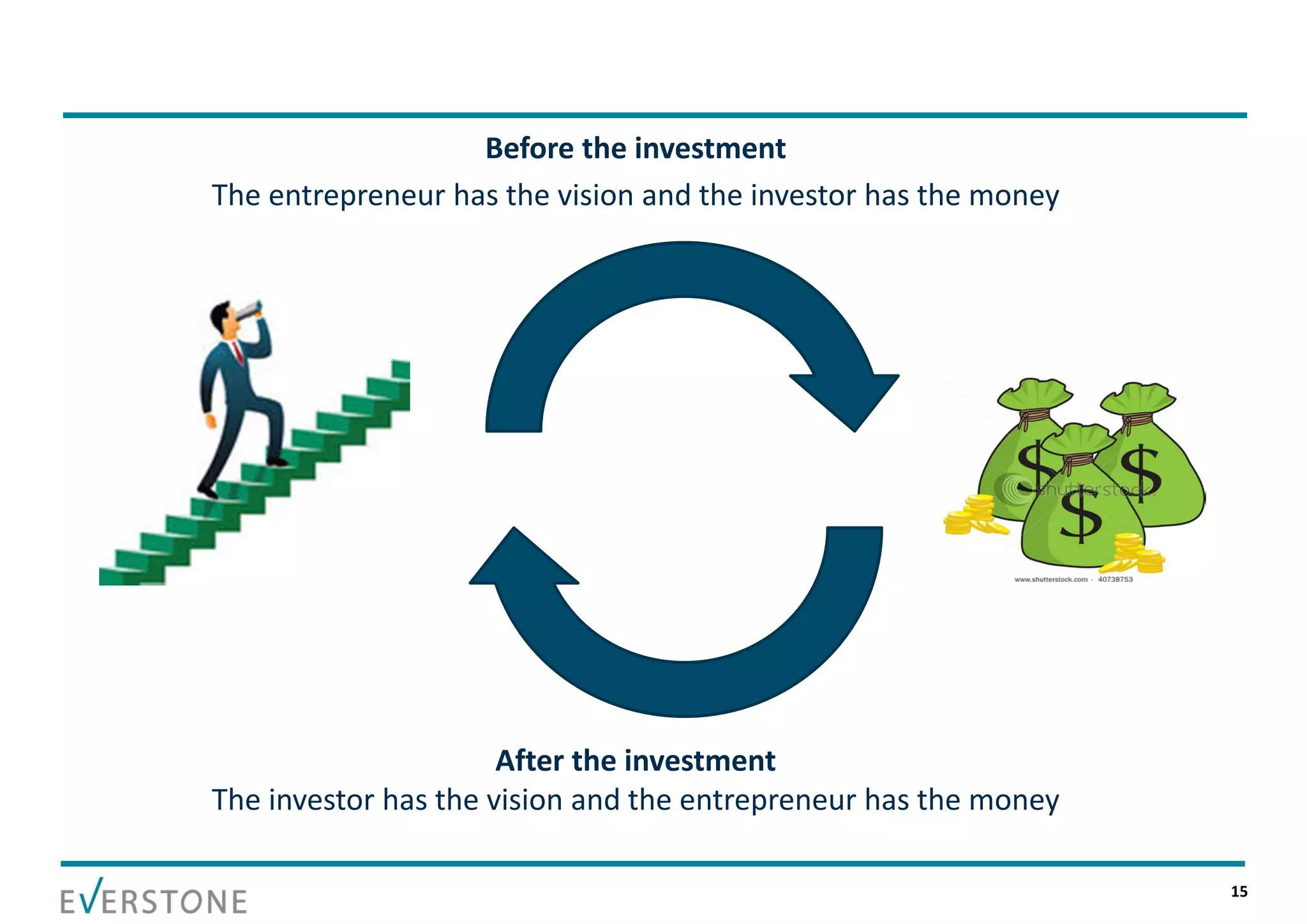
Before the investment
The entrepreneur has the vision and the investor has the money


                      After the investment
The investor has the vision and the entrepreneur has the money

                                                                 15

An Overview of Venture Capital in India by Dhanpal Jhaveri

  • 1.
  • 2.
    Master‐class Contents Basics of Private Capital 2 Evolution of Private Capital in India 6 Venture Capital: Historic Deal Value and Volume 7 Issues and Challenges 9 2
  • 3.
    What is Private Equity? Private Equity Public equity Stock market  listed companies Buy‐outs, Venture capital Later stage financing, Early stage/Angel  Secondaries financing  By definition: “Private Equity is the provision of equity capital by financial investors – over the  medium or long term – to non quoted companies with high growth potential”  Private equity is illiquid, ownership is concentrated, valuation is difficult, intermediaries tend to be  small, finance is accompanied by control and mentoring  Public equity is liquid, ownership is dispersed, valuation is relatively easy, intermediaries are large,  finance is often divorced from control and mentoring   Venture Capital, is a sub‐set of Private Equity and refers to equity investments made for: – The launch – Early development – Or expansion of a business  Venture Capital focuses primarily on entrepreneurial undertakings rather than on mature businesses  The essential difference between the two is the stage of investment 3
  • 4.
    Corporate Development and Private Equity  Last financing round prior  to an initial public offering  IPO/M&A of a company Financing the expansion of  growth companies Private  Third Stage Equity Providing working capital  funding and required  Second Stage financing for young firms  during growth period Financing the  First Stage commercialization and  production of products Venture Providing capital required  Start‐up  Capital Financing for product development  and initial marketing  activities Seed  Angel Financing Providing small sums of  capital necessary to  Funding develop a business idea 4
  • 5.
    Company Lifecycle and Investment Sizes Slow Growth Late • Buy‐out/restructuring  Growth opportunities • Size > $20 mm • Ready for the next  growth orbit • Investment sizes tend to increase along this curve Hyper • PEs tend to be active  Growth investors in early stage  • Growth Capital companies and passive in  Early  • Size between $10 and 20  Growth mm more evolved companies Seed  • Venture Capital Fund • Size < $10 mm • Promoter’s own  money • Friends/Family/Rel atives/Well‐wishers Inception Growth Maturity • Angel investors 5
  • 6.
    Evolution of Private Capital in India  The first generation venture capital funds were launched by financial institutions like ICICI  and IFCI  1984: ICICI launched it VC scheme to encourage start‐up ventures in the emerging  technology sectors  IFCI and Canara Bank followed by launching their own technology oriented VC funds  Between 1995‐2000 several foreign funds like Baring PE partners, CDC Capital, Draper  International, HSBC Private Equity and Warbug Pincus had set food in India  The first set of regulations around VC started coming in the mid‐90s: – SEBI introduced the SEBI Venture Capital Funds Regulations, 1996 – These regulations were further amended based on the recommendations of the K.B.  Chandrashekhar Committee in 2000  The technology bust in 2000 saw a PE slow down, when many foreign investors fled India  during that period  Today, global PE firms continue to dominate the Indian market, appearing in 9 of the top 10  deals by value in Q4 2011 6
  • 7.
    Venture Capital: Historical Deal Value and Volume  Last three years have seen a tremendous amount of interest in India with investments in US$ million: – Angel Funding = 24 – Venture Capital = 2,106 – Private Equity = 21,698  Year 2011 had been record year for early‐stage Venture Capital investing – Deal values & volumes at all time high – Euphoria around e‐commerce, across mobile, internet and related verticals – Evident from recent deals of InMobi, Fashionandyou, Snapdeal  The next few years will distinguish the serious and long‐term players, from the others 500 Breakdown – Volume $20,000 Breakdown – Value ($ mm) 435 $18,484 450 $18,000 400 382 $16,000 350 313 $14,000 $13,151 286 270 300 $12,000 $9,944 250 207 $10,000 185 $7,922 200 154 156 $8,000 $7,167 142 133 150 122 $6,000 100 $3,832 44 $4,000 50 18 19 27 23 16 $1,034 $659 $891 $2,000 $564 $16 $670 $556 $13 $10 $5 $5 $14 0 $0 2006 2007 2008 2009 2010 2011 2006 2007 2008 2009 2010 2011 Angel/Seed Venture capital Private Equity Angel/Seed Venture capital Private Equity Source: VCCEdge 7
  • 8.
    Top 5 Venture Capital Deals in 2011 Target Buyer Value (US$ mm) Happiest Minds Technologies Intel Capital 45 Canaan Partners Fashionandyou.com Sequoia Capital India 40 Norwest Venture Partners Intel Capital Nokia Growth Partners SnapDeal.com IndoUS Venture Partners 40 Nexus Venture Partners Bessemer Venture Partners Naaptol Online Shopping Canaan Partners 25 Silicon Valley Bank New Enterprise Associates TV18 Home Shopping SAIF Partners 22.25 GS Home Shopping Source: VCCircle.com 8
  • 9.
  • 10.
    The Engagement  Pre‐investment phase  Post‐investment phase  Managing exit 10
  • 11.
    Pre‐investment phase: The pre‐nuptials  Valuation: Value versus Price  Projections: Sustainable Growth  Diligence  Rights and Terms  Dilution  Building a connect  – Rational / logical connect – Emotional connect 11
  • 12.
    Post‐investment phase: A Successful Partnership  Shared Vision  Maintaining your business statistics  Managing conflicts of interest  Creating a governance framework  Diverting or Diversification  Finally, “No Surprises” 12
  • 13.
    Managing exit  Managing Duration Mismatch  Market timing is important  IPO can take a minimum one year time frame 13
  • 14.
    Tips for a successful partnership  Do not choose a VC player based on brand reputation but look at the VC firm’s fit  with the organisation  Valuation is not everything. Long term alignment and comfort are equally  important  Carefully understand the VC firm’s ‘Value Add’ model and see if the same aligns  well with your organisation need  Do not rush through the process  Share your successes but also be transparent about the weaknesses /  improvement areas. Nasty surprises in the short term (post investment) will do a  lot of damage to the relationship.  Do not ‘outsource’ assignments to the VC firm. They are not the ‘pilots’ of the  business  Promoters expect VC’s to take quick decisions  VC should not end up as an option of last resort for promoters when they are  unable to tap the public or debt markets 14
  • 15.
    Before the investment The entrepreneur has the vision and the investor has the money After the investment The investor has the vision and the entrepreneur has the money 15