• Describe database
terminologies
• Understand database,
relationships and organizing
data.
• Explore MS Access and its
window.
• Know how to create, open and
print a database.
• Learn to exit MS Access and
know where to get help.
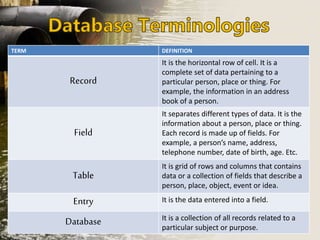
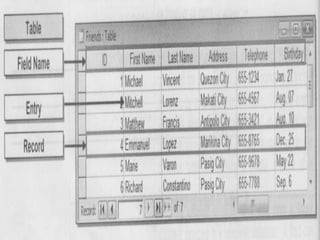
TERM DEFINITION
Record
It is the horizontal row of cell. It is a
complete set of data pertaining to a
particular person, place or thing. For
example, the information in an address
book of a person.
Field
It separates different types of data. It is the
information about a person, place or thing.
Each record is made up of fields. For
example, a person’s name, address,
telephone number, date of birth, age. Etc.
Table
It is grid of rows and columns that contains
data or a collection of fields that describe a
person, place, object, event or idea.
Entry It is the data entered into a field.
Database It is a collection of all records related to a
particular subject or purpose.
First, you must identify the
individual fields. A field is a
characteristic od a person, place,
object, event or idea such as
name, address, phone number,
etc.
Second, you must group related
fields together into tables. A
collection of fields.
• Allows you to create
database structures.
• Allows you to add
new records, change
fields and delete
records.
• Allows you to get
answer to questions
through built-in
query language.
• Allows you to print
formatted reports
through built-in
report generator.
A relational Database
Management System or
DBMS is a program that
allows you to create
databases and
manipulate data with
them.
MS Access is a DBMS
where data is organized
as a collection of tables.
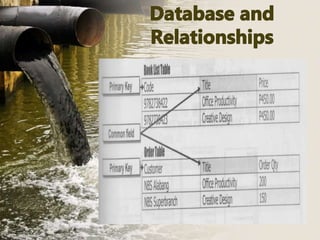
The relationship
between two tables in
DBMS is formed through
a common field.
o Is a relational database
management program that
can create, format, save,
maintain, retrieve and
analyse volumes of related
information or data in a
format know as database.
1) Click the Start or Button.
2) Point to All Programs
3) Point to Microsoft Office.
4) Click on Microsoft Office
Access 2010.
Starting ms access 2010

Starting ms access 2010

  • 2.
    • Describe database terminologies •Understand database, relationships and organizing data. • Explore MS Access and its window. • Know how to create, open and print a database. • Learn to exit MS Access and know where to get help.
  • 3.
    TERM DEFINITION Record It isthe horizontal row of cell. It is a complete set of data pertaining to a particular person, place or thing. For example, the information in an address book of a person. Field It separates different types of data. It is the information about a person, place or thing. Each record is made up of fields. For example, a person’s name, address, telephone number, date of birth, age. Etc. Table It is grid of rows and columns that contains data or a collection of fields that describe a person, place, object, event or idea. Entry It is the data entered into a field. Database It is a collection of all records related to a particular subject or purpose.
  • 5.
    First, you mustidentify the individual fields. A field is a characteristic od a person, place, object, event or idea such as name, address, phone number, etc. Second, you must group related fields together into tables. A collection of fields.
  • 7.
    • Allows youto create database structures. • Allows you to add new records, change fields and delete records. • Allows you to get answer to questions through built-in query language. • Allows you to print formatted reports through built-in report generator. A relational Database Management System or DBMS is a program that allows you to create databases and manipulate data with them. MS Access is a DBMS where data is organized as a collection of tables. The relationship between two tables in DBMS is formed through a common field.
  • 8.
    o Is arelational database management program that can create, format, save, maintain, retrieve and analyse volumes of related information or data in a format know as database.
  • 9.
    1) Click theStart or Button. 2) Point to All Programs 3) Point to Microsoft Office. 4) Click on Microsoft Office Access 2010.

Editor's Notes

  • #4 A database is a collection of related tables or information that can be organized in many ways. It is like keeping a set of file folder or record that contains any number of separate categories or entries which are called fields. There are terminologies that are important to know when working with databases. They relate to the way data is organized in a table.
  • #7 A database or relational database is a collection of related tables. For example, if you want information about the book and how many orders have been placed, you must connect records in the Book List Table and the Order Table through a common field that appears on both tables.
  • #11 On the Access program window, you will see the Quick Access toolbar, File tab, Home tab, Create tab, External Data tab, Database Tools tab, Template and Preview pane.
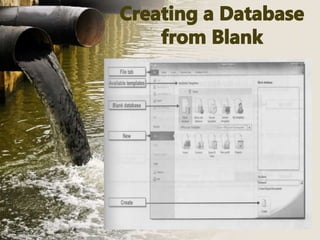
  • #12 1. From the file menu, click New command and click Create. 2. From the Available Templates, double click Blank Database icon.