Lets Learn Database
• Ms. Amrit Kaur
Assistant Professor
Department of Computer Science
Global Engineering College Jabalpur
gamritkaur@live.com, ak.cse@global.org.in
Basic Concepts
Computer Data
– The presentation of facts, information or concepts
which are created in a computer readable form or
are translated into such a form.
Information
– Information is a useable answer to a concrete
question.
– Dimensions of Information
• the syntactic,
• the semantic and
• the pragmatic
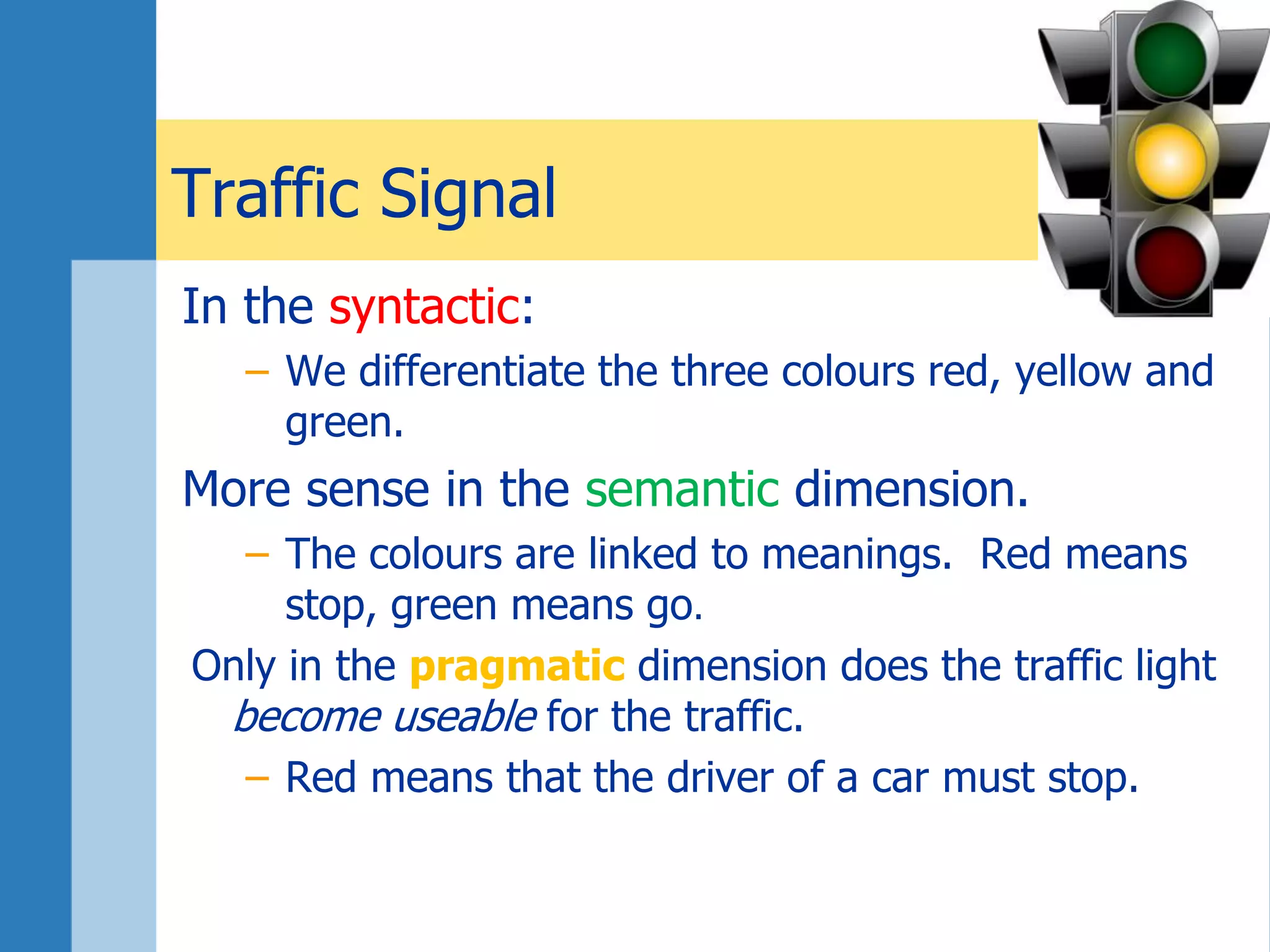
Traffic Signal
In the syntactic:
– We differentiate the three colours red, yellow and
green.
More sense in the semantic dimension.
– The colours are linked to meanings. Red means
stop, green means go.
Only in the pragmatic dimension does the traffic light
become useable for the traffic.
– Red means that the driver of a car must stop.
Information System
An information system extends the database
with a couple of software tools for querying,
presenting, transforming and analysing the
data.
Components
– Data and Databases
– Database Management System
– Database System
– Information System
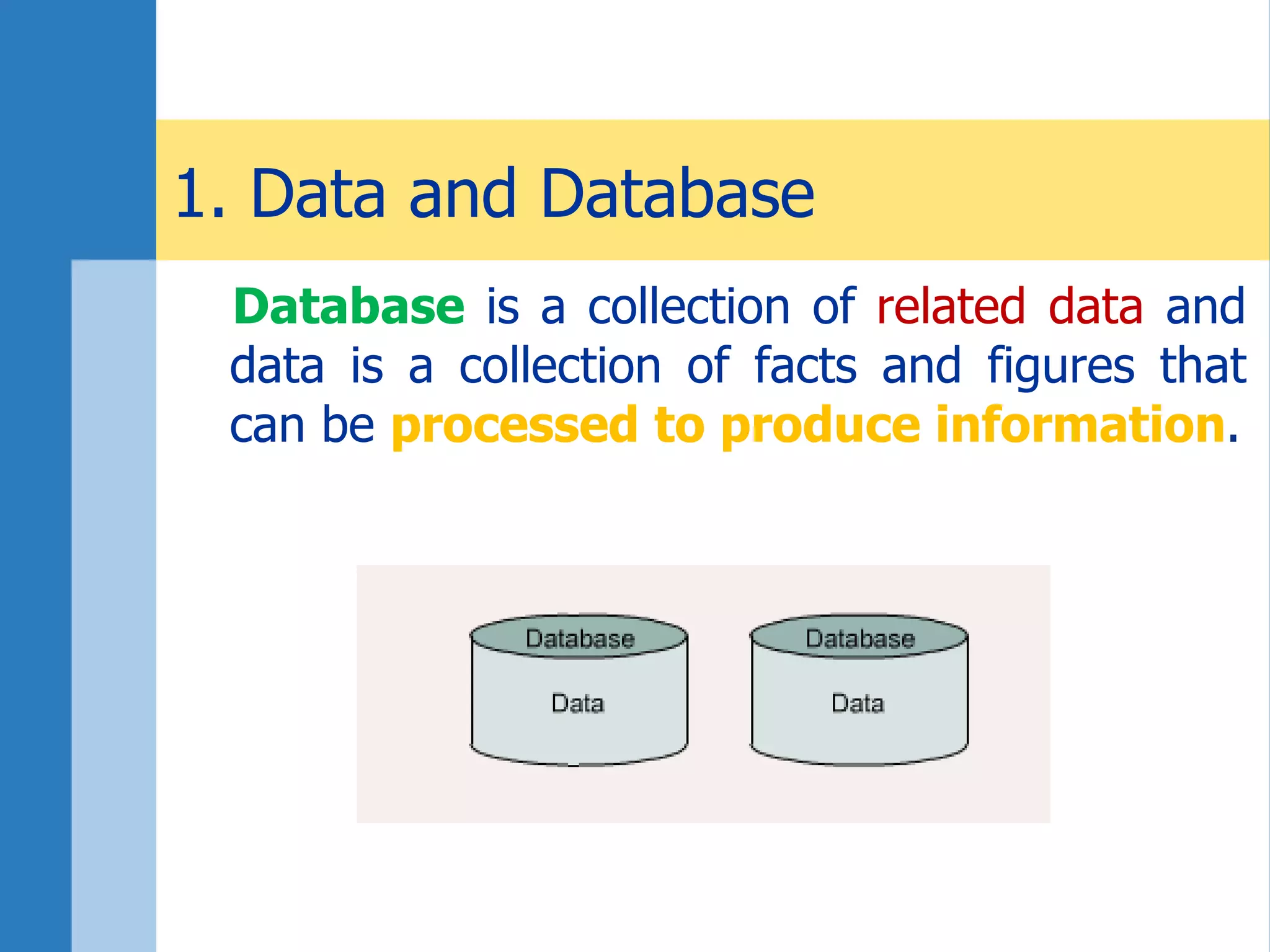
1. Data and Database
Database is a collection of related data and
data is a collection of facts and figures that
can be processed to produce information.
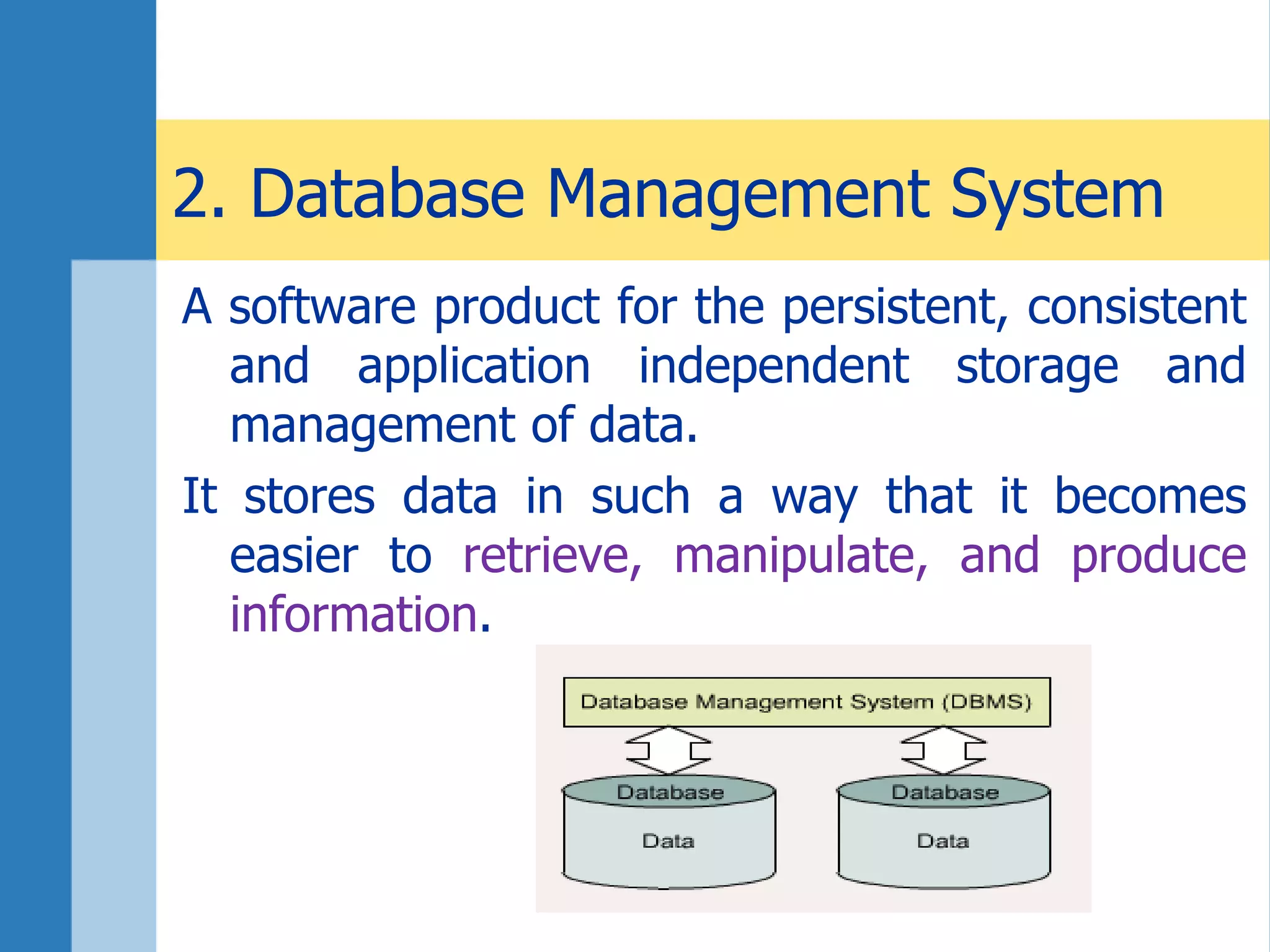
2. Database Management System
A software product for the persistent, consistent
and application independent storage and
management of data.
It stores data in such a way that it becomes
easier to retrieve, manipulate, and produce
information.
...Database Management System
Well-known DBMSs include
...Database Management System
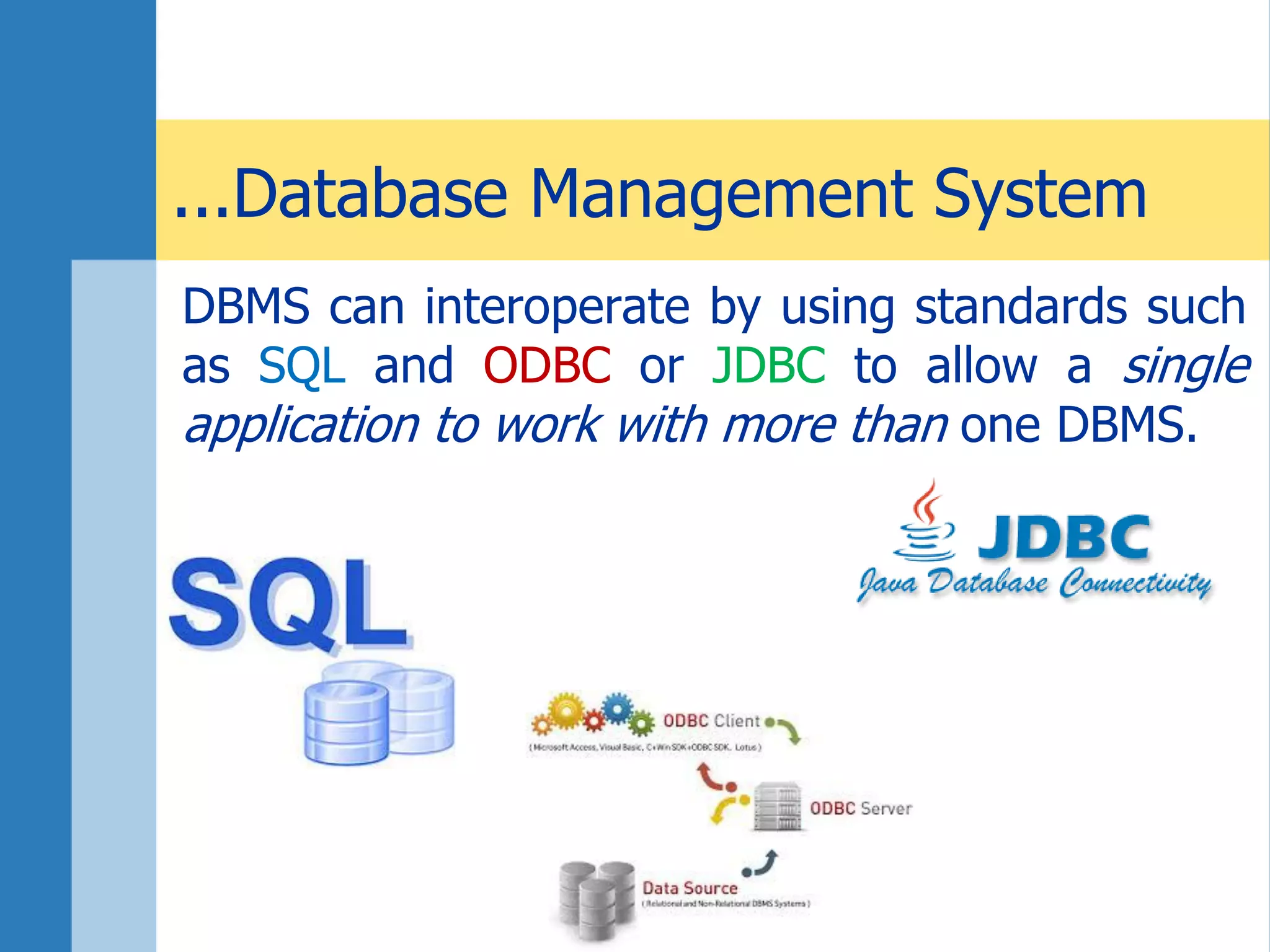
DBMS can interoperate by using standards such
as SQL and ODBC or JDBC to allow a single
application to work with more than one DBMS.
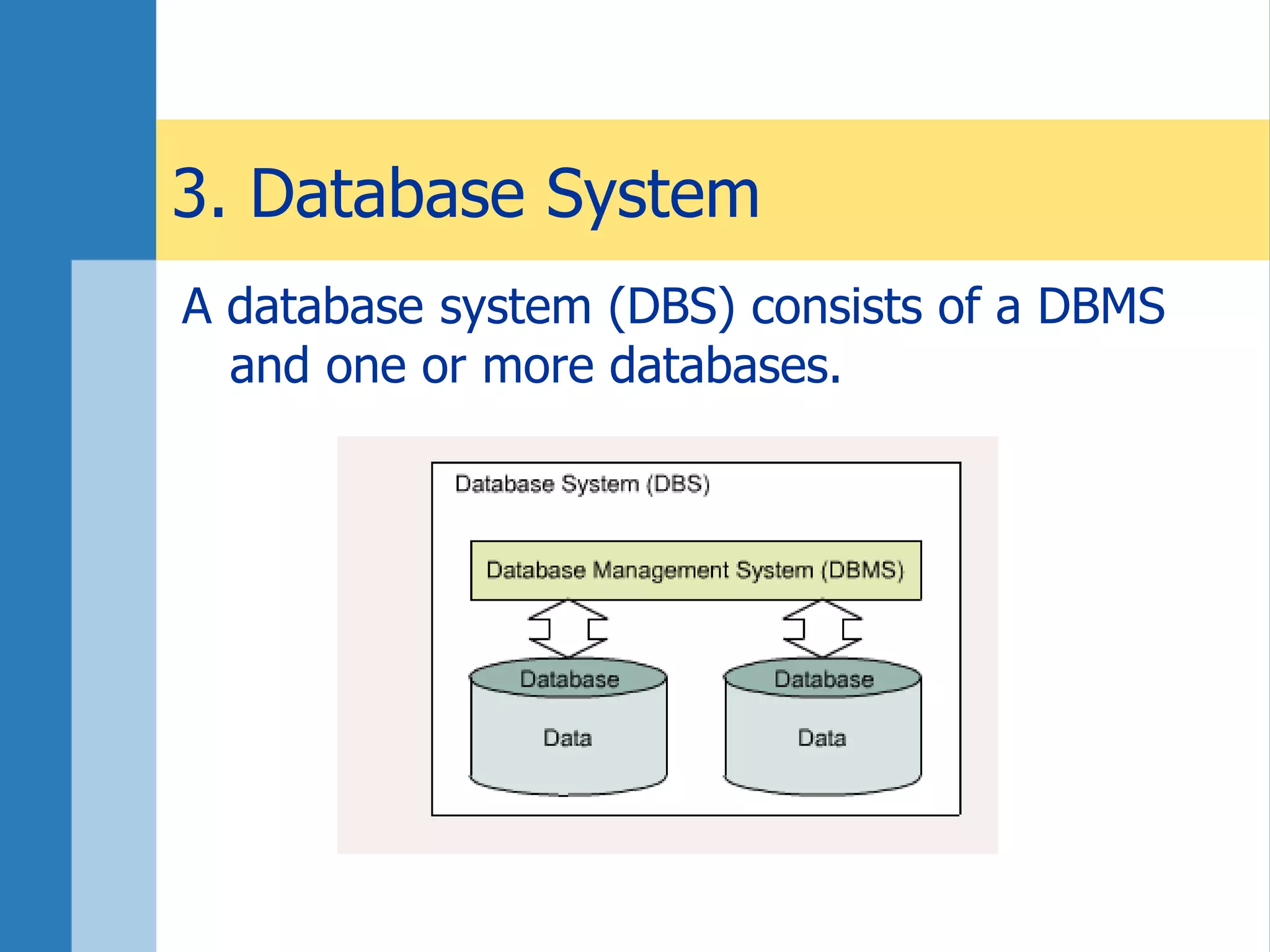
3. Database System
A database system (DBS) consists of a DBMS
and one or more databases.
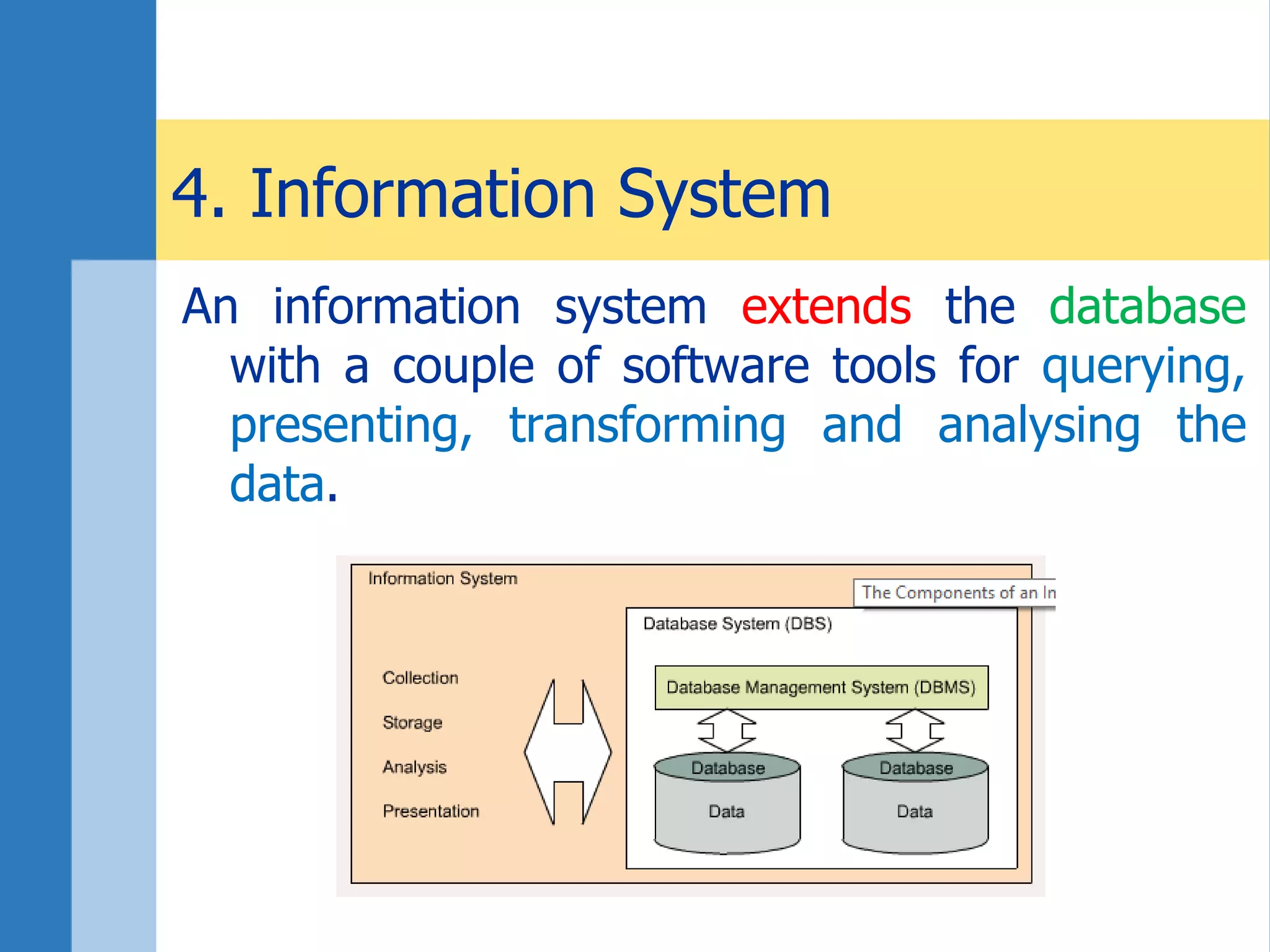
4. Information System
An information system extends the database
with a couple of software tools for querying,
presenting, transforming and analysing the
data.
11 06/04/2016 19:50:11 By Ms. Amrit Kaur
FROM THE FILE-CARD BOX TO
THE DATABASE
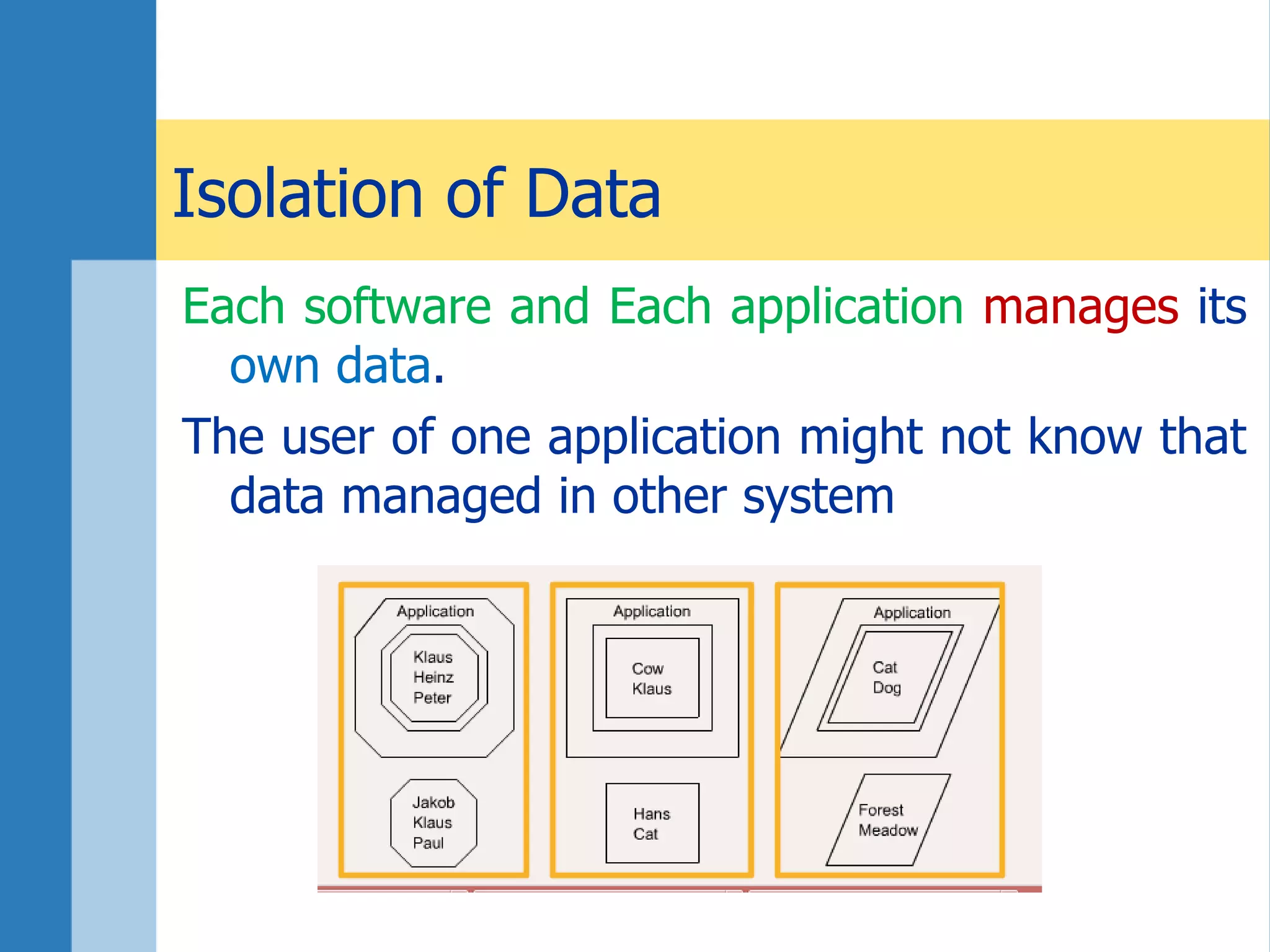
Isolation of Data
Each software and Each application manages its
own data.
The user of one application might not know that
data managed in other system
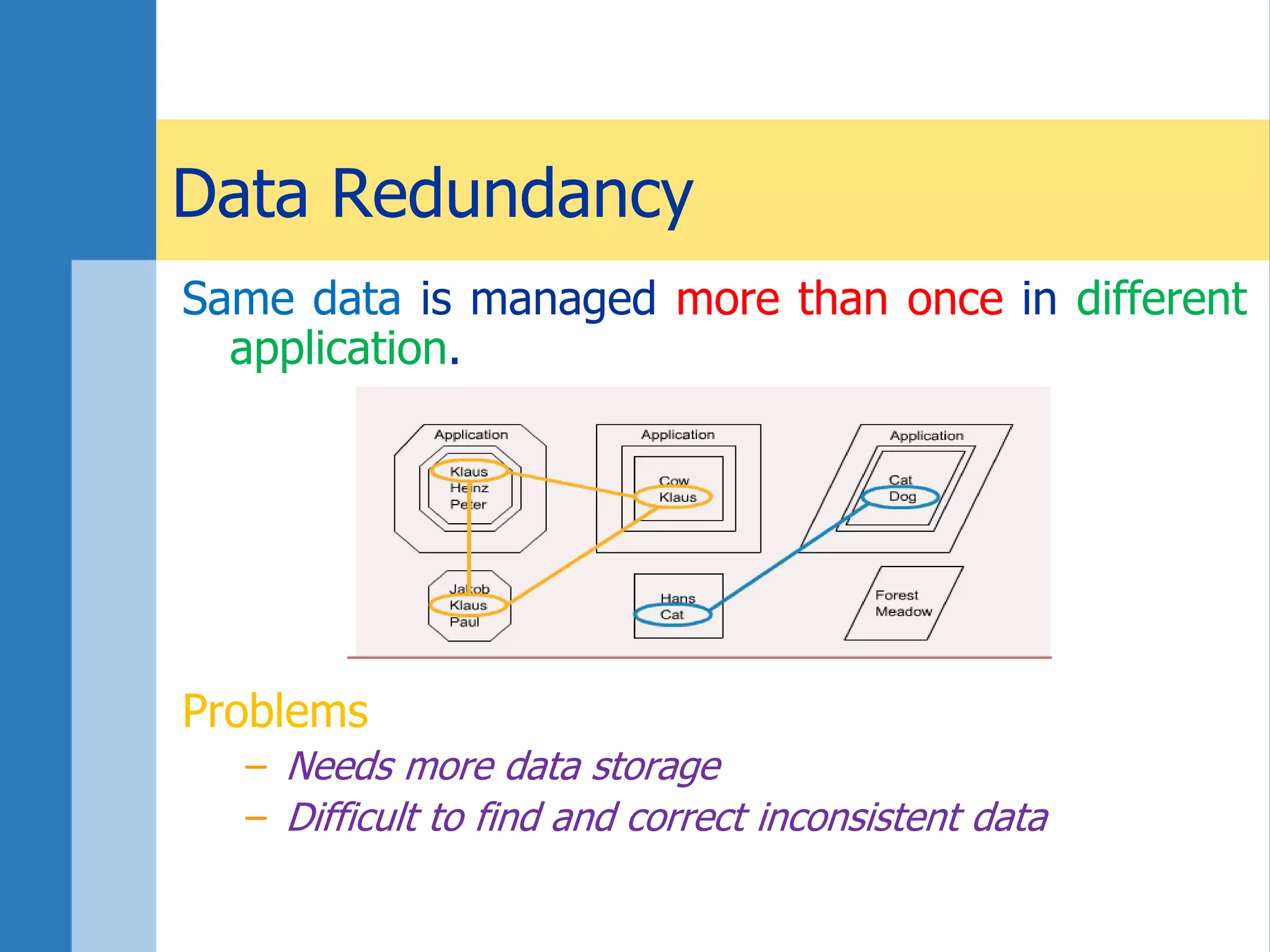
Data Redundancy
Same data is managed more than once in different
application.
Problems
– Needs more data storage
– Difficult to find and correct inconsistent data
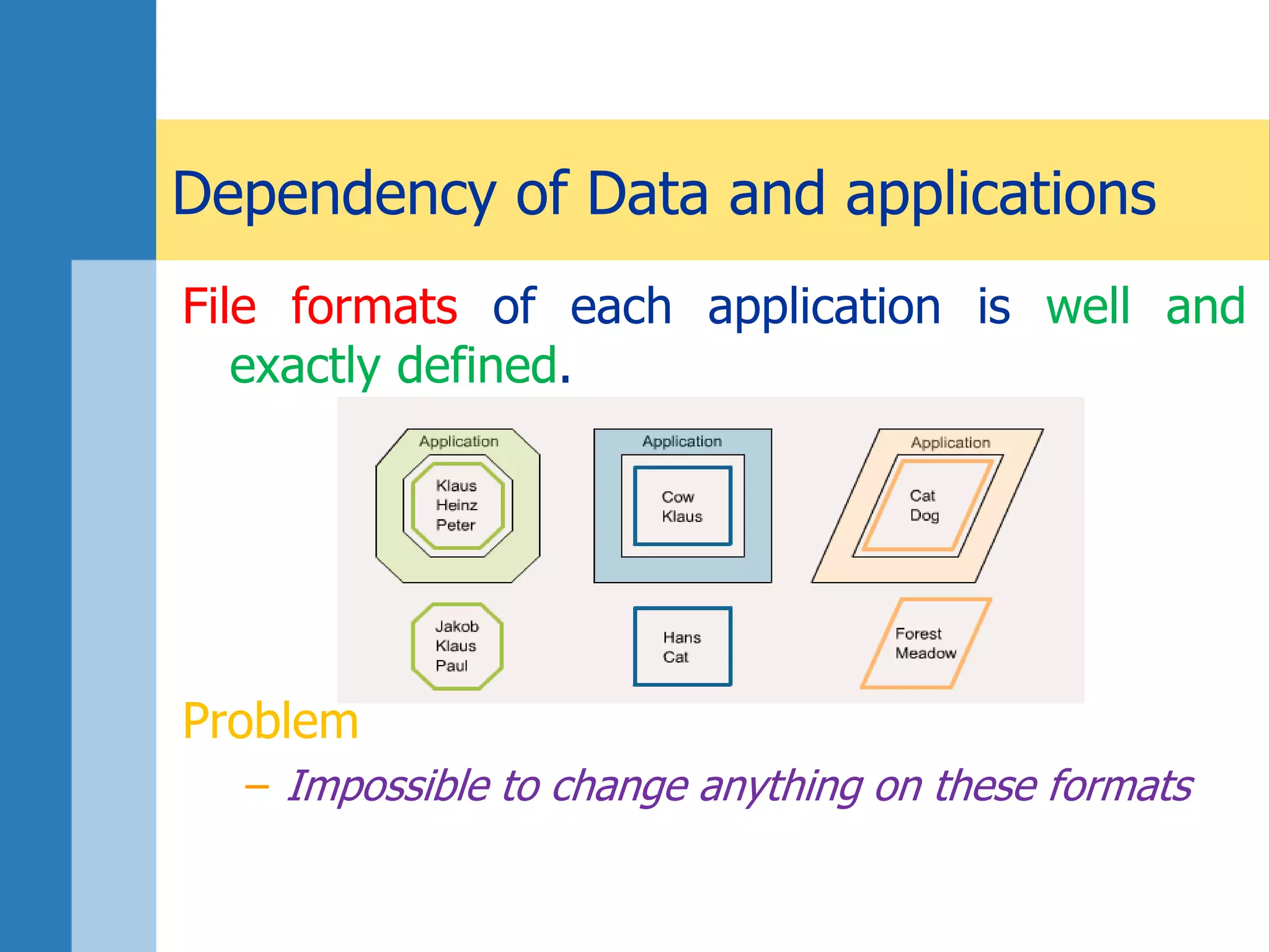
Dependency of Data and applications
File formats of each application is well and
exactly defined.
Problem
– Impossible to change anything on these formats
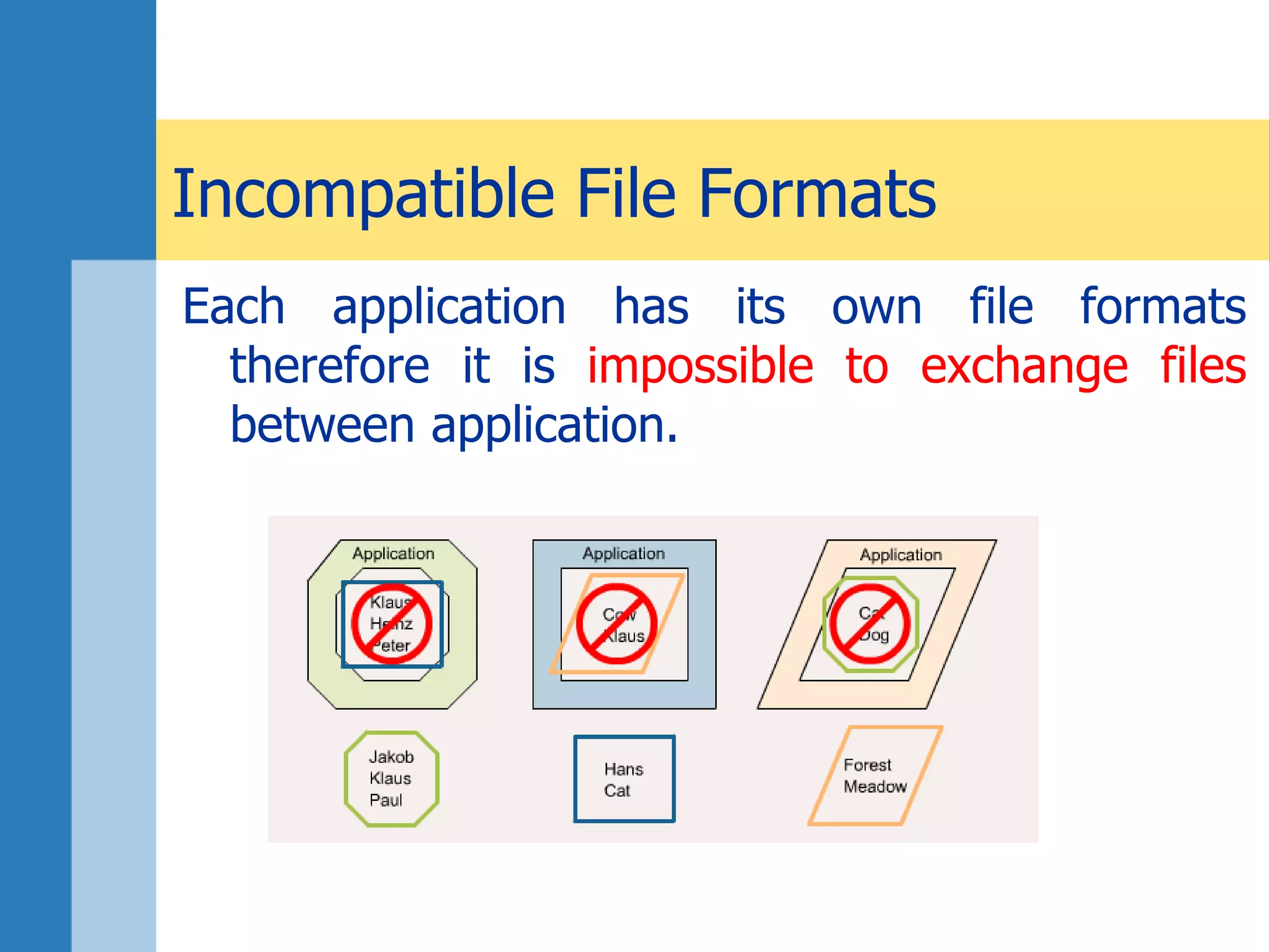
Incompatible File Formats
Each application has its own file formats
therefore it is impossible to exchange files
between application.
16 06/04/2016 19:50:11 By Ms. Amrit Kaur
CHARACTERISTIC OF
DATABASE
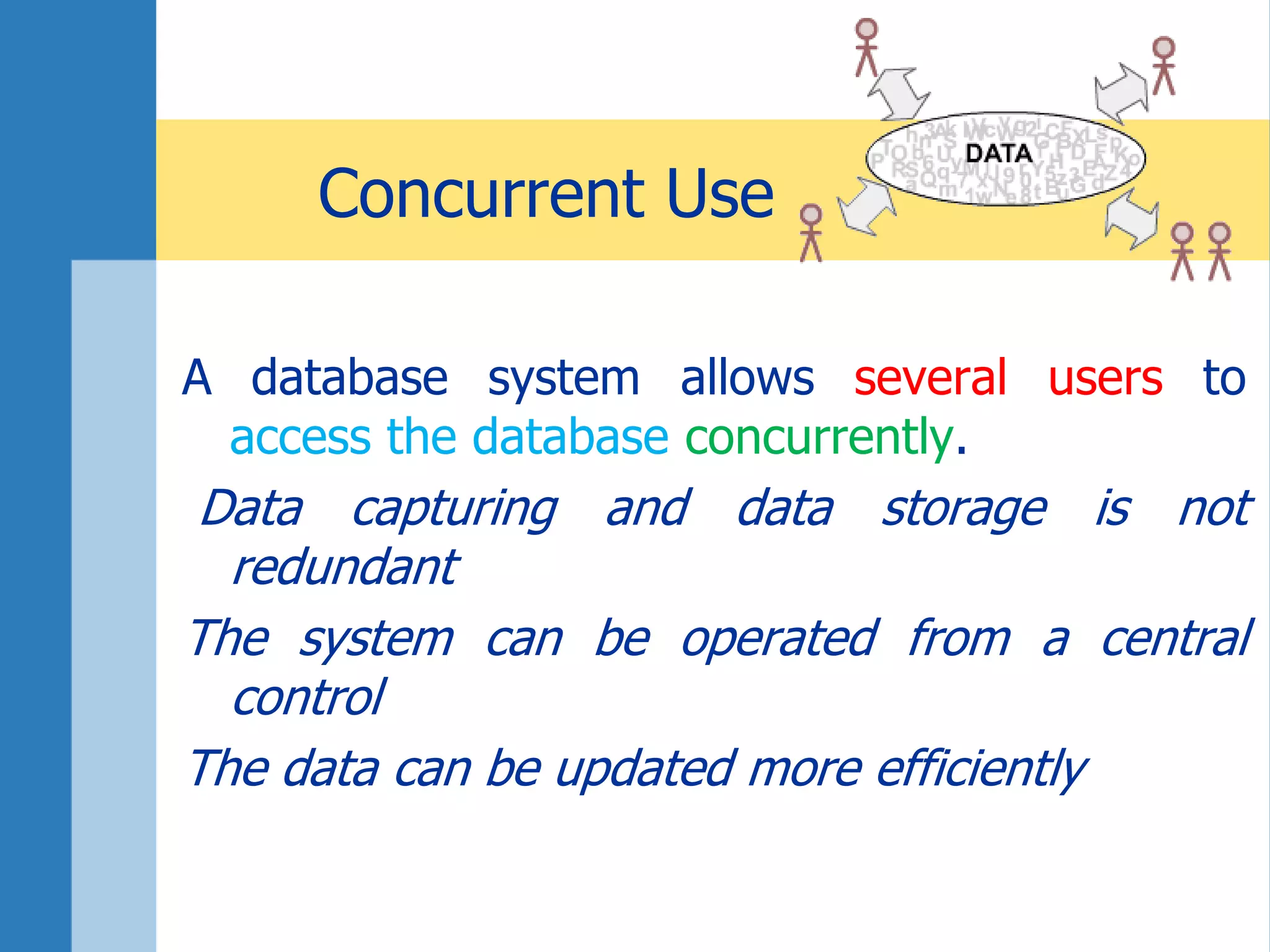
Concurrent Use
A database system allows several users to
access the database concurrently.
Data capturing and data storage is not
redundant
The system can be operated from a central
control
The data can be updated more efficiently
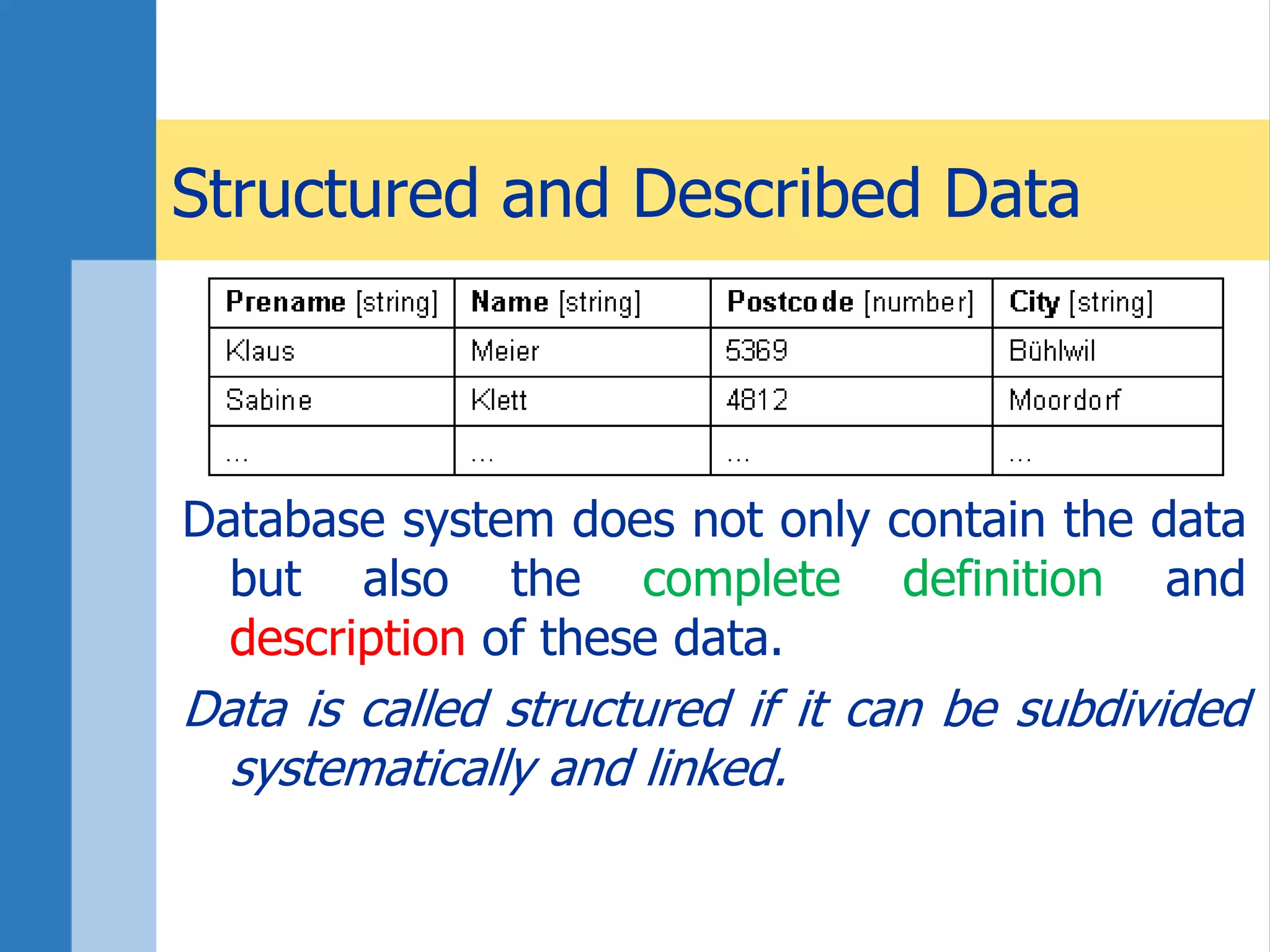
Structured and Described Data
Database system does not only contain the data
but also the complete definition and
description of these data.
Data is called structured if it can be subdivided
systematically and linked.
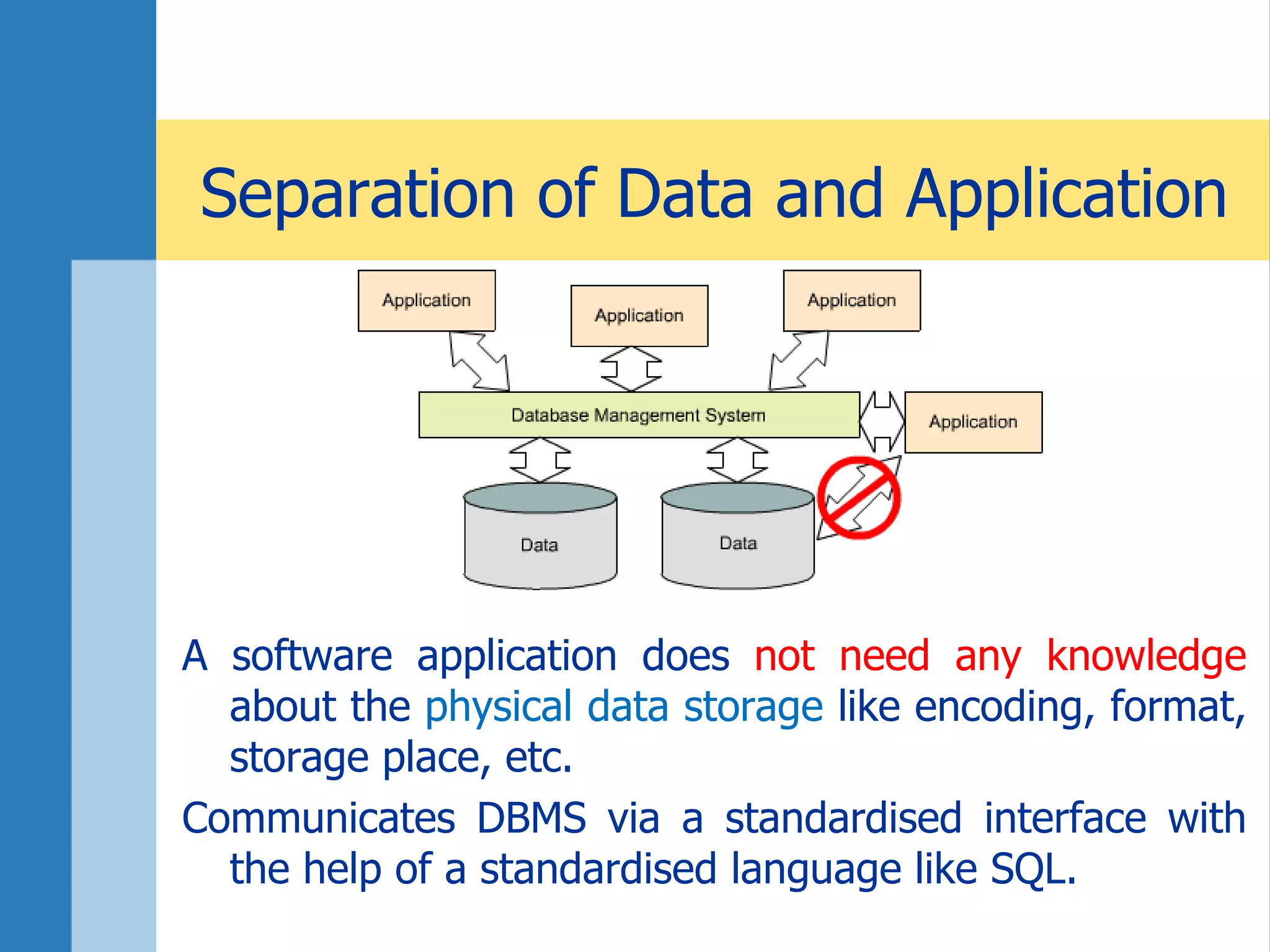
Separation of Data and Application
A software application does not need any knowledge
about the physical data storage like encoding, format,
storage place, etc.
Communicates DBMS via a standardised interface with
the help of a standardised language like SQL.
Data Integrity and Persistence
Data Integrity
– Data integrity includes also the protection of the
database from unauthorised access
(confidentiality) and unauthorised changes.
Data Persistence
– Data persistence means that in a DBMS all data is
maintained as long as it is not deleted explicitly.
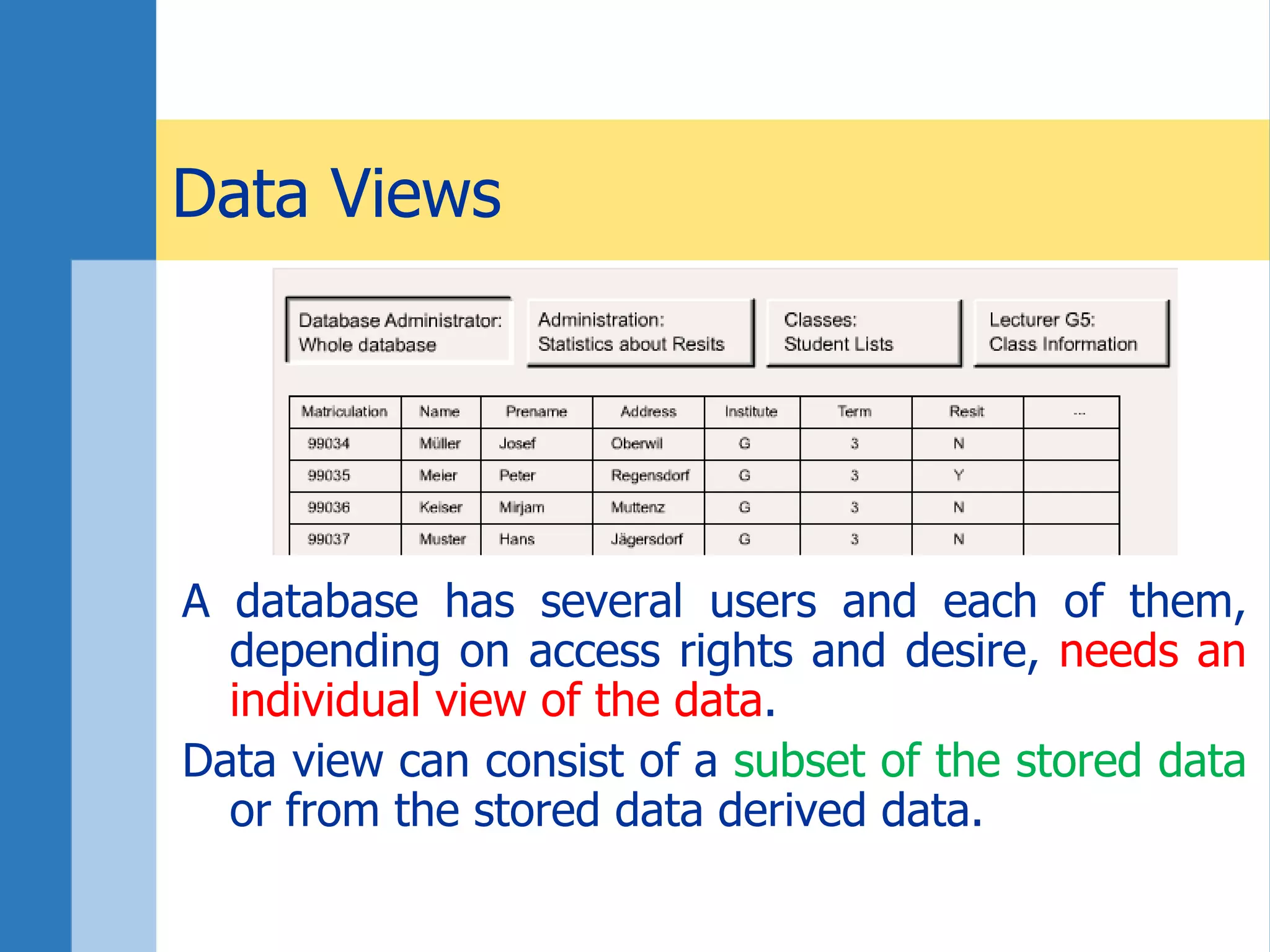
Data Views
A database has several users and each of them,
depending on access rights and desire, needs an
individual view of the data.
Data view can consist of a subset of the stored data
or from the stored data derived data.
Further Advantages of a DBMS
Scalable:
– ability of a system to adapt to different amounts of
data and numbers of users while maintaining the
same performance.
Expandability:
– New applications or other additions like new user
interfaces can be realised without interfering with
already working applications.
Further Advantages of a DBMS
Access Control
– Access to a database or parts of it (like single tables)
can be controlled or restricted for each user but also for
user groups.
Recovery and Back-up
– A DBMS has features which allow to recover data sets,
for example, after a failed transaction or a system
crash.
– Additionally, a back-up from the whole system can be
made to store in a save place.
24 06/04/2016 19:50:11 By Ms. Amrit Kaur
EXAMPLE APPLICATION
Examples of Use of Database System
Management of Bank Account
– Transactions
– Data Integrity
– Data Persistence
Timetable Information System
– Concurrent Use
– Data Integrity
Examples of Use of Database System
Library Catalogue
– Structured and Described Data
– Data Views
Do It Yourself
Find another database application
Try to figure out which are the most important
characteristics of that application.

Lesson 1: Introduction to DBMS

  • 1.
    Lets Learn Database •Ms. Amrit Kaur Assistant Professor Department of Computer Science Global Engineering College Jabalpur gamritkaur@live.com, ak.cse@global.org.in
  • 2.
    Basic Concepts Computer Data –The presentation of facts, information or concepts which are created in a computer readable form or are translated into such a form. Information – Information is a useable answer to a concrete question. – Dimensions of Information • the syntactic, • the semantic and • the pragmatic
  • 3.
    Traffic Signal In thesyntactic: – We differentiate the three colours red, yellow and green. More sense in the semantic dimension. – The colours are linked to meanings. Red means stop, green means go. Only in the pragmatic dimension does the traffic light become useable for the traffic. – Red means that the driver of a car must stop.
  • 4.
    Information System An informationsystem extends the database with a couple of software tools for querying, presenting, transforming and analysing the data. Components – Data and Databases – Database Management System – Database System – Information System
  • 5.
    1. Data andDatabase Database is a collection of related data and data is a collection of facts and figures that can be processed to produce information.
  • 6.
    2. Database ManagementSystem A software product for the persistent, consistent and application independent storage and management of data. It stores data in such a way that it becomes easier to retrieve, manipulate, and produce information.
  • 7.
  • 8.
    ...Database Management System DBMScan interoperate by using standards such as SQL and ODBC or JDBC to allow a single application to work with more than one DBMS.
  • 9.
    3. Database System Adatabase system (DBS) consists of a DBMS and one or more databases.
  • 10.
    4. Information System Aninformation system extends the database with a couple of software tools for querying, presenting, transforming and analysing the data.
  • 11.
    11 06/04/2016 19:50:11By Ms. Amrit Kaur FROM THE FILE-CARD BOX TO THE DATABASE
  • 12.
    Isolation of Data Eachsoftware and Each application manages its own data. The user of one application might not know that data managed in other system
  • 13.
    Data Redundancy Same datais managed more than once in different application. Problems – Needs more data storage – Difficult to find and correct inconsistent data
  • 14.
    Dependency of Dataand applications File formats of each application is well and exactly defined. Problem – Impossible to change anything on these formats
  • 15.
    Incompatible File Formats Eachapplication has its own file formats therefore it is impossible to exchange files between application.
  • 16.
    16 06/04/2016 19:50:11By Ms. Amrit Kaur CHARACTERISTIC OF DATABASE
  • 17.
    Concurrent Use A databasesystem allows several users to access the database concurrently. Data capturing and data storage is not redundant The system can be operated from a central control The data can be updated more efficiently
  • 18.
    Structured and DescribedData Database system does not only contain the data but also the complete definition and description of these data. Data is called structured if it can be subdivided systematically and linked.
  • 19.
    Separation of Dataand Application A software application does not need any knowledge about the physical data storage like encoding, format, storage place, etc. Communicates DBMS via a standardised interface with the help of a standardised language like SQL.
  • 20.
    Data Integrity andPersistence Data Integrity – Data integrity includes also the protection of the database from unauthorised access (confidentiality) and unauthorised changes. Data Persistence – Data persistence means that in a DBMS all data is maintained as long as it is not deleted explicitly.
  • 21.
    Data Views A databasehas several users and each of them, depending on access rights and desire, needs an individual view of the data. Data view can consist of a subset of the stored data or from the stored data derived data.
  • 22.
    Further Advantages ofa DBMS Scalable: – ability of a system to adapt to different amounts of data and numbers of users while maintaining the same performance. Expandability: – New applications or other additions like new user interfaces can be realised without interfering with already working applications.
  • 23.
    Further Advantages ofa DBMS Access Control – Access to a database or parts of it (like single tables) can be controlled or restricted for each user but also for user groups. Recovery and Back-up – A DBMS has features which allow to recover data sets, for example, after a failed transaction or a system crash. – Additionally, a back-up from the whole system can be made to store in a save place.
  • 24.
    24 06/04/2016 19:50:11By Ms. Amrit Kaur EXAMPLE APPLICATION
  • 25.
    Examples of Useof Database System Management of Bank Account – Transactions – Data Integrity – Data Persistence Timetable Information System – Concurrent Use – Data Integrity
  • 26.
    Examples of Useof Database System Library Catalogue – Structured and Described Data – Data Views
  • 27.
    Do It Yourself Findanother database application Try to figure out which are the most important characteristics of that application.