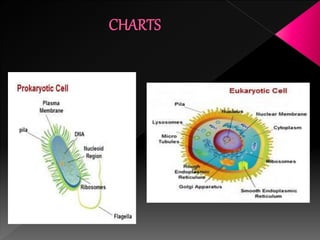
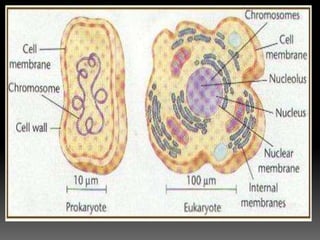
Prokaryotic Cells Eukaryotic Cells
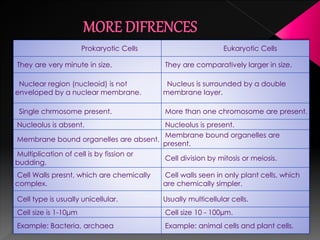
They are very minute in size. They are comparatively larger in size.
Nuclear region (nucleoid) is not
enveloped by a nuclear membrane.
Nucleus is surrounded by a double
membrane layer.
Single chrmosome present. More than one chromosome are present.
Nucleolus is absent. Nucleolus is present.
Membrane bound organelles are absent.
Membrane bound organelles are
present.
Multiplication of cell is by fission or
budding.
Cell division by mitosis or meiosis.
Cell Walls presnt, which are chemically
complex.
Cell walls seen in only plant cells, which
are chemically simpler.
Cell type is usually unicellular. Usually multicellular cells.
Cell size is 1-10μm Cell size 10 - 100µm.
Example: Bacteria, archaea Example: animal cells and plant cells.
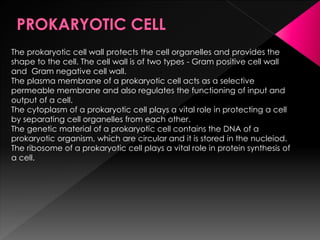
The prokaryotic cell wall protects the cell organelles and provides the
shape to the cell. The cell wall is of two types - Gram positive cell wall
and Gram negative cell wall.
The plasma membrane of a prokaryotic cell acts as a selective
permeable membrane and also regulates the functioning of input and
output of a cell.
The cytoplasm of a prokaryotic cell plays a vital role in protecting a cell
by separating cell organelles from each other.
The genetic material of a prokaryotic cell contains the DNA of a
prokaryotic organism, which are circular and it is stored in the nucleiod.
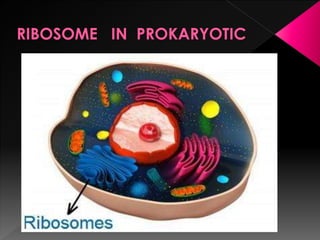
The ribosome of a prokaryotic cell plays a vital role in protein synthesis of
a cell.
They are single celled organisms and are much smaller
compared to eukaryotic cells.
They are unicellular and their size ranges from 1 µm and 10 µm
but in a few cases they may vary in their size from 0.2 µm to 750
µm.
Prokaryotic organisms exist in different shapes, which includes
spherical, rod, flat, coccus, bacillus, spirochete and some of
them are shapeless as they do not possess constant shape.
They consist of very few internal structures like cell wall, ribosome,
plasma membrane, cytoplasm along with circular strands of
DNA.
They have a cell wall, which are made up of peptidoglycan
Eukaryotes can be defined as the group of organisms
that possess a membrane bound nucleus along with the
membrane bound organelles. Eukaryote includes both
unicellular and multicellular organisms. Organisms, with
this cell type are known by the term eukaryotic organisms
(or) eukaryotes. A eukaryotic cell consists of cell wall,
endoplasmic reticulum and other membrane bounded
organelles like mitochondria, Golgi bodies, lysosomes,
plasma membrane, ribosome, cytoplasm, chromosomes
and also has a well organized nucleus with a nuclear
envelope.
They are capable of self-duplication.
They help in transmitting or transferring the characters from one
generation to another generation (or) from parents to offspring.
They play a vital role in controlling biological processes in the
body of an organism.
They control cell metabolism by directing the formatting of
necessary proteins.
They help in cell differentiation during development.
Prokaryotic cell vs eukaryotic cell

Prokaryotic cell vs eukaryotic cell

  • 3.
    Prokaryotic Cells EukaryoticCells They are very minute in size. They are comparatively larger in size. Nuclear region (nucleoid) is not enveloped by a nuclear membrane. Nucleus is surrounded by a double membrane layer. Single chrmosome present. More than one chromosome are present. Nucleolus is absent. Nucleolus is present. Membrane bound organelles are absent. Membrane bound organelles are present. Multiplication of cell is by fission or budding. Cell division by mitosis or meiosis. Cell Walls presnt, which are chemically complex. Cell walls seen in only plant cells, which are chemically simpler. Cell type is usually unicellular. Usually multicellular cells. Cell size is 1-10μm Cell size 10 - 100µm. Example: Bacteria, archaea Example: animal cells and plant cells.
  • 4.
    The prokaryotic cellwall protects the cell organelles and provides the shape to the cell. The cell wall is of two types - Gram positive cell wall and Gram negative cell wall. The plasma membrane of a prokaryotic cell acts as a selective permeable membrane and also regulates the functioning of input and output of a cell. The cytoplasm of a prokaryotic cell plays a vital role in protecting a cell by separating cell organelles from each other. The genetic material of a prokaryotic cell contains the DNA of a prokaryotic organism, which are circular and it is stored in the nucleiod. The ribosome of a prokaryotic cell plays a vital role in protein synthesis of a cell.
  • 5.
    They are singlecelled organisms and are much smaller compared to eukaryotic cells. They are unicellular and their size ranges from 1 µm and 10 µm but in a few cases they may vary in their size from 0.2 µm to 750 µm. Prokaryotic organisms exist in different shapes, which includes spherical, rod, flat, coccus, bacillus, spirochete and some of them are shapeless as they do not possess constant shape. They consist of very few internal structures like cell wall, ribosome, plasma membrane, cytoplasm along with circular strands of DNA. They have a cell wall, which are made up of peptidoglycan
  • 7.
    Eukaryotes can bedefined as the group of organisms that possess a membrane bound nucleus along with the membrane bound organelles. Eukaryote includes both unicellular and multicellular organisms. Organisms, with this cell type are known by the term eukaryotic organisms (or) eukaryotes. A eukaryotic cell consists of cell wall, endoplasmic reticulum and other membrane bounded organelles like mitochondria, Golgi bodies, lysosomes, plasma membrane, ribosome, cytoplasm, chromosomes and also has a well organized nucleus with a nuclear envelope.
  • 8.
    They are capableof self-duplication. They help in transmitting or transferring the characters from one generation to another generation (or) from parents to offspring. They play a vital role in controlling biological processes in the body of an organism. They control cell metabolism by directing the formatting of necessary proteins. They help in cell differentiation during development.